Global Summit Guide
Choose Your Next Mountain With Confidence
Global Summit Guide helps hikers and climbers compare objectives, assess readiness, plan smarter, and progress toward bigger summits.
Global Summit Guide is an independent mountaineering reference for hikers and climbers. Generally, the site helps readers choose the right peak, understand what each climb actually demands, and prepare with fewer surprises. Specifically, the editorial system covers 500 climbing peaks across seven continents. Every Eight-Thousander. The Seven Summits. 25 volcanoes. Major peaks across the Alps, Andes, Himalaya, Karakoram, Rockies, Cascades, and African and Pacific ranges. Notably, operator rankings reflect editorial judgment rather than affiliate revenue. No paid placements. No commission arrangements with commercial expedition operators.
Where To Start
Six entry points into the editorial system. Generally, climbers arrive at Global Summit Guide with one of these questions. Specifically, each door below leads to the most useful starting point depending on what you are trying to figure out. Notably, the Pick Your Mountain quiz is the fastest path for climbers who don’t yet know what they’re looking for.
“I don’t know which mountain to climb”
Take the Pick Your Mountain quiz. Specifically, five questions about your prior experience, available time, and fitness produce a shortlist of three to five appropriate peaks matched to your current capability.
Take the quiz“I want to research a specific peak”
Browse the 500-peak directory by featured collection, continent, or sub-region. Notably every peak link goes to a complete climb guide covering routes, difficulty, weather windows, permits, gear lists, and operator selection.
Open the directory“I want a difficulty assessment”
The Mountain Difficulty Ratings Guide explains the six-level scale, the seven-driver demand stack, and the three-step self-assessment process. Use it to match peaks honestly to your verified capability.
See the scale“I’m planning a Seven Summits attempt”
The Best Mountains Before Seven Summits guide maps progression sequences peak-by-peak. The Progression Plans Hub adds mountain-specific plans for Denali, Aconcagua, Mont Blanc, Elbrus, and more.
Plan a progression“I need to choose an operator”
The Operators Hub applies an eight-criteria evaluation to every major commercial operator. Specifically, side-by-side comparisons cover Everest, K2, Kilimanjaro, Mont Blanc, Matterhorn, Manaslu, Vinson, and Mount Fuji.
Compare operators“I’m a beginner — where do I start?”
The Beginner Mountain Climbing Guide covers the fundamentals — fitness self-assessment, gear basics, safety, first-mountain selection by US region, and what to expect on summit day. The complete first-mountain decision system.
Beginner guideNot sure where to start? If you’ve never climbed a mountain before, start with door 6 (Beginner Guide). If you have hiking experience and want to identify your first real mountain, start with door 1 (Pick Your Mountain quiz). If you already have a target peak in mind, jump straight to door 2 (500-peak directory). Notably, the system is designed so any door leads to the right deeper hub once you know what you need.
Mountains Ranked By Difficulty Level
Every peak on Global Summit Guide maps to a six-level difficulty scale. Generally, the scale combines seven core drivers — fitness demand, technical requirement, altitude, weather exposure, objective hazard, remoteness, and complexity of retreat. Specifically, climbers should match peaks to verified capability rather than ambition. Notably, the most common failure pattern is climbers jumping multiple levels because they have already climbed something famous at a lower level.
Walk-up trails & state highpoints
Mount Fuji (Yoshida). Also low-elevation Hawaii volcanoes. Notably introductory Pyrenees walking peaks too.
Best beginner mountains →Kilimanjaro · Whitney · Toubkal
Mount Kenya (Lenana), Mauna Kea, Pico de Orizaba (winter route), Half Dome cables, Aneto, and Mulhacén all sit here too.
Kilimanjaro guide →Rainier · Hood · Baker · Cotopaxi
Pico de Orizaba, Mount Shasta, Island Peak, Mera Peak, and Mount Toubkal (full route) belong here too.
Rainier guide →Matterhorn · Mont Blanc · Eiger
Grand Teton, Ama Dablam, Aiguille du Midi traverses, and Cerro Castillo all fit this tier.
Matterhorn guide →Denali · Aconcagua · Vinson
Mount Logan, Pik Lenin, Huascarán, Ojos del Salado, and Pik Korzhenevskaya all sit at this tier.
Denali guide →Everest · K2 · Annapurna · Nanga Parbat
Then Lhotse, Kangchenjunga, Makalu, Cerro Torre, Cassin Ridge Denali, and the Eiger North Face.
8000ers ranked →The Six Editorial Hubs
The Global Summit Guide editorial system organizes into six major hubs. Generally, each hub serves a distinct stage of expedition planning — choosing the peak, assessing the difficulty, planning logistics, evaluating operators, building a progression sequence, and selecting gear. Specifically, climbers should reference multiple hubs across the planning timeline. Notably, the hubs cross-link to each other so a climber can move between them seamlessly.
Mountains Directory
500 climbing peaks across seven continents. Featured collections — 14 Eight-Thousanders, Seven Summits, 25 Volcanoes. Continental sections covering Asia, Europe, North America, South America, Africa, Oceania, and Antarctica. Every peak links to its complete climb guide.
Mountain Difficulty Ratings
The six-level difficulty scale. The seven-driver demand stack. The three-step self-assessment process climbers should run before committing to a target peak. Match peaks to verified capability rather than ambition.
Trip Planning
Operator selection · seasonal timing · permits · weather windows · the guided versus independent decision · expedition training plans · best mountains before Seven Summits. The complete planning hub for first-time expeditions through major objectives.
Operators Hub
Eight-criteria operator evaluation applied to every commercial operator across major peaks. Specifically, side-by-side comparisons cover Everest, K2, Kilimanjaro, Mont Blanc, Matterhorn, Manaslu, Vinson, and Mount Fuji. No affiliates. No commission. Honest editorial.
Progression Plans
Mountain-specific progression sequences. Denali Progression. Aconcagua Progression. Mont Blanc Progression. Kilimanjaro, Elbrus, Rainier, Orizaba, and Island Peak progressions. Notably each plan maps the prerequisite peaks and skills before the target objective.
Gear & Safety
The four gear systems · the Ten Essentials updated for current technology · six terrain technical add-ons · gear scaling across the six-level difficulty scale. Specifically, buyer’s guides cover boots, crampons, ice axes, and high-altitude layering.
Most-Searched Topics
The questions climbers actually ask. Generally, these are the most-researched topics across the site based on search behavior and reader analytics. Specifically, each card below answers a specific question with a dedicated guide. Notably, several of these topics combine multiple peaks because the comparison itself is the question.
Best beginner mountains in the world
The complete first-mountain decision system. Which peaks are appropriate as your first real mountain by region, season, and prior experience.
14 Eight-Thousanders ranked by difficulty
From Manaslu (most-accessible first 8K) to K2 and Annapurna (expert-only). Difficulty assessment for every 8,000m peak.
What the Seven Summits actually cost in 2026
Itemized expedition spreadsheets across all seven peaks. Operator fees, permits, gear, flights, insurance. Total range $130k-$250k.
10 hardest mountains to climb in the world
K2 · Annapurna I · Nanga Parbat · Kangchenjunga · Cerro Torre · Eiger North Face · Cassin Ridge Denali. Ranked by fatality rate, technical demand, and objective hazard.
Top 50 non-technical peaks to hike and trek
The complete catalog of major non-technical peaks. From Kilimanjaro to Mount Whitney to the Tour du Mont Blanc summits.
Mountain weather for climbers
How to read forecasts. Seasonal weather windows by peak. The summit-day decision approach. Understanding cyclonic patterns at altitude.
Mountain climbing costs by level
Budget breakdowns from $500 weekend climbs through $110,000+ Everest expeditions. What money actually buys at each level.
Mountaineering permits, fees, and regulations
Permits by peak and country. Nepal royalty fees. Pakistan briefing requirements. Argentina Aconcagua permits. ALE Antarctica. Russia Elbrus.
Mountaineering insurance above 6,000m
Insurance policy comparisons for expeditions above 6,000m. Which providers actually cover high-altitude rescue and which exclude it in the fine print.
Original Research
Global Summit Guide produces original data-driven mountaineering research that goes beyond standard climb guides. Generally, these articles dig into datasets and trip reports to surface patterns invisible at the individual-expedition level. Specifically, each piece combines hundreds or thousands of source records, peer-reviewed altitude medicine, and direct expedition coordinator interviews. Notably, these are the articles other mountaineering sites cite.
State of Mountaineering 2026
The annual report on the state of global mountaineering. Commercial expedition trends. Operator consolidation. Climate volatility impacts on classic routes. The most-attempted versus most-completed peaks. Permit fee inflation.
Everest Death Map: Fatalities Since 1922
Every documented Everest fatality mapped to location, year, cause, and route. Where climbers actually die on Everest. Patterns by season, weather, route, and altitude. The “Death Zone” geography.
Why Kilimanjaro Climbers Fail
Analysis of 2,000 Kilimanjaro trip reports identifying the specific patterns behind summit failure. Why Marangu has the lowest success rate. Why too-fast itineraries fail. Day-by-day altitude profiles that work.
14 Eight-Thousanders Ranked by Difficulty
All 14 peaks above 8,000m ranked across summit success rate, fatality rate, technical demand, objective hazard, and altitude exposure. Which 8K is appropriate as a first 8,000m objective. Which are expert-only.
Why Climbers Die on Everest Summit Day
Analysis of 500 Everest summit-day trip reports identifying the failure patterns climbers can avoid. Turnaround time discipline. Bottlenecks at the Hillary Step. Oxygen management. Late-summit decisions.
Aconcagua vs Denali vs Elbrus
The “first big mountain” decision. Cost, difficulty, weather windows, success rate, and skill prerequisites compared across the three most-common first major expedition peaks. Which one matches your current capability.
Free Climbing Tools
Interactive planning tools climbers can use without account creation or login. Generally, each tool answers a specific decision question. Specifically, the tools draw on the same underlying research as the climb guides. The AMS calculator uses peer-reviewed altitude medicine. The budget calculator uses operator pricing from current programs. The fitness assessment uses the six-level difficulty scale. Notably, all tools are free and unlimited.
Peak Comparison Tool
Compare any two mountains side-by-side across elevation, difficulty level, success rate, weather windows, cost, and operator availability.
Expedition Budget Calculator
Build a complete expedition budget for any peak. Operator fees, permits, gear, flights, insurance, contingency. Total cost projections by operator tier.
AMS Risk Calculator
Calculate your acute mountain sickness risk based on starting elevation, ascent rate, sleeping altitude, and prior acclimatization history.
Acclimatization Schedule Builder
Build a day-by-day acclimatization schedule for any peak. Sleeping elevation progression, rest days, summit window targeting.
Fitness Assessment Checklist
Self-assess fitness readiness against the six-level difficulty scale. Aerobic capacity, strength, uphill endurance, recovery, and altitude tolerance benchmarks.
Your Path to the Seven Summits
Map your personal Seven Summits progression sequence based on prior peaks, available time, and budget. Order recommendations across all seven continental peaks.
Editorial Standards
Why You Can Trust These Guides
Independent Editorial
Global Summit Guide does not accept paid operator placements, sponsored peak guides, or commission arrangements with commercial expedition operators. Operator rankings reflect editorial judgment. Every comparison can identify red flags honestly because no commercial relationship exists between the site and the operators reviewed.
Founding Editor
Eric Fairlie is the founding editor. The site combines editorial coordination with direct verification from commercial operators, IFMGA/AMGA/BMG/UIAGM guide community knowledge, peer-reviewed altitude medicine, and the Himalayan Database for Nepal climbing activity. Read the About page.
Methodology Documented
Every major guide cites numbered sources. The six-level difficulty scale, seven-driver demand stack, and eight-criteria operator approach are documented in dedicated methodology pages. Climbers can verify how every assessment was reached.
Twice-Yearly Review
Climb guides receive a twice-yearly editorial review. Difficulty assessments reflect current route conditions. Climate volatility has moved several iconic routes between difficulty levels since 2022. The editorial system tracks those shifts rather than relying on historical difficulty data.
Sources Cited
The Himalayan Database. UIAA peak registry and national alpine club records. Pakistan Alpine Club and Indian Mountaineering Foundation. Direct verification from leading commercial operators. IFMGA, AMGA, BMG, UIAGM mountain guide community knowledge. Peer-reviewed mountaineering and altitude medicine research.
Reader Contribution
Notably climbers with verified peak experience are invited to contribute trip reports. Generally, trip reports feed into difficulty assessment updates, operator quality observations, and seasonal condition reporting. Submit a trip report.
I have referenced mountaineering content for over two decades. Generally, the value of an independent site like Global Summit Guide is not the climb guides themselves — every operator publishes a climb guide. Specifically, the value is the comparisons no operator will publish. The eight-criteria operator approach. The six-level difficulty scale applied evenly across peaks. The honest assessment of which 8000ers work as first 8K objectives versus expert-only. The analysis of why climbers actually fail. Notably, a site that refuses affiliate revenue can say things commercial operator sites can never say.
— 2026 IFMGA-certified mountain guide, 18 years guiding across Andes, Alps, Alaska, and HimalayaCommon Questions
What is Global Summit Guide?
Global Summit Guide is an independent mountaineering reference covering 500 climbing peaks across seven continents. Specifically, the site provides six core resources. Peak-by-peak route guides. Difficulty assessments using a six-level scale. Eight-criteria operator comparisons. Mountain-specific training and progression plans. Data-driven research on summit success rates, fatality patterns, and seasonal climbing windows. Global Summit Guide does not accept paid operator placements or commission arrangements — operator rankings reflect editorial judgment rather than affiliate revenue.
How should I choose my first mountain to climb?
Generally, first-mountain selection depends on your current capability and prior experience. Generally, climbers without prior glacier experience should start at Level 1-2 of the six-level difficulty scale — long non-technical mountains like Kilimanjaro, Mount Whitney, Mount Toubkal, or Mount Fuji. Then climbers with hiking experience ready for their first glacier climb should progress to Level 3 mountains like Mount Rainier, Mount Hood, Mount Baker, Cotopaxi, or Pico de Orizaba. The Pick Your Mountain quiz and the Mountain Difficulty Ratings Guide walk through specific selection by current capability.
How are mountains ranked by difficulty?
Specifically, Global Summit Guide uses a six-level difficulty scale combining seven core drivers — fitness demand, technical requirement, altitude, weather exposure, objective hazard, remoteness, and complexity of retreat. Level 1 covers introductory walk-up mountain objectives. Level 2 covers long non-technical mountains like Kilimanjaro. Level 3 introduces glacier travel and alpine systems on mountains like Mount Rainier and Cotopaxi. Level 4 covers technical alpine routes like the Matterhorn. Level 5 covers expedition mountaineering like Denali and Aconcagua. Level 6 covers elite expedition objectives including the 14 Eight-Thousanders. The Mountain Difficulty Ratings Guide details the full structure.
Are these guides for guided or independent climbers?
Global Summit Guide serves both guided and independent climbers. Generally, each peak guide covers routes, difficulty, weather windows, permits, gear lists, and operator selection where commercial operators exist. The Operators Hub applies an eight-criteria evaluation to every major commercial operator across Everest, K2, Kilimanjaro, Mont Blanc, Matterhorn, Manaslu, Vinson, and Mount Fuji. The Guided vs Independent Climbing resource details the trade-offs across cost, judgment burden, learning curve, and safety.
What are the Seven Summits and how much do they cost?
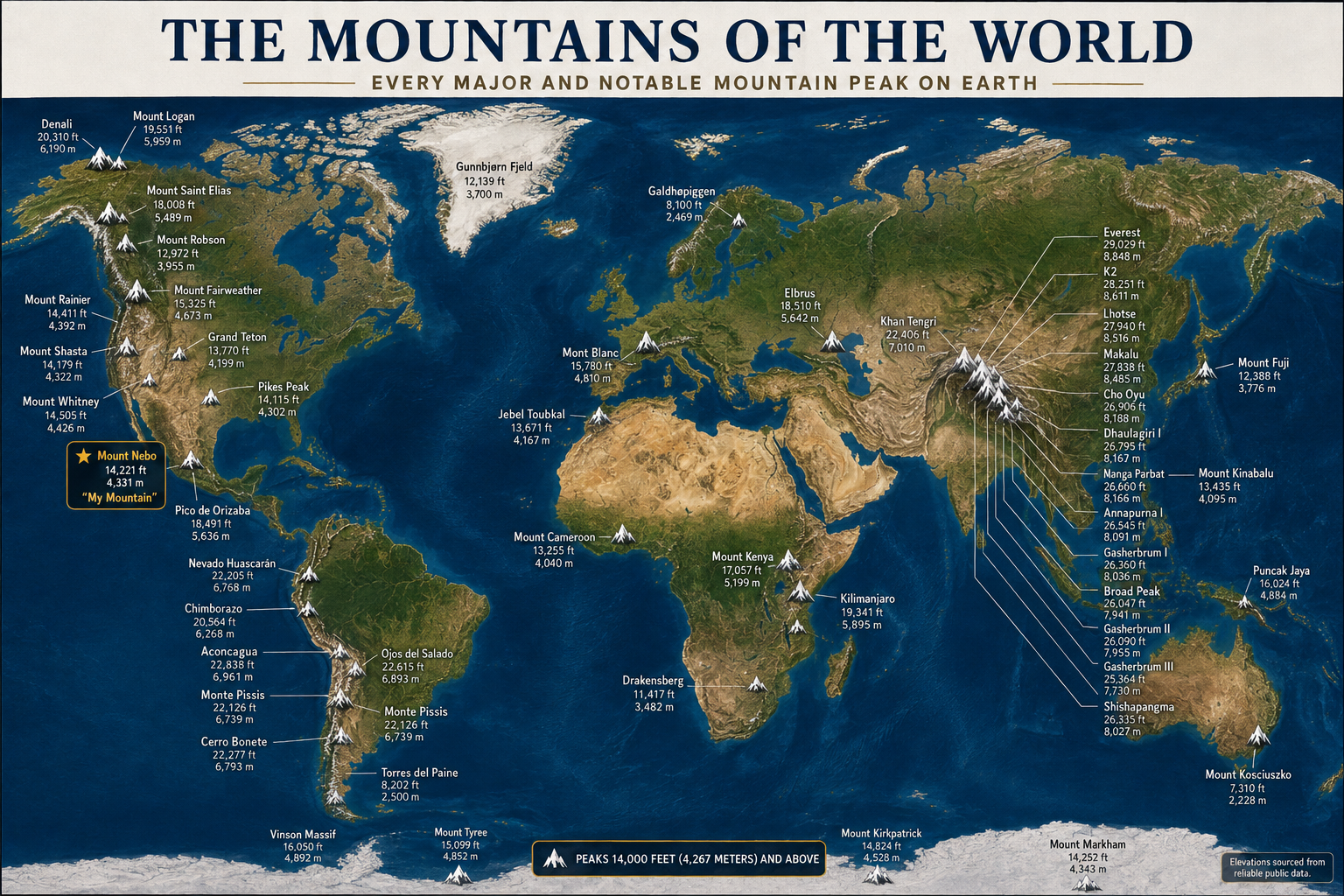
The Seven Summits are the highest peaks on each of the seven continents. Mount Everest covers Asia at 8,848m. Aconcagua covers South America at 6,962m. Denali covers North America at 6,190m. Mount Kilimanjaro covers Africa at 5,895m. Mount Elbrus covers Europe at 5,642m. Vinson Massif covers Antarctica at 4,892m. Oceania has two options — Carstensz Pyramid for the Messner list or Mount Kosciuszko for the Bass list. Specifically, total Seven Summits commercial expedition cost in 2026 ranges from $130,000 to $250,000 depending on operator selection. Notably Everest is the largest single line item at $50,000-$110,000+. Then Vinson Massif is the most expensive per-day climb because of ALE logistics monopoly on Antarctic interior flights. The What the Seven Summits Actually Cost article breaks down each peak with itemized spreadsheets.
How does Global Summit Guide make money?
Global Summit Guide does not accept paid operator placements, sponsored peak guides, or commission arrangements with commercial expedition operators. Notably operator rankings reflect editorial judgment rather than affiliate revenue. Instead the site is supported by advertising via the Advertise With Us program, reader subscriptions to the Mountain Planning Brief, and digital products. Notably this independent funding model is the reason operator comparisons can identify red flags and weaknesses honestly — there is no commercial relationship between Global Summit Guide and the operators reviewed.
Who writes the guides?
Generally, Eric Fairlie is the founding editor of Global Summit Guide. Specifically, editorial methodology draws from six source categories. Peer-reviewed mountaineering and altitude medicine research. Direct verification from leading commercial operators. IFMGA, AMGA, BMG, and UIAGM mountain guide community knowledge. The Himalayan Database for Nepal climbing activity. National alpine club records for European and North American peaks. Twice-yearly review cycles. Notably climbers with verified peak experience are invited to contribute trip reports via the Submit a Trip Report page.
Submit A Trip Report
Help Other Climbers Plan Smarter
Share what worked, what you would do differently, and the details that matter on the mountain. Trip reports feed into difficulty assessment updates, operator quality observations, seasonal condition reporting, and the data-driven research articles. Notably, the most useful trip reports cover the specifics — exact dates, route variations, gear that failed, weather windows, and lessons learned.