
Last updated July 12, 2026
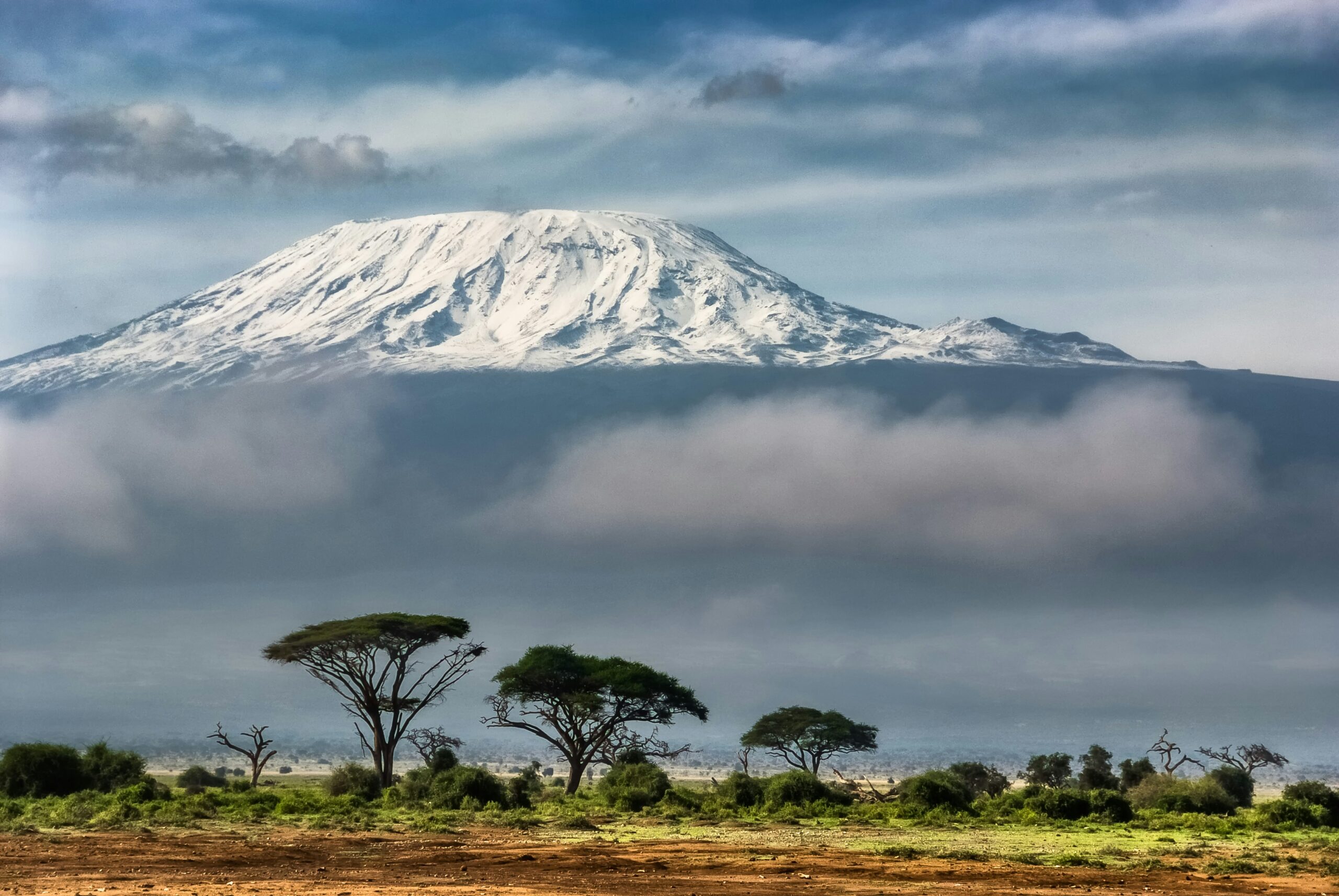
Kilimanjaro vs Mount Kenya: Height, Difficulty & Which to Climb
A side-by-side look at Africa’s two great summits — elevation, trekking versus technical climbing, routes, scenery, crowds, and cost — so you can pick the mountain that fits the trip you actually want.
Kilimanjaro is higher and more famous; Mount Kenya is lower, quieter, and more varied. Kilimanjaro is a non-technical high-altitude trek to the roof of Africa, where the whole challenge is altitude. Mount Kenya is a two-in-one mountain: a trek to Point Lenana, or serious technical rock on Batian and Nelion.
The real choice is trekking prestige versus alpine depth. Want the continent’s high point and a bucket-list summit? Kilimanjaro. Want more mountain character, fewer crowds, lower cost, and route variety? Mount Kenya.
- Non-technical trekking summit
- Challenge is altitude, not terrain
- A Seven Summit and bucket-list icon
- Bigger, busier, more commercial
- ~$1,500–$6,000 guided
- Trek to Point Lenana (4,985 m)
- Or technical rock on Batian & Nelion
- Sharper, wilder, more alpine scenery
- Far fewer visitors, more solitude
- ~$400–$2,500 depending on summit
On this page
Quick comparison at a glance
The whole decision on one screen.
| Category | Kilimanjaro | Mount Kenya |
|---|---|---|
| Height | 5,895 m / 19,341 ft | 5,199 m / 17,057 ft |
| Africa rank | 1st highest | 2nd highest |
| Country | Tanzania | Kenya |
| Mountain type | Free-standing volcanic massif | Eroded extinct volcano with alpine peaks |
| Standard summit style | Non-technical trek (Uhuru Peak) | Trek to Point Lenana; technical rock for Batian & Nelion |
| Technical difficulty | Moderate (a walk-up) | Moderate to hard (Grade III–V on the true summits) |
| Altitude challenge | Very high | High |
| Visitors / year | Large numbers, very commercial | ~15,000–16,000, much quieter |
| Typical cost | ~$1,500–$6,000 guided | ~$400–$800 independent / $1,200–$2,500 guided |
| Best for | Bucket-list summit trekking | A more varied, wilder mountain experience |
Height & location
Close neighbours in East Africa — but they feel completely different.
Kilimanjaro rises to 5,895 m, the highest mountain in Africa, in northeastern Tanzania near the Kenya border. Mount Kenya reaches 5,199 m at Batian, making it Africa’s second-highest peak, in central Kenya straddling the equator about 150 km northeast of Nairobi. Kilimanjaro stands roughly 696 m higher. Both are volcanic in origin, but Kilimanjaro is a huge free-standing cone while Mount Kenya is a deeply eroded old volcano whose core has weathered into sharp rock peaks. The maps below show how each sits.
If your goal is the highest point in Africa, Kilimanjaro wins instantly. If your goal is a more varied and alpine mountain experience, Mount Kenya often becomes the stronger choice. Read each mountain in full in our Kilimanjaro climbing guide and Mount Kenya climbing guide.
Which is harder?
They’re hard in different ways — so the honest answer is “it depends which summit.”
Kilimanjaro is harder for altitude
Kilimanjaro’s whole challenge is its elevation. It’s climbed as a trek, not a technical route, but 5,895 m is high enough that summit night is punishing, and altitude illness is the deciding factor for most climbers. Roughly ten people die on it each year, almost always from altitude sickness worsened by rushed, short itineraries. Acclimatization, not fitness, is what gets people to the top.
Mount Kenya is harder for climbing variety
Mount Kenya is a more complex mountain. Its trekking summit, Point Lenana (4,985 m), is slightly easier than Kilimanjaro — lower and shorter, though more remote. But its true summits, Batian and Nelion, are serious multi-pitch technical rock climbs (Grade III–V) with no equivalent anywhere on Kilimanjaro. So Mount Kenya can be either easier or harder than Kilimanjaro, depending entirely on which summit you’re aiming for.
Routes & climbing style
A trekking mountain versus a mountain with two personalities.
Kilimanjaro is climbed by long trekking routes — Machame, Lemosho, Marangu, Rongai, and the Northern Circuit — where the key decision is about acclimatization, scenery, and total days rather than technical style. Longer routes (Lemosho, Northern Circuit) have the best acclimatization and highest success rates; the short Marangu route is deceptively hard because of its fast altitude gain.
Mount Kenya has three main trekking routes to Point Lenana — Sirimon (best acclimatization), Chogoria (most scenic), and Naro Moru (fastest and steepest, with the notorious Vertical Bog) — and most trekkers combine them, classically the Sirimon–Chogoria traverse. Beyond that, Batian and Nelion give the mountain a true alpine-climbing identity that Kilimanjaro simply doesn’t have.
| Route factor | Kilimanjaro | Mount Kenya |
|---|---|---|
| Main summit style | Trek to Uhuru Peak | Trek to Point Lenana, or climb Batian/Nelion |
| Technical standard route? | No | Only for the higher technical peaks |
| Best known for | High-altitude trekking | Mixed trekking and alpine climbing |
| Classic choice | Lemosho or Machame (7–9 days) | Sirimon–Chogoria traverse (6–7 days) |
| Who it fits | Trekkers | Trekkers and climbers |
Scenery & experience
Iconic bulk versus alpine variety.
Kilimanjaro has the stronger bucket-list identity: it rises dramatically above the plains and takes you through a stack of ecological zones — rainforest, moorland, alpine desert, and the summit glaciers — on one enormous mountain. Mount Kenya tends to win with mountain people for its sharper profile: glacial tarns, deep valleys, giant lobelias and groundsels, rock towers, and five distinct vegetation zones. It feels more like a true mountain-range experience than a single summit push. Kilimanjaro wins for global icon status; Mount Kenya often wins for character and visual richness once you’re actually on it.
Crowds, cost & logistics
Proven infrastructure versus quiet and affordable.
Kilimanjaro has a far larger guiding ecosystem and much more international traffic, which makes it easy to organize but also busier and more commercial in peak season, and more expensive — largely because of Tanzania’s high park fees. Mount Kenya is quieter, more understated, and clearly cheaper: a strong value alternative for a comparable African mountain experience. Both climb best in the dry seasons — January–February and June–October — and the live gateway forecasts below give a feel for current conditions (both sit near the equator, so the summits are far colder than the towns).
🇹🇿 Moshi — Kilimanjaro gateway
Loading…
🇰🇪 Naro Moru — Mount Kenya gateway
Loading…
The Africa progression
These two aren’t the whole story — they sit in a natural East African ladder.
Whichever you choose, it helps to see where it fits. A smart move before Kilimanjaro is an acclimatization climb on Mount Meru (4,562 m) — one of East Africa’s best warm-up peaks, a four-day hut trek in Arusha National Park that gives real altitude exposure before the big summit. And if Kili’s altitude or Mount Kenya’s rock leaves you wanting a bigger step, Mount Stanley (Margherita Peak) in the Rwenzori — Africa’s third-highest summit and its most technical standard climb, with real glacier travel — is the natural next objective.
Who should choose which
Match the mountain to what you actually want from the trip.
Choose Kilimanjaro if…
- Your goal is the highest mountain in Africa
- You want a non-technical but major summit trek
- Bucket-list and Seven Summits status matters to you
- You want the widest choice of routes and operators
- You’re ready for a serious altitude challenge
Choose Mount Kenya if…
- You prefer quieter, less commercial mountain trips
- You want both trekking and technical climbing options
- You value alpine scenery over pure summit prestige
- You want a lower cost for a comparable experience
- You may want to progress into technical climbing
Frequently asked questions
Is Kilimanjaro higher than Mount Kenya?
Yes. Kilimanjaro’s Uhuru Peak is 5,895 m (19,341 ft), the highest point in Africa. Mount Kenya’s Batian is 5,199 m (17,057 ft), the second-highest. Kilimanjaro is about 696 m higher.
Is Mount Kenya harder than Kilimanjaro?
It depends on the summit. Kilimanjaro is harder for altitude. Mount Kenya’s Point Lenana trek is slightly easier, but its true summits, Batian and Nelion, are serious Grade III–V technical rock climbs far harder than anything on Kilimanjaro.
Which is better for beginners?
Both suit fit beginners on their trekking routes, though neither is trivial. Kilimanjaro is the more common first big trek thanks to its infrastructure; Mount Kenya’s Point Lenana is a quieter, lower, cheaper alternative. Acclimatize first either way — Mount Meru is ideal before Kilimanjaro.
Which is more scenic?
Subjective, but many find Mount Kenya more visually interesting up close — rock spires, tarns, and five vegetation zones — while Kilimanjaro has the bigger, more iconic profile.
Which is cheaper?
Mount Kenya, clearly. Kilimanjaro runs about $1,500–$6,000 guided; Mount Kenya is roughly $400–$800 independent or $1,200–$2,500 guided for Point Lenana.
Should I climb Kilimanjaro or Mount Kenya first?
If Africa’s highest summit is the goal, Kilimanjaro. If you want a more varied, quieter, cheaper mountain, Mount Kenya first — and its Point Lenana trek builds useful acclimatization and experience for bigger objectives.
How we compared them
Research-based, with first-hand Kilimanjaro experience on the team. Heights, routes, visitor numbers, seasons, and costs are compiled from Tanzania National Parks and Kenya Wildlife Service information, operator programs, and standard trekking references. A comparison simplifies complex decisions; the better mountain for you depends on current conditions, your skills and budget, and which summit you’re aiming for.
Park fees, permit rules, and route conditions change between seasons. Confirm current requirements and a current mountain forecast, and read each mountain’s full guide, before booking or climbing.
Pick your African summit
Chase the roof of Africa on Kilimanjaro, or trade prestige for a wilder, more varied mountain on Mount Kenya. Read each in full, then build the acclimatization to do it safely.
Kilimanjaro guide →Mount Kenya guide →Was this helpful?
🏔More comparisons
🧭Explore & compare
Global Summit Guide is an independent mountaineering resource founded in 2026. The team combines first-hand trekking and climbing experience with in-depth research and professional health and nutrition review to help climbers choose objectives, prepare properly, and stay safe.
Health, altitude, and nutrition content is reviewed by Taylor Ludlow (Registered Nurse) and Brigg Hoopes (Nutritionist).
What We Don't Know Yet
Mountain information changes quickly. This box explains the limits of what this page can responsibly promise.
- Guide-company prices, departure dates, guide ratios, included services, and cancellation rules can change without notice.
- Route conditions, trailhead access, crevasse exposure, stream crossings, and rescue access may vary from published planning guidance.
- Fitness and altitude response vary by person; no guide, itinerary, or training plan can guarantee acclimatization or summit success.
- Comparisons simplify complex decisions; the better mountain depends on current conditions, skills, timing, budget, and risk tolerance.
Verify current conditions with official land managers, guide services, local forecasts, and current route reports before booking or climbing.
Mountaineering, rock and ice climbing, glacier travel, and high-altitude activity are inherently dangerous and can result in serious injury or death. The information on Global Summit Guide is provided for general informational and educational purposes only and is not a substitute for professional instruction, qualified guiding, proper equipment, or your own judgment and experience.
Route conditions, weather, snowpack, permits, regulations, and hazards change constantly and may differ from what is described here. Details may be incomplete, out of date, or contain errors. Always verify current information with local authorities, certified guides, and official sources before making any decision in the mountains.
Nothing on this site is medical, legal, or financial advice. Our fitness, acclimatization, altitude, and nutrition content is general in nature; consult a qualified physician before beginning any strenuous exercise program or exposing yourself to high altitude.
You are solely responsible for your own safety and decisions. To the fullest extent permitted by law, Global Summit Guide and its team accept no liability for any loss, injury, damage, or expense arising from use of, or reliance on, this information. By using this site you acknowledge these risks and accept these terms.
Some links on this site may be affiliate links. If you buy through them we may earn a small commission at no extra cost to you; this never affects our recommendations.
Global Summit Guide recommendation path
Next Best Mountain to Research
Use these recommendations to continue the right planning path instead of stopping on one page.
Use current permit, weather, route, and operator information before booking or climbing.
Explore Travel Options for Your Destination
Once your mountain, dates and route are taking shape, compare flights, hotels and other travel options that fit the trip.
Affiliate link. We may earn a commission at no additional cost to you.