
Last updated October 4, 2026

K2 Route Comparison: Abruzzi Spur vs Cesen
The Abruzzi is K2’s commercial standard; the Cesen is the principal alternative when lower-route conditions and team skill justify it. This comparison focuses on the decision that actually matters: terrain, rockfall versus avalanche exposure, fixed ropes, camps, shared upper hazards, descent strategy and the questions an operator must answer.
Most qualified first-time K2 expedition climbers should default to the Abruzzi—unless current conditions and an experienced operator make the Cesen the stronger lower-mountain choice.
The Abruzzi Spur usually offers the strongest commercial infrastructure, most established camps and greatest operator familiarity. The Cesen Route substitutes steeper snow, ice and mixed terrain for House’s Chimney and much of the Abruzzi’s Black Pyramid system.
The Cesen does not remove K2’s defining summit hazard. The routes join on the upper mountain and share the Shoulder, Bottleneck and summit finish. Final route selection should follow current rockfall, snow loading, avalanche exposure, fixed-line progress and the leader’s recent experience—not a permanent “safer route” label.
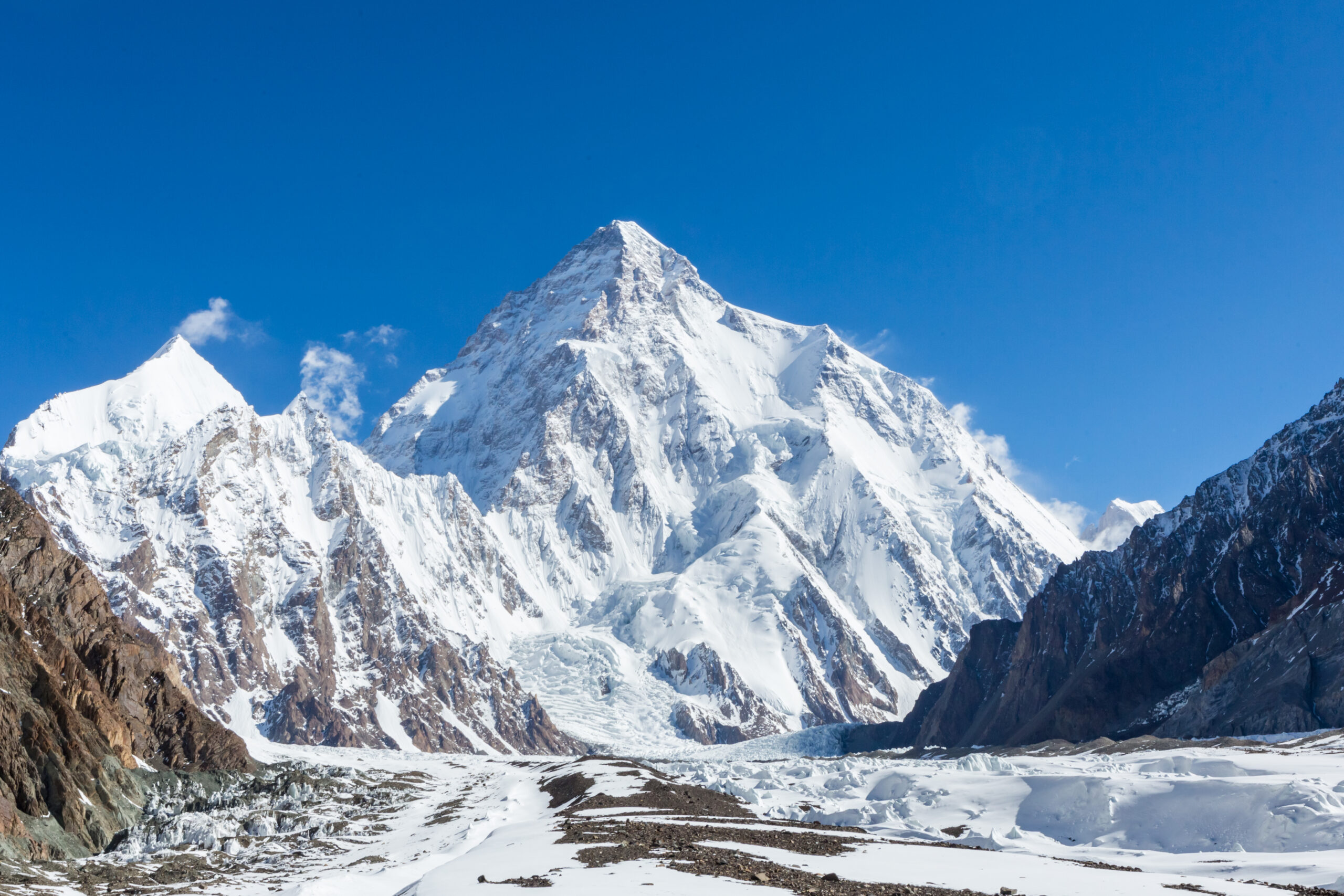
Original K2 route decision map
The map shows the planning distinction without pretending one camp system is permanent.
Abruzzi vs Cesen: ten-second comparison
The factors that should control the expedition discussion.
| Decision factor | Abruzzi Spur | Cesen Route |
|---|---|---|
| Normal role | Commercial standard and first-choice infrastructure line | Main Pakistan-side alternative |
| Broad grade | Commonly described around TD; source and conditions matter | Commonly described around TD to TD+; often steeper and more sustained low down |
| Lower terrain | Mixed rock, snow and ice through House’s Chimney and Black Pyramid | Steeper snow, ice and mixed terrain on the South-Southeast Spur |
| Primary lower hazard | Rockfall, congestion and sustained mixed climbing | Snow loading, avalanche, ice and fewer established camps |
| Fixed ropes | Usually the most complete commercial system | Operator- and season-dependent |
| Camp support | Most established and widely stocked | More variable; exact camp plan depends on the team |
| Upper route | Shoulder, Bottleneck and summit finish | Joins shared Shoulder, Bottleneck and summit finish |
| Typical fit | Qualified climber seeking the strongest established system | Strong steep-ice team with recent operator experience on the line |
| Descent | Commonly used when ropes and camps are established | May be descended, but teams often plan the best-established safe line |
| Final selection | Made by the leader from current conditions, rope progress and team capability | |
Extreme altitude
Both routes require technical movement and decision-making as the body deteriorates above 7,000 and 8,000 metres.
The Shoulder and Camp 4 system
Exact camp positions vary, but both lines feed into the same upper summit strategy.
The Bottleneck
Neither route avoids the couloir and traverse beneath the hanging serac.
Summit and descent pressure
Weather, oxygen, queues, rope condition and turnaround time affect both routes on the decisive day.
Use the K2 death-rate analysis for correctly defined historical ratios and the K2 summit-success analysis for attempt and expedition outcomes. This comparison does not publish invented route-specific death or success percentages.
Abruzzi Spur / Southeast Ridge
Commercial standard · first-ascent line · strongest infrastructure
The Abruzzi follows K2’s Southeast Ridge and was used by Achille Compagnoni and Lino Lacedelli during the 1954 first ascent. Modern teams usually describe the route through House’s Chimney, the Black Pyramid, the Shoulder, the Bottleneck and the summit traverse.
Why teams choose it
- Most operator familiarity
- Most established fixed-rope system
- Better-known camp and rescue logistics
- More traffic and current observations
Why teams reconsider it
- Dry lower terrain can increase rockfall
- House’s Chimney and Black Pyramid create bottlenecks
- Traffic concentrates during short windows
- Shared Bottleneck remains unavoidable
The Abruzzi should usually be the default discussion for a first K2 expedition because infrastructure matters enormously during storms, retreat and descent. That does not mean the route is easy or safe; it means the system is better established.
Cesen Route / South-Southeast Spur
Main alternative · steeper lower line · disputed early history
The Cesen follows the South-Southeast Spur and avoids House’s Chimney and major portions of the Abruzzi lower system. It replaces that terrain with a steeper combination of snow, ice and mixed climbing before joining the upper Abruzzi system.
Why teams choose it
- Avoids House’s Chimney
- Can reduce exposure to a dry, rockfall-prone Abruzzi
- Direct climbing line for a strong ice team
- Provides a condition-based alternative
Why teams reconsider it
- Steeper, more sustained snow and ice
- Avalanche and snow-loading exposure
- Less predictable fixed ropes and camps
- Still shares the Bottleneck and summit finish
Rockfall versus avalanche exposure
The route decision is often a choice between different lower-mountain hazard profiles.
| Condition signal | Abruzzi implication | Cesen implication |
|---|---|---|
| Dry, warm lower ridge | Potentially more loose rock and traffic-triggered rockfall | May become more attractive if its snow and ice remain stable |
| Heavy recent snowfall | Mixed terrain may be slower and avalanche exposure can still exist | Steeper snow slopes may become the larger concern |
| Poor refreeze | Loose rock, wet snow and slower mixed climbing | Soft snow and unstable upper layers can undermine the alternative |
| Strong fixing team only on Abruzzi | Major infrastructure advantage | Cesen may be impractical despite attractive terrain |
| Experienced Cesen operator with stocked camps | Abruzzi remains viable | Cesen becomes a legitimate current-season option |
Fixed ropes, camps and commercial infrastructure
Infrastructure can matter more than a theoretical terrain advantage.
The Abruzzi usually receives the earliest and most extensive rope fixing because most commercial teams depend on it. Camp sites, tents, oxygen caches and rescue communications are also more likely to be concentrated on the standard line.
A Cesen plan is credible only when the operator can identify who will fix it, where camps will be stocked, whether other teams are sharing the work and what happens if the line is abandoned. Read Fixed Lines and Jumars Explained for the movement system, then verify the operator’s actual rope plan.
Ascent route and descent route
The best climbing line and the best retreat line are not always identical.
Some teams may climb the Cesen and descend the Abruzzi when the standard route has better ropes, camps and emergency support. That combination is not automatic. The guide must confirm that the planned descent is fixed, stocked and appropriate for the team’s condition after the summit.
Abruzzi up and down
Operationally simplest when the primary expedition system is concentrated on the standard route.
Cesen up, Abruzzi down
Potentially useful when the Cesen lower terrain is preferable but Abruzzi infrastructure provides the better retreat.
Cesen up and down
Requires a complete rope, camp and rescue plan on the alternative line.
Route switch during rotations
A legitimate response when the leader has enough time, permits, equipment and current information.
Condition-based route selection matrix
A decision tool—not a substitute for the expedition leader.
Discuss the Abruzzi first.
Abruzzi is normally the more defensible commercial choice.
Evaluate the Cesen only if its snow and ice are stable and the route is fully supported.
The alternative may be worse despite avoiding House’s Chimney.
Choose Abruzzi or choose a different operator—not an improvised Cesen plan.
Cesen becomes a legitimate condition-based choice.
Favor the best-established rope and camp system, commonly Abruzzi.
Treat it as a separate North Ridge expedition, not a third standard option.
Use the K2 season and conditions page for the current operating window. This comparison deliberately avoids presenting a seasonal route choice as permanent.
North Ridge: a specialist reference
Historically important, but not a normal choice for a commercial K2 client.
The Chinese-side North Ridge was first climbed by a Japanese expedition in 1982. American Alpine Journal records describe only a handful of repeats. Remote Shaksgam access, permits, limited infrastructure and the lack of ordinary commercial operations make it a separate specialist expedition.
The North Ridge does not use the Pakistan-side Bottleneck system, but avoiding one hazard does not make it a practical alternative for a first K2 expedition. For the North Ridge, Magic Line, West Ridge, Polish Line and other historical routes, use the All K2 Routes Explained guide.
Ten questions for the K2 operator
The written answers reveal whether the route choice is real or marketing language.
The contract should name Abruzzi, Cesen or a condition-based option.
Ask for rockfall, snow-loading, avalanche and rope-progress criteria.
Identify the operator, shared fixing group and backup if another team withdraws.
A route is not commercially viable without a complete high-camp system.
General K2 experience is not the same as current alternative-route experience.
Confirm ropes, camps, oxygen and emergency support after the summit.
Clarify route-change costs, delays, lost summit chances and refunds.
Ask about personal support versus shared group resources.
Use the insurance comparison above 6,000 m to audit the answer.
Use What Should Be Included in an Expedition Price to compare ropes, fixing fees, oxygen, high camps, staff insurance, communications and route-change costs. This is orphan/weak-link addition 2.
The correct K2 internal-link cluster
All destination URLs below were verified during the July 22 rebuild.
Two orphan or weak-link pages integrated contextually
Linked in the route-infrastructure section because personal support does not replace the shared fixing, camp and weather system.
Linked in the operator checklist to expose route-fixing, oxygen, camp, staffing, insurance and route-change exclusions.
K2 route comparison FAQ
Visible answers match the FAQ schema.
Which route is best for a first K2 expedition?
For most qualified first-time K2 climbers, the Abruzzi is the default because it has the strongest infrastructure. The Cesen may be chosen when its conditions and the operator’s specific experience justify it.
What is the difference between Abruzzi and Cesen?
The Abruzzi uses House’s Chimney and Black Pyramid with the most established fixed ropes and camps. The Cesen uses a steeper snow, ice and mixed line before joining the upper Abruzzi system.
Does Cesen avoid the Bottleneck?
No. It shares the Shoulder, Bottleneck and summit finish.
Is Cesen safer?
Not universally. Abruzzi may have more rockfall and congestion; Cesen may have more steep-snow, ice and avalanche exposure. The current season controls the answer.
Are both routes fixed?
Abruzzi normally receives the strongest rope and camp system. Cesen support depends on the operator and season.
Where do they join?
Descriptions vary roughly from around 7,200 m to the upper Shoulder area because route lines and camp systems vary. Both share the upper summit route.
Is the North Ridge a commercial alternative?
No. It is a specialist Chinese-side expedition with remote access, limited infrastructure and only a handful of repeats since 1982.
What should I ask the operator?
Ask for the planned route, switch criteria, fixing team, camp and oxygen plan, recent route experience, descent line, guide ratio and written route-change terms.
Primary sources and methodology
- American Alpine Journal: South-Southeast Spur — records the route’s connection to the Abruzzi at the southeast shoulder and the widely accepted 1994 Basque completion.
- American Alpine Journal: K2—The North Ridge — route history and Chinese-side expedition character.
- American Alpine Journal: North Ridge repeat — confirms the 1982 first ascent and the route’s small number of repeats.
- Current internal K2 parent, routes, operator and conditions pages were reviewed to assign one search intent to each URL and verify the internal-link destinations.
Method: no exact route-use, success or fatality percentages are published here because route lines merge, camp numbering changes and route attribution is not consistently reproducible. Last reviewed July 22, 2026.
Choose the operator and current route system together
Do not buy a Cesen or Abruzzi label in isolation. Compare the leader, fixing plan, camps, oxygen, descent route, weather culture, route-switch policy and written inclusions.
Compare K2 Operators Check Current SeasonWhich K2 Route Is Better?
For most qualified climbers joining a supported K2 expedition, the Abruzzi Spur should remain the default starting point. It normally has the mountain’s strongest fixed-rope effort, most familiar camp system, greatest traffic and deepest commercial operating experience.
The Cesen Route becomes the better choice only when actual conditions and the operating team’s experience justify the change. It avoids House’s Chimney and much of the lower Abruzzi system, but substitutes steeper snow, ice and mixed terrain with more variable camp and rope infrastructure.
Most importantly, the Cesen does not eliminate K2’s defining upper hazards. Both routes feed into the shared upper mountain and ultimately the Shoulder, Bottleneck and summit system.
What K2’s Zero-Summit 2026 Season Teaches About Route Choice
One season should not rewrite the evergreen route hierarchy, but it can show which variables matter once an expedition reaches Base Camp.
Abruzzi Was Still the Main Supported Line
Commercial activity centered on the Abruzzi Spur. The absence of a successful summit was therefore not evidence that teams had selected an obscure or inappropriate route.
The Upper System Never Matured in Time
By July 24, fixed ropes were reported only around 7,000 metres, with additional rope staged higher. Weather and mountain conditions kept the route-development timetable behind the summit timetable.
The Route Name Is Only One Variable
Wind, fresh snow, rockfall, rope progress, acclimatization, camp readiness and descent margin all have to align. A theoretically good route still cannot produce a summit when the larger expedition system is incomplete.
When Should a Team Actually Consider the Cesen Instead?
This is a planning framework for discussing the decision with the expedition leader—not a forecast of future route conditions.
| Situation | Abruzzi | Cesen | Planning verdict |
|---|---|---|---|
| First supported K2 expedition | Strongest infrastructure baseline | Requires a specific reason to depart from the standard system | Discuss Abruzzi first |
| Operator has fixed and stocked only Abruzzi | Complete support system | Incomplete or improvised system | Abruzzi |
| Lower Abruzzi is dry and producing dangerous rockfall | Potentially deteriorating lower-route exposure | May offer a better line if snow and ice are stable | Evaluate Cesen |
| Cesen is heavily snow-loaded | May provide the more defensible line | Steep snow and avalanche exposure may dominate | Do not choose Cesen automatically |
| Team lacks sustained steep-ice experience | Better-known supported system | Stronger steep snow / ice requirement | Abruzzi normally stronger |
| Leader has recent Cesen experience and a full fixing plan | Still the standard alternative | Becomes operationally credible | Conditions decide |
| Retreat and descent simplicity dominate | Usually deepest camp / rope / traffic system | Can require separate descent planning | Favor the established system |
| Goal is to avoid the Bottleneck | Does not avoid it | Does not avoid it | Neither solves that problem |
Do Not Buy “Abruzzi” or “Cesen.” Buy the Complete Route System.
The route name is almost meaningless unless the operator can explain how the route will actually function that season.
| Ask the operator | What a useful answer contains | Why it matters |
|---|---|---|
| What is the primary route? | Abruzzi or Cesen clearly stated, plus the reason it is currently preferred. | “We will decide later” is different from having an intentional condition-based switching plan. |
| Who fixes the route? | Named team or shared fixing arrangement, expected schedule and responsibility above each camp. | A route with no credible rope plan is not a commercial route system. |
| Where will camps and oxygen be stocked? | Route-specific high-camp and cache plan. | Cesen and Abruzzi cannot be treated as interchangeable if all logistics sit on only one line. |
| What triggers a route switch? | Rockfall, snow loading, avalanche stability, fixing progress, traffic or another explicit threshold. | A switch should be a preplanned response to evidence, not an improvised reaction under pressure. |
| What is the descent route? | Planned descent plus a fallback if the ascent line becomes unsuitable. | The best ascent line is not automatically the strongest retreat system. |
| What recent experience does the leader have on this line? | Specific seasons and route experience rather than generic K2 credentials. | Cesen is most defensible when the team actually understands its current operational demands. |
Use the Comparison for the Decision—Then Open the Exact K2 Guide You Need
This page should continue owning Abruzzi-versus-Cesen route choice. The broader route atlas, current season, operator, Bottleneck and expedition planning questions belong on their dedicated pages.
Was this helpful?
🏔Related peaks nearby
🧭Explore & compare
Global Summit Guide is an independent mountaineering resource founded in 2026. The team combines first-hand trekking and climbing experience with in-depth research and professional health and nutrition review to help climbers choose objectives, prepare properly, and stay safe.
Health, altitude, and nutrition content is reviewed by Taylor Ludlow (Registered Nurse) and Brigg Hoopes (Nutritionist).
What We Don't Know Yet
Mountain information changes quickly. This box explains the limits of what this page can responsibly promise.
- Permit availability, reservation windows, quotas, and official fee rules may change after this page is updated.
- Guide-company prices, departure dates, guide ratios, included services, and cancellation rules can change without notice.
- Weather, snowpack, avalanche risk, road access, and route conditions can change quickly and may be different on your climbing dates.
- Route conditions, trailhead access, crevasse exposure, stream crossings, and rescue access may vary from published planning guidance.
- Fitness and altitude response vary by person; no guide, itinerary, or training plan can guarantee acclimatization or summit success.
Verify current conditions with official land managers, guide services, local forecasts, and current route reports before booking or climbing.
Mountaineering, rock and ice climbing, glacier travel, and high-altitude activity are inherently dangerous and can result in serious injury or death. The information on Global Summit Guide is provided for general informational and educational purposes only and is not a substitute for professional instruction, qualified guiding, proper equipment, or your own judgment and experience.
Route conditions, weather, snowpack, permits, regulations, and hazards change constantly and may differ from what is described here. Details may be incomplete, out of date, or contain errors. Always verify current information with local authorities, certified guides, and official sources before making any decision in the mountains.
Nothing on this site is medical, legal, or financial advice. Our fitness, acclimatization, altitude, and nutrition content is general in nature; consult a qualified physician before beginning any strenuous exercise program or exposing yourself to high altitude.
You are solely responsible for your own safety and decisions. To the fullest extent permitted by law, Global Summit Guide and its team accept no liability for any loss, injury, damage, or expense arising from use of, or reliance on, this information. By using this site you acknowledge these risks and accept these terms.
Some links on this site may be affiliate links. If you buy through them we may earn a small commission at no extra cost to you; this never affects our recommendations.
Global Summit Guide recommendation path
Next Best Mountain to Research
Use these recommendations to continue the right planning path instead of stopping on one page.
Use current permit, weather, route, and operator information before booking or climbing.
Explore Travel Options for Your Destination
Once your mountain, dates and route are taking shape, compare flights, hotels and other travel options that fit the trip.
Affiliate link. We may earn a commission at no additional cost to you.