
Last updated July 23, 2026
{ “@context”: “https://schema.org”, “@type”: “Article”, “headline”: “How to Choose Crampons for Mountaineering 2026: The C1/C2/C3 Binding System, Boot Compatibility, Crampon Types, Steel vs Aluminum, Points, Fit, and the Boot-First Method”, “description”: “Complete 2026 guide to choosing the right crampons for mountaineering. Generally, crampons are chosen as part of a system with your boots, so the single most important decision is compatibility: the C1/C2/C3 crampon binding grades must match the B1/B2/B3 boot stiffness grades. Specifically, this guide explains the three binding systems (strap-on, semi-automatic, and fully automatic), the crampon types (general mountaineering, technical, and lightweight), the steel-versus-aluminum material choice, point configuration, anti-balling plates, and how to fit crampons to your boots. Notably, it lays out the boot-first method — choose the boot, then the crampon that matches it — and the common buying mistakes that lead to unstable or unsafe setups. For specific 2026 model recommendations, it points to our dedicated crampons buyer’s guide.”, “image”: “https://globalsummitguide.com/wp-content/uploads/2026/02/1446175981.jpg”, “author”: {“@type”: “Organization”, “name”: “Global Summit Guide Editorial Team”}, “publisher”: {“@type”: “Organization”, “name”: “Global Summit Guide”}, “datePublished”: “2026-02-15”, “dateModified”: “2026-07-23T09:30:38+00:00” } { “@context”: “https://schema.org”, “@type”: “FAQPage”, “mainEntity”: [ {“@type”: “Question”, “name”: “What kind of crampons do I need for mountaineering?”, “acceptedAnswer”: {“@type”: “Answer”, “text”: “Most climbers doing general alpine and glacier routes need general mountaineering crampons that match their boots and expected terrain. Generally, that means a 12-point steel crampon in the binding type your boots accept. Specifically, the right crampon depends on three things: your boots, your terrain, and how technical the route is. A 12-point steel crampon handles glacier travel, snow climbs, and moderate alpine ice, which covers what most mountaineers actually climb. Notably, technical crampons with aggressive front points are needed only for steep ice and mixed climbing, while lightweight aluminum crampons suit ski mountaineering and snow approaches. Start by confirming your boot grade, then choose a crampon graded to match it. Only step up to technical models once your objectives demand them.”}}, {“@type”: “Question”, “name”: “What do C1, C2, and C3 crampons mean?”, “acceptedAnswer”: {“@type”: “Answer”, “text”: “C1, C2, and C3 are crampon binding grades that must match your boot’s B1/B2/B3 stiffness grade. Generally, the grade rises with how secure and rigid the binding is. Specifically, C1 strap-on crampons use plastic baskets at toe and heel and work with flexible B1 or stiffer boots, offering the widest compatibility. C2 semi-automatic crampons use a heel lever clip plus a toe strap and need a stiffer B2 or B3 boot with a heel welt. C3 fully automatic crampons use a wire toe bail and heel lever and require a fully rigid B3 boot with both toe and heel welts. Notably, the rule is that the crampon grade must be equal to or lower than the boot grade. A B2 boot takes C1 and C2 crampons but not C3. Matching them wrong is unsafe, because a binding that does not fit can detach under load.”}}, {“@type”: “Question”, “name”: “Are strap-on crampons enough for mountaineering?”, “acceptedAnswer”: {“@type”: “Answer”, “text”: “Strap-on C1 crampons are enough for many general snow climbs and glacier routes, but not for technical terrain. Generally, they are the most versatile binding because they fit the widest range of boots, including more flexible ones. Specifically, strap-on crampons work well for non-technical glacier travel, snow slopes, and general mountaineering where you are not front-pointing on steep ice. Notably, more technical objectives benefit from semi-automatic or fully automatic systems, which lock onto stiffer boots more securely and precisely for steep climbing. The trade-off is that automatic systems require boots with the right welts. For most climbers on standard alpine and glacier routes, strap-on or semi-automatic crampons on a matching boot are the practical choice.”}}, {“@type”: “Question”, “name”: “Steel or aluminum crampons?”, “acceptedAnswer”: {“@type”: “Answer”, “text”: “Choose steel for general mountaineering and ice, and aluminum only for snow and ski-mountaineering approaches where weight matters most. Generally, steel is more durable and grips ice and rock far better, while aluminum is much lighter but wears down quickly on rock. Specifically, steel crampons are the right choice for one versatile pair that handles glacier travel, alpine ice, and mixed terrain. Aluminum crampons suit fast-and-light snow missions and ski mountaineering, where every gram counts and you will not be climbing technical ice or scrambling over rock. Notably, hybrid models pair an aluminum heel with steel front points to balance weight and durability. For most mountaineers buying one pair, steel is the safe, versatile answer.”}}, {“@type”: “Question”, “name”: “How do I know if my crampons fit correctly?”, “acceptedAnswer”: {“@type”: “Answer”, “text”: “Correctly fitted crampons sit centered on the boot sole and stay secure with no major shifting or looseness during movement. Generally, the crampon must match the sole shape and stiffness of the boot, and the binding system must be designed for that boot type. Specifically, a good fit means the crampon holds the heel and toe correctly, stays centered when walking or front-pointing, and shows no twisting or wobble. Notably, if the fit is sloppy, the crampons are wrong for that boot, full stop. Always test the full system before your climb. Clip the crampons onto the actual boots you will wear and walk around to confirm they stay locked. A loose crampon on steep terrain is a serious safety risk.”}} ] } .crc-page { font-family: ‘Outfit’, sans-serif; color: #122a44; line-height: 1.65; max-width: 1200px; margin: 0 auto; padding: 0; } .crc-page h1, .crc-page h2, .crc-page h3, .crc-page h4 { font-family: ‘DM Serif Display’, serif; font-weight: 400; color: #0a1929; line-height: 1.15; } .crc-page p { font-size: 1.02rem; margin-bottom: 1.1em; } .crc-page a { color: #2e5986; text-decoration: none; border-bottom: 1px solid rgba(46,89,134,0.3); } .crc-page a:hover { color: #d4913a; border-bottom-color: #d4913a; } .crc-hero { position: relative; min-height: 560px; background: linear-gradient(135deg, rgba(10,25,41,0.85) 0%, rgba(18,42,68,0.72) 100%), url(‘https://globalsummitguide.com/wp-content/uploads/2026/02/1446175981.jpg’); background-size: cover; background-position: center; color: #f5e4c8; padding: 70px 40px; display: flex; flex-direction: column; justify-content: center; overflow: hidden; } .crc-hero::before { content: ”; position: absolute; top: -100px; right: -100px; width: 400px; height: 400px; background: radial-gradient(circle, rgba(212,145,58,0.35) 0%, transparent 70%); pointer-events: none; } .crc-hero-content { max-width: 900px; position: relative; z-index: 2; } .crc-hero-breadcrumb { font-size: 0.85rem; color: rgba(245,228,200,0.7); margin-bottom: 14px; letter-spacing: 1px; text-transform: uppercase; } .crc-hero-breadcrumb a { color: rgba(245,228,200,0.85); border-bottom: none; } .crc-hero h1 { font-size: 3rem; color: #f5e4c8; margin: 0 0 20px; line-height: 1.05; } .crc-hero h1 em { color: #d4913a; font-style: italic; } .crc-hero-tagline { font-size: 1.15rem; color: rgba(245,228,200,0.92); margin-bottom: 32px; max-width: 760px; } .crc-stat-grid { display: grid; grid-template-columns: repeat(4, 1fr); gap: 20px; margin-top: 24px; } .crc-stat { background: rgba(245,228,200,0.08); border: 1px solid rgba(212,145,58,0.3); border-radius: 8px; padding: 18px 16px; backdrop-filter: blur(4px); } .crc-stat-num { font-family: ‘DM Serif Display’, serif; font-size: 1.7rem; color: #d4913a; line-height: 1; margin-bottom: 6px; } .crc-stat-label { font-size: 0.78rem; color: rgba(245,228,200,0.85); text-transform: uppercase; letter-spacing: 0.8px; } .crc-hub-strip { background: #122a44; color: rgba(245,228,200,0.85); padding: 14px 40px; font-size: 0.86rem; text-align: center; } .crc-hub-strip a { color: #d4913a; border-bottom: none; } .crc-hub-strip a:hover { color: #f5e4c8; } .crc-main { display: grid; grid-template-columns: 1fr 280px; gap: 50px; padding: 60px 40px; } .crc-content h2 { font-size: 2.2rem; margin-top: 60px; margin-bottom: 20px; padding-bottom: 12px; border-bottom: 2px solid #d4913a; } .crc-content h2:first-child { margin-top: 0; } .crc-content h2 em { color: #d4913a; font-style: italic; } .crc-content h3 { font-size: 1.5rem; margin-top: 32px; margin-bottom: 14px; color: #0a1929; } .crc-content h4 { font-size: 1.2rem; margin-top: 24px; margin-bottom: 10px; color: #122a44; } .crc-sidebar { font-size: 0.92rem; } .crc-sidebar-card { background: #f8f4ec; border-radius: 10px; padding: 22px; margin-bottom: 22px; position: sticky; top: 20px; } .crc-sidebar-card h4 { margin: 0 0 14px; font-size: 1.1rem; color: #0a1929; border-bottom: 1px solid #d4c8a8; padding-bottom: 8px; } .crc-sidebar-card ul { margin: 0; padding-left: 18px; } .crc-sidebar-card li { margin-bottom: 6px; font-size: 0.88rem; } .crc-sidebar-facts { background: #0a1929; color: #f5e4c8; border-radius: 10px; padding: 22px; margin-bottom: 22px; } .crc-sidebar-facts h4 { color: #d4913a; margin: 0 0 14px; font-size: 1rem; border-bottom: 1px solid rgba(212,145,58,0.3); padding-bottom: 8px; } .crc-sidebar-facts dl { margin: 0; } .crc-sidebar-facts dt { color: rgba(245,228,200,0.7); font-size: 0.78rem; text-transform: uppercase; letter-spacing: 0.5px; margin-top: 10px; } .crc-sidebar-facts dd { margin: 2px 0 0; font-size: 0.95rem; color: #f5e4c8; } .crc-table { width: 100%; border-collapse: collapse; margin: 24px 0; font-size: 0.92rem; } .crc-table th { background: #0a1929; color: #f5e4c8; padding: 12px 14px; text-align: left; font-weight: 500; font-size: 0.82rem; letter-spacing: 0.5px; text-transform: uppercase; } .crc-table td { padding: 11px 14px; border-bottom: 1px solid #e8e2d4; vertical-align: top; } .crc-table tr:nth-child(even) td { background: #fbf7ef; } .crc-table.crc-compact { font-size: 0.86rem; } .crc-table.crc-compact th { padding: 10px 8px; font-size: 0.74rem; } .crc-table.crc-compact td { padding: 8px 10px; } .crc-callout-info { background: #e8f0f7; border-left: 4px solid #2e5986; padding: 18px 22px; border-radius: 6px; margin: 24px 0; } .crc-callout-info strong { color: #2e5986; } .crc-callout-warning { background: #fdf3e8; border-left: 4px solid #b86a15; padding: 18px 22px; border-radius: 6px; margin: 24px 0; } .crc-callout-warning strong { color: #b86a15; } .crc-callout-tip { background: #ebf2ec; border-left: 4px solid #2d5a3a; padding: 18px 22px; border-radius: 6px; margin: 24px 0; } .crc-callout-tip strong { color: #2d5a3a; } .crc-type-card { background: #f8f4ec; border-radius: 12px; padding: 26px; margin: 22px 0; border-left: 5px solid #d4913a; } .crc-type-card.general { border-left-color: #2e5986; background: linear-gradient(135deg, #f8f4ec 0%, #ecf1f6 100%); } .crc-type-card.technical { border-left-color: #a83a2b; } .crc-type-card.light { border-left-color: #2d5a3a; } .crc-type-card h3 { color: #0a1929; margin-top: 0; margin-bottom: 6px; font-size: 1.45rem; } .crc-type-meta { font-weight: 600; font-size: 0.9rem; margin-bottom: 12px; color: #b86a15; } .crc-type-stats { display: grid; grid-template-columns: repeat(3, 1fr); gap: 12px; margin: 16px 0; padding: 14px; background: rgba(10,25,41,0.04); border-radius: 6px; } .crc-type-stat { text-align: center; } .crc-type-stat-num { font-family: ‘DM Serif Display’, serif; font-size: 1.1rem; color: #0a1929; line-height: 1.1; } .crc-type-stat-label { font-size: 0.7rem; color: #5a4f30; text-transform: uppercase; letter-spacing: 0.4px; margin-top: 4px; } .crc-feature-img { margin: 32px 0; border-radius: 10px; overflow: hidden; box-shadow: 0 4px 20px rgba(10,25,41,0.12); } .crc-feature-img img { width: 100%; display: block; } .crc-feature-img figcaption { padding: 12px 18px; background: #f8f4ec; font-size: 0.85rem; color: #5a4f30; font-style: italic; } .crc-faq { margin: 30px 0; } .crc-faq-item { background: #f8f4ec; border-radius: 8px; margin-bottom: 12px; padding: 0; } .crc-faq-item summary { padding: 18px 24px; cursor: pointer; font-family: ‘DM Serif Display’, serif; font-size: 1.1rem; color: #0a1929; list-style: none; } .crc-faq-item summary::after { content: ‘+’; float: right; color: #d4913a; font-size: 1.4rem; line-height: 0.8; } .crc-faq-item[open] summary::after { content: ‘−’; } .crc-faq-item div { padding: 0 24px 20px; font-size: 0.95rem; } .crc-related { background: #f8f4ec; padding: 26px; border-radius: 10px; margin: 30px 0; } .crc-related h4 { margin-top: 0; margin-bottom: 16px; color: #0a1929; } .crc-related ul { margin: 0; padding-left: 20px; } .crc-related li { margin-bottom: 8px; font-size: 0.95rem; } .crc-sources { background: #fbf7ef; border: 1px solid #e8d8ad; padding: 22px 26px; border-radius: 8px; margin: 30px 0; font-size: 0.9rem; } .crc-sources h4 { margin-top: 0; color: #5a4f30; } .crc-sources ul { margin: 0; padding-left: 20px; } .crc-sources li { margin-bottom: 6px; } .crc-updated-banner { background: #d4913a; color: #0a1929; padding: 12px 24px; border-radius: 6px; font-weight: 600; text-align: center; font-size: 0.95rem; margin: 24px 0; } .crc-final-cta { background: linear-gradient(135deg, #122a44 0%, #1e3a5f 100%); color: #f5e4c8; padding: 36px 32px; border-radius: 12px; margin: 40px 0 0; text-align: center; } .crc-final-cta h3 { color: #d4913a; margin: 0 0 12px; font-size: 1.6rem; } .crc-final-cta p { color: rgba(245,228,200,0.9); font-size: 1rem; margin: 0 0 22px; max-width: 600px; margin-left: auto; margin-right: auto; line-height: 1.6; } .crc-cta-button { display: inline-block; background: #d4913a; color: #0a1929; padding: 14px 28px; border-radius: 6px; font-weight: 600; text-decoration: none; border: none !important; font-size: 1rem; } .crc-cta-button:hover { background: #f5e4c8; color: #0a1929; } @media (max-width: 900px) { .crc-main { grid-template-columns: 1fr; padding: 40px 20px; } .crc-hero { padding: 40px 20px; min-height: auto; } .crc-hero h1 { font-size: 1.9rem; } .crc-stat-grid { grid-template-columns: repeat(2, 1fr); } .crc-sidebar-card { position: static; } .crc-table.crc-compact { font-size: 0.75rem; } .crc-table.crc-compact th, .crc-table.crc-compact td { padding: 6px 5px; } .crc-type-stats { grid-template-columns: repeat(3, 1fr); } }How to Choose Crampons for Mountaineering 2026 — The C1/C2/C3 Binding System, Boot Compatibility, Types & Fit
Crampons are one of the most important pieces of technical mountain gear, and choosing them is not about buying something sharp for the snow. Generally, the right crampon depends on your boots, your terrain, and how technical your route is. A mismatch between boots and crampons creates instability and real safety problems. Specifically, this guide explains the C1/C2/C3 binding system and how it matches your boots. It also covers the crampon types, the steel-versus-aluminum choice, and how to fit crampons properly. Notably, the central idea is the boot-first method: choose the boot, then choose the crampon that matches it.
Crampons are one of the most important pieces of technical mountain gear you will own. Generally, the right pair improves traction, security, and confidence on snow, glacier ice, firm alpine terrain, and steep routes. Specifically, choosing them is not just about buying something sharp for snow and ice. The right crampon depends on your boots, your terrain, the steepness of the climb, and how technical your route will be. Notably, a mismatch between boots and crampons creates instability, wasted energy, and serious safety problems, which is why compatibility comes first.
This guide walks the crampon decision in order. First, why crampons matter and the C1/C2/C3 binding system that must match your boots. Then the crampon types, the steel-versus-aluminum choice, point configuration, and anti-balling plates. Also how crampons should fit, and the common buying mistakes to avoid. Notably, this is a child page of our main mountaineering gear checklist and the sibling of our boots guide. Read them together, because boots and crampons are one system. For specific 2026 model picks, see our crampons buyer’s guide.
Why Crampons Matter
Crampons give you traction where boots alone are not enough. Generally, on steep snow, glacier ice, frozen couloirs, and exposed alpine slopes, they let you move more safely and efficiently. Specifically, four functions define a good crampon setup. Notably, the last one — compatibility — is the gatekeeper, because a crampon that does not match your boot fails at all the others.
| Function | Why It Matters |
|---|---|
| Traction | Essential for firm snow, ice, and mixed mountain terrain |
| Security | A well-fitted crampon reduces slipping and builds confidence on exposed slopes |
| Efficiency | The right model makes climbing and descending more controlled and less tiring |
| Compatibility | Crampons must match your boots properly to work as intended |
The C1/C2/C3 Binding System
The most important part of choosing crampons is the binding system. Generally, the binding is what connects the crampon to the boot, and not every system works with every boot. Specifically, crampons are graded C1 to C3 to match the B1 to B3 boot stiffness grades. The grade rises with how secure and rigid the binding is. Notably, the matching rule is simple and non-negotiable: the crampon grade must be equal to or lower than the boot grade.
| Crampon Grade | Binding Type | Needs Boot | Best For |
|---|---|---|---|
| C1 | Strap-on (plastic toe & heel baskets) | B1 or stiffer | General snow climbs, glacier travel |
| C2 | Semi-automatic (heel clip + toe strap) | B2 or B3 (heel welt) | General mountaineering, alpine routes |
| C3 | Fully automatic (wire toe bail + heel lever) | B3 only (toe & heel welts) | Technical ice, steep mixed climbing |
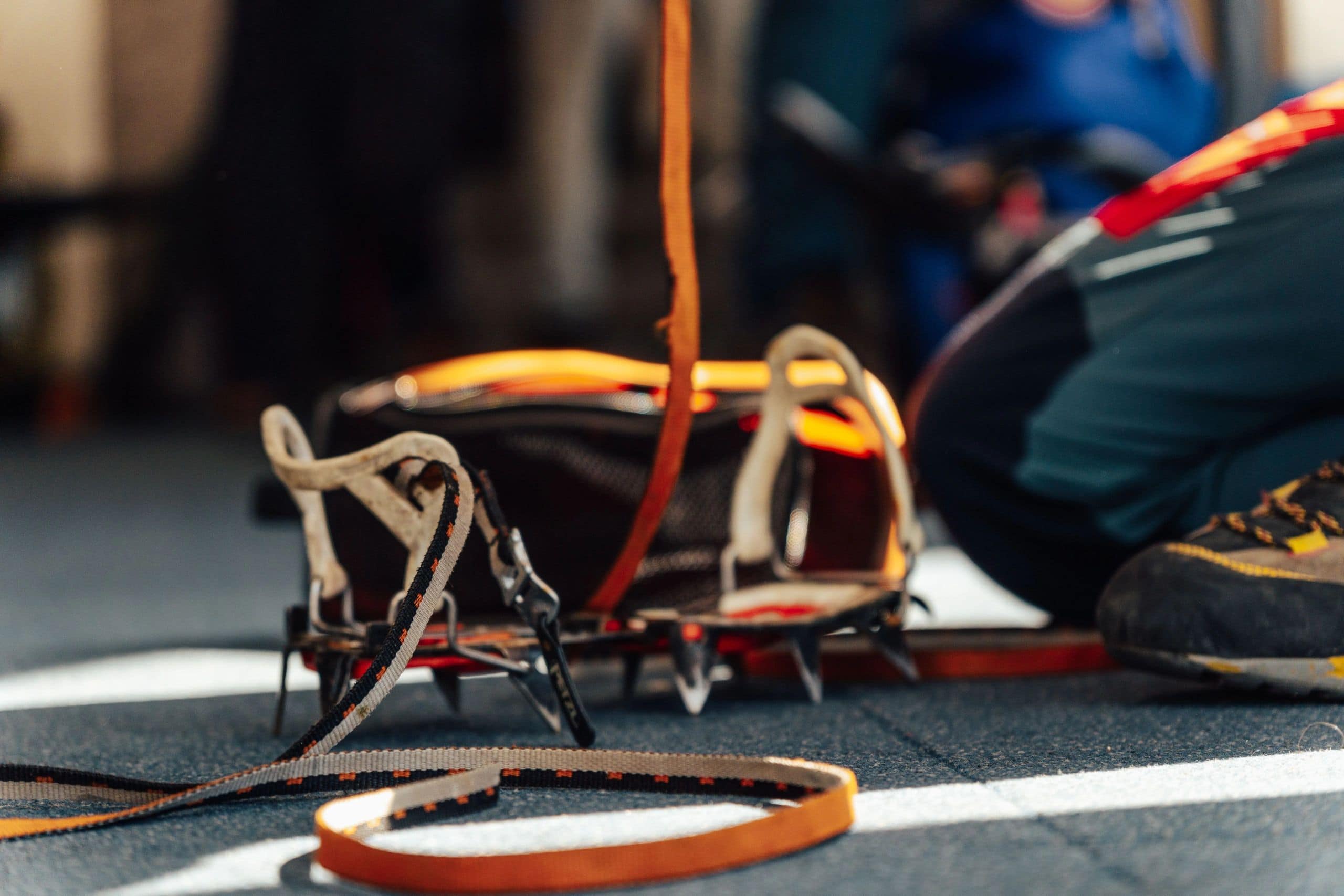
Choose the boot first, then the crampon that matches it. Generally, the boot’s B-grade sets which crampon C-grade you can safely use, so the boot is always the starting point. Specifically, a C1 strap-on works on almost any semi-rigid boot. A C2 semi-automatic needs a boot with a heel welt, and a C3 fully automatic needs a fully rigid boot with both toe and heel welts. Notably, never assume all mountaineering boots work with all crampon systems — a fully automatic binding on a too-soft boot can detach under load. For the boot side of this pairing, see our boots guide.
The Three Crampon Types
Not every crampon is built for the same terrain. Generally, some are designed for general glacier travel and mountaineering, while others are meant for steeper, more technical climbing. Specifically, the three types are general mountaineering, technical, and lightweight crampons. Notably, the right type depends on how demanding your route is, and for most climbers the general mountaineering crampon is the correct first choice.
| Type | Best For | Strengths | Limitations |
|---|---|---|---|
| General mountaineering | Snow climbs, glacier routes, non-technical alpine | Versatile, stable, suits most climbers | Less specialized for steep technical ice |
| Technical | Steep ice, mixed climbing, technical alpine | Aggressive front points and precision | Often overkill for basic snow climbs |
| Lightweight / ski mountaineering | Fast-and-light missions, ski touring, moderate snow | Lighter and more packable | Not ideal for sustained technical climbing |
General Mountaineering Crampons — The All-Rounder
General mountaineering crampons are the versatile workhorses that suit most climbers. Generally, they handle snow climbs, glacier routes, and non-technical alpine objectives, which covers the terrain the majority of mountaineers actually climb. Specifically, a 12-point steel crampon has two forward-angled front points. These let you kick into firm snow and moderate ice while staying stable on flatter glacier travel. Notably, these are the right first crampons for almost everyone, since they balance capability against weight and cost. Match them to your boots in the correct binding grade, and they will carry you up most of the world’s classic peaks.
Technical Crampons — For Steep Ice
Technical crampons are built for steep ice, mixed climbing, and demanding alpine routes. Generally, they have more aggressive front points and greater precision than general models, often with vertical front points that bite into hard ice. Specifically, the most technical versions are modular, letting you switch between a single monopoint and dual front points for vertical terrain. Notably, the trade-off is that they are often overkill for basic snow climbs, and they require a fully rigid B3 boot with a C3 binding. Buy these only once your objectives genuinely involve steep ice — for general mountaineering, the all-rounder is the smarter and cheaper choice.
Lightweight / Ski Mountaineering Crampons
Lightweight crampons trade durability for weight savings on snow-dominant objectives. Generally, they suit fast-and-light missions, ski mountaineering, and moderate snow terrain where every gram counts. Specifically, most use aluminum construction to keep weight low. That makes them ideal for long glacier approaches and ski tours, where you are not climbing technical ice or scrambling over rock. Notably, the trade-off is that aluminum wears down quickly on rock. These are not the right choice for sustained technical climbing or rocky mixed ground. Reserve them for snow-only objectives, and use a steel crampon for everything else.
Crampon Binding Systems
The binding system is the practical expression of the C-grade. Generally, there are three binding types, each matching a crampon grade and a boot requirement. Specifically, strap-on bindings are the most universal. Semi-automatic bindings clip the heel and strap the toe, and fully automatic bindings use wire bails front and back. Notably, the more secure the binding, the stiffer the boot it requires.
| Binding | Works With | Advantages | Notes |
|---|---|---|---|
| Strap-on (C1) | Many boots, including less technical models | Versatile, widely compatible, field-repairable | Good for general use, less precise than automatic |
| Semi-automatic / hybrid (C2) | Boots with a rear (heel) welt | Secure and popular for mountaineering | The common choice for many alpine boots |
| Automatic / step-in (C3) | Rigid boots with front and rear welts | Very secure and precise | Best for technical boots and steeper terrain |
Key Features to Look For
Beyond type and binding, several features shape how a crampon performs. Generally, each maps to a specific demand of the terrain you climb. Specifically, the six features below are the ones to weigh before buying. Notably, the steel-versus-aluminum choice and the anti-balling plates are the two that most affect real-world safety.
| Feature | What to Check | Why It Matters |
|---|---|---|
| Point configuration | 10- or 12-point; front-point angle | More aggressive front points help on steeper terrain |
| Material | Steel or aluminum | Steel is durable for all terrain; aluminum is light for snow only |
| Anti-balling plates | Present front and rear | Stop snow building up underfoot and killing traction |
| Adjustability | Fits your boot size, stays centered | A poorly sized crampon shifts and wobbles |
| Weight | Reasonable for the objective | Matters, but durability and security matter more |
| Intended use | Matched to your actual terrain | Glacier, steep snow, and ice need different setups |
Steel vs Aluminum
The material choice trades weight against durability. Generally, steel is the default for any climber buying one versatile pair. Specifically, steel is durable and dependable, grips ice and rock well, and lasts for years. Aluminum is much lighter but less suited to rugged technical use, and it wears quickly on rock. Notably, aluminum makes sense only for snow-dominant objectives like ski mountaineering. Hybrid models pair an aluminum heel with steel front points to balance the two.
Anti-Balling Plates
Anti-balling plates are not optional on snow. Generally, they are the plastic plates under the crampon frame that stop snow from packing into a heavy, slippery ball under your boot. Specifically, snow balling up negates the points entirely and is a common cause of slips in soft or wet snow. Notably, every modern mountaineering crampon should have anti-balling plates front and rear, so confirm they are included before you buy.
Fit and Boot Compatibility
Crampons should fit your boots securely with minimal movement. Generally, they should sit centered on the sole, hold the heel and toe correctly, and stay attached without wobble. Specifically, if the fit is sloppy, the crampons are not right for that boot — full stop. Notably, the only reliable way to confirm a fit is to test the full system before your climb, not on the mountain.
| Fit Check | What Good Looks Like |
|---|---|
| Sole match | The crampon matches the sole shape and stiffness of the boot |
| Binding match | The binding system is designed for your specific boot type |
| Centering | The crampon stays centered and secure when walking or front-pointing |
| No movement | There is no major shifting, twisting, or looseness |
| System test | You have tested the full setup before your climb |
Boots and crampons are one system, never chosen separately. Generally, this is why the boots guide and the crampons guide belong side by side. The two choices are part of the same combined mountain tool. Specifically, your boot’s stiffness and welts determine which crampon binding you can use, so picking a crampon without knowing your boot grade is guesswork. Notably, always confirm your boot grade first, choose the matching crampon, then clip them together at home and walk around to confirm the fit. For the boot half of this, see our how to choose mountaineering boots guide.
Common Crampon-Buying Mistakes
Most crampon problems trace back to a few predictable mistakes. Generally, they come from ignoring compatibility or buying for the wrong terrain. Specifically, the four mistakes below cause the most trouble. Notably, each has a simple fix that costs nothing but attention before you buy.
| Mistake | Why It Causes Problems | Better Approach |
|---|---|---|
| Buying by brand alone | A popular model may still be wrong for your boots or terrain | Choose based on compatibility and intended use |
| Ignoring boot compatibility | An insecure fit becomes dangerous on steep terrain | Always test crampons directly on your boots |
| Going too technical too early | Aggressive crampons are unnecessary for basic objectives | Buy for the terrain you climb most often |
| Choosing weight over durability | Ultralight options wear faster in rugged terrain | Balance weight savings with reliability |
The two that hurt most: compatibility and over-buying. Generally, the most consequential crampon mistakes are an insecure boot fit and buying more crampon than your terrain needs. Specifically, an unstable crampon on steep ground is a genuine danger, and an over-aggressive technical crampon makes general mountaineering harder, not easier. Notably, the fix for both is the same. Match the crampon to your actual boots and your actual terrain, then test the setup before you go. For specific models that fit each category, see our crampons buyer’s guide.
Matching Crampons to Your Objective
The crampon decision becomes simple once you frame it around the objective and the boot. Generally, the more technical and icy the route, the more aggressive and rigid the crampon. Specifically, the table below maps common objectives to the right crampon type, binding, and material. Notably, the boot grade always sets the ceiling — you cannot use a C3 crampon without a B3 boot, regardless of the objective.
| Objective | Crampon Type | Binding | Material |
|---|---|---|---|
| Glacier travel / trekking peaks | General mountaineering | C1 or C2 | Steel |
| General alpinism / snow climbs | General mountaineering | C2 | Steel |
| Technical ice / steep mixed | Technical | C3 | Steel |
| Ski mountaineering / fast-and-light | Lightweight | C1 or C2 | Aluminum or hybrid |
| Long snow approaches | Lightweight | C1 or C2 | Aluminum |
For most climbers, the answer is a 12-point steel general mountaineering crampon. Generally, this covers glacier travel, snow climbs, and moderate alpine ice — the terrain the vast majority of mountaineers actually face. Specifically, buy it in the binding grade your boots accept and confirm it has anti-balling plates. That gives you a pair that handles most of the world’s classic peaks. Notably, step up to technical or down to lightweight only when a specific objective demands it. For the exact models in each category, see our crampons buyer’s guide. Pair the choice with the right axe via our ice axe guide.
Crampons FAQ
What kind of crampons do I need for mountaineering?
Most climbers doing general alpine and glacier routes need general mountaineering crampons that match their boots and expected terrain. That means a 12-point steel crampon in the binding type your boots accept. The right crampon depends on three things: your boots, your terrain, and how technical the route is. A 12-point steel crampon handles glacier travel, snow climbs, and moderate alpine ice, which covers what most mountaineers actually climb. Technical crampons with aggressive front points are needed only for steep ice and mixed climbing, while lightweight aluminum crampons suit ski mountaineering and snow approaches. Start by confirming your boot grade, then choose a crampon graded to match it. Only step up to technical models once your objectives demand them.
What do C1, C2, and C3 crampons mean?
C1, C2, and C3 are crampon binding grades that must match your boot’s B1/B2/B3 stiffness grade. The grade rises with how secure and rigid the binding is. C1 strap-on crampons use plastic baskets at toe and heel and work with flexible B1 or stiffer boots, offering the widest compatibility. C2 semi-automatic crampons use a heel lever clip plus a toe strap and need a stiffer B2 or B3 boot with a heel welt. C3 fully automatic crampons use a wire toe bail and heel lever and require a fully rigid B3 boot with both toe and heel welts. The rule is that the crampon grade must be equal to or lower than the boot grade. A B2 boot takes C1 and C2 crampons but not C3. Matching them wrong is unsafe, because a binding that does not fit can detach under load.
Are strap-on crampons enough for mountaineering?
Strap-on C1 crampons are enough for many general snow climbs and glacier routes, but not for technical terrain. They are the most versatile binding because they fit the widest range of boots, including more flexible ones. Strap-on crampons work well for non-technical glacier travel, snow slopes, and general mountaineering where you are not front-pointing on steep ice. More technical objectives benefit from semi-automatic or fully automatic systems, which lock onto stiffer boots more securely and precisely for steep climbing. The trade-off is that automatic systems require boots with the right welts. For most climbers on standard alpine and glacier routes, strap-on or semi-automatic crampons on a matching boot are the practical choice.
Steel or aluminum crampons?
Choose steel for general mountaineering and ice, and aluminum only for snow and ski-mountaineering approaches where weight matters most. Steel is more durable and grips ice and rock far better, while aluminum is much lighter but wears down quickly on rock. Steel crampons are the right choice for one versatile pair that handles glacier travel, alpine ice, and mixed terrain. Aluminum crampons suit fast-and-light snow missions and ski mountaineering, where every gram counts and you will not be climbing technical ice or scrambling over rock. Hybrid models pair an aluminum heel with steel front points to balance weight and durability. For most mountaineers buying one pair, steel is the safe, versatile answer.
Do all crampons fit all mountaineering boots?
No. Boot stiffness, sole shape, and welts all affect crampon compatibility, so you must verify the fit directly. The B/C grading system governs this: a boot’s B-grade must be equal to or higher than the crampon’s C-grade. A flexible B1 boot takes only C1 strap-on crampons. A B2 boot with a heel welt takes C1 or C2, and a fully rigid B3 boot with both welts takes any crampon including C3. Beyond the grade, the crampon must physically match the sole shape of your specific boot and sit centered without wobble. Never assume a crampon will fit just because both are rated for mountaineering. Always clip the crampons onto your actual boots and confirm a secure, centered fit before the climb.
How do I know if my crampons fit correctly?
Correctly fitted crampons sit centered on the boot sole and stay secure with no major shifting or looseness during movement. The crampon must match the sole shape and stiffness of the boot, and the binding system must be designed for that boot type. A good fit means the crampon holds the heel and toe correctly, stays centered when walking or front-pointing, and shows no twisting or wobble. If the fit is sloppy, the crampons are wrong for that boot, full stop. Always test the full system before your climb. Clip the crampons onto the actual boots you will wear and walk around to confirm they stay locked. A loose crampon on steep terrain is a serious safety risk.
Crampons Guide Related Resources
About This Guide
- Based on the UIAA B/C boot-crampon compatibility grading standard used across the mountaineering industry
- Crampon types, binding systems, and fitting guidance reflect standard alpine equipment practice for 2026
- Cross-referenced with manufacturer compatibility guidance from major crampon and boot brands
Last updated: May 27, 2026. Note: Boot and crampon compatibility varies by specific model. Always check the manufacturer’s guidance and physically test your crampons on your boots before any climb.
Match Your Crampons to Your Boots
Crampons are half of a system, never chosen alone. Generally, confirm your boot grade first, then pick a crampon graded to match, choose steel for versatility, and check for anti-balling plates. Notably, test the full setup at home before the climb, and step up to technical models only when your objective truly demands it.
See 2026 Crampon Picks →Was this helpful?
Global Summit Guide is an independent mountaineering resource founded in 2026. The team combines first-hand trekking and climbing experience with in-depth research and professional health and nutrition review to help climbers choose objectives, prepare properly, and stay safe.
Health, altitude, and nutrition content is reviewed by Taylor Ludlow (Registered Nurse) and Brigg Hoopes (Nutritionist).
What We Don't Know Yet
Mountain information changes quickly. This box explains the limits of what this page can responsibly promise.
- Weather, snowpack, avalanche risk, road access, and route conditions can change quickly and may be different on your climbing dates.
- Route conditions, trailhead access, crevasse exposure, stream crossings, and rescue access may vary from published planning guidance.
- Gear requirements can change by season, route variation, weather window, personal cold tolerance, and guide-service requirements.
- Comparisons simplify complex decisions; the better mountain depends on current conditions, skills, timing, budget, and risk tolerance.
- Visa, passport, vaccination, border, insurance, and local transportation rules may change before your trip.
Verify current conditions with official land managers, guide services, local forecasts, and current route reports before booking or climbing.
Mountaineering, rock and ice climbing, glacier travel, and high-altitude activity are inherently dangerous and can result in serious injury or death. The information on Global Summit Guide is provided for general informational and educational purposes only and is not a substitute for professional instruction, qualified guiding, proper equipment, or your own judgment and experience.
Route conditions, weather, snowpack, permits, regulations, and hazards change constantly and may differ from what is described here. Details may be incomplete, out of date, or contain errors. Always verify current information with local authorities, certified guides, and official sources before making any decision in the mountains.
Nothing on this site is medical, legal, or financial advice. Our fitness, acclimatization, altitude, and nutrition content is general in nature; consult a qualified physician before beginning any strenuous exercise program or exposing yourself to high altitude.
You are solely responsible for your own safety and decisions. To the fullest extent permitted by law, Global Summit Guide and its team accept no liability for any loss, injury, damage, or expense arising from use of, or reliance on, this information. By using this site you acknowledge these risks and accept these terms.
Some links on this site may be affiliate links. If you buy through them we may earn a small commission at no extra cost to you; this never affects our recommendations.
Global Summit Guide recommendation path
Next Best Mountain to Research
Use these recommendations to continue the right planning path instead of stopping on one page.
Use current permit, weather, route, and operator information before booking or climbing.