
Last updated August 1, 2026
{ “@context”: “https://schema.org”, “@type”: “Article”, “headline”: “Patagonia Icons: Climbing Fitz Roy, Cerro Torre, and the World’s Most Dramatic Granite Towers – A Guide to the Chalten Massif, the Torres del Paine, the Remote Ice-Field Peaks, the Wind, and the Weather-Window Culture”, “description”: “A guide to Patagonia’s iconic granite peaks – Fitz Roy, Cerro Torre, the Torres del Paine towers, and the remote ice-field outliers – covering each peak’s history, difficulty, and season, the trekking alternatives, and the wind that defines climbing here.”, “image”: [ “https://globalsummitguide.com/wp-content/uploads/2026/06/AdobeStock_322194287-scaled.jpeg”, “https://globalsummitguide.com/wp-content/uploads/2026/06/AdobeStock_1963928534-scaled.jpeg”, “https://globalsummitguide.com/wp-content/uploads/2026/06/AdobeStock_187375850-scaled.jpeg” ], “author”: { “@type”: “Person”, “name”: “Travis Ludlow”, “jobTitle”: “Editor, Global Summit Guide”, “url”: “https://globalsummitguide.com/about/” }, “publisher”: { “@type”: “Organization”, “name”: “Global Summit Guide”, “url”: “https://globalsummitguide.com/”, “logo”: { “@type”: “ImageObject”, “url”: “https://globalsummitguide.com/wp-content/uploads/2026/02/global-logo-new-2.png” } }, “datePublished”: “2026-03-15”, “dateModified”: “2026-08-01T13:55:54+00:00”, “mainEntityOfPage”: “https://globalsummitguide.com/mountain-collections/patagonia-icons-climbing-the-worlds-most-dramatic-granite-towers/”, “articleSection”: “Mountain Collections – Patagonia”, “keywords”: “patagonia icons, climbing patagonia, fitz roy, cerro torre, torres del paine towers, chalten massif, patagonia granite towers, fitz roy climbing, cerro torre climbing, aguja poincenot, monte san valentin, patagonia weather windows” } { “@context”: “https://schema.org”, “@type”: “ItemList”, “name”: “Patagonia’s Iconic Peaks”, “description”: “The most significant climbing peaks of Patagonia, from the Chalten massif and Torres del Paine to the remote ice-field outliers, ordered by elevation within region.”, “itemListOrder”: “https://schema.org/ItemListUnordered”, “numberOfItems”: 8, “itemListElement”: [ { “@type”: “ListItem”, “position”: 1, “item”: { “@type”: “Mountain”, “name”: “Cerro Fitz Roy”, “elevation”: { “@type”: “QuantitativeValue”, “value”: 3405, “unitCode”: “MTR” }, “description”: “The defining silhouette of Patagonia – a monolithic granite slab nearly two vertical kilometres high. First climbed 1952; standard Franco-Argentine route graded ED.”, “containedInPlace”: { “@type”: “Place”, “name”: “Chalten Massif, Patagonia (Argentina)” } } }, { “@type”: “ListItem”, “position”: 2, “item”: { “@type”: “Mountain”, “name”: “Cerro Torre”, “elevation”: { “@type”: “QuantitativeValue”, “value”: 3128, “unitCode”: “MTR” }, “description”: “A slender granite spike capped by a rime-ice mushroom, long considered the most impossible-looking mountain on Earth. First fair-means ascent 1974; Ragni route graded ED+.”, “containedInPlace”: { “@type”: “Place”, “name”: “Chalten Massif, Patagonia (Argentina)” } } }, { “@type”: “ListItem”, “position”: 3, “item”: { “@type”: “Mountain”, “name”: “Aguja Poincenot”, “elevation”: { “@type”: “QuantitativeValue”, “value”: 3002, “unitCode”: “MTR” }, “description”: “Fitz Roy’s neighbouring obelisk, often cited as the finest genuinely attainable major objective in the massif. Standard Whillans route graded ED.”, “containedInPlace”: { “@type”: “Place”, “name”: “Chalten Massif, Patagonia (Argentina)” } } }, { “@type”: “ListItem”, “position”: 4, “item”: { “@type”: “Mountain”, “name”: “Torre Central del Paine”, “elevation”: { “@type”: “QuantitativeValue”, “value”: 2884, “unitCode”: “MTR” }, “description”: “The central of the three iconic Paine towers; a serious technical granite objective via the south face, graded ED, far less climbed than Chalten peaks.”, “containedInPlace”: { “@type”: “Place”, “name”: “Torres del Paine, Patagonia (Chile)” } } }, { “@type”: “ListItem”, “position”: 5, “item”: { “@type”: “Mountain”, “name”: “Cerro Paine Grande”, “elevation”: { “@type”: “QuantitativeValue”, “value”: 2884, “unitCode”: “MTR” }, “description”: “The highest point of the Paine Massif – a mixed snow-and-ice peak (D to TD) rather than a pure granite tower.”, “containedInPlace”: { “@type”: “Place”, “name”: “Torres del Paine, Patagonia (Chile)” } } }, { “@type”: “ListItem”, “position”: 6, “item”: { “@type”: “Mountain”, “name”: “Aguja Guillaumet”, “elevation”: { “@type”: “QuantitativeValue”, “value”: 2579, “unitCode”: “MTR” }, “description”: “The most accessible meaningful summit in the Chalten massif (Amy-Vidailhet route, AD to D) and the classic Patagonian calibration climb.”, “containedInPlace”: { “@type”: “Place”, “name”: “Chalten Massif, Patagonia (Argentina)” } } }, { “@type”: “ListItem”, “position”: 7, “item”: { “@type”: “Mountain”, “name”: “Monte San Valentin”, “elevation”: { “@type”: “QuantitativeValue”, “value”: 4058, “unitCode”: “MTR” }, “description”: “The highest peak in all of Patagonia – a remote ice-and-snow expedition objective on the Northern Patagonian Ice Field, difficult mainly for its isolation.”, “containedInPlace”: { “@type”: “Place”, “name”: “Northern Ice Field, Patagonia (Chile)” } } }, { “@type”: “ListItem”, “position”: 8, “item”: { “@type”: “Mountain”, “name”: “Cerro San Lorenzo”, “elevation”: { “@type”: “QuantitativeValue”, “value”: 3706, “unitCode”: “MTR” }, “description”: “Taller than Fitz Roy and far more remote – an expedition-grade mixed peak whose south face is one of Patagonia’s great challenges.”, “containedInPlace”: { “@type”: “Place”, “name”: “Outlying, Patagonia (Argentina/Chile)” } } } ] } { “@context”: “https://schema.org”, “@type”: “FAQPage”, “mainEntity”: [ { “@type”: “Question”, “name”: “What are Patagonia’s most famous peaks?”, “acceptedAnswer”: { “@type”: “Answer”, “text”: “The icons are Cerro Fitz Roy (3,405 m) and Cerro Torre (3,128 m) in the Chalten massif on the Argentine side, and the three granite Torres of Torres del Paine (Torre Central 2,884 m, Torre Sur 2,850 m, Torre Norte 2,248 m) in Chile. Around them are Aguja Poincenot, the Aguja group (Guillaumet, Mermoz, Saint-Exupery), Cerro Paine Grande, and remote outliers like Monte San Valentin – Patagonia’s highest at 4,058 m – and Cerro San Lorenzo.” } }, { “@type”: “Question”, “name”: “How tall is Fitz Roy and is it hard to climb?”, “acceptedAnswer”: { “@type”: “Answer”, “text”: “Fitz Roy is 3,405 m (11,171 ft) – modest by global standards, but it rises as a single granite slab nearly two vertical kilometres high. It is extremely hard: every established route involves 1,500+ m of technical rock at 5.10 or harder with ice and mixed sections, and the standard Franco-Argentine route is graded ED, among the hardest standard routes on any major world mountain. Summit success runs roughly 5-15% in a given season, and most climbers spend 3-5 weeks in El Chalten waiting for a weather window, often never climbing.” } }, { “@type”: “Question”, “name”: “Why is Cerro Torre considered one of the hardest peaks on Earth?”, “acceptedAnswer”: { “@type”: “Answer”, “text”: “Cerro Torre is a slender 3,128 m granite spike topped by an unstable rime-ice mushroom, in a region defined by ferocious wind. Its first fair-means ascent didn’t come until 1974 – more than 22 years after Fitz Roy – and its standard Ragni route is a sustained ED+ ice climb with a vertical ice crux and a summit mushroom that changes shape season to season. The history is fraught too: Cesare Maestri’s 1959 claim is widely regarded as fabricated, and his 1970 bolt-laden Compressor Route was largely removed in 2012. Success rates are around 1-5%.” } }, { “@type”: “Question”, “name”: “Can a beginner climb Fitz Roy or Cerro Torre?”, “acceptedAnswer”: { “@type”: “Answer”, “text”: “No. Fitz Roy and Cerro Torre are expert-only objectives (ED and ED+) requiring advanced rock, ice, and mixed skills, big-wall experience, and a tolerance for committing weather-window climbing. Strong climbers seeking a first real Patagonian summit usually start with Aguja Guillaumet (AD to D), the massif’s accessible ‘calibration’ peak, and progress toward Poincenot before attempting the giants. Anyone wanting to experience these peaks without technical climbing should trek instead – see the next question.” } }, { “@type”: “Question”, “name”: “Do you have to be a climber to see Fitz Roy and Cerro Torre?”, “acceptedAnswer”: { “@type”: “Answer”, “text”: “Not at all. The most famous views are reachable on foot. From El Chalten, the Laguna de los Tres day hike delivers the classic Fitz Roy viewpoint and Laguna Torre gives the Cerro Torre view; in Chile, the Base of the Towers hike and the W and O treks bring you under the Paine towers and to Grey Glacier. Most people who visit Patagonia’s icons are trekkers, not climbers.” } }, { “@type”: “Question”, “name”: “What’s the difference between the Chalten massif and Torres del Paine?”, “acceptedAnswer”: { “@type”: “Answer”, “text”: “The Chalten massif (Argentina, gateway El Chalten) is the technical-climbing heart of Patagonia – Fitz Roy, Cerro Torre, and the Agujas, with the deepest climbing culture in South America. Torres del Paine (Chile, gateway Puerto Natales) is the most-visited destination, built around the three Paine towers and the W and O treks, with far more trekkers than climbers. They sit about 350 km apart across roadless wilderness, so most trips focus on one.” } }, { “@type”: “Question”, “name”: “When is the best time to climb in Patagonia?”, “acceptedAnswer”: { “@type”: “Answer”, “text”: “The austral summer, December to February, offers the most stable weather, longest days, and the best chance of a weather window. Even then, climbing happens in narrow 24-72 hour windows when wind drops below about 40 km/h and the sky clears – windows that might come once a week, once a month, or not at all. The waiting is central to the experience. For a full month-by-month breakdown, see our best time to visit Patagonia guide.” } }, { “@type”: “Question”, “name”: “Why is the wind such a big deal in Patagonia?”, “acceptedAnswer”: { “@type”: “Answer”, “text”: “Patagonia sits directly in the Roaring Forties and Furious Fifties, with almost no land between it and Antarctica to slow the westerly winds. Sustained winds of 80-100 km/h are normal in the climbing season and gusts can exceed 150 km/h on exposed ridges – enough to blow climbers off stances and make ropes unmanageable. Climbing above roughly 60 km/h becomes dangerous, which is why the entire local culture is organised around waiting for the rare calm windows.” } } ] } { “@context”: “https://schema.org”, “@type”: “BreadcrumbList”, “itemListElement”: [ { “@type”: “ListItem”, “position”: 1, “name”: “Home”, “item”: “https://globalsummitguide.com/” }, { “@type”: “ListItem”, “position”: 2, “name”: “Mountain Collections”, “item”: “https://globalsummitguide.com/mountain-collections/” }, { “@type”: “ListItem”, “position”: 3, “name”: “Patagonia Icons” } ] } @import url(‘https://fonts.googleapis.com/css2?family=Outfit:wght@300;400;500;600;700&family=DM+Serif+Display:ital@0;1&display=swap’); .pic-page { font-family: ‘Outfit’, sans-serif; color: #122a44; line-height: 1.65; margin: 0 auto; padding: 0; } .pic-page h1, .pic-page h2, .pic-page h3, .pic-page h4 { font-family: ‘DM Serif Display’, serif; font-weight: 400; color: #0a1929; line-height: 1.15; } .pic-page p { font-size: 1.02rem; margin-bottom: 1.1em; } .pic-page a { color: #2e5986; text-decoration: none; border-bottom: 1px solid #c8d4e0; } .pic-page a:hover { color: #d4913a; border-bottom-color: #d4913a; } .pic-hero { position: relative; padding: 0; color: #f5e4c8; overflow: hidden; background: #0a1929; border-radius: 12px; margin-bottom: 0; } .pic-hero-image { width: 100%; height: auto; display: block; max-width: 100%; } .pic-hero-text { padding: 40px 36px; background: linear-gradient(135deg, rgba(10,25,41,0.93), rgba(46,89,134,0.86)); } .pic-hero-tag { font-size: 0.84rem; color: #d4913a; text-transform: uppercase; letter-spacing: 2px; font-weight: 700; margin-bottom: 14px; } .pic-hero h1 { color: #f5e4c8 !important; font-size: 2.3rem; line-height: 1.1; margin: 0 0 16px; } .pic-hero h1 em { color: #d4913a; font-style: italic; } .pic-hero p { color: #f5e4c8; font-size: 1.06rem; line-height: 1.5; margin: 0; } .pic-byline { background: #f8f4ec; padding: 14px 22px; font-size: 0.85rem; color: #5a4f30; border: 1px solid #e8d8ad; border-radius: 8px; margin: 18px 0; } .pic-byline-top { display: flex; justify-content: space-between; flex-wrap: wrap; gap: 10px; align-items: center; margin-bottom: 8px; } .pic-byline-author { font-weight: 600; color: #0a1929; font-size: 0.94rem; } .pic-byline-author a { color: #2e5986; border-bottom: none; } .pic-byline-meta { color: #7a6f50; font-size: 0.82rem; } .pic-byline-credentials { font-size: 0.82rem; color: #5a4f30; line-height: 1.45; padding-top: 6px; border-top: 1px solid #e8d8ad; font-style: italic; } .pic-byline-credentials strong { color: #0a1929; font-style: normal; } .pic-editorial-callout { background: linear-gradient(135deg, #e8f0f7 0%, #d4e4f0 100%); border-left: 5px solid #2e5986; padding: 18px 24px; margin: 22px 0; border-radius: 8px; font-size: 0.92rem; color: #0a1929; } .pic-editorial-callout .pic-editorial-title { font-weight: 700; color: #2e5986; font-size: 0.95rem; margin-bottom: 5px; display: block; } .pic-editorial-callout p { margin: 0 0 8px; font-size: 0.92rem; line-height: 1.5; } .pic-editorial-callout p:last-child { margin-bottom: 0; } .pic-framing { background: linear-gradient(135deg, #e8f0d8 0%, #cfe0b0 100%); border: 2px solid #5a8a2e; padding: 18px 24px; margin: 18px 0; border-radius: 10px; } .pic-framing h4 { color: #4a7a3d; margin: 0 0 8px; font-size: 1rem; } .pic-framing p { margin: 0 0 8px; font-size: 0.92rem; line-height: 1.55; color: #0a1929; } .pic-framing strong { color: #4a7a3d; } .pic-framing p:last-child { margin-bottom: 0; } .pic-quick-verdict { background: linear-gradient(135deg, #a83a2b 0%, #c84a3b 100%); color: #fff; padding: 30px 36px; margin: 26px 0; border-radius: 14px; box-shadow: 0 8px 24px rgba(168,58,43,0.4); border: 4px solid #d4913a; } .pic-quick-verdict h2 { margin: 0 0 14px !important; font-size: 1.5rem !important; color: #fff !important; padding-bottom: 0 !important; border-bottom: none !important; } .pic-quick-verdict h2 em { color: #fdd47a; font-style: italic; } .pic-quick-verdict p { margin: 0 0 12px; font-size: 1.06rem; color: #fff; line-height: 1.55; } .pic-quick-verdict p:last-child { margin-bottom: 0; } .pic-quick-verdict strong { color: #fdd47a; font-weight: 700; } .pic-quick-verdict .pic-verdict-tag { display: inline-block; background: #d4913a; color: #0a1929; padding: 4px 12px; border-radius: 4px; font-size: 0.78rem; font-weight: 700; text-transform: uppercase; letter-spacing: 0.6px; margin-bottom: 12px; } .pic-stat-grid { display: grid; grid-template-columns: repeat(4, 1fr); gap: 12px; padding: 22px; background: linear-gradient(135deg, #0a1929 0%, #122a44 100%); color: #f5e4c8; border-radius: 10px; margin: 22px 0; } .pic-stat { background: #1a3354; border: 1px solid #d4913a; border-radius: 8px; padding: 14px 12px; text-align: center; } .pic-stat-num { font-family: ‘DM Serif Display’, serif; font-size: 1.4rem; color: #d4913a; line-height: 1; margin-bottom: 4px; } .pic-stat-label { font-size: 0.72rem; color: #f5e4c8; text-transform: uppercase; letter-spacing: 0.6px; } .pic-toc { background: #f8f4ec; border: 1px solid #e8d8ad; border-radius: 10px; padding: 18px 24px; margin: 22px 0; } .pic-toc h4 { margin: 0 0 12px; font-size: 1.08rem; color: #0a1929; } .pic-toc ol { margin: 0; padding-left: 22px; columns: 2; column-gap: 28px; font-size: 0.92rem; } .pic-toc li { margin-bottom: 5px; line-height: 1.4; } .pic-inline-image { margin: 32px 0; border-radius: 10px; overflow: hidden; box-shadow: 0 4px 14px rgba(212,200,168,0.5); } .pic-inline-image img { width: 100%; height: auto; display: block; max-width: 100%; } .pic-inline-image figcaption { padding: 14px 22px; background: #f8f4ec; font-size: 0.88rem; color: #5a4f30; font-style: italic; line-height: 1.5; } .pic-inline-image figcaption strong { color: #0a1929; font-style: normal; } .pic-section-header { background: linear-gradient(135deg, #122a44 0%, #2e5986 100%); color: #f5e4c8; padding: 28px 34px; margin: 40px 0 24px; border-radius: 12px; border-left: 8px solid #d4913a; box-shadow: 0 6px 18px rgba(18,42,68,0.4); } .pic-section-header h2 { color: #d4913a !important; font-size: 1.85rem !important; margin: 0 0 6px !important; padding: 0 !important; border: none !important; } .pic-section-header h2 em { color: #fdd47a; font-style: italic; } .pic-section-header p { color: #f5e4c8; font-size: 0.96rem; margin: 0; line-height: 1.5; } .pic-content { padding: 24px 0 0; } .pic-content h2 { font-size: 1.95rem; margin-top: 48px; margin-bottom: 18px; padding-bottom: 11px; border-bottom: 2px solid #d4913a; } .pic-content h2:first-of-type { margin-top: 0; } .pic-content h2 em { color: #d4913a; font-style: italic; } .pic-content h3 { font-size: 1.38rem; margin-top: 28px; margin-bottom: 12px; color: #0a1929; } .pic-content h4 { font-size: 1.1rem; margin-top: 22px; margin-bottom: 10px; color: #0a1929; } .pic-route-card { background: #fff; border-radius: 12px; padding: 24px 28px; margin: 22px 0; border-left: 6px solid #2e5986; box-shadow: 0 3px 10px rgba(212,200,168,0.4); } .pic-route-card.standard { border-left-color: #d4913a; } .pic-route-card.alternative { border-left-color: #5a8a2e; } .pic-route-card.alternative-2 { border-left-color: #2e5986; } .pic-route-card.winter { border-left-color: #a83a2b; } .pic-route-card-tag { display: inline-block; padding: 5px 14px; border-radius: 4px; font-size: 0.76rem; font-weight: 700; text-transform: uppercase; letter-spacing: 0.6px; margin-bottom: 10px; font-family: ‘Outfit’, sans-serif; } .pic-route-card.standard .pic-route-card-tag { background: #d4913a; color: #0a1929; } .pic-route-card.alternative .pic-route-card-tag { background: #5a8a2e; color: #fff; } .pic-route-card.alternative-2 .pic-route-card-tag { background: #2e5986; color: #fff; } .pic-route-card.winter .pic-route-card-tag { background: #a83a2b; color: #fff; } .pic-route-card h3 { margin: 6px 0 8px; font-size: 1.36rem; color: #0a1929; } .pic-route-card h3 em { color: #d4913a; font-style: italic; } .pic-route-card p { margin: 0 0 10px; } .pic-route-card p:last-child { margin-bottom: 0; } .pic-route-stats { display: grid; grid-template-columns: repeat(4, 1fr); gap: 8px; margin: 14px 0; } .pic-route-stat { background: #f8f4ec; border: 1px solid #e8d8ad; border-radius: 6px; padding: 8px; text-align: center; } .pic-route-stat-label { font-size: 0.68rem; color: #7a6f50; text-transform: uppercase; letter-spacing: 0.4px; margin-bottom: 2px; } .pic-route-stat-value { font-size: 0.9rem; font-weight: 700; color: #0a1929; } .pic-table { width: 100%; border-collapse: collapse; margin: 22px 0; font-size: 0.88rem; background: #fff; box-shadow: 0 2px 7px rgba(212,200,168,0.5); border-radius: 8px; overflow: hidden; } .pic-table th { background: #0a1929; color: #f5e4c8; padding: 11px 12px; text-align: left; font-weight: 500; font-size: 0.78rem; text-transform: uppercase; letter-spacing: 0.4px; } .pic-table td { padding: 9px 12px; border-bottom: 1px solid #e8e2d4; vertical-align: top; } .pic-table tr:nth-child(even) td { background: #fbf7ef; } .pic-table td strong { color: #0a1929; } .pic-table a { color: #2e5986; font-weight: 700; } .pic-callout-info { background: #e8f0f7; border-left: 5px solid #2e5986; padding: 16px 22px; border-radius: 6px; margin: 20px 0; font-size: 0.95rem; color: #0a1929; } .pic-callout-info strong { color: #0a1929; } .pic-callout-info .pic-callout-title { font-weight: 700; color: #2e5986; font-size: 0.98rem; margin-bottom: 6px; display: block; } .pic-callout-warning { background: #fdf3e8; border-left: 5px solid #b86a15; padding: 16px 22px; border-radius: 6px; margin: 20px 0; font-size: 0.95rem; color: #0a1929; } .pic-callout-warning strong { color: #b86a15; } .pic-callout-warning .pic-callout-warning-title { font-weight: 700; color: #b86a15; font-size: 0.98rem; margin-bottom: 6px; display: block; } .pic-callout-danger { background: #fbe5e2; border-left: 5px solid #a83a2b; padding: 16px 22px; border-radius: 6px; margin: 20px 0; font-size: 0.95rem; color: #0a1929; } .pic-callout-danger strong { color: #a83a2b; } .pic-callout-danger .pic-callout-danger-title { font-weight: 700; color: #a83a2b; font-size: 0.98rem; margin-bottom: 6px; display: block; } .pic-callout-success { background: #e8f0d8; border-left: 5px solid #5a8a2e; padding: 16px 22px; border-radius: 6px; margin: 20px 0; font-size: 0.95rem; color: #0a1929; } .pic-callout-success strong { color: #5a8a2e; } .pic-callout-success .pic-callout-success-title { font-weight: 700; color: #5a8a2e; font-size: 0.98rem; margin-bottom: 6px; display: block; } .pic-callout-success ul { margin: 6px 0 0; padding-left: 20px; } .pic-callout-success li { margin-bottom: 5px; } .pic-faq-item { background: #f8f4ec; border-radius: 8px; margin-bottom: 11px; } .pic-faq-item summary { padding: 14px 20px; cursor: pointer; font-family: ‘DM Serif Display’, serif; font-size: 1.04rem; color: #0a1929; list-style: none; } .pic-faq-item summary::-webkit-details-marker { display: none; } .pic-faq-item summary::after { content: ‘+’; float: right; color: #d4913a; font-size: 1.4rem; line-height: 0.8; } .pic-faq-item[open] summary::after { content: ‘-‘; } .pic-faq-item div { padding: 0 20px 16px; font-size: 0.93rem; color: #0a1929; } .pic-methodology { background: #f8f4ec; border: 2px solid #2e5986; padding: 22px 26px; border-radius: 10px; margin: 26px 0; } .pic-methodology h3 { margin: 0 0 12px; font-size: 1.18rem; color: #2e5986; } .pic-methodology h4 { font-size: 1rem; margin: 14px 0 6px; color: #0a1929; } .pic-methodology p { font-size: 0.92rem; line-height: 1.55; margin: 0 0 8px; color: #0a1929; } .pic-author-bio { background: linear-gradient(135deg, #f8f4ec 0%, #fbf7ef 100%); border: 2px solid #d4913a; padding: 26px 30px; border-radius: 12px; margin: 32px 0 18px; display: flex; gap: 22px; align-items: flex-start; } .pic-author-bio-image { flex-shrink: 0; width: 100px; height: 100px; border-radius: 50%; background: #d4913a url(‘https://globalsummitguide.com/wp-content/uploads/2026/03/561db5f8-15bb-43d8-9eba-251a8c35f89f.jpg’) center/cover; border: 3px solid #d4913a; } .pic-author-bio-content { flex: 1; } .pic-author-bio h3 { margin: 0 0 4px; font-size: 1.26rem; color: #0a1929; } .pic-author-bio .pic-author-title { font-size: 0.9rem; color: #b86a15; font-weight: 700; margin-bottom: 11px; font-style: italic; } .pic-author-bio p { margin: 0 0 9px; font-size: 0.92rem; line-height: 1.55; color: #0a1929; } .pic-related { background: #f8f4ec; padding: 22px; border-radius: 10px; margin: 22px 0; } .pic-related h4 { margin-top: 0; margin-bottom: 13px; color: #0a1929; } .pic-related h4.pic-related-sub { margin-top: 18px; } .pic-related ul { margin: 0; padding-left: 20px; } .pic-related li { margin-bottom: 6px; font-size: 0.92rem; } .pic-final-cta { background: linear-gradient(135deg, #122a44 0%, #1e3a5f 100%); color: #f5e4c8; padding: 36px 30px; border-radius: 14px; margin: 32px 0 0; text-align: center; border: 3px solid #d4913a; box-shadow: 0 8px 22px rgba(18,42,68,0.4); } .pic-final-cta h3 { color: #d4913a; margin: 0 0 12px; font-size: 1.6rem; } .pic-final-cta h3 em { color: #fdd47a; font-style: italic; } .pic-final-cta > p { color: #f5e4c8; font-size: 1.02rem; margin: 0 auto 22px; max-width: 600px; line-height: 1.55; } .pic-cta-button { display: inline-block; background: transparent; color: #f5e4c8 !important; padding: 13px 24px; border-radius: 6px; font-weight: 600; border: 2px solid #d4913a !important; margin: 0 5px 8px; text-decoration: none !important; transition: all 0.15s; } .pic-cta-button:hover { background: #d4913a; color: #0a1929 !important; } @media (max-width: 768px) { .pic-page { padding: 0 4px; } .pic-stat-grid { grid-template-columns: repeat(2, 1fr); } .pic-route-stats { grid-template-columns: repeat(2, 1fr); } .pic-toc ol { columns: 1; } .pic-hero-text { padding: 28px 18px; } .pic-hero h1 { font-size: 1.7rem; } .pic-hero p { font-size: 0.96rem; } .pic-byline, .pic-editorial-callout, .pic-framing, .pic-quick-verdict, .pic-route-card, .pic-section-header { padding: 18px 20px; } .pic-quick-verdict h2 { font-size: 1.3rem !important; } .pic-section-header h2 { font-size: 1.5rem !important; } .pic-final-cta { padding: 26px 20px; } .pic-final-cta h3 { font-size: 1.35rem; } .pic-author-bio { flex-direction: column; align-items: center; text-align: center; } .pic-content h2 { font-size: 1.6rem; } .pic-content h3 { font-size: 1.22rem; } .pic-table { font-size: 0.78rem; } .pic-table th, .pic-table td { padding: 6px 5px; } }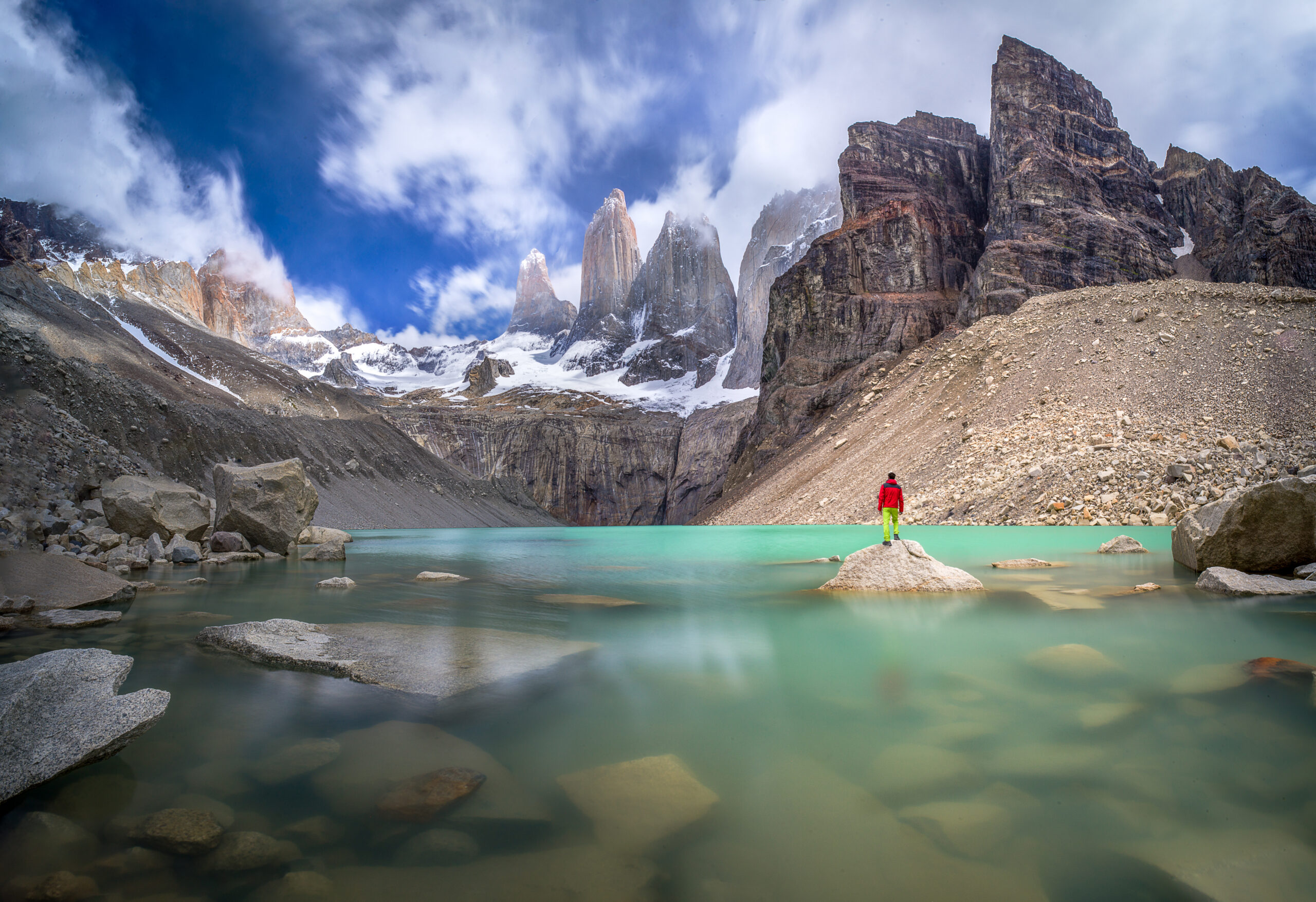
Patagonia Icons: Fitz Roy, Cerro Torre & the Granite Towers
A million square kilometres of ice, rock, and wind at the tail of the Americas — where the Andes fracture into granite spires that look designed for magazine covers. This is a guide to Patagonia’s iconic peaks: the Chaltén massif (Fitz Roy, Cerro Torre, the Agujas), the towers of Torres del Paine, the remote ice-field outliers, the history that made this the emotional capital of alpinism, and the wind-obsessed culture of waiting for weather windows.
There is a photograph every climber has seen of Cerro Fitz Roy at sunrise: a jagged black silhouette igniting in pink light against the indigo dawn. Most climbing destinations look good in that light. Patagonia is the only one where you’ll later realise the photograph undersold what it was like to stand there. This guide covers Patagonia in all its forms — the legendary granite towers of the Chaltén massif, the wind-carved walls of Torres del Paine, the Southern Patagonian Ice Field that connects them, and the small, patient village where climbers wait for the windows that define everything.
Why Patagonia Captures Climbers Like Nowhere Else
Climbing Patagonia is not like climbing anywhere else. Every other major region is defined by altitude, technical difficulty, or remoteness. Patagonia is defined by the weather — by the thousands of hours climbers spend in El Chaltén’s cafés watching forecasts, and by the fleeting 24-72 hour windows when the wind drops, the sky clears, and the whole social geography of the town shifts as climbers race to their base camps.
The mountains themselves are absurd. Fitz Roy is 3,405 m — a third the height of Everest — yet it rises from its glacial apron as a single monolithic granite slab nearly two vertical kilometres high. Cerro Torre next door is smaller still at 3,128 m, and yet its first confirmed ascent took until 1974 — more than two decades after Everest and Annapurna. Patagonia’s peaks humbled the best climbers of multiple generations not because they were high, but because they were impossible in ways altitude-climbing conventions never prepared anyone for. Success rates on the marquee objectives hover between roughly 1% and 15% in a given season – climbers return year after year not to tick a summit, but because the waiting is the experience.
“If I had to choose only one mountain area in the world to photograph, it would be Patagonia — I don’t know any place with comparable beauty.”
— Reinhold Messner, first to summit all 14 eight-thousanders. Reinhold Messner has called this the most beautiful mountain area in the world; Rolando Garibotti devoted a life and a 400-page guidebook, Patagonia Vertical, to documenting its routes.
📑 Contents
Understanding Patagonia’s Geography
Patagonia is a region, not a country – shared between Argentina (~930,000 km² on the dry eastern side) and Chile (~110,000 km² on the wet Pacific side), with the Andes forming the border down its spine. It runs from roughly 39° S to Tierra del Fuego, and its total area exceeds France, Germany, Italy, and the UK combined. For climbers, almost everything happens in the southern half, between about 47° and 51° S, where two great massifs rise — the Chaltén massif (Argentina) and the Paine Massif (Chile) — about 350 km apart across roadless wilderness and fjord.
The geographic heart is the Southern Patagonian Ice Field (Hielo Patagónico Sur), a single continuous ice sheet of ~12,363 km² – the third-largest contiguous ice mass on Earth after Antarctica and Greenland. It feeds Perito Moreno, Grey, Viedma, and Upsala glaciers, and Fitz Roy, Cerro Torre, and the Paine peaks all rise as rocky nunataks – islands of stone – from this ice. Stand at the base of any of them and you are standing on a glacier flowing out of a much larger body of ice.
Argentine Patagonia is dry, windblown steppe on the leeward side of the Andes – grasslands, guanacos, far horizons. Chilean Patagonia is wet temperate rainforest on the windward side – the westerlies dump their moisture on Chile before crossing the mountains dry. Climbers put it as “Argentina looks like Wyoming, Chile looks like British Columbia.” The peaks sit on the border, weather arrives from Chile and exits to Argentina – which is why windows are set by what happens over the Pacific.

The Three Climbing Regions of Patagonia
Climbing Patagonia breaks neatly into three regions, each with its own character and community. Almost every trip starts by choosing one – and a realistic two-week trip covers only one with any depth.
Chaltén Massif
Gateway: El Chaltén, Argentina
The spiritual centre of modern Patagonian climbing. Fitz Roy, Cerro Torre, Poincenot, and the Aguja group rise as one interconnected skyline above the village. More technical climbing and more climbing culture than anywhere else in South America – weather-window climbing at its most refined.
Torres del Paine
Gateway: Puerto Natales, Chile
The most-visited Patagonian destination – a national park built around three iconic granite spires and the massive Paine Massif. Far more trekkers than climbers (the W and O circuits draw tens of thousands a year); technical climbing on the Torres themselves is serious and less often attempted than Chaltén objectives.
Ice-Field Outliers
Gateway: Various remote
The peaks beyond the two centres – Monte San Valentín (Patagonia’s highest), Cerro San Lorenzo, Cerro Murallón, and the peaks of the Cordillera Darwin and Beagle Channel. Genuinely remote: boat approaches, aerial drops, multi-week expeditions, and almost no commercial guiding.
A two-week trip realistically covers one main region with depth. Climbers typically choose Chaltén; trekkers typically choose Torres del Paine; ambitious multi-month trips occasionally combine both. The remote ice-field peaks are for climbers who’ve already spent seasons in the region. Don’t try to do everything in ten days.
Patagonia’s Most Important Peaks & Destinations
The ten most significant climbing and trekking destinations in this guide. Difficulty uses the French alpine system (F easiest through ED+ hardest) for climbs, or a trekking grade for non-climbing destinations.
| # | Peak / Destination | Elevation | Country | Region | Type | Difficulty |
|---|---|---|---|---|---|---|
| 1 | Monte San Valentín | 4,058 m / 13,314 ft | Chile | N. Ice Field | Ice/Snow | Remote PD+ |
| 2 | Cerro San Lorenzo | 3,706 m / 12,159 ft | Arg/Chi | Outlying | Mixed | Remote D |
| 3 | Cerro Fitz Roy | 3,405 m / 11,171 ft | Argentina | Chaltén Massif | Granite | ED (Franco-Arg) |
| 4 | Cerro Torre | 3,128 m / 10,262 ft | Argentina | Chaltén Massif | Ice tower | ED+ (Ragni) |
| 5 | Aguja Poincenot | 3,002 m / 9,849 ft | Argentina | Chaltén Massif | Granite | ED |
| 6 | Torre Central (Paine) | 2,884 m / 9,462 ft | Chile | Torres del Paine | Granite | ED |
| 7 | Cerro Paine Grande | 2,884 m / 9,462 ft | Chile | Torres del Paine | Mixed | D to TD |
| 8 | Aguja Guillaumet | 2,579 m / 8,461 ft | Argentina | Chaltén Massif | Granite | AD to D |
| 9 | Torres del Paine O Circuit | 130 km trek | Chile | Torres del Paine | Trekking | Moderate |
| 10 | Torres del Paine W Circuit | 80 km trek | Chile | Torres del Paine | Trekking | Moderate |
The Chaltén Massif: Fitz Roy, Cerro Torre & the Agujas
The Chaltén massif is the beating heart of Patagonian climbing – a single connected skyline of granite spires above the village of El Chaltén, holding more iconic named peaks per square kilometre than anywhere on Earth. The main group (Fitz Roy, Poincenot, Saint-Exupéry, Mermoz, Guillaumet) and the Torre group (Cerro Torre, Torre Egger, Punta Herron, Cerro Standhardt) together make up what climbers mean by “the massif.” Every serious Patagonian climbing trip begins here.
Cerro Fitz Roy
Chaltén Massif · Los Glaciares NP · First ascent 1952 (Terray & Magnone)
The defining mountain of Patagonia – the silhouette on the clothing logo and the peak everyone pictures. Known locally as Chaltén (“smoking mountain” in Aonikenk), it was first summited on February 2, 1952 by Lionel Terray and Guido Magnone via the southeast face. Fitz Roy has no easy route: every line involves 1,500+ m of technical rock at 5.10 or harder, with ice, mixed ground, and committing position. Honnold and Caldwell’s 2014 Fitz Traverse – all seven massif summits in a five-day push – stands as one of the great modern alpine feats. Most who come spend 3-5 weeks waiting; the experience is its own reward.
Full Fitz Roy climb guide →Cerro Torre
Chaltén Massif · Torre Group · First confirmed ascent 1974 (Ferrari)
If Fitz Roy is the soul of Patagonia, Cerro Torre is its ghost story – a slender granite spike capped by a terrifying rime-ice mushroom, considered by many the most impossible-looking mountain on Earth. Cesare Maestri’s 1959 claim (with Toni Egger, who died on descent) is widely regarded as fabricated; his 1970 Compressor Route drilled 400+ bolts up the southeast ridge. The first accepted fair-means ascent came January 13, 1974 via the west face – 22 years after Fitz Roy. The modern Ragni route is a sustained ED+ ice climb to a summit mushroom so unstable it changes shape season to season. In 2012 Kennedy and Kruk removed 125 of Maestri’s bolts, restoring the line’s character.
Full Cerro Torre climb guide →Aguja Poincenot
Chaltén Massif · First ascent 1962 (Comesaña & Fonrouge)
Fitz Roy’s next-door obelisk, named for Jacques Poincenot, who drowned in 1952 attempting Fitz Roy. For climbers seeking a major Patagonian summit that is genuinely attainable rather than purely aspirational, Poincenot is often cited as the finest objective in the massif – the full Patagonian experience (granite, exposure, central position) at a grade that lets more parties actually summit than the harder lines on Fitz Roy or Cerro Torre. It’s also the third leg of the celebrated Fitz Traverse.
The Aguja Group: Guillaumet, Mermoz, Saint-Exupéry
Chaltén Massif · Named for French aviators · First ascents 1959-60s
The northern peaks – named for Aeropostale aviators Guillaumet, Mermoz, and Saint-Exupéry (later author of The Little Prince). Aguja Guillaumet is the easiest meaningful summit in the massif (Amy-Vidailhet, AD to D) and the classic “calibration climb” – a way to learn Patagonian rock, weather windows, and base-camp life before harder objectives. Mermoz and Saint-Exupéry are more serious (D to TD, sustained 5.10), popular second objectives. All three share the Piedras Blancas / Piedra del Fraile valley system, making multi-peak trips efficient.
Torres del Paine: Chile’s Crown Jewel
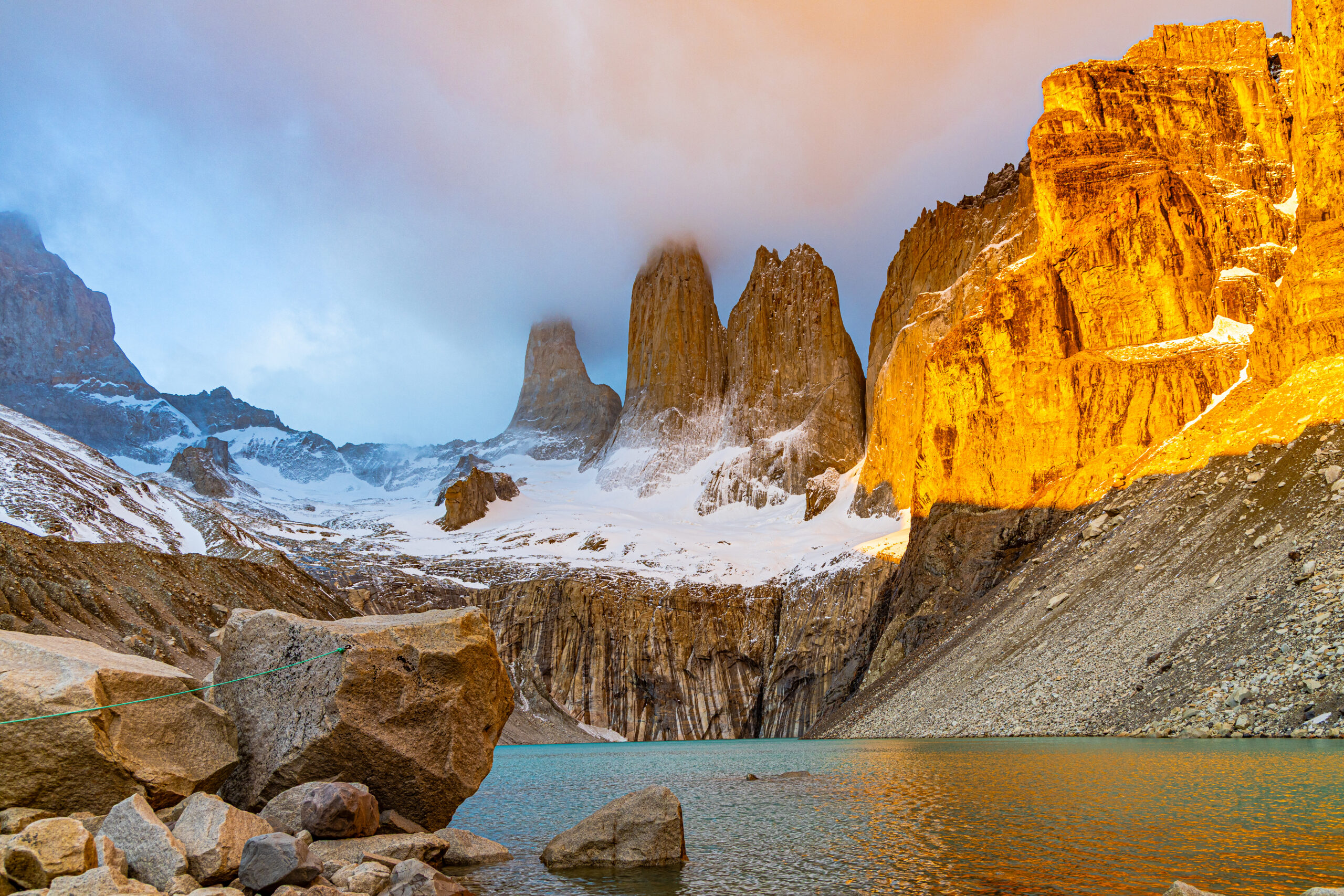
If the Chaltén massif is where climbers go, Torres del Paine is where everyone else goes. The Chilean national park (established 1959, a UNESCO Biosphere Reserve since 1978) is the most-visited destination in Patagonia, with roughly 300,000 annual visitors drawn by its three granite towers, the massive Paine Massif, and two of the most celebrated treks on Earth – the W and O circuits. For every serious climber on the technical peaks, there are perhaps 500 trekkers moving through the valleys.
The park’s defining feature is the Paine Massif – a compact concentration of peaks crowned by three vertical granite towers (las Torres) whose faces soar 1,200-1,500 m straight above the valley floor: Torre Sur (2,850 m), Torre Central (2,884 m), and Torre Norte (2,248 m). Behind them rise Paine Grande (the massif’s highest), the black-capped Cuernos del Paine (the “Horns”), and Cerro Almirante Nieto.
Climbing the Paine Towers
The Torres are serious technical objectives comparable to Fitz Roy, but less frequently climbed – the park bureaucracy is more complex, approaches are longer, and windows are harder to time from a commercial base. Torre Central‘s standard south-face route is graded ED; Torre Sur (first climbed 1963) remains demanding; Torre Norte is the shortest and moderately easier but still serious. Climbing here requires coordination with CONAF and longer approach commitments than Chaltén. For most visitors, though, Torres del Paine is a trekking destination.
W Circuit vs O Circuit
The W Circuit
Named for the W-shape across the park’s three valleys
The iconic Torres del Paine experience, hitting all three arms: the Base of the Towers viewpoint (the sunrise photo), the French Valley below the Cuernos, and the Grey Glacier terminus at the edge of the ice field. The right choice for visitors with 4-6 days who want the essentials. Campsites and refugios need advance reservations, booked 6+ months ahead for summer.
The O Circuit
The W plus the wild backcountry northern half
The O encompasses the entire Paine Massif – the W plus ~50 km of backcountry and the dramatic John Gardner Pass (1,200 m), with northern-face views most visitors never see. The backcountry is far quieter – some days you’ll walk hours without seeing another trekker. The serious trekker’s choice; only hiked counterclockwise (CONAF rule), and not recommended for first-time Patagonian trekkers.
Campsites are run by two concessioners (Vértice and Las Torres/Fantástico Sur) plus CONAF, and fill completely for summer dates 6-12 months ahead. Open reservations the moment they’re released (typically July-August for the following summer) and book campsites in sequence along your route. Park entry runs roughly US$35-50 depending on season. Full day-by-day logistics are in our Torres del Paine guide and Glacier Grey hike & catamaran guide.
Beyond Chaltén & Paine: The Remote Peaks
For climbers who’ve done the main centres – or who want away from them – Patagonia’s outlying peaks offer some of the most genuinely remote climbing on Earth, with a fraction of the attention and far more complex logistics.
- Monte San Valentín (4,058 m) – the highest peak in all of Patagonia, yet little known. A remote ice-field expedition near Laguna San Rafael, hard mainly for its isolation; first climbed 1952, only a handful of summits a year.
- Cerro San Lorenzo (3,706 m) – taller than Fitz Roy, more technical than San Valentín, and far more remote. Its south face is one of the great challenges in Patagonia.
- Cerro Murallón (2,831 m) – one of the most beautiful big-wall objectives in Patagonia, rising from the edge of the Southern Ice Field; many faces remain unclimbed or rarely attempted.
- Cordillera Darwin (Tierra del Fuego) – Monte Sarmiento (2,404 m), Monte Darwin, and peaks rising from the Beagle Channel; boat access only, weather worse than the mainland, successful summits rare. The far end of committed mountaineering.
The Wind: Patagonia’s Defining Challenge
Climbers new to Patagonia expect the challenge to be technical – the granite, the ice, the cold. They learn fast that the challenge is the wind. Nowhere else organises an entire climbing culture around windspeed forecasts; nowhere else do experienced alpinists spend three weeks in a village watching weather apps and leave without climbing, counting the trip a success because they made good decisions.
Patagonia sits squarely in the Roaring Forties and Furious Fifties, with almost no land between it and Antarctica to slow the westerlies. Storms slam in from the Pacific, dump moisture on Chile, and emerge onto the Argentine steppe carrying ferocious wind:
- Sustained 80-100 km/h is normal in the Chaltén massif during the climbing season.
- Gusts exceeding 150 km/h occur regularly on exposed ridges and summits.
- Wind chill at -10°C with 100 km/h wind yields effective temperatures around -35°C.
- Climbing above ~60 km/h becomes physically dangerous – climbers can be blown off stances and ropes become unmanageable.
So most Patagonian climbing happens in weather windows: narrow 24-72 hour periods when wind drops below ~40 km/h and precipitation is absent. They might arrive once a week, once a month, or not at all in a given trip.
Best Time & Weather Windows
The climbing season is the austral summer, December to February, with the most stable weather, the longest days, and the best chance of a window. Even then, success is weather-bound and patience is the core skill – climbers base themselves in El Chaltén (or Puerto Natales for Paine) and move the moment the forecast aligns. For a full month-by-month breakdown of weather, daylight, crowds, and prices across both countries, see our best time to visit Patagonia guide.
See Them Without Climbing
You don’t have to be a climber to stand beneath these peaks – the most famous views are day hikes and treks:
- Fitz Roy: the Laguna de los Tres hike from El Chaltén – the classic viewpoint.
- The Paine towers: the Base of the Towers hike, and the W and O treks.
- Grey Glacier & the ice field: the Glacier Grey hike & catamaran guide.
- Choosing between the giants: our Fitz Roy vs Cerro Torre comparison.
What We Don’t Know
This is research-based. Patagonia’s icons are expert technical objectives our team has not climbed; this guide synthesises the regional literature, first-ascent records, and current climbing reports rather than personal summit experience – we flag that openly.
Grades, success rates, and even summit heights carry uncertainty. Patagonian success rates are estimates that swing wildly with weather; Cerro Torre’s summit mushroom has even been measured at different heights by different parties. Park fees, reservation rules, and access change yearly – verify before any trip.
Methodology & Sources
How This Collection Was Built
Sources
Built from the definitive regional climbing literature (including Rolando Garibotti’s Patagonia Vertical and the Pataclimb record), documented first-ascent histories, CONAF and Los Glaciares National Park information, the park concessioners, and current climbing and trekking reports. Quotations from public figures are genuine and attributed.
Honesty on the Numbers
Elevations follow standard references; grades use the French alpine system; success rates are season-dependent estimates from the climbing record. Where figures are contested (summit heights, success rates), we say so.
Independence
Independent editorial, no paid placements and no affiliate links on this page. Reviewed seasonally as our Patagonia coverage expands.
Frequently Asked Questions
What are Patagonia’s most famous peaks?
The icons are Cerro Fitz Roy (3,405 m) and Cerro Torre (3,128 m) in the Chaltén massif (Argentina), and the three granite Torres of Torres del Paine (Chile). Around them are Aguja Poincenot, the Aguja group (Guillaumet, Mermoz, Saint-Exupéry), Cerro Paine Grande, and remote outliers like Monte San Valentín – Patagonia’s highest at 4,058 m – and Cerro San Lorenzo.
How tall is Fitz Roy and is it hard to climb?
Fitz Roy is 3,405 m – modest in height, but it rises as a granite slab nearly two vertical kilometres high. It’s extremely hard: every route involves 1,500+ m of technical rock at 5.10 or harder, and the standard Franco-Argentine route is graded ED, among the hardest standard routes on any major mountain. Success runs ~5-15% a season, and most climbers spend 3-5 weeks waiting for a window, often never climbing.
Why is Cerro Torre considered one of the hardest peaks on Earth?
It’s a slender 3,128 m granite spike topped by an unstable rime-ice mushroom, in a region defined by ferocious wind. Its first fair-means ascent came only in 1974 – 22 years after Fitz Roy – and the standard Ragni route is a sustained ED+ ice climb with a vertical crux and a mushroom that changes shape each season. Maestri’s 1959 claim is widely regarded as fabricated. Success runs ~1-5%.
Can a beginner climb Fitz Roy or Cerro Torre?
No – both are expert-only (ED and ED+), needing advanced rock, ice, and mixed skills and big-wall experience. Strong climbers seeking a first Patagonian summit usually start with Aguja Guillaumet (AD to D), the accessible calibration peak, then progress toward Poincenot. To experience the peaks without technical climbing, trek to the viewpoints instead.
Do you have to be a climber to see Fitz Roy and Cerro Torre?
No – the famous views are reachable on foot. From El Chaltén, the Laguna de los Tres day hike gives the classic Fitz Roy viewpoint and Laguna Torre the Cerro Torre view; in Chile, the Base of the Towers hike and the W and O treks bring you under the Paine towers and to Grey Glacier. Most visitors to the icons are trekkers, not climbers.
What’s the difference between the Chaltén massif and Torres del Paine?
Chaltén (Argentina, gateway El Chaltén) is the technical-climbing heart – Fitz Roy, Cerro Torre, the Agujas – with the deepest climbing culture in South America. Torres del Paine (Chile, gateway Puerto Natales) is the most-visited destination, built around the three Paine towers and the W and O treks, with far more trekkers than climbers. They’re ~350 km apart, so most trips focus on one.
When is the best time to climb in Patagonia?
The austral summer, December to February, for the most stable weather and longest days. Even then, climbing happens in narrow 24-72 hour windows when wind drops below ~40 km/h – windows that may come once a week, once a month, or not at all. See our best time to visit Patagonia guide for the full month-by-month picture.
Why is the wind such a big deal in Patagonia?
Patagonia sits in the Roaring Forties and Furious Fifties, with almost nothing between it and Antarctica to slow the westerlies. Sustained 80-100 km/h is normal in season and gusts can top 150 km/h – enough to blow climbers off stances and make ropes unmanageable. Climbing above ~60 km/h is dangerous, which is why the whole culture revolves around waiting for calm windows.
About the Author
Explore Patagonia
The Granite Capital of Alpinism
Patagonia can’t be summarised in a listicle – you either understand what this place is or you don’t, and understanding it takes time. Whether you come to attempt Fitz Roy, to trek beneath the Paine towers, or just to stand in that dawn light, the region rewards patience above all. Pick one region, respect the wind, and let the weather windows set the pace.
Fitz Roy vs Cerro Torre →Best Time to Visit →


Was this helpful?
🏔Peaks in this region
🧭Explore & compare
Global Summit Guide is an independent mountaineering resource founded in 2026. The team combines first-hand trekking and climbing experience with in-depth research and professional health and nutrition review to help climbers choose objectives, prepare properly, and stay safe.
Health, altitude, and nutrition content is reviewed by Taylor Ludlow (Registered Nurse) and Brigg Hoopes (Nutritionist).
What We Don't Know Yet
Mountain information changes quickly. This box explains the limits of what this page can responsibly promise.
- Weather, snowpack, avalanche risk, road access, and route conditions can change quickly and may be different on your climbing dates.
- Route conditions, trailhead access, crevasse exposure, stream crossings, and rescue access may vary from published planning guidance.
- Route conditions, snowpack, closures, and weather can change quickly after this page is updated.
- Permit rules, fees, quotas, and reservation windows may change between review cycles.
- Operator availability, pricing, guide ratios, and cancellation terms can change by season.
Verify current conditions with official land managers, guide services, local forecasts, and current route reports before booking or climbing.
Mountaineering, rock and ice climbing, glacier travel, and high-altitude activity are inherently dangerous and can result in serious injury or death. The information on Global Summit Guide is provided for general informational and educational purposes only and is not a substitute for professional instruction, qualified guiding, proper equipment, or your own judgment and experience.
Route conditions, weather, snowpack, permits, regulations, and hazards change constantly and may differ from what is described here. Details may be incomplete, out of date, or contain errors. Always verify current information with local authorities, certified guides, and official sources before making any decision in the mountains.
Nothing on this site is medical, legal, or financial advice. Our fitness, acclimatization, altitude, and nutrition content is general in nature; consult a qualified physician before beginning any strenuous exercise program or exposing yourself to high altitude.
You are solely responsible for your own safety and decisions. To the fullest extent permitted by law, Global Summit Guide and its team accept no liability for any loss, injury, damage, or expense arising from use of, or reliance on, this information. By using this site you acknowledge these risks and accept these terms.
Some links on this site may be affiliate links. If you buy through them we may earn a small commission at no extra cost to you; this never affects our recommendations.
Global Summit Guide recommendation path
Next Best Mountain to Research
Use these recommendations to continue the right planning path instead of stopping on one page.
Use current permit, weather, route, and operator information before booking or climbing.