
Last updated June 28, 2026
Fitz Roy / Cerro Chaltén Guide: How to Hike to Laguna de los Tres from El Chaltén, the Fitz Roy vs Cerro Torre Comparison & How Climbers Reach the 3,405m Granite Summit (2026)
Fitz Roy — properly Cerro Chaltén, “Smoking Mountain” in the Tehuelche language — is one of Patagonia’s most iconic mountains. The 3,405m granite tower on the Argentina-Chile border attracts 50,000+ annual trekkers to the village of El Chaltén for the legendary Laguna de los Tres day hike, while the actual summit is climbed only 30-50 times per year via technical alpine routes including the historic 1952 Franco-Argentine line. This guide covers everything: the iconic 20 km Laguna de los Tres hike, the El Chaltén staging town logistics, the Fitz Roy vs Cerro Torre comparison, the Tehuelche heritage, the Patagonia clothing brand connection, and how the small audience of qualified alpinists actually climbs this mountain.
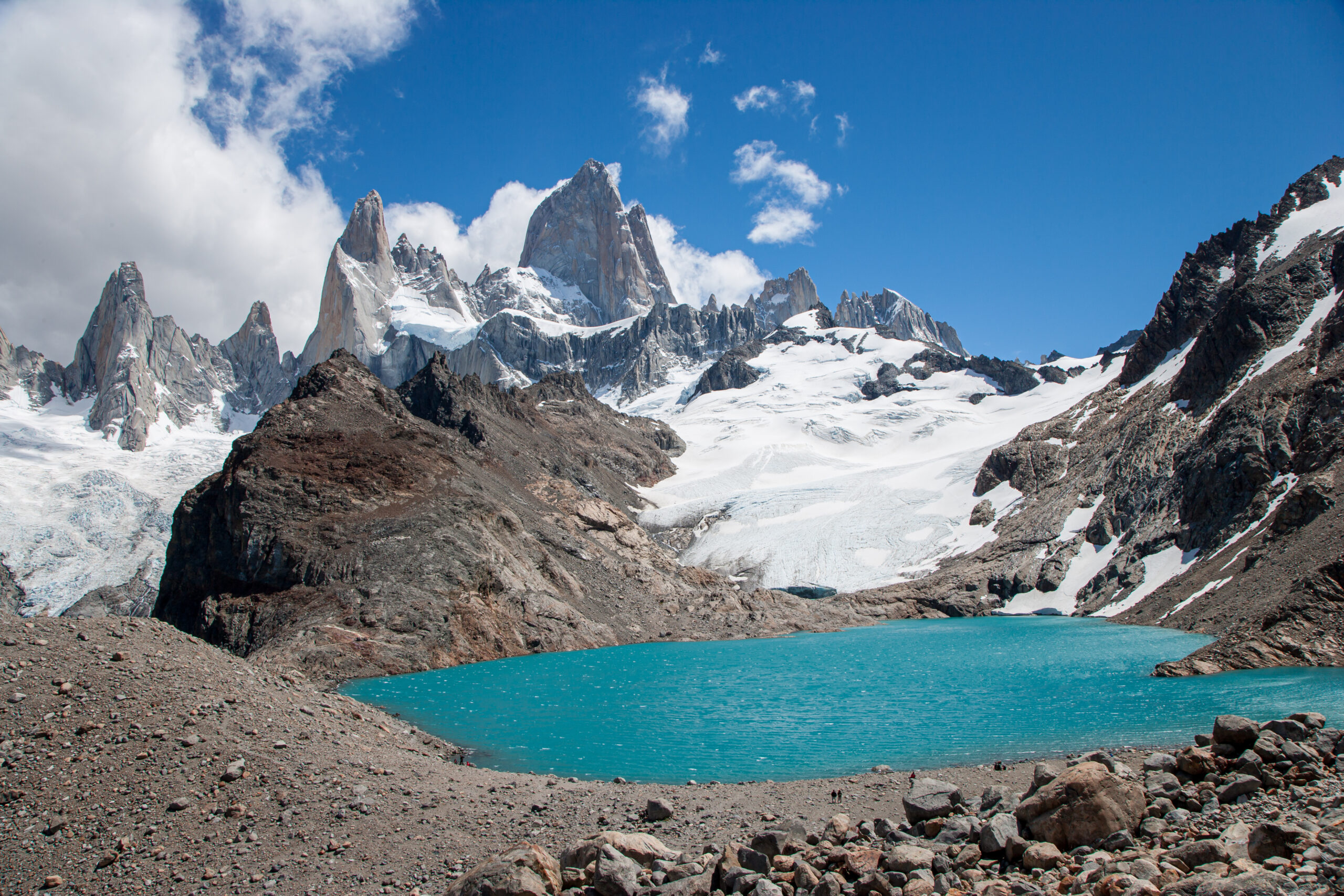
Los Glaciares National Park. Fitz Roy sits within Los Glaciares National Park (Parque Nacional Los Glaciares) — one of Argentina’s most important protected areas, established 11 May 1937 covering approximately 726,927 hectares / 7,269 km² / 2,807 mi². The park was designated a UNESCO World Heritage Site in 1981 for its exceptional geological and ecological significance — including 47 major glaciers (with the Patagonian Ice Field being the third-largest ice mass on Earth after Antarctica and Greenland), the Perito Moreno Glacier (in the southern park sector), and the Fitz Roy and Cerro Torre massifs (in the northern park sector). The park is divided into two main zones: the southern zone accessed via El Calafate (Perito Moreno Glacier focus) and the northern zone accessed via El Chaltén (Fitz Roy and Cerro Torre focus). Park entrance fee for the northern (El Chaltén) zone: $35-$45 USD (online booking required as of 2025+). Approximately 800,000+ annual park visitors across both zones combined; the El Chaltén zone alone receives 50,000-100,000+ trekkers annually.
The History of Cerro Chaltén / Fitz Roy
Fitz Roy rises 3,405 meters (11,171 feet) above the surrounding Patagonian steppe — substantially shorter than the Andean giants of Ecuador, Peru, or Argentina-Chile’s northern Andes, but defined by something else entirely: sheer granite faces, sustained difficulty, and Patagonia’s notorious weather. The mountain is a granite massif (not a volcano) formed by the uplift and erosion of the Patagonian Batholith — a vast body of granite intruded approximately 100 million years ago. Subsequent glaciation over the past 2 million years carved the dramatic spire shape that defines the mountain today, with the surrounding glaciers (including the Marconi, Río Blanco, and Torre glaciers) continuing to shape the massif into the present.
The mountain sits on the Argentina-Chile border, with the actual political boundary running through the summit ridge. The Argentine side (where El Chaltén and Los Glaciares National Park are located) is the standard access point — Argentina has developed the trekking and climbing infrastructure that virtually all visitors use. The Chilean side faces the Southern Patagonian Ice Field, accessible only via difficult multi-week expeditions. The province of Santa Cruz, Argentina features Fitz Roy on its provincial coat of arms.
Cerro Chaltén — The Smoking Mountain. Before any European explorer reached southern Patagonia, the mountain had its name. The Tehuelche (also called Aonikenk) — the Indigenous inhabitants of southern Patagonia — called the mountain Chaltén, meaning “Smoking Mountain” in their language. The name refers to the near-constant cloud and storm activity that wraps the summit, which the Tehuelche people interpreted as smoke from a powerful living mountain (despite Fitz Roy being a granite peak, not a volcano). The cloud-wrapping pattern is so consistent that even modern visitors often spend days in El Chaltén without ever seeing the full mountain — the “Fitz Roy reveal” during a clear weather window is the standard goal of multi-day visits.
The Tehuelche/Aonikenk people inhabited southern Patagonia for at least 12,000-14,000 years before European arrival, with substantial populations across what is now southern Argentina and Chile. The Spanish colonial era brought disease, displacement, and conflict; by the late 19th century the Tehuelche population had collapsed to a few hundred people. Today, the Tehuelche/Aonikenk language is critically endangered with fewer than 5 native speakers remaining as of 2020s estimates. The Cerro Chaltén name represents one of the most prominent ongoing uses of the Tehuelche language in modern Patagonian geography. Argentine official usage increasingly designates the mountain as Cerro Chaltén alongside Fitz Roy — particularly on provincial maps, in Argentine climbing literature, and in cultural heritage contexts. The town of El Chaltén (founded 1985) takes its name directly from this Tehuelche term.
1520: Magellan and the First European Contact
Ferdinand Magellan’s 1519-1522 expedition sailed through what is now the Strait of Magellan (south of the modern Fitz Roy region) on its 1520 passage. The Tehuelche/Aonikenk people had their first sustained contact with Europeans during this period. Spanish records from the 16th-17th centuries reference Patagonian mountains but with limited geographic specificity — the difficult terrain and Indigenous resistance prevented systematic Spanish exploration of the southern Patagonian interior for over 300 years.
1834: Robert FitzRoy and HMS Beagle
The British captain Robert FitzRoy (1805-1865) commanded HMS Beagle on its famous 1831-1836 voyage with Charles Darwin aboard. FitzRoy mapped substantial portions of the Patagonian coast and led the Beagle through the Strait of Magellan in 1834. FitzRoy never saw the mountain that would later bear his name — the Beagle’s coastal mapping did not extend into the interior glaciated regions — but his naval contributions to South American hydrography were substantial enough that the Argentine explorer Francisco Moreno later named the peak in his honor.
1877: The “Fitz Roy” Name Bestowed
Argentine explorer Francisco Pascasio Moreno (1852-1919), known as “Perito Moreno,” led an expedition into the Patagonian interior in 1877 and gave the mountain its modern non-Indigenous name in honor of Robert FitzRoy. Moreno’s choice reflected the 19th-century scientific networks connecting Argentine, British, and broader European geographic communities — the Beagle voyage was a touchstone of South American scientific exploration. Moreno made fundamental contributions to Argentine geography and would later donate substantial land that became part of the foundational protected areas of Argentine Patagonia. The Perito Moreno Glacier (in the southern Los Glaciares park sector) is also named for him.
1900s-1940s: First Attempts and Failed Expeditions
The first serious mountaineering interest in Fitz Roy emerged in the 1930s as European alpinism expanded into South America. Multiple expeditions in the 1930s-1940s attempted Fitz Roy without success. The mountain’s combination of technical granite climbing, notorious weather, and difficult approach made it a “last great problem” of South American alpinism by mid-century. The Argentine and Chilean climbing communities developed substantial expertise in Patagonian conditions during this period, but the technical challenge of Fitz Roy itself remained beyond the capacity of available climbing methods.
2 February 1952: Lionel Terray and Guido Magnone First Ascent
The first ascent of Fitz Roy was achieved on 2 February 1952 by French alpinists Lionel Terray (1921-1965) and Guido Magnone (1917-2012) via the southeast face — now called the Franco-Argentine Route (also Ruta Francesa or Franco Route). The ascent was part of a French expedition led by Magnone that had been attempting the mountain since 1949. The summit climb took 6 days from the base camp, with sustained technical climbing through cracks, dihedrals, and ice-mixed terrain in classic Patagonian conditions.
The achievement was substantial in the broader context of 1950s alpinism. Lionel Terray was already one of France’s most celebrated mountaineers — he had been part of Maurice Herzog’s 1950 Annapurna expedition that made the first ascent of any 8,000m peak. Adding Fitz Roy to his record cemented Terray’s status as one of the era’s greatest alpinists; he would go on to climb Makalu (1955, first ascent), Chacraraju (1956), and many other major peaks. Guido Magnone (Italian-born, French-naturalized) had built his reputation on demanding Alpine ascents including the West Face of the Dru. The Terray-Magnone climb established Patagonia as a serious alpinist destination and the Franco-Argentine Route as the standard line — both characterizations that remain accurate in 2026.
The mountain’s difficulty proved so substantial that no second ascent was made until 1965 — a 13-year gap that reflected both Patagonian access difficulties and the genuine challenge of the climbing itself. In an era when Mount Everest had been climbed multiple times and Annapurna had seen sustained activity, Fitz Roy remained an objective for only the most committed alpinists.
The Patagonia Clothing Brand Connection
Few mountains in the world have a comparable corporate identity association. The Patagonia outdoor clothing company — founded 1973 by climber Yvon Chouinard — uses a stylized silhouette of Fitz Roy as its corporate logo, making the mountain’s skyline one of the most globally recognized outdoor industry marks. The connection is real and worth understanding for anyone planning a Fitz Roy visit.
How the Patagonia logo came to be. Yvon Chouinard (born 1938) — climber, blacksmith, and founder of Patagonia, Inc. — visited Fitz Roy in 1968 as part of the legendary “Fun Hogs” expedition. The expedition, a 4-month road trip from Ventura, California to El Chaltén with climbing friends Doug Tompkins, Dick Dorworth, Lito Tejada-Flores, Chris Jones, and Tompkins’ associates, made the third ascent of Fitz Roy via the southwest ridge (now called the California Route). The trip was documented in the influential 1968 documentary “Mountain of Storms” — which captured both the climbing itself and the surrounding Patagonian wilderness in a way that profoundly influenced 1970s outdoor culture.
Chouinard founded the Patagonia clothing company in 1973 (initially as a spinoff from his Chouinard Equipment hardware company). The brand name and the Fitz Roy silhouette logo were direct references to the 1968 expedition and Chouinard’s broader connection to Patagonian alpinism. The logo as designed shows the distinctive skyline of the Fitz Roy massif as viewed from the eastern approach near El Chaltén — the same view that any modern Laguna de los Tres trekker sees from the final viewpoint. Over the decades since, Patagonia has grown into a $1.5+ billion outdoor apparel company, with the Fitz Roy silhouette becoming one of the most recognized outdoor brand marks globally.
The criticism — commercialization vs heritage. The Patagonia brand’s commercial success has created a substantial irony: many millions of people worldwide recognize the Fitz Roy silhouette as the Patagonia logo without knowing it represents a specific Indigenous-named mountain in Argentina. Some El Chaltén locals and Argentine cultural commentators have noted that the brand’s commercialization of Cerro Chaltén obscures the mountain’s Tehuelche heritage and reduces a sacred Indigenous landmark to a corporate emblem. The Patagonia brand has responded periodically with cultural sensitivity programs and Indigenous-focused giving, but the fundamental tension between corporate identity and Indigenous heritage remains. For SEO purposes — and for anyone researching Fitz Roy: searches for “Patagonia logo” return Patagonia clothing brand pages by definition. The mountain has its own distinct identity that this guide focuses on, separate from the apparel brand that shares its silhouette.
Fitz Roy vs Cerro Torre: Patagonia’s Two Iconic Granite Spires
Fitz Roy and Cerro Torre are the two most iconic granite peaks of southern Patagonia, located approximately 10 km apart in Los Glaciares National Park near El Chaltén. The two mountains are often compared but rarely understood properly — most travel content treats them as interchangeable “Patagonian granite spires,” but they are genuinely different mountains representing different climbing achievements and trekking experiences. Here’s the honest comparison.
The full Fitz Roy vs Cerro Torre comparison.
| Dimension | Fitz Roy | Cerro Torre |
|---|---|---|
| Elevation | 3,405 m (11,171 ft) — taller | 3,128 m (10,262 ft) |
| Indigenous name | Cerro Chaltén (“Smoking Mountain”) | Torre (“Tower” — Spanish, no Indigenous-language equivalent in widespread use) |
| Mountain type | Granite massif with multiple summits | Single granite spire with ice mushroom summit cap |
| Technical difficulty | High — sustained 5.10+ alpine granite | Higher — sheerer walls, sustained 5.11+, ice mushroom summit |
| First ascent | 2 February 1952 — Terray & Magnone (verified) | Contested — Maestri 1959 (disputed) or Ferrari 1974 (verified) |
| Standard route grade | Franco-Argentine: 650m 6a+ / 6c A1 | Compressor Route: 1,200m 6a+ A2 (now without bolts after 2012 chopping) |
| Annual summits | 30-50 | 10-20 |
| Famous trekking destination | Laguna de los Tres (20 km RT day hike) | Laguna Torre (18 km RT day hike) |
| Trekking difficulty | Harder — 400m steep final ascent | Easier — flatter approach, no steep final climb |
| Visible from El Chaltén | Yes — dominates the skyline | Yes — to the west of Fitz Roy |
| Famous controversy | Tommy Caldwell-Alex Honnold 2014 traverse | Cesare Maestri’s disputed 1959 claim, 2012 Compressor Route bolt removal |
| Cultural status | Patagonia clothing brand logo; Santa Cruz Province coat of arms | “Hardest mountain to climb” reputation in mountaineering circles |
| Best trekking destination if you can do only one | Laguna de los Tres (the iconic Patagonia view) | Laguna Torre (substantially less crowded, equally beautiful) |
The honest take. For trekkers, both day hikes are exceptional — the Laguna de los Tres is the more iconic and crowded, the Laguna Torre is somewhat easier and substantially less crowded. Most El Chaltén visitors do both within a 3-4 day stay; serious trekkers add the 4-day Huemul Circuit and the Loma del Pliegue Tumbado day hike. For climbers, Cerro Torre is generally considered the harder objective — its sheer granite walls, sustained difficulty, and ice mushroom summit make it one of the world’s most technically demanding accessible mountains. Fitz Roy is the more achievable climbing objective (still highly demanding) and the more visited by guided climbing parties. The mountains are often summited together in the famous “Fitz Traverse” — the Tommy Caldwell-Alex Honnold February 2014 first ascent of the full ridge traverse from Aguja Guillaumet through Fitz Roy is one of modern alpinism’s landmark achievements, though it doesn’t include Cerro Torre itself.
What Makes Fitz Roy Different from Every Other Major Mountain
Fitz Roy doesn’t fit the standard “high mountain” framing that defines most of the rebuilds in this series. Cotopaxi and Chimborazo are accessible glaciated summits in the 5,000-6,000m range; Mauna Kea and Mauna Loa are massive volcanic peaks with cultural depth; the Cascades and Alps are well-developed climbing destinations. Fitz Roy is something else: a 3,405m granite spire that is one of the world’s hardest technical climbs despite a “modest” elevation, surrounded by one of the world’s premier trekking destinations. The mountain’s identity is split between two completely different audiences who almost never overlap.
What sets Fitz Roy structurally apart:
- Difficulty is about technical climbing, not altitude. Unlike Aconcagua (6,961m, ~60% success on a non-technical scramble) or Chimborazo (6,263m, ~40-60% success on moderate glacier), Fitz Roy at 3,405m has approximately 1-5% success per attempt on its easiest route. The difficulty is sustained 5.10+ alpine granite climbing, not altitude. Climbers who summit Fitz Roy are technical alpinists; climbers who summit Aconcagua may be ordinary fit hikers. The mountains demand fundamentally different preparation and skill sets.
- The dual audience — trekkers vs climbers. Roughly 50,000+ annual trekkers reach the Laguna de los Tres viewpoint at the base of Fitz Roy; 30-50 climbers per year reach the summit. The trekker-to-climber ratio is approximately 1,000:1 — among the most extreme of any famous mountain in the world. Both experiences are legitimate and substantive: the trekking experience captures Fitz Roy as a photographic and cultural icon; the climbing experience treats it as a serious alpine objective. Most mountain guides separate these audiences entirely.
- Patagonian weather is the dominant factor, not technical skill. Successful Fitz Roy climbs typically require waiting in El Chaltén for 1-3 week weather windows. The famous Patagonian winds (sustained 100+ km/h common in summer; gusts to 200+ km/h documented) create unclimbable conditions even on technically sunny days. Climbers with capability for the technical climbing routinely fail attempts because no acceptable weather window appears during their available trip days. The mountain’s success rates aren’t determined by the climbers — they’re determined by Patagonian meteorology.
- The Patagonia clothing brand association is unique. No other mountain has comparable corporate identity — Fitz Roy’s silhouette is one of the most globally recognized brand marks. This creates both opportunities (international name recognition) and challenges (commercial obscuring of Indigenous heritage).
- The Cerro Chaltén Indigenous heritage is genuinely active. Unlike many “discovered by Europeans” peaks, Cerro Chaltén’s Indigenous Tehuelche name has been adopted into official Argentine usage and increasingly into international literature. The dual-naming (Fitz Roy / Cerro Chaltén) is genuinely meaningful rather than tokenistic, and reflects ongoing efforts to honor the Indigenous peoples whose name for the mountain predated all European contact by thousands of years.
- The town of El Chaltén exists specifically because of border politics. El Chaltén was founded in 1985 — specifically to assert Argentine sovereignty over a disputed border region with Chile. The town’s existence and population growth is therefore tied to Argentine national policy, not natural settlement patterns. The 3,000-resident town hosting 50,000-100,000+ annual trekkers is a deliberately created tourism infrastructure, not an organic mountain village.
- Approximately 0% of typical “climbing tourists” attempt Fitz Roy. This is unlike Cotopaxi (climbed by ordinary travelers as a 2-day trip), Kilimanjaro (climbed by 50,000 non-climbers annually), or even Aconcagua (climbed by fit but not technical hikers). Fitz Roy climbing requires substantial multi-pitch trad climbing experience, alpine training, and the patience to wait weeks for weather windows. The mountain is genuinely “expert only” for climbing while being “anyone with leg fitness” for trekking — an unusual structural combination.
Where Fitz Roy fits in mountaineering ambitions. For climbers, Fitz Roy is a major life-list objective alongside Cerro Torre, Mount Robson, the Eiger North Face, and other technical Patagonian / European objectives. Climbers attempting Fitz Roy should already have substantial alpine climbing experience (Alps, Wind Rivers, Canadian Rockies), multi-pitch trad experience to 5.10+, alpine ice and mixed climbing competence, and the patience for weather-window waiting. For trekkers, the Laguna de los Tres day hike is one of the world’s most iconic mountain views — comparable in significance to Everest Base Camp, the Annapurna Sanctuary, or the Cape Horn lighthouse. As preparation for harder Patagonian objectives (Cerro Torre, Torres del Paine technical routes), Fitz Roy is the natural training peak.
Fitz Roy Historical Timeline
The granite that forms Fitz Roy is intruded into the Earth’s crust as part of the Patagonian Batholith during the Cretaceous period. The granite cools slowly underground over millions of years.
Pleistocene glaciation carves the dramatic spire shape of modern Fitz Roy. The surrounding glaciers (Marconi, Río Blanco, Torre) shape the granite into the towers and faces visible today.
The Tehuelche (Aonikenk) people establish themselves as the Indigenous inhabitants of southern Patagonia. The mountain becomes known as Chaltén — “Smoking Mountain” — in their language, named for the near-constant cloud activity wrapping the summit.
Ferdinand Magellan’s 1519-1522 expedition passes through what is now the Strait of Magellan south of the modern Fitz Roy region. The Tehuelche people have their first sustained contact with Europeans during this period.
British naval captain Robert FitzRoy commands HMS Beagle through the Strait of Magellan during the famous 1831-1836 voyage with Charles Darwin aboard. FitzRoy never sees the mountain that will later bear his name, but his hydrographic work in Patagonia is substantial.
Argentine explorer Francisco Pascasio Moreno (“Perito Moreno”) leads an expedition into the Patagonian interior and names the mountain in honor of Robert FitzRoy. The Cerro Chaltén Tehuelche name remains in use among Indigenous and Argentine cultural communities, but “Fitz Roy” becomes the dominant non-Indigenous name internationally.
European alpinism expands into South America, with the first serious mountaineering interest in Fitz Roy emerging in the 1930s. Multiple expeditions attempt the peak without success. The mountain develops a reputation as a “last great problem” of South American alpinism.
The Argentine government establishes Los Glaciares National Park, formally protecting the Fitz Roy and Cerro Torre massifs alongside the Perito Moreno Glacier and the broader Patagonian Ice Field. The park initially covers approximately 600,000 hectares.
French alpinists Lionel Terray and Guido Magnone make the first verified ascent of Fitz Roy via the southeast face (now the Franco-Argentine Route). Terray, already famous from Annapurna 1950, becomes one of the era’s most decorated alpinists. The climb takes 6 days from base camp.
Italian alpinist Cesare Maestri claims first ascent of neighboring Cerro Torre with Toni Egger (who dies in the descent). The claim is disputed for decades and is now widely considered untrue — the surviving photographic evidence does not support a summit. Maestri’s controversial 1959 “ascent” remains one of the most famous disputes in mountaineering history.
Argentine climbers Carlos Comesaña and José Luis Fonrouge make the second ascent of Fitz Roy via the Supercanaleta — the long ice gully and rock route on the west side. The route becomes one of Fitz Roy’s classic alpine objectives. The 13-year gap between first and second ascents reflects the genuine difficulty of the mountain.
Yvon Chouinard, Doug Tompkins, Dick Dorworth, Lito Tejada-Flores, and Chris Jones make the third ascent of Fitz Roy via the southwest ridge (California Route). The expedition is documented in “Mountain of Storms” and directly leads to Chouinard’s 1973 founding of the Patagonia clothing company with the Fitz Roy silhouette as its logo.
Italian climbers Casimiro Ferrari, Daniele Chiappa, Mario Conti, and Pino Negri make the first verified ascent of Cerro Torre via the West Face. The 1974 ascent is widely considered the first verified Cerro Torre summit, definitively superseding the disputed Maestri 1959 claim.
French climbers establish the Afanassieff Route on the northwest ridge — a 1,550m route that becomes one of Fitz Roy’s classic alpine challenges. The route remains one of the longest sustained climbs on the mountain.
Los Glaciares National Park is designated a UNESCO World Heritage Site for its exceptional geological and ecological significance — including the Patagonian Ice Field, Perito Moreno Glacier, and the Fitz Roy / Cerro Torre massifs.
The village of El Chaltén is founded by Argentine government policy specifically to assert sovereignty over the disputed Argentina-Chile border region. The town is positioned at the base of Fitz Roy and Cerro Torre, with population initially under 100. The deliberate creation of El Chaltén transforms Fitz Roy access from expedition-only to day-trip accessible.
El Chaltén grows from a few hundred residents to several thousand as international trekking tourism develops. The Laguna de los Tres hike becomes one of South America’s most-visited trekking destinations. Annual trekker visitation grows from approximately 10,000 in 1995 to 50,000+ by 2015.
American climbers Hayden Kennedy and Jason Kruk make a clean ascent of Cerro Torre’s Compressor Route and remove approximately 120 bolts that Cesare Maestri had drilled during his 1970 “Compressor Route” ascent. The act sparks substantial controversy in international climbing circles about climbing ethics and route preservation.
Tommy Caldwell and Alex Honnold complete the first ascent of the full Fitz Traverse — a multi-day continuous traverse of seven summits including Aguja Guillaumet, Mermoz, Fitz Roy, Poincenot, and others. The route covers approximately 4,000m of climbing with multi-pitch difficulties to 5.11+, making it one of modern alpinism’s landmark achievements.
Los Glaciares National Park implements mandatory online entry booking for the El Chaltén zone, with entry fees of $35-$45 USD per visitor (varies by season). The system replaces the previous on-site purchase model and is intended to manage the growing visitor pressure on park infrastructure.
El Chaltén continues to receive 50,000-100,000+ annual trekkers during the November-March season. Fitz Roy climbing remains restricted to approximately 30-50 successful summits per year by qualified alpinists. Indigenous Tehuelche heritage continues to gain recognition through Argentine official policies emphasizing the Cerro Chaltén designation.
How to Climb Fitz Roy: The Standard Franco-Argentine Route
Fitz Roy is one of the world’s most technically demanding accessible mountains. Unlike Cotopaxi or Chimborazo where commercial guided programs serve fit recreational climbers, Fitz Roy climbing programs are reserved for climbers with substantial alpine experience. The mountain’s success rate of approximately 1-5% per attempt is determined primarily by weather windows and secondarily by technical difficulty — both factors that ordinary “guided clients” cannot overcome through expedition logistics alone.
| Route | Grade | Length / Style | Annual Climbs | Status |
|---|---|---|---|---|
| Franco-Argentine (Normal) | 650m, 6a+ / 6c A1 | Southeast face; standard line; first ascent 1952 | ~20-40 | ● Standard Route |
| Supercanaleta | 1,600m, TD+ 5.10 90° | Ice gully + sustained granite; long alpine objective | ~5-15 | ● Classic Alpine Line |
| Afanassieff (NW Ridge) | 1,550m, sustained granite | Longest route on mountain; northwest ridge | ~2-5 | ● Experienced Alpinists Only |
| California / SW Ridge | ~900m, 5.10 A2 | 1968 Fun Hogs route; less-traveled alternative | ~1-3 | ● Rarely Climbed |
| Polaca Route | 900m, 6a A2 | Polish 1984 route; UNREPEATED | 0 since 1984 | ● Unrepeated Since First Ascent |
| Other technical routes | Various | Multiple grade VI alpine routes on various faces | ~5-10 combined | ● Elite Alpinists |
Franco-Argentine Route — The Standard Line
Style: Multi-day technical alpine climbing · 650m of difficulty at 6a+ / 6c A1 (approximately 5.10c with some aid sections) · The line of the 1952 first ascent · ~70-80% of all Fitz Roy summits use this route.
The approach:
- Day 1 — El Chaltén to Niponino Base Camp: 4-6 hour approach hike from El Chaltén carrying full climbing kit. Trail follows the Río Blanco valley past Laguna de los Tres area, then ascends through moraine and ice to Niponino — the standard climbers’ base camp at approximately 1,400m, on the eastern side of the Fitz Roy massif.
- Day 2-? — Weather Window Wait: Climbers wait at Niponino (or return to El Chaltén) for an acceptable weather window. The Patagonian wind is the determining factor — sustained 100+ km/h winds are common, and climbing is impossible in such conditions even on otherwise sunny days. Weather window waits commonly range 1-3 weeks; some expeditions return home without any climbing window appearing.
The climbing day:
- 2-4 AM Departure: From Niponino, climbers ascend the Brecha de los Italianos (the col between Fitz Roy and Aguja Poincenot) — a steep snow/ice approach taking 2-4 hours.
- The climbing proper begins (~6 AM): The route ascends the southeast face through sustained granite climbing. The early pitches involve crack systems and chimneys at 5.9-5.10a difficulty.
- The middle sections (mid-morning to early afternoon): Increasingly sustained 5.10+ climbing through dihedrals, off-widths, and exposed face features. Several pitches require aid climbing technique (using climbing gear to assist progress) at A1 difficulty. The crux pitches are typically encountered in this middle section.
- Upper headwall (afternoon): The final climbing sections to the summit involve sustained mixed terrain — granite climbing with occasional ice patches, exposed traverses, and the final summit ridge.
- Summit (late afternoon): The actual summit is a sharp granite point with views across the Patagonian Ice Field to Chile and back to El Chaltén. Strong winds typical even in calm weather.
- Descent: The descent involves approximately 20-30 rappels on fixed and improvised anchors back to the Brecha de los Italianos. Climbers typically don’t reach Niponino base camp until after dark; many parties bivouac on the descent due to fatigue.
Total time on route: Single-push ascents 18-24+ hours; multi-day ascents with bivouacs 2-3 days from Niponino. Caldwell and Honnold’s 2014 single-push speed ascent of the route is approximately 14 hours, but is not typical of guided programs.
Equipment: Full alpine rack including substantial trad gear (cams, nuts, slings) for sustained 5.10+ climbing, ice axes and crampons for the approach and any mixed sections, technical clothing system for severe Patagonian weather, bivy gear for unplanned overnight, substantial rope system (typically 2x 60m ropes for the rappels).
Guide pricing: $4,000-$15,000 per person for 4-7 day guided programs with IFMGA/AAGM-certified guides. Clients must demonstrate substantial multi-pitch trad climbing experience to be accepted by reputable operators.
The Supercanaleta — Classic Alpine Line
Style: Long sustained alpine objective combining ice gully and granite climbing · 1,600m vertical · TD+ 5.10 with sections to 90° ice · One of Patagonia’s most respected routes.
Character: The Supercanaleta ascends the western flank of Fitz Roy via a long ice gully (the “Super Couloir”) for approximately 1,000m, then transitions to 600m of sustained granite climbing on the upper headwall. Total vertical of 1,600m makes it the longest commonly-climbed route on Fitz Roy. The route was first climbed in 1965 by Argentine climbers Comesaña and Fonrouge in 2.5 days.
Why climbers choose it: The Supercanaleta represents classic Patagonian alpinism — substantial commitment, sustained difficulty, technical demand across mixed disciplines (ice, mixed, granite), and a more remote line away from the El Chaltén-side standard routes. Climbers seeking a “proper alpine experience” rather than the more rock-climbing-focused Franco-Argentine choose the Supercanaleta.
The approach: The Supercanaleta is approached from the west — significantly more remote than El Chaltén-side routes. Standard approach involves either (1) helicopter access to the western Marconi Glacier, or (2) multi-day ski/glacier approach from El Chaltén around the Marconi Glacier traverse. The western approach is one factor that makes the Supercanaleta substantially less popular than the Franco-Argentine despite the route’s classic status.
Notable ascents: 1965 first ascent by Comesaña and Fonrouge (2.5 days, 2nd overall Fitz Roy ascent). 2009 second solo ascent by Colin Haley. 2016 first one-day car-to-car ascent by Colin Haley and Andy Wyatt. 2022 first winter solo ascent by Colin Haley (22-hour blitz). The route’s repeated soloing by elite alpinists reflects both its prestige and the genuine commitment level required.
Climbing parties: Approximately 5-15 successful Supercanaleta ascents per year, primarily by experienced alpinists rather than guided clients. Commercial guided programs for the Supercanaleta are rare given the route’s commitment level.
Other Fitz Roy Routes
Afanassieff Route (Northwest Ridge): Established 1979 by French climbers. 1,550m of sustained granite climbing on the northwest ridge — the longest route on the mountain. Sustained 5.10+ difficulty across the ridge. The route was famously solo climbed by Jim Reynolds in 2019 (climbed up and down the 30+ pitch route solo). Approximately 2-5 successful Afanassieff ascents per year.
California Route / Southwest Ridge: The 1968 Yvon Chouinard / Doug Tompkins “Fun Hogs” expedition route. Third ascent of Fitz Roy. ~900m of climbing at 5.10 A2 difficulty. The historical significance of this route — directly leading to the Patagonia clothing brand — is substantial, but it’s not commonly climbed today. Approximately 1-3 ascents per year.
Polaca Route: Established 1984 by Polish climbers Burzyński, Dąsal, Kochańczyk, Kozaczkiewicz, and Lutyński. 900m at 6a A2. This route remains unrepeated since its 1984 first ascent — one of the few major routes on a famous mountain that has resisted repeat attempts for 40+ years. The route’s continued unrepeat status is a substantial alpinism mystery.
Slovak Way (West Face): 1983 first ascent of the west face by R. Gálfy, M. Orolin, and V. Petrík. Rarely climbed since its first ascent. Substantially exposed to Patagonian Ice Field weather.
Numerous variations and lesser-known routes: Multiple grade VI alpine routes have been established on various faces of Fitz Roy. Most see only 1-2 ascents per decade and are climbed only by elite alpinists seeking new objectives. The full route list of Fitz Roy includes approximately 30 documented routes; the standard four (Franco-Argentine, Supercanaleta, Afanassieff, California) account for ~95% of all summit attempts.
The Fitz Traverse — Modern Alpinism’s Landmark
Style: Multi-day continuous traverse of seven peaks in the Fitz Roy massif · ~4,000m total climbing · Sustained 5.11+ difficulty · One of the most significant alpinism achievements of the 21st century.
First ascent (February 2014): American climbers Tommy Caldwell and Alex Honnold completed the first traverse of the seven major peaks of the Fitz Roy massif over a 5-day, single-push effort. The traverse covers (in approximate order): Aguja Guillaumet, Aguja Mermoz, Fitz Roy itself, Aguja Poincenot, Aguja Rafael Juárez, Aguja Saint-Exupéry, and Aguja De L’S — approximately 4,000m of climbing with sustained 5.11+ difficulty, occasional ice and mixed sections, and approximately 65 multi-pitch rappels.
Significance: The Fitz Traverse is widely considered one of the most significant alpinism achievements of the 21st century. The combination of (1) sustained technical difficulty (5.11+ over multiple days), (2) substantial commitment (5 days without descent, full Patagonian weather exposure), (3) the seven-summit objective itself, and (4) the partnership of Caldwell and Honnold (both already among the world’s most accomplished climbers) created a benchmark that has not been substantially exceeded since.
Subsequent traverses: The Fitz Traverse has been repeated by approximately 2-3 climbing parties since 2014, with no significantly faster times documented. The route remains highly accessible to top-tier climbers but rarely attempted due to the combination of weather requirements, technical sustainment, and the substantial commitment level.
Reference: Caldwell and Honnold’s account “The Fitz Traverse” published in various alpinism publications (Climbing Magazine, Alpinist) provides detailed technical descriptions. The traverse is documented in the climbing film “A Line Across the Sky” (2014).
El Chaltén Logistics: Argentina’s National Capital of Trekking
El Chaltén is the gateway to Fitz Roy and Cerro Torre — a small village of approximately 3,000 permanent residents that hosts 50,000-100,000+ annual trekkers during the November-March season. The town’s compact layout and dense tourism infrastructure make logistics relatively straightforward for visitors who plan ahead.
Costs & 2026 Logistics
Fitz Roy / El Chaltén is more expensive than non-Patagonian South American hiking destinations but more affordable than most major mountaineering expeditions. The combination of remote location (everything must be transported from El Calafate or further), short season (November-March), and growing international tourism creates a substantial pricing premium relative to mainland Argentina.
| Item | Cost (USD) | Notes |
|---|---|---|
| Los Glaciares National Park entrance (El Chaltén zone) | $35-$45/person | Online booking required as of 2025+; varies by season; valid for single day |
| International flights to Argentina (Buenos Aires EZE) | $800-$2,000 RT | From major US cities; longer flight times than Andean countries |
| Domestic flight Buenos Aires to El Calafate (FTE) | $150-$400 RT | Aerolíneas Argentinas, JetSmart; 3-hour flight; advance booking essential in season |
| El Calafate to El Chaltén bus | $30-$50 each way | 3-hour journey; multiple daily departures in season; Caltur and Chaltén Travel are main operators |
| El Chaltén hostel (per night) | $30-$80 | Substantial range of hostels; dorms and private rooms; Rancho Grande and Pudu Lodge are popular |
| El Chaltén mid-range hotel | $80-$200 | Hosteria Senderos, Don Los Cerros Boutique, and similar mid-range options |
| El Chaltén premium hotel | $200-$500 | Limited premium options; Aguas Arribas Lodge and similar boutique properties |
| Restaurant meal (mid-range) | $15-$40 | El Chaltén dining is solid but expensive due to remoteness; Mathilda, Estepa, La Tapera are popular |
| Day-hike guide service (optional) | $80-$150/person | Local guide for Laguna de los Tres; not required but useful for first-time Patagonian trekkers |
| Camping at Poincenot (free) | $0 with reservation | Advance reservation required; bring all own equipment; no facilities or fires permitted |
| Guided Fitz Roy climb (4-7 days) | $4,000-$15,000/person | IFMGA/AAGM-certified guides; clients must have multi-pitch trad climbing experience and alpine background; only reputable operators |
| Multi-day Huemul Circuit (guided) | $400-$1,200/person | 4-day backcountry trek; one of Patagonia’s premier circuits; requires technical glacier crossing |
| Travel insurance with adventure coverage | $50-$150 | Standard policies often don’t cover technical climbing; Global Rescue, World Nomads Explorer Plus required for climbers |
| Standard 4-Day El Chaltén Trip (Trekker) | $1,500-$3,000 total | Including international flights, internal travel, hostel accommodation, hiking; from major North American cities |
| Standard 7-10 Day Patagonia Trip (Trekker) | $2,500-$5,500 total | Adding El Calafate / Perito Moreno Glacier, multiple day hikes, premium accommodation |
| Guided Fitz Roy Climbing Trip (10-14 days) | $7,000-$20,000 total | Including flights + El Chaltén staging + guided climb + weather window buffer; substantially more expensive than any other 3,000m peak |
Fitz Roy / El Chaltén is the most expensive accessible “mountain destination” relative to peak elevation in global mountaineering. The high cost-to-elevation ratio reflects the unique combination of factors: remote location (everything must be supplied via Buenos Aires → El Calafate → El Chaltén logistics chain), short tourism season (November-March only), severe weather requiring extended weather-window waits, and the disproportionate fame relative to physical scale (Fitz Roy is a famous mountain at modest 3,405m vs the substantially cheaper but less-famous 5,000-6,000m+ Ecuadorian or Bolivian peaks). For trekkers, El Chaltén is competitive in cost with major European Alpine trekking destinations like Chamonix or Zermatt while offering substantially more remote and wild character. For climbers, Fitz Roy is genuinely expensive — guided programs cost more per day than Aconcagua, Cotopaxi, or many Himalayan 6,000m peaks. The pricing premium reflects the genuine logistical complexity (weather windows requiring 1-3 week stays in expensive accommodation), the substantial guide expertise required (IFMGA certification + specific Patagonian experience), and the low success rate that means many guided expeditions return without summits.
Best Time to Visit & Patagonian Weather Reality
Patagonian weather is the single most distinctive feature of any Fitz Roy visit — substantially more unpredictable, more severe, and more limiting than the weather conditions on most major mountains. The “Patagonian wind” is a recurring theme in climbing literature; the “Fitz Roy reveal” is the standard goal of multi-day trekker visits. Understanding the weather is essential for planning.
| Period | Window | Conditions | Watch For |
|---|---|---|---|
| Peak Trekking Season | December – February | Argentine summer; warmest temperatures (4-18°C); longest daylight (16-17 hours); maximum tourist volume | Strongest winds; peak booking demand; trails extremely crowded on the Laguna de los Tres approach |
| Shoulder Trekking | November + March | Substantial trekking possible; cooler temperatures; less crowded; full park infrastructure operational | More variable weather; some longer days; excellent if weather cooperates |
| Climbing Window | December – February (within trekking peak) | The only realistic window for technical Fitz Roy climbing; January often considered optimal | Weather windows still unpredictable; multi-week waits common; climbing parties rarely succeed without 2+ week stays |
| Shoulder Trekking Cool | April + October | Limited trekking; some park infrastructure reducing; substantially fewer crowds; possible snow | Daylight shortening; weather increasingly unreliable; many tour operators closing for season |
| Winter (Off-Season) | May – September | Most park infrastructure closed; limited services in El Chaltén; substantial snow at higher elevations; minimal daylight (8-9 hours) | Only specialist winter expeditions visit; Laguna de los Tres trail may be impassable; not recommended for ordinary visitors |
The “Fitz Roy reveal” phenomenon. Patagonian weather is so unpredictable that many El Chaltén visitors spend days in town without ever seeing the full Fitz Roy massif clearly. The mountain is wrapped in cloud, mist, or storm for the majority of any given week even in peak summer season. When the cloud breaks and Fitz Roy emerges fully into clear view — typically during morning or late-evening hours — it is locally called the “Fitz Roy reveal.” Many trekkers plan 4-7 day stays specifically to maximize reveal chances. The Laguna de los Tres hike can be completed on cloud-wrapped days (the lake itself is the immediate destination, with the spire visible only intermittently overhead) — but the iconic Fitz Roy photo requires the reveal. Plan accordingly.
The Patagonian wind is the dominant weather factor. Southern Patagonia is one of the windiest inhabited regions on Earth. Sustained wind speeds of 80-120 km/h (50-75 mph) are common during the November-March summer season; gusts to 150-200 km/h (95-125 mph) are documented during weather events. The wind can develop within hours and continue for days. Even on technically sunny days, the wind can make:
- The Laguna de los Tres final ascent (steep, exposed 1 km section) dangerous and difficult — hikers can be physically knocked over by gusts.
- Any technical climbing on Fitz Roy impossible — rope handling, multi-pitch climbing, and rappel descents require manageable wind conditions that simply don’t exist on windy days.
- Photography difficult — handheld cameras at 100+ km/h winds produce unusable shots, and tripod stability becomes impossible.
- Movement around El Chaltén itself uncomfortable — walking between accommodations and restaurants in the town can require effort.
The Patagonian wind is not a hazard that can be solved with better gear or fitness — it is a fundamental geographic feature that determines all activity. Climbers planning Fitz Roy attempts must allow 1-3 week trip durations to maximize the probability of catching an acceptable wind window. Trekkers should accept that their Laguna de los Tres day hike may happen on a less-than-ideal weather day, and that the iconic clear-summit view may simply not be available during their visit.
Essential Gear Checklist
Fitz Roy’s gear requirements depend dramatically on the visit type — Laguna de los Tres day hikers need standard Patagonian trekking gear; multi-day Poincenot campers need additional camping equipment; technical Fitz Roy climbers need substantial alpine climbing kit. The weather demands consistently severe protection regardless of activity type.
Laguna de los Tres Day Hike
- Sturdy hiking boots or trail runners (waterproof preferred)
- Hiking socks (synthetic or merino)
- Long pants (sun + wind protection)
- Synthetic or merino base layer
- Fleece or light insulating mid-layer
- Windproof outer shell (essential — the wind is real)
- Rain jacket (lightweight, can layer)
- Warm hat / beanie
- Sun hat with chin strap (won’t blow away)
- Sunglasses (Category 3-4)
- Sunscreen SPF 30-50
- Lip balm with SPF
- Light gloves (helpful in wind/cold)
- 25-35L daypack
- 2-3 liters water (some refill points at park entrance; bring enough)
- 2,000-3,000 calories of trail food (substantial day hike)
- Headlamp (insurance against late return)
- Basic first aid kit
Multi-Day Poincenot Camping
- Same as day-hike kit, plus:
- Tent (4-season ideally; sturdy in wind essential)
- Sleeping bag rated to -5°C / 23°F minimum
- Sleeping pad (insulated)
- Camping stove + fuel (no fires permitted in park)
- Cookware (single pot + bowl/spoon adequate)
- Food for camping days (no resupply available)
- Water filter or purification tablets
- Larger pack (50-65L)
- Bivy or emergency shelter
- Repair kit (tent pole sleeves, gear repair tape)
- Camping toilet system if going beyond Poincenot
- Backup headlamp
Technical Fitz Roy Climbing
- Multi-pitch trad climbing rack (cams .3-#4 doubled, nuts, slings)
- 2x 60-70m climbing ropes (typically half ropes)
- Crampons (general mountaineering, possibly technical for harder routes)
- Ice tools (2x technical tools for mixed sections)
- Mountaineering boots (rigid for crampons)
- Rock shoes (lightweight, for warmer pitches)
- Climbing helmet
- Climbing harness
- 15-20 quickdraws
- Personal anchor system + cordelette
- Belay device (for rappels — Reverso or similar)
- Ascenders (for the substantial rappels)
- Prussiks / mechanical ascending equipment
- Approach shoes (for the hike to Niponino)
- Substantial alpine clothing system (windproof, waterproof, insulated)
- Bivy gear (light bivy bag, emergency shelter)
- 30-40L technical climbing pack
- Substantial energy food + electrolytes for multi-day routes
- Headlamps + abundant spare batteries
Patagonia-Specific Considerations
- Wind-rated tent if camping (Hilleberg, Mountain Hardwear Trango, Big Agnes Copper Spur HV are common choices)
- Extra-stable trekking poles (the wind makes ordinary poles flap)
- Tightly-secured sun hat (chin strap essential)
- Sunglasses with retention strap (wind will pull off ordinary glasses)
- Multiple base layer changes (Patagonian sun + wind dries clothes fast but they get sweaty quickly)
- Substantial cash backup (Argentine ATMs in El Chaltén unreliable; some restaurants cash-only)
- Power bank for phone (camera battery life critical for the once-in-a-trip Fitz Roy reveal)
- Patagonian weather apps (Windguru and YR.no are standard)
- Spanish language basics (English widely spoken at tourism operators but not universal)
Difficulty & What Fitz Roy Actually Demands
Fitz Roy’s difficulty is genuinely split between trekking (accessible to most fit hikers) and climbing (one of the world’s most demanding objectives). Five characteristics define what visitors should understand:
1. The Laguna de los Tres day hike is harder than its 20 km length suggests. The trail starts gently from El Chaltén but the final 1 km gains 400 meters on a steep, rocky, exposed approach to the lake. This final section is genuinely demanding for ordinary hikers — substantial breathing effort, careful footwork on loose terrain, exposed conditions in wind, and approximately 30-45 minutes of sustained uphill at the end of an already 8-9 km approach. Many trekkers find the final ascent harder than they expected and arrive at the lake substantially fatigued. Allow 4 hours one-way (uphill), 3 hours one-way (downhill), plus rest time at the lake. Total trip time 8-10 hours is realistic for fit hikers; 10-12 hours for less-fit groups.
2. The Patagonian wind genuinely affects every activity. The wind is not weather to be managed — it is the dominant geographic feature of southern Patagonia. Sustained 80-120 km/h winds are common on summer days; gusts to 150-200 km/h are documented. Hikers can be physically knocked over by major gusts on the final exposed Laguna de los Tres approach. Climbers face complete inability to climb during high-wind days regardless of other conditions. Photographers struggle with camera shake at any wind above ~50 km/h. Tents flap dangerously even with proper guy lines in major events. The mountain’s success rates are determined more by wind than by anything else.
3. Fitz Roy climbing is genuinely “expert only.” Unlike Cotopaxi or Chimborazo where commercial guided programs serve fit recreational climbers with basic technical training, Fitz Roy climbing requires substantial alpine experience: solid multi-pitch trad climbing to 5.10+; competent rope team management and crevasse rescue; alpine ice and mixed climbing competence; experience with multi-day weather window waits; and physical fitness for sustained technical climbing across multiple days. The 1-5% success rate per attempt reflects both the technical difficulty and the weather window unpredictability. Climbers without substantial prior alpine experience attempting Fitz Roy are taking on substantially elevated risk and should expect failed attempts.
4. The Patagonian descent is genuinely dangerous. Multiple Fitz Roy fatalities have occurred on descent — particularly during the substantial multi-pitch rappel sequence from the summit ridge. Climbers fatigued from technical climbing must execute approximately 20-30 rappels on a combination of fixed anchors and improvised anchors back to the Brecha de los Italianos. Two climbers have fallen to their deaths during solo Supercanaleta attempts — both bodies recovered after the falls. Climbers attempting Fitz Roy should be at least as competent on descent rappel systems as on ascent climbing. Multiple-rope team protocols, backup anchors, and time-management during descent are critical safety factors.
5. The dual climber-trekker audience requires honest framing. Approximately 50,000+ annual visitors trek to Laguna de los Tres; 30-50 climbers per year reach the Fitz Roy summit. These audiences are essentially separate — the trekking experience is accessible to ordinary fit travelers, while the climbing experience is reserved for elite alpinists. The mountain doesn’t reward conflating these audiences: trekkers should not think of themselves as “almost climbing Fitz Roy” (Laguna de los Tres is the base of the mountain, not anywhere near the summit), and prospective climbers should not think the mountain is “just a granite tower” that can be climbed by ordinary fit hikers (it requires substantial alpine expertise). Both experiences are legitimate and substantive in their own right.
What Fitz Roy / Cerro Chaltén rewards: Trekkers who allow 4-7 days in El Chaltén to maximize Fitz Roy reveal chances; trekkers who pack appropriate Patagonian wind/weather gear regardless of forecast; climbers with substantial multi-pitch trad and alpine experience approaching the technical routes; climbers who plan 2-3 week trips to allow proper weather window waits; visitors who engage with the Indigenous Tehuelche heritage (Cerro Chaltén as the original name); visitors who respect El Chaltén’s small population and growing tourism pressure; and acceptance of Patagonian weather as a fundamental limitation rather than something to overcome. As iconic photographic destination, the Laguna de los Tres view of Fitz Roy is one of the world’s most spectacular mountain scenes. As technical climbing objective, Fitz Roy is among the world’s most respected alpine peaks. As Indigenous-named sacred mountain, Cerro Chaltén carries genuine cultural significance that visitors should understand. As “easy mountain to tick off” — no, Fitz Roy is genuinely demanding in every meaningful sense, just demanding in different ways depending on the visitor.
Featured Fitz Roy / El Chaltén Operators & Resources
El Chaltén’s compact size means a relatively manageable number of tour operators, guide services, and infrastructure providers. The town’s primary economic activity is supporting Fitz Roy and Cerro Torre tourism, with substantial expertise among local operators. Below are the established resources in 2026.
Climbing Patagonia
Major El Chaltén-based climbing guide service with IFMGA-certified guides. Specializes in technical Fitz Roy and Cerro Torre climbing programs with multi-week trip durations. Long-standing local operation with substantial reputation. Premium pricing reflects the technical difficulty and weather window planning required.
Patagonia Vertical
El Chaltén guide service offering both rock climbing instruction and Fitz Roy expedition support. Programs from intermediate Patagonian rock climbing through full technical alpine ascents. Local Argentine guides with substantial granite climbing expertise.
57hours
International guide marketplace with multiple vetted Fitz Roy climbing expedition options. Useful for comparing programs across operators including local Argentine guides and IFMGA-certified international guides. Detailed program descriptions and pricing. 57hours.com/destination/fitz-roy-massif
Andescross
Argentine guide service with substantial Fitz Roy and broader Patagonian expertise. Programs include Fitz Roy climbing, Huemul Circuit guided treks, and the Loma del Pliegue Tumbado day hikes. Local guide team with bilingual capabilities.
El Chaltén Trekking Operators
Numerous local operators provide guided day hikes to Laguna de los Tres, Laguna Torre, and other El Chaltén-area objectives. Pricing typically $80-$150 per person for guided day hikes. Operators include local Argentine companies and international expedition outfitters. Trekking does not require guides for the main trails — well-marked paths from El Chaltén — but guides add cultural context and route knowledge.
Caltur (El Calafate-El Chaltén Bus)
Major bus operator running between El Calafate Airport (FTE) and El Chaltén. Multiple daily departures in peak season; 3-hour journey on Ruta 23 / Ruta 40. Comfortable coach buses with substantial luggage capacity for trekkers. Online booking available. caltur.com.ar
Chaltén Travel
Alternative bus operator on the El Calafate – El Chaltén route. Similar service to Caltur with multiple daily departures. Bookings recommended in advance during peak season.
Los Glaciares National Park Office
The Argentine national park system administers Los Glaciares National Park. As of 2025+, online booking for the El Chaltén zone is mandatory ($35-$45 USD entrance fee). Park status, current closures, and weather warnings are published through the park’s official channels. argentina.gob.ar/parquesnacionales/losglaciares
Patagonian Weather Resources
Windguru — the standard windward weather forecast site used by climbers and serious trekkers; provides 7-10 day forecasts including the critical wind component. YR.no — Norwegian Meteorological Institute, considered reliable for Patagonian forecasts. SMN Argentina — official Argentine national weather service. All three are essential for trip planning, especially for technical climbing windows.
Frequently Asked Questions
The Laguna de los Tres hike (also called the Fitz Roy hike) is the iconic Patagonian trekking experience — a 20 km / 12.4 mi round-trip day hike from El Chaltén to the glacial lake at the base of Fitz Roy. Standard logistics: starts at the northern edge of El Chaltén (no transport needed), follows the well-marked trail through Patagonian beech forest and along the Río Blanco valley, passes Laguna Capri (2.5 km, optional viewpoint), reaches Campamento Poincenot at 9 km, then climbs the steep final 1 km gaining 400 meters to Laguna de los Tres at 1,170m elevation. Total elevation gain: approximately 750-800m. Time required: 8-10 hours round-trip for fit hikers; 10-12 hours for slower groups. Entry fee: $35-$45 USD via online booking as of 2025+. Best season: November-March. No permits required for day hiking.
El Chaltén is a small village in Santa Cruz Province, southern Argentine Patagonia, founded 12 October 1985 specifically to assert Argentine sovereignty over the disputed border region with Chile. The town sits at 405m elevation at the northern edge of Los Glaciares National Park, directly beneath Fitz Roy and Cerro Torre. Population approximately 3,000 permanent residents, hosting 50,000-100,000+ annual visitors during the November-March trekking season. El Chaltén is officially designated Argentina’s “National Capital of Trekking” and serves as the staging town for the Laguna de los Tres hike, Cerro Torre hikes, multi-day Huemul Circuit trekking, and all Fitz Roy climbing expeditions. Accessed via 3-hour bus from El Calafate (the larger regional hub with the FTE airport).
Fitz Roy and Cerro Torre are the two iconic granite spires of southern Patagonia, located 10 km apart in Los Glaciares National Park. Fitz Roy at 3,405m is taller; Cerro Torre at 3,128m is shorter but generally considered more technically difficult due to its sheer granite walls and ice mushroom summit cap. Fitz Roy was first climbed in 1952 by Terray and Magnone; Cerro Torre’s first ascent is contested (1959 Maestri claim widely disputed; 1974 Ferrari ascent considered first verified). Trekking-wise: Laguna de los Tres (Fitz Roy) is the more iconic but more crowded; Laguna Torre (Cerro Torre) is easier and substantially less crowded. Most El Chaltén visitors do both within a 3-4 day stay. For climbing: Fitz Roy has ~30-50 successful summits per year; Cerro Torre ~10-20.
Fitz Roy is climbed via technical alpine routes requiring substantial advanced alpine climbing experience. The standard route is the Franco-Argentine Route on the southeast face, first climbed 1952 by Terray and Magnone. Route grade: ~650m at 6a+ / 6c A1 (5.10c with some aid). The route involves a multi-day approach with bivouac at Niponino base camp (4-6 hours from El Chaltén), a long traverse to the southeast face, then sustained technical climbing through cracks, dihedrals, and the Brecha de los Italianos. Other major routes include the Supercanaleta (1965), the Afanassieff Route (1979), and the California Route (1968). Approximately 30-50 successful Fitz Roy summits per year. Guided climbs cost $4,000-$15,000 for 4-7 day programs; clients must have substantial multi-pitch trad climbing experience.
Fitz Roy was first climbed on 2 February 1952 by French alpinists Lionel Terray (1921-1965) and Guido Magnone (1917-2012) via the southeast face (now called the Franco-Argentine Route). The first ascent was part of a French expedition led by Magnone that had been attempting the mountain since 1949. The climb took 6 days from the base. Lionel Terray was already one of France’s most celebrated mountaineers — he had been part of the 1950 Annapurna expedition that made the first ascent of any 8,000m peak. The mountain proved so technically difficult that no second ascent was made until 1965, when Carlos Comesaña and José Luis Fonrouge climbed the Supercanaleta. The 1952 Terray-Magnone climb established Patagonia as a serious alpinist destination and the Franco-Argentine Route as the standard line.
Cerro Chaltén is the original Indigenous Tehuelche name for the mountain now also known as Fitz Roy. Chaltén in the Tehuelche/Aonikenk language means “Smoking Mountain” — referring to the near-constant cloud and storm activity that wraps the summit, which the Tehuelche people interpreted as smoke from a living mountain (despite Fitz Roy being a granite mountain, not a volcano). The Tehuelche (Aonikenk) people are the Indigenous inhabitants of southern Patagonia. The “Fitz Roy” name was given in 1877 by Argentine explorer Francisco Moreno in honor of Robert FitzRoy, the British captain of HMS Beagle. Modern Argentine usage increasingly favors Cerro Chaltén as the official designation alongside Fitz Roy, in recognition of the Indigenous heritage. The village of El Chaltén (founded 1985) takes its name from this Tehuelche term.
The Patagonian summer (November-March) is the standard visiting season for Fitz Roy and El Chaltén. December-February brings the warmest temperatures, longest daylight (16-17 hours), and most stable weather windows — though Patagonian weather remains genuinely unpredictable even in peak summer. Average summer temperatures at El Chaltén: 4-18°C (39-64°F). The trekking trails are open year-round but services in El Chaltén substantially reduce in April-October winter. Climbing season for Fitz Roy is restricted: December-February offers the best conditions, with January often optimal. The Patagonian wind is the dominant weather factor — sustained 100+ km/h winds are common, creating unclimbable conditions even on sunny days. Successful Fitz Roy climbs typically require 1-3 week weather windows.
Yes — the Patagonia outdoor clothing company (founded 1973 by Yvon Chouinard) takes both its name and its iconic logo from Mount Fitz Roy. The Patagonia logo is a simplified silhouette of the Fitz Roy massif’s distinctive granite spire skyline. Chouinard had visited Patagonia on the legendary 1968 “Fun Hogs” expedition that made the third ascent of Fitz Roy via the Southwest Ridge (California Route). The expedition’s documentary “Mountain of Storms” and Chouinard’s subsequent founding of Patagonia in 1973 cemented the mountain’s commercial identity. The logo is one of the most recognized outdoor apparel brand marks globally. Some El Chaltén locals have noted that the commercialization obscures the mountain’s Indigenous heritage. The Patagonia brand is unrelated to the global tourism that has transformed El Chaltén since the 1990s.
Fitz Roy / El Chaltén budgets for typical visits (2026 pricing): Day-hiker visit (4-5 days El Chaltén-based, hiking Laguna de los Tres + Laguna Torre): $1,500-$3,000 per person including international flights, El Calafate-El Chaltén bus, hostel accommodation, and meals. Multi-week trekking: $2,500-$5,500 per person. Guided Fitz Roy climb (4-7 days): $4,000-$15,000 per person for the guided service alone, $7,000-$20,000 total trip cost. Component costs: International flights to El Calafate (FTE) $1,200-$2,500 round trip; El Calafate-El Chaltén bus $30-$50 each way; El Chaltén hostels $30-$80/night; restaurant meals $15-$40 per meal; Los Glaciares National Park entrance $35-$45 USD per visit. El Chaltén is substantially more expensive than other Patagonian destinations due to its remoteness.
Fitz Roy Map & El Chaltén Weather
Fitz Roy summit coordinates: 49°16’16.6″S 73°02’35.6″W (-49.2714, -73.0428). The map below shows the mountain’s position on the Argentina-Chile border within Los Glaciares National Park. Live weather is shown for El Chaltén — the trekking gateway village at 405m elevation. Summit conditions are typically 25-35°C colder than El Chaltén due to the ~3,000m elevation difference, plus dramatically stronger winds and more severe weather.
Was this helpful?
🏔Related peaks nearby
🧭Explore & compare
Global Summit Guide is an independent mountaineering resource founded in 2026. The team combines first-hand trekking and climbing experience with in-depth research and professional health and nutrition review to help climbers choose objectives, prepare properly, and stay safe.
Health, altitude, and nutrition content is reviewed by Taylor Ludlow (Registered Nurse) and Brigg Hoopes (Nutritionist).
What We Don't Know Yet
Mountain information changes quickly. This box explains the limits of what this page can responsibly promise.
- Permit availability, reservation windows, quotas, and official fee rules may change after this page is updated.
- Weather, snowpack, avalanche risk, road access, and route conditions can change quickly and may be different on your climbing dates.
- Route conditions, trailhead access, crevasse exposure, stream crossings, and rescue access may vary from published planning guidance.
- Comparisons simplify complex decisions; the better mountain depends on current conditions, skills, timing, budget, and risk tolerance.
- Visa, passport, vaccination, border, insurance, and local transportation rules may change before your trip.
Verify current conditions with official land managers, guide services, local forecasts, and current route reports before booking or climbing.
Mountaineering, rock and ice climbing, glacier travel, and high-altitude activity are inherently dangerous and can result in serious injury or death. The information on Global Summit Guide is provided for general informational and educational purposes only and is not a substitute for professional instruction, qualified guiding, proper equipment, or your own judgment and experience.
Route conditions, weather, snowpack, permits, regulations, and hazards change constantly and may differ from what is described here. Details may be incomplete, out of date, or contain errors. Always verify current information with local authorities, certified guides, and official sources before making any decision in the mountains.
Nothing on this site is medical, legal, or financial advice. Our fitness, acclimatization, altitude, and nutrition content is general in nature; consult a qualified physician before beginning any strenuous exercise program or exposing yourself to high altitude.
You are solely responsible for your own safety and decisions. To the fullest extent permitted by law, Global Summit Guide and its team accept no liability for any loss, injury, damage, or expense arising from use of, or reliance on, this information. By using this site you acknowledge these risks and accept these terms.
Some links on this site may be affiliate links. If you buy through them we may earn a small commission at no extra cost to you; this never affects our recommendations.
Global Summit Guide recommendation path
Next Best Mountain to Research
Use these recommendations to continue the right planning path instead of stopping on one page.
Use current permit, weather, route, and operator information before booking or climbing.
Search Flights, Hotels & Rental Cars
Have the mountain or destination picked? Use Expedia to compare the flights, lodging and rental cars that fit your actual trip dates. For mountain travel, consider arriving early enough for delays and adding a buffer night after the climb before a fixed flight home.
Compare current flight, hotel and car options.
Affiliate disclosure: Global Summit Guide may earn a commission if you book through this link, at no additional cost to you.