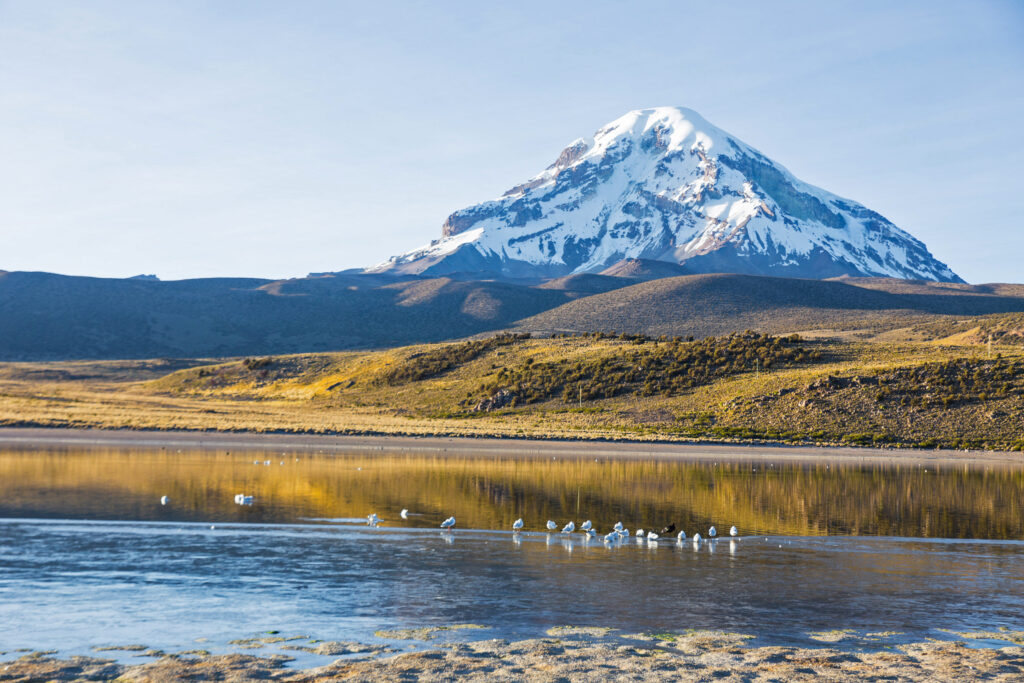
Sajama is the highest mountain in Bolivia and one of the great high-altitude volcano climbs in the Central Andes. Rising above the Altiplano inside Sajama National Park, it is known for its remote setting, long summit day, glacier travel, and the serious altitude challenge that defines nearly every expedition. This page covers the main climbing approach, expedition style, access planning, season notes, essential gear, safety considerations, featured videos, and guide companies for planning a Sajama ascent.
Theme: the standard guided line and the classic way to climb Sajama.
Best for: experienced high-altitude trekkers and climbers on a guided Bolivia program.
Character: a glacier ascent involving steep snow sections, crampon travel, and a long summit day.
Important note: even the standard route is serious because of altitude and cold, not just technical difficulty.
Route #2: Base Camp to High Camp Progression
Theme: the typical expedition pattern used by most guided teams.
Best for: climbers who want a structured, staged ascent with better summit odds.
Character: approach to base camp, move to high camp, then a summit push in alpine style.
Note: the move to high camp is usually where the mountain starts to feel much more serious.
Route #3: Sajama as an Acclimatization Objective
Theme: often climbed after other Bolivia peaks rather than as a true first altitude objective.
Best for: climbers building toward one major Bolivian summit after several acclimatization peaks.
Character: Sajama is frequently the capstone mountain in a Bolivia expedition itinerary.
Route #4: Independent vs Guided Style
Theme: the main decision is often logistics and support, not just route choice.
Best for: those evaluating transport, pack support, camp setup, glacier management, and summit timing.
Character: guided teams simplify the difficult logistics of a remote Andean volcano.
Why Sajama is so different
It combines a relatively straightforward expedition structure with very serious altitude.
The mountain sits in a remote, high desert environment where logistics matter nearly as much as climbing ability.
Many climbers discover that the altitude, cold, and summit-day length are the real crux.
Access & Logistics
What to know before you go
Most teams approach from La Paz after spending time acclimatizing on other Bolivian peaks.
Sajama is usually climbed from base camp with a move to high camp before summit day.
The area is remote, so transport, weather timing, food, and camp logistics matter.
Do not treat Sajama like a simple trekking peak just because it follows a normal guided expedition pattern.
Typical expedition rhythm
Travel from La Paz to the Sajama area.
Establish base camp and continue acclimatization.
Move to high camp.
Launch a very early summit attempt and descend.
Planning notes
Altitude preparation is the single most important planning factor.
Pack support and local logistics can make a major difference.
Weather, snow conditions, and glacier conditions can reshape summit timing quickly.
Best Time to Climb (Season Window)
Season
Typical Conditions
Pros
Watch-outs
Dry season
Generally the preferred period for climbing with more stable conditions
Better summit windows, colder firmer snow, and more reliable expedition planning
Cold nights, strong wind, and very dry high-altitude conditions
Shoulder / wetter periods
Greater chance of unstable weather and snow variation
Sometimes fewer teams
Storm risk, poorer visibility, softer snow, and more complicated glacier travel
Season planning tip
On Sajama, the best season usually means choosing the drier Andean climbing window and arriving already acclimatized enough to capitalize on a short summit-weather opportunity.
Essential Gear Checklist
Core expedition gear
Warm high-altitude layering system
Insulated summit gloves and spare gloves
Mountaineering boots appropriate for snow and glacier travel
Harness, crampons, helmet, and glacier kit if required by your guide service
High camp and summit additions
Headlamp and spare batteries
Goggles or glacier sunglasses
Insulated layers for pre-dawn cold
Water system protected from freezing and easy-access summit nutrition
Most underestimated factor
The biggest mistake on Sajama is underestimating how much energy altitude takes away. Climbers often focus on the volcano’s “normal route” status while forgetting that 6,500 meters turns an otherwise manageable climb into a major effort.
Difficulty & Safety Notes
What makes Sajama challenging
Altitude: this is the defining difficulty and the main reason teams fail to summit.
Cold: summit temperatures and wind can be severe even in the preferred season.
Glacier travel: crevasses, hard snow, and changing conditions require proper judgment.
Summit day length: the effort from high camp is much bigger than many climbers expect.
Remote setting: rescue and retreat are more complicated than on front-country peaks.
Disclaimer: Mountain travel has serious objective risk. This page is educational and not a substitute for current guide service advice, weather checks, glacier assessment, or local judgment.
Featured Videos (Sajama)
Global Summit Guide • Video Hub
Sajama: Watch & Learn
These videos help visualize the mountain, camp structure, terrain, and overall Sajama expedition experience.
Yes. The standard route is not only about technique—it is a major high-altitude climb where acclimatization and endurance are critical.
Do I need glacier gear for Sajama?
Most guided teams treat Sajama as a true glaciated mountaineering objective, so proper boots, crampons, and glacier travel systems are part of the normal planning process.
How many days does Sajama take?
Many expeditions spend 2–4 days on Sajama itself, but the overall trip is usually longer because acclimatization is essential.
What is the biggest reason climbers fail on Sajama?
The biggest reasons are usually inadequate acclimatization, cold, fatigue, and the cumulative effects of altitude on summit day.
Related Peaks
Global Summit Guide • Internal Links
More Andes & High-Altitude Objectives
Strong additions to your South America cluster and internal linking structure.
Five Notable Sajama Climbs and Developments from 2025
A look at five notable Sajama climbs and developments from 2025, followed by practical lessons climbers learned about Sajama National Park logistics, base-camp strategy, high-camp timing, altitude, and smart decision-making on Bolivia’s highest mountain.
Mountain
Sajama
Region
Andes – Bolivia
Season Focus
2025 Climbs
Overview
National Park Logistics, Long Summit Day, and High-Altitude Discipline
Sajama in 2025 again showed why it remains one of the most important high volcano climbs in Bolivia. It often gets described as a non-technical 6,000-meter peak, but the mountain still combines major altitude, a long summit day, changing upper-mountain snow conditions, and enough glacier terrain to punish poor timing. The strongest 2025 themes centered on proper acclimatization, the classic Sajama village to base-camp progression, and the continuing need to treat the climb like a serious high-altitude expedition rather than a simple walk-up.
Climb / Development 1
Sajama Village and the National Park Approach Stayed the Defining 2025 Starting Pattern
Classic Staging Area
Main Access Hub
Sajama village inside Sajama National Park
Typical Start
Short vehicle transfer and approach hike to base camp
Base-Camp Pattern
Camp near the stream with nearby water source and shelter area
Theme
The Climb Still Starts With Park and Camp Logistics
One of the clearest 2025 Sajama realities was that the standard climb still begins with the Sajama village access system and a measured move to base camp. Current route references continue to describe the base-camp area as a 2 to 3 hour approach from the trailhead, with running water and a stone shelter nearby. On Sajama, clean camp setup and pacing still matter before the high mountain really begins.
Climb / Development 2
Strong Acclimatization Continued to Be the Big 2025 Success Divider
Altitude Reality
Mountain Height
About 6,542 m in commonly cited references
Main Limiter
Altitude more than technical climbing
Common Strategy
Use nearby 6,000-meter peaks for acclimatization before Sajama
Theme
Sajama Still Punishes Climbers Who Rush the Altitude Curve
Another strong 2025 theme was that Sajama still behaves like a true altitude mountain first and a route mountain second. Current route descriptions continue to emphasize that the high altitude makes even moderate terrain feel demanding, and climber references still treat nearby peaks as useful acclimatization before the main objective. That keeps Sajama firmly in the category of a serious 6,500-meter climb.
Climb / Development 3
The High-Camp Option Still Mattered in 2025 for Teams Managing the Long Summit Day
High-Camp Strategy
Standard Choice
Either direct summit push or break the climb with high camp
Why It Matters
The mountain is long even when conditions are favorable
Common Outcome
Well-acclimatized teams manage pace better by structuring the climb
Theme
Sajama Still Rewards Teams That Respect the Length of the Mountain
One of the most practical 2025 truths on Sajama was that the climb still rewards structured pacing. Current route references continue to mention both base-camp and high-camp patterns, and climber logs still describe Sajama as long even when the terrain does not feel highly technical. That makes camp strategy a real performance factor rather than a small detail.
Climb / Development 4
The 2025 Sajama Story Still Centered on a Non-Technical Mountain With Real Consequences
Category
Details
General Character
Often described as non-technical or moderate in standard conditions
Hidden Difficulty
Very high altitude, cold, wind, and changing snow still make it serious
2025 Lesson
The route still needs conservative judgment even when it looks straightforward
Theme
Sajama Still Wins by Height, Cold, and Endurance Rather Than Technical Showmanship
One of the broader 2025 Sajama realities was that the mountain still draws climbers because it appears approachable compared with steeper Andean peaks, but the real test remains altitude, exposure, and duration. Current climber references continue to describe Sajama as not especially technical in normal conditions while still stressing that the mountain becomes difficult because of its scale and elevation. That is still the defining Sajama lesson.
Climb / Development 5
The 2025 Dry-Season Pattern Again Reinforced Sajama as Bolivia’s Big Volcano Goal
Active Season
Common Season Window
Bolivian dry season, especially around May to September
Best Months Commonly Cited
June, July, and August pattern for Bolivia remains the key reference
Typical Team Style
Guided or self-managed expedition teams with staged acclimatization
Theme
Sajama Remains Bolivia’s Classic Big Volcano Objective
The wider 2025 story on Sajama was that it remained one of Bolivia’s most important dry-season summit goals. While Sajama is less commercial than some peaks near La Paz, the same broader Bolivia season pattern still supports summit attempts in the drier months when weather is more stable. In practice, that means the strongest 2025 teams still succeeded by showing up acclimatized, prepared, and patient.
What Climbers Learned on Sajama in 2025
These advice notes reflect the most practical lessons that stood out from Sajama in 2025.
Sajama still starts with logistics, not with the summit slope
The 2025 pattern again showed that clean planning through Sajama village and a well-run base camp still shape the whole climb.
Altitude still decides more than the route grade
At more than 6,500 meters, Sajama remains a mountain where preparation and acclimatization matter more than ego.
Camp structure still matters on a long mountain
Teams that respect the length of Sajama and organize their climb around realistic pacing still give themselves the best chance.
A non-technical mountain can still be fully serious
Sajama’s biggest 2025 reminder is that cold, wind, distance, and altitude can be enough to turn an apparently simple climb into a major effort.
The dry season still offers the clearest summit window
The broader 2025 Bolivia pattern reinforced that stable winter conditions remain the best framework for a Sajama attempt.
A successful Sajama climb ends only after a safe descent
The strongest overall lesson from 2025 is that on Sajama, success still depends on patient acclimatization, conservative pacing, and a controlled return below the upper mountain.
Mountain Map & Weather
Map of Sajama
View the summit location, route area, current weather, and 5-day mountain forecast.
Global Summit Guide
Sajama Additional Information
Answers to common questions about Sajama routes, altitude, timing, safety, and expedition planning.
How hard is Sajama to climb?
Sajama is a high-altitude glaciated volcano that is physically demanding but not highly technical on its standard route. Climbers should be comfortable with glacier travel, crampons, and ice axe use. The biggest challenge is the extreme altitude, along with long summit days and cold conditions.
How much does it cost to climb Sajama?
Costs depend on whether you arrange logistics independently or with a guide. Typical expenses include transport from La Paz, park access, local support such as mules or porters, food, lodging, and guide services if desired. Many climbers opt for a guide due to the remoteness and altitude.
How long does it take to climb Sajama?
Most climbers plan Sajama as part of a multi-day or week-long trip with acclimatization beforehand. The climb typically involves establishing a high camp and completing a long summit push, often starting early in the morning or overnight.
Can a beginner climb Sajama?
A strong beginner with good acclimatization and basic glacier skills may be able to climb Sajama with a guide. However, the altitude is extreme, and climbers should ideally have prior high-altitude trekking or mountaineering experience.
Where is Sajama located?
Sajama is located in western Bolivia near the Chilean border within Sajama National Park. It is the highest peak in Bolivia and stands as a prominent stratovolcano in the Andes.
Do you need a guide or permit for Sajama?
A permit is typically required to enter Sajama National Park. While experienced climbers may go independently, many hire a guide due to the remote location, altitude challenges, and glacier travel on the upper mountain.
Why is Sajama considered dangerous?
Sajama is dangerous because of extreme altitude, cold temperatures, glacier travel, crevasses, and long summit days. Its remote location also means that rescue and support options are limited compared to more developed climbing areas.
Global Summit Guide
Expert Resources & Further Reading
Trusted resources for Bolivia travel, park access, and high-altitude preparation.
Resource
Description
Link
Bolivia Travel
Official travel information for Bolivia and planning logistics.
Global Summit Guide is an independent mountaineering resource founded in 2026. The team combines first-hand trekking and climbing experience with in-depth research and professional health and nutrition review to help climbers choose objectives, prepare properly, and stay safe.
Travis LudlowFounder & Head of Research · Master's in Business
Dawson LudlowClimbing & Mountaineering Lead
Walker LudlowClimber & Contributor
Health, altitude, and nutrition content is reviewed by Taylor Ludlow (Registered Nurse) and Brigg Hoopes (Nutritionist).
?
What We Don't Know Yet
Mountain information changes quickly. This box explains the limits of what this page can responsibly promise.
Permit availability, reservation windows, quotas, and official fee rules may change after this page is updated.
Weather, snowpack, avalanche risk, road access, and route conditions can change quickly and may be different on your climbing dates.
Route conditions, trailhead access, crevasse exposure, stream crossings, and rescue access may vary from published planning guidance.
Gear requirements can change by season, route variation, weather window, personal cold tolerance, and guide-service requirements.
Fitness and altitude response vary by person; no guide, itinerary, or training plan can guarantee acclimatization or summit success.
Confidence: Medium
Verify current conditions with official land managers, guide services, local forecasts, and current route reports before booking or climbing.
Safety, medical & liability disclaimer
Mountaineering, rock and ice climbing, glacier travel, and high-altitude activity are inherently dangerous and can result in serious injury or death. The information on Global Summit Guide is provided for general informational and educational purposes only and is not a substitute for professional instruction, qualified guiding, proper equipment, or your own judgment and experience.
Route conditions, weather, snowpack, permits, regulations, and hazards change constantly and may differ from what is described here. Details may be incomplete, out of date, or contain errors. Always verify current information with local authorities, certified guides, and official sources before making any decision in the mountains.
Nothing on this site is medical, legal, or financial advice. Our fitness, acclimatization, altitude, and nutrition content is general in nature; consult a qualified physician before beginning any strenuous exercise program or exposing yourself to high altitude.
You are solely responsible for your own safety and decisions. To the fullest extent permitted by law, Global Summit Guide and its team accept no liability for any loss, injury, damage, or expense arising from use of, or reliance on, this information. By using this site you acknowledge these risks and accept these terms.
Some links on this site may be affiliate links. If you buy through them we may earn a small commission at no extra cost to you; this never affects our recommendations.
Global Summit Guide recommendation path
Next Best Mountain to Research
Use these recommendations to continue the right planning path instead of stopping on one page.