
Last updated May 24, 2026
Denali West Buttress Conditions 2026: NPS Permits, Camps, Weather Windows & Recent Climber Reports
Everything you need to know about climbing North America’s highest peak via the West Buttress route in the active 2026 season. NPS permit costs, camp progression from Kahiltna Glacier base camp to 14 Camp and High Camp, current weather windows, recent ranger station reports, and 2026 regulations for the standard route used by 90% of Denali climbers.
If you’re planning to climb Denali via the West Buttress this season, you need to understand the current state of the mountain. The 2026 season is currently active. NPS rangers are in their high camps. Several patrols are working the Kahiltna Glacier and the 14,200-foot camp. Climbers are flying in daily from Talkeetna. The peak window opens now and runs through late June. This page covers everything from current NPS permit costs to camp-by-camp conditions, weather patterns, and what climbers should know before flying onto the Kahiltna.
The 2026 Denali season runs May 1 through approximately July 15. Peak conditions on the West Buttress fall between mid-May and late June, when daylight reaches 20+ hours, temperatures are warmest by Alaska Range standards, and stable high-pressure systems produce the most reliable summit windows. NPS registration for the 2026 season opened January 1, 2026, with the mandatory 60-day pre-registration period enforced strictly. Climbers without permits cannot fly into the Kahiltna Glacier base camp.
The West Buttress is the standard route on Denali, used by approximately 90% of climbers. The route is technically moderate by world mountaineering standards but the cold, altitude, and self-sufficient logistics make it genuinely difficult. Climbers haul approximately 100-120 pounds of gear, food, and fuel for the entire expedition. The route uses six camps from base camp at 7,200 feet to High Camp at 17,200 feet, with the summit at 20,310 feet (6,190 m).
Denali West Buttress Live Conditions Snapshot
Here’s the current state of the West Buttress route as of May 24, 2026, verified against NPS field reports, Talkeetna Ranger Station updates, and recent climber communications.
2026 Season Status — Updated May 24, 2026
Daily NPS updates during the season. The Walter Harper Talkeetna Ranger Station maintains an automated statistics phone line at (907) 733-9127 with current registration numbers and climbing statistics. NPS Field Reports publish updates from patrol rangers at 14 Camp and the high camps. MountainWeather.com aggregates the 7K and 14K weather station telemetry, NWS Denali Climbing Forecasts, and FAA webcam feeds. Climbers should monitor all three sources before flying into the Kahiltna and again before any summit attempt.
Denali Location & Kahiltna Glacier Live Weather
Denali sits in the Alaska Range, approximately 150 miles north of Anchorage and 100 miles west of Fairbanks. The West Buttress route begins at the Kahiltna Glacier Base Camp (7,200 ft), reached only by bush plane from Talkeetna (358 ft). Summit coordinates: 63.0692°N, 151.0070°W. The mountain straddles Denali National Park and Preserve, a 6-million-acre wilderness larger than the state of New Hampshire.
Live weather data from Open-Meteo at Talkeetna (358 ft / 109m), the bush-plane departure point. Kahiltna Glacier (7,200 ft) typically runs 20-30°F colder than Talkeetna. Summit-day temperatures at 20,310 ft average -30 to -40°F with wind chill below -60°F not uncommon. Always cross-reference with the NPS Denali Climbing Forecast and MountainWeather.com before flying in.
Denali West Buttress At a Glance
| Summit elevation | 20,310 ft (6,190 m) — North America’s highest peak; one of the Seven Summits |
|---|---|
| Location | Denali National Park and Preserve, Alaska Range, Alaska, USA |
| Coordinates | 63.0692°N, 151.0070°W |
| Route | West Buttress — standard route, ~90% of all Denali climbers |
| Technical grade | Alaska Grade 2; moderate glacier and snow climbing with sustained altitude and cold exposure |
| Total distance | ~13 miles horizontal; 13,500 ft vertical gain from base camp to summit |
| Camps | 6: Base Camp 7,200 ft → 7,800 → 9,500 → 11,000 → 14,200 (14 Camp) → 17,200 (High Camp) → Summit |
| 2026 climbing season | May 1 – July 15, 2026 (peak: mid-May to late June) |
| NPS permit fee 2026 | $450 USD adults (25+) / $350 USD climbers 24 and under |
| Park entrance fee | $15 USD per person, valid 7 days |
| Combined 2026 fees | $465 USD adult / $365 USD under 24 |
| Registration deadline | 60 days before climb start; non-refundable after Feb 15 |
| Expedition length | 18-24 days from Talkeetna to summit and back |
| Approach | Talkeetna → Kahiltna Glacier via bush plane (K2 Aviation, Talkeetna Air Taxi, Sheldon Air Service) |
| 2026 guided cost | $12,900-$19,000 USD (NPS-authorized concessions only) |
| Authorized guide concessions | 7 federally-licensed companies on Denali |
| Summit success rate | ~50% average (range: 28-60%+ by season and weather) |
| Guided success rate | 55-70% typical; better than independent climber average |
| Summit-day temperatures | -30 to -40°F with wind chill below -60°F not uncommon |
| Critical hazards | Crevasses on Kahiltna, Windy Corner, Headwall fixed lines, Autobahn, Denali Pass, Summit Ridge |
| Waste management | Clean Mountain Cans (CMCs) mandatory; all waste packed out |
| Self-sufficient | ~100-120 lbs of gear, food, fuel per climber for the expedition |
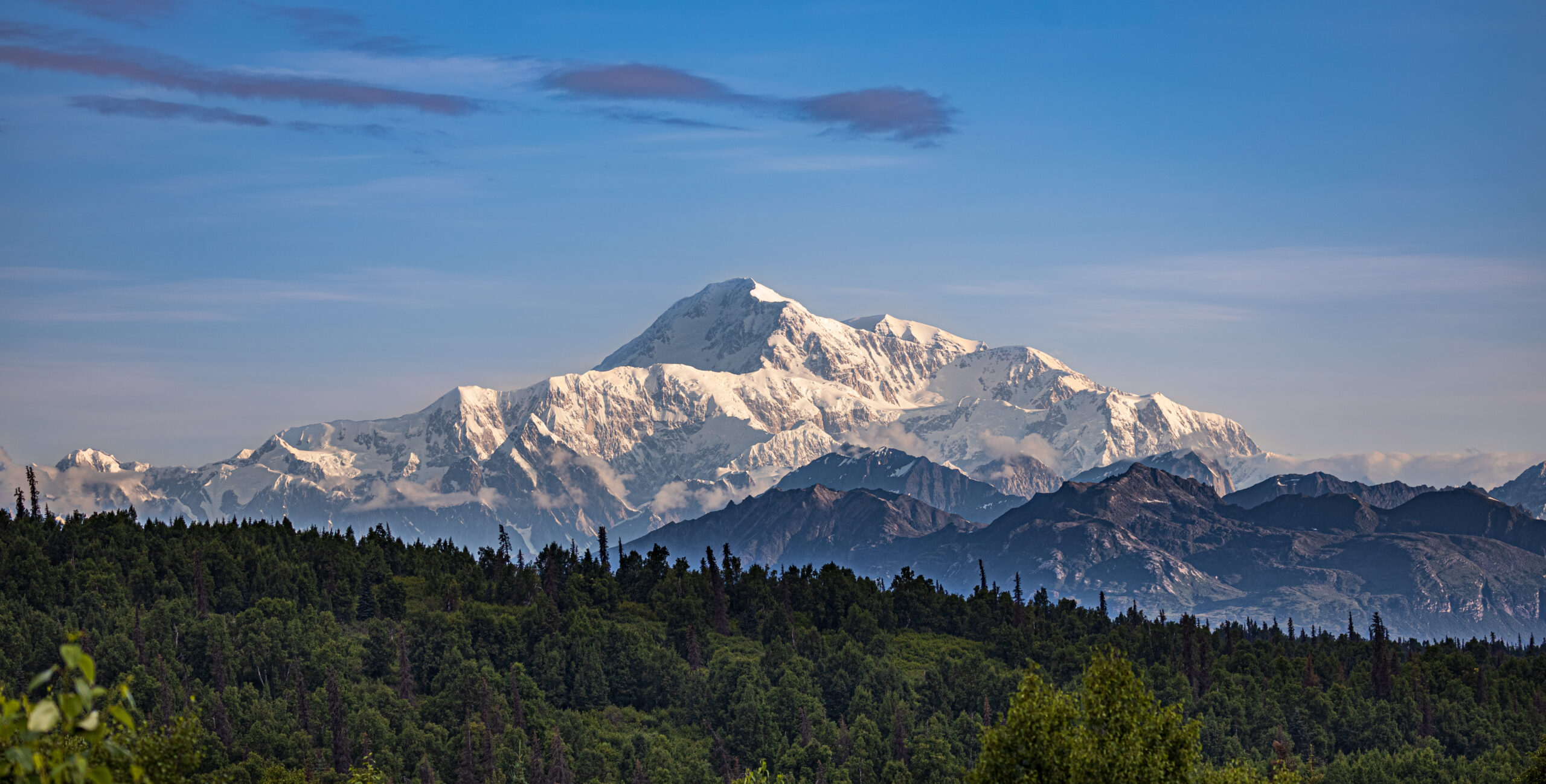
The West Buttress Camp Progression: 7,200 ft to Summit
The West Buttress uses six camps over 13 miles of horizontal distance, gaining 13,500 vertical feet from the Kahiltna Glacier base camp to the summit. Most expeditions use a carry-and-cache pattern — moving gear progressively higher while climbers acclimatize, sleeping low and carrying high. Here’s the standard camp-by-camp breakdown for the 2026 season.
| Camp | Elevation | Distance from BC | Typical Stay | Key Feature |
|---|---|---|---|---|
| Base Camp | 7,200 ft (2,195 m) | 0 mi | 1-2 nights | Bush plane landing on Kahiltna Glacier |
| Camp 1 (Ski Hill) | 7,800 ft (2,378 m) | ~4 mi | 1 night | Base of Ski Hill climb; sled hauling |
| Camp 2 (Kahiltna Pass) | 9,500 ft (2,896 m) | ~5 mi | 0-1 night (often skipped) | Base of Kahiltna Pass climb |
| Camp 3 (Motorcycle Hill) | 11,000 ft (3,353 m) | ~7 mi | 1-2 nights | Last camp before upper mountain |
| 14 Camp (Genet Basin) | 14,200 ft (4,328 m) | ~9 mi | 4-7 nights | NPS ranger camp + medical tent |
| 17 Camp (High Camp) | 17,200 ft (5,242 m) | ~11 mi | 1-3 nights | Summit launching point; wind-exposed |
| Summit | 20,310 ft (6,190 m) | ~13 mi | Summit day only | Autobahn → Denali Pass → Summit Ridge |
Below: detailed camp-by-camp breakdown with what to expect at each stop.
Base Camp — Kahiltna Glacier
The Kahiltna Glacier Base Camp sits at 7,200 feet at the base of the southwest fork of the Kahiltna. Bush planes from Talkeetna (K2 Aviation, Talkeetna Air Taxi, Sheldon Air Service) land here on skis. The base camp has a small NPS ranger presence and a base camp manager who coordinates incoming and outgoing flights. Climbers cache equipment, organize sleds, and prepare for the haul up the glacier. Most teams spend 1-2 nights here before starting the climb. Weather at base camp can shift rapidly — incoming flights are weather-dependent and can delay arrivals by days.
Camp 1 — Ski Hill
Camp 1 sits at the base of “Ski Hill,” a steeper section of the Kahiltna Glacier. The hike from Base Camp follows the southeast fork down to the main Kahiltna Glacier and then up — paradoxically, you lose 1,000 feet from base camp before climbing back up to Camp 1. Climbers haul approximately 60 pounds per person on sleds plus 40-50 pounds in packs. Crevasse risk is high in this section; teams travel roped up at all times.
Camp 2 — Kahiltna Pass Base
Camp 2 sits at the base of Kahiltna Pass, the major climb to the upper mountain. Some teams skip this camp and continue directly to Camp 3 at 11,000 feet. The decision depends on team strength and acclimatization needs. Crevasse risk remains high. Weather windows for this section are reliable in May-June.
Camp 3 — Motorcycle Hill
Camp 3 sits at 11,000 feet just above the steep “Motorcycle Hill” climb. This is the last camp before the major terrain change to the upper mountain. Climbers cache food and equipment here for the descent. Most teams spend 1-2 nights at Camp 3 for acclimatization before continuing. The view from Camp 3 toward Mount Foraker and the Kahiltna becomes one of the route’s iconic visual moments.
Camp 4 — 14 Camp (Genet Basin)
The 14,200-foot camp — commonly called “14 Camp” or “Genet Basin” — is the main acclimatization camp on Denali. The NPS Talkeetna rangers establish a patrol camp here each season with a medical tent, weather station, and emergency communications. Climbers typically spend 4-7 days here for acclimatization, weather waits, and equipment preparation for the upper mountain. 14 Camp has a small wall of snow blocks around individual tent sites for wind protection. Cell coverage is limited but functional with the right networks. Temperatures at 14 Camp range from -20 to 10°F during the climbing season.
The Headwall & Fixed Lines
The Headwall is the steep section between 14 Camp and the West Buttress ridge at 16,200 feet. NPS rangers install fixed ropes here at the start of each season for safety. This is the most technical section of the West Buttress route — 40-45 degree snow and ice with significant exposure. Climbers clip into the fixed lines with ascenders for protection. The Headwall typically takes 4-6 hours to climb from 14 Camp. Most teams do a carry day to High Camp first, then move and sleep at High Camp on a subsequent day.
Camp 5 — 17 Camp / High Camp
The 17,200-foot camp is the highest established camp on the West Buttress route. Climbers typically spend 1-3 nights here before summit day, waiting for a weather window. High Camp is significantly more wind-exposed than 14 Camp, with sustained winds frequently above 40 mph. Temperatures range from -30 to 0°F. Tent placements are bounded by snow walls for wind protection. Most teams launch their summit attempt from High Camp at 04:00-06:00 depending on weather forecasts.
Summit Day — Autobahn, Denali Pass, Summit Ridge
Summit day from High Camp covers several distinct sections. First, the “Autobahn” — a 40-degree slope traverse from 17,200 to 18,200 feet that has been the site of multiple historical fatalities due to climbers sliding on hard snow without crampons engaged. Next, Denali Pass at 18,200 feet, the saddle between the South and North summits of Denali. From Denali Pass, the route ascends gradually to the Football Field at 19,500 feet, then up the final Summit Ridge to the South Summit (the true summit) at 20,310 feet. Total summit day is typically 10-14 hours round trip.
Critical Hazards on the West Buttress
Despite being the standard route, the West Buttress has multiple dangerous sections that contribute to Denali’s overall fatality history. Climbers should understand each before attempting the route.
| Hazard | Elevation | Risk Level | Primary Danger | Mitigation |
|---|---|---|---|---|
| Kahiltna Crevasses | 7,200-11,000 ft | High | Hidden crevasse falls | Rope team travel; crevasse rescue gear |
| Windy Corner | 12,500-13,500 ft | High | 60+ mph winds; frostbite | Cross in morning calm before afternoon winds |
| Headwall Fixed Lines | 14,200-16,200 ft | Moderate | Falls on 40-45° snow/ice | Proper ascender technique; back up fixed rope |
| The Autobahn | 17,200-18,200 ft | Critical | Fatal slides on hard snow | Crampons engaged; ice axe self-arrest ready |
| Denali Pass | 18,200 ft | Critical | 100+ mph storm winds | Weather window discipline; turn back early |
| Football Field | 19,500 ft | High | Whiteout disorientation | GPS waypoints; team navigation protocols |
| Summit Ridge | 19,500-20,310 ft | High | Cornice exposure; falls | Stay climber’s right of corniced edge |
| Frostbite (all camps) | 14,200+ ft | Critical | Tissue loss on hands/feet | Vapor barrier liners; expedition mittens; hand warmers |
Kahiltna Glacier Crevasses
The Kahiltna Glacier has extensive crevasse fields, particularly in the lower sections between Base Camp and Camp 3. Climbers must travel roped up at all times on the glacier. Late-season climbers (late June, July) face more open crevasses as snow bridges deteriorate from warming temperatures. The 2025 season saw two crevasse rescue events on the Kahiltna; the patterns continue in 2026.
Windy Corner
Windy Corner is a notorious wind-channel section between 12,500 and 13,500 feet on the climb from Camp 3 to 14 Camp. Wind speeds frequently exceed 60 mph here, and the section has limited shelter. Climbers traversing Windy Corner in bad weather face exposure that has caused multiple frostbite injuries in recent seasons. Most teams aim to cross Windy Corner in early morning calm before afternoon winds build.
The Headwall & Fixed Lines
The Headwall fixed ropes are critical safety infrastructure but require active management. Climbers must clip ascenders correctly, manage rope drag, and avoid creating bottlenecks. The 2025 season saw several falls on the Headwall, most without serious injury due to the fixed line catch. Always back up the fixed rope when conditions allow.
The Autobahn
The Autobahn is the traverse from 17,200 to 18,200 feet, named for the dangerous “fast slide” potential. The route crosses a 40-degree snow slope with significant exposure below. Climbers must keep crampons engaged and ice axe in proper self-arrest position. Multiple Denali fatalities have occurred here when climbers slipped on hard wind-packed snow. The section is short — typically 30-45 minutes — but demands focus throughout.
Denali Pass and the Football Field
Denali Pass at 18,200 feet sits in a wind tunnel between the South and North summits. Wind speeds here can reach 100+ mph in storm conditions. Multiple climbers have died at or near Denali Pass when caught in unexpected weather changes. The Football Field at 19,500 feet is a broad snow plateau where teams typically pause before the final summit ridge. Weather decisions made here are critical — climbers who continue in marginal weather face descent challenges as conditions deteriorate.
Summit Ridge
The final Summit Ridge from the Football Field to the South Summit is exposed on both sides with significant drop-offs. The ridge is typically corniced, requiring careful navigation to stay on the safe (climber’s right) side. Wind exposure here is severe — even on calm summit days, sustained winds of 30-50 mph are common. The final 200-300 feet to the summit demand focus and quick movement.
Frostbite is the most common Denali injury. The combination of severe cold (-30 to -40°F summit day), high wind, and the inability to safely remove gloves at altitude makes frostbite the leading injury on Denali. The NPS reports frostbite cases nearly every season — most on hands and feet during summit day or descent. Vapor barrier liners in boots, expedition mittens (not gloves) above 14 Camp, and chemical hand warmers as backup are essential. Multiple climbers have lost fingers or toes to Denali frostbite. This is a real risk, not a theoretical one.
2026 NPS Permits & Registration
Denali permits are issued by the National Park Service through a strict 60-day pre-registration system. Here’s the current 2026 process.
2026 Permit Costs
| Fee | Adult (25+) | Climbers 24 & Under |
|---|---|---|
| Mountaineering Special Use Fee | $450 USD | $350 USD |
| Denali NP Entrance Fee | $15 USD | $15 USD |
| Combined 2026 total | $465 USD | $365 USD |
Two-Step Registration Process
The 2026 registration is a two-step process per the current NPS protocol:
- Pay.gov fee payment: Pay the Mountaineering Special Use Fee through the official Pay.gov website. The fee is non-refundable after February 15 of your climbing year.
- Special Use Permit Application: Submit the Application for Special Use Permit via email to the Talkeetna Ranger Station, including detailed climbing experience, proposed route, group member information, and emergency contacts.
Both steps must be completed at least 60 days before your intended climb start date. The 60-day rule is strict — climbers attempting to register inside the 60-day window are typically declined. The pre-registration period exists so NPS mountaineering rangers can review applications, contact climbers for any clarifications, and ensure all climbers are properly prepared before they fly into the Kahiltna.
Walter Harper Talkeetna Ranger Station
All Denali climbers must check in at the Walter Harper Talkeetna Ranger Station before flying in. The station is named after Walter Harper, the first person to reach the summit of Denali in 1913. Climbers receive a pre-climb orientation, current conditions briefing, and their Clean Mountain Can (CMC) for waste management. The orientation typically takes 30-60 minutes and covers route-specific hazards, current weather patterns, and emergency protocols.
Guided vs. Independent Climbing
The NPS authorizes seven mountain guide concessions for Denali. Guided expeditions handle the entire registration and logistics process, including fee payment, permit submission, and pre-climb orientation. Independent climbers complete all steps themselves but pay the same fees. The 2026 guided expedition costs run $12,900-$19,000 USD for the standard 18-24 day West Buttress program. Major operators include RMI Expeditions, International Mountain Guides (IMG), Alpine Ascents International, Mountain Trip, and Mountain Madness.
2026 Climbing Season Month-by-Month Conditions
| Period | Conditions | Daylight | Climber Volume | Best For |
|---|---|---|---|---|
| Late April | Cold; firm snow; minimal crevasses; some rangers arriving | ~17 hours | Minimal (~50 on mountain) | Experienced cold-weather climbers; quiet route |
| Early May | Stable cold; building climber volume; rangers establish camps | ~18 hours | Building (~200) | Cold-tolerant climbers; first season window |
| Mid-May | Peak window opens; warmer days; reliable weather | ~19 hours | Heavy (~400-600) | Most climbers; established weather patterns |
| Late May – Early June | Prime conditions; longest daylight; warmer camps | ~20+ hours | Maximum (~600-800) | Standard guided expedition window |
| Mid-June | Peak window continuing; warmer base camp | ~20+ hours | Maximum (~600-800) | Optimal balance of conditions and crowds |
| Late June – Early July | Crevasses opening; warmer weather; reduced firm snow | ~20 hours | Heavy (~400-500) | Late-season climbers willing to accept softer conditions |
| Mid-July | Season closing; rangers departing; significant crevasses | ~19 hours | Reducing (~100-200) | End of season; experienced teams only |
Late May – Mid June 2026: The Sweet Spot
The May 25 – June 15 window represents the optimal Denali climbing conditions. Daylight reaches its maximum (20+ hours of usable light), temperatures are warmest by Alaska Range standards, weather windows open more frequently than at any other point in the season, and the trail through 14 Camp is well-established by NPS rangers and earlier climbers. Most major guided expeditions schedule departures in this window.
Mid-June – Early July 2026: Late Window
Late June and early July offer continued strong conditions but with developing concerns. Crevasses on the lower Kahiltna Glacier open as snow bridges weaken. Temperatures warm enough to make heavy expedition clothing uncomfortable on the lower mountain. The headwall fixed lines see significant wear. NPS ranger patrols begin transitioning out of 14 Camp by July 5-10.
Mid-July: Season Closing
By mid-July, the climbing season is effectively over. Most operators have completed their final summit windows. NPS ranger camps are being dismantled. Climbers attempting July ascents face deteriorating snow conditions, increased crevasse exposure, and reduced infrastructure. The official permitting season extends through July 15, but very few climbers attempt summits in the final two weeks.
Recent Denali Trip Reports & NPS Ranger Updates
NPS rangers publish field reports throughout the Denali climbing season. These provide ground-truth context for climbers planning trips. Here’s a synthesis of recent patterns relevant to 2026 planning.
2025 Season Summary
The 2025 Denali climbing season ran from April 28 (first NPS patrol assembling) through July 12. Total registered climbers: approximately 1,100. Summit success rate for the season: approximately 52%, slightly above the long-term average. The May 24 – June 10 window produced the highest concentration of summits, with several reliable weather windows of 24-72 hours each.
2025 Ranger Reports — Key Patterns
- Early May 2025: First NPS West Buttress patrol assembled in Talkeetna on April 28. Rangers reported variable snow conditions with crusts on solar slopes and dry cold snow on north faces.
- Mid-May 2025: Fixed lines on the Headwall installed by NPS patrols. Trail through Kahiltna established. Crevasse bridges intact.
- Late May 2025: Upper mountain reported “busy” with approximately 100 climbers ascending to High Camp on multiple days. Fixed line steps improving with use.
- June 2025: Multiple weather windows produced strong summit numbers. Several frostbite incidents reported on summit day, particularly hands and toes.
- July 2025: Season winding down. Final NPS patrols departing 14 Camp. Crevasses on Kahiltna opening significantly.
2026 Pre-Season Observations
The 2026 NPS season opened with rangers arriving in Talkeetna in late April. The first West Buttress patrol assembled in early May with rangers and VIPs (Volunteers in Park) packing for their upcoming climb. Initial flights to the Kahiltna Glacier began in early May as weather permitted. Climbers booked for early-May start dates faced typical weather delays in Talkeetna; one to three days of waiting for flyable conditions is standard.
Independent Climber Notes from 2025
- Cell coverage at 14 Camp: Limited but functional on Verizon and AT&T. Useful for non-emergency communication.
- Garmin InReach: The standard satellite communicator on Denali. Battery life is the limiting factor at cold temperatures — keep devices warm in inner pockets.
- Bush plane reliability: K2 Aviation, Talkeetna Air Taxi, and Sheldon Air Service are the primary operators. All three are reliable when weather allows. Plan 1-3 days of buffer in Talkeetna for flight delays.
- Food caching: Climbers cache food and fuel at each camp for the descent. Cache locations should be marked clearly with wands and GPS coordinates.
- Equipment failures: The cold breaks gear that performs fine in lower-altitude conditions. Test stoves, sleeping bags, and fuel systems in cold conditions before traveling to Alaska.
Required Gear for 2026 Denali West Buttress
Denali demands the most extensive personal equipment list of any standard climbing route on Earth. Cold, altitude, and self-sufficient logistics make every gear choice consequential. Most guided operators provide group equipment (tents, stoves, ropes); climbers bring their own personal gear.
Footwear
| Item | Spec / Example | Notes |
|---|---|---|
| Double mountaineering boots | La Sportiva G2 SM, Scarpa Phantom 8000, Millet Everest Summit GTX | -40°F rated; built-in gaiter |
| Overboots | Forty Below or similar | Warmth multiplier for summit day |
| Crampons | 12-point steel | Semi-automatic or step-in binding |
| Camp booties | Insulated down booties | For camp evenings |
| Expedition socks | Wool or wool-synthetic blend | 5-6 pairs minimum |
| Liner socks | Thin synthetic | Blister prevention |
| Vapor barrier liners | RBH Designs or similar | Reduces sweat → frostbite |
Clothing System
| Layer | Item | Rating / Notes |
|---|---|---|
| Base | Top and bottom (merino or synthetic) | 2-3 sets |
| Mid | Fleece or wool top | Mid-weight |
| Active insulation | Synthetic insulated jacket (Patagonia DAS Parka) | Working layer for climbing |
| Heavy insulation | Down parka | 800-fill, -40°F minimum |
| Insulated pants | Down pants | Camp and summit day |
| Hardshell jacket | Gore-Tex Pro | Generous cut for layering |
| Hardshell pants | Full side-zip | For crampon transitions |
| Soft shell pants | Schoeller or similar | Lower mountain wear |
| Hat / balaclava / buff | Wool or synthetic | Frostbite protection |
| Gloves (3 pairs) | Liner + insulated + expedition mittens | Mittens -40°F rated |
| Chemical warmers | Hand + toe warmers | 10-15 pairs minimum |
Technical Equipment
| Item | Spec | Purpose |
|---|---|---|
| Ice axe | 60-70cm general mountaineering | Self-arrest; cramponing |
| Climbing harness | Adjustable leg loops | Rope team travel |
| Helmet | Climbing-rated | Required on the route |
| Ascenders / jumars | Petzl Ascension or similar | Headwall fixed lines |
| Trekking poles | Adjustable, 3-section | Glacier travel |
| Climbing rope | 60m half rope per team | Usually group equipment |
| Carabiners | 5-6 locking + 5-6 non-locking | Anchor + rope work |
| Prusik cord | 6mm × 2 lengths | Crevasse self-rescue |
| Slings / runners | 3-4 60cm + 2-3 120cm | Anchor building |
| Belay device | ATC-Guide or similar | Rope work |
| Snow pickets | 24″ aluminum | 2-3 per team (shared) |
Hauling, Camp & Sleeping
| Item | Spec | Notes |
|---|---|---|
| Pulk / sled | Paris Expedition or custom | For 60+ lb hauls on lower glacier |
| Sled rigging | Rope + carabiners + drag straps | Attaches sled to harness |
| Expedition backpack | 90-100L | Upper mountain (above 14 Camp) |
| 4-season tent | The North Face VE-25 or similar | Usually group equipment |
| Sleeping bag | -40°F rated (WM Puma, FF Snowy Owl) | 800+ fill down |
| Sleeping pads (2) | Closed-cell foam + inflatable insulated | Critical insulation from ground |
| Stove | White gas (MSR XGK EX) | Group equipment |
| Fuel | ~0.5 liters per person per day | Plan for 9-12L per climber |
| Snow shovel + saw | Aluminum shovel; collapsible saw | Building wind walls |
| Water bottles (3L total) | Insulated Nalgenes | Bladder hoses freeze unreliably |
| Wide-mouth pee bottle | 1L Nalgene | Tent use during cold nights |
Personal Safety & Required NPS Equipment
| Item | Spec | Notes |
|---|---|---|
| Clean Mountain Can (CMC) | Issued at Talkeetna Ranger Station | NPS mandatory waste pack-out |
| Biodegradable bags | Provided with CMC | NPS issued |
| Headlamp + spare batteries | Lithium batteries for cold | 2 spare battery sets minimum |
| Glacier glasses (Cat 4) | + backup pair | UV at altitude is severe |
| Goggles | Storm-rated | Whiteout + summit ridge |
| Sunscreen + lip balm | SPF 50+ with SPF lip balm | Reapply throughout day |
| First aid kit | Blister care, ibuprofen, electrolytes, AMS meds | Customize to team needs |
| Diamox / acetazolamide | 250mg twice daily (typical) | Discuss with doctor |
| Satellite communicator | Garmin InReach or sat phone | Cell signal limited above BC |
| NPS Permit + Park Entrance receipt | Print + digital copies | Verify at base camp |
| Travel insurance | High-altitude rescue coverage | Heli-evac coverage essential |
| Cash (USD) | $200-500 | Tips, fuel surcharges, emergencies |
2026 Booking Strategy
Denali expeditions have a unique booking timeline driven by the 60-day NPS pre-registration rule and the limited authorized guide concessions.
For Remaining 2026 Season (May-July)
If you haven’t booked yet for the 2026 season, your options are limited:
- May 2026 departures: Likely fully booked with authorized guide concessions. NPS 60-day rule eliminates last-minute registrations.
- Early June 2026: Limited availability with some guide services. Independent climbers can still register if exactly 60 days from start date.
- Late June 2026: Some availability remaining. Late-season conditions but still within climbing window.
- Early July 2026: End-of-season departures available. Higher weather risk; reduced infrastructure.
For 2027 Booking
Climbers planning 2027 Denali expeditions should:
- July-September 2026: Research authorized guide concessions, compare itineraries and pricing
- October 2026: Make initial bookings with deposits to guide services
- January 2027: NPS registration opens January 1; complete Pay.gov fee payment
- February 2027: Submit Special Use Permit application; non-refundable after Feb 15
- March 2027: Complete training requirements; verify gear; book travel to Anchorage
- May 2027: Travel to Talkeetna for orientation and climb
The 7 Authorized Guide Concessions
NPS authorizes seven mountain guide companies to operate on Denali. Climbers wanting guided expeditions must use one of these. The standard list includes RMI Expeditions, International Mountain Guides (IMG), Alpine Ascents International, Mountain Trip, Mountain Madness, NOLS, and AAI/American Alpine Institute. Each operates under specific NPS permits with established itineraries and guide ratios. Independent climbers can climb without a guide service but handle all logistics themselves.
Frequently Asked Questions About Denali West Buttress Conditions
When is the 2026 Denali climbing season?
The 2026 Denali climbing season is currently active, running from approximately May 1 through July 15, 2026. Peak conditions on the West Buttress route fall between mid-May and late June, when daylight is maximum (up to 20+ hours), temperatures are warmest by Alaska Range standards, and stable high-pressure systems produce the most reliable summit windows. NPS registration for the 2026 season opened January 1, 2026, with climbers required to register at least 60 days before their planned start date.
How much does the Denali permit cost in 2026?
The 2026 Denali mountaineering permit costs $450 USD for climbers aged 25 and older, or $350 USD for climbers aged 24 and younger. This is the NPS Mountaineering Special Use Fee paid through Pay.gov when you register. Additionally, the Denali National Park entrance fee is $15 per person, valid for 7 days. Combined fees total $465 for adult climbers in 2026. The fee is non-refundable after February 15 of your climbing year. Guided expedition prices range from $12,900 to $19,000 USD for the standard 18-24 day West Buttress program.
What is the camp progression on the Denali West Buttress route?
The Denali West Buttress route uses six camps over approximately 13 miles of horizontal distance and 13,500 feet of vertical gain. Camp 1 is the Kahiltna Glacier Base Camp at 7,200 feet, reached by bush plane from Talkeetna. The standard progression then runs to Camp 2 at 7,800 feet (Ski Hill), Camp 3 at 9,500 feet, Camp 4 at 11,000 feet, Camp 5 at 14,200 feet (commonly called 14 Camp), and Camp 6 at 17,200 feet (High Camp). The summit at 20,310 feet sits 3,110 feet above High Camp via the Autobahn, Denali Pass, and Summit Ridge.
What are current Denali West Buttress weather conditions?
Base camp temperatures in late May range from -10 to 25°F. The 14,200-foot camp typically runs -20 to 10°F. The 17,200-foot High Camp ranges from -30 to 0°F with significant wind. Summit-day temperatures average -30 to -40°F with wind chill below -60°F not uncommon. Weather windows on Denali open every 5-10 days during the climbing season, lasting 24-72 hours each. The NPS posts daily weather observations from 7K and 14K weather stations. Climbers should have 5-7 days of weather buffer built into their itinerary.
What is the Denali summit success rate?
The long-term average across all Denali climbers is approximately 50%, but individual seasons range from 28% (poor weather years) to over 60% (excellent weather years). Guided expeditions typically achieve higher success rates of 55-70% due to experienced leaders, established camp infrastructure, and better weather decision-making. Independent climbers average 35-45% success. The biggest factors in summit success are weather windows, acclimatization quality, and team fitness. Compressed 14-16 day attempts produce lower summit rates than the standard 18-24 day expeditions.
How long does a Denali expedition take?
A standard Denali West Buttress expedition runs 18-24 days from Talkeetna to summit and back. Bush flight from Talkeetna to Kahiltna Glacier base camp takes 1-2 days due to weather windows. The climb itself uses a carry-and-cache pattern: 2-4 days from base camp to 14 Camp, 4-7 days at 14 Camp for acclimatization, 1-2 days to High Camp, 1-3 days at High Camp waiting for weather, summit day, and 2-4 days descent back to base camp. Some experienced climbers complete the route in 14-16 days, but this compresses acclimatization and reduces success rates.
Can I climb Denali without a guide in 2026?
Yes, independent climbing is permitted on Denali. Unlike some peaks where solo or unguided climbing is banned, Denali allows independent climbers. However, you must complete the full NPS registration process (60-day advance, Pay.gov fee payment, Special Use Permit application), attend the Walter Harper Talkeetna Ranger Station orientation, and follow all NPS regulations including CMC waste management. Solo climbers face additional scrutiny and may need to demonstrate prior high-altitude experience. The NPS strongly discourages solo climbing due to the rescue and self-rescue challenges. Most climbers travel in teams of 2-4 minimum.
What is the most dangerous part of the West Buttress route?
Multiple sections of the West Buttress have caused fatalities. The Autobahn — the 40-degree snow traverse from 17,200 to 18,200 feet — has been the site of multiple climber slides resulting in deaths. Denali Pass and the Football Field at 18,200-19,500 feet sit in a wind tunnel where multiple climbers have died caught in unexpected storms. The Kahiltna Glacier crevasses cause injuries throughout the season. The Headwall fixed lines see falls but rarely fatalities. Frostbite is the most common Denali injury due to summit-day cold. Statistically, the Autobahn and Denali Pass area produce the most fatalities per climber-day exposed.
What fitness do I need to climb Denali?
Denali demands more sustained fitness than virtually any other guided peak. The standard benchmark: capable of carrying 60-100 pounds for 8-10 hours per day for multiple consecutive days, with strong recovery overnight. Aerobic capacity should support sustained effort at altitude. Most climbers train for 6-12 months before Denali with heavy backpack hikes, weighted stair climbing, and progressive endurance work. Beyond aerobic fitness, climbers need cold tolerance, mental resilience for sustained discomfort, and prior glacier travel experience. Most guide services require climbers to demonstrate prior high-altitude experience (Mount Rainier, Aconcagua, or equivalent) before accepting Denali clients.
Where do I fly into for Denali?
The primary airport is Ted Stevens Anchorage International Airport (ANC). From Anchorage, climbers typically drive 2 hours north to Talkeetna, where the Walter Harper Talkeetna Ranger Station and bush plane operators are located. Some climbers fly from Anchorage to Talkeetna via small aircraft instead of driving. From Talkeetna, bush planes operated by K2 Aviation, Talkeetna Air Taxi, and Sheldon Air Service fly climbers to the Kahiltna Glacier base camp at 7,200 feet. The bush plane flight takes approximately 45 minutes and is the only access to the West Buttress route.
Denali Planning Resources
Sources & Further Reading
- National Park Service — Denali National Park & Preserve mountaineering page (nps.gov/dena)
- Walter Harper Talkeetna Ranger Station — official 2026 climbing registration and conditions
- Pay.gov — Denali Climbing Registration Form
- NPS Denali Dispatches — 2025 season field reports and ranger updates
- Mountain Trip — 2026 pre-trip information and NPS fee documentation
- RMI Expeditions — Denali permitting regulations and 2025-2026 program details
- International Mountain Guides (IMGD) — 2026 NPS fee structure and West Buttress program
- Explore-Share — Denali climbing facts, routes, climate, equipment overview
- U.S. Highpoint Guide — Denali camp progression and route details
- Ian Taylor Trekking — 2026 24-day Denali expedition program
- MesoWest — 7K and 14K weather station telemetry
- National Weather Service Denali Climbing Forecast
- MountainWeather.com — Denali weather aggregator
- FAA webcams — Kahiltna Glacier visibility monitoring
- Wikipedia — Denali, West Buttress route references
Last updated: May 24, 2026. Next scheduled update: June 30, 2026 (mid-season conditions verification).
Planning a 2026 Denali Expedition?
For the full Denali expedition guide including training plans, complete gear lists, cost breakdowns, and route comparisons, see our pillar guide.
Read the Full Denali Guide →