
Last updated August 10, 2026
Cerro Torre Guide: The Hardest Mountain to Climb in the World, the Cesare Maestri Compressor Route Controversy & How Cerro Torre Compares to Fitz Roy (2026)
Cerro Torre is one of the most legendary mountains in alpinism — a 3,128m granite spire capped by a massive overhanging ice mushroom, widely considered one of the hardest mountains to climb in the world among technically accessible peaks. The mountain’s history is dominated by the famous Cesare Maestri controversy — the disputed 1959 first ascent claim, the catastrophic 1970 Compressor Route that bolted hundreds of expansion bolts into the granite, the genuine 1974 Ferrari ascent via the West Face, and the dramatic 2012 Hayden Kennedy and Jason Kruk bolt-removal that ended the Compressor Route era. Only 10-20 climbers per year reach this Patagonian summit. This guide covers the climbing history, the Cerro Torre vs Fitz Roy comparison, the ice mushroom challenge, and the trekking access via Laguna Torre.
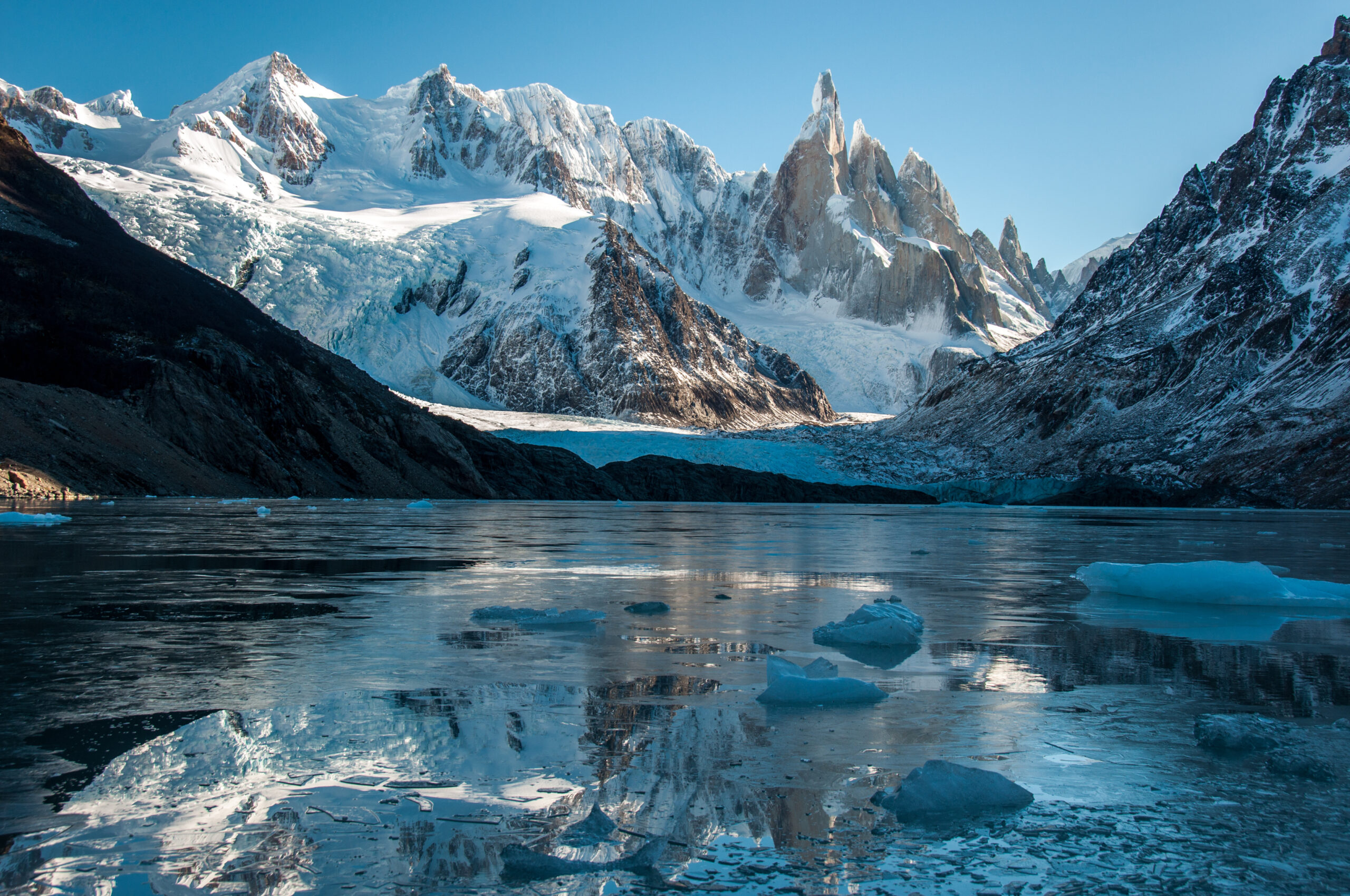
Los Glaciares National Park. Cerro Torre sits within Los Glaciares National Park (Parque Nacional Los Glaciares) — Argentina’s protected area covering approximately 726,927 hectares / 7,269 km² / 2,807 mi², established 11 May 1937 and designated a UNESCO World Heritage Site in 1981. The park encompasses 47 major glaciers including the Patagonian Ice Field (the third-largest ice mass on Earth after Antarctica and Greenland), the Perito Moreno Glacier in the southern park sector, and the Fitz Roy and Cerro Torre massifs in the northern park sector. Park entrance fee for the northern (El Chaltén) zone: $35-$45 USD (online booking required as of 2025+). Cerro Torre is accessed from the trekking village of El Chaltén in the park’s northern zone via the Laguna Torre trail (for trekkers viewing the mountain) or the Niponino base camp (for technical climbing attempts).
The History of Cerro Torre
Cerro Torre rises 3,128 meters (10,262 feet) above the surrounding Patagonian glaciers — substantially shorter than the Andean giants of Ecuador, Peru, or northern Argentina, but defined by something entirely different: sheer vertical granite walls, the famous overhanging ice mushroom summit, and Patagonian weather producing 100-200 km/h winds. The mountain is a granite massif formed by uplift and erosion of the Patagonian Batholith (granite intruded into the Earth’s crust approximately 100 million years ago) with subsequent glacial carving over the past 2 million years.
The mountain sits on the Argentina-Chile border approximately 10 km west of Fitz Roy in Los Glaciares National Park. The Argentine side (accessed from El Chaltén) is the standard climbing approach; the Chilean side faces the Southern Patagonian Ice Field, accessible only via difficult multi-week expeditions. The name Cerro Torre (“Tower Mountain” in Spanish) reflects the mountain’s distinctive spire shape — a near-vertical granite tower rising dramatically from the surrounding ice and glaciers. The Tehuelche/Aonikenk Indigenous peoples did not have a separate name for Cerro Torre as they did for Fitz Roy (Cerro Chaltén — “Smoking Mountain”), reflecting the mountain’s relative geographic obscurity in Indigenous cosmology compared to the more prominent and visible Fitz Roy.
1948-1958: First Western Reconnaissance
Cerro Torre’s existence as a serious mountaineering objective emerged in the late 1940s as Italian and other European alpinists began exploring southern Patagonia following World War II. Walter Bonatti, one of Italy’s most accomplished post-war climbers, and Carlo Mauri made the first serious reconnaissance attempts in 1958 — establishing that the mountain was substantially more difficult than initially expected and developing the foundational understanding of Patagonian climbing conditions. Bonatti’s reconnaissance work would inform the later expeditions of the 1950s-1970s. Multiple early European expeditions established base camps in the El Chaltén area but were unable to make serious attempts on the mountain itself due to combinations of weather, technical difficulty, and insufficient equipment for the genuinely vertical granite climbing required.
1959: The Cesare Maestri-Toni Egger First Ascent Claim
The most famous and controversial event in Cerro Torre’s history began in 1959 when Italian climber Cesare Maestri claimed first ascent of Cerro Torre with Austrian climber Toni Egger. The pair was attempting the northeast face / north face. According to Maestri’s account, they reached the summit after a six-day climb, but Egger was killed in an avalanche during the descent — taking with him the photographic evidence of the supposed summit. Maestri returned to El Chaltén alone with his story.
The disputed Maestri 1959 claim. The Maestri 1959 first ascent claim is one of the most famous disputed events in mountaineering history — and is now universally considered untrue within the climbing community. Multiple lines of evidence have systematically discredited the claim over the decades:
- No photographic evidence. Maestri’s claim that Egger had been carrying the summit photographs when he died has been characterized as too convenient by subsequent investigators. The pattern of “exclusive evidence destroyed in an accident” is recognized as a common feature of fabricated mountaineering claims.
- Route descriptions inconsistent with the mountain. Maestri’s described route did not match the actual geographic features of Cerro Torre’s north face. Subsequent climbers attempting to verify or repeat the Maestri route found discrepancies that could not be explained by snow conditions or weather variations.
- No physical traces of the supposed climb. Subsequent expeditions on the supposed Maestri route found no fixed ropes, no pitons, no bolts, no rappel anchors, no fixed equipment — none of the substantial gear that a six-day technical climb in 1959 would have left behind.
- Maestri’s own subsequent behavior. Maestri returned to Cerro Torre in 1970 with overwhelming force (compressor, 400 bolts, large team) to “prove” he could climb the mountain — a substantial departure from the relatively pure 1959 style he had previously claimed.
- The definitive 2005 investigation. In 2005, Italian climbers Ermanno Salvaterra, Rolando Garibotti, and Alessandro Beltrami retraced Maestri’s claimed route via the north face (calling it “El Arca de los Vientos”) and definitively confirmed there were no traces of any previous passage. Their detailed analysis, published by Garibotti as “A Mountain Unveiled,” became the standard reference establishing the Maestri claim as fabricated.
The 1959 Maestri claim is now considered one of the most blatant hoaxes in mountaineering history. Toni Egger remains a respected figure — he was a genuinely accomplished ice climber whose death was a real tragedy regardless of the disputed circumstances. The fabrication is attributed solely to Maestri, whose subsequent behavior on Cerro Torre in 1970 substantially confirmed the broader pattern of his disputed claims. Cesare Maestri died in 2021 at age 91, never having acknowledged the 1959 dispute despite decades of evidence.
1970: The Compressor Route — Maestri’s Return
To silence his critics, Maestri returned to Cerro Torre in 1970 with a substantial team — Ezio Alimonta, Daniele Angeli, Claudio Baldessarri, Carlo Claus, and Pietro Vidi. The expedition’s most infamous feature: Maestri brought a 440-pound gas-powered air compressor from Italy — the first time a compressor had ever been used in mountaineering — specifically to drill expansion bolts into the granite faces of Cerro Torre’s southeast ridge. Over approximately two months, the team placed approximately 360-400 bolts into the granite, creating what was effectively a 1,150-foot bolted ladder up the mountain.
The Compressor Route — desecration of a mountain. Maestri’s 1970 Compressor Route was immediately recognized as a substantial departure from mountaineering ethics. The international climbing community reacted with horror at the scale of the bolting — Mountain Magazine ran the headline “A mountain desecrated” after the route became known. The criticisms were substantial:
- The scale of bolting was unprecedented. ~360-400 bolts over 350m of climbing meant a bolt approximately every meter — converting genuine technical climbing into mechanical ascent. The route was characterized by critics as “the world’s hardest via ferrata” (iron-aided path) rather than a real climbing route.
- The compressor itself was a symbolic gesture. Maestri left the 440-pound compressor bolted to the wall near the top of the route as a deliberate provocation to his critics. The compressor remained on the mountain for decades as a permanent monument to the controversy.
- Maestri stopped short of the actual summit. Approximately 30-60 meters below the true summit (the ice mushroom), Maestri abandoned the climb and declared the ice mushroom “not part of the mountain.” This was widely seen as another evasion — Maestri claimed his second ascent without actually summiting the mountain.
- The compressor as evasion. The 1970 climb was widely understood as Maestri’s response to criticism of his 1959 claim — but it raised more questions than it answered. If Maestri had really climbed the mountain in 1959 in pure alpine style, why was 1970 effort so much more aggressive and unethical? Critics noted that the 1970 effort effectively contradicted the 1959 claim by demonstrating Maestri couldn’t climb the mountain without overwhelming aid.
The Compressor Route nonetheless became the standard climbing route for decades — most subsequent Cerro Torre ascents used Maestri’s bolt ladders to access the upper headwall. The first complete summit ascent of the Compressor Route was made by Americans Jim Bridwell and Steve Brewer in 1979, who climbed the ice mushroom summit that Maestri had dismissed — establishing the standard that an ascent of Cerro Torre is only complete if the climber summits the ice mushroom.
13 January 1974: The First Verified Ascent — Casimiro Ferrari and the Ragni di Lecco
The first verified ascent of Cerro Torre was made on 13 January 1974 by the Italian Ragni di Lecco (Spiders of Lecco) expedition led by Casimiro Ferrari. The summit team consisted of Casimiro Ferrari, Daniele Chiappa, Mario Conti, and Pino Negri — climbing the West Face via what is now called the Ragni Route (also “Via dei Ragni” — Route of the Spiders).
The 1974 ascent represented genuine alpinism in stark contrast to Maestri’s 1970 compressor approach. The Ragni expedition:
- Approached from the western Patagonian Ice Field — a substantially harder approach than the Argentine-side El Chaltén access
- Climbed in fast alpine style without permanent bolting (using temporary protection only)
- Successfully ascended the actual summit ice mushroom — the first verified summit of the true mountain
- Completed the climb during a brief weather window
The Ragni Route remains the standard climbing line on Cerro Torre in 2026. The route has been climbed approximately 100+ times since 1974 (with notable winter solos and speed ascents), but remains a serious technical objective — sustained 5.10+ ice and granite climbing across approximately 1,200m vertical. The first repeat of the Ragni Route was made in 1977 by a German expedition.
1979: Bridwell-Brewer Complete the Compressor Route to True Summit
Americans Jim Bridwell and Steve Brewer made the first complete ascent of the Compressor Route to the true summit ice mushroom in 1979 — completing what Maestri had abandoned in 1970. Bridwell, already legendary for his Yosemite Valley big-wall climbing, brought elite technical climbing skills to the Compressor Route and successfully navigated the upper ice mushroom that had defeated previous parties. The Bridwell-Brewer ascent established the standard that only a summit of the ice mushroom counts as a real Cerro Torre summit — a position that has been universally accepted since.
The Ice Mushroom Summit: Cerro Torre’s Most Distinctive Feature
Cerro Torre’s summit is capped by a massive rime ice mushroom — a feature unique to Patagonian mountains and the single most recognizable aspect of the peak. Understanding the ice mushroom is essential to understanding why Cerro Torre is so technically difficult and so dangerous.
What the ice mushroom is — and why it makes Cerro Torre so dangerous. The ice mushroom is a massive overhanging dome of rime ice — not glacial snow or normal ice, but rime formed when supercooled water droplets carried by the Patagonian wind freeze on contact with the granite summit. Over decades, rime accumulates into structures of remarkable size and instability. Cerro Torre’s mushroom characteristics:
- Size: Approximately 30-60 meters tall depending on season and recent weather. The mushroom changes shape continuously throughout each year.
- Position: The mushroom caps the summit granite, overhanging beyond the rock on multiple sides. To reach the actual summit point of the mountain, climbers must climb up and over the overhanging ice.
- Structural weakness: Rime ice is structurally substantially weaker than glacial snow or compact mountain ice. Sections regularly break off during major weather events — and during climbing attempts. Multiple climbers have fallen from mushroom sections that broke off mid-climb.
- Continuous change: Photographs of Cerro Torre’s summit from different decades show dramatically different mushroom shapes. The mushroom is, structurally, a temporary feature in geological time — it grows and partially collapses in cycles measured in years and decades.
- Climbing technique: Modern ice tools and screws are used, but the rime ice is too weak for conventional ice protection. Climbers move quickly through ice mushroom sections to minimize exposure time and weight on weak ice.
From 1996 to 2001, no climbers managed to climb to the true summit on top of the overhanging ice mushroom — a 5-year period when the mountain was effectively unclimbable due to mushroom conditions. The mushroom was structurally compromised during this period; sections broke off during attempts, making safe summit reaching genuinely impossible. The mushroom subsequently re-formed during the 2001-2005 period, and modern ascents have continued — but the lesson stands: Cerro Torre can become unclimbable for years at a time based on factors entirely outside human control.
Is Cerro Torre the Hardest Mountain to Climb in the World?
The “hardest mountain to climb in the world” debate is one of mountaineering’s most discussed questions. Cerro Torre is routinely cited alongside K2, Annapurna I, Nanga Parbat, and a handful of other peaks as candidates. Here’s the honest analysis.
The “Hardest Mountain in the World” Comparison
“Hardest” depends on what you measure. The candidates differ dramatically:
| Peak | Elevation | Difficulty Category | Death Rate |
|---|---|---|---|
| Cerro Torre | 3,128m | Sustained technical alpine; ice mushroom; weather | Significant per attempt (~10-20% historically) |
| K2 | 8,611m | Severe altitude + technical mixed climbing | ~22% historical death rate |
| Annapurna I | 8,091m | Severe avalanche + altitude | ~32% historical death rate (highest of 8000ers) |
| Nanga Parbat | 8,126m | Severe weather + technical + altitude | ~20% historical death rate |
| Latok I North Ridge | 7,145m | Sustained technical alpinism | First ascent only in 2018 after 40+ years of attempts |
| Gangkhar Puensum | 7,570m | Bhutanese government climbing ban since 2003 | Unclimbed (highest unclimbed peak) |
The honest answer. Among the world’s 8,000m peaks, Annapurna I has the highest historical death rate (~32%) — making it statistically the deadliest major mountain. K2 is widely considered the hardest 8,000m peak to climb due to the combination of altitude, technical difficulty, and objective hazards. Among technically accessible mountains (mountains that experienced climbers can reach without expedition-scale logistics), Cerro Torre is widely considered the hardest. Among unclimbed mountains, Gangkhar Puensum (Bhutan) is the highest peak that has never been climbed — but it remains unclimbed because of a government ban rather than technical impossibility. Latok I North Ridge was considered the “last great problem” of alpinism for 40+ years before being first climbed in 2018.
So is Cerro Torre the hardest mountain in the world? Genuinely yes within one specific definition: the hardest mountain that ordinary expert alpinists can attempt. Cerro Torre is the answer to: “What is the hardest mountain that doesn’t require Himalayan expedition scale?” K2 and Annapurna are harder, but they require months of expedition planning, base camps, and substantial logistical support. Cerro Torre can be attempted with a 2-week trip from a single base camp in El Chaltén — but the climbing itself is among the most demanding alpinism on Earth.
Why Cerro Torre Earns Its “Hardest Mountain” Reputation
Five specific characteristics combine to make Cerro Torre genuinely one of the world’s most demanding technical mountains:
- Sustained vertical granite climbing. The granite walls of Cerro Torre are sustained vertical for 1,000+ meters — substantially more sustained than most major peaks. Climbers don’t get the “easier sections” common to most mountains; the difficulty is constant from base to ice mushroom.
- The ice mushroom summit. The overhanging rime ice summit is unique among accessible peaks. Climbing this feature requires substantial ice climbing skill, the ability to handle structurally weak ice, and the willingness to climb in conditions where the ice itself can break off without warning.
- Patagonian weather. Sustained 100-200 km/h winds make Cerro Torre genuinely unclimbable on most days. Climbers wait weeks for windows; many expeditions return without any attempt.
- Substantial commitment. Cerro Torre routes are committing — limited bailout options once climbers reach the upper headwall. Mid-route weather changes can trap parties in dangerous extended-bivouac situations.
- Multi-day descent. The descent involves 30+ rappels through technical terrain. Climbers fatigued from technical ascent must execute substantial rappel sequences with stuck-rope risks and weather exposure.
Cerro Torre vs Fitz Roy: Patagonia’s Two Iconic Spires
Cerro Torre and Fitz Roy are the two most famous mountains of southern Patagonia, located only 10 km apart in Los Glaciares National Park. The two peaks are constantly compared but represent fundamentally different climbing experiences and serve different audiences within the broader El Chaltén tourism economy.
The complete Cerro Torre vs Fitz Roy comparison.
| Dimension | Cerro Torre | Fitz Roy |
|---|---|---|
| Elevation | 3,128 m (10,262 ft) | 3,405 m (11,171 ft) — 277m taller |
| Mountain type | Granite spire + ice mushroom summit | Granite massif with multiple summits |
| Technical difficulty | Higher — sustained 5.11+, ice mushroom climbing | High — sustained 5.10+ granite |
| First ascent | 13 Jan 1974 (Ferrari et al., disputed Maestri 1959) | 2 Feb 1952 (Terray + Magnone, uncontested) |
| Standard route grade | Ragni Route West Face: ~1,200m sustained | Franco-Argentine SE Face: 650m, 6a+ / 6c A1 |
| Annual summits | 10-20 | 30-50 |
| Famous controversy | Maestri 1959 disputed claim + 1970 Compressor Route + 2012 bolt removal | 2014 Caldwell-Honnold Fitz Traverse |
| Indigenous name | No widely-used Tehuelche name | Cerro Chaltén (“Smoking Mountain”) |
| Trekking destination | Laguna Torre (18 km RT, easier, less crowded) | Laguna de los Tres (20 km RT, iconic, very crowded) |
| Best trekking day hike if you can do only one | Laguna Torre — easier + less crowded | Laguna de los Tres — iconic photo opportunity |
| Commercial guided climb | Rare; $8,000-$25,000+ when available | Available; $4,000-$15,000 for 4-7 day program |
| Brand associations | Climbing community; “hardest mountain” reputation | Patagonia clothing brand logo |
| “Hardest” reputation | Often cited as world’s hardest accessible technical mountain | Major alpine objective; not in “world’s hardest” tier |
| Best for | Elite alpinists; climbers seeking the ultimate accessible challenge | Trekkers; serious alpine climbers; first-time Patagonia visitors |
The honest take. For trekkers, both day hikes are exceptional. Laguna Torre (Cerro Torre) is easier (less elevation gain, no steep final ascent), substantially less crowded, and offers equally dramatic views — making it the better choice if you can only do one or want a quieter experience. Laguna de los Tres (Fitz Roy) is the more iconic and photographed but substantially more crowded and physically demanding. Most El Chaltén visitors do both within a 3-4 day stay. For climbers, Cerro Torre is genuinely harder — the ice mushroom summit, sustained technical difficulty, and weather sensitivity create a combination that exceeds Fitz Roy’s challenges. Climbers seeking the ultimate accessible Patagonian objective choose Cerro Torre; climbers seeking a real Patagonian summit experience without quite the same commitment choose Fitz Roy. Both peaks are world-class mountains; the choice depends on the climber’s specific ambitions and experience level.
What Makes Cerro Torre Unique in Global Mountaineering
Cerro Torre occupies a singular position in global alpinism — a 3,128m granite spire that has shaped modern climbing ethics, generated mountaineering’s most famous controversy, and continues to challenge the world’s elite alpinists more than 50 years after its first verified ascent. The mountain’s identity is built from multiple distinctive features that no other peak quite combines.
What sets Cerro Torre apart:
- The hardest accessible technical mountain in the world. Among mountains that elite alpinists can attempt without Himalayan-scale expedition logistics, Cerro Torre is widely considered the hardest. The sustained difficulty (5.11+ across virtually every route), the ice mushroom summit, the Patagonian weather, and the substantial commitment combine to create a technical objective that exceeds most accessible peaks anywhere on Earth.
- The Maestri Compressor Route — climbing’s most famous controversy. The 1959 disputed first ascent and the 1970 Compressor Route created the most famous and substantial controversy in mountaineering history. The 2012 Hayden Kennedy-Jason Kruk bolt-removal ended the Compressor Route era and remains one of the most discussed climbing-ethics events of the 21st century. No other mountain has comparable controversy-driven cultural significance.
- The ice mushroom summit — unique terrain. The overhanging rime ice mushroom that caps Cerro Torre’s summit is unique among accessible peaks. The structural challenge of climbing weak rime ice, the continuous shape changes, and the periods when the mushroom becomes unclimbable (1996-2001) create terrain that simply doesn’t exist on other major mountains.
- Patagonian weather dominance. The mountain’s success rates are determined by weather more than any other factor. Even elite climbers with all the necessary skill and equipment routinely fail Cerro Torre attempts because acceptable weather windows simply don’t appear during their available trip duration. The “Patagonian wind” is a recurring theme in climbing literature specifically because Cerro Torre embodies it more dramatically than any other accessible peak.
- The hardest mountain to climb in the world — for one specific definition. Genuine debate exists about which mountain is “the world’s hardest” — K2, Annapurna, Nanga Parbat, and Latok I all have legitimate claims. Cerro Torre wins the specific category of “hardest mountain that ordinary expert alpinists can attempt.” For climbers seeking the ultimate technical challenge accessible without expedition-scale logistics, Cerro Torre is the answer.
- Limited commercial guiding. Unlike Fitz Roy, Cotopaxi, Chimborazo, or most major peaks, Cerro Torre is rarely guided commercially. The mountain’s difficulty exceeds what commercial guide operators typically offer to clients — even experienced clients. The rare guided programs available cost $8,000-$25,000+ and require climbers to demonstrate substantial alpine experience before acceptance. This creates a peak that exists almost entirely outside the commercial mountaineering economy.
- The Laguna Torre trekking alternative. Despite Cerro Torre’s “hardest mountain in the world” reputation, the Laguna Torre day hike from El Chaltén is one of Patagonia’s most accessible major mountain experiences. Trekkers can stand at the base of one of the world’s hardest mountains via a 6-8 hour day hike — an unusual structural combination that creates substantial visitor appeal.
Where Cerro Torre fits in mountaineering history. Cerro Torre has substantially shaped modern alpinism — its difficulty established the standards for accessible technical climbing, the Maestri controversy established climbing ethics around bolting and aid, the ice mushroom climbing defined a unique mountaineering challenge, and the 2012 bolt removal redirected climbing-community thinking about route preservation. For elite alpinists, Cerro Torre is among the most respected mountains on Earth. For trekkers, the Laguna Torre experience offers proximity to one of the world’s most legendary mountains without the climbing demands. For climbing-history enthusiasts, Cerro Torre’s controversies and milestones make it the most narratively rich mountain in the world. As just another Patagonian peak — no. Cerro Torre is structurally unique in global mountaineering and deserves to be understood on its own terms.
Cerro Torre Historical Timeline
The granite that forms Cerro Torre is intruded into the Earth’s crust as part of the Patagonian Batholith during the Cretaceous period. The same geological event creates Fitz Roy approximately 10 km to the east.
Pleistocene glaciation carves the dramatic spire shape of modern Cerro Torre. The surrounding glaciers — the Torre Glacier, the Adela Glacier, the Marconi Glacier — shape the granite into the near-vertical tower visible today.
The Argentine government establishes Los Glaciares National Park covering 600,000+ hectares including the Cerro Torre and Fitz Roy massifs. Formal protection begins for what will become one of the world’s most famous mountaineering destinations.
European alpinism expands into southern Patagonia following World War II. Multiple early expeditions reach the Cerro Torre area but are unable to make serious attempts on the mountain itself due to weather, equipment, and reconnaissance limitations.
Italian climbers Walter Bonatti and Carlo Mauri make the first serious reconnaissance of Cerro Torre. The expedition establishes that the mountain is substantially more difficult than initially expected and develops foundational understanding of Patagonian climbing conditions that informs subsequent expeditions.
Italian climber Cesare Maestri claims first ascent of Cerro Torre with Austrian climber Toni Egger via the north face. Egger dies in an avalanche on the descent. Maestri returns alone with the claim — no photographic evidence, no fixed equipment on the route. The claim becomes one of the most famous disputed events in mountaineering history.
Maestri returns to Cerro Torre with a 440-pound gas-powered air compressor and a large team. Over two months, they bolt 360-400 expansion bolts into the southeast ridge, creating what critics characterize as “the world’s hardest via ferrata.” Maestri stops 30-60m below the summit, dismissing the ice mushroom as “not part of the mountain.” Leaves the compressor bolted to the wall as a taunt to critics.
Italian climbers Casimiro Ferrari, Daniele Chiappa, Mario Conti, and Pino Negri of the Ragni di Lecco (Spiders of Lecco) make the first verified ascent of Cerro Torre via the West Face — now called the Ragni Route. The ascent is unanimously recognized as the genuine first ascent of the mountain. The Ragni Route becomes the standard climbing line through the present.
A German expedition makes the first repeat of the Ragni Route, confirming both the route’s quality as the standard line and the substantial difficulty of the mountain. Multiple subsequent expeditions establish Cerro Torre as a major international alpine objective.
Americans Jim Bridwell and Steve Brewer make the first complete ascent of the Compressor Route to the true summit — climbing the ice mushroom that Maestri had abandoned in 1970. The Bridwell-Brewer ascent establishes the standard that an ascent of Cerro Torre is only complete if the climber summits the ice mushroom.
Los Glaciares National Park is designated a UNESCO World Heritage Site, formally recognizing the international significance of Cerro Torre and the surrounding Patagonian peaks.
Italian climber Ermanno Salvaterra makes the first winter ascent of Cerro Torre in July 1985 — one of the most committing winter alpine objectives ever undertaken. Later in 1985 (26 November), Italian climber Marco Pedrini makes the first solo ascent of the Compressor Route. The mountain becomes a sustained venue for groundbreaking alpinism.
Italian climber Rosanna Manfrini makes the first female ascent of Cerro Torre via the Compressor Route in a roped party with Maurizio Giordani. The achievement opens Cerro Torre to broader women’s alpinism participation in subsequent decades.
For five years, no climbers manage to climb to the true summit on top of the overhanging ice mushroom. The mushroom is structurally compromised during this period; sections break off during attempts. The mountain becomes effectively unclimbable due to factors entirely outside human control — demonstrating the mushroom’s role in Cerro Torre’s overall difficulty.
Italian climbers Ermanno Salvaterra, Rolando Garibotti, and Alessandro Beltrami retrace Maestri’s claimed 1959 route via the north face (calling it “El Arca de los Vientos” — “Ark of the Winds”). They find no traces of any previous passage, definitively confirming that Maestri’s 1959 claim was fabricated. Garibotti’s subsequent investigation “A Mountain Unveiled” becomes the standard reference establishing the Maestri claim as a hoax.
American climbers Hayden Kennedy and Jason Kruk make the first “by fair means” ascent of the Compressor Route — climbing without using Maestri’s bolts. On descent, they remove approximately 120 of Maestri’s bolts, effectively ending the Compressor Route as a climbable line. The act sparks substantial controversy in international climbing circles — Argentine guides and some climbers in El Chaltén view the action as destruction of historic climbing heritage; others view it as appropriate restoration of mountain ethics.
Austrian climber David Lama makes the first free ascent of the southeast ridge of Cerro Torre — climbing without aid through a new variation on the upper headwall. Lama estimates the difficulty at grade X- (hard 8a/5.13c with mental difficulty). The ascent demonstrates that the southeast ridge can be climbed by fair means by elite climbers — making Maestri’s 1970 bolting genuinely unnecessary.
Cesare Maestri dies at age 91, never having acknowledged the 1959 controversy despite decades of evidence. The Italian climbing community remains divided on his legacy — he is recognized as a genuinely accomplished climber in the Dolomites with significant first ascents, but the Cerro Torre controversies cast a shadow over his broader reputation. The Maestri story remains the most famous example of disputed mountaineering claims.
Los Glaciares National Park implements mandatory online entry booking for the El Chaltén zone with entry fees of $35-$45 USD per visitor. The system manages growing visitor pressure on park infrastructure including the Laguna Torre trail.
Cerro Torre continues to host approximately 10-20 successful summits per year by elite alpinists. The Ragni Route remains the standard line. The southeast ridge (former Compressor Route) is now climbed “by fair means” without Maestri’s removed bolts. The mountain retains its reputation as one of the hardest accessible technical mountains in the world.
How to Climb Cerro Torre: The Technical Routes
Cerro Torre is climbed via several technical alpine routes — all reserved for elite alpinists with substantial Patagonian experience. The mountain’s difficulty and weather sensitivity mean that even highly experienced climbers routinely fail attempts. Commercial guided programs are extremely rare. Below are the established climbing routes in 2026.
| Route | Grade | Length / Character | Status |
|---|---|---|---|
| Ragni Route (West Face) | 5.10 WI 5 / sustained | ~1,200m vertical · The verified first ascent line; standard route | ● Standard Route · ~70% of summits |
| Southeast Ridge (former Compressor) | 5.11+ A2 WI 4 / sustained | ~1,200m · Without Maestri’s bolts since 2012 | ● Climbed by fair means · Substantially harder |
| North Face / Arca de los Vientos | 5.11+ WI 5 / sustained | ~1,500m · The 2005 verification route | ● Rarely climbed · Most committing line |
| South Face Variations | 5.11+ A1-A2 / variable | Multiple variations · Less repeated | ● Expert Alpinists Only |
Ragni Route (West Face) — The Verified First Ascent Line
Style: Multi-day technical alpine climbing · ~1,200m vertical · Sustained 5.10 / WI 5 with ice mushroom climbing to the true summit · The 1974 Ferrari first ascent line; standard route through 2026.
Why it’s the standard: The Ragni Route earns its standard-route status from being the verified first ascent line (1974 Ferrari et al.), being climbed in pure alpine style without bolting, going to the true summit via the ice mushroom, and being the most consistently climbable line in modern Patagonian conditions. The route has been climbed approximately 100+ times since 1974, with notable winter solos and speed ascents.
The approach: The Ragni Route ascends Cerro Torre’s west face. Climbers approach from El Chaltén via Niponino base camp (5-7 hour hike), then continue west across the Adela Glacier or via the Marconi Pass to reach the west face approach. The total approach from El Chaltén to the start of climbing takes 1-2 days depending on conditions. The approach itself is substantially more committing than Fitz Roy’s standard approach — climbers must cross glaciated terrain with crevasse hazards.
The climbing: The route ascends in three major sections:
- Lower headwall (granite climbing, ~400m): Sustained 5.9-5.10 granite climbing on the lower west face. Standard alpine trad climbing with pitches of varying width cracks and dihedrals.
- Middle headwall (mixed and ice, ~500m): Combination of granite climbing and ice/mixed pitches as the route ascends through the central part of the face. The Patagonian rime and snow conditions matter substantially in this section.
- Upper headwall and ice mushroom (~300m): The crux section — sustained difficult mixed climbing leading to the famous ice mushroom summit. The ice mushroom itself requires specialized rime ice technique and the ability to move quickly through structurally weak terrain. The actual summit is reached by climbing up and over the overhanging mushroom.
Timing: Total climbing time 18-30 hours for elite climbers in a single push; 2-3 day climbs are common for less-elite parties. Descent involves 30+ rappels through the route’s complex terrain. Total round-trip time from Niponino base camp typically 3-5 days including weather window timing.
Required experience: Climbers attempting the Ragni Route should have substantial multi-pitch trad climbing to 5.11, alpine ice and mixed climbing competence to WI 5 / M6, ability to handle rime ice and structurally weak ice features, prior Patagonian experience or equivalent committing alpine terrain, and proven physical and psychological capacity for multi-day sustained technical climbing.
Southeast Ridge — Climbing By Fair Means
Style: Multi-day technical alpine climbing · ~1,200m vertical · Sustained 5.11+ A2 / WI 4 · The former Compressor Route, now climbed without Maestri’s bolts since 2012.
Why it changed: The southeast ridge was Cerro Torre’s most accessible route from 1970-2011 because of Maestri’s compressor bolts that effectively created a via ferrata up the upper headwall. In January 2012, Hayden Kennedy and Jason Kruk made the first ascent of the route “by fair means” — climbing without using Maestri’s bolts — and removed approximately 120 of them on descent. The route is now substantially harder than it was during the Compressor Route era; some sections that climbers previously aided through the bolts now require true free climbing or new aid placement.
The character now: Without Maestri’s bolts, the upper headwall requires either sustained free climbing at 5.12-5.13 difficulty (only David Lama’s 2012 free ascent has accomplished this fully) or substantial aid climbing with temporary protection. The route is genuinely more difficult than the Ragni Route despite Cerro Torre’s southeast ridge being the same elevation.
Politics and ethics: The 2012 bolt removal remains controversial. Argentine guide associations and some El Chaltén locals view the action as destruction of historic climbing heritage; international climbing communities largely view it as appropriate restoration of mountain ethics. The southeast ridge remains a climbing target but its character has fundamentally shifted from “accessible aid route” to “elite-level free climbing or genuine aid.”
Climbing parties: Approximately 1-5 successful ascents per year of the southeast ridge by fair means. Even fewer free ascents in Lama’s style. The route is rarely guided commercially.
Other Cerro Torre Routes
North Face / El Arca de los Vientos (2005): The route Salvaterra, Garibotti, and Beltrami climbed in 2005 while retracing Maestri’s claimed 1959 line. The route follows the north face of Cerro Torre and is the most committing of the major routes — sustained 5.11+ climbing with substantial ice and mixed sections. The route name translates to “Ark of the Winds” — reflecting the Patagonian wind exposure on this north-facing line. Rarely climbed; approximately 1-2 successful ascents per year.
South Face Variations: Multiple route variations have been established on Cerro Torre’s south and southwest faces. The south face is the most weather-exposed face of the mountain; routes here are subject to even more severe Patagonian conditions than the standard routes. Approximately 1-3 ascents per year combined across all south face variations.
Speed records and solos: Cerro Torre has been the venue for substantial speed climbing achievements. Italian climber Marco Pedrini made the first solo ascent in 1985. Various subsequent speed ascents have established the modern records on the Ragni Route. The mountain remains a venue for ground-breaking alpinism rather than commercial guided climbing.
The Torre Traverse: Various proposals exist for a complete traverse of the Cerro Torre group (Cerro Torre + Torre Egger + Punta Herron + Aguja Standhardt). The full Torre Traverse has been completed in various combinations but never as a single sustained traverse comparable to the 2014 Fitz Traverse on the Fitz Roy massif. The Torre Traverse remains a “last great problem” of Patagonian alpinism for elite climbers.
Laguna Torre Hike — The Trekking Access
Style: Standard Patagonian day hike from El Chaltén to the base of Cerro Torre · 18 km / 11 mi round-trip · Easier than the Fitz Roy hike.
The Laguna Torre hike is one of El Chaltén’s most popular trekking experiences — substantially less crowded than the Laguna de los Tres (Fitz Roy) hike while offering equally dramatic close-up views of one of the world’s iconic mountains. The hike is accessible to most fit hikers without specialized equipment.
The route:
- Start (El Chaltén western edge, 405m): Trail begins at the western edge of El Chaltén near the park entrance. Well-marked with park signage. No transport needed; walk from accommodation.
- Mirador Margarita (~2 km, ~500m): First major viewpoint of Cerro Torre. Short climb from the trail start with substantial reward for short effort.
- Mirador Maestri (~5 km, ~600m): Named for the controversial climber. Substantial viewpoint of Cerro Torre and the Adela range.
- Río Fitz Roy valley (~5-8 km): Trail follows the Río Fitz Roy valley through Patagonian beech forest. Relatively flat walking with substantial mountain views.
- Laguna Torre (~9 km, ~700m): The destination — the glacial lake at the toe of the Torre Glacier directly beneath Cerro Torre. Dramatic close-up views of the mountain, the Adela range, and the Cerro Solo peak. Spending 1-2 hours at the lake is standard.
Logistics: Total elevation gain ~300-400m (substantially less than the Laguna de los Tres hike). Time required: 6-8 hours round-trip for fit hikers; 7-10 hours for slower groups. Entry fee: $35-$45 USD via online booking. Best season: November-March. Substantially less crowded than the Laguna de los Tres hike — for many trekkers, the better quiet-experience day hike option.
Multi-day option: The De Agostini campground (free with reservation) sits near the Laguna Torre area and allows multi-day stays for trekkers wanting to maximize Cerro Torre reveal opportunities. Camping is more practical for the Torre area than for Fitz Roy due to the easier approach.
The Cerro Torre Approach Progression (El Chaltén to Summit)
The climbing approach to Cerro Torre progresses through these named locations from El Chaltén (405m) to the summit ice mushroom (3,128m):
Costs & 2026 Logistics
Cerro Torre is one of the most expensive accessible mountains in global mountaineering for climbers — substantially more expensive than Fitz Roy due to the lower success rates, longer required trip durations, and the rarity of qualified guides willing to take the mountain on commercially. For trekkers visiting the Laguna Torre, the costs are similar to other El Chaltén destinations.
| Item | Cost (USD) | Notes |
|---|---|---|
| Los Glaciares National Park entrance (El Chaltén zone) | $35-$45/person | Online booking required as of 2025+; varies by season; valid for single day |
| International flights to Argentina (Buenos Aires EZE) | $800-$2,000 RT | From major US cities; longer flight times than Andean countries |
| Domestic flight Buenos Aires to El Calafate (FTE) | $150-$400 RT | Aerolíneas Argentinas, JetSmart; 3-hour flight; advance booking essential |
| El Calafate to El Chaltén bus | $30-$50 each way | 3-hour journey; multiple daily departures in season |
| El Chaltén hostel (per night) | $30-$80 | Multi-week stays common for climbers waiting for weather windows |
| El Chaltén mid-range hotel | $80-$200 | Hosteria Senderos, Don Los Cerros Boutique, similar properties |
| El Chaltén premium hotel | $200-$500 | Limited premium options |
| Restaurant meal (mid-range) | $15-$40 | El Chaltén dining is solid but expensive due to remoteness |
| Laguna Torre day-hike guide service | $80-$150/person | Local guide; not required but useful for first-time Patagonian trekkers |
| Camping at De Agostini Camp (free) | $0 with reservation | Free camping; advance reservation required; no facilities or fires permitted |
| Guided Cerro Torre climb (when available) | $8,000-$25,000+/person | Extremely rare; clients must demonstrate substantial alpine experience; multi-week trip durations required; only top-tier IFMGA guides offer this |
| Travel insurance with technical climbing coverage | $100-$300 | Standard policies don’t cover technical climbing; specialized policies required; Cerro Torre is at the upper end of what insurers cover |
| Laguna Torre Day-Hike Trip (Trekker) | $1,500-$3,000 total | Full Patagonia trip including flights, lodging, hike — same cost as Fitz Roy trekking trip; the mountains are visited together |
| Guided Cerro Torre Climbing Trip (2-3 weeks) | $15,000-$35,000 total | Including flights + extended El Chaltén staging + guided climb + multi-week weather window buffer; among the most expensive accessible-mountain climbing trips on Earth |
| Independent Cerro Torre Attempt | $3,000-$8,000 total | For elite alpinists capable of independent climbing; flight + lodging + food + multi-week El Chaltén stay; substantially cheaper than guided but requires demonstrable expertise |
Cerro Torre is the most expensive accessible technical mountain in global mountaineering — primarily because of the success rate and required commitment. The mountain has an effective cost-per-successful-summit that is among the highest of any peak globally. Guided programs cost $8,000-$25,000+ but have success rates of perhaps 10-30% per trip due to weather windows. Climbers therefore commonly require multiple trips to achieve a summit — driving the effective cost-per-summit toward $30,000-$80,000+. By comparison, Mount Everest’s $45,000-$85,000 climbing cost provides ~50-60% summit success per trip, making the cost-per-summit similar despite Everest’s higher headline price. For trekkers, the Laguna Torre experience is competitively priced with other El Chaltén day hikes ($1,500-$3,000 for full Patagonia trip). For climbers, Cerro Torre represents one of the most expensive and uncertain investments in mountaineering — explaining why the mountain has only 10-20 successful summits per year despite its iconic status.
Best Time to Visit & Patagonian Weather Reality
Cerro Torre’s weather sensitivity is even more extreme than Fitz Roy’s — the mountain’s success rates are determined by weather more than any other factor. The “Patagonian wind” is not weather to be managed but a fundamental geographic feature that determines whether climbing is possible at all.
| Period | Window | Conditions | Watch For |
|---|---|---|---|
| Peak Climbing Season | December – February | Argentine summer; warmest temperatures; longest daylight (16-17 hrs); best ice mushroom conditions | Climbing windows still rare; multi-week waits standard; January often optimal |
| Peak Trekking Season | December – February | Same as climbing window; substantial Laguna Torre traffic | Bookings essential; trail substantially less crowded than Laguna de los Tres |
| Shoulder Climbing | November + Early March | Substantial climbing possible; cooler temperatures; fewer climbers competing for windows | More variable conditions; some elite climbers prefer for the lower traffic |
| Trekking Shoulder | November + March-April | Trekking possible; many tour operators still open; less crowded | More variable weather; some operators reducing operations |
| Winter Season | May – August | Most park infrastructure closed; substantial snow; very limited daylight | Only elite winter expeditions; Salvaterra’s 1985 winter ascent remains a major achievement |
The Cerro Torre weather window challenge. Cerro Torre climbing windows are substantially shorter and rarer than Fitz Roy windows. The mountain’s western position (closer to the Patagonian Ice Field) and the ice mushroom’s sensitivity to weather mean that even an apparent “good day” may not produce climbable conditions on the mountain itself. Climbers planning Cerro Torre attempts should budget 2-3 weeks minimum in El Chaltén — many elite alpinists return home without any climbing window appearing during their available trip days. The “Cerro Torre reveal” (mountain emerging fully from cloud) is genuinely rarer than the equivalent Fitz Roy reveal. Trekkers visiting Laguna Torre should accept that the mountain may remain cloud-wrapped throughout their visit.
The wind makes Cerro Torre climbing fundamentally different from other peaks. Sustained 100-200 km/h winds are common during the November-March summer season at Cerro Torre’s elevation; documented gusts reach 250+ km/h during major weather events. Climbing in such conditions is genuinely impossible — rope handling becomes uncontrollable, climbers can be physically lifted off holds, communication between rope team members becomes impossible, and the ice mushroom rime ice becomes structurally compromised by extreme wind loading. The mountain’s success rates are determined by wind more than any other single factor. Climbers don’t fail Cerro Torre due to inadequate technique or insufficient training — they fail because acceptable wind conditions don’t appear during their trip duration. Even elite alpinists with all necessary capability routinely return from Cerro Torre expeditions without attempts.
Essential Gear Checklist
Cerro Torre’s gear requirements split sharply between trekkers (Laguna Torre day hike) and climbers (technical Cerro Torre routes). The climbing kit requirements are among the most demanding of any accessible peak — substantial alpine rack, ice climbing equipment, ice mushroom-specific gear, and storm-tested clothing systems.
Cerro Torre Technical Climbing
- Multi-pitch trad climbing rack — cams .3-#4 doubled, full nut set, slings, alpine draws
- 2x 60-70m climbing ropes (typically half ropes for the substantial rappels)
- Crampons — technical/automatic for hard ice; secondary lighter set for approaches
- Ice tools — 2x technical tools with hammer-pick combos for mixed climbing
- Mountaineering boots (rigid for crampons, warm enough for multi-day cold exposure)
- Rock shoes (lightweight, for warmer granite pitches)
- Climbing helmet (heavier weight rated for rockfall and ice fall)
- Climbing harness (alpine — multi-day comfort + gear loops)
- 20+ quickdraws plus extended slings for rope management on overhanging terrain
- Personal anchor systems + multiple cordelettes
- Belay device (Reverso or similar for guide mode rappels)
- Ascenders + mechanical ascending equipment for the substantial rappel sequences
- Prussiks (multiple lengths)
- Ice screws — 8-12 screws of varying lengths; some rime-specific designs
- Bivy gear (light bivy bag, emergency shelter, sleeping system rated to -10°C)
- Approach shoes (for Niponino approach hike)
Patagonian Storm-Tested Clothing
- Base layer system (synthetic; multiple changes for multi-day climbs)
- Insulating mid-layers — both light (active climbing) and heavy (belay/bivy)
- Hardshell jacket and pants (Gore-Tex Pro or equivalent; storm-rated)
- Insulated belay parka (down or synthetic; substantial warmth for bivouac)
- Insulated mountaineering gloves (multiple pairs for switching when wet)
- Mittens for severe cold exposure
- Warm hat / balaclava
- Buff or neck gaiter for face protection in wind
- Glacier sunglasses (Category 4 — UV substantial at Patagonian altitude)
- Insulated socks (multiple pairs)
- Goggles for high-wind/storm climbing
- Liner gloves for technical climbing work
Laguna Torre Day Hike (Trekker)
- Sturdy hiking boots or trail runners
- Hiking socks
- Long pants (sun + wind protection)
- Base layer + fleece + windshell layering
- Windproof outer shell (essential — the Patagonian wind is real)
- Light rain jacket
- Warm hat / beanie
- Sun hat with chin strap
- Sunglasses with retention strap
- Sunscreen SPF 30-50
- Lip balm with SPF
- Light gloves
- 25-35L daypack
- 2 liters water
- 1,500-2,000 calories of trail food
- Headlamp (insurance)
- Basic first aid kit
Patagonia-Specific Considerations
- Wind-rated tent (storm-rated 4-season; Hilleberg Allak or similar)
- Substantial bivy gear backup for unplanned overnights on technical routes
- Multiple-week food/fuel supplies for the climbing weather-window wait
- Windguru/YR.no/SMN apps for current forecasts
- Patagonian Spanish basics (English widely spoken at tourism operators but not universal)
- Travel insurance specifically covering technical climbing (Global Rescue is standard for elite alpinists)
- Communication device (Garmin inReach or similar satellite communicator)
- Multiple battery banks for the substantial multi-week communication needs
- Cash backup (Argentine ATMs in El Chaltén unreliable)
Difficulty & What Cerro Torre Actually Demands
Cerro Torre’s difficulty is genuinely one of the most demanding in global mountaineering. Five characteristics define what climbers must understand:
1. The ice mushroom is the most distinctive technical challenge in accessible mountaineering. The overhanging rime ice mushroom that caps Cerro Torre’s summit is unique terrain — climbers face structurally weak ice that can break off during the climb, the requirement to climb up and over an overhanging feature, and the absence of reliable protection (rime ice doesn’t accept ice screws well). The 1996-2001 unclimbable period demonstrated that this feature can become genuinely impossible regardless of climber skill. Modern attempts require specialized rime ice technique and the willingness to climb in conditions where the protection is genuinely unreliable.
2. Sustained 5.11+ alpine climbing throughout. Cerro Torre routes don’t have “easier sections” — the difficulty is sustained from base to summit. Climbers must be capable of 5.11+ granite climbing AND WI 4-5 ice AND M6 mixed AND ice mushroom climbing — and must be capable of all of these in multi-day alpine settings with substantial fatigue. The technical demands exceed what most “5.11 trad climbers” can sustain in the alpine environment.
3. Patagonian weather dominates everything. Even elite alpinists with perfect skill routinely fail Cerro Torre because acceptable weather windows don’t appear. Sustained 100-200 km/h winds make climbing impossible regardless of other factors. Climbers planning attempts should budget 2-3 weeks minimum in El Chaltén; many attempts produce zero climbing days during the entire trip. The mountain’s success rates are determined by weather more than by climber ability.
4. The commitment factor — limited bailout options. Once climbers reach the upper headwall, retreat is genuinely difficult — the upper portions of all routes have limited bailout options. Mid-route weather changes can trap parties in extended-bivouac situations with severe weather exposure. Climbers must commit to the full ascent before reaching the upper portions of the route — and the decision must account for the possibility of weather windows closing during the climb.
5. The descent is genuinely dangerous. Cerro Torre descents involve 30+ rappels through technical terrain with fatigue, weather, stuck-rope risks, and substantial objective hazards. Multiple climber fatalities on Cerro Torre have occurred on descent rather than during ascent. Climbers must be at least as competent on descent rappel systems as on ascent climbing, must have multiple backup systems for stuck ropes, and must allocate substantial time and energy reserves for the descent itself.
What Cerro Torre rewards. Climbers with elite-level multi-pitch trad climbing (sustained 5.11+ in alpine settings), alpine ice and mixed climbing competence (WI 5 / M6+), prior Patagonian or comparable expedition experience, substantial Big Wall experience for the long technical pitches, willingness to wait 2-3 weeks for weather windows, financial capacity for extended trip duration and potential multiple-attempt seasons, and psychological capacity for failed attempts (most Cerro Torre trips don’t produce summits). The mountain is genuinely “elite alpinist only” in the climbing sense — substantially more so than Fitz Roy or any commercially guided peak. As technical climbing destination, Cerro Torre is among the world’s most respected mountains. As climbing-history pilgrimage, the mountain’s controversies (Maestri, Compressor Route, bolt removal) make it the most narratively rich peak in global mountaineering. As trekking destination, the Laguna Torre day hike offers proximity to one of the world’s hardest mountains via accessible 6-8 hour hiking. As “climb it with some training” — no. Cerro Torre genuinely requires elite alpine capability.
Featured Cerro Torre Operators & Resources
The Cerro Torre guided market is one of the smallest in global mountaineering — the mountain’s difficulty exceeds what most commercial guide operations offer, even to experienced clients. Most successful Cerro Torre ascents are by independent elite alpinists rather than guided parties. Below are the established resources in 2026.
Climbing Patagonia (Premium Technical)
El Chaltén-based climbing guide service with IFMGA-certified guides. One of the few operations occasionally offering Cerro Torre programs to qualified clients. Multi-week trip durations required. Pricing $15,000-$30,000+ for the rare programs available. Clients must demonstrate substantial alpine climbing experience before acceptance.
Andescross
Argentine guide service with substantial Patagonian expertise. Occasionally offers Cerro Torre attempts as part of broader Patagonian programs for highly qualified clients. Combined Fitz Roy + Cerro Torre programs occasionally available for elite parties.
Independent IFMGA Guides
The most common Cerro Torre guiding model is private engagement of individual IFMGA-certified guides with substantial Patagonian experience. Notable individuals include Argentine-based guides who have climbed Cerro Torre multiple times themselves. Pricing typically $1,500-$3,000 per day for elite individual guides on multi-week trips. Substantially more flexible than commercial company programs but requires established relationships and demonstrated client capability.
57hours (Marketplace)
International guide marketplace with vetted Patagonian climbing options. The platform helps clients find appropriate Cerro Torre programs across multiple operators. Useful for comparison pricing and verifying guide qualifications. 57hours.com
El Chaltén Park Office
Los Glaciares National Park administration. Manages climbing permits (no specific climbing permit beyond the standard park entrance fee), weather alerts, and current park conditions. As of 2025+, online booking ($35-$45 USD) is mandatory for park entrance.
Patagonian Weather Resources
Windguru — the standard wind forecast site used by climbers for the critical wind component prediction. YR.no — Norwegian Meteorological Institute, considered reliable for Patagonian forecasts. SMN Argentina — official Argentine national weather service. Climbers attempting Cerro Torre routinely check all three sources daily during the weather window period.
Rolando Garibotti’s Climbing Resources
Italian-Argentine climber Rolando Garibotti is one of the most authoritative voices on Cerro Torre climbing history and ethics. His writings (including “A Mountain Unveiled” documenting the Maestri claim) and his guidebook “Patagonia Vertical” remain essential references. The Pataclimb website (pataclimb.com) provides ongoing Patagonian climbing information.
Frequently Asked Questions
Cerro Torre is widely considered one of the hardest mountains to climb in the world — particularly among technically accessible peaks. At 3,128m, the mountain is shorter than 8,000m Himalayan giants like K2 or Annapurna I, but its difficulty is technical rather than altitude-based. The mountain combines sustained vertical granite climbing, the famous summit ice mushroom (a massive rime ice cap requiring genuinely dangerous overhanging ice climbing), Patagonian weather producing 100-200 km/h winds, sustained 5.11+ alpine climbing on every route, and substantial descent rappel sequences. Only 10-20 climbers reach the summit per year. The “hardest mountain in the world” debate depends on definitions — K2, Annapurna I, and Nanga Parbat win on death rate; Cerro Torre wins on technical difficulty among accessible peaks. Within the climbing community, Cerro Torre is routinely cited as the world’s hardest accessible technical mountain.
The Cesare Maestri Compressor Route controversy is one of the most famous disputes in mountaineering history. Italian climber Cesare Maestri claimed first ascent of Cerro Torre in 1959 with Austrian climber Toni Egger, who died in an avalanche on descent. The claim was disputed — no photographic evidence, route descriptions inconsistent with the mountain, no physical traces. To silence skeptics, Maestri returned in 1970 with a 440-pound gas-powered air compressor and a large team, placing 360-400 expansion bolts into the granite of the southeast ridge — creating what critics called “the world’s hardest via ferrata.” Maestri stopped 30-60m below the summit, dismissing the ice mushroom as “not part of the mountain.” He left the compressor bolted to the wall as a taunt. In January 2012, American climbers Hayden Kennedy and Jason Kruk made a clean ascent and removed ~120 of Maestri’s bolts on descent, ending the Compressor Route era. The 1959 claim has been definitively discredited; the verified first ascent is the 1974 Ferrari-Chiappa-Conti-Negri ascent via the West Face.
Cerro Torre (3,128m) and Fitz Roy (3,405m) are the two iconic granite spires of southern Patagonia, located 10 km apart in Los Glaciares National Park. Fitz Roy is taller but Cerro Torre is generally considered more technically difficult — its sheer vertical granite walls and ice mushroom summit cap make it one of the world’s hardest accessible technical mountains. Fitz Roy has 30-50 successful summits per year; Cerro Torre only 10-20. Fitz Roy’s first ascent (1952 Terray-Magnone) is verified and uncontroversial; Cerro Torre’s first ascent is the famous 1974 Ferrari ascent after the disputed 1959 Maestri claim. Trekking-wise: the Laguna Torre hike (Cerro Torre) is easier and less crowded than the Laguna de los Tres hike (Fitz Roy) — 18 km RT vs 20 km RT with less elevation gain. Most El Chaltén visitors do both within a 3-4 day stay. For climbers: Cerro Torre is reserved for elite alpinists; Fitz Roy is the more achievable objective.
The first verified ascent of Cerro Torre was made on 13 January 1974 by the Ragni di Lecco (Spiders of Lecco) Italian expedition led by Casimiro Ferrari. The summit team consisted of Casimiro Ferrari, Daniele Chiappa, Mario Conti, and Pino Negri, who climbed the West Face (now called the Ragni Route or West Face Route). The 1959 Cesare Maestri-Toni Egger claim is the famous disputed first ascent — Maestri claimed they reached the summit via the north face, but extensive subsequent investigation (including a 2005 retracing of the route by Ermanno Salvaterra and Rolando Garibotti) found no evidence of Maestri’s passage, and the 1959 claim is now widely considered untrue. Egger died in an avalanche on the descent, and the photographic evidence Maestri claimed existed was lost. The 1974 Ferrari ascent is universally recognized as the first verified Cerro Torre summit.
Cerro Torre’s summit is capped by a massive rime ice mushroom — a feature unique to Patagonian mountains. The rime forms when supercooled water droplets carried by the Patagonian wind freeze on contact with the granite summit, building up over decades into a massive overhanging dome of ice. The mushroom is approximately 30-60 meters tall depending on season and recent weather. Climbing the ice mushroom is one of the most technical and dangerous sections of any Cerro Torre route — the ice is rime (frozen fog rather than glacial snow), making it structurally weak and prone to breaking off. The 1959 Maestri claim notably did NOT include climbing the ice mushroom — Maestri dismissed it as “not part of the mountain.” Modern Cerro Torre ascents are only considered complete if the climber summits the actual ice mushroom. From 1996 to 2001, no climbers managed to summit due to mushroom conditions — a 5-year period when the mountain was effectively unclimbable.
Cerro Torre is climbed via several technical alpine routes reserved for elite alpinists. The main routes: (1) Ragni Route / West Face — first ascent 1974, the original verified route, sustained ice climbing and granite face climbing ~1,200m vertical; (2) Southeast Ridge — the former Compressor Route now climbed “by fair means” since the 2012 bolt removal, substantially harder; (3) North Face / Arca de los Vientos — the 2005 verification route; (4) South Face variations. All routes share common challenges: sustained 5.11+ alpine climbing, ice mushroom summit climbing, multi-day weather window waits, and serious descent objective hazards. Climbers approach via Niponino base camp from El Chaltén (5-7 hour hike), then wait 1-3 weeks for acceptable weather windows. Approximately 10-20 successful summits per year. Commercial guided programs are extremely rare; most successful climbers are independent elite alpinists. Pricing for guided programs when available: $8,000-$25,000+ for 2-3 week trips.
Cerro Torre is genuinely one of the most dangerous accessible technical mountains in the world. Documented climbing fatalities span from Toni Egger in 1959 through multiple subsequent decades. Primary hazards: (1) The ice mushroom — rime ice is structurally weak and can collapse during climbing; (2) Severe Patagonian weather — 100-200 km/h winds with limited forecasting mean climbers can be caught in unclimbable conditions mid-route; (3) Substantial descent rappel sequences — 30+ rappels through technical terrain with fatigue, weather, and stuck-rope risks; (4) Rockfall and serac collapse hazards during approach and descent; (5) The commitment factor — Cerro Torre routes have limited bailout options once committed. The mountain has experienced multiple fatalities per decade across climbers ranging from inexperienced parties to elite alpinists. The “cerro torre death rate” is genuine — the mountain has one of the highest objective danger profiles among accessible technical peaks.
Yes — the Laguna Torre hike from El Chaltén is a popular Patagonian trekking experience reaching the base of Cerro Torre at the glacial lake (Laguna Torre) directly beneath the mountain. The hike is 18 km / 11 mi round-trip (more accessible than the Fitz Roy / Laguna de los Tres hike) with ~300-400m elevation gain. The trail starts at El Chaltén’s western edge, follows the Río Fitz Roy valley, passes Mirador Margarita and Mirador Maestri (named for the controversial climber), reaching Laguna Torre at the toe of the Torre Glacier. The lake offers dramatic close-up views of Cerro Torre, the Adela range, and Cerro Solo. Time required: 6-8 hours round-trip for fit hikers. Entry fee: $35-$45 USD via online booking. Best season: November-March. The Laguna Torre hike is substantially less crowded than the Laguna de los Tres hike — preferred by visitors seeking a quieter Patagonian experience.
The Patagonian summer (November-March) is the standard visiting season. December-February brings warmest temperatures and longest daylight (16-17 hours), though Patagonian weather remains unpredictable. For climbers, the Cerro Torre climbing season is more restricted than Fitz Roy’s: late November through early March only, with December and January typically offering best ice mushroom conditions. The Patagonian wind is the dominant weather factor — sustained 100-200 km/h winds create unclimbable conditions even on sunny days. Successful Cerro Torre climbs typically require 2-3 week stays in El Chaltén. For trekkers visiting Laguna Torre, conditions are similar to other El Chaltén day hikes. The “Cerro Torre reveal” phenomenon (the mountain emerging from cloud) is rarer than the equivalent Fitz Roy reveal due to Cerro Torre’s western position closer to the Patagonian Ice Field.
Cerro Torre Map & El Chaltén Weather
Cerro Torre summit coordinates: 49°17’36″S 73°05’55″W (-49.2933, -73.0986). The map below shows the mountain’s position on the Argentina-Chile border within Los Glaciares National Park — approximately 10 km west of Fitz Roy. Live weather is shown for El Chaltén — the trekking gateway village at 405m elevation. Summit conditions are typically 25-35°C colder than El Chaltén plus dramatically stronger winds — the Patagonian wind dominates all weather considerations on this mountain.
Was this helpful?
🏔Related peaks nearby
🧭Explore & compare
Global Summit Guide is an independent mountaineering resource founded in 2026. The team combines first-hand trekking and climbing experience with in-depth research and professional health and nutrition review to help climbers choose objectives, prepare properly, and stay safe.
Health, altitude, and nutrition content is reviewed by Taylor Ludlow (Registered Nurse) and Brigg Hoopes (Nutritionist).
What We Don't Know Yet
Mountain information changes quickly. This box explains the limits of what this page can responsibly promise.
- Permit availability, reservation windows, quotas, and official fee rules may change after this page is updated.
- Weather, snowpack, avalanche risk, road access, and route conditions can change quickly and may be different on your climbing dates.
- Route conditions, trailhead access, crevasse exposure, stream crossings, and rescue access may vary from published planning guidance.
- Fitness and altitude response vary by person; no guide, itinerary, or training plan can guarantee acclimatization or summit success.
- Comparisons simplify complex decisions; the better mountain depends on current conditions, skills, timing, budget, and risk tolerance.
Verify current conditions with official land managers, guide services, local forecasts, and current route reports before booking or climbing.
Mountaineering, rock and ice climbing, glacier travel, and high-altitude activity are inherently dangerous and can result in serious injury or death. The information on Global Summit Guide is provided for general informational and educational purposes only and is not a substitute for professional instruction, qualified guiding, proper equipment, or your own judgment and experience.
Route conditions, weather, snowpack, permits, regulations, and hazards change constantly and may differ from what is described here. Details may be incomplete, out of date, or contain errors. Always verify current information with local authorities, certified guides, and official sources before making any decision in the mountains.
Nothing on this site is medical, legal, or financial advice. Our fitness, acclimatization, altitude, and nutrition content is general in nature; consult a qualified physician before beginning any strenuous exercise program or exposing yourself to high altitude.
You are solely responsible for your own safety and decisions. To the fullest extent permitted by law, Global Summit Guide and its team accept no liability for any loss, injury, damage, or expense arising from use of, or reliance on, this information. By using this site you acknowledge these risks and accept these terms.
Some links on this site may be affiliate links. If you buy through them we may earn a small commission at no extra cost to you; this never affects our recommendations.
Global Summit Guide recommendation path
Next Best Mountain to Research
Use these recommendations to continue the right planning path instead of stopping on one page.
Use current permit, weather, route, and operator information before booking or climbing.
Search Flights, Hotels & Rental Cars
Have the mountain or destination picked? Use Expedia to compare the flights, lodging and rental cars that fit your actual trip dates. For mountain travel, consider arriving early enough for delays and adding a buffer night after the climb before a fixed flight home.
Compare current flight, hotel and car options.
Affiliate disclosure: Global Summit Guide may earn a commission if you book through this link, at no additional cost to you.