
Last updated September 13, 2026
Climbing Illimani 2026: Bolivia’s Sacred Mountain, the Normal Route & the Cordillera Real’s Highest Peak
At 6,438 meters, Illimani is Bolivia’s second-tallest peak and the highest mountain of the Cordillera Real. The Aymara people call it an achachila — a tutelary god. The Normal Route to Pico Sur climbs the southwest ridge through 1,000 meters of sustained 50° snow and ice. It starts from one of the most beautiful high camps in the Andes. The complete 2026 guide.
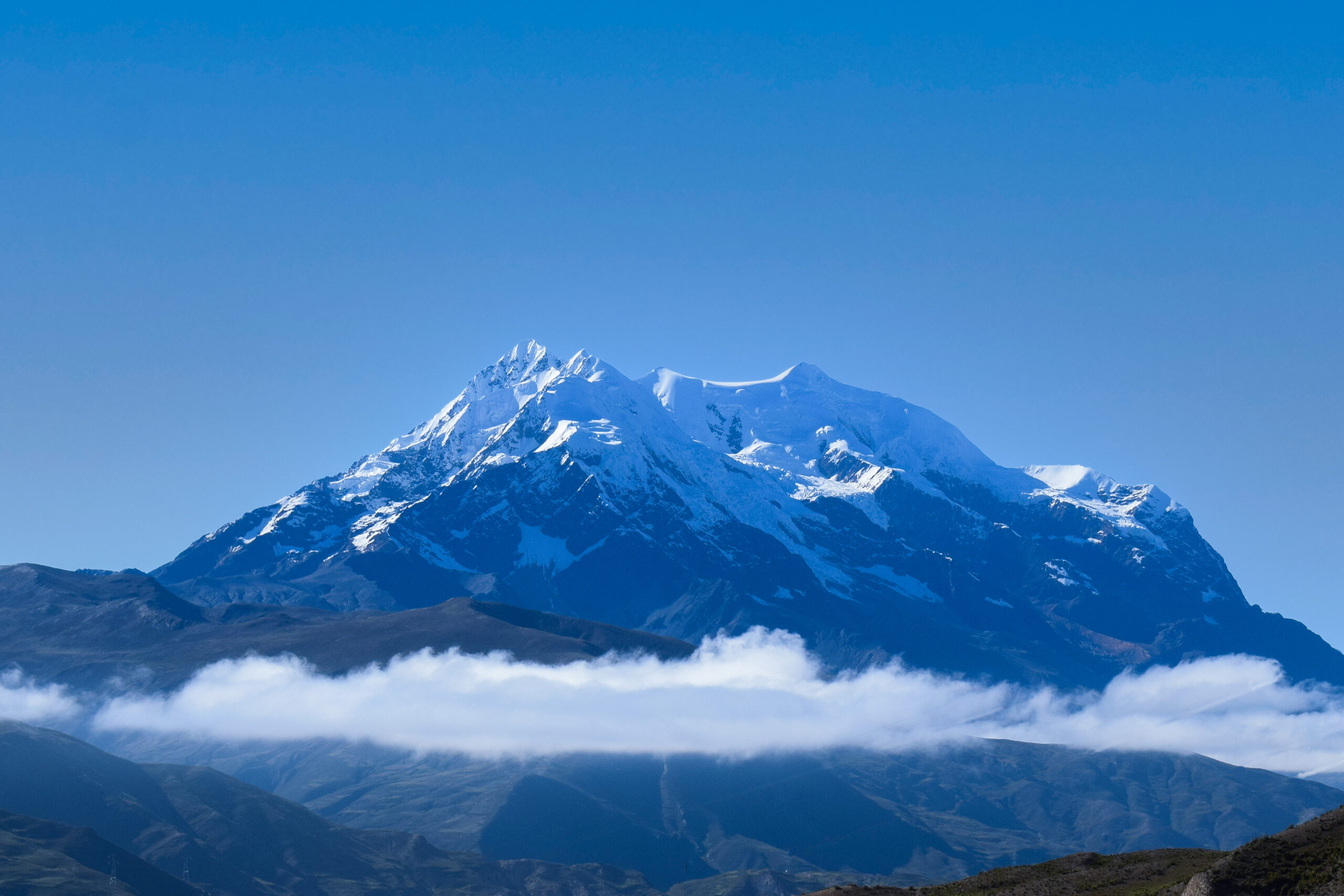
Illimani dominates the skyline of La Paz the way few mountains anywhere in the world dominate a major city. Notably, from every street, every plaza, every taxi window, the snow-topped massif rises 4,000 meters above the valley floor. The Aymara people who lived here long before any climbing literature mentioned the peak call it one of their tutelary gods — an achachila that protects La Paz. The mountain’s spiritual significance hasn’t faded. Modern climbers walking from Pinaya village to base camp pass through Aymara communities. Here offerings to Illimani are still made. The mountain isn’t a sport climbing objective but a presence.
At 6,438 meters, Illimani is Bolivia’s second-tallest peak after Nevado Sajama (6,542m) and the highest mountain in the Cordillera Real. The massif has four named summits: Pico Sur (6,438m, the main and target peak), Pico Norte (6,403m), Pico Central (6,362m), and Pico del Indio (6,109m). The Normal Route climbs Pico Sur via the southwest ridge. It’s graded Alpine PD with 1,000 vertical meters of sustained 45-50° snow and ice from the Nido de Condores high camp at 5,450m. The climbing is moderate by world-altitude standards but genuinely committing: a bergschrund crossing, exposed ridge work, and the sustained altitude effort that defines all 6,000-meter ascents.
This guide covers what you need to climb Illimani in 2026. The standard 4-day expedition from La Paz through Pinaya village to Puente Roto base camp. Then the move to Nido de Condores high camp and the pre-dawn summit push to Pico Sur. Verified operator pricing from $800 (budget local Bolivian) to $4,500 (premium international combined “Great Peaks” programs). The cultural context that makes climbing Illimani unlike climbing any peak in Nepal or the Alps. And honest assessment of what level of climber should and shouldn’t attempt this mountain — because Illimani is not a beginner’s peak, despite its commercial accessibility.

Illimani At a Glance
The essential reference facts for Illimani. Detailed sections follow below.
| Summit elevation | 6,438 m (21,122 ft) — Pico Sur (South Peak) |
|---|---|
| Four named summits | Pico Sur (6,438m), Pico Norte (6,403m), Pico Central (6,362m), Pico del Indio (6,109m) |
| Location | Cordillera Real, La Paz Department, Bolivia |
| Coordinates | 16.6533°S, 67.7833°W |
| Mountain range | Cordillera Real, Andes |
| Ranking | Highest peak in Cordillera Real; 2nd highest in Bolivia (after Sajama, 6,542m) |
| Cultural status | Sacred Aymara achachila (tutelary god); protector of La Paz |
| First ascent | September 10, 1898 — Sir William Martin Conway and Antoine Maquignaz (Swiss/Italian) |
| Aymara names | Various ceremonial names; broadly the mountain itself is the spiritual entity |
| Distance from La Paz | ~72 km southeast (3-4 hour drive to trailhead at Pinaya) |
| Visibility from La Paz | Dominates the city skyline; visible from virtually any rooftop or hillside |
| Standard route | Normal Route to Pico Sur via Nido de Condores high camp |
| Technical grade | Alpine PD (Peu Difficile) with 45-50° sustained snow/ice and bergschrund |
| Key camps | Puente Roto base camp (4,400-4,700m), Nido de Condores high camp (5,450-5,500m) |
| Expedition duration | 4 days from La Paz typical (1 day approach, 1 day base→high camp, 1 day summit + return, 1 day La Paz) |
| Summit day length | 8-12 hours round trip from Nido de Condores |
| Best season | May to September (austral winter dry season); peak window June-July |
| Permits / fees | None — free access; small fee paid to Pinaya community for trail and grazing rights |
| 2026 guided cost | $800-$4,500 USD ex-La Paz (local operators to premium international programs) |
| Prerequisites | Prior 5,500m+ summit (typically Huayna Potosi), proven crampon/ice-axe technique, glacier travel experience |
| Gateway airport | La Paz El Alto (LPB) — 3-4 hours by road to Pinaya trailhead |
Illimani in Aymara culture. For the Aymara people of the Bolivian altiplano, Illimani is an achachila — one of the tutelary mountain spirits that protect specific communities. Indigenous tradition treats Illimani as a living entity, not a sporting objective. Climbers passing through Pinaya village will often see offerings, ceremonies, and quiet acknowledgment of the mountain’s spiritual status. The Aymara worldview holds that Illimani protects La Paz and the surrounding altiplano. Climbers benefit from respecting this context. A small offering of coca leaves at base camp before the climb is traditional and welcomed by the Pinaya community. The mountain isn’t just a peak. It’s a presence.
Why Illimani Matters in South American Mountaineering
Illimani occupies a specific position in the world of high-altitude climbing that few other peaks share. It’s not the highest mountain in South America. That’s Aconcagua at 6,961m. It’s not the most technical Andean peak. Cerro Torre and the Cordillera Blanca offer far harder climbs. It’s not even Bolivia’s highest peak. Sajama edges it out at 6,542m. What Illimani is, uniquely, is the cultural and geographic anchor of the Cordillera Real, and one of the most rewarding 6,000m climbs for properly-prepared mountaineers.
The Cultural Significance
Climbing Illimani is unlike climbing any peak in Europe or North America because the cultural context cannot be separated from the mountain itself. The Aymara people consider Illimani an achachila — a tutelary mountain spirit. This isn’t a historical artifact preserved for tourists. The spiritual relationship between Bolivia’s indigenous communities and their mountains remains active and contemporary. Climbers walking from Pinaya village to base camp pass through communities where Illimani is treated as a living presence. Many local guides offer prayers or coca-leaf offerings before climbing. The mountain isn’t separate from the culture; it shapes it. For mountaineers tired of climbing peaks that exist only as physical challenges, Illimani offers something genuinely different.
The Cordillera Real Centerpiece
The Cordillera Real stretches 125 kilometers along Bolivia’s eastern Andes, containing six peaks above 6,000 meters and dozens above 5,500. Illimani anchors the southern end of the range and is the highest of them all. Climbers building toward the full Cordillera Real climbing portfolio — Huayna Potosi, Pequeño Alpamayo, Condoriri, Ancohuma — eventually reach Illimani as the capstone climb. Many operators package Illimani with Huayna Potosi (6,088m) as the “Great Peaks of Bolivia” combination, a logical progression that builds altitude and skill gradually.
The Visual Drama from La Paz
Few major climbing peaks anywhere in the world maintain such a constant visual presence over a major city. From any street in La Paz, Illimani is visible. The mountain reflects the morning sun before the city wakes. It glows pink at sunset. Climbers staying in La Paz before their expedition often spend days simply watching the mountain from various viewpoints, building anticipation. The climb itself begins with that visual relationship already established. You’re not approaching an unknown peak — you’re approaching the mountain that has been visible from your hotel window for a week.
Accessible Yet Genuine 6,438m
The Normal Route is graded Alpine PD with 45-50° sustained snow and ice — moderate by world climbing standards but genuinely demanding at altitude. Compared to other 6,000m+ peaks, Illimani sits between the relatively non-technical (Mera Peak, Cayambe) and the highly technical (Alpamayo, Ama Dablam). The combination of moderate technical demands with serious altitude makes Illimani an ideal “final summit” for climbers progressing through the broader Andean climbing portfolio. It’s not a first 6,000m peak — but it’s an excellent second, third, or capstone Andean climb.
The Andean Mercurio Connection. In 1985, an Eastern Airlines flight crashed into Illimani’s eastern slopes at approximately 5,800 meters. The wreckage and partial debris remain on the mountain today, including at certain altitudes visible from Nido de Condores high camp. The 1985 crash killed 29 people. Bolivian authorities recover artifacts as conditions permit, but the high-altitude environment preserves much of the original debris. Climbers approaching from certain directions may see fragments — a sobering reminder of how exposed and remote this mountain truly is despite its proximity to La Paz.
Who Should Climb Illimani?
Illimani is more demanding than many of the commercial Andean climbs marketed to international clients. Honest self-assessment matters here. The combination of 6,438m altitude, sustained 45-50° technical climbing, and a bergschrund crossing means climbers attempting Illimani without adequate preparation face genuine consequences.
Illimani Is Appropriate For:
Climbers with proven 5,500m+ altitude experience. Climbers who’ve summited Huayna Potosi (6,088m), Cayambe (5,790m), Chimborazo (6,263m), or comparable peaks have the right foundation. Illimani is the natural next step after these climbs, not a starting point for South American mountaineering.
Climbers with documented glacier and technical experience. The route involves real glacier travel with crevasses, a bergschrund crossing that requires technical assessment, and 1,000 meters of sustained 45-50° snow climbing. Climbers should have completed at least one comparable technical glacier route — Mont Blanc Goûter, Matterhorn Hörnli, Aconcagua Polish Glacier, or similar.
Mountaineers building toward 7,000m peaks. Illimani serves as ideal preparation for Aconcagua’s Polish Glacier route, the Peruvian Cordillera Blanca peaks, or Himalayan 7,000m objectives. The combination of altitude, technical demands, and expedition rhythm at Illimani translates directly to harder targets.
Cultural-experience-focused mountaineers. Climbers seeking peaks where mountain experience integrates with indigenous culture and spirituality find Illimani exceptional. The relationship between Aymara communities and the mountain is unlike anything in European, North American, or even most Himalayan climbing.
Climbers seeking value at 6,400m. A guided Illimani climb costs roughly one-third of a guided Aconcagua climb and offers comparable altitude experience with arguably better technical content. For climbers comparing 6,000-meter objectives, Illimani delivers exceptional value.
Illimani Is Not Appropriate For:
Climbers without prior 5,000m+ summit experience. The jump from sea level (or even Kilimanjaro’s 5,895m) to attempting a technical 6,438m climb is significant. Climbers without prior real-altitude experience face elevated AMS risk that compounds the technical difficulty.
Trekkers without technical climbing background. Illimani is not a hike-up like Kilimanjaro or Mount Toubkal. Climbers need genuine crampon and ice-axe technique, glacier rope-team experience, and the ability to climb 45-50° sustained snow. Pure trekkers should choose easier objectives.
Climbers on rigid 2-3 day schedules. Weather windows in the Cordillera Real are reliable but not guaranteed. Programs without weather buffer days force bad decisions. Build in a 1-2 day margin minimum.
Solo climbers without partner. The glacier travel, bergschrund, and exposure on the summit ridge make solo climbing genuinely dangerous. Most operators require minimum group sizes of 2-3 clients.
Climbers uncomfortable with cultural integration. The relationship between local communities and the mountain is part of the climbing experience. Climbers wanting purely sport-focused expeditions without cultural context should choose ranges where indigenous communities are less present.
Where Illimani Fits in Your Andean Progression
| Stage | Peak / Experience | Elevation | What it builds |
|---|---|---|---|
| Foundation | Mexican volcanoes (Iztaccíhuatl, Pico de Orizaba) | 5,230-5,636m | First altitude exposure; basic crampon work |
| Bolivian primer | Pequeño Alpamayo, Condoriri | 5,400-5,648m | Cordillera Real introduction; technical fundamentals |
| First 6,000m | Huayna Potosi (Bolivia) | 6,088m | Standard 6,000m introduction; usually paired with Illimani |
| The Illimani step | Illimani Normal Route | 6,438m | Technical 6,000m; cultural depth; capstone Cordillera Real climb |
| Bigger Andean peaks | Aconcagua (Argentina), Sajama (Bolivia) | 6,542-6,961m | Higher altitude; longer expeditions |
| Technical Andean | Alpamayo, Huascarán (Cordillera Blanca, Peru) | 5,947-6,768m | Sustained technical climbing at altitude |
| Patagonian | Cerro Torre, Fitz Roy (Patagonia) | 3,128-3,405m | Different paradigm — weather, granite, technical alpinism |
| Himalayan transition | Mera Peak, Island Peak, Cho Oyu | 6,189-8,188m | Where Andean skills meet bigger mountains |
The Standard Route Up Illimani
The Normal Route handles 90%+ of Illimani climbers. Two alternative routes exist (Khoya Khuyu and the German South Ridge) but are climbed only by experienced parties seeking variety. Here’s the breakdown of each.
| Route | Aspect | Difficulty | First ascent | Usage |
|---|---|---|---|---|
| Normal Route to Pico Sur | Southwest | Alpine PD (45-50° snow/ice) | 1898 (Conway) | ~90% of climbers |
| Khoya Khuyu Route | South face | Alpine D+ (technical mixed) | July 1972 (Mesili/Sanchez) | Experienced parties only |
| South Ridge German Route | South ridge | Alpine D- | May 1950 (Ertl/Schroder) | Independent expert parties |
Route 1: The Normal Route to Pico Sur (90% of climbers)
The Normal Route is the route that nearly every Illimani climber, guided or independent, uses to summit Pico Sur. The progression spans approximately 4 days from La Paz. It follows a logical altitude ramp through Pinaya village, Puente Roto base camp, and Nido de Condores high camp before the summit push. The route’s technical content sits at the upper range of Alpine PD. It’s moderate by global standards but genuinely demanding at altitude with a bergschrund and sustained steep climbing.
The Full Day-by-Day Progression
- Day 1: La Paz to Pinaya (3,800m) to Puente Roto base camp (4,400-4,700m). Morning departure from La Paz. The drive through the Palca canyon is a highlight in itself — dramatic geology and rural communities. Arrival in Pinaya around midday, organize mule/porter support with the village. The 3-hour hike to Puente Roto gains 600m through high-altitude grassland and small streams. Make camp, hydrate, eat well, sleep early.
- Day 2: Base camp to Nido de Condores high camp (5,450-5,500m). Morning departure, 5-6 hours of climbing through moraine fields, an orange-colored rock ridge, and the col known locally as Markirivi or Maikibirri. The trail follows the southwest ridge to one of the most spectacular high camps in the Cordillera Real — perched directly above the glacier with views to Huayna Potosi, the Bolivian altiplano, and (on clear days) Lake Titicaca far in the distance. Tent setup, gear check, hydration, dinner. Sleep is difficult at 5,500m — most climbers sleep poorly the first night.
- Day 3 (Summit Day): Nido de Condores to Pico Sur (6,438m) and return to base camp. 02:00 wake-up. 03:00 departure with headlamps. The route crosses the bergschrund within the first hour, then climbs sustained 45-50° snow and ice for 5-6 hours to the summit ridge. The final ridge to Pico Sur exposes climbers to significant drops on both sides. Summit typically reached between 08:00 and 10:00. Brief summit time (15-30 minutes) for photos and the panoramic view before descent. Total summit day: 8-12 hours round trip to base camp.
- Day 4: Descent from base camp to Pinaya, transfer to La Paz. 1-hour hike down to Pinaya village. Vehicle transfer back to La Paz. Most climbers arrive at hotel by early afternoon, celebrate over a Bolivian meal, then begin recovery.
Strengths
- Most efficient route — 4-day expedition from La Paz
- Nido de Condores is among the most beautiful high camps in the Andes
- Cultural depth through Pinaya village approach
- Affordable Bolivian guide network with strong route knowledge
- Logical progression after Huayna Potosi
Considerations
- Sustained 45-50° climbing demands solid technique
- Bergschrund crossing adds technical commitment
- Sleep at 5,500m is genuinely difficult — most climbers sleep poorly
- Exposed summit ridge requires steady mountain sense
- Compressed 4-day schedule leaves limited weather buffer
Route 2: Khoya Khuyu Route (experienced parties)
The Khoya Khuyu route ascends Illimani’s south face through technical mixed terrain. First climbed by Alain Mesili and a partner in July 1972, this route remains a serious technical objective rarely attempted by guided expeditions. Climbers attempting Khoya Khuyu need extensive technical climbing experience, comfort on mixed rock and ice, and the willingness to commit to a route with limited rescue options. The route is climbed by perhaps a handful of parties per season — usually independent expert climbers seeking an alternative to the Normal Route.
Strengths
- Technical climbing on a historic 1972 line
- Far less crowded than the Normal Route
- Genuine technical challenge for accomplished climbers
Considerations
- Sustained Alpine D+ on mixed terrain
- Limited rescue infrastructure on the south face
- Independent expedition planning required
- Not commercially guided
Route 3: South Ridge German Route (independent climbers)
The South Ridge German Route was first climbed in May 1950 by Hans Ertl and a German partner. The line follows the south ridge of Illimani — a more direct but more technically demanding ascent than the Normal Route. Like Khoya Khuyu, this route is climbed primarily by experienced independent parties rather than commercial groups. The combination of altitude, technical content, and exposure makes the route a serious undertaking that requires careful planning, strong technical climbing skills, and self-rescue capability.
Illimani Climbing History: From 1898 to 2026
For centuries before any European climber attempted Illimani, the Aymara people of the Bolivian altiplano treated the mountain as one of their tutelary gods (achachila). The peak’s protective relationship with La Paz and surrounding communities was central to indigenous spirituality. Ceremonial offerings, prayers, and seasonal rituals connected Aymara culture to the mountain in ways that persisted through Spanish colonization and continue in modern Bolivia. Local communities maintained intimate knowledge of the mountain’s slopes long before any climbing record existed.
French explorer Charles Wiener conducted the first recorded European exploration of Illimani’s lower slopes in 1877. Wiener’s expedition didn’t attempt the summit but established the first detailed European understanding of the mountain’s geography and approach. His maps and observations laid the groundwork for subsequent climbing expeditions through the late 19th century.
British alpinist Sir William Martin Conway and Italian guide Antoine Maquignaz made the first ascent of Illimani’s Pico Sur on September 10, 1898. Conway was one of the most accomplished mountaineers of his generation, having previously climbed extensively in the Karakoram and the Alps. The 1898 ascent established the Normal Route — essentially the same line used by modern climbers via the southwest ridge from Nido de Condores. Conway published his account in The Bolivian Andes (1901), opening the Cordillera Real to international mountaineering attention.
Following Conway’s ascent, Illimani saw irregular climbing activity for several decades. Various European expeditions through the early 20th century repeated the Normal Route and explored alternative lines. The mountain’s remoteness, combined with the logistical challenges of reaching Bolivia in this era, kept climbing volume low. Most ascents were undertaken by serious mountaineers rather than commercial parties.
Hans Ertl and his climbing partner established the South Ridge German Route in May 1950. Ertl was a notable mountaineer who had previously been involved in the controversial 1934 Nanga Parbat expedition. The South Ridge climb opened a more technical alternative to the Normal Route and demonstrated that Illimani could be approached from multiple aspects.
French climber Alain Mesili and Sanchez established the technically demanding Khoya Khuyu route on Illimani’s south face in July 1972. The route added a difficult mixed climbing line to the mountain’s growing portfolio of climbs. Mesili would go on to become one of the most influential figures in Bolivian mountaineering, eventually establishing the country’s first commercial guiding service.
On New Year’s Day 1985, Eastern Airlines Flight 980 crashed into Illimani’s eastern slopes at approximately 5,800 meters, killing all 29 people on board. The aircraft had been en route from Asunción to Miami via La Paz when it impacted the mountain in poor visibility. The wreckage remains on Illimani today at altitude. Bolivian authorities have recovered partial debris over the years, but the high-altitude environment preserves most of the original site. The crash remains one of the most significant aviation incidents in Bolivian history.
Through the 1990s, Bolivian commercial guiding services developed structured Illimani climbing programs. Alain Mesili’s pioneering work in earlier decades led to a generation of Bolivian guides who could lead international clients through the Normal Route safely. Cordillera Real climbing became economically significant for La Paz tourism, and Illimani emerged as the flagship climb of the range.
The early 21st century saw major improvements in Cordillera Real climbing infrastructure. Local Bolivian operators including Andean Ascents, Bolivian Mountains, and others established consistent service standards. International operators (Alpine Ascents, Adventure Consultants) began offering Illimani programs as part of “Great Peaks of Bolivia” combinations. The Pinaya village community formalized arrangements with climbing operators for trail access and mule support.
Bolivia’s pandemic restrictions suspended international Illimani climbing for most of 2020. Local Bolivian guides lost significant income during this period. Limited climbing resumed in late 2021 with extensive testing requirements. By 2022, international climbing returned to roughly 70% of pre-pandemic volume, with full recovery achieved by the 2023 season.
The 2023-2025 climbing seasons saw strong international demand for Illimani expeditions. Local Bolivian operators reported full booking calendars during the peak June-July window. The 2026 season is currently active with departures running from May through September. Glacier retreat on the upper mountain continues as it does across the tropical Andes — the bergschrund position and crevasse patterns shift annually, requiring updated route assessment each season. The cultural relationship with the Pinaya community remains positive and stable.
Illimani Summit Day Timeline: Hour-by-Hour from Nido de Condores
Summit day on Illimani runs 8-12 hours round trip from Nido de Condores high camp at 5,450 meters to Pico Sur at 6,438 meters and back to base camp. Strong, well-acclimatized teams complete the round trip in 8-9 hours. Slower parties or those affected by altitude may take 11-13 hours. Here’s the standard timeline used by Bolivian guides.
Standard Illimani Summit Day — Nido de Condores (5,450m) to Pico Sur (6,438m) and Return
Why the early start matters on Illimani. The 45-50° upper slope must be climbed before mid-morning sun softens the snow. Climbers who reach the summit by 09:00-10:00 typically descend in firm conditions with manageable risk. Climbers still on the upper face at noon face softening snow, increased avalanche risk on the steeper sections, and reduced safety margins. The 02:00 wake-up isn’t optional discipline — it’s the standard timing that defines safe Illimani ascents. Compressed schedules that delay summit day starts compound risk significantly.
Which Illimani Approach Fits Your Situation?
The choice on Illimani isn’t typically about route — the Normal Route handles 90% of climbers. The real choices are about operator tier, expedition variant, and combination with other Cordillera Real peaks.
Match Yourself to an Illimani Approach
When to Climb Illimani: Season-by-Season Analysis
May: Early Season
The Illimani climbing season opens in May as the austral autumn transitions to dry winter conditions. Some operators run the first programs of the year in mid-to-late May. Conditions are typically excellent — firm snow, stable weather, clear visibility — though daylight hours are shortest and temperatures coolest. Climbers willing to accept the cold often find this an excellent quieter window before peak season crowds arrive in June.
June to July: Peak Window
The prime Illimani climbing window. Cordillera Real weather is at its most stable. Dry, clear days dominate. Cold but predictable temperatures. Snow conditions are typically firm at night for the 02:00 summit starts. Nido de Condores high camp sees its highest occupancy during this window. Most fixed-date operator programs run during June and July. Booking refuges and operators 6-8 weeks ahead is recommended for peak departures.
August: Late Peak
August remains an excellent climbing month though winds can pick up on the upper mountain. Days lengthen slightly compared to June. Snow conditions remain reliable. Crowds decline modestly from June-July peak. Many climbers consider August an optimal balance of stable weather and slightly less crowded camps.
September: Shoulder Season
September brings increasing variability. Daylight hours lengthen significantly. Temperatures warm gradually as spring approaches. Some operators continue programs through mid-September, but increased avalanche risk on warming upper slopes pushes most operators to end their seasons by month-end. Climbers attempting September departures should plan for higher weather variability.
October to April: Rainy Season
The austral wet season delivers heavy precipitation, low visibility, and dangerous trail and route conditions. Commercial Illimani climbing doesn’t operate during these months. Some experienced parties attempt the mountain in shoulder months (October, April) but conditions are highly variable and risk increases considerably. The mountain effectively closes from October through April for international climbing.
Illimani in 2026: Cost Breakdown
Illimani is among the most affordable major 6,000-meter peaks for international climbers. Bolivia’s lower overall cost structure, combined with no permit or park fees, makes Illimani exceptionally good value compared to Himalayan or Aconcagua programs.
2026 Guided Expedition Pricing
| Operator Tier | 2026 Cost (USD) | What’s Included |
|---|---|---|
| Budget local Bolivian | $800-$1,500 | Bolivian guide, mule support, basic logistics, group cooking |
| Mid-tier local (Andean Ascents, Jiwaki, Travels Bolivia) | $1,500-$2,500 | IFMGA Bolivian guide, full Sherpa-style support, quality meals, La Paz transfers |
| “Great Peaks of Bolivia” combined (Illimani + Huayna Potosi) | $2,000-$3,500 | 8-10 day program covering both summits with progressive acclimatization |
| Premium international (Alpine Ascents, Adventure Consultants) | $2,800-$4,500 | Western + Bolivian guide team, smaller ratios, hotel upgrades, often combined with Huayna Potosi |
| Private 1:1 guiding | $400-$600/day | Custom dates, flexible itinerary, dedicated Bolivian guide |
2026 Total Trip Budget Breakdown
| Cost Component | 2026 Amount (USD) | Notes |
|---|---|---|
| Guided expedition (mid-tier) | $1,500-$2,500 | Standard 4-day Illimani program ex-La Paz |
| International flights to La Paz (LPB) | $1,000-$1,800 | From US: $900-$1,400; from Europe: $1,200-$1,800; from Australia: $1,500-$2,200 |
| La Paz hotel (pre/post) | $80-$300 | 3-5 nights; mid-range hotels in central La Paz or San Pedro |
| Meals in La Paz | $60-$150 | Bolivian cuisine is excellent and very affordable |
| Personal climbing gear | $300-$1,500 | If you don’t own crampons, ice axe, harness, hard shell |
| Gear rental in La Paz | $50-$120 | Plastic boots, crampons, harness available from outfitters |
| Travel and rescue insurance | $120-$300 | High-altitude rescue coverage required |
| Tips for guides, cooks, mule team | $100-$250 | Customary; significant portion of staff income |
| Pinaya community fee | $10-$30 | Paid to village for trail access and grazing rights |
| Park fees / permits | $0 | No permits required; access to Illimani is free |
| Realistic 2026 trip budget | $3,200-$5,500 | Including international flights and full preparation |
How Illimani compares. A complete Illimani trip costs roughly one-quarter of a guided Aconcagua expedition, half of a guided Mera Peak climb, and one-tenth of a guided Denali ascent. The technical difficulty exceeds Mera Peak (non-technical) and Aconcagua’s Normal Route (also non-technical), placing Illimani in similar difficulty to Aconcagua’s Polish Glacier route but at significantly lower cost. For climbers seeking technical 6,400m+ mountaineering at moderate cost, Illimani delivers exceptional value. The cultural depth adds further differentiation that purely cost-comparison can’t capture.
Gear Checklist for Illimani
Illimani gear sits at the technical end of Andean climbing kit. The Normal Route doesn’t require ice-climbing specialist gear, but the sustained 45-50° terrain and bergschrund crossing mean standard mountaineering equipment must be in good condition and properly fitted.
Footwear
- B3 double mountaineering boots — La Sportiva G2, Scarpa Phantom 6000, or similar; rentable in La Paz for $30-$50
- 12-point crampons — Petzl Vasak, Grivel G12 (see our Crampons Buyer’s Guide)
- Approach shoes — for the 3-hour hike from Pinaya to base camp
- Full-length gaiters — to keep snow out on summit day
- Climbing socks (3 pairs) — heavy weight merino wool
Clothing System
- Base layers (top and bottom) — merino or synthetic
- Mid-layer fleece — for active climbing
- Light insulated jacket — synthetic or down sweater
- Heavy down parka — for summit day and Nido de Condores nights; -25°C rating minimum
- Hardshell jacket — Gore-Tex Pro or equivalent
- Hardshell pants — required above base camp
- Soft shell pants — for the approach
- Warm hat / balaclava
- Sun hat — UV at 5,500m+ is intense
- Light gloves — for active climbing
- Heavy mittens or down mitts — for summit day
Technical Climbing Gear
- Ice axe — straight-shaft general mountaineering axe, 60-70cm length — see our Ice Axe Guide
- Climbing harness — adjustable alpine harness
- Helmet — required on the route
- Locking carabiners (4-6)
- Non-locking carabiners (4-6)
- Prusik cord / mechanical ascender — for crevasse rescue and self-rescue
- Belay/rappel device — ATC or similar
- Slings / runners (4)
- Trekking poles — useful for the Pinaya approach
Sleep & Camp Gear
- 60-75L backpack — for personal gear during the climb
- Sleeping bag rated to -20°C — for Nido de Condores; mules carry the bag to base camp
- Sleeping bag liner — adds warmth, hygiene
- Insulated water bottles (2-3L total)
- Personal mug — for tea breaks at high camp
Personal & Safety
- Headlamp with spare batteries — essential for 02:00 summit day
- Sunscreen SPF 50+ and lip balm with SPF
- Glacier glasses (Cat 4) — and a backup pair
- Personal first aid kit — blisters, ibuprofen, electrolytes
- Diamox / acetazolamide — discuss with your doctor
- Emergency bivy or space blanket
- Passport (Bolivian entry stamp) and travel insurance documentation
- Cash (USD and Bolivianos) — for tips, gear rental, community fees
- Coca leaves — useful for altitude; also traditional offering at base camp
Frequently Asked Questions About Climbing Illimani
How tall is Illimani and where is it located?
Illimani rises to 6,438 meters (21,122 feet) at its highest point, Pico Sur (South Peak). The mountain stands in the Cordillera Real range of the Bolivian Andes, in the La Paz Department, about 72 kilometers southeast of La Paz. The coordinates are 16.6533°S, 67.7833°W. Illimani is the highest peak in the Cordillera Real and the second-highest mountain in Bolivia after Nevado Sajama (6,542m). The massif has four named summits: Pico Sur (6,438m), Pico Norte (6,403m), Pico Central (6,362m), and Pico del Indio (6,109m). For the Aymara people, Illimani is one of their tutelary gods (achachila) and remains spiritually significant today. The peak dominates the skyline of La Paz, visible from nearly every street in the city.
How difficult is climbing Illimani?
Illimani’s Normal Route to Pico Sur is graded Alpine PD (Peu Difficile) with sustained sections of 45-50 degree snow and ice climbing. The route is technically moderate but involves real glacier travel, crevasse exposure, a bergschrund crossing, and a 1,000-meter sustained snow and ice climb on summit day. At 6,438 meters, climbers face severe altitude challenges with approximately 47% of sea-level oxygen. The summit day from Nido de Condores high camp runs 8-12 hours round trip. Illimani is harder than Mera Peak (non-technical) or Mount Kazbek (moderate technical). This is not a first 6,000-meter climb — Bolivia’s Huayna Potosi (6,088m) is the standard prep mountain.
What’s the best route to climb Illimani?
The Normal Route on Illimani climbs the West Face to Pico Sur via Nido de Condores high camp. The full progression starts in La Paz with a 3-4 hour drive to the village of Pinaya (3,800m), then a 3-hour hike to base camp at Puente Roto (4,400-4,700m). Day two ascends 5-6 hours to high camp at Nido de Condores (5,450-5,500m). The summit push begins around 02:00 from Nido de Condores, climbing the southwest ridge for 6-7 hours through sustained 45-50 degree snow and ice with a bergschrund crossing, reaching Pico Sur at 6,438m. Alternative routes exist including the Khoya Khuyu line (Alpine D+) and the South Ridge German Route (Alpine D-), but the Normal Route handles 90%+ of climbers.
When is the best time to climb Illimani?
The Illimani climbing season runs from May through September during the Bolivian dry season (austral winter). June and July represent the peak window with the most stable weather, reliable snow conditions, and clear days. August can bring stronger winds but remains a popular climbing month. May is shoulder season with potentially better ice quality but more variable weather. September brings warming temperatures and increasing avalanche risk on the upper face. October through April is the rainy season — heavy precipitation, low visibility, and dangerous route conditions make climbing impractical. Most operators run fixed-date programs from late May through early September.
How much does climbing Illimani cost in 2026?
Guided Illimani expeditions in 2026 typically cost between $800 and $3,500 USD per person for the standard 4-day climbing program ex-La Paz. Local Bolivian operators offer the most affordable options at $800-$1,500 per person with Bolivian IFMGA-certified guides and complete logistics including mule support. Mid-range international operators charge $2,000-$2,800 with smaller group ratios. Premium international operators charge $2,800-$4,500 typically as part of a “Great Peaks of Bolivia” combination including Huayna Potosi. International flights to La Paz add another $1,000-$1,800 depending on origin. Bolivia has no national park fees or climbing permits for Illimani — access to the mountain is free, with only small fees paid to the Pinaya community for trail and grazing rights.
Do I need prior climbing experience to attempt Illimani?
Yes — Illimani requires meaningful prior climbing experience. The Normal Route involves sustained 45-50° snow and ice climbing for 1,000 vertical meters, a bergschrund crossing, glacier travel, and altitude effort at 6,438 meters. Climbers should have prior 5,500m+ summit experience (Huayna Potosi at 6,088m is the standard prep mountain), proven crampon and ice-axe technique on real terrain, and glacier rope-team experience. This is not a first 6,000-meter climb. Climbers attempting Illimani without adequate preparation face genuine risk. The combination of technical demands and altitude makes Illimani significantly harder than non-technical altitude peaks like Kilimanjaro or Aconcagua’s Normal Route.
What’s the summit success rate on Illimani?
Summit success rates on Illimani vary by operator and conditions. Well-acclimatized climbers on standard 4-day programs typically report 55-70% summit success — lower than non-technical peaks because of the technical demands and altitude combination. Climbers who acclimatize first on Huayna Potosi as part of a combined “Great Peaks of Bolivia” program report higher success rates of 70-80%. Weather is the second-largest factor — though Cordillera Real weather is more predictable than Himalayan weather, multi-day storms still affect summit timing. Operators that include a 1-day weather buffer in their programs achieve more consistent success rates than rigid 4-day schedules.
How does Illimani compare to Huayna Potosi?
Huayna Potosi (6,088m) and Illimani (6,438m) are the two flagship climbs of the Cordillera Real. Huayna Potosi is the standard “first 6,000m peak” in Bolivia — easier technical demands, shorter expedition, more accessible. Illimani is harder, taller, and more committing. Most climbers should do Huayna Potosi first to validate their altitude and technical performance. Then they can attempt Illimani in a later trip or as the second peak in a “Great Peaks of Bolivia” combined program. Climbers who can summit Huayna Potosi cleanly are typically ready to attempt Illimani; climbers who struggled on Huayna Potosi should consolidate skills before attempting Illimani. The combined program is the most logical Bolivian climbing trip for most international clients.
What’s the cultural significance of Illimani?
Illimani is an achachila — a tutelary mountain god — in the Aymara spiritual tradition. The Aymara people who live in the Bolivian altiplano and the La Paz region consider Illimani a living presence that protects their communities. This isn’t a historical artifact preserved for tourists — the spiritual relationship remains active and contemporary. Climbers walking through Pinaya village will often see traditional offerings, prayers, and quiet acknowledgment of the mountain’s status. Many local guides offer coca-leaf offerings before climbing. Visitors who respect this cultural context find the climbing experience considerably richer. Small offerings at base camp and respectful engagement with Pinaya community members make a real difference compared to purely sport-focused expeditions elsewhere.
Can I see the 1985 Eastern Airlines crash site on Illimani?
Eastern Airlines Flight 980 crashed into Illimani’s eastern slopes on New Year’s Day 1985, killing 29 people. The wreckage remains at approximately 5,800 meters on the eastern aspect of the mountain. The Normal Route on the southwest ridge doesn’t pass through or near the crash site. Climbers on the standard route may glimpse debris from certain angles at Nido de Condores high camp, but the crash site itself is on a different face. Bolivian authorities have recovered partial debris over the years, but the high-altitude preservation means much remains. The crash isn’t a tourist destination and shouldn’t be sought out — it’s a memorial site for the families involved and should be treated with respect.
Illimani Planning Resources
Sources & Further Reading
- SummitPost — Illimani comprehensive route descriptions and historical climbing records
- SummitPost — Illimani Normal Route detailed technical notes
- Alpine Ascents International — Great Peaks of Bolivia itinerary and 2026 program details
- Andean Ascents — Climb Illimani 6,442m route guide and 2026 pricing
- Jiwaki — Climbing Illimani 4-day expedition program (February 2026)
- DirectMountain — Mountaineering in Bolivia: climbing Nevado Illimani
- Expedition Bolivia — Illimani Normal Route 4-day program and operator information
- Travels Bolivia (Thaki Travel) — Illimani Ascent detailed itinerary
- Kanoo Tours — Illimani 4-day climb program
- Sir William Martin Conway — The Bolivian Andes (1901) first ascent account
- Alain Mesili — Bolivian mountaineering historical archives
- Wikipedia — Illimani comprehensive reference for elevation, history, geology
Last updated: May 24, 2026. Next scheduled update: April 2027 (pre-season verification of operator pricing and route conditions).
Planning an Andes Climbing Trip?
Illimani is the capstone climb of Bolivia’s Cordillera Real, ideally paired with Huayna Potosi as a “Great Peaks of Bolivia” combination. See our comprehensive Andes High-Altitude Giants collection for the complete South American mountaineering portfolio.
View Andes Collection →Three Ways Up Illimani — Only One Is the Normal Commercial Route
For most climbers, the decision is easy: climb Pico Sur from Nido de Cóndores by the normal southwest-side route. The other lines belong to experienced independent or highly technical parties and should not be treated as casual alternatives when normal-route conditions deteriorate.
| Route | Grade reference | Typical length / structure | Crux | Objective hazard | Descent | Camp / approach | Best fit | 2026 access note |
|---|---|---|---|---|---|---|---|---|
| Pico Sur Normal Route Standard choice | Source-dependent: PD to AD− / AD. SummitPost’s dedicated route description uses PD. Current local operators Andean Ascents and Andes Brothers publish AD− / AD. | Standard commercial structure: 4 days / 3 nights from La Paz. Nido de Cóndores: ~5,450–5,500 m. Summit climb: roughly 6 hours up, commonly 10–12+ hours for the complete summit day. | Bergschrund / major crevasse negotiation plus the 45–55° “Escalera al Cielo” snow-and-ice section. | Crevasses, changing snow bridges, avalanche/soft-snow exposure, steep icy slopes, exposed upper ridge and 6,400m altitude. | Normally reverse the ascent route. Strong teams commonly descend from the summit past Nido de Cóndores and continue to base camp. | La Paz → Pinaya → Puente Roto base camp → Nido de Cóndores → Pico Sur. | Properly acclimatized climbers with proven crampon, ice-axe and rope-team skills. Ideal after Huayna Potosí or equivalent experience. | Current local operators continue to publish the Pinaya / Puente Roto / Nido de Cóndores program. Reconfirm glacier condition, road access and community/site arrangements immediately before departure. |
| Khoya Khuyu Expert technical line | D+ in the established route references used by this guide. | No standardized four-day commercial template. Expedition timing depends on line condition, technical pace and camp strategy. | Sustained technical mixed / snow-and-ice terrain rather than one short normal-route crux. | Serious exposure, complex retreat, objective ice/snow hazard and extremely limited rescue support. | Route-dependent. Do not assume the normal-route descent is automatically available or appropriate without prior planning. | South-face objective; requires a dedicated technical expedition plan rather than the normal Pinaya tourist itinerary. | Self-sufficient, highly experienced alpinists with technical mixed-climbing and high-altitude rescue skills. | Not a standard commercial Illimani program. Current line condition must be established locally before committing. |
| German South Ridge Serious ridge objective | D− in the historical/reference grading used by the existing Illimani guide. | Expedition-style route; significantly less standardized than the Pico Sur normal route. | Sustained ridge and mixed technical movement combined with altitude and commitment. | Exposure, rock/ice condition, cornices, route-finding, retreat difficulty and altitude. | Must be planned as part of the route strategy. Do not treat it as a simple harder version of the normal route. | South-ridge approach rather than a routine commercial Nido program. | Independent experts seeking a historic, committing Alpine route. | Very rarely climbed compared with the normal route. Local route intelligence is essential. |
Why you will see both PD and AD in Illimani route descriptions
Alpine grades are condition-sensitive, and Illimani’s glacier is changing. SummitPost’s dedicated normal-route description uses Grade II / PD with roughly 50° snow and ice, while current Bolivian operators publish AD or AD− for the same normal climbing line. Rather than treating one letter as permanent, plan for the actual terrain: roped glacier travel, large crevasses, a bergschrund, 45–55° snow/ice, exposed ridges and almost 1,000 vertical metres of climbing above a 5,450m high camp.
Illimani Still Runs as a Compact Four-Day Climb — If You Arrive Acclimatized
Current Bolivian programs continue to use the classic Pinaya → Puente Roto → Nido de Cóndores → Pico Sur structure. The four climbing days are compact; they are not a substitute for the acclimatization that should happen before the expedition.
Andes Brothers and Viacha Tours currently publish four-day normal-route programs from La Paz.
Andes Brothers currently publishes a 1:2 UIAGM mountain-guide ratio for its normal Illimani program.
Viacha lists $694 per person with a two-person minimum; Andes Brothers lists $870 pp for two or three and $1,450 solo. These are examples, not a market average.
Some local operators advertise a broader April–October operating range. Use May–September as the cleaner dry-season planning window and verify snow/glacier conditions for the actual date.
Solve the Skill and Condition Questions First
The normal route is technically moderate only for a climber who already knows how to move efficiently on steep snow and a crevassed glacier at altitude.
Put Illimani in the Right Andean Sequence
Illimani works best as a serious glaciated 6,000m progression peak—not as an isolated bucket-list climb. Compare it with the neighboring Andes giants and build the altitude and glacier competence before committing.
Was this helpful?
🏔Related peaks nearby
🧭Explore & compare
Global Summit Guide is an independent mountaineering resource founded in 2026. The team combines first-hand trekking and climbing experience with in-depth research and professional health and nutrition review to help climbers choose objectives, prepare properly, and stay safe.
Health, altitude, and nutrition content is reviewed by Taylor Ludlow (Registered Nurse) and Brigg Hoopes (Nutritionist).
What We Don't Know Yet
Mountain information changes quickly. This box explains the limits of what this page can responsibly promise.
- Route conditions, trailhead access, crevasse exposure, stream crossings, and rescue access may vary from published planning guidance.
- Total trip cost can change with flights, lodging, guide pricing, permits, gear rentals, transportation, and exchange rates.
- Visa, passport, vaccination, border, insurance, and local transportation rules may change before your trip.
Verify current conditions with official land managers, guide services, local forecasts, and current route reports before booking or climbing.
Mountaineering, rock and ice climbing, glacier travel, and high-altitude activity are inherently dangerous and can result in serious injury or death. The information on Global Summit Guide is provided for general informational and educational purposes only and is not a substitute for professional instruction, qualified guiding, proper equipment, or your own judgment and experience.
Route conditions, weather, snowpack, permits, regulations, and hazards change constantly and may differ from what is described here. Details may be incomplete, out of date, or contain errors. Always verify current information with local authorities, certified guides, and official sources before making any decision in the mountains.
Nothing on this site is medical, legal, or financial advice. Our fitness, acclimatization, altitude, and nutrition content is general in nature; consult a qualified physician before beginning any strenuous exercise program or exposing yourself to high altitude.
You are solely responsible for your own safety and decisions. To the fullest extent permitted by law, Global Summit Guide and its team accept no liability for any loss, injury, damage, or expense arising from use of, or reliance on, this information. By using this site you acknowledge these risks and accept these terms.
Some links on this site may be affiliate links. If you buy through them we may earn a small commission at no extra cost to you; this never affects our recommendations.
Global Summit Guide recommendation path
Next Best Mountain to Research
Use these recommendations to continue the right planning path instead of stopping on one page.
Use current permit, weather, route, and operator information before booking or climbing.
Search Flights, Hotels & Rental Cars
Have the mountain or destination picked? Use Expedia to compare the flights, lodging and rental cars that fit your actual trip dates. For mountain travel, consider arriving early enough for delays and adding a buffer night after the climb before a fixed flight home.
Compare current flight, hotel and car options.
Affiliate disclosure: Global Summit Guide may earn a commission if you book through this link, at no additional cost to you.