
Last updated September 18, 2026
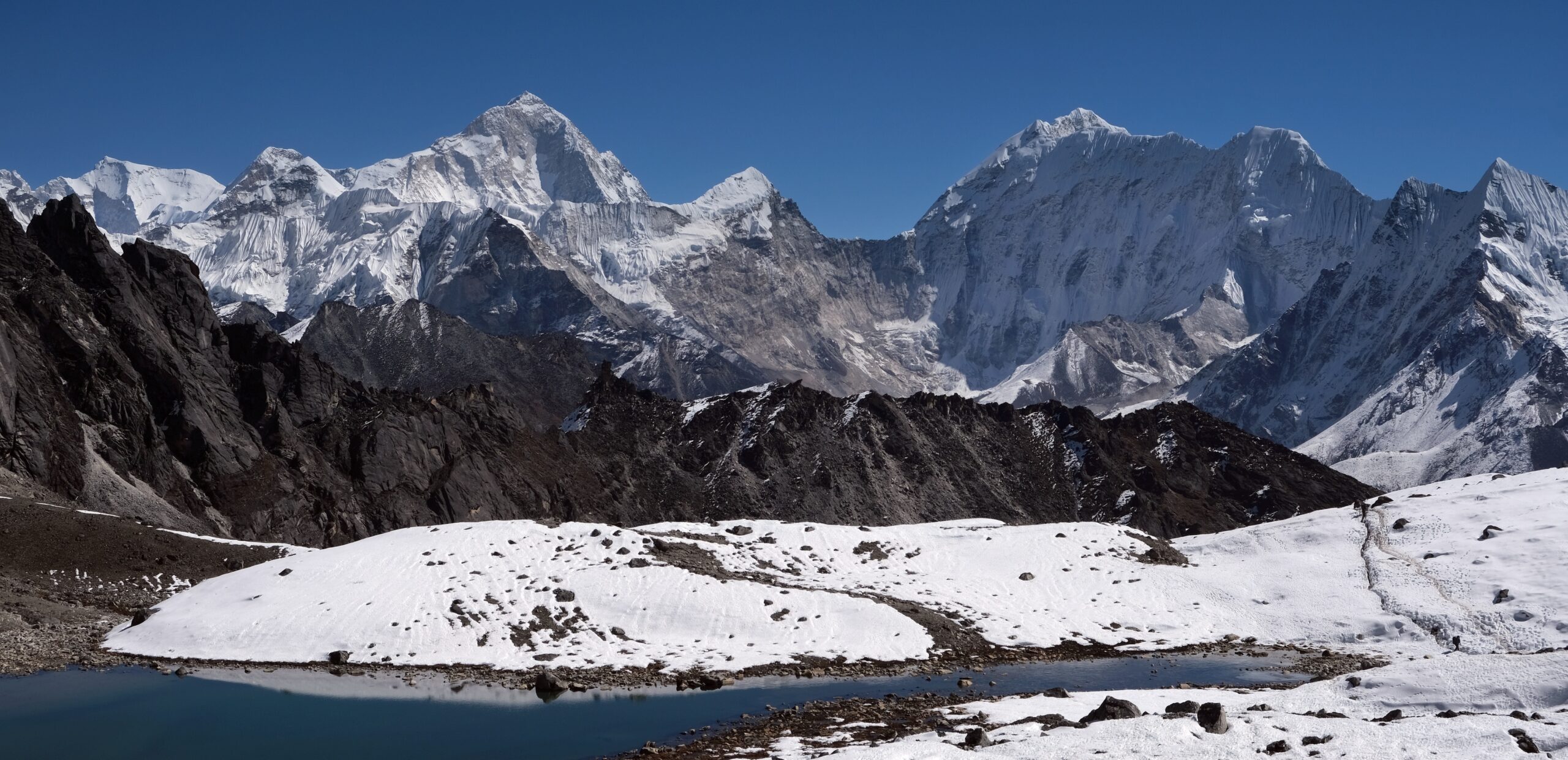
Makalu Climbing Guide: Northwest Ridge, Cost, Difficulty & Permits
Makalu is a technical 8,000-metre expedition, not simply a lower alternative to Everest. The normal route crosses Makalu La and finishes on a steep summit pyramid where exposed snow, ice and rock demand strong skills after weeks at extreme altitude.
Makalu is one of the hardest standard-route 8,000ers.
The normal commercial climb approaches from Nepal and ascends the northwest side through Makalu La before traversing onto the upper mountain. The final summit pyramid is the defining problem: the route becomes steeper, more exposed and more technical when the climber is already above 8,000 metres.
Makalu is best treated as a later-stage Himalayan objective. A prior 8,000er, strong fixed-line efficiency, technical snow-and-ice experience, proven cold management and the ability to function independently at high camps are more important here than simply having excellent aerobic fitness.
Makalu at a glance
Makalu stands on the Nepal-China border in the Mahalangur Himal, roughly 19-20 km southeast of Everest. Its isolated four-sided pyramid rises above the Barun valley and gives the mountain a very different expedition character from the heavily trafficked Everest corridor.
| Planning question | Makalu answer | Why it matters |
|---|---|---|
| Elevation | 8,485 m / 27,838 ft | Death-zone altitude with prolonged exposure during the final summit push. |
| World ranking | Fifth-highest mountain | Lower than Everest, K2, Kangchenjunga and Lhotse, but height alone understates route difficulty. |
| Normal commercial side | Nepal | Most modern commercial logistics approach from Nepal through the Barun region. |
| Normal route | Northwest side via Makalu La | The route’s identity comes from the high col, upper traverse and summit pyramid. |
| Main season | Spring | Late April through May usually offers the strongest commercial support and the best-established summit window. |
| Typical commitment | About 6-8 weeks | Acclimatization, load carries, weather waiting, summit push and descent all need margin. |
Makalu orientation map
Use the map for geographic context only. Camp positions, glacier lines and fixed-rope placement vary by expedition and conditions.

Why Makalu is harder than its height rank suggests
Makalu is not difficult because of one spectacular crux. The challenge is the combination of technical upper terrain, extreme altitude, wind exposure, a smaller support ecosystem and a summit day that remains serious all the way through the descent.
Technical at the worst altitude
The summit pyramid adds steep snow, ice and rock when coordination, pace and judgment are already impaired by hypoxia.
Less commercial redundancy
Makalu normally has fewer teams, less traffic and less duplicated support than Everest. That increases the value of self-sufficiency.
Wind can erase a window
Makalu’s exposed upper mountain can turn a seemingly acceptable forecast into a very narrow usable summit margin.

The northwest route through Makalu La
The modern standard line broadly follows the route established by the successful 1955 French expedition. Camp elevations and exact rope lines vary, so the useful planning model is to understand the terrain transitions rather than memorize one operator’s camp chart.
The expedition moves into the Barun region and establishes a working base for acclimatization, load carries, communications and weather waiting.
Teams move onto glaciated terrain and establish the first high camps. Efficiency with crampons, ascenders, fixed ropes and loaded movement should already be automatic.
The route steepens and the cumulative altitude load becomes more important. Rotation strategy and recovery at lower elevation start to determine summit readiness.
The high col around 7,400 m is a defining feature of the route. From here the line traverses and climbs toward the upper mountain rather than simply following one continuous ridge.
Teams stage the summit push from the upper mountain. Oxygen plan, weather timing, partner condition and descent margin must all be settled before leaving.
The final terrain includes steep snow, ice and exposed rock, including the French Couloir area. The route remains technical when the climber has the least physiological reserve.

For camp-by-camp route detail, alternative lines and technical-route history, use the dedicated Makalu routes guide and Makalu route comparison.
Makalu’s permit is inexpensive compared with Everest. The expedition is not.
Nepal’s updated royalty schedule, effective September 1, 2025, places Makalu in the category for non-Everest, non-Manaslu mountains above 8,000 m.
The permit is only one line in a Makalu budget. The full price can include high-altitude staff, bottled oxygen, base-camp services, fixed-rope or route fees, domestic flights or helicopter logistics, cargo, communications, medical support, insurance, personal equipment, gratuities, hotels and contingency days. A low headline package can become expensive once exclusions are restored.
Oxygen
Ask how many cylinders are included, intended flow rates, regulator/mask system, cache locations and replacement policy.
High-altitude support
Compare guide or Sherpa ratio, load carries, summit support, personal climbing assistance and rescue authority.
Exclusions
Price the travel, insurance, tips, personal gear, extra oxygen, helicopter contingency and Kathmandu costs outside the package.
Use the complete Makalu cost guide before comparing operators.
Spring is the main Makalu expedition window
Most commercial Makalu expeditions are built around April and May, when teams can use the pre-monsoon acclimatization cycle and wait for a late-spring summit window. Autumn is possible but attracts fewer teams and generally offers less route infrastructure.
Build altitude gradually, establish Base Camp systems and avoid letting a compressed arrival schedule dictate the first rotation.
Climb high, return low enough to recover, and use performance rather than the calendar to judge whether the next rotation is justified.
Wind, precipitation, temperature, route condition and descent timing all matter. A calm summit hour is not enough if the descent sits inside deteriorating weather.
The expedition is not finished on the summit. Build enough schedule and physical margin to descend safely and absorb delays.

For the detailed month-by-month framework, use Best Time to Climb Makalu. For forecast interpretation, use the Mountain Weather for Climbers decision guide.
Who should attempt Makalu?
Makalu should not be treated as a beginner’s first exposure to fixed ropes, expedition camping or 8,000-metre altitude. The mountain asks for competence before the expedition starts.
| Capability | Practical Makalu expectation | Evidence to bring |
|---|---|---|
| Altitude history | Extensive 6,000-7,000 m experience and normally prior 8,000 m exposure | A record of functioning well during multi-week high-altitude expeditions, not one isolated summit. |
| Fixed-line systems | Efficient ascending, clipping, changeovers and descent while tired and gloved | Automatic technique on steep terrain before Nepal. |
| Snow, ice & mixed terrain | Comfort in crampons on steep snow, ice and exposed rock | Technical climbs where movement quality mattered under fatigue. |
| Glacier travel | Crevasse awareness and rescue-system literacy | Real glacier travel, not only a classroom session. |
| Expedition independence | Ability to manage hydration, layers, oxygen systems, sleep and judgment at high camp | Previous expeditions where you were not dependent on constant guide intervention. |
| Fitness | Long uphill days plus repeat movement after incomplete recovery | A training block built around sustained aerobic work, vertical gain and pack carries. |
Use the dedicated Makalu training plan and Makalu gear list to turn those expectations into preparation.
Use the right denominator when discussing Makalu risk
Makalu is often given a single historical “death rate,” but that number changes depending on whether deaths are divided by summits, expedition members, attempts or another population. Those metrics answer different questions.
| Metric | Useful for | Do not interpret it as |
|---|---|---|
| Deaths ÷ summits | Historical comparison across mountains when calculated consistently | Your personal probability of dying on a modern guided expedition |
| Deaths ÷ members | Participant-level historical analysis when the member population is defined | A universal probability across all eras, roles and support styles |
| Summits ÷ members | Understanding broad historical summit productivity | The success probability for one current operator |
| Season-specific outcomes | Understanding what happened in a particular year | A stable long-term rate that should be projected forward |
Makalu vs Everest, Cho Oyu and K2
The point of comparison is not to rank mountains with one difficulty number. It is to understand what type of expedition problem Makalu creates.
| Mountain | Standard-route character | Commercial infrastructure | Best comparison lesson |
|---|---|---|---|
| Everest | Extreme altitude, fixed-line expedition system, major objective hazards | Very deep on Nepal side | Makalu is lower but generally more technical high on the standard route and less commercially redundant. |
| Cho Oyu | Historically one of the more straightforward 8,000m normal routes when access permits | Commercially established when Tibet access is open | Makalu demands stronger technical skills and greater independence. |
| K2 | Highly technical, sustained and objectively hazardous | Smaller than Everest | Makalu belongs closer to the technical end of the 8,000er spectrum, though its normal route is not K2’s Abruzzi Spur. |
| Makalu | Technical upper mountain via Makalu La and summit pyramid | Smaller commercial field | Prioritize technical competence, self-sufficiency and expedition judgment over altitude pedigree alone. |

From the 1954 reconnaissance to the first winter ascent
Makalu’s climbing history established the route logic still used on the normal line while also reinforcing the mountain’s reputation as a serious technical 8,000er.
Jean Franco’s team reconnoitred the mountain, reached Makalu La and climbed neighboring peaks, building the route knowledge for the following year’s attempt.
Lionel Terray and Jean Couzy reached the summit first. Other members of the French expedition followed on May 16 and 17.
New ridges, faces and pillars expanded Makalu’s technical history far beyond the normal route.
Simone Moro and Denis Urubko reached the summit in winter after climbing the northwest-ridge system in severe cold and wind.

Use the parent guide as a router, not the last page you read
The parent page answers the mountain-level questions. The child pages own the detailed decisions that deserve their own research.
Makalu Routes
Northwest route structure plus alternative ridges, faces and pillars.
Makalu Route Comparison
Compare Makalu’s main route families by technical difficulty, commitment and modern use.
Permits, Fees & Expedition Cost
Separate the government royalty from operator packages and full-trip cost.
Makalu Death Rate
Understand the difference between historical deaths-to-summits and participant-level metrics.
Makalu Summit Success Rate
Read summit outcomes with the denominator and era clearly defined.
Best Time to Climb Makalu
Spring, autumn and the weather variables that shape a usable summit window.
Makalu Training Plan
Build aerobic durability, vertical capacity, strength and expedition-specific movement.
Makalu Gear List
Plan the complete high-altitude system rather than treating gear as an isolated shopping list.
How this Makalu guide is researched
Permanent mountain facts and climbing history are kept separate from changeable permit, package, weather and access information. Current administrative details should be rechecked before money is committed.
Primary and high-value references
- Nepal Department of Tourism — updated mountaineering royalty schedule, effective September 1, 2025.
- Nepal Ministry of Culture, Tourism and Civil Aviation — Mountaineering in Nepal: Facts and Figures.
- American Alpine Journal — 1955 French Makalu expedition / first ascent report.
- American Alpine Journal — Simone Moro’s account of the first winter ascent.
- Global Summit Guide — current Makalu expedition update for season-specific status.
Build the Makalu plan around the next decision
Stay inside the Makalu cluster for route, risk, cost and preparation, then use the broader expedition tools for acclimatization, training, gear, budget and operator due diligence.
Makalu climbing FAQ
How high is Makalu?
Makalu is 8,485 m (27,838 ft), making it the fifth-highest mountain on Earth.
Where is Makalu?
Makalu stands in the Mahalangur Himal on the Nepal-China border, roughly 19-20 km southeast of Everest.
What is the normal route on Makalu?
The normal commercial route approaches from Nepal and climbs the northwest side through Makalu La before continuing to the upper mountain and summit pyramid.
Is Makalu harder than Everest?
Makalu is lower but generally more technical high on its standard route and has less commercial infrastructure. Everest has different objective hazards and a much larger support system, so the two should be compared by route character rather than one difficulty label.
How much is the Makalu permit?
Nepal’s current foreign-climber royalty for non-Everest, non-Manaslu mountains above 8,000 m is US$3,000 in spring, US$1,500 in autumn and US$750 in winter or summer.
How much does a Makalu expedition cost?
Published packages vary widely by support level. Compare the complete cost of oxygen, high-altitude staff, route fees, travel, insurance, equipment, contingency, tips and exclusions rather than using one headline package as the trip budget.
When is the best time to climb Makalu?
Spring, especially late April through May, is the main commercial season. Autumn is a less common alternative.
Can Makalu be my first 8,000er?
For most climbers, no. Makalu is better suited to people who already have substantial 6,000-7,000 m expedition experience and normally prior 8,000 m exposure, plus strong fixed-line and technical climbing skills.
Who first climbed Makalu?
Lionel Terray and Jean Couzy reached the summit on May 15, 1955 as part of the French expedition led by Jean Franco. Other members of the team followed on May 16 and 17.
Who made the first winter ascent?
Simone Moro and Denis Urubko completed the first winter ascent on February 9, 2009.

About this research
Travis Ludlow leads Global Summit Guide’s mountain, route, cost and expedition-data research. Safety review is by Dawson Ludlow. This page keeps permanent mountain facts separate from changing permit, package, weather and access information. Read about the team and editorial approach.
Plan Makalu from the route outward
Start with the normal-route demands, confirm the current permit and season, then test your readiness, complete budget, oxygen plan and operator systems before committing.
Open the Makalu Route GuideBuild the Makalu BudgetThis peak is one of the 14 mountains on Earth above 8,000 meters
The 14 eight-thousanders are the only mountains on Earth that rise above 8,000m — the altitude where the human body enters the Death Zone. See the complete collection ranked by elevation, with death rates, first ascent history, and the Messner/Kukuczka/Nims Purja completion records.
View All 14 Eight-Thousanders →🏔 Part of the 14 Eight-Thousanders
One of the 14 mountains on Earth above 8,000m. See the complete collection with death rates, first ascents, and the 14 Peaks Challenge history.
View All 14 Eight-Thousanders →Was this helpful?
🏔Related peaks nearby
🧭Explore & compare
Global Summit Guide is an independent mountaineering resource founded in 2026. The team combines first-hand trekking and climbing experience with in-depth research and professional health and nutrition review to help climbers choose objectives, prepare properly, and stay safe.
Health, altitude, and nutrition content is reviewed by Taylor Ludlow (Registered Nurse) and Brigg Hoopes (Nutritionist).
What We Don't Know Yet
Mountain information changes quickly. This box explains the limits of what this page can responsibly promise.
- Route conditions, trailhead access, crevasse exposure, stream crossings, and rescue access may vary from published planning guidance.
- Total trip cost can change with flights, lodging, guide pricing, permits, gear rentals, transportation, and exchange rates.
- Visa, passport, vaccination, border, insurance, and local transportation rules may change before your trip.
Verify current conditions with official land managers, guide services, local forecasts, and current route reports before booking or climbing.
Mountaineering, rock and ice climbing, glacier travel, and high-altitude activity are inherently dangerous and can result in serious injury or death. The information on Global Summit Guide is provided for general informational and educational purposes only and is not a substitute for professional instruction, qualified guiding, proper equipment, or your own judgment and experience.
Route conditions, weather, snowpack, permits, regulations, and hazards change constantly and may differ from what is described here. Details may be incomplete, out of date, or contain errors. Always verify current information with local authorities, certified guides, and official sources before making any decision in the mountains.
Nothing on this site is medical, legal, or financial advice. Our fitness, acclimatization, altitude, and nutrition content is general in nature; consult a qualified physician before beginning any strenuous exercise program or exposing yourself to high altitude.
You are solely responsible for your own safety and decisions. To the fullest extent permitted by law, Global Summit Guide and its team accept no liability for any loss, injury, damage, or expense arising from use of, or reliance on, this information. By using this site you acknowledge these risks and accept these terms.
Some links on this site may be affiliate links. If you buy through them we may earn a small commission at no extra cost to you; this never affects our recommendations.
Global Summit Guide recommendation path
Next Best Mountain to Research
Use these recommendations to continue the right planning path instead of stopping on one page.
Use current permit, weather, route, and operator information before booking or climbing.