
Last updated June 9, 2026
Mount Kenya: Complete Climbing Guide to Africa’s Second-Highest Peak — Batian, Nelion & Point Lenana (5,199m, 2026)
Mount Kenya at 5,199 m / 17,057 ft is the highest mountain in Kenya and the second-highest mountain in Africa after Kilimanjaro. The extinct stratovolcano sits 150 km northeast of Nairobi, straddling the equator in Mount Kenya National Park — a UNESCO World Heritage Site. The mountain has three main summits: Batian and Nelion are technical rock climbing summits; Point Lenana is the standard trekking objective accessible to fit hikers. Climbed via four standard routes (Sirimon, Chogoria, Naro Moru, Burguret), Mount Kenya attracts approximately 16,000 climbers annually — substantially less crowded than Kilimanjaro and one of the best-value major mountaineering experiences in Africa.
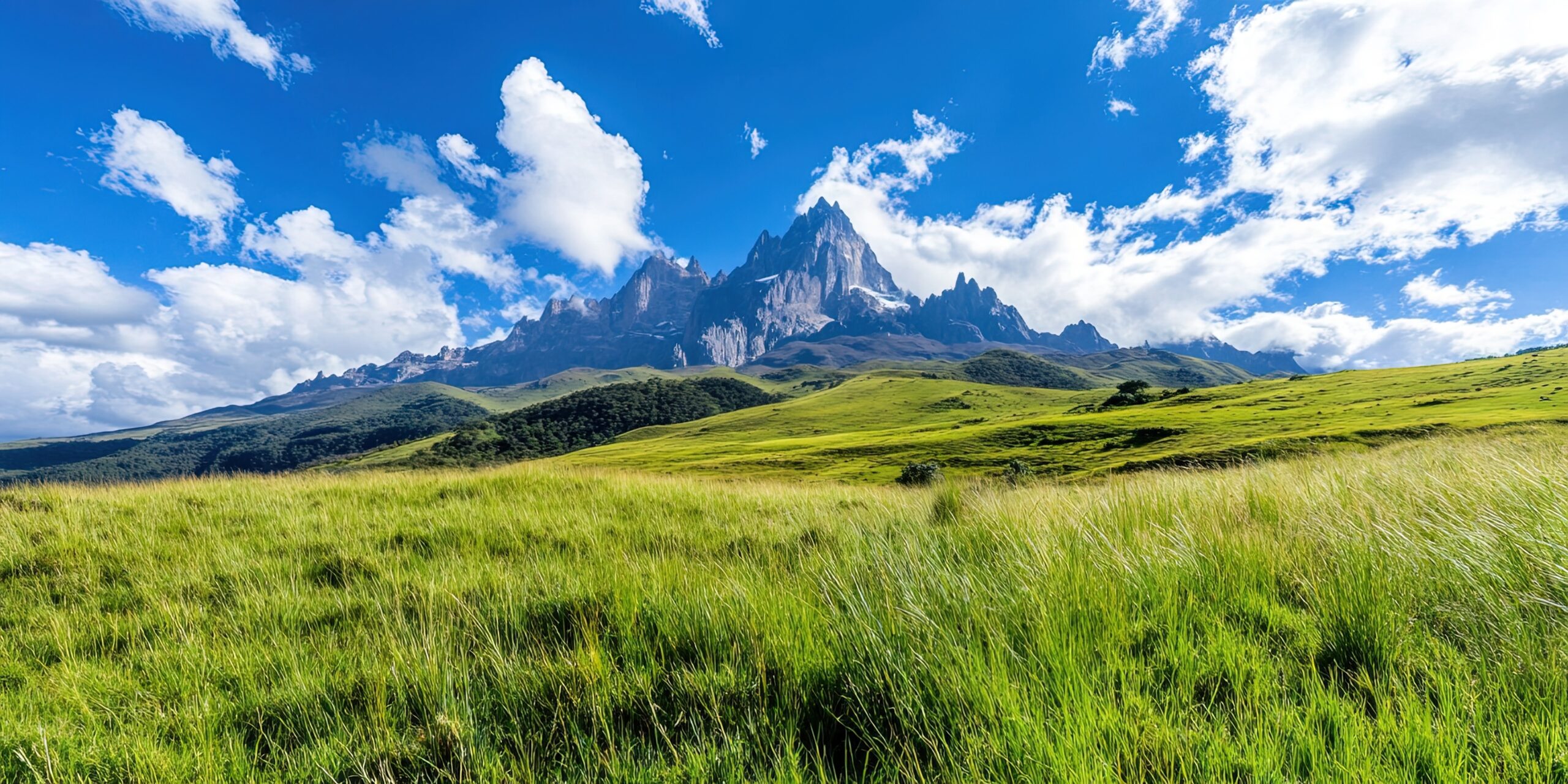
Mount Kenya at a Glance
Mount Kenya is an extinct stratovolcano located in central Kenya, approximately 150 km northeast of Nairobi. The mountain formed through volcanic activity approximately 3 million years ago and originally rose substantially higher than its current elevation — erosion over millions of years has reduced the once-massive volcanic edifice to today’s craggy summits. The mountain dominates the landscape of central Kenya and is visible from Nairobi, Nyeri, Meru, and Embu on clear days. Mount Kenya National Park (established 1949, UNESCO World Heritage Site since 1997) protects the upper mountain and surrounding ecosystems across 715 km².
Mount Kenya is one of Africa’s most ecologically diverse mountains — five distinct vegetation zones from tropical rainforest at the base to alpine glaciers at the summit. The mountain creates its own weather: tropical valleys, montane forest, bamboo zones, moorland, and alpine zones all exist within a single 4-day climb. Mount Kenya is also the source of substantial Kenyan river systems including the Tana River (Kenya’s longest river) and the Ewaso Ng’iro.
The cultural and national significance. Mount Kenya is the namesake of the country itself — Kenya derives its name from the mountain. The original Kikuyu name for the mountain, Kirinyaga (“place of brightness” or “mountain of whiteness”), refers to the snow on the summit. The Kikuyu people, Kenya’s largest ethnic group, traditionally believed the mountain was the home of Ngai (also called Mwene Nyaga, “Possessor of Brightness”), the supreme creator god. Many Kikuyu still face Mount Kenya when praying. The mountain holds substantial spiritual significance for the Kikuyu, Embu, Meru, and Maasai peoples. The two highest summits — Batian and Nelion — are named after Maasai elders: Mbatian (a famous 19th-century laibon or spiritual leader) and Nelyon. Point Lenana is named after Mbatian’s son Lenana, who succeeded his father as Maasai laibon.
The Three Summits of Mount Kenya
Mount Kenya has three main summits at substantially different elevations and requiring substantially different climbing skills. The mountain is unique among Africa’s major peaks because its two highest summits are reserved for technical rock climbers, while the third-highest summit is accessible to non-technical hikers — creating two fundamentally different Mount Kenya experiences.
Batian
Type: Technical rock climbing summit. Africa’s second-highest peak after Uhuru Peak on Kilimanjaro.
Standard route: North Face Standard Route (UIAA IV / YDS 5.5-5.6); multiple pitches of moderate alpine rock climbing.
Required skills: Multi-pitch rock climbing, rappelling, anchor building, rope team movement.
Time on summit day: 12-15 hours from Austrian Hut.
Named after: Mbatian, a famous 19th-century Maasai laibon (spiritual leader and warrior chief).
Nelion
Type: Technical rock climbing summit; 140m east of Batian across the “Gates of Mist” gap.
Standard route: South-East Face (UIAA IV / YDS 5.6-5.7); often climbed together with Batian via traverse.
Required skills: Same as Batian; technical rock climbing experience essential.
Summit feature: Howell Hut — the highest bivouac shelter in Africa at ~5,100m used by technical climbers.
Named after: Nelyon, a Maasai elder; the name shares its Maa-language root with Mbatian.
Point Lenana
Type: Non-technical hiking/trekking summit. The standard tourist objective.
Standard routes: Four trekking routes (Sirimon, Chogoria, Naro Moru, Burguret) all converge on Point Lenana.
Required skills: Fitness for sustained 4-5 day high-altitude trekking; no technical climbing skills needed.
Annual climbers: Approximately 14,000-16,000 per year (vs ~200-300 attempting Batian/Nelion).
Named after: Lenana, son of Mbatian and successor as Maasai laibon.
Why Mount Kenya has both hiking and technical summits. Mount Kenya is unique among Africa’s major peaks because its highest two summits (Batian and Nelion) are reserved for rock climbers, while the third-highest summit (Point Lenana) is accessible to non-technical hikers. This creates two fundamentally different Mount Kenya experiences: the trekking tradition (Point Lenana via the four standard routes) draws approximately 14,000-16,000 annual climbers; the technical climbing on Batian and Nelion attracts only 200-300 annual attempts. By contrast, Mount Kilimanjaro’s Uhuru Peak (5,895m) is non-technical despite being higher — meaning Mount Kenya’s Batian represents a substantially harder ascent than Kilimanjaro’s summit despite being 696m lower in elevation. The technical rock summits make Mount Kenya the “real mountaineering” objective in East Africa, while Kilimanjaro remains the more popular trekking destination.
Climbing Mount Kenya: The Four Standard Routes
Mount Kenya has four established trekking routes to Point Lenana, each approaching the mountain from a different direction with substantially different character. The routes vary in scenery, difficulty, acclimatization profile, and crowds. Below is the comprehensive route comparison followed by detailed profiles of each.
| Route | Side | Duration | Distance | Difficulty | Best For |
|---|---|---|---|---|---|
| Sirimon Route | Northern | 4-5 days | ~52 km RT | Moderate; best acclimatization | First-time climbers; most popular; recommended standard |
| Chogoria Route | Eastern | 4-5 days | ~50 km RT | Moderate; substantial elevation | Most scenic — Lake Michaelson, Hall Tarns, waterfalls |
| Naro Moru Route | Western | 3-4 days | ~25 km RT | Steepest; “Vertical Bog” | Fastest ascent; less acclimatization time |
| Burguret Route | Southwestern | 5-6 days | Variable | Substantial bush travel | Experienced trekkers; least crowded; substantial wilderness |
Sirimon Route — The Standard Recommendation
The Sirimon Route is the most popular Mount Kenya trekking route and the recommended choice for first-time climbers. The route ascends from Sirimon Gate (2,650m) through montane forest, bamboo zones, and moorland to Shipton’s Camp at the base of the technical summits. The gradual ascent profile provides the best acclimatization of the four routes — substantially reducing AMS risk. The route is on the driest side of the mountain (the rain shadow from the southeast-facing summit), making it the most reliable choice during shoulder seasons. Most operators use Sirimon for ascent and combine with Chogoria descent for the optimal traverse experience.
Chogoria Route — The Most Scenic
The Chogoria Route is widely considered the most scenically dramatic Mount Kenya route. The eastern approach passes through Mount Kenya’s most spectacular landscape features: the Nithi Falls, Lake Ellis, Hall Tarns, and the stunning Lake Michaelson nestled in a glacial cirque. The Mackinder’s Valley section provides substantial photographic opportunities. The route is slightly wetter than Sirimon (the eastern slopes receive more orographic precipitation) but the scenic reward typically justifies the trade-off. The Chogoria descent is the standard pairing with Sirimon ascent for the optimal 5-day traverse.
Naro Moru Route — The Fastest
The Naro Moru Route is the fastest and shortest route to Point Lenana but provides the least acclimatization time. The route includes the infamous “Vertical Bog” section — a 1.5 km stretch of waterlogged terrain that can be exhausting in wet conditions. The Naro Moru river valley features substantial montane forest and Mackinder Valley access. The compressed timeline produces substantially higher AMS rates than Sirimon or Chogoria; not recommended for first-time high-altitude climbers. Best suited for fit, acclimatized climbers seeking efficient summit attempts.
Burguret Route — The Wilderness Option
The Burguret Route is the least-trafficked Mount Kenya route — providing substantial wilderness experience with virtually no crowds. The route involves substantial bush travel and route-finding through dense forest in lower sections. The longer duration provides excellent acclimatization. Best suited for experienced trekkers who value solitude over infrastructure. Often combined with Chogoria descent for an extended “Burguret-Chogoria Traverse” — a 5-7 day wilderness route that experiences the full ecological diversity of Mount Kenya.
The Recommended Itinerary: Sirimon Up + Chogoria Down (5 Days)
The standard recommendation among experienced Mount Kenya operators is the 5-day Sirimon-Chogoria traverse: ascending the drier, gentler Sirimon Route and descending the scenically dramatic Chogoria side. This itinerary experiences both sides of the mountain, provides optimal acclimatization, and produces the highest summit success rates (~85-90%).
| Day | Stage | Elevation | Distance | Time |
|---|---|---|---|---|
| Day 1 | Sirimon Gate to Old Moses Camp | 2,650m → 3,300m | ~9 km | 3-4 hours |
| Day 2 | Old Moses Camp to Shipton’s Camp | 3,300m → 4,200m | ~14 km | 6-7 hours |
| Day 3 (optional) | Acclimatization day at Shipton’s Camp | 4,200m | Variable | Hike to Hausburg Tarn / Lower Simba Col |
| Day 4 | Summit Day — Shipton’s Camp → Point Lenana → descent to Mintos Hut | 4,200m → 4,985m → 4,200m | ~13 km total | 8-10 hours |
| Day 5 | Descent: Mintos Hut to Chogoria Gate | 4,200m → 2,950m | ~22 km | 6-8 hours |
Summit day reality check. Point Lenana summit day starts at 2:30-3:00 AM from Shipton’s Camp to reach the summit by sunrise (5:30-6:30 AM). The pre-dawn start is timed to the stable weather window before Mount Kenya’s daily afternoon cloud development. Climbers ascend via the western slopes of Point Lenana in headlamp light, often on frozen scree and snow patches. Final 100m approach involves substantial scrambling on rock. Summit temperatures: -5°C to 0°C with substantial wind exposure. After sunrise summit, climbers descend back to Shipton’s Camp for breakfast then continue substantial descent to Mintos Hut on the Chogoria side — a long day totaling 8-10 hours of movement with substantial altitude change. The “summit by 7 AM” rule is critical: by 10 AM, clouds typically envelop the upper mountain making navigation difficult.
Mount Kenya Location and Live Weather
Current Conditions at Batian Summit (5,199m)
Live data from Open-Meteo at coordinates 0.1521°S, 37.3084°E. Substantial weather variations between summit and lower routes — use only as guidance.
Mount Kenya Cost & Permits (2026)
Mount Kenya climbing costs are substantially lower than Mount Kilimanjaro for comparable mountaineering experiences. The Kenya Wildlife Service (KWS) updated its conservation fee structure effective October 1, 2025 under new regulations — current 2026 pricing reflects these adjustments. Below is the comprehensive cost reference for non-resident climbers.
Kenya Wildlife Service Park Fees (2026)
| Fee | Non-Resident | East African Citizen | Notes |
|---|---|---|---|
| Park entry (per 24 hours) | $70 USD | KES 300 | Mandatory for all visitors; eCitizen platform |
| Camping fee (per night) | $20 USD | KES 300 | Required for camping zones along all routes |
| Mountain hut fee (per night) | $30-50 USD | Variable | Old Moses, Shipton’s Camp, Austrian Hut |
| Climbing permit (Batian/Nelion) | Additional fee | Additional fee | Required for technical summits beyond Point Lenana |
| Children ≤ 5 years | Exempt | Exempt | — |
| Kenyan citizens ≥ 70 years | — | Exempt | — |
Total Cost Tiers (2026 Operator Pricing)
| Tier | Cost Range | Inclusions | Best For |
|---|---|---|---|
| Budget | $400-$800 | Park fees, basic guide, basic camping; minimal extras | Independent climbers; budget-conscious experienced trekkers |
| Mid-Range (Standard) | $800-$1,500 | All park fees, certified guide, porters, full meals, hut/camping, transport from Nairobi | First-time Mount Kenya climbers; most popular tier |
| Premium | $1,500-$2,500 | Mid-range + private guide, upgraded accommodation, pre/post stays in Nairobi hotels | Comfort-focused climbers; small groups |
| Luxury | $2,500-$5,000 | Premium + private vehicles, gourmet meals, top-tier lodges before/after, dedicated staff | Luxury market; combined with safari extensions |
| Technical (Batian/Nelion) | $2,000-$3,500+ | Standard package + specialist rock climbing guide; multi-pitch climbing gear | Experienced rock climbers; technical summit attempts |
Mount Kenya vs Kilimanjaro cost comparison. Mount Kenya is substantially cheaper than Kilimanjaro for comparable mountaineering: Mid-range Mount Kenya $800-$1,500 vs mid-range Kilimanjaro $1,800-$5,000. The cost difference reflects (1) substantially shorter standard climb (4-5 days vs 6-9 days); (2) lower park fees ($70/day vs $70-100/day plus Tanzania’s higher operator costs); (3) substantially less commercial infrastructure with smaller huts and lower porter ratios. The cost-effectiveness makes Mount Kenya a strong value alternative for African mountain climbing or perfect preparation for Kilimanjaro. Many experienced East African climbers recommend Mount Kenya as the first East African peak — climbing Mount Kenya then Kilimanjaro produces substantially higher Kilimanjaro summit success rates than direct Kilimanjaro attempts.
Cost Components Breakdown (Independent Climb)
| Component | 2026 Cost | Notes |
|---|---|---|
| Park entry × 5 days | $350 | $70/day × 5 days non-resident |
| Camping × 4 nights | $80 | $20/night standard camping zones |
| Mandatory guide × 5 days | $125-200 | $25-40/day; required by Kenya law |
| Porter × 5 days (1 porter) | $50-75 | $10-15/day; recommended |
| Cook × 5 days (optional) | $75-100 | $15-20/day; optional |
| Gear rental (if needed) | $50-150 | Sleeping bag, poles, jacket as needed |
| Tips for guides/porters | $100-150 | Industry standard expectations |
| Travel insurance | $50-300 | Including high-altitude rescue coverage |
| Transport from Nairobi | $50-150 | Variable by group size |
| Total (5-day independent) | $900-$1,500 | Comparable to standard mid-range package |
Best Time to Climb Mount Kenya
Mount Kenya has two distinct dry seasons separated by Kenya’s two rainy seasons — substantially different from temperate-zone mountains where one main climbing season dominates. The equatorial location means temperatures vary little throughout the year, but precipitation patterns dictate climbing window quality.
| Period | Conditions | Best For | Considerations |
|---|---|---|---|
| January – February | Primary dry season; clearest views; most stable weather | First-time Western climbers; technical Batian/Nelion attempts | Peak Western tourist season; book early |
| March | Transitional; increasing afternoon clouds | Risk-tolerant experienced climbers | Long rains approaching; substantial cloud development |
| April – May | “Long rains” — heavy precipitation; muddy trails | AVOID | Trail damage; substantial mist/cloud cover; muddy descents |
| June | Transitional; rains decreasing; cool temperatures | Experienced climbers willing to risk weather | Substantial residual moisture; lingering cloud cover |
| July | Cold dry conditions; substantial winds | Cold-tolerant climbers; less crowded | Cooler than primary seasons; clear views possible |
| August – September | Secondary dry season; substantial daylight; drier weather | Technical climbs (Batian/Nelion); avoiding crowds | Cooler than January; substantial daylight for technical climbs |
| October | Transitional; “short rains” beginning | Late-season risk-takers | Some operators reduce capacity; weather variable |
| November – December | “Short rains” — moderate precipitation | Generally avoid | Variable weather; some clear windows possible |
The Mount Kenya weather paradox. Mount Kenya creates its own weather — the mountain is large enough to develop substantial orographic effects independent of regional patterns. Even during the dry seasons (January-February, August-September), the typical daily pattern is: clear skies from dawn through approximately 10:00 AM, then cumulus cloud development on the eastern slopes, often reaching full mountain cloud cover by early afternoon, then clearing by sunset. This pattern is why all summit attempts start at 2:30-3:00 AM — to reach the summit before clouds obscure visibility. Summit temperatures range from -5°C to +5°C year-round; substantially different from the temperature swings of temperate-zone mountains. Wind exposure is the more variable factor, with substantial summit winds particularly during the transitional months.
The Cultural Significance of Mount Kenya
Mount Kenya holds substantially deeper cultural significance than most major mountains. The peak is the namesake of the country itself, is sacred to multiple Kenyan ethnic groups, and was central to the modern Kenyan independence movement.
Mount Kenya as Kirinyaga — the sacred mountain of the Kikuyu people. The Kikuyu name for Mount Kenya is Kirinyaga, often translated as “place of brightness” or “mountain of whiteness” referring to the snow on the summit. The Kikuyu people — Kenya’s largest ethnic group with approximately 8.1 million people — traditionally believed the mountain was the home of Ngai (also called Mwene Nyaga, “Possessor of Brightness”), the supreme creator god. According to Kikuyu mythology, Ngai created the first man, Gikuyu, on Mount Kenya, and gave him a wife, Mumbi, with whom Gikuyu had nine daughters who became the nine Kikuyu clans. Many Kikuyu still face Mount Kenya when praying and traditional ceremonies still occur on the mountain’s lower slopes. The Kikuyu word for prayer, ihoya, comes from the act of facing the mountain. The Embu, Meru, and parts of the Maasai also hold the mountain sacred in different cultural traditions.
The Mau Mau and Mount Kenya’s role in Kenyan independence. Mount Kenya was central to the Mau Mau Uprising (1952-1960), the Kenyan armed resistance against British colonial rule. Mau Mau fighters used the dense forests on Mount Kenya’s lower slopes as hideouts during the eight-year struggle. The British colonial administration declared a State of Emergency on October 20, 1952, and substantial military operations were conducted on the mountain’s slopes. Several caves on Mount Kenya served as Mau Mau command centers and supply depots — some remain accessible to hikers today on the Naro Moru and Burguret route approaches. The Mau Mau period led directly to Kenyan independence on December 12, 1963. Mount Kenya National Park was established during the colonial period (1949) but was reorganized and expanded under independent Kenya. The mountain remains a powerful symbol of Kenyan national identity.
Why Batian and Nelion bear Maasai names. Despite Mount Kenya being Kikuyu sacred territory, the two highest summits bear Maasai names. Mbatian (Batian) was a famous 19th-century Maasai laibon (spiritual leader and warrior chief) who led the Maasai during the period of substantial regional power expansion. Mbatian’s family included his son Lenana (after whom Point Lenana is named) who succeeded him as laibon. Nelion (sometimes spelled Nelyon) was another Maasai elder. The naming convention dates to the late 19th century when European explorers including Halford Mackinder used local Maasai informants for geographic naming during the first ascent expedition in 1899. The Maasai naming of the highest summits reflects the substantial overlap between Maasai grazing territory and the Mount Kenya region during the pre-colonial era — Maasai cattle traditionally grazed up to approximately 3,500m on the mountain’s lower slopes.
Mount Kenya Wildlife & Five Ecological Zones
Mount Kenya National Park (UNESCO World Heritage Site since 1997) contains five distinct vegetation zones from the foothills to the summit — climbers experience all five during a standard climb. This tropical-to-alpine progression in a single 4-day climb is unique among major African mountains and substantially exceeds the ecological diversity of mountains in temperate zones.
| Zone | Elevation Range | Vegetation | Wildlife |
|---|---|---|---|
| 1. Rainforest Belt | 1,500 – 2,500 m | Tropical rainforest; mahogany, podocarpus, dense canopy | Elephants, buffalo, leopards, colobus monkeys, bushbucks |
| 2. Bamboo Zone | 2,500 – 3,000 m | Dense bamboo (Yushania alpina) up to 15m tall | Elephants, buffalo, bongo antelope (rare) |
| 3. Hagenia-Hypericum Zone | 3,000 – 3,500 m | African rosewood (Hagenia abyssinica); St. John’s Wort | Elephants (rare); various bird species |
| 4. Moorland Zone | 3,500 – 4,500 m | Giant heather, giant lobelias, senecios (afroalpine flora) | Hyrax, rock hyrax, eagles, alpine swifts |
| 5. Alpine Zone | 4,500 – 5,199 m | Lichens, mosses, rock; remnant glaciers (diminishing) | Limited fauna; alpine birds only |
The mandatory armed ranger requirement. Kenya Wildlife Service requires an armed ranger to accompany climbers through the wildlife zones on the lower slopes (typically Days 1-2 on most routes). The ranger is included in standard tour packages and required by law for safety reasons — Mount Kenya’s lower slopes have substantial elephant and buffalo populations that occasionally pose risks to hikers. Elephant encounters on the Naro Moru and Sirimon route approaches are common; buffalo encounters less common but more dangerous. The ranger fee ($20-30/day) is typically bundled into operator packages. Climbers should respect the ranger’s authority on wildlife matters — KWS rangers have substantial expertise in safe wildlife approach distances and behavioral cues. The wildlife concentration on Mount Kenya’s lower slopes is one of the substantial differences from Kilimanjaro climbing — Mount Kenya provides a wildlife element absent from comparable East African mountains.
Mount Kenya vs Kilimanjaro: The Definitive Comparison
Mount Kenya is most frequently compared to Mount Kilimanjaro since both are major East African peaks. The comparison reveals fundamentally different mountaineering experiences despite the geographic proximity (Mount Kenya is approximately 320 km north of Kilimanjaro).
| Feature | Mount Kenya | Mount Kilimanjaro |
|---|---|---|
| Elevation | 5,199 m / 17,057 ft (Batian) | 5,895 m / 19,341 ft (Uhuru Peak) |
| Country | Kenya (central Kenya) | Tanzania (northeastern Tanzania) |
| Type | Extinct stratovolcano | Dormant stratovolcano (3 cones) |
| Standard climb duration | 4-5 days (Point Lenana) | 6-9 days (Uhuru Peak) |
| Annual climbers | ~16,000 | ~35,000-50,000 |
| Summit success rate | ~85-90% (Point Lenana) | ~50-70% (depends on route + days) |
| Technical summit available | YES — Batian (5,199m, UIAA IV) | NO — Uhuru Peak is non-technical |
| Standard cost (guided) | $400-$2,500 | $1,500-$6,000 |
| Park fees (non-resident) | $70/day + $20 camping | $70-100/day + $50 camping |
| Ecological diversity | 5 zones; substantial wildlife on lower slopes | 5 zones; less wildlife concentration |
| Cultural significance | Sacred to Kikuyu (Kirinyaga); namesake of Kenya | Sacred to Chagga people (Kibo) |
| First ascent (highest summit) | 1899 (Mackinder, Hausburg, Ollier — Batian) | 1889 (Meyer, Purtscheller — Uhuru Peak) |
| Best as | Standalone challenge OR Kilimanjaro acclimatization | Bucket-list summit; non-technical big mountain |
Why climbers do both — and which first. Many serious East African climbers complete both Mount Kenya and Kilimanjaro as a combined “East African Big Two” project. The recommended order is Mount Kenya first, Kilimanjaro second — for three reasons: (1) Mount Kenya’s 4,985m Point Lenana provides substantial altitude exposure without reaching the extreme heights where serious AMS becomes prevalent; (2) Mount Kenya costs substantially less, allowing climbers to assess their altitude tolerance before committing to the bigger Kilimanjaro expense; (3) Mount Kenya’s compressed 4-5 day timeline produces strong acclimatization for the subsequent Kilimanjaro climb. The combined “Mount Kenya + Kilimanjaro” itinerary (typically 14-18 days) produces substantially higher Kilimanjaro summit success rates (~90%+) compared to direct Kilimanjaro attempts (~50-70%). Mount Meru in Tanzania serves a similar acclimatization role but Mount Kenya provides substantially more cultural and ecological depth.
What Makes Mount Kenya a Distinctive Mountaineering Objective
Mount Kenya occupies a unique position in African mountaineering — substantially less commercialized than Kilimanjaro, more technically interesting than most African peaks, and culturally deeper than nearly any major mountain on the continent. Understanding what makes Mount Kenya distinctive helps climbers decide whether it suits their objectives.
What sets Mount Kenya apart:
- Two summits for two different climber types. Mount Kenya is unique among Africa’s major peaks because Point Lenana (4,985m) is accessible to non-technical hikers while Batian (5,199m) and Nelion (5,188m) require substantial multi-pitch rock climbing. This dual character means Mount Kenya can be a “first 5,000m peak” trekking objective OR a serious technical alpine climbing destination — the same mountain serves both communities.
- Substantially less crowded than Kilimanjaro. Approximately 16,000 annual Mount Kenya climbers vs 35,000-50,000 annual Kilimanjaro climbers means substantially better trail conditions, less hut competition, and a more wilderness-oriented experience. Mount Kenya’s trails feel like serious mountaineering; Kilimanjaro’s iconic routes can feel like organized commercial tourism.
- Cost-effectiveness is exceptional. Mid-range Mount Kenya climbs $800-$1,500 vs comparable Kilimanjaro climbs $1,800-$5,000 — Mount Kenya delivers fundamentally similar mountaineering experience at approximately half the cost.
- Substantial wildlife encounters on lower slopes. Mount Kenya’s lower slopes contain elephants, buffalo, leopards, and colobus monkeys — wildlife encounters are routine during Days 1-2 of standard routes. Mandatory armed rangers accompany climbers through wildlife zones. This wildlife element is absent or minimal on Kilimanjaro climbs.
- Deeper cultural significance. Mount Kenya is the namesake of the country — Kenya derives its name from the mountain. The Kikuyu Kirinyaga tradition, the Mau Mau independence movement history, and the Maasai connection through Mbatian/Nelyon/Lenana names provide substantial cultural context unmatched by Kilimanjaro’s mostly-Chagga associations.
- Ecological diversity in compressed time. Five vegetation zones in a 4-5 day climb — tropical rainforest → bamboo → Hagenia → moorland → alpine — is among the most ecologically diverse mountaineering experiences anywhere in the world.
- Equatorial year-round climbing. Two dry seasons (January-February + August-September) mean Mount Kenya is climbable for approximately 4-5 months per year, with substantially more options than temperate-zone mountains restricted to single summer seasons.
- The Mackinder legacy. Mount Kenya’s first ascent was led by Sir Halford Mackinder — a British geographer who later became famous for inventing geopolitics as a discipline. The 1899 Mackinder expedition was substantially more scientific than typical first-ascent expeditions, including substantial geographical, botanical, and ethnological documentation. The Mackinder Valley on Mount Kenya is named for him.
- Diamond Couloir technical climbing heritage. Mount Kenya’s Diamond Couloir on the South Face was historically one of the world’s most coveted ice climbing routes — though substantial climate change has reduced the ice in recent decades. The Diamond Couloir’s golden era (1970s-1990s) saw substantial first ascents by climbers including Phil Snyder, Yvon Chouinard, and Ian Howell (whose name lives on at Howell Hut at 5,100m on Nelion).
Where Mount Kenya fits in mountaineering progression. For first-time East African climbers, Mount Kenya’s Point Lenana is an accessible introduction to high-altitude trekking with substantial cultural and ecological depth. For climbers building toward Kilimanjaro, Mount Kenya provides ideal acclimatization plus a genuine African mountaineering experience. For technical alpinists, Batian and Nelion offer multi-pitch rock climbing at moderate UIAA IV grade — substantially more demanding than anything available on Kilimanjaro or most other African peaks. For cultural and historical depth, Mount Kenya substantially exceeds typical mountaineering objectives. The mountain is one of the most underrated major peaks in world mountaineering — substantial reward for climbers willing to look beyond the better-marketed Kilimanjaro.
Mount Kenya Gear Requirements
Mount Kenya gear requirements vary substantially by objective. Point Lenana trekking requires substantial cold-weather hiking gear; Batian/Nelion technical climbing requires full alpine rock climbing kit.
Point Lenana Trekking Gear (Standard)
- Footwear: Waterproof hiking boots (B1 mountaineering boot rating ideal); broken in; suitable for 5-day continuous use
- Sleeping bag: -10°C to -15°C rated (substantial cold tolerance for summit night)
- Layering system: Base layer + insulation (down or synthetic puffy) + waterproof shell jacket + shell pants
- Headwear: Warm hat + sun hat + headlamp with spare batteries
- Trekking poles: Adjustable poles recommended for descent
- Pack: 50-65L pack (porters carry most weight; day pack 30L for personal items)
- Hydration: 3L water capacity + water purification (LifeStraw or tablets)
- Sun protection: Glacier glasses (UV 4 protection); high SPF sunscreen; lip protection
Batian/Nelion Technical Gear (Additional)
- Climbing equipment: 50m climbing rope (or 60m); harness; helmet; rock protection (cams, nuts, slings)
- Hardware: Belay device; locking carabiners (4-6); standard alpine quickdraws
- Footwear: Approach shoes for the technical route base; rock shoes for technical sections
- Crampons: Aluminum or steel; required for early-season approaches with ice
- Ice axe: Standard mountaineering axe for approach
- Communications: Satellite communicator (Garmin inReach or similar) — strongly recommended for remote technical climbing
Gear rental is available in Nairobi from specialist outdoor shops including Atul’s Camping and various Mount Kenya tour operators. Standard rental rates (2026): sleeping bags $40-50/trek; trekking poles $30/trek; waterproof boots $50/trek; warm jacket $20/trek; technical climbing gear $100-300/trek depending on completeness. Most fully-guided packages include rental gear when needed.
Mount Kenya Historical Timeline
German missionary Johann Ludwig Krapf becomes the first European to report sighting Mount Kenya, observing the snow-capped summit from approximately 60 km distance. Krapf’s report is initially dismissed by European geographers who refuse to believe snow could exist on the equator. Krapf had previously reported sighting Mount Kilimanjaro (1848). His observations are eventually confirmed by subsequent expeditions.
Scottish geologist Joseph Thomson conducts the first European expedition attempting to climb Mount Kenya, reaching approximately 3,000m before being forced back. Thomson’s expedition produces the first detailed geographic survey of the mountain and surrounding region.
British geographer Sir Halford Mackinder leads the expedition that completes the first ascent of Batian (5,199m) on 13 September 1899. The summit team includes Mackinder, Italian guide Cesar Ollier, and Swiss guide Joseph Brocherel. The expedition is substantially scientific — Mackinder collects extensive botanical, geological, and ethnographic data alongside the climbing achievement. Mackinder later becomes famous as the founder of modern geopolitics through his “Heartland Theory” (1904). The Mackinder Valley on Mount Kenya is named for him.
British climbers Eric Shipton and Percy Wyn-Harris complete the first ascent of Nelion (5,188m) on 6 January 1929. Shipton goes on to become one of the most important figures in Himalayan exploration including the 1951 Everest reconnaissance. Shipton’s Camp on Mount Kenya is named for him.
The colonial British administration establishes Mount Kenya National Park, protecting the upper mountain above approximately 3,200m. The park initially covers 588 km² and is later expanded to 715 km². Park boundaries are reorganized after Kenyan independence in 1963.
The Mau Mau Uprising against British colonial rule uses Mount Kenya’s dense lower-slope forests as bases for resistance fighters. The British declare a State of Emergency on 20 October 1952. The eight-year conflict produces substantial casualties (estimated 10,000-25,000 Kenyan deaths) and shapes the trajectory toward Kenyan independence. Several Mau Mau caves on Mount Kenya remain accessible to hikers on the Naro Moru and Burguret route approaches.
Kenya achieves independence on 12 December 1963. The new nation’s name derives from Mount Kenya itself, reflecting the mountain’s central place in Kenyan national identity. Mount Kenya is featured in substantial Kenyan national symbolism including the coat of arms.
Mount Kenya’s Diamond Couloir on the South Face becomes one of the world’s most coveted ice climbing routes. Substantial first ascents during this period include Phil Snyder and Thumbi Mathenge (1973), and various subsequent ascents by Yvon Chouinard and Ian Howell. The Diamond Couloir’s reputation as a world-class technical objective attracts international alpinists. Climate change subsequently reduces the ice substantially, with the route becoming substantially harder and less reliable into the 2010s-2020s.
Mount Kenya National Park is designated a UNESCO World Heritage Site for its outstanding biological and geological significance, particularly the afro-alpine ecosystem and the substantial endemic species concentration. The designation provides international conservation protection and substantially raises Mount Kenya’s tourist profile globally.
The Kenya Wildlife Service implements new Conservation Fee Regulations (2025-2026) effective 1 October 2025. The new fee structure standardizes access costs at $70/day non-resident for park entry. Tickets shift fully to the eCitizen electronic platform. The reorganization substantially modernizes Mount Kenya National Park access while maintaining accessibility for international climbers.
Featured Mount Kenya Operators & Resources
Mount Kenya is climbed almost entirely through Kenyan-based operators. Below are established 2026 operators with substantial reputations and the key resources used by the international climbing community.
Kenyan Operators (Standard Mount Kenya Climbing)
AJ Kenya Safaris — Licensed Kenya safari operator with substantial Mount Kenya climbing programs; combined safari + climb packages standard. Ahambi Tours — Mid-range Mount Kenya specialist; substantial published 2026 pricing transparency. Wild Springs — Budget-friendly Mount Kenya climbing packages from $700; substantial route flexibility. Africa Natural Tours — Premium/luxury Mount Kenya climbing with substantial post-climb safari combinations. Kenya Wildlife Tours — Detailed Mount Kenya climbing programs with substantial route customization. Jaynevy Tours — 5-day Sirimon-Chogoria traverse specialists at $800-$1,200 price point. Mount Kenya Trekkers — Local Mount Kenya specialists with substantial guide reputation.
International Operators (Booking from Abroad)
Explore-Share — International booking platform with Mount Kenya operators including technical climbing programs for Batian/Nelion. Summit Climb — European Mount Kenya technical climbing programs (UIAA IV+ rock climbing). African Walking Company — Tanzania-Kenya combined Kilimanjaro + Mount Kenya itineraries.
Essential Resources
- Kenya Wildlife Service (kws.go.ke) — Official park management; permit information; eCitizen platform access
- Mount Kenya Trust — Conservation and access organization; substantial environmental data
- Mount Kenya National Park (mtkenyapark.org) — Official park information; current 2025/26 fee structure
- UNESCO World Heritage Centre — Site documentation and conservation status
- 14ers.com regional equivalents — Community resources for Mount Kenya climbing tradition
Frequently Asked Questions
Mount Kenya stands at 5,199 meters / 17,057 feet at its highest point — Batian Peak. This makes Mount Kenya the highest mountain in Kenya and the second-highest in Africa after Mount Kilimanjaro (5,895m in Tanzania). The mountain has three main summits at different elevations: Batian (5,199m / 17,057 ft), Nelion (5,188m / 17,021 ft), and Point Lenana (4,985m / 16,355 ft). Batian and Nelion are technical rock climbing summits requiring multi-pitch climbing skills; Point Lenana is the standard trekking objective accessible to fit hikers without technical climbing experience.
Mount Kenya climbing costs in 2026 range from $400 to $5,000 per person depending on route and service level. Budget Kenyan operators offer 4-5 day Point Lenana treks from $400-$800. Mid-range fully-guided packages cost $800-$1,500 including all park fees, guides, porters, meals, and accommodation. Premium luxury packages reach $2,500-$5,000 with private guides and upgraded accommodation. Key 2026 cost components: Kenya Wildlife Service park entry $70/day for non-residents (~$280-$350 for a 4-5 day climb), camping fees $20/night, mandatory guide $25-$40/day, optional porter $10-$15/day. Technical climbs to Batian or Nelion peaks add $1,500-$3,500 above standard Point Lenana trekking pricing due to specialist rock climbing guides required.
The two best windows to climb Mount Kenya are January-February and August-September — the two dry seasons separated by Kenya’s rainy seasons. January-February offers the most stable weather and is the most popular Western tourist season. August-September provides drier conditions during the Kenyan summer dry season with substantial daylight for technical climbs of Batian and Nelion. Avoid the long rains (April-June) and short rains (October-November/December) which create dangerous trail conditions and limited summit visibility. Mount Kenya’s equatorial location means temperatures vary little by season — summit conditions range from -5°C to +5°C year-round — but precipitation patterns dictate climbing window quality. The mountain creates its own weather with afternoon clouds typical even in dry season; 3:00 AM summit starts are timed to the stable pre-dawn window.
Mount Kenya has four standard routes to Point Lenana: (1) Sirimon Route from the north — the most popular and recommended for first-time climbers; driest conditions; gradual altitude gain; 4-5 days. (2) Chogoria Route from the east — most scenic with substantial waterfalls and lake views; passes Hall Tarns and Lake Michaelson; 4-5 days. (3) Naro Moru Route from the west — fastest but steepest; includes the famous Vertical Bog section; 3-4 days. (4) Burguret Route from the southwest — least crowded; experienced trekkers only; 5-6 days. The recommended approach for most climbers is “Sirimon up, Chogoria down” — a 5-day traverse experiencing both sides of the mountain with optimal acclimatization. Batian and Nelion technical summits are accessed primarily via the Mackinder’s Valley approach (Sirimon side) with the North Face Standard Route or South Face routes.
The answer depends on which Mount Kenya summit. For Point Lenana (4,985m, trekking), Mount Kenya is generally considered substantially easier than Kilimanjaro’s Uhuru Peak (5,895m) — both are non-technical but Point Lenana is 910m lower and the standard 4-5 day climb is shorter than Kilimanjaro’s 6-9 days. Mount Kenya’s Point Lenana summit success rate (~85-90%) is substantially higher than Kilimanjaro’s (~50-70%). However, for Batian (5,199m, technical), Mount Kenya is substantially HARDER than Kilimanjaro because Batian requires multi-pitch rock climbing (UIAA IV / YDS 5.5-5.6) — skills that Kilimanjaro never requires regardless of route. Kilimanjaro is harder for non-technical climbers due to altitude; Mount Kenya is harder for technical climbers attempting its highest summits. Most climbers comparing the two compare Point Lenana to Uhuru Peak — in which case Mount Kenya is easier.
Standard Point Lenana climb takes 4-5 days. The most recommended itinerary is the 5-day Sirimon-Chogoria traverse: Day 1 Sirimon Gate to Old Moses Camp; Day 2 Old Moses to Shipton’s Camp; Day 3 optional acclimatization day; Day 4 summit day (3 AM start) + descent to Mintos Hut; Day 5 descent to Chogoria Gate. Fast-paced 3-4 day climbs via Naro Moru route are possible but produce substantially lower summit success rates due to compressed acclimatization. Technical climbs to Batian or Nelion require 6-8 days total to allow for rock climbing time. Many climbers add 1-2 rest days in Nairobi before/after the climb. Combined Mount Kenya + Kilimanjaro itineraries typically span 14-18 days total.
Yes — Kenya Wildlife Service requires all Mount Kenya climbers to use registered guides through KWS-licensed operators. Independent unguided climbing is not permitted. The mandatory guide requirement was implemented for both safety reasons (Mount Kenya’s lower slopes contain elephants and buffalo requiring armed ranger accompaniment) and economic reasons (supporting Kenyan guide employment). All registered operators include guides and necessary rangers in their packages. Cost: $25-40/day guide + $20-30/day armed ranger for wildlife zones (Days 1-2). Guides are typically Kenyan nationals with substantial Mount Kenya expertise; many speak multiple languages. The guide requirement is rarely an obstacle since substantial value comes from local expertise in route conditions, weather assessment, and cultural interpretation.
Point Lenana at 4,985m / 16,355 ft is Mount Kenya’s third-highest summit and the standard trekking objective for non-technical climbers. The peak is named after Lenana, son of Maasai laibon Mbatian (after whom the highest summit Batian is named) who succeeded his father as Maasai spiritual leader. Point Lenana is reached by all four standard Mount Kenya trekking routes (Sirimon, Chogoria, Naro Moru, Burguret) and represents the highest accessible summit without technical rock climbing skills. Approximately 14,000-16,000 climbers reach Point Lenana annually compared to only 200-300 attempting Batian/Nelion. The summit features substantial views of the technical summits, surrounding glaciers (substantially diminished due to climate change), and the Kenyan landscape including Mount Kilimanjaro on exceptionally clear days. Summit day standard timing: 3:00 AM start from Shipton’s Camp, summit by sunrise (~5:30-6:30 AM), descent to lower camps by afternoon.
Continue Reading — Related Resources
Mount Kenya Within the East African Rift Collection
Mount Kenya is Africa’s second-highest peak (5,199m) and the most technically demanding standard climb in East Africa — Batian and Nelion require UIAA III-V rock climbing skills, while Point Lenana (4,985m) is achievable by trekking. Specifically, Mount Kenya is part of the Eastern Branch (Gregory Rift) volcanic chain alongside Kilimanjaro, Mount Meru, and Mount Elgon. Notably, climbers seeking technical mountains often pursue Mount Stanley in the Rwenzori range next.
Africa’s highest peak. Trekking summit — no technical skills required. The natural “first” East African climb. Kilimanjaro guide →
Africa’s third-highest. Rwenzori range. Glaciated technical climb via the 7-9 day Central Circuit. Mount Stanley guide →
Largest volcanic massif by base area (80 km diameter). Far less crowded than Mount Kenya. Mount Elgon guide →
Was this helpful?
🏔Related peaks nearby
🧭Explore & compare
Global Summit Guide is an independent mountaineering resource founded in 2026. The team combines first-hand trekking and climbing experience with in-depth research and professional health and nutrition review to help climbers choose objectives, prepare properly, and stay safe.
Health, altitude, and nutrition content is reviewed by Taylor Ludlow (Registered Nurse) and Brigg Hoopes (Nutritionist).
What We Don't Know Yet
Mountain information changes quickly. This box explains the limits of what this page can responsibly promise.
- Visa, passport, vaccination, border, insurance, and local transportation rules may change before your trip.
- Route conditions, snowpack, closures, and weather can change quickly after this page is updated.
- Permit rules, fees, quotas, and reservation windows may change between review cycles.
- Operator availability, pricing, guide ratios, and cancellation terms can change by season.
- Your fitness, altitude response, risk tolerance, and experience level may change what is safe or realistic.
Verify current conditions with official land managers, guide services, local forecasts, and current route reports before booking or climbing.
Mountaineering, rock and ice climbing, glacier travel, and high-altitude activity are inherently dangerous and can result in serious injury or death. The information on Global Summit Guide is provided for general informational and educational purposes only and is not a substitute for professional instruction, qualified guiding, proper equipment, or your own judgment and experience.
Route conditions, weather, snowpack, permits, regulations, and hazards change constantly and may differ from what is described here. Details may be incomplete, out of date, or contain errors. Always verify current information with local authorities, certified guides, and official sources before making any decision in the mountains.
Nothing on this site is medical, legal, or financial advice. Our fitness, acclimatization, altitude, and nutrition content is general in nature; consult a qualified physician before beginning any strenuous exercise program or exposing yourself to high altitude.
You are solely responsible for your own safety and decisions. To the fullest extent permitted by law, Global Summit Guide and its team accept no liability for any loss, injury, damage, or expense arising from use of, or reliance on, this information. By using this site you acknowledge these risks and accept these terms.
Some links on this site may be affiliate links. If you buy through them we may earn a small commission at no extra cost to you; this never affects our recommendations.
Global Summit Guide recommendation path
Next Best Mountain to Research
Use these recommendations to continue the right planning path instead of stopping on one page.
Use current permit, weather, route, and operator information before booking or climbing.
Search Flights, Hotels & Rental Cars
Have the mountain or destination picked? Use Expedia to compare the flights, lodging and rental cars that fit your actual trip dates. For mountain travel, consider arriving early enough for delays and adding a buffer night after the climb before a fixed flight home.
Compare current flight, hotel and car options.
Affiliate disclosure: Global Summit Guide may earn a commission if you book through this link, at no additional cost to you.