
Last updated September 17, 2026
Mont Blanc Summit Success Rate: What the Data Actually Shows
There is no official mountain-wide database recording every Mont Blanc attempt and summit. A broad estimate of about 60% is often cited, while individual guide companies publish results from roughly two-thirds to near 80%. Those figures describe different groups and cannot be combined into one precise personal probability.
What is the real Mont Blanc success rate?
No official mountain-wide rate exists. The old page’s exact 58% figure was incorrectly attributed to “PGHM-registered attempts.” PGHM records rescues and incidents; it does not maintain a complete registry of every climber who starts and summits.
A broad historical estimate of about 60% is commonly cited. Published company results include about 66% for Mont Blanc Guides courses able to make a summit attempt and near 80% for Alpine Ascents clients. These are not comparable denominators and should remain separate.
What we can say confidently
Operator outcomes vary greatly by year. Weather, heat, wind, fitness, acclimatization, route condition and whether a team was allowed to attempt the summit all change the result.
What we cannot defend
Exact mountain-wide percentages by route, month, experience level, guided status, turnaround reason, rescue rate or historical trend without a published dataset and denominator.
The Mont Blanc success-rate evidence
A transparent source table is more useful than one unsupported headline number.
| Evidence source | Published figure | What it measures | Confidence and limitation |
|---|---|---|---|
| Official mountain-wide registry | None identified | No authority has published a complete census of all starts and summits. | High confidence. Rescue, hut and operator systems do not equal a universal attempt database. |
| Broad historical estimate | About 60% | An older Mountain Tracks estimate based on roughly 20,000 annual summits. | Medium. Frequently repeated, but the total-attempt denominator and current methodology are not transparent. |
| Mont Blanc Guides | Average about 66% | Company courses able to reach the summit; yearly table currently spans 2005–2024. | Medium-high for that company. It does not equal individual-client success and varies from 35% to 80% by year. |
| Alpine Ascents International | Near 80% | The company’s guided clients within a seven-day program with training and acclimatization. | Medium-high for that company. Selected guided clientele and flexible alternatives are not representative of all climbers. |
What counts as an attempt—or a success?
The denominator can change the rate before any climber leaves Chamonix.
Individual climbers
Did every paying client who began the program reach the summit? This is the strictest and most useful client-level measure.
Courses or teams
Did at least part of the course reach the summit, or was the course able to make an attempt? This can produce a higher result.
Weather-cancelled programs
Are programs with no Mont Blanc attempt included as failures, excluded, or counted as alternative-objective success?
Guided selection
Companies screen clients, use training days and may prevent an underprepared participant from joining the summit phase.
Route changes
A team may switch from the Goûter Route to Trois Monts—or climb another 4,000-meter peak—without that alternative being a Mont Blanc summit.
Annual variation
Snowy, windy or very hot summers can move one operator’s outcomes sharply even when the itinerary remains unchanged.
Every future success-rate claim should include the operator or authority, years covered, number of clients or teams, definition of an attempt, treatment of cancellations and whether the rate is individual- or team-based.
Published guided success rates
Guide-company figures are evidence—not a universal guided average.
Mont Blanc Guides
The company describes a two-thirds average and publishes yearly course results from 2005 through 2024. The page says the percentages are based on courses able to reach the summit, not the total number of individual clients who summited.
Alpine Ascents International
The company reports a client rate near 80%. Its program includes several days of training, a Gran Paradiso acclimatization climb, a low summit guide ratio and itinerary flexibility.
The companies use different programs, clients, years and definitions. A blended number would look precise while discarding the information that makes each rate meaningful.
What actually improves a Mont Blanc summit profile?
These factors are supported by program design and route requirements, not invented percentage swings.
Longer program
Six- or seven-day programs can include training, an acclimatization peak, rest and more than one possible summit day.
Prior Alpine skills
Crampon technique, ice-axe use, glacier rope travel, crevasse awareness and efficient movement should not be learned for the first time on summit day.
Acclimatization
Time above 3,000–4,000 meters and a preparatory summit provide more useful evidence than a quick cable-car visit.
Fitness reserve
The team must reach the summit with enough capacity for the full descent. Minimum pace at the hut is not the same as a safe reserve.
Weather flexibility
A second summit opportunity or the freedom to move the itinerary matters more than choosing one supposedly perfect month.
Current conditions
Rockfall, snow, hard ice, wind, visibility, avalanche exposure and hut or lift disruptions can override preparation.
Legal hut plan
The normal route requires named reservations and prohibits unauthorized bivouac through the regulated protection area.
Conservative guide decision
A professional turnaround or alternative objective may reduce Mont Blanc summit statistics while improving the quality and safety of the trip.
Route match
Goûter, Trois Monts and the Italian normal route involve different objective hazards and technical demands.
Use the Mont Blanc Goûter Route conditions and Grand Couloir status page for refuge operations, current rockfall reporting, tram access and the official sources that must be rechecked immediately before the climb.
Grand Couloir: correct location and timing
The legacy page placed the couloir above the Goûter Hut and built an impossible 2 a.m. rule around that error.
Where the couloir is
The Grand Couloir is crossed between Tête Rousse and the climb toward the Refuge du Goûter. Climbers encounter it on the approach to the hut and again after descending from the hut area.
A summit departure from the Goûter Hut begins above the couloir. It cannot place the team through the crossing before dawn because the team already crossed it the previous day.
Why one clock time is misleading
Rockfall often increases with warming, but temperature is not the only control. Precipitation, snow cover, freeze-thaw history, queues and active instability matter, and rockfall can occur at night.
The correct instruction is to obtain current observations and use professional judgment—not to promise that 2 a.m., 4 a.m. or sunrise is safe.
Peer-reviewed research describes the Goûter Couloir access section as exceptionally accident-prone and reports an average of about 3.7 deaths per year in the studied period. That evidence supports treating the hazard seriously; it does not support a universal safe-hour formula.
Route names corrected
The old page confused the French, Trois Monts and Italian approaches.
| Route | Correct approach | What affects success |
|---|---|---|
| Goûter Route | French normal route via Nid d’Aigle, Tête Rousse, Grand Couloir and Refuge du Goûter. | Rockfall exposure, upper-ridge wind and ice, hut reservations, fitness and a long descent. |
| Trois Monts Route | Aiguille du Midi and Cosmiques Hut, then Mont Blanc du Tacul and Mont Maudit. | Serac and avalanche exposure, bergschrunds, steep or icy Maudit terrain and an entirely high-altitude summit day. |
| Italian normal route | Val Veny and Gonella Hut, often called the Pope Route. | Longer, more remote approach, glacier complexity, route finding and fewer convenient retreat options. |
| Innominata and Brouillard | Serious technical ridges and faces. | These are not synonyms for the Trois Monts Route and should not be included in normal-route success comparisons. |
For a full side-by-side decision, use the Mont Blanc route comparison and the complete routes guide.
Mont Blanc Success Preparation Profile
This tool identifies preparation strength and schedule compression. It deliberately does not return a summit probability.
2026 normal-route planning status
Operating dates are verifiable; same-day climbing conditions are not frozen into this page.
Refuge du Goûter
FFCAM lists the staffed 2026 period from May 30 through October 4. A valid named reservation is required.
Refuge de Tête Rousse
FFCAM lists the staffed period from May 29 through October 3. Normal-route reservation rules apply.
Tramway and bivouac
The 2026 tramway season was scheduled to begin June 13. La Chamoniarde states that hut reservations are compulsory and bivouac is prohibited on the regulated normal-route corridor.
Continue to the Mont Blanc difficulty and safety guide for the PD route grade, exposure, glacier skills, altitude, objective hazards and the difference between “technically moderate” and “low risk.”
Mont Blanc internal-link cluster
Keep each page focused: this URL owns success-rate evidence; conditions, safety, routes, operators and acclimatization remain separate planning decisions.
Core Mont Blanc planning
Complete Mont Blanc guideMont Blanc operators comparisonMont Blanc progression planWhat to climb before Mont BlancRoutes, season and logistics
Mont Blanc route comparisonMont Blanc weather and best seasonMont Blanc permits and logisticsMont Blanc acclimatizationMont Blanc summit-success FAQ
Direct answers that match the visible FAQ schema.
What is the Mont Blanc summit success rate?
There is no official mountain-wide database that records every Mont Blanc attempt and summit. An older broad estimate of about 60% is frequently cited. Current guide-company figures include an average near 66% for Mont Blanc Guides courses able to make a summit attempt and a rate near 80% for Alpine Ascents clients. Those figures use different groups and denominators and should not be blended into one exact rate.
Is the Mont Blanc success rate really 58%?
A precise 58% mountain-wide figure cannot be verified from a complete official registry. It may resemble the commonly cited broad estimate of about 60%, but the old page incorrectly attributed 58% to PGHM-registered attempts. PGHM is a rescue service, not a comprehensive summit-attempt database.
What is the guided Mont Blanc success rate?
Published operator rates vary. Mont Blanc Guides reports an average around 66% across its courses, with large year-to-year changes, and notes that its table counts courses able to reach the summit rather than every individual client. Alpine Ascents reports a rate near 80% for its clients. These are operator-specific outcomes, not the rate for all guided climbers.
Does a guide guarantee a Mont Blanc summit?
No. A guide improves route assessment, pacing, rope-team management, weather interpretation and the ability to change objectives, but weather, rockfall, snow, wind, fitness and acclimatization can still prevent an attempt or force a turnaround.
What most affects the chance of summiting Mont Blanc?
The most important controllable factors are a sufficiently long program, prior crampon and glacier experience, strong uphill endurance, acclimatization, weather-flexibility days, a valid hut plan and current route-condition verification. The strongest uncontrollable factors are weather and objective hazards.
Is July the best month for Mont Blanc success?
July and August are the core summer months, but no month guarantees better outcomes. Mont Blanc Guides states that no period within the season has a reliably better chance of success. Conditions can be too snowy, too windy, too warm or too dry in any part of the staffed season.
Where is the Grand Couloir on the Goûter Route?
The Grand Couloir lies between Tête Rousse and the climb toward the Refuge du Goûter. It is crossed on the approach to the hut and again on the descent. It is not above the Goûter Hut, and leaving the hut at 2 a.m. does not place a team through the couloir before dawn.
What time is safe to cross the Grand Couloir?
There is no universally safe hour. Cooler early conditions may reduce some warming-related rockfall, but rockfall can occur at any time. The crossing decision must use current field observations, weather, freezing level, team speed and professional judgment.
How long should a Mont Blanc program be?
A short two- or three-day ascent provides little margin for skills, acclimatization or weather. Many established programs use six or seven days and include training or a preparatory 4,000-meter peak before the Mont Blanc attempt. Longer programs cannot guarantee success, but they provide more opportunities to arrive prepared and adapt the schedule.
How should I improve my Mont Blanc success profile?
Build prior glacier and crampon experience, complete one or more Alpine 4,000-meter progression climbs, train for sustained uphill movement with reserve capacity, use a flexible itinerary, secure legal hut reservations and verify Goûter or Trois Monts conditions immediately before the climb.
Sources, corrections and editorial limits
- Mont Blanc Guides: current FAQ with an average near 66%, yearly course outcomes from 2005–2024 and an explicit denominator caveat.
- Alpine Ascents International: current company claim near 80%, plus program design, guide ratio and acclimatization itinerary.
- Mountain Tracks: older broad estimate of about 60%; retained only as an approximate historical reference.
- La Chamoniarde: official local route descriptions, classic-route distinctions, compulsory reservations and bivouac prohibition.
- FFCAM: 2026 Goûter and Tête Rousse operating periods and normal-route booking rules.
- Grand Couloir research: peer-reviewed accident and exposure analysis; used for hazard context, not a fake success-rate model.
- No Dataset schema: the legacy page’s claimed 2010–2026 dataset, route percentages and turnaround distribution were removed because the underlying dataset was not published or reproducible.
- No personal probability: the preparation tool never returns “your chance is 74%.”
- No firsthand claim: Global Summit Guide has not climbed Mont Blanc.
Mont Blanc Guides success definition · Alpine Ascents program and rate · La Chamoniarde routes and regulations · FFCAM normal-route portal · Grand Couloir research
Improve the plan—not the percentage.
Use published rates as context. Build the actual summit plan around skills, acclimatization, fitness reserve, weather flexibility, legal hut access and current route conditions.
Evaluate the preparation profileBuild the progressionCheck route conditionsThe most useful Mont Blanc success statistic is still the denominator.
The existing evidence remains the right framework: there is no complete official registry of every Mont Blanc start and summit, so a mountain-wide percentage should not be presented as exact. Operator figures can still be useful when the population is named. Mont Blanc Guides publishes yearly course outcomes from 2005–2024, while Alpine Ascents says it gets close to 80% of its own climbers to the summit.
The strongest new evidence from summer 2026 is not another percentage. It is a reminder of why yearly rates move so much: the Goûter corridor went through an emergency August closure and reopened on August 26. The mountain can remove an otherwise well-prepared team’s summit opportunity before fitness ever becomes the limiting factor.
Where is Mont Blanc—and why route geography changes the success story?
Mont Blanc sits on the France–Italy border. The three main normal-route systems begin from different valleys and expose climbers to different hazards before they ever share the summit ridge.
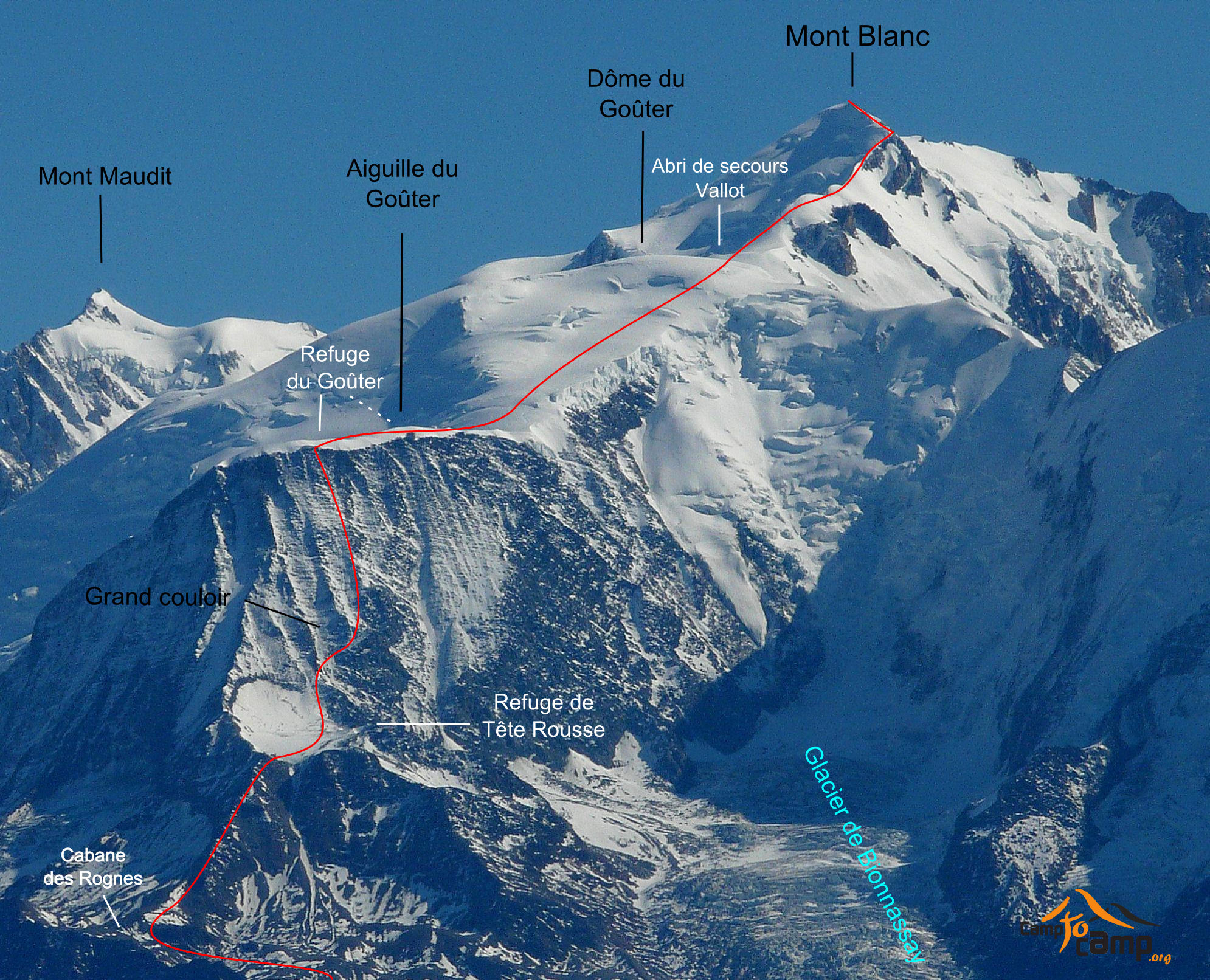
The Goûter line contains a hazard that can stop the climb before summit day begins.
The Grand Couloir sits below Refuge du Goûter, between Tête Rousse and the higher hut. That matters when interpreting success statistics. A climber can be fit, acclimatized and technically prepared yet never make a summit attempt because the access corridor becomes unacceptable or is administratively closed.
That is exactly what summer 2026 demonstrated. Tête Rousse and Goûter were closed during the August emergency period and reopened on August 26. FFCAM explicitly warned that reopening did not mean the access route had become risk-free.

Why one Mont Blanc season can swing without climbers becoming less capable
The August closure is a useful case study in why operator percentages should be treated as outcomes of a specific year—not permanent properties of the mountain.
| Date / evidence | What happened | Why it matters to success-rate interpretation |
|---|---|---|
| 2005–2024 MBG record | Published yearly course outcomes range from 35% to 80%. | Large annual variation exists even within one company and broadly similar program structure. |
| 2010 | Mont Blanc Guides reports a 35% year associated with persistent wind and snow. | Weather can reduce opportunities across an entire season. |
| 2015 | Mont Blanc Guides reports another 35% year during a heatwave that made the Grand Couloir too dry to cross safely for much of the season. | Too much heat can be as limiting as too much snow. |
| August 2026 | Tête Rousse and Goûter refuges were temporarily closed during a serious rockfall/route-condition episode. | An administrative closure can erase summit attempts from otherwise viable programs. |
| Aug. 26, 2026 | Both refuges reopened, with FFCAM warning that reopening did not mean the access route was free of risk. | “Open” and “good summit conditions” are not the same variable. |
Which Mont Blanc success claims deserve the most weight?
The page already separates operator rates. This ladder makes the evidence standard explicit for future updates.
Official access, hut and closure records
FFCAM, Saint-Gervais and La Chamoniarde can confirm whether the route system is operating, reservations are legal and a closure or warning is active. They do not provide a complete all-climber summit denominator.
Operator-specific published outcomes
Mont Blanc Guides’ 2005–2024 yearly table and Alpine Ascents’ near-80% client claim are useful when attributed exactly to those programs. They should not be merged into a universal guided rate.
Unattributed mountain-wide percentages
A number such as 58%, 60% or 70% is weak evidence unless the source explains who was counted, over which years, which routes were included and how cancelled programs were treated.
Routes, conditions, operators, safety & progression
This page owns the success-rate evidence. Use the pages below for the route, condition, operator and preparation decisions that should remain separate from one percentage.
Was this helpful?
🏔Related safety data
🧭Explore & compare
Global Summit Guide is an independent mountaineering resource founded in 2026. The team combines first-hand trekking and climbing experience with in-depth research and professional health and nutrition review to help climbers choose objectives, prepare properly, and stay safe.
Health, altitude, and nutrition content is reviewed by Taylor Ludlow (Registered Nurse) and Brigg Hoopes (Nutritionist).
What We Don't Know Yet
Mountain information changes quickly. This box explains the limits of what this page can responsibly promise.
- Guide-company prices, departure dates, guide ratios, included services, and cancellation rules can change without notice.
- Weather, snowpack, avalanche risk, road access, and route conditions can change quickly and may be different on your climbing dates.
- Route conditions, trailhead access, crevasse exposure, stream crossings, and rescue access may vary from published planning guidance.
- Gear requirements can change by season, route variation, weather window, personal cold tolerance, and guide-service requirements.
- Fitness and altitude response vary by person; no guide, itinerary, or training plan can guarantee acclimatization or summit success.
Verify current conditions with official land managers, guide services, local forecasts, and current route reports before booking or climbing.
Mountaineering, rock and ice climbing, glacier travel, and high-altitude activity are inherently dangerous and can result in serious injury or death. The information on Global Summit Guide is provided for general informational and educational purposes only and is not a substitute for professional instruction, qualified guiding, proper equipment, or your own judgment and experience.
Route conditions, weather, snowpack, permits, regulations, and hazards change constantly and may differ from what is described here. Details may be incomplete, out of date, or contain errors. Always verify current information with local authorities, certified guides, and official sources before making any decision in the mountains.
Nothing on this site is medical, legal, or financial advice. Our fitness, acclimatization, altitude, and nutrition content is general in nature; consult a qualified physician before beginning any strenuous exercise program or exposing yourself to high altitude.
You are solely responsible for your own safety and decisions. To the fullest extent permitted by law, Global Summit Guide and its team accept no liability for any loss, injury, damage, or expense arising from use of, or reliance on, this information. By using this site you acknowledge these risks and accept these terms.
Some links on this site may be affiliate links. If you buy through them we may earn a small commission at no extra cost to you; this never affects our recommendations.
Global Summit Guide recommendation path
Next Best Mountain to Research
Use these recommendations to continue the right planning path instead of stopping on one page.
Use current permit, weather, route, and operator information before booking or climbing.