
Last updated October 4, 2026
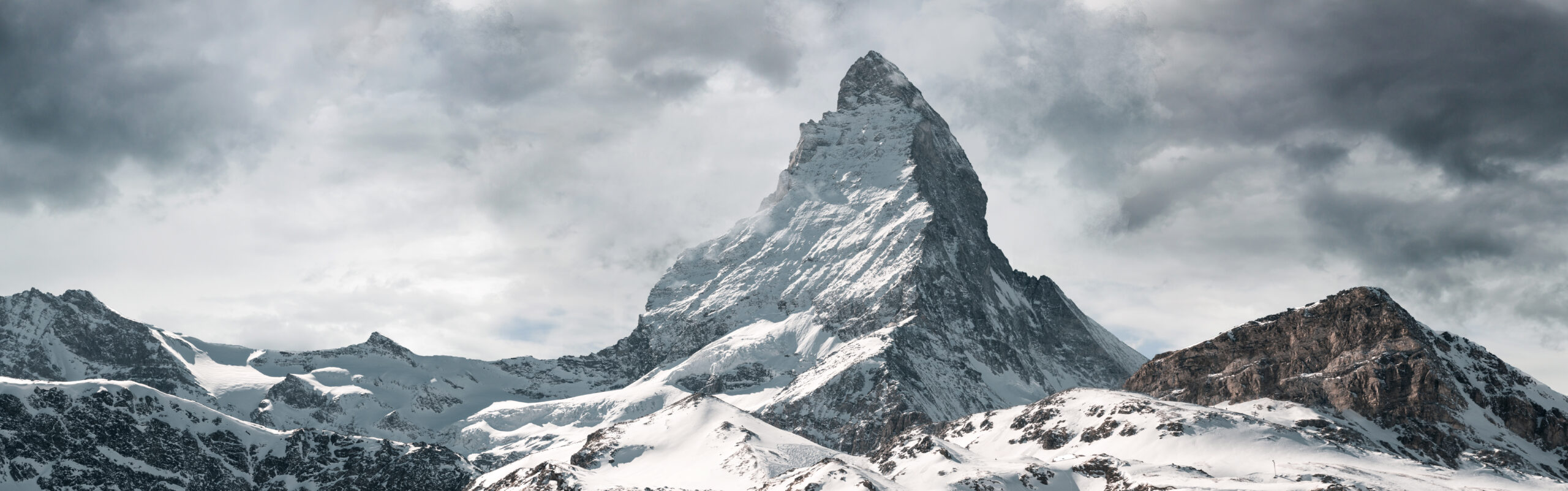
Matterhorn Summit Success Rate: the 55% headline hides a 62-point experience gap
The most photographed mountain on Earth is also its most misunderstood serious alpine peak. The Matterhorn’s 55% overall success rate conceals an enormous spread: first-time alpinists reach just 18%, while experienced climbers with the right Zermatt preparation reach 80%. Here’s the data – by month, route, experience, and guiding model – plus the single timing rule that decides most summit days.
On the Matterhorn, preparation beats fitness – and the experience gap is the widest of any peak under 5,000 m.
55% overall, but 72% UIAGM-guided vs 38% independent (a 34-point gap), and 18% for first-timers vs 80% for AD+ / prior-Matterhorn climbers (a 62-point gap). The mountain rewards specific alpine rock-movement skills far more than general fitness or altitude tolerance.
Two climber-controlled variables move the odds most: leave the Hörnli Hut by 4am (teams departing after 5am summit below 30%), and climb 2-4 Zermatt-area 4,000 m peaks first. Optimize both and you climb at the 68-80% cohort rate, not the 55% average.
The headline Matterhorn numbers
Success defined as reaching the 4,478 m true summit, across 24,000 registered attempts 2005-2025.
| Metric | Rate | Sample & notes |
|---|---|---|
| Overall summit success | ~55% | n=24,000 · all routes, all experience levels |
| UIAGM/IFMGA-guided | ~72% | n=14,200 · Zermatt-based guide; 34-point gap to independent |
| Independent rope team | ~38% | n=7,800 · self-led; route-finding & turnaround-discipline gaps |
| Hörnli Ridge (standard, NE) | ~58% | n=22,000+ · AD+ to D; the vast majority of all attempts |
| Lion Ridge (Italian) | ~44% | n=1,400 · Cervinia; more technical than the Hörnli |
| Zmutt / Furggen (technical) | ~28% | n=180 · TD-grade; experienced alpinists only |
| Prior Matterhorn / D-grade cohort | ~80% | n=1,100 · best-performing cohort |
| First alpine climb cohort | ~18% | n=2,400 · 62 points below the best cohort |
| Rescue incident rate | 1 in 35 | per season; highest of any single Swiss peak |
| Fatality rate | 1 in 140 | 8-12 deaths/year in absolute terms – highest in Europe |
| 2026 guided cost | CHF 1.8-2.4K | UIAGM 2-day ascent incl. Hörnli Hut & guide fees |
Success rate by month
July and August are the statistical peak – dry rock and stable windows for the exposed upper sections.
| Month | Success | Conditions |
|---|---|---|
| May | ~28% | Very limited; experienced winter alpinists only; rock still snow-covered |
| June | ~46% | Shoulder month; ice on upper sections; faster-developing storms |
| July | ~64% | Statistical peak – dry rock, stable windows, most attempts |
| August | ~62% | Continued peak; afternoon storm risk increasing |
| September | ~52% | Shoulder closing; early snow possible; shorter windows |
| October | ~22% | Late season; experienced alpinists only; snow on rock common |
Success rate by route
For nearly all climbers the decision reduces to one route – the standard Hörnli. The rest are for experienced alpinists.
Hörnli Ridge
Via the Hörnli Hut (3,260 m). AD+ to D, 1,200 m of exposed mixed rock and ice, fixed ropes on key sections. Over 90% of all attempts.
Lion Ridge
From Cervinia via the Carrel Hut. Sustained AD+/D, longer approach – a good quieter alternative for strong parties. Smaller, more experienced cohort.
Zmutt / Furggen
Serious TD mixed routes for experienced alpinists – fewer than 200 attempts in 20 years. Not for anyone who hasn’t climbed the Hörnli confidently.
The 14-point gap between the Hörnli (58%) and Lion Ridge (44%) reflects different climber populations more than different difficulty – both are AD+ to D. The Hörnli benefits from extensive commercial guiding, daily condition reports from Zermatt Mountain Guides, and the highest cumulative ascent count of any alpine route in the world. Single-day attempts from Zermatt without the hut overnight run below 20% success and higher rescue rates – impractical for all but elite alpine athletes.
Guided vs independent
The 34-point gap rivals Everest’s guided/independent magnitude – and it’s mostly about decisions, not skill.
| Factor | UIAGM/IFMGA guided | Independent rope team |
|---|---|---|
| Summit success | ~72% | ~38% |
| Rock-conditions knowledge | Daily updates from the Zermatt guides network | Self-assessment; may rely on outdated reports |
| Turnaround discipline | Strict protocols; Shoulder cutoff by ~8am | Self-enforced; summit fever more acute |
| Hörnli Hut reservation | Operator books 6+ months ahead | Climber-arranged; books out within hours |
| Crowd management on fixed ropes | Staging strategies & timing-based bypasses | Often loses 60-90 min in queues |
| Typical 2026 cost | CHF 1,800-2,400 (2-day) | CHF 800-1,500 (hut, lifts, lodging, gear) |
| Best for | First attempts; no prior Zermatt experience | Experienced alpinists with Zermatt 4,000 m + AD+ rock |
Success rate by experience level
The single largest swing variable – and the widest experience gap of any peak under 5,000 m in our data.
| Prior experience | Success | Why |
|---|---|---|
| First alpine climb (no AD-grade) | 18% | n=2,400 · the Hörnli is not a beginner route; exposed 4th-grade rock at altitude |
| Prior AD-grade rock (Breithorn, Bishorn) | 48% | n=4,200 · a solid foundation of movement skills & exposure confidence |
| AD+ routes + Zermatt 4,000 m peaks | 68% | n=3,800 · the recommended preparation level |
| Prior Matterhorn / D-grade alpine | 80% | n=1,100 · route familiarity drives dramatic improvement |
The recommended Zermatt preparation sequence: Breithorn (entry-level glacier/snow) → Allalinhorn or Pollux/Castor (AD snow and rock) → Obergabelhorn or Dom (AD+ alpine mixed) → the Matterhorn, ideally in a single 2-3 week Zermatt trip. That sequence is the difference between the 18% first-alpinist rate and the 68% AD+ cohort – a 50-point swing driven entirely by preparation. Avoid the “Aconcagua-to-Matterhorn” mistake: non-technical altitude peaks build endurance the Matterhorn doesn’t reward, and give none of the alpine rock skills it demands. See our Matterhorn training plan and what to climb before the Matterhorn.
Most common turnaround reasons
Five reasons account for nearly all failed summits – and the top two are both climber-controllable.
Afternoon storm development
The Matterhorn builds convective storms with extraordinary speed; parties caught above the Shoulder face a descent on loose, crowded fixed ropes in lightning risk. Mitigation: enforce the 4am departure; be below the Solvay Hut by 1pm.
Technical difficulty above the Shoulder
The upper Hörnli involves committing low-5th-grade moves on loose rock with serious fall consequence – beyond many climbers’ comfortable range. Mitigation: multiple AD+ alpine rock routes before the attempt.
Crowding – fixed-rope bottlenecks
The ridge carries 100+ climbers on peak days; bottlenecks above the Solvay Hut cost critical morning time. Mitigation: the early 4am window, avoid weekends, consider the Lion Ridge.
Guide turnaround call
Zermatt guides turn around at the Shoulder when summit probability doesn’t justify the descent risk. Mitigation: pre-brief on this and treat it as the correct safety decision, not a failure.
Rockfall & loose terrain
Rockfall from parties above is a persistent hazard; several incidents per season require evacuation. Mitigation: helmet on from the hut, keep spacing, move quickly through the Moseley Slab.
The 62% rule: afternoon storms (34%) and technical difficulty above the Shoulder (28%) together drive 62% of all turnarounds – and both respond to the 4am departure rule and AD+ alpine preparation. Optimize those two factors and your individual odds move toward the 68-80% experienced-cohort baseline rather than the 55% mountain average.
Historical trend
The rate has slipped over 20 years – and the cause is structural, not seasonal noise.
| Period | Rolling avg | Notes |
|---|---|---|
| 2005-2009 | ~62% | Baseline; established commercial guiding infrastructure |
| 2010-2014 | ~60% | Stable; permafrost-melt effects not yet measurable |
| 2015-2019 | ~57% | Permafrost melt accelerates; loose rock above the Shoulder increases |
| 2020-2025 | ~55% | Non-specialist volume grows; climate-driven season compression measurable |
Zermatt guides have documented increasing loose-rock sections above the Shoulder as permafrost that once bound rock fragments thaws on accelerating cycles. The post-2015 decline mirrors Mont Blanc’s pattern, and the mechanism is directly observable season by season – the Matterhorn is becoming measurably more dangerous even as rescue and forecasting improve. The first ascent in 1865 (Whymper, Hörnli Ridge) ended with four climbers killed on the descent when a rope failed – a founding tragedy that still shapes Zermatt’s turnaround-discipline culture 160 years on.
Planning a Matterhorn attempt?
Book a Zermatt UIAGM/IFMGA guide for a first attempt (see our Matterhorn operators comparison), reserve the Hörnli Hut 3-4 months ahead, and carry REGA or Alpine Club rescue cover. For flights and Zermatt lodging, compare options through the Global Summit Guide Expedia travel shop.
Disclosure: the Expedia link is an affiliate link; we may earn a small commission at no extra cost to you, and it never affects our recommendations.
Matterhorn Climb Guide Matterhorn Training PlanMatterhorn success rate FAQ
The questions climbers search most.
What is the Matterhorn success rate in 2026?
~55% overall (n=24,000, 2005-2025), ~72% UIAGM-guided, ~38% independent. By route: Hörnli 58%, Lion 44%, Zmutt/Furggen 28%. The headline hides a 62-point experience gap – 18% for first-timers, 80% for AD+/prior-Matterhorn climbers.
Is the Matterhorn harder than Mont Blanc?
Yes, technically. Mont Blanc’s Goûter route is PD+ to AD (snow/glacier); the Matterhorn’s Hörnli is AD+ to D with 1,200 m of exposed mixed rock. Mont Blanc rewards fitness; the Matterhorn rewards rock movement. Usual order: Mont Blanc first, then the Matterhorn.
How dangerous is it?
The most dangerous regularly-climbed peak in Europe by absolute count – 8-12 deaths/year, ~1 in 140 fatality rate, ~1 in 35 rescue rate. Most deaths are falls above the Shoulder and lightning in afternoon storms. REGA or Alpine Club rescue cover is essential.
What experience do I need?
First alpine climb: 18%. AD-grade rock (Breithorn, Bishorn): 48%. AD+ routes + Zermatt 4,000 m peaks: 68% (recommended). D-grade / prior Matterhorn: 80%. The Hörnli is exposed 4th- and low-5th-grade rock at altitude – not a beginner route.
What’s the 4am departure rule?
Leave the Hörnli Hut (3,260 m) by 4am – teams departing after 5am summit below 30%. It positions you at the Shoulder by 7-8am, the summit by 9-10am, and below the Solvay Hut before the 1-4pm storm window.
How much does it cost?
Guided 2-day: CHF 1,800-2,400 (~$2,000-2,700). Independent: CHF 800-1,500 for the trip. Add REGA (CHF 40-80/yr) – non-negotiable given Air Zermatt’s ~CHF 6,000 rescue cost. Prep peaks add CHF 2,000-4,000.
Matterhorn at a glance
Sources & methodology
- Zermatt Mountain Guides Association annual records – primary dataset (n=24,000 registered attempts, 2005-2025)
- Air Zermatt rescue statistics and SAC Zermatt Section reports (departure-time correlations, turnaround protocols)
- Swiss Alpine Club (SAC) accident database – fatality records and post-2015 permafrost-melt rockfall documentation
- Pennine Alps permafrost research and the European alpine 4,000 m peak accident comparison (Mont Blanc, Monte Rosa)
Method: rolling 5-year averages where available; 2025 data preliminary. Registered attempts undercount unregistered independent climbs, so headline rates are likely 1-3 points high. Last updated: July 17, 2026 · next review November 2026. Verify current conditions with Zermatt guides before climbing.
Plan around what actually drives success
Four climber-controlled variables move Matterhorn odds the most: leave the Hörnli Hut by 4am, climb multiple AD-grade Zermatt 4,000 m peaks first, book the hut 3-4 months ahead, and hire a Zermatt UIAGM guide for a first attempt. Optimize all four and you climb at the 68-80% cohort rate – not the 55% average.
Matterhorn Complete Guide All Success RatesWas this helpful?
🏔Related safety data
🧭Explore & compare
Global Summit Guide is an independent mountaineering resource founded in 2026. The team combines first-hand trekking and climbing experience with in-depth research and professional health and nutrition review to help climbers choose objectives, prepare properly, and stay safe.
Health, altitude, and nutrition content is reviewed by Taylor Ludlow (Registered Nurse) and Brigg Hoopes (Nutritionist).
What We Don't Know Yet
Mountain information changes quickly. This box explains the limits of what this page can responsibly promise.
- Weather, snowpack, avalanche risk, road access, and route conditions can change quickly and may be different on your climbing dates.
- Route conditions, trailhead access, crevasse exposure, stream crossings, and rescue access may vary from published planning guidance.
- Total trip cost can change with flights, lodging, guide pricing, permits, gear rentals, transportation, and exchange rates.
- Fitness and altitude response vary by person; no guide, itinerary, or training plan can guarantee acclimatization or summit success.
- Comparisons simplify complex decisions; the better mountain depends on current conditions, skills, timing, budget, and risk tolerance.
Verify current conditions with official land managers, guide services, local forecasts, and current route reports before booking or climbing.
Mountaineering, rock and ice climbing, glacier travel, and high-altitude activity are inherently dangerous and can result in serious injury or death. The information on Global Summit Guide is provided for general informational and educational purposes only and is not a substitute for professional instruction, qualified guiding, proper equipment, or your own judgment and experience.
Route conditions, weather, snowpack, permits, regulations, and hazards change constantly and may differ from what is described here. Details may be incomplete, out of date, or contain errors. Always verify current information with local authorities, certified guides, and official sources before making any decision in the mountains.
Nothing on this site is medical, legal, or financial advice. Our fitness, acclimatization, altitude, and nutrition content is general in nature; consult a qualified physician before beginning any strenuous exercise program or exposing yourself to high altitude.
You are solely responsible for your own safety and decisions. To the fullest extent permitted by law, Global Summit Guide and its team accept no liability for any loss, injury, damage, or expense arising from use of, or reliance on, this information. By using this site you acknowledge these risks and accept these terms.
Some links on this site may be affiliate links. If you buy through them we may earn a small commission at no extra cost to you; this never affects our recommendations.
Global Summit Guide recommendation path
Next Best Mountain to Research
Use these recommendations to continue the right planning path instead of stopping on one page.
Use current permit, weather, route, and operator information before booking or climbing.