
Last updated September 12, 2026
{ “@context”: “https://schema.org”, “@graph”: [ { “@type”: [ “WebPage”, “Article” ], “@id”: “https://globalsummitguide.com/mountains-matterhorn-switzerland/#article”, “url”: “https://globalsummitguide.com/mountains-matterhorn-switzerland/”, “headline”: “Matterhorn Climbing Guide: Hörnli Ridge, Difficulty, Cost & Readiness”, “description”: “Plan a Matterhorn climb from Zermatt with the Hörnli Ridge, technical difficulty, guide requirements, hut logistics, cost, best season, preparation standards and readiness checklist.”, “dateModified”: “2026-09-12T13:55:38+00:00”, “inLanguage”: “en-US”, “articleSection”: “Mountain Guides”, “image”: [ “https://globalsummitguide.com/wp-content/uploads/2026/03/AdobeStock_255784802-scaled.jpeg”, “https://globalsummitguide.com/wp-content/uploads/2026/04/AdobeStock_174974086-1-scaled.jpeg” ], “about”: { “@type”: “Mountain”, “name”: “Matterhorn”, “elevation”: “4478 m”, “geo”: { “@type”: “GeoCoordinates”, “latitude”: 45.9763, “longitude”: 7.6586 } }, “author”: { “@type”: “Person”, “name”: “Travis Ludlow”, “url”: “https://globalsummitguide.com/about/” }, “publisher”: { “@type”: “Organization”, “name”: “Global Summit Guide”, “url”: “https://globalsummitguide.com/” } }, { “@type”: “BreadcrumbList”, “itemListElement”: [ { “@type”: “ListItem”, “position”: 1, “name”: “Home”, “item”: “https://globalsummitguide.com/” }, { “@type”: “ListItem”, “position”: 2, “name”: “Mountains”, “item”: “https://globalsummitguide.com/mountains/” }, { “@type”: “ListItem”, “position”: 3, “name”: “Matterhorn”, “item”: “https://globalsummitguide.com/mountains-matterhorn-switzerland/” } ] }, { “@type”: “FAQPage”, “mainEntity”: [ { “@type”: “Question”, “name”: “What is the normal route on the Matterhorn?”, “acceptedAnswer”: { “@type”: “Answer”, “text”: “The Hörnli Ridge from Zermatt is the standard first-ascent route for most climbers. It starts from the Hörnli Hut at 3,260 metres and reaches the 4,478-metre summit over sustained exposed alpine terrain.” } }, { “@type”: “Question”, “name”: “How hard is the Matterhorn?”, “acceptedAnswer”: { “@type”: “Answer”, “text”: “The standard Hörnli Ridge is a serious technical alpine climb requiring efficient movement on exposed rock, crampon competence on mixed terrain, strong route-finding, excellent endurance and a fast technical descent.” } }, { “@type”: “Question”, “name”: “How long does the Matterhorn take from the Hörnli Hut?”, “acceptedAnswer”: { “@type”: “Answer”, “text”: “ZERMATTERS lists about four hours for the ascent and about four hours for the descent, with an overall tour duration of roughly eight hours for well-prepared climbers in suitable conditions.” } }, { “@type”: “Question”, “name”: “Do I need a guide for the Matterhorn?”, “acceptedAnswer”: { “@type”: “Answer”, “text”: “Experienced independent alpinists can climb without a commercial guide, but the Hörnli Hut strongly recommends a mountain guide, and ZERMATTERS operates the standard climb at one climber per guide.” } }, { “@type”: “Question”, “name”: “When is the best time to climb the Matterhorn?”, “acceptedAnswer”: { “@type”: “Answer”, “text”: “ZERMATTERS currently lists its Matterhorn season from mid-July to mid-September, depending on route and summit conditions. The Hörnli Hut opens in late June, but the climbing route itself still needs to be in suitable condition.” } }, { “@type”: “Question”, “name”: “How much does the Hörnli Hut cost in 2026?”, “acceptedAnswer”: { “@type”: “Answer”, “text”: “The official Hörnli Hut lists public dormitory beds at CHF 150 per person in 2026, including dinner and breakfast, with a sleeping-bag liner required for dormitory stays.” } }, { “@type”: “Question”, “name”: “What should I climb before the Matterhorn?”, “acceptedAnswer”: { “@type”: “Answer”, “text”: “The best preparation is not one mandatory peak but a progression that proves exposed rock movement, crampon use, acclimatization, fast transitions, long technical days and efficient descent skills.” } }, { “@type”: “Question”, “name”: “Is the Matterhorn harder than Mont Blanc?”, “acceptedAnswer”: { “@type”: “Answer”, “text”: “For most climbers, the Matterhorn standard route is more technically demanding than the standard Mont Blanc route. Mont Blanc is more dominated by glacier travel, altitude and endurance; the Matterhorn demands faster technical movement on exposed alpine terrain.” } } ] } ] } @import url(‘https://fonts.googleapis.com/css2?family=DM+Serif+Display:ital@0;1&family=Outfit:wght@300;400;500;600;700&display=swap’); .gsg-matt66{–navy:#071a2b;–navy2:#102a43;–blue:#214f75;–gold:#d4913a;–gold2:#f0b45d;–cream:#f7f2e8;–paper:#fffdfa;–ink:#122a44;–muted:#657482;–line:#e4d7bd;–soft:#eef5f8;–green:#356b57;–red:#934a3d;–amber:#98611c} .gsg-matt66,.gsg-matt66 *{box-sizing:border-box}.gsg-matt66{background:var(–paper);color:var(–ink);font-family:’Outfit’,Arial,sans-serif;line-height:1.64;overflow-x:clip}.gsg-matt66 a{color:var(–blue);text-decoration:none}.gsg-matt66 a:hover{color:var(–navy)}.gsg-matt66 img{max-width:100%;display:block}.gsg-matt66 h1,.gsg-matt66 h2,.gsg-matt66 h3{font-family:’DM Serif Display’,Georgia,serif;font-weight:400;line-height:1.08;margin-top:0}.gsg-matt66 p{margin-top:0}.gsg-matt66-container{width:min(1120px,calc(100% – 44px));margin:auto}.gsg-matt66-section{padding:70px 0}.gsg-matt66-band{background:#f8f4ec}.gsg-matt66-soft{background:var(–soft)}.gsg-matt66-kicker{display:block;color:var(–amber);font-size:.72rem;font-weight:800;letter-spacing:1.2px;text-transform:uppercase;margin-bottom:9px}.gsg-matt66-section-head{display:grid;grid-template-columns:1fr minmax(280px,430px);gap:32px;align-items:end;margin-bottom:28px}.gsg-matt66-section-head h2{font-size:clamp(2.2rem,4vw,3.7rem);color:var(–navy);margin:0}.gsg-matt66-section-head p{color:var(–muted);font-size:.92rem;margin:0} /* HERO */ .gsg-matt66-hero{position:relative;min-height:72svh;display:flex;align-items:center;overflow:hidden;background:#e7ddd2}.gsg-matt66-hero-image{position:absolute!important;inset:0!important;width:100%!important;height:100%!important;object-fit:cover!important;object-position:center 48%!important;z-index:0!important}.gsg-matt66-hero:after{content:””;position:absolute;inset:0;background:linear-gradient(90deg,rgba(248,244,236,.99),rgba(248,244,236,.94) 43%,rgba(248,244,236,.57) 68%,rgba(248,244,236,.08));z-index:1}.gsg-matt66-hero-inner{position:relative;z-index:2;width:min(1120px,calc(100% – 44px));margin:auto;padding:60px 0}.gsg-matt66-breadcrumb{display:flex;flex-wrap:wrap;gap:7px;font-size:.74rem;color:#536b7a;margin-bottom:18px}.gsg-matt66-hero h1{max-width:1060px;color:var(–navy);font-size:clamp(3rem,5.7vw,5.8rem);letter-spacing:-.04em;margin:0 0 18px}.gsg-matt66-hero h1 em{color:#98611c}.gsg-matt66-lead{max-width:930px;color:#405a6b;font-size:clamp(1rem,1.5vw,1.18rem);margin-bottom:23px}.gsg-matt66-actions{display:flex;flex-wrap:wrap;gap:10px}.gsg-matt66-btn{display:inline-flex;align-items:center;justify-content:center;min-height:48px;padding:11px 19px;font-size:.82rem;font-weight:800;border:1px solid transparent}.gsg-matt66-btn-primary{background:var(–navy);color:#fff!important}.gsg-matt66-btn-secondary{background:#fff;color:var(–navy)!important;border-color:rgba(7,26,43,.22)}.gsg-matt66-trust{display:flex;flex-wrap:wrap;gap:9px 18px;margin-top:18px;color:#445d6c;font-size:.75rem}.gsg-matt66-trust span:before{content:”✓”;color:#98611c;margin-right:6px} /* WORDPRESS COLLISION GUARD */ .gsg-matt66 .gsg-matt66-hero .avatar, .gsg-matt66 .gsg-matt66-hero img.avatar, .gsg-matt66 .gsg-matt66-hero .user-avatar, .gsg-matt66 .gsg-matt66-hero .author-avatar, .gsg-matt66 .gsg-matt66-hero .wp-user-avatar, .gsg-matt66 .gsg-matt66-hero [class*=”avatar”], .gsg-matt66 .gsg-matt66-hero [class*=”author”] img:not(.gsg-matt66-hero-image){display:none!important;visibility:hidden!important} /* STATS + DIRECT ANSWER */ .gsg-matt66-stats{display:grid;grid-template-columns:repeat(5,1fr);max-width:1120px;margin:-30px auto 0;position:relative;z-index:4;background:var(–cream);border:1px solid var(–line)}.gsg-matt66-stats div{padding:20px 12px;text-align:center;border-right:1px solid var(–line)}.gsg-matt66-stats div:last-child{border-right:0}.gsg-matt66-stats strong{display:block;color:var(–navy);font:400 1.55rem ‘DM Serif Display’,serif}.gsg-matt66-stats span{display:block;color:var(–muted);font-size:.61rem;text-transform:uppercase}.gsg-matt66-byline{display:flex;flex-wrap:wrap;justify-content:space-between;gap:10px;padding:16px 0;border-bottom:1px solid var(–line);font-size:.76rem;color:var(–muted)} .gsg-matt66-answer{display:grid;grid-template-columns:1.15fr .85fr;gap:26px;background:#fff;border:1px solid var(–line);border-top:5px solid var(–gold);padding:31px;margin-top:27px}.gsg-matt66-answer h2{font-size:2.3rem;color:var(–navy);margin-bottom:12px}.gsg-matt66-answer p{color:#526a7a}.gsg-matt66-chips{display:grid;grid-template-columns:1fr 1fr;gap:8px}.gsg-matt66-chip{background:var(–cream);border:1px solid var(–line);padding:11px}.gsg-matt66-chip span{display:block;color:#98611c;font-size:.61rem;text-transform:uppercase;font-weight:800}.gsg-matt66-chip b{font-size:.79rem;color:var(–navy)} .gsg-matt66-alert{margin-top:20px;padding:20px;background:#fff8ef;border:1px solid #e8cda6;border-left:5px solid var(–gold);font-size:.83rem;color:#665a4b}.gsg-matt66-alert-red{background:#fff3f1;border-color:#e1b6af;border-left-color:var(–red);color:#704d47}.gsg-matt66-alert-green{background:#f0f7f3;border-color:#c7ddd1;border-left-color:var(–green);color:#496256}.gsg-matt66-toc{margin-top:23px;background:#fff;border:1px solid var(–line);padding:22px}.gsg-matt66-toc h2{font-size:1.45rem;color:var(–navy)}.gsg-matt66-toc-grid{display:grid;grid-template-columns:repeat(4,1fr);gap:7px}.gsg-matt66-toc-grid a{padding:9px 10px;border:1px solid #edf0f1;font-size:.74rem;font-weight:800} /* DECISION */ .gsg-matt66-decision{display:grid;grid-template-columns:repeat(4,1fr);gap:12px}.gsg-matt66-decision-card{background:#fff;border:1px solid var(–line);border-top:4px solid var(–gold);padding:21px}.gsg-matt66-decision-card span{color:#98611c;font-size:.63rem;text-transform:uppercase;font-weight:800}.gsg-matt66-decision-card h3{font-size:1.45rem;color:var(–navy);margin:15px 0 8px}.gsg-matt66-decision-card p{font-size:.79rem;color:var(–muted)} /* TABLE */ .gsg-matt66-tablewrap{overflow:auto;background:#fff;border:1px solid var(–line)}.gsg-matt66 table{width:100%;border-collapse:collapse;min-width:1080px}.gsg-matt66 th{padding:13px;background:var(–navy);color:#fff;text-align:left;font-size:.67rem;text-transform:uppercase;letter-spacing:.6px}.gsg-matt66 td{padding:13px;border-bottom:1px solid #edf0f1;color:var(–muted);font-size:.79rem;vertical-align:top}.gsg-matt66 td strong{color:var(–navy)}.gsg-matt66-pill{display:inline-block;padding:3px 7px;background:var(–cream);font-size:.61rem;color:#765d34;font-weight:800;text-transform:uppercase} /* ROUTE CARDS */ .gsg-matt66-ranking{display:grid;grid-template-columns:repeat(2,1fr);gap:14px}.gsg-matt66-hike{position:relative;background:#fff;border:1px solid var(–line);padding:24px}.gsg-matt66-num{position:absolute;right:17px;top:12px;color:#dbc7a4;font:400 2.3rem ‘DM Serif Display’,serif}.gsg-matt66-hike small{display:block;padding-right:55px;color:#98611c;font-size:.63rem;text-transform:uppercase;font-weight:800}.gsg-matt66-hike h3{padding-right:55px;font-size:1.65rem;color:var(–navy);margin:15px 0 5px}.gsg-matt66-meta{font-size:.72rem;font-weight:700;color:#557083;margin-bottom:11px}.gsg-matt66-hike p{font-size:.81rem;color:var(–muted)}.gsg-matt66-verdict{background:var(–cream);border-left:3px solid var(–gold);padding:10px 11px;font-size:.76rem;color:#536675;margin:12px 0}.gsg-matt66-more{font-size:.75rem;font-weight:800} /* PHOTO */ .gsg-matt66-photo{position:relative;min-height:520px;display:flex;align-items:end;overflow:hidden}.gsg-matt66-photo img{position:absolute;inset:0;width:100%;height:100%;object-fit:cover}.gsg-matt66-photo:after{content:””;position:absolute;inset:0;background:linear-gradient(0deg,rgba(7,26,43,.89),rgba(7,26,43,.03) 72%)}.gsg-matt66-photo-copy{position:relative;z-index:2;width:min(1120px,calc(100% – 44px));margin:auto;padding:50px 0}.gsg-matt66-photo-panel{max-width:900px;background:rgba(7,26,43,.83);border-left:5px solid var(–gold);padding:25px}.gsg-matt66-photo-panel h2{font-size:clamp(2.3rem,4.5vw,4rem);color:#fff}.gsg-matt66-photo-panel p{color:#e4edf1} /* GRIDS */ .gsg-matt66-grid{display:grid;grid-template-columns:repeat(2,1fr);gap:14px}.gsg-matt66-card{background:#fff;border:1px solid var(–line);padding:22px;display:flex;flex-direction:column}.gsg-matt66-card>span{color:#98611c;font-size:.63rem;text-transform:uppercase;font-weight:800}.gsg-matt66-card h3{font-size:1.48rem;color:var(–navy);margin:15px 0 8px}.gsg-matt66-card p,.gsg-matt66-card li{font-size:.8rem;color:var(–muted)}.gsg-matt66-card ul{padding-left:18px}.gsg-matt66-card b{margin-top:auto;font-size:.74rem} /* JOURNEY */ .gsg-matt66-journey{background:var(–navy);border-top:5px solid var(–gold);padding:30px}.gsg-matt66-journey h2{font-size:2.3rem;color:#fff}.gsg-matt66-journey p{color:#dbe7ed;max-width:890px}.gsg-matt66-path{display:flex;flex-wrap:wrap;gap:7px 10px;color:#cbd8df;font-size:.66rem;text-transform:uppercase;font-weight:800;margin:17px 0}.gsg-matt66-path .gsg-matt66-active{color:var(–gold2)}.gsg-matt66-journey-grid{display:grid;grid-template-columns:repeat(4,1fr);gap:8px;margin:18px 0}.gsg-matt66-journey-choice{background:#fff;padding:14px}.gsg-matt66-journey-choice span{display:block;color:#98611c;font-size:.58rem;text-transform:uppercase;font-weight:800}.gsg-matt66-journey-choice strong{display:block;color:var(–navy);font-size:.83rem;margin-top:4px}.gsg-matt66-journey-choice p{color:var(–muted);font-size:.69rem;margin:5px 0 0} /* METHOD + FAQ */ .gsg-matt66-method{display:grid;grid-template-columns:1fr 1fr;gap:15px}.gsg-matt66-method article{background:#fff;border:1px solid var(–line);padding:23px}.gsg-matt66-method h3{font-size:1.45rem;color:var(–navy)}.gsg-matt66-method p,.gsg-matt66-method li{font-size:.8rem;color:var(–muted)} .gsg-matt66-faq{display:grid;gap:8px}.gsg-matt66-faq details{background:#fff;border:1px solid var(–line)}.gsg-matt66-faq summary{padding:17px 19px;font-weight:800;color:var(–navy);cursor:pointer}.gsg-matt66-faq p{padding:0 19px 18px;color:var(–muted);font-size:.82rem}.gsg-matt66-final{padding:76px 22px;text-align:center;background:var(–cream)}.gsg-matt66-final h2{font-size:clamp(2.3rem,5vw,4rem);color:var(–navy)}.gsg-matt66-final p{max-width:790px;margin:0 auto 20px;color:var(–muted)} @media(max-width:1000px){.gsg-matt66-stats{grid-template-columns:repeat(3,1fr)}.gsg-matt66-decision,.gsg-matt66-journey-grid{grid-template-columns:repeat(2,1fr)}}@media(max-width:920px){.gsg-matt66-section-head,.gsg-matt66-answer,.gsg-matt66-method{grid-template-columns:1fr}}@media(max-width:700px){.gsg-matt66-container,.gsg-matt66-hero-inner{width:min(100% – 28px,1120px)}.gsg-matt66-section{padding:50px 0}.gsg-matt66-hero{min-height:82svh;align-items:flex-end}.gsg-matt66-stats{grid-template-columns:repeat(2,1fr);margin-top:0}.gsg-matt66-ranking,.gsg-matt66-grid,.gsg-matt66-decision,.gsg-matt66-journey-grid,.gsg-matt66-toc-grid{grid-template-columns:1fr}}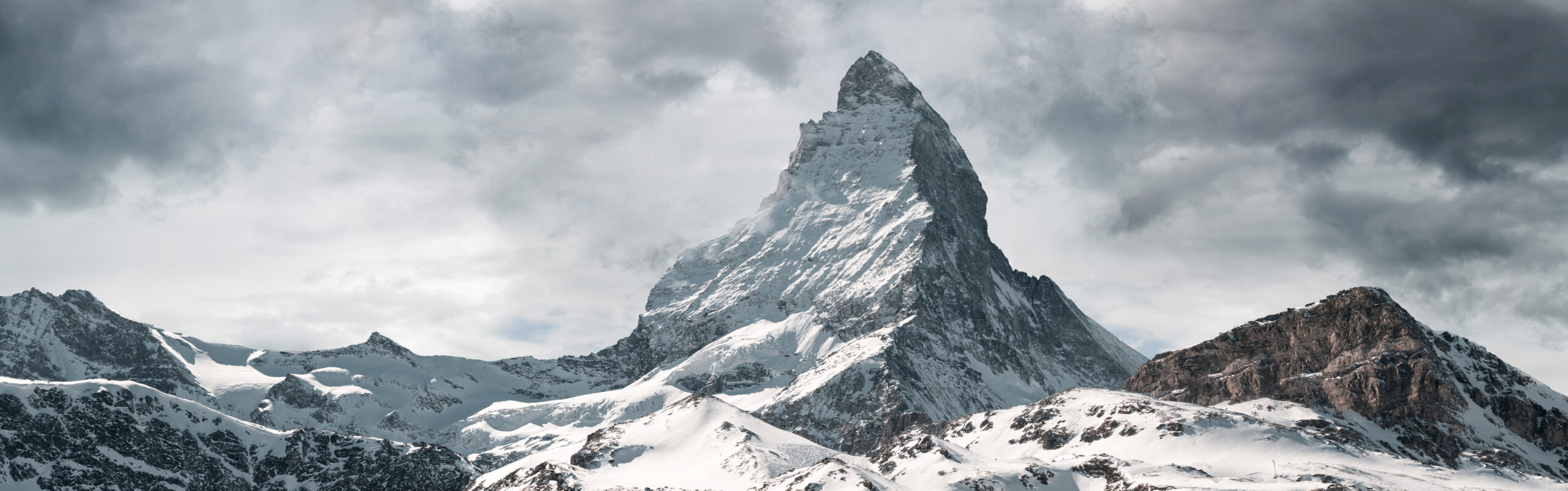
Matterhorn Climbing Guide: Hörnli Ridge, Difficulty, Cost & Readiness
For a first Matterhorn attempt, the Hörnli Ridge from Zermatt is the default route—but the Matterhorn is not an introductory 4,000er. You need to move quickly on exposed alpine rock, use crampons confidently on mixed terrain, manage transitions without delay, and descend the same complex route while tired.
Should You Climb the Matterhorn?
Yes—if you already have real alpine climbing experience and can move efficiently on exposed terrain. The Matterhorn is a technical graduation objective, not a first high mountain. Elevation is only part of the challenge; speed, route-finding and descent efficiency are what make the Hörnli Ridge unforgiving.
The Decisions That Matter Most
| Decision | Best default | Why |
|---|---|---|
| First route | Hörnli Ridge | Standard Zermatt route and the logical first Matterhorn line |
| Guide model | 1:1 for most visiting climbers | ZERMATTERS lists one participant per guide for its Matterhorn program |
| High hut | Hörnli Hut | Normal-route launch point at 3,260 m |
| Summit-day target | Fast, efficient round trip | ZERMATTERS lists roughly 4 hr up + 4 hr down |
| Preparation | Technical Alpine ridge competence | Climbing speed matters as much as raw fitness |
| Schedule | Build weather buffer | The route can fall out of condition quickly after snow or storms |
The Hörnli Ridge from Zermatt
The Hörnli Ridge is the standard route for most first-time Matterhorn climbers. The summit day begins at the Hörnli Hut at 3,260 m and climbs roughly 1,218 vertical metres to the summit at 4,478 m.
ZERMATTERS currently describes the climb as an approximately 8-hour tour: about four hours to the summit and four hours back to the hut. Their readiness standard is equally revealing: several previous 4,000-metre peaks, strong acclimatization, comfortable ice-axe and crampon use, and confidence on ridge climbing up to grade III and steep rock/ice terrain.
The Matterhorn Punishes Hesitation.
The standard route is not defined by one isolated crux. It is defined by sustained movement, exposure, route-finding, transitions and the need to reverse the whole system efficiently.
Which Matterhorn Route Should You Climb?
Hörnli Ridge
Swiss side from Zermatt. The standard line for most first-time Matterhorn climbers.
Lion Ridge
Italian-side route from Cervinia. A separate objective with different logistics and character.
Zmutt Ridge
More serious route-finding and commitment; not the normal first Matterhorn route.
Furggen / faces
Technical lines for experienced alpinists; outside the scope of a first-attempt planning framework.
For route-by-route details, keep this parent broad and use the dedicated Matterhorn routes guide and route comparison.
Why the Matterhorn Is Harder Than It Looks on Paper
Sustained consequence
Large sections of the route require confidence moving quickly where a slip has serious consequences.
Efficiency matters
Small navigation errors consume time and can pull climbers onto looser or harder terrain.
Rock + crampons
You must transition between dry rock, snow and icy terrain without losing momentum.
Down-climbing tired
The technical descent is not a walk-off; fatigue exposes weaknesses late in the day.
Hörnli Hut Logistics
| Item | 2026 official information |
|---|---|
| Elevation | 3,260 m |
| 2026 opening | Open from June 26, 2026 |
| Public dormitory | CHF 150 per person |
| Meals | Dinner and breakfast included with dormitory booking |
| Sleeping liner | Required in public dormitories; available for purchase at reception |
| Approach | About 2 hours on foot from Schwarzsee cable-car station |
The hut is both accommodation and the operational gateway to the Hörnli Ridge. Do not book flights around one non-flexible summit date; align the hut reservation with a larger Zermatt weather buffer.
Matterhorn Season: Calendar vs Conditions
ZERMATTERS currently lists daily Matterhorn guiding from mid-July to mid-September, depending on route and summit-area conditions. The Hörnli Hut opens earlier, in late June, but an open hut does not automatically mean the route is ready for a normal summer ascent.

Matterhorn Is Usually the Technical Step After Easier Alpine 4,000ers.
Mont Blanc, Breithorn and other alpine objectives can build altitude and glacier experience, but the decisive gap is technical speed on exposed rock and mixed ground.
What Does a Matterhorn Climb Cost?
There is no single all-in Matterhorn price because the largest cost depends on how many preparation days, guiding days, valley nights and weather-buffer days you buy. Use components instead of one false universal total.
| Cost component | Planning note |
|---|---|
| Mountain guide | Usually the largest climb-specific cost; ZERMATTERS uses 1:1 on the Matterhorn |
| Hörnli Hut | Official 2026 public dormitory: CHF 150 per person |
| Zermatt lodging | Add enough nights for acclimatization, preparation and weather buffer |
| Lifts / local transport | Schwarzsee access and other acclimatization lifts |
| Gear / rental | Depends on what you already own and what the guide service supplies |
| Insurance | Confirm technical mountaineering and mountain-rescue coverage |
For operator-specific current pricing, use the Matterhorn operator comparison rather than freezing prices into the mountain parent.
Are You Ready for the Matterhorn?
| Readiness gate | You should be able to say yes |
|---|---|
| Endurance | I can sustain an 8–10 hour technical alpine day without falling apart on descent |
| Rock movement | I move confidently on exposed scrambling / low-grade alpine rock in boots |
| Crampons | I can use crampons efficiently on steep mixed alpine terrain |
| Transitions | I can change systems quickly without long stops |
| Acclimatization | I have a plan to arrive well acclimatized before summit day |
| Descent | I am comfortable down-climbing technical terrain when tired |
| Judgment | I will accept a no-go call from conditions, guide or weather without forcing the date |
Key Matterhorn Climbing Routes: Hörnli & Lion Ridge
Matterhorn Routes
Detailed route family and route-specific character.
Compare routes → ChildMatterhorn Route Comparison
Hörnli vs Lion vs the harder ridge options.
Open comparison → BookingMatterhorn Operators
Compare current guide companies, preparation days and inclusions.
Compare guides → Deep recoveryMatterhorn Training Plan
Build climbing-specific endurance and technical movement.
Train for Hörnli → Deep recoveryWhat to Climb Before Matterhorn
Use readiness gates and precursor objectives to close skill gaps.
Build progression → Deep recoveryMatterhorn Summit Success
Keep success-rate analysis separate from this broad planning parent.
See success data → CurrentHörnli Ridge Conditions
Check current route state before your actual attempt.
Check conditions → SeasonMatterhorn Weather & Best Season
Use the detailed season page for freezing level, storms and route timing.
Plan season → DecisionMont Blanc vs Matterhorn
Choose whether you need a glacier/altitude objective or a technical ridge objective next.
Compare peaks → JourneyMy Climb
Save guide, hut, buffer days and readiness milestones in one plan.
Build Matterhorn plan →How This Matterhorn Parent Is Maintained
Official 2026 checks
- Hörnli Hut official site: elevation, 2026 opening, dormitory rate, meals and liner requirement.
- ZERMATTERS: one-climber-per-guide model, approximate 4 hr ascent + 4 hr descent, mid-July to mid-September operating window and technical-readiness expectations.
- Current route conditions remain on the separate conditions tracker rather than being frozen into this evergreen parent.
What this page does not own
- Detailed route-by-route climbing instructions.
- Current guide-company pricing.
- Live Hörnli Ridge conditions.
- Full training program.
- Prerequisite peak progression.
Those intents remain on their dedicated child pages to prevent internal competition.
Matterhorn Climbing FAQ
What is the normal route?
The Hörnli Ridge from Zermatt is the standard first Matterhorn route.
How hard is the Matterhorn?
It is a serious technical alpine climb requiring efficient exposed rock movement, crampon competence, endurance and a fast descent.
How long does summit day take?
ZERMATTERS lists roughly four hours up and four hours down for well-prepared climbers in suitable conditions.
Do I need a guide?
Independent ascent is possible for experienced alpinists, but the Hörnli Hut recommends guiding and ZERMATTERS uses a 1:1 model.
When is the best season?
ZERMATTERS lists mid-July to mid-September, depending on route and summit conditions.
How much is the Hörnli Hut?
The official 2026 public dormitory rate is CHF 150 per person, including dinner and breakfast.
What should I climb first?
Use a technical-alpine progression that proves exposed rock, crampons, acclimatization, speed and descent ability rather than chasing one mandatory prerequisite peak.
Is Matterhorn harder than Mont Blanc?
For most climbers, yes in technical movement. Mont Blanc’s standard route is more focused on glacier travel, altitude and endurance.
Key Matterhorn Climbing Routes: Hörnli & Lion Ridge
The Matterhorn is a complete alpine systems test: technical movement, route-finding, acclimatization, transitions, weather judgment and a demanding descent. Build the whole system before booking the summit day.
Was this helpful?
🏔Related peaks nearby
🧭Explore & compare
Global Summit Guide is an independent mountaineering resource founded in 2026. The team combines first-hand trekking and climbing experience with in-depth research and professional health and nutrition review to help climbers choose objectives, prepare properly, and stay safe.
Health, altitude, and nutrition content is reviewed by Taylor Ludlow (Registered Nurse) and Brigg Hoopes (Nutritionist).
What We Don't Know Yet
Mountain information changes quickly. This box explains the limits of what this page can responsibly promise.
- Weather, snowpack, avalanche risk, road access, and route conditions can change quickly and may be different on your climbing dates.
- Route conditions, trailhead access, crevasse exposure, stream crossings, and rescue access may vary from published planning guidance.
- Total trip cost can change with flights, lodging, guide pricing, permits, gear rentals, transportation, and exchange rates.
- Gear requirements can change by season, route variation, weather window, personal cold tolerance, and guide-service requirements.
- Fitness and altitude response vary by person; no guide, itinerary, or training plan can guarantee acclimatization or summit success.
Verify current conditions with official land managers, guide services, local forecasts, and current route reports before booking or climbing.
Mountaineering, rock and ice climbing, glacier travel, and high-altitude activity are inherently dangerous and can result in serious injury or death. The information on Global Summit Guide is provided for general informational and educational purposes only and is not a substitute for professional instruction, qualified guiding, proper equipment, or your own judgment and experience.
Route conditions, weather, snowpack, permits, regulations, and hazards change constantly and may differ from what is described here. Details may be incomplete, out of date, or contain errors. Always verify current information with local authorities, certified guides, and official sources before making any decision in the mountains.
Nothing on this site is medical, legal, or financial advice. Our fitness, acclimatization, altitude, and nutrition content is general in nature; consult a qualified physician before beginning any strenuous exercise program or exposing yourself to high altitude.
You are solely responsible for your own safety and decisions. To the fullest extent permitted by law, Global Summit Guide and its team accept no liability for any loss, injury, damage, or expense arising from use of, or reliance on, this information. By using this site you acknowledge these risks and accept these terms.
Some links on this site may be affiliate links. If you buy through them we may earn a small commission at no extra cost to you; this never affects our recommendations.
Global Summit Guide recommendation path
Next Best Mountain to Research
Use these recommendations to continue the right planning path instead of stopping on one page.
Use current permit, weather, route, and operator information before booking or climbing.
Explore Travel Options for Your Destination
Once your mountain, dates and route are taking shape, compare flights, hotels and other travel options that fit the trip.
Affiliate link. We may earn a commission at no additional cost to you.