
Last updated May 24, 2026
Climbing Alpamayo: The World’s Most Beautiful Mountain, the Ferrari & French Direct Routes, and a 2026 Cordillera Blanca Guide
Voted the most beautiful mountain in the world by a German jury in 1966 — and it’s lived up to the title ever since. Alpamayo’s perfectly fluted ice pyramid rises to 5,947 meters in Peru’s Cordillera Blanca. Two classic routes (the Ferrari and the French Direct) trace 8-10 pitches of 50-80° snow and ice to a corniced summit ridge. Not the hardest mountain in the Andes. Quite possibly the most photogenic.
Alpamayo doesn’t need to be the tallest mountain to draw climbers from every continent. At 5,947 meters in Peru’s Cordillera Blanca, it isn’t even the highest peak in its own range. Yet for nearly six decades the perfect ice pyramid has held a title that no other mountain has matched. In July 1966, a jury assembled by the German magazine Alpinismus voted Alpamayo “the most beautiful mountain in the world.” The verdict stuck.
One look at the Southwest Face explains why. Wind-sculpted snow flutes run vertically down a 400-meter pyramid of ice, evenly spaced as if measured. The summit terminates in a knife-edge ridge with massive cornices. From the right angle, the mountain looks too symmetrical to be natural. Climbers who reach the col camp at 5,486 meters often describe the view as the moment when the trip suddenly feels worth every soles paid in park fees.
This guide covers what you actually need to know to climb Alpamayo in 2026. Two modern routes dominate the mountain. The Ferrari Route (opened by Casimiro Ferrari’s Italian team in 1975) is the standard line. The French Direct is the steeper modern test piece. Both ascend the Southwest Face from a high col camp. Expect eight to ten pitches of sustained 50-80° snow and ice, an Alpine AD to AD+ grade, and a corniced summit ridge that demands respect on the descent. You’ll fly into Lima, transit eight hours to Huaraz, acclimatize on Ishinca or Vallunaraju, then trek into the Santa Cruz Valley from Cashapampa to base camp at 4,300m. The whole expedition runs 6-14 days depending on whether you add Quitaraju, Artesonraju, or Huascarán.
Costs in 2026 sit between $3,000 and $8,000 USD for guided trips ex-Huaraz, with Adventure Consultants pricing their Alpamayo + Quitaraju expedition at $7,750. The Huascarán National Park entry fee runs around 150 soles. Permits aren’t restrictive the way they are on Denali or Aconcagua, but the technical difficulty is. Alpamayo is not a beginner’s mountain. You’ll need solid multi-pitch ice technique, comfort climbing Alpine AD or Scottish III, and experience above 5,000 meters before you book.
Alpamayo Location & Live Weather
Alpamayo sits in Peru’s Ancash Region, deep in the northern Cordillera Blanca and inside Huascarán National Park (a UNESCO World Heritage Site). The summit coordinates are 8.87917°S, 77.65367°W. From Lima, the standard approach runs north on the Pan-American Highway to Pativilca. From there, the road turns east into the mountains to reach Huaraz, the climbing hub of the Cordillera Blanca. The full drive takes roughly 8 hours by bus. From Huaraz, vehicles continue north to Caraz and the village of Cashapampa, where the Santa Cruz Valley trek begins.
Weather data from Open-Meteo at 8.88°S, 77.65°W. Summit conditions at 5,947m typically run 15-20°C colder than valley readings in Huaraz. The dry climbing season from mid-May to early September offers the most stable weather, with June-August representing peak conditions.
Alpamayo At a Glance
| Summit elevation | 5,947 m (19,511 ft) |
|---|---|
| Local name | Shuyturaju (Quechua) |
| Location | Cordillera Blanca, Ancash Region, Peru |
| Coordinates | 8.87917°S, 77.65367°W |
| Prominence | 524 m (1,719 ft) — parent peak: Quitaraju |
| Mountain range | Cordillera Blanca, Andes |
| Protected area | Huascarán National Park (UNESCO World Heritage Site, 1985) |
| Cultural distinction | Named “Most Beautiful Mountain in the World” by German magazine Alpinismus, July 1966 |
| First confirmed ascent | June 20, 1957 — Günter Hauser, Bernhard Huhn, Frieder Knauss, Horst Wiedmann (Germany) via North Ridge |
| Disputed earlier claim | 1951 — Georges and Claude Kogan (French-Belgian team); the German team later concluded the 1951 party did not reach the true summit |
| Ferrari Route opened | 1975 by Italian team led by Casimiro Ferrari (Southwest Face) |
| Standard routes today | Ferrari Route (Southwest Face) and French Direct — both 8-10 pitches, Alpine AD to AD+ |
| Technical character | Multi-pitch snow and ice climbing, 50-80° with steeper steps; corniced summit ridge |
| Camps | Base camp 4,300 m → moraine camp 4,900 m → col/high camp ~5,486 m → summit |
| Expedition duration | 6-10 days for Alpamayo alone; 11-15 days combined with Quitaraju, Artesonraju, or Huascarán |
| Best climbing season | Mid-May to early September; peak window mid-June to mid-August |
| Park entrance fee | ~150 soles (~$40 USD) for Huascarán National Park |
| 2026 guided cost range | $3,000-$8,000 USD ex-Huaraz; Adventure Consultants $7,750 for Alpamayo + Quitaraju |
| Prerequisites | Multi-pitch ice climbing to 80°, Alpine AD or Scottish III experience, prior altitude above 5,000 m |
| Gateway city | Huaraz (3,052 m), reached from Lima by 8-hour bus |
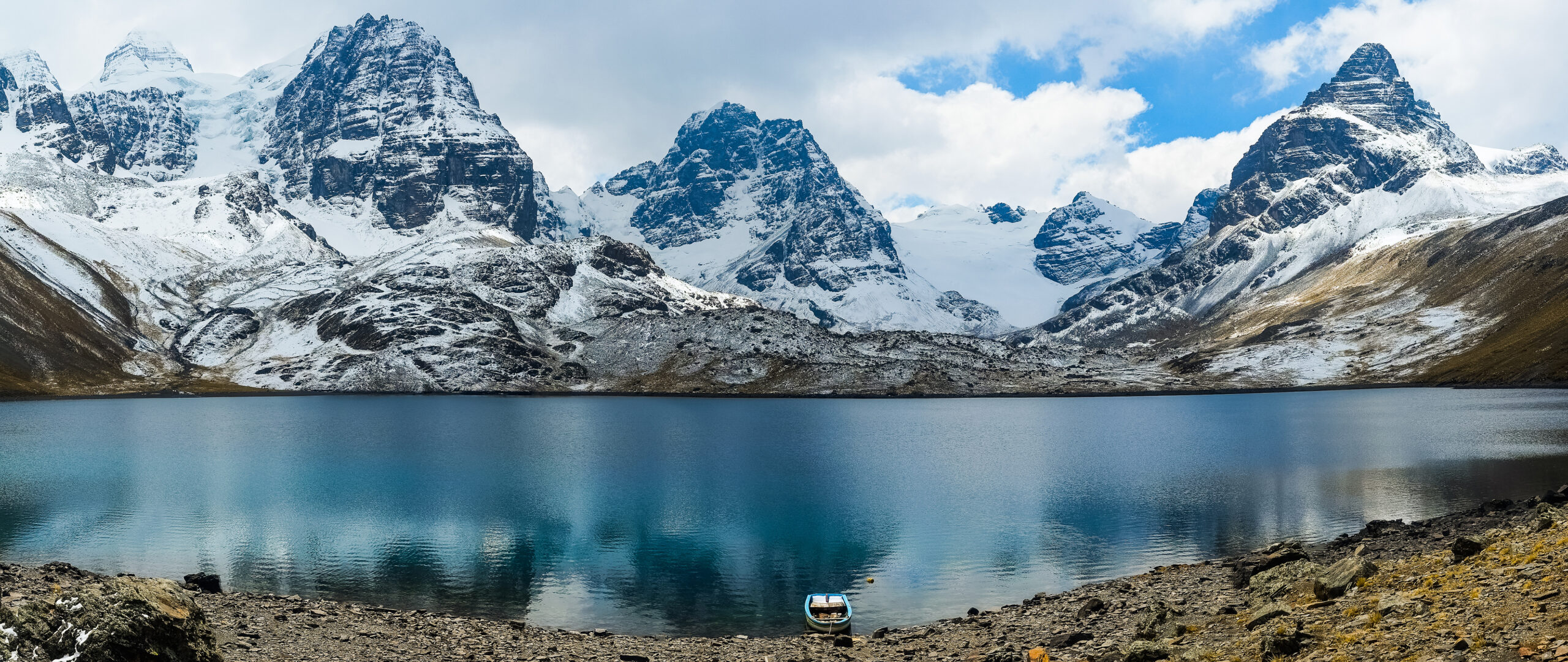
Why Alpamayo Earned the Title “Most Beautiful Mountain in the World”
The 1966 vote was not a marketing stunt. Mountaineers from across Europe submitted nominations to Alpinismus, and Alpamayo won by a wide margin. Six decades later, the title still holds because three things converge on this single summit:
The Geometry of the Ice Pyramid
Most mountains look like piles of rock and snow. Alpamayo looks designed. The Southwest Face rises as a near-perfect equilateral triangle of ice, capped by a corniced summit ridge that runs roughly horizontal. Wind erosion has carved deep, regularly spaced flutes down the face — vertical channels that read like ribs on a fan. The flutes catch shadow differently through the day, so the mountain photographs differently every hour from sunrise to sunset. No other peak in the Andes presents this kind of repeating geometric pattern at this scale.
The Setting in the Cordillera Blanca
Alpamayo doesn’t stand alone. It sits in a cluster of 5,000- and 6,000-meter peaks that includes Quitaraju (its parent peak, 6,036m), Artesonraju (6,025m — famously the inspiration for the Paramount Pictures logo), and Pucajirca to the south. The Santa Cruz Valley approach passes through some of the most spectacular alpine scenery anywhere on Earth: turquoise glacial lakes, hanging glaciers, and a backdrop of nine peaks above 6,000 meters. Even climbers who don’t reach the summit consistently describe the trek in as one of the best mountain experiences of their lives.
The Difficulty-to-Reward Ratio
Alpamayo gives climbers what they came for. Unlike Aconcagua (high but ugly scree slopes) or Denali (long, cold, glacial slog), Alpamayo delivers genuinely beautiful, sustained technical climbing at moderate altitude. The 8-10 pitches of 50-80° ice on the Southwest Face are the kind of climbing alpinists train years for. Steep enough to feel committing. Varied enough to stay interesting. Short enough to complete in a single push from high camp. The reward-per-effort ratio is among the best in world mountaineering.
An honest framing. Alpamayo gets called “moderate” by experienced alpinists, but that label assumes you’ve already done European AD routes, Cascade ice, or Cordillera Blanca acclimatization peaks. For climbers without that background, Alpamayo is genuinely hard — sustained vertical exposure on ice you can’t always see, at an altitude where everything takes twice as long. Don’t let the reputation fool you. The mountain rewards preparation and humbles improvisation.
Who Should Climb Alpamayo?
Alpamayo sits in a specific tier of world mountaineering: harder than a Cascade volcano, easier than a 7,000-meter peak, and squarely in the territory of technical alpinism. The question isn’t whether you want to climb it. The question is whether you have the right experience to be safe on it.
Alpamayo Is Appropriate For:
Climbers with prior Alpine AD experience. If you’ve climbed Mont Blanc by the Trois Monts traverse, the Matterhorn by the Hörnli, or a route at similar grade in the Cascades or Bolivia, you have the technical foundation. Pure Hörnli scramblers without ice-climbing time may struggle on the sustained 60-80° pitches.
Scottish Grade III ice climbers and WI3 alpinists. The ice quality on Alpamayo’s Southwest Face varies year to year, but the angles are the angles. If you’ve led WI3 on multi-pitch routes and feel comfortable with screws, second tools, and corniced ridges, you’re qualified.
Climbers who have spent meaningful time above 5,000 meters. Acclimatization matters more on Alpamayo than on a non-technical peak of the same height, because you’ll be making technical decisions at altitude. A prior Aconcagua summit, a successful Mexican volcano combo (Iztaccíhuatl + Pico de Orizaba), or a Cordillera Blanca acclimatization peak (Pisco, Ishinca, Vallunaraju) is the right preparation.
Climbers building toward 6,000- and 7,000-meter peaks. Alpamayo is the perfect proving ground before stepping up to Huascarán (6,768m), Ama Dablam (6,812m), or Aconcagua’s Polish Glacier. The technical skills, altitude exposure, and expedition rhythm transfer directly.
Photographers and alpinists who care about the climb itself. Some mountains are just objectives. Alpamayo is one of those rare summits where the climbing itself is the point. If you climb partly for the aesthetic experience — for the line you draw up the face, for the photograph at sunrise from high camp — Alpamayo will not disappoint.
Alpamayo Is Not Appropriate For:
First-time technical alpinists. The mountain isn’t a place to learn ice climbing. The Southwest Face will expose any weakness in technique, and the descent (a long series of V-thread rappels) demands competence at every step.
Climbers without prior altitude experience. Sea-level climbers who arrive in Huaraz without high-altitude time will spend their first week feeling terrible. Alpamayo’s brief summit window makes that risk substantial — you can lose your weather window before your body adjusts.
Trekkers stepping up from non-technical peaks. If your background is Kilimanjaro, Mount Hood South Side, or Aconcagua’s Normal Route, the gap to Alpamayo’s Ferrari Route is significant. Build that bridge first with an Alps AD route or a Bolivian technical peak.
Climbers on rigid schedules. Cordillera Blanca weather can be excellent or it can be sustained snowfall for a week. The trek in alone takes 2-3 days. If you can’t absorb a 5-7 day delay, this isn’t the trip.
Where Alpamayo Fits in Your Climbing Progression
| Stage | Peak / Experience | Elevation | What it builds |
|---|---|---|---|
| Foundation | Cascade volcanoes (Hood, Rainier, Baker) | 3,400-4,400m | Glacier travel, basic ice technique, multi-day camping |
| Altitude foundation | Mexican volcanoes (Iztaccíhuatl, Pico de Orizaba) | 5,230-5,636m | First experience above 5,000m |
| Technical alpine | Mont Blanc (Trois Monts), Matterhorn (Hörnli) | 4,478-4,809m | Alpine AD grade, multi-pitch ice and mixed |
| Cordillera Blanca warmup | Pisco (5,752m), Ishinca, Vallunaraju | 5,400-5,700m | Acclimatization in the Cordillera Blanca itself |
| The Alpamayo step | Alpamayo Southwest Face | 5,947m | Sustained 50-80° ice at altitude; corniced summit ridge |
| Next step in range | Quitaraju, Artesonraju | 6,025-6,036m | Technical 6,000m climbs; often combined with Alpamayo |
| Peruvian high point | Huascarán (6,768m) | 6,768m | Peru’s highest peak; serious expedition climbing |
| Greater Himalaya | Ama Dablam (6,812m), Cho Oyu (8,188m) | 6,800-8,200m | Where Alpamayo’s technical lessons pay off |
The path through Alpamayo isn’t fixed, but the order tends to be consistent. Build glacier and ice technique on accessible peaks first. Get altitude exposure on Mexico or the Alps. Then come to the Cordillera Blanca with the toolkit already assembled. Climbers who skip steps usually pay for it on the descent.
Alpamayo History: From Disputed Claims to the Modern Routes
Local Quechua-speaking communities knew the mountain as Shuyturaju long before any European climber arrived in the valley. The name persists today in formal references, though Alpamayo dominates English-language climbing literature. Remarkably, the peak doesn’t appear on the first published map of the Cordillera Blanca from 1932. That absence measures how remote and unstudied this corner of the range remained until the second half of the twentieth century.
Through the late 1940s, German, Swiss, and French expeditions began surveying the Cordillera Blanca in earnest. Several major peaks fell to first ascents during this period, but Alpamayo’s steepness and remoteness kept it off the early summit lists. Climbers approaching from the Santa Cruz Valley could see the pyramid clearly, but no team had a credible plan to climb it.
A French-Belgian expedition led by Georges Kogan and his wife Claude Kogan reached what they believed to be Alpamayo’s summit and published an account in The Ascent of Alpamayo. The book circulated through European alpine clubs and the climb was widely accepted as the first ascent — until the German team’s photographs from six years later cast doubt on the claim.
Günter Hauser, Bernhard Huhn, Frieder Knauss, and Horst Wiedmann reached Alpamayo’s true summit on June 20, 1957. After studying the Kogan photographs from 1951, the German team concluded that the earlier party had stopped short of the true high point on a subsidiary feature. The 1957 ascent is now recognized as the first confirmed summit of Alpamayo, and Hauser’s name is permanently attached to the mountain’s climbing record.
The German mountaineering magazine Alpinismus ran a feature soliciting nominations from climbers across Europe for the most beautiful mountain they had ever seen. When the votes were tallied, Alpamayo came out on top. The title appeared in the July 1966 issue and was picked up by alpine journals worldwide. UNESCO has since echoed the designation in tourism materials, though no formal UN body voted on the matter — the title traces directly to the 1966 Alpinismus readers’ poll.
Italian alpinist Casimiro Ferrari led a team up the Southwest Face in 1975, establishing what would become the modern standard route. The “Ferrari Route” follows a line of consolidated snow and ice on the right side of the face, exiting onto the summit ridge above the most heavily corniced section. Ferrari’s line shifted the mountain’s center of gravity: future expeditions would climb from the south side rather than the north, and the Southwest Face became the public image of Alpamayo.
A Yugoslav team summited via a new line they called the Kranj route, then descended what is now known as the French Direct — the steeper line straight up the center of the Southwest Face. The descent ended with a bergschrund jump that became infamous in Cordillera Blanca lore. The French Direct subsequently became the harder modern test piece on the face, with 8 pitches that include sections at 70-80° and corniced summit transitions that demand careful protection.
UNESCO inscribed Huascarán National Park on the World Heritage List in 1985, recognizing the Cordillera Blanca’s outstanding biodiversity, glaciated landscape, and cultural significance. The designation brought formal protection to Alpamayo and its surrounding peaks, established the park entrance fee system that climbers pay today (currently around 150 soles), and channeled tourism revenue into local communities in the Ancash Region.
Through the 1990s, Peruvian guide services began offering commercially-organized Alpamayo expeditions. The Ferrari Route became the default for guided groups, with the French Direct reserved for independent teams and stronger commercial parties. Huaraz transformed from a regional capital into a climbing hub, with IFMGA-certified Peruvian guides, equipment rental shops, and expedition logistics infrastructure to rival Chamonix or Zermatt at smaller scale.
The Cordillera Blanca has lost more than 30% of its glacier ice since 1970, and Alpamayo has not been immune. Climbers and guides report that the bergschrund at the base of the Southwest Face has grown wider and more difficult over the past two decades. Ice conditions vary year to year more dramatically than they once did. The traditional climbing window has shifted slightly earlier (now favoring mid-June to mid-August rather than late August), and the routes occasionally close mid-season when conditions degrade.
Peru’s strict pandemic-era border closures suspended commercial Cordillera Blanca climbing for most of 2020 and parts of 2021. Local Huaraz guides lost a full season of income. By 2022, international climbing returned to roughly 80% of pre-pandemic volume, and 2023-2024 saw a full recovery. The pause briefly relieved pressure on the popular routes, with climbers reporting unusually quiet conditions on the Ferrari Route in the 2022 and 2023 seasons.
The 2025 season saw strong international demand and stable climbing conditions on the Southwest Face. Adventure Consultants and other international operators continued offering combined Alpamayo + Quitaraju expeditions at the $7,750 USD price point. Local Huaraz operators competed at the $2,500-$4,500 range. Climate-driven ice variability remains the ongoing concern, with climbers increasingly choosing earlier season dates (mid-June rather than August) to find more reliable ice.
The Routes of Alpamayo
Three routes dominate modern Alpamayo climbing. The Ferrari Route handles roughly 70-80% of summit attempts. The French Direct draws the strongest commercial parties and independent climbers. The original North Ridge sees occasional traffic from teams seeking less-traveled terrain.
| Route | Face | Pitches | Grade | Best For |
|---|---|---|---|---|
| Ferrari Route | Southwest Face | 8-10 | Alpine AD, 50-65° with steeper steps | Standard modern route; ~70-80% of climbers |
| French Direct | Southwest Face (center) | 8 | Alpine AD+/D, 50-80° sustained | Stronger parties; classic test piece |
| North Ridge (original) | North | Variable | Alpine D, mixed terrain | Less crowded; historical route |
| SW Face variations | Southwest Face | 8-12 | Alpine D to TD | Experienced independent teams |
Route 1: The Ferrari Route (Standard)
The Ferrari Route is the most popular line on Alpamayo because it offers the best ratio of climbing quality to objective hazard. Casimiro Ferrari’s 1975 line trends slightly right on the Southwest Face, exiting onto the summit ridge above the most heavily corniced terrain.
Section breakdown:
- Col camp to bergschrund (5,486-5,600m): Pre-dawn departure from the high col camp. A short glacier walk and a fixed-rope crossing of the bergschrund deposit you at the base of the face. Allow 30-60 minutes.
- Pitches 1-3 (5,600-5,750m): The first three pitches climb sustained 50-55° snow and ice on the lower face. Belays at ice screw anchors. Good ice in early season; expect mixed snow-over-ice in late August.
- Pitches 4-7 (5,750-5,900m): The angle steepens through the middle of the face to 60-65°, with occasional steps at 70°. This is the sustained climbing section. The flutes that make Alpamayo photograph so beautifully become navigation features — you climb between them rather than over them.
- Pitches 8-10 (5,900-5,947m): The final pitches exit onto the corniced summit ridge. Approach the cornices from below, never on top. The summit is a small knife-edge platform with views across Quitaraju, Artesonraju, and Huascarán to the south.
- Descent: Rappel the route using V-threads. Most teams build 6-8 V-thread anchors on descent, doubling-back the ropes on each pitch. Allow 4-6 hours for the rappel descent to col camp.
Route 2: The French Direct
The French Direct draws climbers who want the steepest line on the mountain. The route runs straight up the center of the Southwest Face, intersecting the most sustained ice and the cleanest flute lines. Pitches at 70-80° appear in the upper third, and the summit ridge transitions require careful protection through heavily corniced terrain.
The route is considerably more committing than the Ferrari. Pitches stay closer to vertical for longer. Ice quality matters more because escape options are fewer. The descent typically uses V-threads on the route itself, with less rappel margin than the Ferrari line. SCARPA-sponsored climber Susi from Berghasen completed the French Direct in 2025 using Phantom Tech HD boots. It’s a useful reference point for what’s still on the lower end of “technical Andes climbing” for accomplished alpinists. Most guide services climb this route only with experienced commercial clients or independent teams.
Route 3: The Original North Ridge
The North Ridge was the line of the 1957 first ascent and saw most early traffic on the mountain. Modern teams rarely climb it because the Southwest Face routes offer better-quality climbing and easier descent options. The North Ridge remains a serious undertaking with mixed terrain, longer total time on route, and complex route-finding through corniced sections of the upper ridge. It’s appropriate for experienced independent teams interested in less-traveled terrain and historical significance.
The Alpamayo Summit Day: Hour-by-Hour from Col Camp
Summit day on Alpamayo starts in the dark and ends in the dark. From the col camp at roughly 5,486 meters, the round trip to the summit and back runs 9-14 hours depending on team speed, ice conditions, and queue traffic on the Ferrari Route. Here’s the standard timeline:
Standard Alpamayo Summit Day — Col Camp (5,486 m) to Summit (5,947 m) and Return
Weather and timing discipline. Cordillera Blanca afternoons bring cloud build-up and occasional snowfall from December through March, and even in the dry season, late-morning sun can soften the face and increase surface release risk. Teams that summit before 11:00 and start descending immediately tend to have the safest days. If your team is still climbing past 12:00, the descent will run into deteriorating snow conditions on the lower face. Pre-dawn 02:00-03:00 departures from col camp are the standard discipline, and they’re not optional. Climbers who wait for daylight to start often run out of time before the summit.
Alpamayo Costs in 2026: What You’ll Actually Pay
Alpamayo is one of the more affordable major technical climbs in world mountaineering. Compared to Denali ($7,000-$15,000) or Vinson Massif ($55,000+), an Alpamayo expedition is achievable on a working professional’s budget. Here’s the 2026 breakdown:
2026 Guided Expedition Pricing
| Operator / Program | 2026 Cost (USD) | What’s Included |
|---|---|---|
| Adventure Consultants — Alpamayo + Quitaraju (16 days) | $7,750 | IFMGA guides, all logistics ex-Huaraz, park fees, food, group equipment, hotel in Huaraz |
| Jagged Globe — Alpamayo expedition | $5,500-$6,500 | UK-based operator; Peruvian IFMGA guides at 1:2 ratio; flights from London available |
| Madison Mountaineering — Alpamayo | $6,500-$8,000 | Smart acclimatization itinerary; standard SW Face program |
| Andes World Travel (Huaraz-based) | $3,500-$5,000 | 8-day local program with IFMGA guide; French Direct route |
| Local Huaraz operators (basic) | $2,500-$4,000 | Local certified guides; basic logistics; you arrange your own gear |
| Combined Alpamayo + Huascarán expedition | $7,000-$12,000 | 14-18 days; both summits with full logistics support |
| Custom private expedition | $8,000-$15,000+ | 1:1 guiding, flexible dates, premium logistics |
2026 Total Trip Budget
| Cost Component | 2026 Amount (USD) | Notes |
|---|---|---|
| Guided expedition (mid-range) | $4,000-$6,500 | Standard 8-10 day Alpamayo program with IFMGA guide |
| International flights to Lima (LIM) | $800-$2,000 | From US: $800-$1,200; from Europe: $1,200-$1,800; from Australia: $1,500-$2,000 |
| Lima to Huaraz transport | $30-$300 | Bus: $30-$60 (8 hours); LATAM flight: $150-$300 |
| Pre/post-expedition hotels in Huaraz | $150-$500 | 3-5 nights; mid-range hostels to comfortable hotels |
| Meals in Lima and Huaraz | $100-$300 | Peruvian cuisine is excellent and affordable |
| Huascarán National Park fee | $40 | ~150 soles per person, typically included in operator price |
| Personal climbing gear | $500-$2,000 | If you don’t own ice tools, harness, helmet, gaiters |
| Equipment rental in Huaraz | $100-$300 | Boots, crampons, sleeping bag, hardshells available locally |
| Travel and rescue insurance | $100-$300 | Mandatory; high-altitude rescue coverage required |
| Tips for guides and muleteers | $100-$300 | Customary; typically $50-$100 per guide and $20-$40 per muleteer |
| Total realistic 2026 trip budget | $5,500-$11,000 | Including international flights and full preparation |
How Alpamayo compares. A guided Alpamayo trip costs roughly one-fifth of a Denali expedition, one-eighth of a Vinson Massif climb, and one-tenth of a guided Everest expedition. For climbers who want serious technical alpinism on a famous peak without spending their savings, Alpamayo is among the best values in world mountaineering. Local Huaraz operators offer the most affordable option, while international operators like Adventure Consultants and Jagged Globe provide IFMGA-certified guides and full logistics for the premium tier.
Alpamayo Gear Checklist: What You’ll Need
Alpamayo is a technical ice climb at altitude. Gear matters more here than on a non-technical peak — especially boots, tools, and your hardshell system. Here’s the standard kit.
Footwear
- Double mountaineering boots — La Sportiva G2 SM, Scarpa Phantom Tech HD, or similar B3 boots rated for cold and technical ice
- Vertical-front-point crampons — Petzl Lynx, Black Diamond Sabretooth, or similar 12-point steel with vertical front points
- Gaiters — full-length to keep snow out
- Approach shoes — for the trek in from Cashapampa
- Hiking and climbing socks — merino wool, 4-5 pairs for the multi-day expedition
Clothing System
- Base layer top and bottom — merino or synthetic
- Mid-layer fleece — for variable temperatures
- Light insulated jacket — synthetic or down sweater for active climbing
- Heavy insulated jacket — down parka for summit day and col camp
- Hardshell jacket — Gore-Tex Pro; Cordillera Blanca weather can shift quickly
- Hardshell pants — required on the face
- Soft shell pants — for the trek and lower camps
- Warm hat / balaclava
- Sun hat — UV exposure at altitude is severe
- Climbing gloves (lightweight) — for active climbing
- Heavy gloves or mittens — for summit and belays
Technical Equipment
- Two technical ice tools — Petzl Quark or Nomic, Black Diamond Viper, or similar leashless tools
- Climbing harness — alpine harness with adjustable leg loops
- Helmet — required on the face
- Ice screws — 6-8 screws, mix of 13cm and 17cm
- V-thread hooker — Abalakov hook for descent anchors
- 6mm cord — 20-30m for V-threads
- Carabiners — assortment of locking and non-locking
- Belay/rappel device — ATC-Guide or similar
- Prusik cords — for crevasse rescue and emergency self-rescue
- Slings/runners — 5-6 slings for anchor building
- Trekking poles — for the approach
Camping and Expedition Equipment
- Backpack 55-70L — capacity for technical gear, food, and overnight equipment
- 4-season tent — typically provided by guide service at col camp
- Sleeping bag rated to -15°C or lower
- Sleeping pad — insulated for col camp use
- Stove and fuel — typically provided by guide service
- Water bottles 3L total capacity
- Water filter or purification tablets — for stream water during trek
Personal Items and Safety
- Headlamp with spare batteries — essential for 02:30 summit day starts
- Sunscreen SPF 50+ and lip balm with SPF — UV at 5,000m+ burns fast
- Glacier glasses (Cat 4) — and a backup pair
- Personal first aid kit — blister care, ibuprofen, electrolyte tablets, AMS medication if needed
- Diamox / acetazolamide — for altitude prevention; discuss with your doctor
- Emergency bivy or space blanket
- Passport (entry stamp) and travel insurance documentation
- Cash (USD and Peruvian soles) — for Huaraz expenses and tips
When to Climb Alpamayo: Season-by-Season Analysis
June to August: The Prime Window
The peak Alpamayo climbing window runs from mid-June through mid-August. Cold nights consolidate the ice on the Southwest Face. Days stay clear with reliable high pressure. The Cordillera Blanca dry season is at its most predictable. If you’re booking a guided trip, this is the window operators recommend — and the dates fill up first.
Within the prime window, July tends to offer the best ice quality. August brings slightly warmer afternoons but more wind. Crowds peak in mid-July through early August, which can mean queues at the bergschrund crossing and slower progress on the face when teams are stacked behind each other.
Mid-May to Mid-June: Early Season
The early season offers fewer teams on the mountain, fresh ice from the recent winter, and reliably cold conditions. The trade-off is occasional residual storms that delay climbing for a day or two. Early-season climbers report some of the best ice quality of the year and the quietest col camp experiences. Adventure Consultants and other operators specifically schedule early-season departures for climbers willing to accept slightly more weather risk in exchange for better ice and fewer crowds.
Late August to Early September: Late Season
Late-season climbing brings warmer temperatures and increased rockfall risk on the approach trails. The ice on the Southwest Face starts to soften, with more snow over ice rather than clean water-ice. Climbers report the late season feels noticeably different from early season — same mountain, looser conditions. Operators typically end their fixed-date programs by the first week of September.
September to May: Wet Season
The Cordillera Blanca wet season runs from roughly mid-September through April, with the heaviest precipitation from December through March. Climbing Alpamayo during the wet season is technically possible but operationally rare. The Southwest Face becomes loaded with unconsolidated snow that releases unpredictably; the approach trails are muddy and exposed to thunderstorms; and visibility frequently drops to nothing. Local guides may operate during the shoulder months (September and April-May) when conditions permit, but commercial international expeditions don’t run.
Alpamayo 2025 Season Retrospective
The 2025 Cordillera Blanca season produced a strong year for Alpamayo, with reliable ice on the Southwest Face and full operator schedules from June through August. Here are the patterns that emerged.
Pattern 1: Early-Season Climbers Got the Best Ice
Teams that summited in mid-June through early July reported the most consolidated ice on the Ferrari Route. By late July, surface release events were more common on the lower face, particularly on sunny afternoons. The trend toward earlier-season departures continued in 2025, with some operators shifting their first-departure dates to early June.
Pattern 2: The French Direct Saw Increased Traffic
SCARPA athlete Susi from Berghasen completed the French Direct in 2025 using Phantom Tech HD boots, and several other strong commercial parties followed the same line. The route appears to be moving from “occasional test piece” toward “regular advanced option” as more climbers arrive with the technical skills to attempt it. Most guide services still default to the Ferrari Route for first-time Alpamayo clients.
Pattern 3: Combined Alpamayo + Quitaraju Expeditions Filled Fast
The combined Alpamayo + Quitaraju format — pioneered as a package by international operators a decade ago — has become the new default for many climbers visiting the Cordillera Blanca. Adventure Consultants, Jagged Globe, and Mountain Madness all reported strong demand for the combined format at the $7,750-$8,500 USD price tier. Quitaraju (6,036m) sits adjacent to Alpamayo and shares the col camp.
Pattern 4: Huaraz Recovery Complete
The Huaraz climbing economy fully recovered from pandemic-era disruption by 2024, and 2025 saw further growth. Equipment rental shops, hotels, and local IFMGA-certified guides reported strong booking volumes. The city’s role as the climbing hub of the Cordillera Blanca is more established than ever, with new specialty restaurants and gear shops opening to serve the international climbing community.
Pattern 5: Glacier Retreat Continues
The Cordillera Blanca’s long-term ice loss continued in 2025, with the bergschrund at the base of Alpamayo’s Southwest Face widening another half-meter from 2024 measurements. The lower approach glaciers to col camp show steady recession year-over-year. Climbers planning 2026 trips should expect modestly different conditions from any previous trip, and operators continue refining the approach route accordingly.
The 2025 takeaway. Climbers planning 2026 Alpamayo trips should book early. Most prime-window departures fill 4-8 months ahead. Consider the early-season window if ice quality matters more than temperature. Budget realistic expectations for shifting glacier conditions. The mountain remains as beautiful and as climbable as ever, but the margins are tighter than they were a decade ago.
Frequently Asked Questions About Climbing Alpamayo
How tall is Alpamayo and where is it located?
Alpamayo rises to 5,947 meters (19,511 feet) in the Cordillera Blanca of Peru’s Ancash Region. The coordinates are 8.87917°S, 77.65367°W. The peak sits inside Huascarán National Park, a UNESCO World Heritage Site, roughly 8 hours by bus from Lima via the city of Huaraz. Its Quechua name is Shuyturaju, and the mountain has a topographic prominence of 524 meters with Quitaraju as its parent peak.
How difficult is climbing Alpamayo?
Alpamayo is a technical alpine climb graded Alpine AD on the Ferrari Route and Alpine AD+/D on the French Direct, with sustained 50-80° snow and ice pitches across 8-10 rope lengths. The mountain demands proficiency in multi-pitch ice climbing up to 80°, solid crampon and ice-axe technique, comfort on knife-edge corniced summit ridges, and prior experience above 5,000 meters. This is not a beginner’s mountain. Climbers should arrive with prior alpine experience equivalent to Scottish Grade III ice or European WI3, and should have climbed Alpine AD routes before attempting Alpamayo.
Who first climbed Alpamayo?
A German team made the first confirmed ascent of Alpamayo on June 20, 1957: Günter Hauser, Bernhard Huhn, Frieder Knauss, and Horst Wiedmann reached the summit via the North Ridge. A French-Belgian expedition led by Georges and Claude Kogan claimed an earlier ascent in 1951. Later analysis of their summit photos by the German team concluded they had not reached the true summit. The Ferrari Route on the Southwest Face was opened in 1975 by an Italian team led by Casimiro Ferrari, and it remains one of the two most popular routes today.
What is the best time to climb Alpamayo?
The Cordillera Blanca dry season runs from mid-May to early September, with June through August offering the most stable weather and best ice conditions on Alpamayo’s Southwest Face. July and August represent the peak window, with reliable cold nights that consolidate the ice and clear days that allow safe rope work. Early-season climbers in June often find better ice quality and fewer teams on the mountain. October through April is the wet season and is not recommended for climbing.
How much does it cost to climb Alpamayo in 2026?
A guided Alpamayo expedition in 2026 typically costs between $3,000 and $8,000 USD ex-Huaraz, depending on operator, group size, and whether the trip is combined with another peak. Adventure Consultants lists their 2026 Alpamayo and Quitaraju combination at $7,750 USD. Local Peruvian operators based in Huaraz offer Alpamayo-only expeditions from roughly $2,500-$4,000 USD. Adding Huascarán doubles the trip length and pushes the cost to $7,000-$12,000 USD. International flights to Lima add another $800-$2,000. Park fees for Huascarán National Park run roughly 150 soles per person (about $40 USD).
Why is Alpamayo called the most beautiful mountain in the world?
In July 1966, the German mountaineering magazine Alpinismus ran a feature soliciting nominations from climbers across Europe for the most beautiful mountain they had ever seen. When the votes were counted, Alpamayo won by a wide margin. The title traces directly to that 1966 readers’ poll, and it has stuck for nearly six decades because the mountain genuinely earns it. Alpamayo’s Southwest Face rises as a near-perfect ice pyramid with vertically-fluted snow patterns that no other major peak displays at the same scale. The combination of geometric symmetry, the setting in the heart of the Cordillera Blanca, and the high contrast of white ice against blue Andean sky has made the mountain a favorite for photographers. It’s now one of the most-photographed peaks in world mountaineering.
How long does an Alpamayo expedition take?
A standard Alpamayo-only expedition runs 6-10 days from Huaraz. Here’s the typical schedule. Day 1 covers the drive to Cashapampa. Days 2-3 trek to base camp via the Santa Cruz Valley. Day 4 acclimatizes at base camp. Days 5-6 move equipment to moraine camp and col camp. Day 7 is summit day. Days 8-10 cover descent and return to Huaraz. Combined with Quitaraju, the expedition runs 11-14 days. Combined with Huascarán, the full trip takes 16-20 days. Most operators add 2-3 days for pre-trip acclimatization in Huaraz with hikes to lakes Wilcacocha, Churup, or 69. Build in a 2-3 day buffer for weather delays.
Do I need a permit to climb Alpamayo?
Alpamayo doesn’t require a climbing permit in the way that Denali or Aconcagua do. You do pay the Huascarán National Park entrance fee — approximately 150 soles per person (around $40 USD) for the full multi-day access. Most guided expeditions include this fee in the trip price. Independent climbers pay at the park entrance station when entering the valley. The fee covers both trekking and climbing access. There are no quotas or advance reservations for Alpamayo, so the booking constraint is operator capacity rather than government permits.
How do I acclimatize for Alpamayo?
Most operators build 3-5 days of acclimatization into the Alpamayo program. Standard acclimatization hikes from Huaraz (3,052m) include Laguna Wilcacocha (3,700m), Laguna Churup (4,450m), and Laguna 69 (4,600m). Some operators add a climb of an acclimatization peak like Pisco (5,752m), Ishinca (5,530m), or Vallunaraju (5,686m) before moving to Alpamayo. Climbers arriving from sea level should plan a minimum of 5-7 days of acclimatization before attempting Alpamayo’s summit. Diamox (acetazolamide) can help, but doesn’t replace proper acclimatization time. Climbers with a recent prior trip above 5,000 meters (within 3-4 months) can sometimes shorten the acclimatization schedule.
What’s the difference between the Ferrari Route and the French Direct?
Both routes climb Alpamayo’s Southwest Face, but they take different lines. The Ferrari Route (opened by Casimiro Ferrari’s Italian team in 1975) trends slightly right on the face, with 8-10 pitches at 50-65° including some steeper steps. It’s graded Alpine AD and handles roughly 70-80% of summit attempts. The French Direct runs straight up the center of the face at sustained 50-80° angles across 8 pitches, graded Alpine AD+ to D. It’s the steeper, more committing line and is typically reserved for stronger commercial parties and independent teams. Both routes converge at the corniced summit ridge and descend via V-thread rappels. The Ferrari is the choice for first-time Alpamayo climbers; the French Direct is the test piece for return visits.
Alpamayo Related Reading & Planning
Sources & Further Reading
- Wikipedia — Alpamayo (comprehensive reference for elevation, prominence, first ascent history, and route information)
- Wikipedia — List of First Ascents in the Cordillera Blanca
- SummitPost — Alpamayo route descriptions and trip reports
- Adventure Consultants 2026 Alpamayo and Quitaraju Trip Notes
- Jagged Globe — Alpamayo expedition program
- Madison Mountaineering — Nevado Alpamayo program
- SCARPA — Susi from Berghasen 2025 Alpamayo French Direct ascent report
- UNESCO World Heritage Centre — Huascarán National Park designation (1985)
- Georges Kogan, The Ascent of Alpamayo (1953) — the disputed 1951 expedition account
- Alpinismus magazine, July 1966 — original “Most Beautiful Mountain in the World” feature
- American Alpine Journal — historical Cordillera Blanca ascent records
- Peruvian Mountains, AndinoTrek, Exped Tribe, Andes World Travel — current Huaraz operator pricing and program information
Last updated: May 23, 2026. Next scheduled review: April 2026 (pre-season verification of operator pricing and 2026 conditions).
Was this helpful?
🏔Related peaks nearby
🧭Explore & compare
Global Summit Guide is an independent mountaineering resource founded in 2026. The team combines first-hand trekking and climbing experience with in-depth research and professional health and nutrition review to help climbers choose objectives, prepare properly, and stay safe.
Health, altitude, and nutrition content is reviewed by Taylor Ludlow (Registered Nurse) and Brigg Hoopes (Nutritionist).
What We Don't Know Yet
Mountain information changes quickly. This box explains the limits of what this page can responsibly promise.
- Route conditions, trailhead access, crevasse exposure, stream crossings, and rescue access may vary from published planning guidance.
- Visa, passport, vaccination, border, insurance, and local transportation rules may change before your trip.
- Route conditions, snowpack, closures, and weather can change quickly after this page is updated.
- Permit rules, fees, quotas, and reservation windows may change between review cycles.
- Operator availability, pricing, guide ratios, and cancellation terms can change by season.
Verify current conditions with official land managers, guide services, local forecasts, and current route reports before booking or climbing.
Mountaineering, rock and ice climbing, glacier travel, and high-altitude activity are inherently dangerous and can result in serious injury or death. The information on Global Summit Guide is provided for general informational and educational purposes only and is not a substitute for professional instruction, qualified guiding, proper equipment, or your own judgment and experience.
Route conditions, weather, snowpack, permits, regulations, and hazards change constantly and may differ from what is described here. Details may be incomplete, out of date, or contain errors. Always verify current information with local authorities, certified guides, and official sources before making any decision in the mountains.
Nothing on this site is medical, legal, or financial advice. Our fitness, acclimatization, altitude, and nutrition content is general in nature; consult a qualified physician before beginning any strenuous exercise program or exposing yourself to high altitude.
You are solely responsible for your own safety and decisions. To the fullest extent permitted by law, Global Summit Guide and its team accept no liability for any loss, injury, damage, or expense arising from use of, or reliance on, this information. By using this site you acknowledge these risks and accept these terms.
Some links on this site may be affiliate links. If you buy through them we may earn a small commission at no extra cost to you; this never affects our recommendations.
Global Summit Guide recommendation path
Next Best Mountain to Research
Use these recommendations to continue the right planning path instead of stopping on one page.
Use current permit, weather, route, and operator information before booking or climbing.
Explore Travel Options for Your Destination
Once your mountain, dates and route are taking shape, compare flights, hotels and other travel options that fit the trip.
Affiliate link. We may earn a commission at no additional cost to you.