
Last updated September 21, 2026
Nanga Parbat Gear List: Complete 8,000m Packing Guide
A route-specific expedition gear guide for Nanga Parbat’s modern Diamir–Kinshofer system: what you personally need, what your operator normally supplies, what must work on the Kinshofer Wall, and what should be tested before summit day.
What Gear Do You Need for Nanga Parbat?
For the standard Kinshofer Route, a climber needs a complete 8,000-meter personal system: 8,000m high-altitude boots, expedition down insulation, technical crampons, mountaineering ice axe, helmet, adjustable harness, mechanical ascender, fixed-line attachment system, descent device, high-altitude sleeping system, Category 4 glacier eyewear, expedition mitts, insulated hydration, reliable lighting and cold-resistant electronics.
The key distinction is between personal systems you must trust and team systems your operator controls. Base Camp tents, high-camp tents, route fixing, fixed ropes, stoves, fuel, oxygen logistics, radios and rescue equipment vary significantly by operator and service level.
Nanga Parbat Gear Recommendation Matrix
Pack by where the equipment must work. A system that performs perfectly at Base Camp can fail when it is used above 7,000 meters in wind, darkness and heavy gloves.
| Expedition phase | Critical personal gear | Usually team / operator | Main failure risk |
|---|---|---|---|
| Approach & Base Camp | Trekking footwear, waterproof shell, layers, approach pack, sun protection, personal sleep/comfort items | Dining tent, kitchen, Base Camp infrastructure, team medical and communications | Blisters, wet gear, poor recovery |
| Kinshofer Wall | Helmet, harness, ascender, attachment system, crampons, ice axe, descent device | Fixed ropes, anchors, route-fixing hardware | Compatibility or transition errors |
| Upper Camps | 8,000m boots, down system, mitts, sleeping bag, mat, headlamp, insulated bottles | Tents, stoves and fuel on many full-service expeditions | Cold injury and poor recovery |
| Summit Day | Full insulation, technical system, goggles, Category 4 glasses, redundant lighting, insulated hydration | Route support, team communication and oxygen logistics where contracted | Cold, darkness, dehydration, icing and equipment failure |
Approach
Protect your feet and keep expensive high-altitude gear clean and unused until it is actually needed.
Technical route
Your crampons, ascender, harness, connectors and gloves must function together on repeated fixed-line movement.
High camps
Equipment shifts from movement efficiency toward survival, sleep, hydration and cold management.
Summit day
Critical systems need redundancy because small failures become expensive when you are already above 7,000 meters.
What You Bring vs What the Operator Provides
Expedition service levels are not standardized. One company may include high-camp tents, oxygen and personal climbing support in the quoted package while another may treat those as separate costs.
Your personal gear should cover the systems where fit, familiarity and reliability directly affect your safety. Shared infrastructure should be confirmed in writing with the operator.

| Equipment | Normally personal? | Often operator supplied? | What to verify |
|---|---|---|---|
| 8,000m boots | Yes | Rarely | Fit, liner system and crampon compatibility |
| Expedition down suit / system | Yes | Rarely | Harness fit and mobility |
| Helmet, harness, ascender, crampons | Usually | Sometimes spare/shared hardware | Operator procedure and compatibility |
| Base Camp tent | Usually no | Commonly | Single or shared occupancy |
| High-camp tents | Depends | Often | Who supplies, carries and caches them |
| Fixed ropes & anchors | No | Team system | Route-fixing arrangement |
| Oxygen system | Strategy is personal | Normally organized through operator | Cylinders, mask, regulator, flow and spares |
| Stoves & high-camp fuel | Depends | Often | Exactly which camps are supported |
| Radios / satellite communication | Personal backup useful | Usually team-level | Channels, charging and emergency protocol |
Build Layers for Four Different Environments
A Nanga Parbat expedition moves from warm valley travel into cold Base Camp mornings, technical climbing and finally extreme upper-mountain exposure. One jacket cannot solve all four problems.
Next-to-skin layers
- Lightweight synthetic or merino tops
- Midweight thermal top and bottom
- Dry summit set kept protected
- Expedition underwear and socks
Midlayers
- Fleece or light synthetic insulation
- Softshell climbing pants
- Wind-resistant active layer
- Light down or synthetic jacket
Storm protection
- Waterproof breathable jacket
- Full side-zip shell pants
- Hood compatible with helmet
- Easy operation with gloves
8,000m insulation
- Expedition down suit or equivalent system
- Must fit over underlying layers
- Harness must work over insulation
- Practice bathroom access before expedition
Three-level glove system
- Thin dexterity liner
- Insulated climbing glove
- Expedition mitt
- Spare liners kept dry
Wind and frostbite protection
- Warm hat
- Balaclava
- Neck gaiter
- Face coverage compatible with goggles

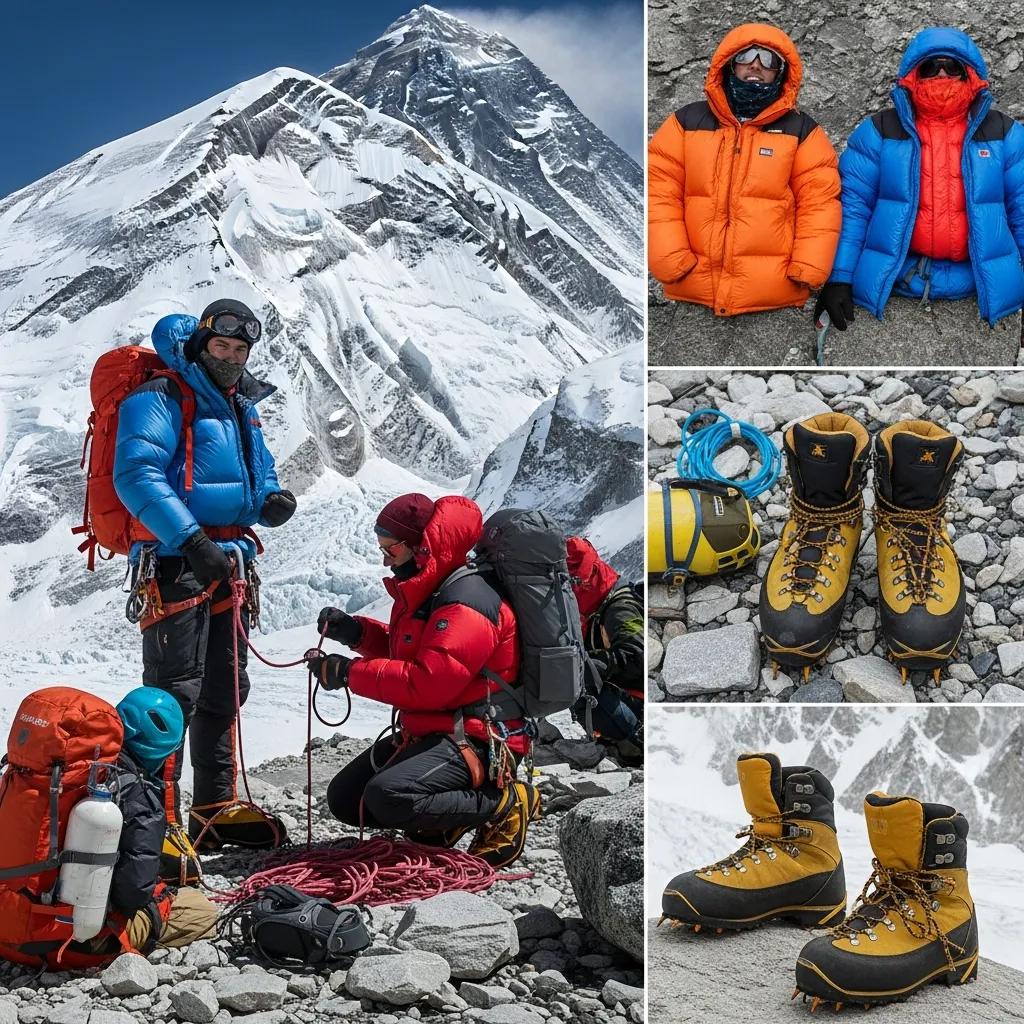
Boots and Crampons Must Be Treated as One System
The upper mountain requires true high-altitude footwear designed for extreme cold. The most important decision is not the logo on the boot—it is whether the boot fits your foot, accommodates your sock system and accepts the exact crampon you will climb in.
Keep approach footwear separate. Walking the approach in expensive 8,000m boots adds wear, moisture and blister risk before the technical climbing even starts.
Technical Gear for Fixed Lines and the Kinshofer Wall
Nanga Parbat’s normal supported route is not simply a snow walk with an ascender attached. The lower route includes steep mixed terrain where repeated transitions, fixed-line movement and controlled descent make equipment familiarity essential.
| Item | What to bring | Why it matters | What to verify |
|---|---|---|---|
| Helmet | Mountaineering helmet | Rockfall, ice and technical terrain | Fit over hat / balaclava |
| Harness | Adjustable alpine harness | Repeated fixed-line travel | Fits over shell and down suit |
| Mechanical ascender | Operator-approved handled ascender | Upward progress on installed rope | Rope compatibility and team procedure |
| Attachment system | Operator-approved tethers / connectors | Transitions and protected movement | Exact team standard |
| Descent device | Operator-approved device | Descending fixed technical terrain | Practice with gloves |
| Ice axe | Route-appropriate mountaineering axe | Snow and ice movement | Operator recommendation |
| Crampons | Technical 12-point mountaineering crampons | Snow, ice and mixed ground | Exact boot fit |
Your Sleeping System Is Recovery Equipment
A sleeping bag and pad system on Nanga Parbat is not simply about surviving the night. Poor sleep, cold exposure and inadequate insulation compound fatigue during acclimatization rotations and summit preparation.
Many climbers use a separate Base Camp comfort system and a lighter, colder-weather high-camp system, but the exact arrangement depends on the operator’s porter and caching strategy.
Extreme-cold rated
Choose an expedition bag appropriate to upper-camp conditions and personal cold tolerance.
Insulated pad system
Air temperature ratings mean little if heat is being lost into snow and ice beneath the sleeper.
Keep insulation dry
Use dry bags and disciplined tent management to protect down over a multi-week expedition.
The Small Systems That Commonly Become Big Problems
Category 4 + goggles
Carry high-protection glacier glasses for bright conditions and goggles for wind, storm and whiteout. Eye protection deserves redundancy.
Warmth + dexterity
Your glove system must be warm enough for summit exposure but still allow you to operate the ascender, connectors, headlamp and oxygen system.
Insulated bottles
Wide-mouth insulated containers and thermoses reduce freezing risk. Avoid making one bottle your only hydration option.
Two independent headlamps
Summit-day darkness makes lighting a critical system. Carry a complete second lamp rather than relying only on spare batteries.
Cold changes everything
Keep power banks and critical batteries warm, protect connectors from moisture and test charging before leaving Base Camp.
UV protection
High-SPF sunscreen, lip protection and face coverage remain important even when temperatures are extremely cold.
Critical Systems Need Redundancy
Summit day is the wrong place to discover that a headlamp, glove system, bottle, goggle lens or connector does not work in the cold. Redundancy should focus on systems whose failure can stop movement or immediately increase exposure.
If You Use Oxygen, Treat It as a Complete System
Supplemental oxygen use on Nanga Parbat is a personal and expedition-level decision. If your climb includes oxygen, the system should be organized through the operator rather than assembled piecemeal from unrelated equipment.
Cylinders
Confirm the planned number, cache locations, reserve strategy and how unused cylinders are handled.
Mask + regulator
The mask, regulator and cylinder connections must all belong to the same compatible system.
Failure plan
Know what the operator carries for regulator, mask and cylinder failures and what you are expected to carry personally.
Use a Three-Bag Expedition System
Organizing equipment by where it must travel is more useful than putting everything into one huge “gear list.”
Expedition duffel
Base Camp clothing, comfort items, spare gear and equipment moved by porter or expedition logistics.
Climbing pack
The pack you personally carry above Base Camp. It should work while wearing a harness and full cold-weather clothing.
Protected summit cache
Dry, mission-critical clothing and summit equipment kept organized so it is not accidentally consumed during rotations.
Test the Gear as a System Before Pakistan
| Test | Do it wearing… | Pass condition |
|---|---|---|
| Harness test | Down suit + shell system | Adjustable without removing critical layers |
| Ascender test | Expedition gloves | Can operate, transfer and release deliberately |
| Crampon test | Exact 8,000m boots | No movement, heel lift or binding mismatch |
| Headlamp test | Helmet + hood + gloves | Can operate every mode without exposed fingers |
| Hydration test | Expedition mitts | Can open, drink and reseal containers easily |
| Summit-pack test | Harness + down suit | Pack does not obstruct hardware or movement |
| Goggle test | Balaclava + hood + helmet | No major gaps, pressure points or immediate fogging |
Why Nanga Parbat Gear Is Not Just an Everest List
The modern supported line generally uses the Diamir side and Kinshofer system. The lower technical sections mean fixed-line hardware and transition efficiency matter early, while the upper mountain still demands the full insulation and survival systems expected on an 8,000-meter peak.
Route conditions change between seasons. Snow, ice, rock exposure, fixed-rope placement and camp locations can all change the equipment emphasis. Your final list should therefore be checked against the current expedition briefing rather than copied unchanged from a previous year.
For route details, use our Nanga Parbat Routes guide.
Where the Gear System Changes on Nanga Parbat
Nanga Parbat Expedition Packing Checklist
Use this as a verification sheet, then compare it line-by-line against your operator’s current expedition list.
Documents & travel
- Passport
- Visa / expedition documentation
- Travel insurance documents
- Mountaineering / evacuation insurance proof
- Emergency contact information
- Copies stored offline and digitally
- Cash / payment backup
Approach & Base Camp
- Trekking footwear
- Approach pants
- Light base layers
- Fleece / active insulation
- Waterproof shell
- Sun hat
- Camp footwear
- Base Camp comfort layers
High-altitude clothing
- Expedition down suit or equivalent
- High-altitude thermal layers
- Warm hat
- Balaclava
- Neck gaiter
- Expedition mitts
- Insulated climbing gloves
- Spare liner gloves
- High-altitude socks
Footwear & traction
- 8,000m double / triple boots
- Fitted 12-point crampons
- Anti-balling plates
- Spare footbeds if used
- Blister treatment supplies
- Dry liner strategy
Technical climbing
- Helmet
- Adjustable harness
- Mechanical ascender
- Operator-approved tether system
- Locking connectors as specified
- Descent device as specified
- Mountaineering ice axe
- Trekking poles
Sleeping system
- High-camp sleeping bag
- Insulated sleeping mat
- Repair kit for inflatable mat
- Dry bag for sleeping insulation
- Separate Base Camp system if planned
Eyes & sun
- Category 4 glacier glasses
- Spare sunglasses
- High-altitude goggles
- Spare / low-light lens if used
- High-SPF sunscreen
- UV lip protection
Hydration & food access
- Insulated wide-mouth bottles
- Thermos
- Bottle insulation covers
- Summit snacks accessible with gloves
- Personal electrolyte strategy
Lighting & electronics
- Primary headlamp
- Second complete headlamp
- Cold-capable batteries
- Power banks
- Charging cables
- Phone / GPS device
- Personal satellite communicator if used
- Battery insulation strategy
Repair & spares
- Tenacious repair tape
- Duct tape
- Boot / crampon spare parts
- Small sewing kit
- Multi-tool appropriate to team rules
- Zip ties
- Spare buckles / cord
Personal health & hygiene
- Personal medications
- Operator-approved personal first-aid kit
- Blister care
- Hand sanitizer
- Toiletries
- Toilet system as instructed by operator
- Personal medical information
Verify with operator
- Base Camp tent
- High-camp tents
- Fixed ropes
- Route anchors
- Stoves and fuel
- Team radios
- Satellite phone
- Supplemental oxygen system
- Team medical kit
- Shared rescue equipment
Nanga Parbat Gear FAQ
What gear do you need to climb Nanga Parbat?
Climbers on the standard Kinshofer Route need a full 8,000m personal system including high-altitude boots, expedition down insulation, crampons, ice axe, helmet, adjustable harness, mechanical ascender, operator-approved fixed-line attachment system, cold-rated sleeping equipment, glacier eyewear, expedition mitts, insulated hydration and redundant summit-day lighting.
Do you need an 8,000m down suit on Nanga Parbat?
Most supported climbers use an expedition down suit or equivalent separate parka-and-pant system intended for extreme 8,000-meter cold. The complete system should be tested with the harness and climbing pack before departure.
What boots should you use for Nanga Parbat?
Use insulated double or triple high-altitude boots designed for 8,000-meter expeditions. Fit and crampon compatibility are more important than brand.
Do you need a jumar on Nanga Parbat?
A mechanical ascender is normally required on the fixed-line Kinshofer Route. The ascender, tether and connector arrangement should match the expedition operator’s procedure and rope system.
What gear does a Nanga Parbat operator usually provide?
Full-service operators commonly provide Base Camp infrastructure, fixed ropes, team communications and some or all high-camp tents, stoves and fuel. Supplemental oxygen and personal climbing support vary significantly, so exact inclusions should be confirmed in writing.
Do climbers use supplemental oxygen on Nanga Parbat?
Some do and some do not. If supplemental oxygen is part of your expedition strategy, the cylinders, regulator, mask, spares and logistics should be arranged through the expedition operator as one compatible system.
How many headlamps should you bring?
Two complete headlamps are a sensible summit-day redundancy. A second lamp protects against more failure modes than spare batteries alone.
Should you bring two sleeping bags?
Some climbers use a comfortable Base Camp sleeping bag plus a separate colder and lighter high-camp bag. Whether that makes sense depends on the operator’s camp, cache and porter plan.
What should you not buy before speaking with the operator?
Avoid independently buying team tents, oxygen hardware, radios, stoves, fixed-rope hardware and shared rescue equipment until you know exactly what the operator supplies and which systems the expedition uses.
Continue Planning the Expedition
Final Gear Rule for Nanga Parbat
The best Nanga Parbat packing list is not the longest list. It is the shortest complete system that matches the current Kinshofer Route, your expedition operator, your cold tolerance and the equipment you have already practiced using together.
Operator inclusions, camp locations, fixed-line configuration, snow conditions and route equipment can change between expeditions. Reconcile this guide against your operator’s final pre-departure equipment list before traveling to Pakistan.
Nanga Parbat: Gear, Route & Full Risk
Gear is one piece of the Nanga Parbat picture. See the full guide, its death rate and the wider set below.
Was this helpful?
🏔Related peaks nearby
🧭Explore & compare
Global Summit Guide is an independent mountaineering resource founded in 2026. The team combines first-hand trekking and climbing experience with in-depth research and professional health and nutrition review to help climbers choose objectives, prepare properly, and stay safe.
Health, altitude, and nutrition content is reviewed by Taylor Ludlow (Registered Nurse) and Brigg Hoopes (Nutritionist).
What We Don't Know Yet
Mountain information changes quickly. This box explains the limits of what this page can responsibly promise.
- Gear requirements can change by season, route variation, weather window, personal cold tolerance, and guide-service requirements.
- Visa, passport, vaccination, border, insurance, and local transportation rules may change before your trip.
- Route conditions, snowpack, closures, and weather can change quickly after this page is updated.
- Permit rules, fees, quotas, and reservation windows may change between review cycles.
- Operator availability, pricing, guide ratios, and cancellation terms can change by season.
Verify current conditions with official land managers, guide services, local forecasts, and current route reports before booking or climbing.
Mountaineering, rock and ice climbing, glacier travel, and high-altitude activity are inherently dangerous and can result in serious injury or death. The information on Global Summit Guide is provided for general informational and educational purposes only and is not a substitute for professional instruction, qualified guiding, proper equipment, or your own judgment and experience.
Route conditions, weather, snowpack, permits, regulations, and hazards change constantly and may differ from what is described here. Details may be incomplete, out of date, or contain errors. Always verify current information with local authorities, certified guides, and official sources before making any decision in the mountains.
Nothing on this site is medical, legal, or financial advice. Our fitness, acclimatization, altitude, and nutrition content is general in nature; consult a qualified physician before beginning any strenuous exercise program or exposing yourself to high altitude.
You are solely responsible for your own safety and decisions. To the fullest extent permitted by law, Global Summit Guide and its team accept no liability for any loss, injury, damage, or expense arising from use of, or reliance on, this information. By using this site you acknowledge these risks and accept these terms.
Some links on this site may be affiliate links. If you buy through them we may earn a small commission at no extra cost to you; this never affects our recommendations.
Global Summit Guide recommendation path
Next Best Mountain to Research
Use these recommendations to continue the right planning path instead of stopping on one page.
Use current permit, weather, route, and operator information before booking or climbing.