
Last updated August 5, 2026
Climbing Mount Damavand: The Complete 2026 South Route, Permit & Iran’s Sacred Volcano Guide
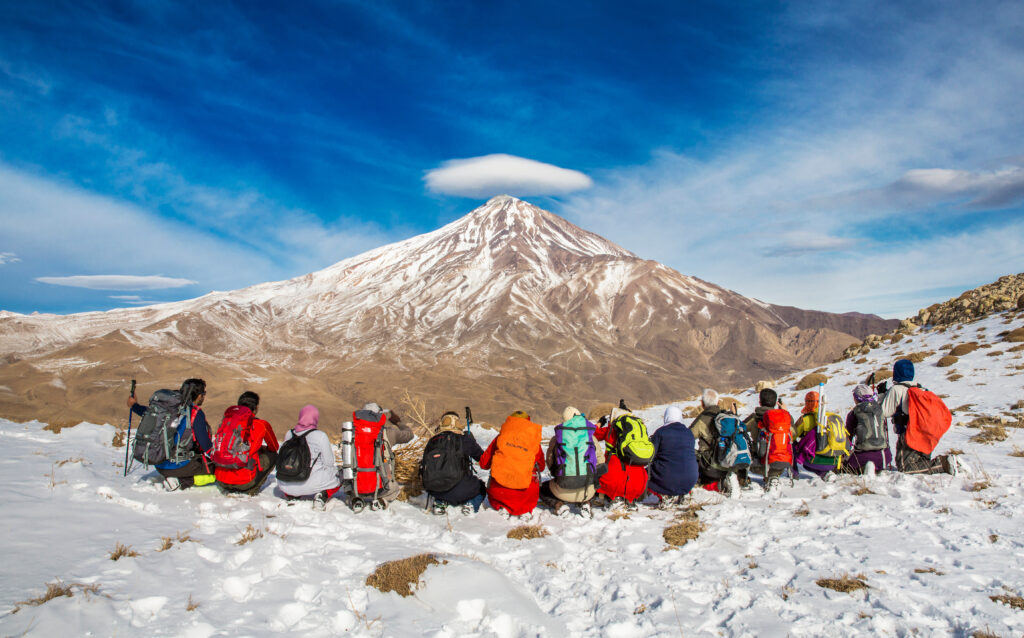
Mount Damavand rises to 5,610 meters (18,402 ft) in northern Iran. Specifically, it stands as the country’s highest peak and the highest volcano in all of Asia. Additionally, it ranks as the 12th most prominent mountain on Earth and anchors the Volcanic Seven Summits challenge.
Persians call this peak Damāvand — possibly meaning “the mountain from which smoke and ash arises.” Moreover, it appears on the reverse of the 10,000 rial banknote and anchors Iranian national identity. Importantly, the mountain symbolizes Iranian resistance against despotism in the classical poetry of Mohammad Taqi Bahar. Furthermore, the Shahnameh epic places the tyrant Zahhak imprisoned within Damavand’s depths.
Additionally, Mount Damavand is a dormant stratovolcano. Notably, the last confirmed eruption occurred approximately 5,300 BCE during the Holocene. However, thermal activity persists — with active fumaroles releasing sulfur gases near the summit, seismic-detected magma chambers 2-5 kilometers below the surface, and the Larijan hot springs at the mountain’s base. Importantly, geologists classify Damavand as dormant rather than extinct.
Furthermore, Mount Damavand features a conical volcanic profile with sixteen documented climbing routes. Moreover, the four main routes — South, West, Northeast, and North Face — each offer distinct difficulty levels and shelter systems. Additionally, the iconic Abshar Yakhi (frozen waterfall) at 5,100m on the South Route creates a dramatic pre-summit landmark. Finally, the small summit crater contains sulfurous deposits and a permanent ice cap.
Ultimately, Mount Damavand delivers one of mountaineering’s most culturally resonant 5,000-meter summits. Specifically, the South Route requires no technical climbing skills for fit beginners. Additionally, climbers face mandatory permit registration ($50 USD) at Camp 1 Polour through the Iran Mountaineering & Sport Climbing Federation. Consequently, this guide covers everything needed for a safe, legal, and culturally informed 2026 Mount Damavand expedition.
(18,402 ft)
Alborz range
Iran Federation (IMSCF)
Bargah Sevom 4,220m
Mount Damavand Location & Summit Weather
Check live 7-day forecast conditions at the Mount Damavand summit (5,610m). Additionally, view the interactive terrain map showing Damavand’s position in the central Alborz range, approximately 66 kilometers northeast of Tehran in Mazandaran Province.
Mount Damavand · Alborz Range, Iran
35.96°N, 52.11°ESummit Weather
Elev: 5,610 m · Summit −15 to −25°CMount Damavand stands as Iran’s supreme summit. Specifically, it combines genuine 5,600-meter altitude with profound cultural significance spanning three millennia. Additionally, the mountain anchors Persian mythology as div-e sepid (the white giant) chained in the Shahnameh epic. Furthermore, its near-perfect conical profile dominates the central Alborz range, rising dramatically above Tehran’s northern horizon on clear days.
The peak rises to 5,610 meters (18,402 ft) in Mazandaran Province. Moreover, it is a dormant stratovolcano built through 600,000 years of volcanic activity. Notably, the last confirmed eruption occurred approximately 5,300 BCE during the Holocene. However, active solfataras at the summit release sulfur gases continuously. Consequently, seismic studies reveal magma chambers between 2-5 kilometers below the surface, confirming the volcano remains dormant rather than extinct.
Today’s climbers encounter dramatically varied terrain across the South Route. First, Persian carpet meadows around Polour village (2,270m) with nomadic shepherd settlements. Second, rocky trail through Goosfand-Sara (3,040m) — the traditional sheepfold base camp. Third, steeper volcanic scree rising to Bargah Sevom (4,220m) with the established mountain hut system. Fourth, the iconic Abshar Yakhi — a 12-meter frozen waterfall at 5,100m. Finally, sulfurous fumaroles and the small summit crater at 5,610m.
However, Mount Damavand is no casual hike. Specifically, the standard 3-5 day program covers approximately 2,630 meters of vertical gain from Goosfand-Sara to summit. Additionally, the average climbing speed of 800 meters per hour means 10-hour summit days over two sessions. Moreover, altitude acclimatization represents the primary challenge since the climb itself requires only basic trekking skills (YDS Class 2). Consequently, excellent cardiovascular fitness and proper acclimatization pacing are essential prerequisites.
Currently, a straightforward permit system governs every ascent. Specifically, the Iran Mountaineering & Sport Climbing Federation charges USD 50 (or EUR 50) per person for the climbing permit. Additionally, the permit is issued at Camp 1 Polour rather than through embassies or pre-arrival applications. Furthermore, all foreign climbers must register personal details and itinerary with the Federation. Consequently, unregistered climbers face police intervention and fines if encountered on the mountain.
Most importantly, Mount Damavand is a sacred Persian cultural landmark, not merely a climbing objective. Specifically, the mountain holds supreme significance in Iranian national identity — from ancient Zoroastrian texts to the modern 10,000 rial banknote. Moreover, the Arash legend places the hero shooting his arrow from Damavand to mark the eastern border of Iran. Additionally, the Shahnameh portrays the peak as the prison of Zahhak, the demon king defeated by Fereydun. Ultimately, Damavand offers the most culturally layered 5,000-meter volcanic summit in the Middle East.
The Iran Mountaineering & Sport Climbing Federation (IMSCF) sets the 2026 Mount Damavand climbing permit at USD 50 per person (or EUR 50 equivalent). Importantly, the permit is issued on-site at Camp 1 in Polour village rather than through embassies or pre-arrival applications. Additionally, the Official Certificate of Ascent costs an extra EUR 5. Moreover, registered tour agencies typically handle payment in advance and bundle fees into packages. Furthermore, peak-season July-August slots at Bargah Sevom hut fill fast — book at least 3-4 weeks ahead. Operators like Damavand Camp, Damavand Adventures, and Iran Exploration handle all logistics. See the 2026 Permit section for the complete booking walkthrough.
Although a mountain guide is not technically mandatory, every climber must register with the Iranian Mountaineering Federation at Camp 1 Polour before ascending. Specifically, climbers provide name, passport details, and itinerary. Additionally, failure to register triggers police intervention with fines and forced removal. Moreover, solo climbers without registration who require rescue must pay all rescue costs personally. Consequently, registration is essentially non-negotiable regardless of experience level.
All 2026 figures were verified against Iran Mountaineering & Sport Climbing Federation permit requirements, licensed operator 2026 pricing from Damavand Camp, Damavand Adventures (Ardeshir Soltani), Iran Exploration, Jagged Globe UK, and Iran Safar. Additionally, cultural context draws on the Shahnameh by Ferdowsi, Mohammad Taqi Bahar’s Damavand poem, and scholarly research in Encyclopaedia Iranica. Furthermore, geological data references Wikipedia’s Damavand article and seismic studies of the magma chamber structure. Moreover, route information comes from the 1958 C.N.R.S. expedition survey and modern operator GPX tracks. Fact-check: April 23, 2026.
Mount Damavand at a Glance
Why Mount Damavand Holds Iconic Status
Iran’s Supreme Summit
Mount Damavand stands at 5,610 meters as the highest peak in Iran, Western Asia, and the Middle East. Specifically, it towers above every other summit in a region stretching from the Caucasus through Central Asia. Additionally, the peak dominates Tehran’s northern horizon, visible on clear days from the Iranian capital 66 kilometers away.
Asia’s Highest Volcano
Damavand ranks as the highest volcano in all of Asia and the third-highest volcano of the Volcanic Seven Summits challenge. Specifically, it sits behind only Kilimanjaro and Elbrus globally. Moreover, its near-perfect conical symmetry makes it one of the most photogenic stratovolcanoes anywhere on Earth.
Sacred in Persian Mythology
Mount Damavand occupies the mythological heart of the Shahnameh epic. Specifically, Ferdowsi’s 10th-century masterwork imprisons the tyrant Zahhak within the mountain. Additionally, the peak appears as div-e sepid (white giant) in classical Persian poetry. Furthermore, the hero Arash shot his border-marking arrow from its summit in legend.
Non-Technical 5,600-Meter Summit
The South Route requires no technical climbing skills — rated YDS Class 2 moderate walk-up. Specifically, fit beginners can reach the summit using trekking boots rather than mountaineering boots in summer conditions. Moreover, the clear footpath, established hut system, and mule support make logistics remarkably accessible compared to other 5,000m peaks.
Tehran’s Doorstep Expedition
Damavand sits just 66 kilometers northeast of Tehran via the scenic Haraz Road. Consequently, climbers can drive from the international airport to Polour Camp in approximately two hours. Additionally, this proximity allows compressed itineraries: 3-day ascents are feasible for well-acclimatized alpine athletes, while 5-day programs suit most visitors.
Abshar Yakhi Frozen Waterfall
The South Route features Abshar Yakhi — a dramatic 12-meter frozen waterfall at 5,100 meters elevation. Specifically, this permanent ice formation sits approximately 500 meters below the summit. Additionally, it serves as a landmark indicating the final glacial section of the climb where snow patches and small crevasses begin.
Active Summit Fumaroles
The summit crater contains active sulfur vents releasing volcanic gases continuously. Specifically, yellow sulfur crystals form around the fumaroles, creating a vivid landscape. Moreover, Iranians historically climbed Damavand to gather summit sulfur for commercial trade. Additionally, this ongoing thermal activity confirms the volcano’s dormant (not extinct) classification.
Iranian National Symbol
Damavand appears on the reverse of the 10,000 rial banknote as a national symbol. Furthermore, it anchors Iranian cultural identity across poetry, literature, and political symbolism. Moreover, Mohammad Taqi Bahar’s famous 1922 poem celebrates the peak as representing resistance against despotism and foreign rule throughout Iranian history.
Who Can Climb Mount Damavand?
Mount Damavand suits climbers with strong hiking fitness, tolerance for altitudes above 4,000 meters, and willingness to accept mandatory federation registration. However, no prior mountaineering experience is required for the standard South Route in summer conditions. Moreover, the non-technical terrain welcomes first-time high-altitude climbers with proper preparation.
Physical preparation matters substantially more than technical skill. Specifically, guides recommend the ability to hike 8-10 kilometers with a light daypack at moderate pace, sustained over 3-5 consecutive days. Additionally, cardiovascular conditioning through running, cycling, or hill walking for 3-4 months before departure dramatically reduces altitude-related risks.
Age is rarely a barrier on the South Route. Notably, operators regularly guide climbers from 18 to 70+ years old to the summit, provided they hold doctor-cleared fitness certificates. Moreover, the standard 4-5 day itinerary includes acclimatization days at Camp 2 (3,040m) or on nearby Mount Tochal (3,964m) near Tehran.
Travel insurance covering high-altitude rescue remains essential, though not formally required for permit approval. Furthermore, standard travel policies typically exclude mountaineering above 4,000m, so climbers must specifically purchase extreme-sports coverage. Specifically, Global Rescue, Truetraveller, and World Nomads Explorer Plus offer appropriate policies for Damavand.
Operators consistently report that climbers who acclimatize properly on Mount Tochal (3,964m) near Tehran before attempting Damavand achieve the highest summit rates. Additionally, those who arrive with broken-in waterproof boots and hike Tochal during their first 1-2 days experience noticeably fewer AMS symptoms at Bargah Sevom. Conversely, rushed 2-day ascents from Tehran correlate with altitude-related failures. Moreover, starting the summit push from Bargah Sevom at 4-6 a.m. (rather than midnight) reduces exhaustion since most climbers prefer to walk in daylight and reach the summit by early afternoon. Consequently, budget an extra Tochal day rather than compressing the Damavand schedule.
Mount Damavand in Regional Mountaineering Context
Mount Damavand occupies a unique geological and cultural position. Specifically, it anchors the central Alborz range that separates the Iranian plateau from the Caspian Sea. Additionally, the peak represents the highest volcanic summit across all of Asia, outranking famous Himalayan volcanoes and Indonesian stratovolcanoes.
For climbers planning regional trips, Damavand pairs logically with several nearby summits. Specifically, Mount Ararat (5,137m) in eastern Turkey lies approximately 1,200km west and shares similar permit logistics with mandatory licensed guides. Moreover, Alam-Kuh (4,850m) in the same Alborz range offers an excellent 2-3 day acclimatization climb before Damavand attempts.
Mount Damavand on the Volcanic Seven Summits Challenge
Damavand represents Asia’s peak on the Volcanic Seven Summits — the highest volcano on each continent. Additionally, it ranks as the third-highest volcano globally, behind only Kilimanjaro and Elbrus.
Main Climbing Routes on Mount Damavand
Mount Damavand’s recorded history spans three thousand years. Ultimately, few peaks on Earth carry such dense layers of mythology, religious tradition, and national symbolism. Specifically, the mountain appears in Zoroastrian texts, Ferdowsi’s Shahnameh, medieval Persian chronicles, and contemporary Iranian literature.
Ancient Mythology and Zoroastrian Origins
Damavand holds supreme significance in Persian mythology. Specifically, Zoroastrian texts name it as the birthplace of magical powers and the source of divine creation. Moreover, the name Damāvand likely derives from the Middle Persian Dumbawand, possibly meaning “the mountain from which smoke and ash arises” — alluding to its volcanic nature.
In Iranian legend, the hero Arash the Archer shot his magical arrow from Damavand’s summit to mark the eastern border of Iran during the ancient territorial dispute between Iran and Turan. Additionally, the arrow’s flight established the Oxus River as the frontier. Consequently, Damavand became the symbolic anchor of Iranian sovereignty.
The Shahnameh: Zahhak’s Prison
Ferdowsi’s 10th-century epic Shahnameh gave Damavand its most enduring literary role. Specifically, the mountain serves as the prison where the hero Fereydun chains the tyrant king Zahhak — a demon with serpents growing from his shoulders. Moreover, this narrative transformed Damavand into the symbol of Iranian resistance against despotism.
The peak appears in classical Persian poetry as div-e sepid (white giant), gonbad-e giti (dome of the world), and ey pā-dar-band (chained-foot mountain). Furthermore, Mohammad Taqi Bahar’s influential 1922 poem Damavand begins: “O white giant with feet in chains, O dome of the world, O Damāvand.” Consequently, the mountain became a potent symbol during the Constitutional Revolution era.
The First Recorded Ascent: 905 CE
The earliest recorded ascent of Mount Damavand was made in 905 CE (292 AH) by Abu Dolaf Kazraji — the Arab traveler, poet, and chronicler. Moreover, local Iranians had likely climbed the mountain earlier to collect sulfur from the summit, but Kazraji’s account provides the first written documentation.
Three centuries later, the Byzantine-Arab geographer Yaqut attempted the climb but failed to reach the summit. However, his local guides provided detailed summit descriptions that he incorporated into his Dictionary of Geography — a description that remarkably conforms with modern geographical reality. Subsequently, Ebn Esfandiar recorded that ascents from Ask village took approximately two days.
The Sulfur Trade Era
Before the Mongol invasion of the 13th century, climbs of Damavand were not uncommon. Specifically, Iranian climbers regularly ascended to collect summit sulfur for commercial purposes — a practice documented in Nasser-i Khosrow’s medieval travel book. Furthermore, this commercial activity continued through the 19th century, providing local guides with extensive high-altitude experience.
Nineteenth-Century European Ascents
The first recorded European ascent was made by W.T. Thompson of the British legation in 1837. Moreover, Thompson published his account in the Royal Geographical Society magazine in 1838. Notably, his description confirmed that Iranian climbers were regularly summiting Damavand at that time to gather sulfur commercially, demonstrating that Iranian mountaineering predated European exploration substantially.
Subsequently, Jacques de Morgan conducted early scientific investigations of the volcano. However, systematic geological studies waited until the French C.N.R.S. expedition of 1958 led by Bout and Derruau — which produced the first comprehensive volcanic survey and established much of our modern understanding of Damavand’s structure.
Twentieth-Century Route Development
The Iranian Mountaineering Federation has progressively developed Damavand’s route infrastructure throughout the 20th century. Specifically, the first Bargah-e Sevom shelter at 4,200m was constructed in 1968. However, a 1972 avalanche destroyed the original metal cabin. Subsequently, the stone replacement shelter served climbers for decades until the modern New Hut was built in 2009 at approximately 4,250m.
Additional shelters expanded access to other routes. Specifically, the Simorgh Shelter at 4,200m on the West Route was completed in 1995. Moreover, the Takht-e Fereydoun shelter on the Northeast Route opened in 1976 at 4,380m, commemorating two climbers who died on the mountain. Over 200 volunteers contributed to its construction.
Technical Route Pioneers
German climbers Steinauer and Gorter pioneered the challenging Northern Arête in 1936 — a significantly more technical line compared to the South Route. Subsequently, the Eastern Arête was first climbed in 1952 by Iranian climber Kazem Gilanpur with Bernard Pierre. Additionally, the Northeast Ridge and various technical variations expanded the climbing landscape throughout the second half of the 20th century.
Climbing Routes on Mount Damavand
Mount Damavand offers sixteen documented routes to the summit, though four main approaches dominate modern expedition traffic. Specifically, the South Route handles the overwhelming majority of commercial climbing. Furthermore, each primary route features an established shelter at approximately 4,200m for overnight acclimatization.
| Route | Starting Point | Shelter (~4,200m) | Difficulty | Duration | Best Season |
|---|---|---|---|---|---|
| South Route | Polour (2,270m) | Bargah Sevom | Moderate (YDS Class 2) | 3-5 days | Jun-Sep |
| West Route | Polour via Vararood | Simorgh Shelter | Moderate + steep descent | 4-5 days | Jun-Sep |
| Northeast Route | Nandal Village | Takht-e Fereydoun | Moderate + long | 4-6 days | Jul-Aug |
| North Face | Landal basin | (technical camp) | Steep / technical | 5-7 days | Jul-Aug |
South Route — The Polour Standard
The South Route starts from Polour village (Camp 1) at 2,270m on the Haraz Road, approximately two hours by vehicle from Tehran. Moreover, this is the default approach used by virtually every licensed operator including Damavand Camp, Damavand Adventures, and Iran Exploration. Additionally, climbers continue by 4WD vehicle to Goosfand-Sara (Camp 2 / Base Camp) at 3,040m featuring a small shelter and the Saheb al-Zaman mosque.
From Goosfand-Sara, climbers trek approximately 4-6 hours through rocky volcanic terrain to Bargah Sevom (Camp 3) at 4,220m. Specifically, the trail gains 1,180m across progressively steeper scree. Furthermore, mules can transport 10-15kg of personal gear to Bargah Sevom, easing the load substantially. The modern New Hut (built 2009) offers dormitory-style accommodation with electricity and meals.
Summit day begins around 4-6 a.m. from Bargah Sevom. Specifically, the 6-8 hour push climbs 1,400m past the iconic Abshar Yakhi (12m frozen waterfall at 5,100m) through active sulfur vents to reach the 5,610m crater summit. Additionally, the final 500m involves moderate snow fields in summer, requiring basic crampons only if icy conditions prevail.
Descent to Bargah Sevom takes approximately 3 hours, then another 3 hours down to Goosfand-Sara. Consequently, the standard itinerary spreads the descent over one day following the summit bid. Moreover, post-climb visits to the Larijan Thermal Spa provide welcome muscle relief during the Tehran transfer.
West Route — Vararood via Simorgh Shelter
The West Route approaches Damavand via Polour with 4WD transfer to the Vararood basecamp during summer months. Specifically, this route uses the Simorgh Shelter (built 1995) at 4,200m as its high camp. Moreover, it is the second most popular route after the South, typically less crowded with experienced climbers seeking solitude.
The ascent itself runs 5-7 hours from Simorgh Shelter to summit — broadly comparable to the South Route in time. However, the descent is notably steeper and more challenging than the South approach. Consequently, many climbers who summit from the West Route prefer to descend via the South for safety and ease. Additionally, Simorgh Shelter offers fewer facilities than Bargah Sevom, requiring climbers to carry more self-supported equipment.
Northeast Route — Gazaneh Trail via Nandal
The Northeast Route begins at Nandal village and follows the Gazaneh Trail to Takht-e Fereydoun Shelter at 4,380m (built 1976). Specifically, the shelter memorializes two climbers who died on the mountain, with over 200 volunteers contributing to its construction. Moreover, this is the longest of the four main routes.
The extended trail requires two days to reach the summit with an overnight at the two-story Takht-e Fereydoun shelter. Additionally, the route offers stunning landscapes across the Landal basin and views of the northern Alborz slopes. However, the length and altitude combination demand excellent fitness and solid acclimatization preparation. Consequently, many climbers combine this route with a traverse descent via the South.
North Face — Advanced Technical Route
The North Face represents Damavand’s most challenging route, featuring steep ice, rock, and snow sections that require full alpine technical skills. Specifically, the route climbs through rocky arêtes, significant snow fields, and small glaciers on the northeastern flank. Moreover, first ascent of the Northern Arête came in 1936 by German climbers Steinauer and Gorter.
This route suits only experienced mountaineers with rope, ice axe, and crampon proficiency. Additionally, objective hazards including rockfall, avalanche risk, and crevassed glacier sections make guided support essential. Furthermore, no commercial operators regularly offer North Face ascents, making this route primarily the domain of private alpine teams.
Mount Damavand Permits & Regulations 2026
Every foreign climber requires a formal climbing permit issued by the Iran Mountaineering & Sport Climbing Federation (IMSCF). Furthermore, the permit is issued on-site at Camp 1 in Polour village rather than through embassies or pre-arrival processes. Additionally, the 2026 fee remains set at USD 50 (or EUR 50) per person regardless of route or season.
Even solo climbers must register with the IMSCF at Camp 1 Polour before ascending. Specifically, climbers provide name, passport details, itinerary, and route information. Additionally, unregistered climbers encountered on the mountain face police intervention, fines, and forced removal. Moreover, rescue costs for unregistered climbers must be paid personally by the climber. Consequently, registration is functionally non-negotiable despite guide requirements being technically optional.
Required Documentation for 2026
For 2026 permit applications, each climber must provide the following through their agency or at Camp 1:
- Valid passport — original plus photocopy, with at least 6 months validity beyond entry date
- Climbing itinerary — route selected, planned ascent dates, expected summit date
- USD 50 payment — or EUR 50 equivalent, payable in cash at Camp 1 or in advance through registered agency
- Travel insurance documentation — covering mountaineering above 4,000m (strongly recommended though not mandatory)
- Entry visa for Iran — verify current requirements as these vary significantly by passport
- Personal information form — provided at Camp 1 Polour by IMSCF representatives
Permit Fee Breakdown
The permit fee structure for 2026 includes several optional components:
- Base climbing permit: USD 50 or EUR 50 per person (mandatory)
- Official Certificate of Ascent: EUR 5 (optional keepsake, IMSCF-issued)
- Guide certification: Federation-approved local guides available at Camp 1
- Mule/porter services: Additional cost, bookable through operators or at Camp 2
Application Timeline
Most climbers obtain permits on-arrival at Camp 1 Polour, making the 2026 process considerably simpler than many 5,000m peaks. However, agencies recommend booking tour packages at least 3-4 weeks in advance to secure Bargah Sevom hut reservations during peak July-August. Specifically, the New Hut books up during high-season weekends.
Booking Sequence with Registered Agency
Working through a registered tour agency streamlines the process significantly. First, select your preferred departure date from the operator schedule approximately 3-4 months ahead. Second, submit passport copy and confirm Tehran hotel transfer. Third, the agency handles IMSCF registration coordination. Finally, pay the permit fee through the operator or directly at Camp 1 upon arrival.
Iran Visa Considerations
Iran visa requirements vary dramatically by nationality and change frequently due to geopolitical factors. Specifically, most Western European nationals can obtain visa-on-arrival at Imam Khomeini International Airport (IKA) for 30 days. However, US, UK, and Canadian citizens typically require pre-arranged visas through tour agencies. Additionally, verify current requirements at the Iranian embassy well before departure.
Mount Damavand Expedition Costs 2026
Mount Damavand remains one of the most affordable 5,000-meter summits in the world. Furthermore, licensed operators based in Tehran and Polour offer competitive 2026 pricing across several tiers based on group size and inclusions. Additionally, most packages bundle the IMSCF permit, transfers, huts, meals, and guide services into a single all-inclusive price.
2026 Core Fee Breakdown
Standard 2026 expedition packages include these core components across all tiers:
- Climbing permit: USD 50 (or EUR 50) per person via Iran Mountaineering & Sport Climbing Federation
- Federation-certified mountain guide: included in guided packages (strongly recommended)
- Mules or porters to Bargah Sevom: 10-15kg per climber, bookable separately
- Meals on mountain: included in packages — cook prepares hot meals at Bargah Sevom
- Hut accommodation: included (New Hut or Old Shelter at Bargah Sevom)
- Tehran hotel (pre/post climb): €30-80 per night for 3-star accommodations
- Airport transfers: included in most packages (Tehran IKA to Polour)
- Certificate of Ascent: EUR 5 (optional, IMSCF-issued)
2026 Expedition Package Tiers
Independent 5-Day Climb
Self-organized 5-day ascents start around EUR 400 per person including hut bookings, basic meals, and local transport. Specifically, this tier requires climbers to arrange Tehran-Polour transport independently, book Bargah Sevom hut directly, and pay the $50 IMSCF permit separately at Camp 1. However, no tour support means handling Iranian visa logistics and language barriers personally.
This pricing tier suits experienced, budget-conscious climbers comfortable with independent logistics in Iran. Moreover, climbers still must register with the IMSCF at Camp 1 regardless of guided status.
Standard 5-Day Guided Tour
Standard 5-day guided tours cost EUR 600-900 per person for complete Tehran-to-Tehran programs. Specifically, this tier includes IMSCF permit, certified guide, hotel nights in Tehran, 4WD transfers from airport through Polour, Bargah Sevom hut accommodation, all meals, and basic porter support. Moreover, this represents the most popular pricing level through operators like Damavand Camp, Damavand Adventures (Ardeshir Soltani), and Iran Exploration.
Most standard tours use the proven itinerary: arrival in Tehran, drive to Camp 1, transfer to Camp 2, acclimatization hike, move to Bargah Sevom, summit day, descent, and return to Tehran. Additionally, these packages often include the Certificate of Ascent and Larijan Thermal Spa visit post-climb.
7-Day Tour with Tochal Acclimatization
Extended 7-day tours cost EUR 1,000-1,500 per person with added Mount Tochal (3,964m) acclimatization near Tehran. Additionally, these tours include extra rest days, private transfer logistics, and more personalized guide attention. Moreover, the Tochal acclimatization climb (with gondola descent option) dramatically improves success rates on Damavand.
Operators often recommend this tier for first-time high-altitude climbers. Furthermore, the extra days enable more comprehensive Tehran cultural experiences including museums, bazaars, and historical sites. Consequently, this tier provides the best value for climbers combining mountaineering with Iran exploration.
Jagged Globe & International Tours
Premium Western-operated tours cost GBP 2,000-2,800 per person for 10-12 day programs through operators like Jagged Globe UK. Specifically, these tours include UK group leadership, return flights from UK, comprehensive Tehran sightseeing, Mount Tochal acclimatization, full Damavand expedition, and 4-star hotel accommodation. Moreover, they remove all language barriers and logistical complexities for Western climbers.
This tier suits climbers wanting fully supported Western-style service with no Iran navigation concerns. Additionally, flights from the UK to Tehran, airport taxes, and international travel insurance are included. However, the significantly higher price reflects comprehensive inclusions rather than premium mountain-side service.
Ski Mountaineering & Winter Climbs
Ski mountaineering tours run EUR 1,200-2,000 per person for specialized winter or shoulder-season programs. Specifically, the ski season extends from December through April with best conditions in March-April. Moreover, these tours require backcountry ski experience, skins, and full avalanche awareness training. Additionally, winter climbs without skis demand full alpine mountaineering equipment.
The ski drop from summit to Camp 2 covers approximately 2,570 meters of vertical — among the longest continuous ski descents in the Middle East. Furthermore, the Bargah Sevom huts remain accessible year-round but require more self-supported logistics during winter months.
Essential Gear for Mount Damavand
Gear requirements for Mount Damavand combine standard trekking essentials with lightweight alpine equipment for the summit day. Fortunately, the South Route in summer requires only basic gear compared to technical 5,000m peaks. Consequently, climbers who hike regularly likely already own most required equipment.
Footwear (Essential)
- Waterproof trekking boots with good ankle support
- Semi-rigid sole (suitable for light crampon use if needed)
- Wool or synthetic socks — 3 pairs minimum
- Lightweight camp shoes for hut evenings
- Gaiters (for snow patches near summit)
Layered Clothing
- Merino wool base layers — 2 sets top and bottom
- Fleece mid-layer jacket
- Insulated down or synthetic puffy jacket
- Waterproof hardshell jacket and pants
- Softshell trekking pants
Head & Hands
- UV-rated sunglasses (category 3 or 4)
- Buff or bandana (useful for sulfur vents)
- Warm beanie hat
- Sun hat with brim
- Warm gloves plus mittens for summit day
Technical Gear (Summer)
- Trekking poles with snow baskets
- Light crampons (useful in icy conditions)
- Ice axe (recommended for steep snow)
- Climbing helmet (optional but useful)
Sleep System
- Sleeping bag rated to −5°C (for huts)
- −15°C bag if camping or winter
- Inflatable pad or compact foam pad
- Silk or fleece liner
Pack & Lighting
- 50-60L backpack for full trip
- 15-20L summit daypack
- Headlamp plus spare batteries
- Dry bags for waterproofing
Hydration & Nutrition
- 1-2L insulated water bottles or hydration bladder
- Water purification tablets or filter
- High-calorie trail snacks (dates, nuts, bars)
- Electrolyte powders or tablets
Health & Sun (Essential)
- High-altitude SPF 50+ sunscreen
- Lip balm with SPF
- Personal medications
- Diamox/Acetazolamide (consult doctor first)
- Basic first aid kit
Mount Damavand Hazards & Risk Assessment
Mount Damavand is non-technical in summer but carries specific hazards requiring preparation. Consequently, climbers must understand and plan for several documented risks that cause most rescues and aborted summit attempts. Additionally, most incidents trace back to altitude, weather, or sulfur exposure rather than technical terrain.
Altitude Sickness
At 5,610m, acute mountain sickness (AMS) threatens every climber. Moreover, the standard 5-day itinerary includes minimal dedicated acclimatization beyond the Goosfand-Sara to Bargah Sevom transfer. Symptoms typically appear above 4,000m and include headache, nausea, fatigue, and loss of appetite. Importantly, climbers experiencing severe symptoms must descend immediately to avoid HAPE (high-altitude pulmonary edema) or HACE (cerebral edema).
Sulfur Exposure Near Summit
The active fumaroles near Damavand’s summit release sulfur dioxide and hydrogen sulfide gases. Specifically, these gases can cause eye irritation, respiratory distress, and nausea particularly in climbers with asthma or respiratory conditions. Moreover, crossing the sulfur plateau quickly minimizes exposure. Additionally, a buff, bandana, or specialized sulfur filter mask provides useful protection during the final summit approach.
Cold Exposure and Summit Temperatures
Summit temperatures routinely drop to −15 to −25°C even in summer months. Furthermore, wind chill can push effective temperatures below −35°C on exposed sections of the final ridge. Consequently, frostbite of fingers, toes, and exposed facial skin ranks among the most common injuries on Damavand ascents. Additionally, the pre-dawn summit start means climbers face the coldest hours during the steepest sections.
Abshar Yakhi Ice Section
The 12-meter frozen waterfall at 5,100m creates an icy bypass section that requires careful navigation. Specifically, the trail traverses to the left of the waterfall on a section that can be slick. Additionally, in early season or shoulder months, this area may require crampons. Moreover, fall danger increases during descent when tired climbers may lose footing on the compacted snow.
Weather Volatility
Damavand weather changes rapidly at altitude. Specifically, sudden snowfall, hail, or strong winds can materialize within minutes at Bargah Sevom. Therefore, responsible operators build reserve days into itineraries for weather delays. Additionally, summit attempts should never proceed in marginal conditions given the exposed final ridge. Moreover, lightning strikes near the summit during convective storms pose a documented hazard in July-August afternoons.
Crowding at Bargah Sevom
During peak July-August weekends, Bargah Sevom and the New Hut can host 100+ climbers simultaneously. Consequently, the narrow summit trail experiences significant congestion during summit pushes. Additionally, hut space becomes severely limited, making advance reservations essential. Moreover, crowded conditions increase exposure to illness and slow rest breaks.
Safety Protocols for Mount Damavand
Safety on Damavand rests on three pillars: proper acclimatization, IMSCF registration, and appropriate travel insurance. Furthermore, every reputable operator builds redundant safety measures into their standard programs including communications equipment, first aid supplies, and trained medical responders.
Travel insurance covering high-altitude mountaineering is strongly recommended though not formally required. Notably, standard travel policies typically exclude climbing above 4,000m, so Damavand climbers must specifically purchase extreme-sports coverage. Specifically, Global Rescue, Truetraveller, and World Nomads Explorer Plus offer appropriate policies covering Iran and high-altitude rescue.
Medical assistance infrastructure is reasonably developed on the South Route. Specifically, the nearest hospital lies in Tehran — approximately two hours drive from Polour. Additionally, rescue teams based in Polour can reach Bargah Sevom within several hours. Moreover, helicopter rescue is possible but coordinated through Iranian civil aviation and military channels.
Emergency descent procedures focus on immediate altitude loss. If a climber develops severe AMS, HAPE, or HACE symptoms at Bargah Sevom, the standard response involves rapid descent to Goosfand-Sara (3,040m), followed by 4WD evacuation to Polour and Tehran. Additionally, licensed operators carry emergency oxygen and dexamethasone for worst-case scenarios.
When to Climb Mount Damavand
The Mount Damavand climbing calendar divides clearly into four distinct seasons, each offering different experiences and challenges. Specifically, the main summer window dominates commercial traffic, with specialized ski operations extending into winter months.
Main Summer Season: Mid-June through Mid-September
From mid-June to mid-September, conditions remain optimal for standard South Route climbs. Specifically, operators maintain full Bargah Sevom hut services throughout this window. Furthermore, daytime temperatures at Camp 2 typically range 10-20°C, while summit nights drop to −10 to −15°C. Additionally, the trails are mostly snow-free above Goosfand-Sara.
July and August deliver the highest success rates with the most stable weather windows. However, these peak months also bring the most crowded huts and earliest reservation sellouts. Consequently, experienced climbers often prefer late June or early September for thinner crowds with comparable weather.
Shoulder Season: May and October
May offers emerging summer conditions but significant snow remains above 3,500m. Moreover, October brings rapidly cooling temperatures and early winter storms. Additionally, Bargah Sevom services scale back during October, making logistics more challenging. Consequently, these months suit experienced climbers prepared for winter-like conditions.
Winter Climbs: December through March
Winter climbs are highly demanding alpine expeditions suitable only for experienced mountaineers. Specifically, temperatures drop below −30°C, avalanche risk increases substantially on upper slopes, and the Polour-Goosfand-Sara road often closes requiring foot approach. Additionally, winter climbers often start from Rineh at 2,400m and walk 10-15km on snow-covered roads to reach the route start.
Ski Mountaineering: March-April Prime
March and April represent the prime ski-mountaineering season. Notably, the combination of abundant snow cover and slightly warmer temperatures creates optimal conditions for backcountry skiers. Additionally, specialized operators like Damavand Adventures and Iran Exploration offer scheduled ski tours. Furthermore, the descent from summit to Camp 2 covers 2,570 vertical meters — one of the Middle East’s most dramatic ski lines.
Historical Expeditions on Mount Damavand
905 CE — Abu Dolaf Kazraji
The earliest recorded ascent of Mount Damavand was completed by Abu Dolaf Kazraji — the Arab traveler, poet, and chronicler. Moreover, Kazraji served in the Abbasid court under al-Muqtadir. Specifically, his written account provides the first documented summit. However, local Iranians had almost certainly climbed earlier for sulfur collection, though without formal documentation preserved to modern times.
~1220 CE — Yaqut al-Hamawi
The Byzantine-Arab geographer Yaqut attempted Damavand three centuries after Kazraji but failed to reach the summit. However, his local guides provided a detailed summit description that he incorporated into his famous Dictionary of Geography. Remarkably, that medieval description conforms perfectly with modern geographical reality — a tribute to the accuracy of Iranian oral knowledge.
1837 — W.T. Thompson
W.T. Thompson of the British Legation in Tehran made the first recorded European ascent of Mount Damavand in 1837. Subsequently, he published his account in the Royal Geographical Society magazine in 1838. Notably, Thompson’s report documented ongoing Iranian summit ascents for sulfur collection — demonstrating that Iranian mountaineering substantially predated European exploration.
1936 — Steinauer & Gorter
German climbers Steinauer and Gorter completed the first ascent of Damavand’s challenging Northern Arête in 1936. Specifically, their route introduced technical alpine climbing to the mountain for the first time. Moreover, this ascent opened subsequent development of the North Face and various technical variations throughout the 20th century.
1952 — Gilanpur & Pierre
Iranian climber Kazem Gilanpur and French alpinist Bernard Pierre pioneered the Eastern Arête in 1952. Additionally, this collaboration marked a significant moment in Iranian-Western mountaineering partnerships. Furthermore, Pierre’s subsequent book documented the climb and helped introduce European climbers to Iranian mountains during the early Cold War era.
1958 — C.N.R.S. French Expedition
The French C.N.R.S. (Centre National de la Recherche Scientifique) expedition led by Bout and Derruau conducted the first comprehensive geological and volcanic survey of Damavand in 1958. Moreover, their systematic measurements and mapping established much of the modern scientific understanding of the volcano’s structure, magma chamber system, and eruptive history.
Planning Your 2026 Mount Damavand Expedition
Mount Damavand Frequently Asked Questions
How much does the Mount Damavand climbing permit cost in 2026?
The 2026 Mount Damavand climbing permit costs USD 50 (or EUR 50) per person, paid to the Iran Mountaineering and Sport Climbing Federation (IMSCF). Moreover, the permit is issued at Camp 1 in Polour village on the south side of the mountain. Additionally, if you travel with a registered tour agency, the fee can be paid in advance through your tour leader and is usually included in the package cost.
All foreign trekkers, hikers, and skiers on any route and in any season must obtain this permit. Furthermore, the Official Certificate of Ascent costs an additional EUR 5 as an optional keepsake. Permits without payment are legally invalid and climbers risk fines or removal by authorities at Camp 1.
How difficult is climbing Mount Damavand?
Mount Damavand via the standard South Route rates as a moderate walk-up (YDS Class 2) — technically non-technical but physically demanding due to its 5,610m altitude. Specifically, no rock climbing or roped glacier travel is required in summer. However, the North Face route is steep and technically challenging.
The main challenge is acclimatization, with thin air and sulfur exposure near the summit. Moreover, average climbing speed is about 800 meters per hour. Additionally, total summit ascent takes approximately 10 hours spread over 1-2 days. Furthermore, good cardiovascular fitness through 3-4 months of regular hiking substantially improves success rates.
Do I need a guide to climb Mount Damavand?
Although hiring a mountain guide is strongly recommended, it is not technically mandatory for the South Route. However, the Iranian Mountaineering Federation requires all climbers to register at Camp 1 Polour with personal details, itinerary, and route information.
Failure to register results in police intervention and fines. Moreover, experienced guides significantly increase safety, help with acclimatization, navigate sudden weather changes, and improve summit success rates substantially. Furthermore, for first-time Damavand climbers, beginners, or winter attempts, a certified guide is essentially required. Additionally, solo summit attempts in winter or technical North Face ascents without guides are strongly discouraged.
What is the best time to climb Mount Damavand?
The optimal climbing window runs from mid-June through mid-September, with July and August offering the most stable weather. Additionally, summer trekking conditions are mostly free of snow, weather is mild, and public transportation to the base camp operates regularly. Moreover, peak season can be crowded, so midweek departures are recommended.
Winter climbs from December through March require full alpine equipment including ice axe, crampons, and avalanche awareness — suitable only for highly experienced mountaineers. Furthermore, the spring shoulder season (April-May) features winter-like conditions requiring full preparation. Summit temperatures drop to −10 to −25°C in summer nights.
Who made the first ascent of Mount Damavand?
The earliest recorded ascent of Mount Damavand was made in 905 CE by Abu Dolaf Kazraji, the Arab traveler and chronicler, though unrecorded earlier ascents by locals likely preceded him. Three centuries later, the Byzantine-Arab geographer Yaqut attempted the climb but failed to reach the summit.
Ebn Esfandiar noted that ascents from Ask took approximately two days. Moreover, the first recorded European ascent was by W.T. Thompson of the British Legation in 1837. Additionally, at that time Iranians regularly ascended to gather sulfur from the summit for commercial purposes, a practice documented in Nasser-i Khosrow’s medieval travels and European 19th-century accounts.
Why is Mount Damavand important in Persian culture?
Mount Damavand holds supreme cultural significance in Persian mythology and literature. Specifically, the Shahnameh epic describes the mountain as the prison of Zahhak, the tyrant king defeated by Fereydun. Additionally, Damavand is called the div-e sepid (white giant) in classical Persian poetry.
According to the legend of Arash the Archer, the hero shot his magical arrow from Damavand to mark the eastern border of Iran. Moreover, Mohammad Taqi Bahar’s famous poem Damavand celebrates the mountain as a symbol of Iranian resistance against tyranny. Furthermore, the peak appears on the reverse of the 10,000 rial banknote and anchors national identity as the “Roof of Iran.”
What is the standard route up Mount Damavand?
The South Route is the most popular and easiest path, handling most commercial climbing traffic. Specifically, the journey begins with a drive from Tehran via Haraz Road to Polour village (Camp 1, approximately 2,270m). Moreover, climbers continue by 4WD vehicle to Goosfand-Sara (Camp 2 / Base Camp at 3,040m) featuring a small shelter and the Saheb al-Zaman mosque.
The trek to Bargah Sevom (Camp 3 at 4,220m) takes 4-6 hours through volcanic terrain. Additionally, summit day begins before dawn with a 6-8 hour push past Abshar Yakhi (12m frozen waterfall at 5,100m) and active sulfur vents to reach the 5,610m crater summit. Furthermore, total South Route ascent covers approximately 2,630 meters of vertical gain.
How much does a Mount Damavand expedition cost in 2026?
Mount Damavand expedition costs vary by group size, tour length, and inclusions. Specifically, self-organized 5-day climbs start around EUR 400 including hut bookings and basic logistics. Additionally, standard 5-day guided tours from Tehran typically cost EUR 600-900 per person, including permit, guide, transport, huts, meals, and support.
Comprehensive 7-day packages with Tochal acclimatization run EUR 1,000-1,500. Moreover, premium small-group expeditions from Western operators like Jagged Globe cost GBP 2,000-2,800 for 10-12 day programs including Tehran stay and cultural visits. Furthermore, the USD 50 permit is often excluded and paid separately at Camp 1.
Is Mount Damavand an active volcano?
Mount Damavand is classified as dormant rather than extinct, with no recorded eruptions in historical times. Specifically, the last confirmed eruption occurred approximately 5,300 BCE during the Holocene period. However, ongoing thermal activity including active fumaroles near the summit, sulfur deposits, and hot springs at Larijan indicate the volcano is not extinct.
Seismic studies reveal a magma chamber between 2-5 kilometers below the surface, with inner molten regions at 3-4.5 kilometers depth. Moreover, subsidence of 5mm per year was observed between 2003-2008. Additionally, the current volcanic edifice began forming approximately 600,000 years ago. Furthermore, one major explosive event occurred about 280,000 years ago.
What equipment do I need to climb Mount Damavand?
Summer South Route gear includes waterproof trekking boots with good ankle support, merino base layers, fleece mid-layer, insulated jacket, waterproof hardshell, and softshell pants. Moreover, bring UV-rated sunglasses, sun hat, warm beanie, gloves, 50-60L backpack, trekking poles, headlamp, and sleeping bag rated to −5°C for hut use.
For sulfur vent sections, a bandana or buff helps filter fumes. Additionally, winter or shoulder-season climbs require 12-point crampons, ice axe, −15°C sleeping bag, mountaineering boots (B2/B3), gaiters, and avalanche transceiver. Furthermore, licensed tours typically provide mules or porters for 10-15kg gear transport to Bargah Sevom.
Sources & References
This 2026 Mount Damavand climbing guide was compiled from primary operator documentation, Iran Mountaineering Federation permit requirements, historical archives, and verified field reports. Additionally, all figures were cross-referenced across multiple licensed operators for accuracy.
- Iran Mountaineering & Sport Climbing Federation (IMSCF) — 2026 Damavand permit fee schedule
- Damavand Camp (damavand.camp) — 2026 South Route tour pricing and itineraries
- Damavand Adventures / damawand.de — Ardeshir Soltani’s comprehensive route documentation
- Iran Exploration (iranexploration.com) — 2026 tour pricing and climbing guide
- Iran Safar (iransafar.co) — Damavand South Face programs
- Jagged Globe UK (jagged-globe.co.uk) — Premium Western tour operator
- Mount Damavand Group (mountdamavand.com) — Climbing tour operator documentation
- Ferdowsi, Shahnameh — 10th century Persian epic primary source
- Mohammad Taqi Bahar, “Damavand” poem (1922) — Persian literary reference
- Encyclopaedia Iranica — Damavand entry for cultural and geographical context
- Wikipedia — Mount Damavand comprehensive overview article
- Bout & Derruau, C.N.R.S. expedition report (1958) — scientific geological survey
- W.T. Thompson — Royal Geographical Society report (1838) — first European ascent
More from Global Summit Guide
Ready to Climb Asia’s Highest Volcano?
Mount Damavand rewards thorough preparation with one of mountaineering’s most culturally layered summits. Book with a registered Iranian tour operator, arrange your visa 2-3 months ahead, and train seriously for the altitude and sulfur exposure.
Was this helpful?
🏔Related peaks nearby
🧭Explore & compare
Global Summit Guide is an independent mountaineering resource founded in 2026. The team combines first-hand trekking and climbing experience with in-depth research and professional health and nutrition review to help climbers choose objectives, prepare properly, and stay safe.
Health, altitude, and nutrition content is reviewed by Taylor Ludlow (Registered Nurse) and Brigg Hoopes (Nutritionist).
What We Don't Know Yet
Mountain information changes quickly. This box explains the limits of what this page can responsibly promise.
- Permit availability, reservation windows, quotas, and official fee rules may change after this page is updated.
- Weather, snowpack, avalanche risk, road access, and route conditions can change quickly and may be different on your climbing dates.
- Route conditions, trailhead access, crevasse exposure, stream crossings, and rescue access may vary from published planning guidance.
- Total trip cost can change with flights, lodging, guide pricing, permits, gear rentals, transportation, and exchange rates.
- Gear requirements can change by season, route variation, weather window, personal cold tolerance, and guide-service requirements.
Verify current conditions with official land managers, guide services, local forecasts, and current route reports before booking or climbing.
Mountaineering, rock and ice climbing, glacier travel, and high-altitude activity are inherently dangerous and can result in serious injury or death. The information on Global Summit Guide is provided for general informational and educational purposes only and is not a substitute for professional instruction, qualified guiding, proper equipment, or your own judgment and experience.
Route conditions, weather, snowpack, permits, regulations, and hazards change constantly and may differ from what is described here. Details may be incomplete, out of date, or contain errors. Always verify current information with local authorities, certified guides, and official sources before making any decision in the mountains.
Nothing on this site is medical, legal, or financial advice. Our fitness, acclimatization, altitude, and nutrition content is general in nature; consult a qualified physician before beginning any strenuous exercise program or exposing yourself to high altitude.
You are solely responsible for your own safety and decisions. To the fullest extent permitted by law, Global Summit Guide and its team accept no liability for any loss, injury, damage, or expense arising from use of, or reliance on, this information. By using this site you acknowledge these risks and accept these terms.
Some links on this site may be affiliate links. If you buy through them we may earn a small commission at no extra cost to you; this never affects our recommendations.
Global Summit Guide recommendation path
Next Best Mountain to Research
Use these recommendations to continue the right planning path instead of stopping on one page.
Use current permit, weather, route, and operator information before booking or climbing.