
Last updated May 25, 2026
Climbing Nuptse 2026: The ‘West Peak’ of Everest, the Khumbu Icefall Route & One of the Hardest 7,000m Summits
At 7,861 meters, Nuptse rises just 2 km west of Everest and forms the dramatic third corner of the Everest-Lhotse-Nuptse triangle. Considered one of the most technically demanding 7,000m peaks in the world, this Khumbu giant shares its lower-mountain access with Everest expeditions before turning to its own demanding upper terrain. The complete 2026 climbing guide.
Nuptse occupies a singular position in Himalayan mountaineering. The peak isn’t quite the tallest in the Khumbu — that distinction belongs to Everest at 8,849m, almost 1,000 meters taller. It isn’t on the list of the world’s highest mountains — Nuptse’s modest 319-meter prominence over the Western Cwm excludes it from the standard 8,000m and 7,000m peak lists despite its considerable 7,861m elevation. What Nuptse holds, uniquely, is reputation as one of the most technically demanding 7,000-meter mountains in the world. The peak also occupies an iconic position as the third corner of the Everest-Lhotse-Nuptse triangle that defines the Khumbu skyline. For elite Himalayan climbers seeking objectives beyond the standard 8,000m peaks, Nuptse represents one of the most respected technical achievements.
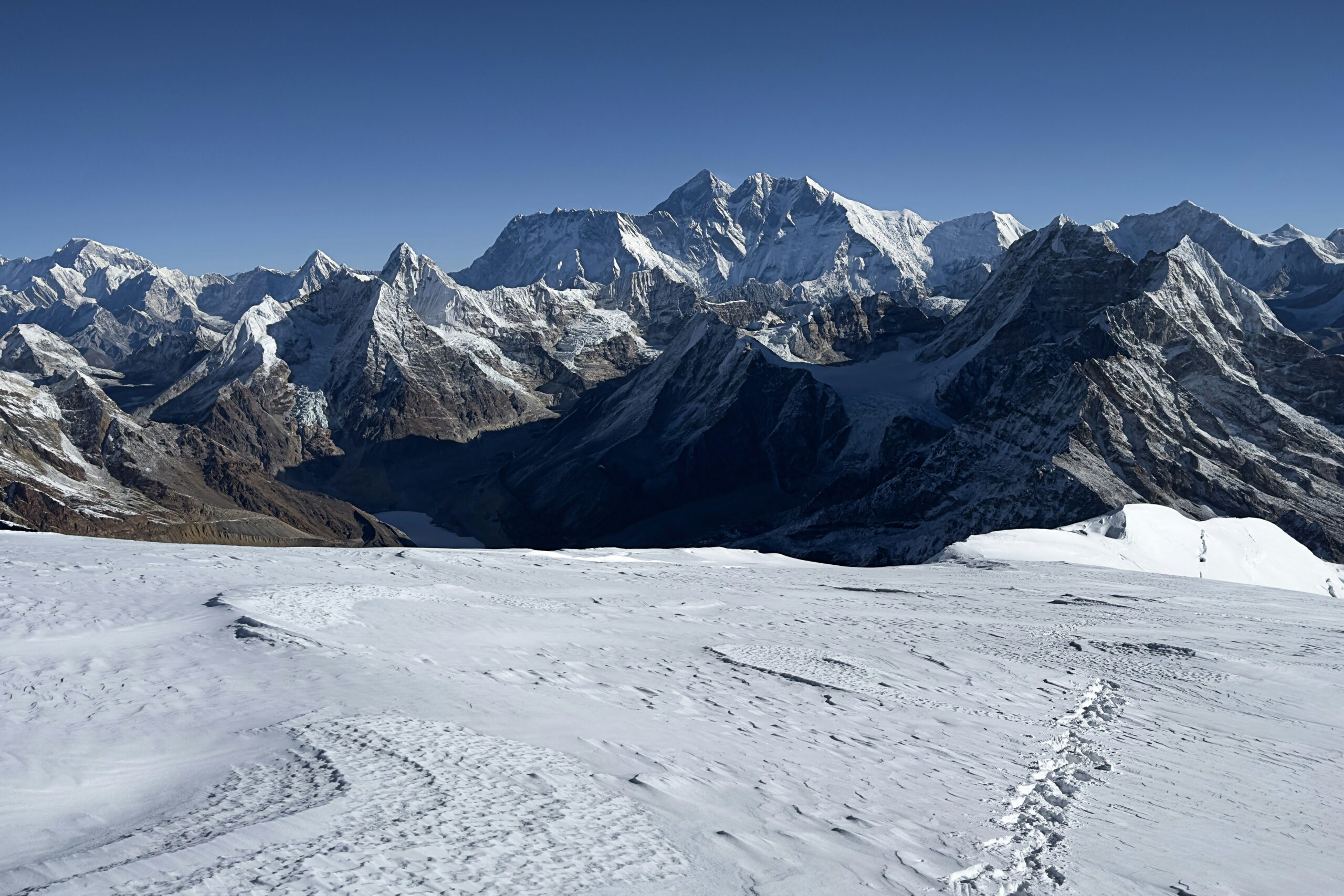
The mountain stands in the Mahalangur Himal range of Nepal’s Khumbu region, just 2 kilometers west-southwest of Mount Everest. The name “Nuptse” derives from Tibetan and Sherpa, meaning “West Peak” — reflecting the mountain’s position relative to Everest. The peak forms a continuous ridge with Lhotse, with seven significant summits crowning the long east-west trending ridge between Lhotse and Nuptse main. The Everest-Lhotse-Nuptse triangle is among the world’s most photographed mountain configurations, visible from Kala Patthar, the Everest Base Camp trek, and numerous viewpoints across the Khumbu.
The climbing itself sets Nuptse apart from peer Himalayan objectives. The standard route shares its lower mountain with Everest and Lhotse expeditions. Climbers pass through the notorious Khumbu Icefall — the same icefall used by approximately 1,500 climbers each season heading to Everest. Then up the Western Cwm to Camp 2 at 6,400m, before turning to Nuptse’s specific upper terrain. The upper mountain demands sustained steep ice climbing, technical mixed terrain, and demanding rock work in places. Sections of loose snow with hollows present serious avalanche hazards. Many climbers describe Nuptse as one of the most technically demanding climbs in the Everest region. The peak demands genuine alpine climbing competence at extreme altitude. This contrasts with the fixed-rope ascent style that characterizes Everest’s standard route.
This guide covers what you need to climb Nuptse in 2026. The standard route via Khumbu Icefall and Western Cwm in detail. The technical upper mountain that distinguishes Nuptse from Everest. Permits, Khumbu Icefall fees, and the unique aspects of climbing a peak that shares lower access with Everest. The Triple Crown context (climbers attempting Everest + Lhotse + Nuptse). Gear specifications for extreme altitude and technical climbing. And honest assessment of who should consider this peak. Despite its modest height ranking among Himalayan peaks, Nuptse demands more technical climbing competence than first-time visitors typically realize. The route’s elite reputation among Himalayan veterans is well-earned.
Nuptse At a Glance
The essential reference facts for Nuptse. Detailed sections follow below.
| Summit elevation | 7,861 m (25,790 ft) — Nuptse main peak |
|---|---|
| Location | Khumbu region, Mahalangur Himal, Nepal |
| Coordinates | 27.9667°N, 86.8917°E |
| Mountain range | Mahalangur Himal, Nepal Himalaya |
| Distance from Everest | ~2 km west-southwest of Everest summit |
| Prominence | 319 m only (over the Western Cwm) |
| Status | One of the most technically demanding 7,000m peaks in the world |
| Name origin | From Tibetan/Sherpa “Nuptse” meaning “West Peak” |
| Triple Crown | Part of Everest-Lhotse-Nuptse Triple Crown sought by elite Himalayan climbers |
| Ridge feature | Long east-west ridge with seven significant summits between Lhotse and Nuptse main |
| First ascent | May 16, 1961 — Dennis Davis and Tashi Sherpa (British expedition led by Joe Walmsley) |
| Standard route | South Face/Buttress via Khumbu Icefall, Western Cwm, and Nuptse’s upper mountain |
| National park | Sagarmatha National Park (UNESCO World Heritage Site) |
| Approach | Same trekking route as Everest Base Camp from Lukla through Namche Bazaar |
| Base camp | Everest Base Camp area (~5,364 m); shared with Everest expeditions in spring |
| Camp 1 | Above Khumbu Icefall (~6,000 m) |
| Camp 2 | Western Cwm (~6,400 m) |
| Camp 3 | Nuptse upper face (~7,000 m) |
| Expedition duration | 45-55 days from Kathmandu typical |
| Best season | Spring (April-May); secondary autumn (September-November) |
| Nepal climbing permit | $1,800 USD per climber (foreign nationals) |
| Khumbu Icefall fee | $600-$800 per climber (SPCC) |
| 2026 guided cost | $22,000-$55,000 USD depending on operator tier |
| Gateway city | Kathmandu, Nepal |
| Mountain airport | Lukla (LUA) — gateway to Khumbu region |
Why Nuptse isn’t on the world’s highest peaks list. Despite its impressive 7,861-meter elevation, Nuptse doesn’t appear on lists of the world’s highest mountains. The reason is prominence — the height a peak rises above the highest col connecting it to a higher peak. Nuptse’s prominence is only 319 meters over the Western Cwm separating it from Lhotse. International mountaineering conventions typically require 500 meters minimum prominence for a peak to be classified as a distinct summit on the major lists. Nuptse falls below this threshold despite being clearly an independent climbing objective with distinct technical character. The convention frustrates many climbers — Nuptse is genuinely harder to climb than several 8,000m peaks on the canonical lists. The list inclusion is a definitional matter, not a measure of climbing significance. Among climbers, Nuptse is widely considered one of the most technically demanding peaks in the Khumbu region.
Why Nuptse Stands Among the Hardest 7,000m Peaks
Nuptse holds a precise position in elite Himalayan mountaineering that few other peaks match. The mountain combines four distinguishing elements. First, status as one of the most technically demanding 7,000m peaks in the world. Second, iconic position in the Everest-Lhotse-Nuptse triangle. Third, shared lower-mountain access with Everest creating unique logistical patterns. Finally, the Triple Crown context that draws elite climbers seeking all three peaks. For Himalayan veterans seeking objectives beyond standard 8,000m peaks, Nuptse delivers something genuinely distinctive.
One of the Hardest 7,000m Peaks Globally
The world holds approximately 100 mountains above 7,000 meters. Within this group, Nuptse occupies a position among the technically hardest. Many climbers consider Nuptse harder than several 8,000m peaks on the canonical list — Cho Oyu’s standard route, for example, demands significantly less technical climbing than Nuptse’s upper mountain. Several factors create this difficulty. First, Khumbu Icefall objective hazards. Second, sustained steep ice climbing on the upper face. Third, technical mixed terrain on the summit ridge. Finally, extreme altitude challenges. Together these demand genuine alpine competence at altitudes where most climbers operate purely on fixed ropes. Few 7,000m peaks anywhere match Nuptse for sustained technical content at extreme altitude.
The Iconic Everest-Lhotse-Nuptse Triangle
Few mountain configurations on Earth are as iconic as the Everest-Lhotse-Nuptse triangle visible from Kala Patthar, the Everest Base Camp trek, and across the Khumbu. The three peaks form a continuous ridge with Everest (8,849m) at the apex, Lhotse (8,516m) to the south, and Nuptse (7,861m) forming the western corner. Photographs of this configuration appear on countless climbing books, magazine covers, and trekking documentation. Climbing Nuptse means becoming part of this iconic visual landscape — standing on the western corner of the triangle that defines Himalayan mountaineering imagery for millions of people worldwide.
The Shared Lower Mountain with Everest
Nuptse’s standard route shares the Khumbu Icefall and Western Cwm with Everest expeditions through Camp 2. This creates unique logistical patterns. Nuptse climbers benefit from Khumbu Icefall route fixing performed each spring by the “Icefall Doctors” (Sherpa specialists who maintain ladder crossings and fixed rope through the icefall). Base camp infrastructure is fully operational due to Everest expeditions. Communication, weather forecasting, and emergency response infrastructure is robust due to the Everest presence. Nuptse climbers then break away from this shared infrastructure above Camp 2, traveling to their specific upper-mountain camps on terrain not accessed by Everest parties. The combination creates expedition logistics unique to Nuptse and Lhotse.
The Triple Crown Achievement
Climbers attempting all three peaks of the Everest-Lhotse-Nuptse triangle pursue what’s called the “Triple Crown” of Khumbu mountaineering. Very few climbers have completed all three summits. The Triple Crown represents one of the elite Himalayan achievements available — combining the world’s highest peak (Everest), the world’s fourth-highest peak (Lhotse), and one of the most technically demanding 7,000m peaks (Nuptse). For climbers building toward this achievement, Nuptse typically comes last because its technical demands exceed the other two peaks’ standard routes despite its lower elevation.
The Lhotse-Nuptse ridge: seven significant summits. The continuous ridge between Lhotse and Nuptse main is one of the most complex high-mountain ridges in the Himalayas. Seven significant summits crown this ridge. However, most climbers focus on Nuptse main at 7,861m as the primary objective. The seven summits include Nuptse main, Nuptse Shar, Nuptse East, and several other named summits along the ridge. Some elite parties have attempted full ridge traverses linking multiple Nuptse summits with Lhotse — extraordinarily difficult objectives that remain rarely accomplished. For most expeditions, the standard objective is Nuptse main accessed via the south buttress and upper face. The ridge complexity is genuinely worth understanding before attempting the peak — what looks like a single summit from afar reveals itself as a continuous high-altitude ridge demanding careful route-finding on the upper mountain.
Who Should Climb Nuptse?
Nuptse sits in a specific position in Himalayan mountaineering progression. The peak is more technically demanding than standard 8,000m routes (Everest, Cho Oyu, Manaslu) but more accessible logistically than truly remote 7,000m peaks. Honest pre-trip self-assessment matters considerably here, particularly regarding technical climbing competence at extreme altitude.
Nuptse Is Appropriate For:
Climbers with prior 8,000m peak experience. Climbers who’ve completed Cho Oyu, Manaslu, or other 8,000m peaks have the altitude tolerance and expedition rhythm baseline. The technical demands then become the additional learning rather than starting from scratch.
Climbers building toward the Triple Crown. For climbers pursuing the Everest-Lhotse-Nuptse Triple Crown, Nuptse typically becomes the third objective after Everest and Lhotse standard routes. Nuptse’s technical demands exceed both standard 8,000m routes despite the lower elevation.
Technically experienced alpine climbers. Climbers with strong technical ice climbing background (WI4-WI5), mixed climbing experience, and confidence with rope team configurations at altitude have the foundation. Nuptse demands more technical climbing than fixed-rope ascent style supports.
Khumbu region veterans. Climbers familiar with the Khumbu region — having previously trekked to Everest Base Camp or climbed peaks like Lobuche, Island Peak, or Ama Dablam — have advantages. The cultural patterns, lodge infrastructure, and Lukla flight logistics are all easier with prior experience.
Climbers comfortable with extreme objective hazards. The Khumbu Icefall is the single most dangerous section of the route — climbers must accept genuine objective hazards from serac collapse, crevasse falls, and avalanche. Many Nuptse parties spend less time in the Icefall than Everest parties (fewer carries needed) but the danger is genuine.
Patient, well-funded expedition climbers. The 45-55 day expedition duration combined with $25,000+ pricing demands serious time and financial commitment. Climbers without flexibility for extended weather windows or financial resources for the full expedition shouldn’t attempt the peak.
Nuptse Is Not Appropriate For:
First-time Himalayan climbers. Nuptse isn’t a first major Himalayan objective in any sense. Climbers without prior 7,000m or 8,000m experience face genuinely elevated risk. Complete easier Himalayan objectives first.
Climbers expecting fixed-rope ascent style. The upper mountain demands real climbing skill rather than pure fixed-rope ascent. Climbers comfortable only with the Everest standard route style face technical sections beyond their experience.
Climbers without ice climbing competence. The upper Nuptse face features sustained steep ice climbing. WI4-level competence is essentially a prerequisite. Climbers without technical ice experience shouldn’t attempt the peak.
Climbers seeking budget Himalayan experience. The minimum guided cost of $22,000+ makes Nuptse one of the more expensive 7,000m peak objectives. Climbers seeking budget Himalayan experience should look at Mera Peak, Island Peak, or other trekking peaks.
Solo climbers. The technical demands, objective hazards, and remote setting make solo Nuptse attempts genuinely dangerous. Even experienced parties operate in teams of 4-6 climbers with multiple Sherpa support.
Where Nuptse Fits in Your Himalayan Progression
| Stage | Peak / Experience | Elevation | What it builds |
|---|---|---|---|
| Foundation | Cascade volcanoes (Rainier, Baker, Hood) | 10,000-14,000 ft | Glacier travel, crampon use, rope team basics |
| First Himalayan trek | Everest Base Camp trek or Annapurna Circuit | 5,500m | Altitude exposure, Khumbu region familiarity |
| First Himalayan climbing peak | Mera Peak or Island Peak | 6,189-6,476m | NMA trekking peaks; introduction to Nepali mountaineering |
| Technical 6,000m peak | Ama Dablam or Pumori | 6,812-7,161m | Genuine technical climbing at altitude; expedition rhythm |
| First 8,000m peak | Cho Oyu or Manaslu standard route | 8,188-8,163m | Extreme altitude; multi-week expedition; fixed-rope style |
| The Nuptse step | Nuptse via Khumbu Icefall + Western Cwm | 7,861m | Technical climbing at extreme altitude; mixed terrain mastery |
| Triple Crown peers | Everest + Lhotse standard routes | 8,516-8,849m | Combined Khumbu objectives; Triple Crown progression |
| Elite 8,000m peaks | K2, Nanga Parbat, Annapurna | 8,091-8,611m | Where Nuptse’s technical lessons fully apply |
The Standard Routes Up Nuptse
Three principal route lines exist on Nuptse. The South Buttress / Standard Route via the Khumbu Icefall handles approximately 90% of commercial climbers. Variations on the South Buttress provide alternative technical lines. The North Ridge from the Western Cwm offers a distinct approach for experienced parties.
| Route | Side | Difficulty | First ascent | Usage |
|---|---|---|---|---|
| South Buttress (Standard) | South face | Alpine TD with extreme altitude | 1961 — Davis & Tashi Sherpa | ~90% of climbers |
| South Pillar / Buttress Variations | South face | Alpine TD+ to ED | Various modern parties | ~5% of climbers |
| North Ridge from Western Cwm | North | Alpine D+ to TD | Less commonly climbed | ~5% of climbers |
Route 1: South Buttress via Khumbu Icefall (Standard — 90% of climbers)
The South Buttress is the standard climbing line on Nuptse. The route shares the Khumbu Icefall and Western Cwm access with Everest and Lhotse expeditions. Then it turns to Nuptse’s specific upper terrain — Camp 3 on the upper Nuptse face at approximately 7,000m. Summit day climbs technical steep ice and mixed terrain to the summit at 7,861m. Total expedition duration is 45-55 days from Kathmandu arrival, including extensive acclimatization and multiple rotations through camps.
The Full Expedition Progression
- Days 1-3 — Kathmandu arrival and preparation: Arrive Kathmandu (1,400m). Permit processing, gear sorting, briefings. Visit Thamel for last-minute equipment. Some operators include cultural visits to UNESCO sites in the valley.
- Day 4 — Flight to Lukla: Domestic flight from Kathmandu (or Ramechhap during high season) to Lukla (2,860m). Tenzing-Hillary Airport — one of the world’s most dramatic airports with a short, sloped runway. Begin trek toward Namche Bazaar.
- Days 5-13 — Trek to Everest Base Camp: 8-10 day trek through Phakding, Namche Bazaar (3,440m), Tengboche (3,860m), Dingboche (4,410m), Lobuche (4,940m), and Gorak Shep (5,140m), arriving at Everest Base Camp at 5,364m. Multiple acclimatization rest days. Optional Kala Patthar viewpoint (5,545m) for spectacular Everest, Lhotse, and Nuptse panoramic views.
- Days 14-18 — Base camp establishment and rest: Set up base camp infrastructure. Rest day, acclimatization, gear preparation. Brief on Khumbu Icefall route, fixed lines, and safety protocols. Practice rope work and ladder crossings.
- Days 18-25 — First Khumbu Icefall rotation: First push through Khumbu Icefall to Camp 1 (~6,000m above the Icefall). Acclimatization night at Camp 1. Touch Camp 2 (~6,400m in the Western Cwm), return to Camp 1 or base camp.
- Days 25-35 — Higher rotations and Camp 3 establishment: Multiple rotations through Camp 1, 2, and 3. Each rotation builds acclimatization while moving food, fuel, and equipment higher. Camp 3 on Nuptse’s upper face at approximately 7,000m. Rest days at base camp between rotations.
- Days 35-45 — Summit window waiting: Return to base camp for full recovery. Monitor weather forecasts. Spring summit windows typically open in late April through mid-May depending on jet stream conditions. Patience is essential.
- Summit attempt (typically days 42-50): Move through camps to Camp 3. Summit day starts pre-dawn from Camp 3. Climb technical steep ice and mixed terrain to the summit at 7,861m. 8-12 hours typical summit day. Descent to Camp 3 or Camp 2 same day.
- Days 50-55 — Descent and return: Reverse the route. Descent through the Icefall typically faster than ascent. Trek back to Lukla. Flight to Kathmandu. Total expedition: 45-55 days.
Strengths
- Shared Khumbu Icefall route fixing with Everest expeditions
- Base camp infrastructure fully operational during spring
- Iconic Everest-Lhotse-Nuptse triangle position
- Triple Crown progression toward elite achievement
- Standard Khumbu region cultural and logistical patterns
- Reaches one of hardest 7K peaks via established route
Considerations
- Khumbu Icefall objective hazards genuinely serious
- Upper mountain technical climbing demanding
- $22,000+ minimum guided cost considerable
- 45-55 day expedition duration significant
- Loose snow sections create avalanche risks
- Climbing harder than its modest 7,861m suggests
Route 2: South Pillar & Buttress Variations (Advanced Technical Lines)
The dramatic south face of Nuptse presents some of the most demanding technical climbing in the Khumbu region. Multiple South Pillar and Buttress variations have been climbed by elite alpine parties seeking lines harder than the standard route. Notable historic ascents include the 1979 South Pillar by Doug Scott, Georges Bettembourg, Brian Hall, and Alan Rouse — a route considered one of the harder Himalayan technical achievements of its era. More recent modern attempts have climbed direct lines on the south face in alpine style, representing some of the most demanding alpine climbing accomplished in the Khumbu. Commercial guiding doesn’t operate on these routes — they’re climbed exclusively by experienced alpine teams operating in lightweight style.
Route 3: North Ridge from Western Cwm (Less Commonly Climbed)
The North Ridge route approaches Nuptse from the Western Cwm — the same upper basin used by Everest and Lhotse expeditions. The route accesses Nuptse from its less-photographed north side. Climbing has been done by various parties over the decades but the route is significantly less popular than the South Buttress standard. The route shares the same lower-mountain logistics through the Khumbu Icefall but turns south from Camp 2 rather than continuing toward the Lhotse Face. The North Ridge typically demands different acclimatization patterns and route-finding compared to the standard South Buttress. Most modern parties choose the standard South Buttress for its more established logistics and Sherpa support familiarity.
Nuptse Climbing History: From 1961 to 2026
The Khumbu region has been home to Sherpa communities for over 500 years. Sherpa peoples migrated from Tibet during the 15th-16th centuries, establishing villages including Namche Bazaar, Tengboche, and Khumjung. The peaks of the Khumbu held deep spiritual significance — Buddhist mountain reverence shaped Sherpa relationships to peaks long before European mountaineering interest. Nuptse and its neighboring peaks were known and venerated locally though never named or formally climbed during this period. The mountain’s Tibetan-derived name “West Peak” reflects its position relative to Everest.
Following Nepal’s opening to mountaineering in 1949, multiple expeditions surveyed the Khumbu region. The 1950 Charles Houston reconnaissance and the 1951 Eric Shipton expedition explored the Western Cwm and surrounding peaks, providing the first detailed information about Nuptse’s character. Hillary and Tenzing’s 1953 Everest first ascent passed through the Khumbu Icefall and Western Cwm — the same access used for modern Nuptse routes. Through the 1950s, Nuptse remained an unclimbed objective with growing reputation as a technically demanding peak.
The first ascent of Nuptse was completed on May 16, 1961 by Dennis Davis and Tashi Sherpa as part of a British expedition led by Joe Walmsley. The expedition climbed the south face via what became the standard route, establishing the line still used by most modern parties. The achievement was significant because Nuptse was widely considered one of the most technically demanding Himalayan peaks attempted to that point. The 1961 expedition demonstrated that the mountain could be climbed while confirming its reputation for technical difficulty. Dennis Davis became one of the most accomplished British Himalayan climbers of his era following the Nuptse ascent.
Following the 1961 first ascent, Nuptse saw relatively few attempts through the 1960s and 1970s. Most Himalayan expeditions during this period targeted Everest, Lhotse, or the more famous 8,000m peaks. Nuptse remained a peak respected by climbers familiar with the Khumbu but rarely attempted commercially. The mountain’s technical demands and lack of “highest mountain” cachet contributed to limited interest during this period. Various international parties attempted the south buttress with mixed success.
The 1979 ascent of Nuptse’s South Pillar by Doug Scott, Georges Bettembourg, Brian Hall, and Alan Rouse represented a landmark in Himalayan alpine climbing. The route — climbed in pure alpine style without supplementary oxygen or fixed ropes — was considered one of the harder technical Himalayan achievements of its era. The ascent established Nuptse’s south face as a venue for elite technical climbing. Doug Scott’s accomplishment on Nuptse came during an extraordinary career that included pioneering ascents on Everest, K2, and other major peaks. The 1979 ascent influenced subsequent alpine-style approaches to Himalayan climbing.
Through the 1980s and 1990s, commercial Himalayan climbing began to emerge. Major operators like Adventure Consultants, Mountain Madness, and Himalayan Experience established programs on Everest that secondarily made Nuptse logistically more accessible. Commercial Nuptse expeditions remained rare during this period because the peak’s technical demands didn’t match the fixed-rope ascent style commercial operators were developing for Everest. Elite alpine parties continued attempting harder South Face variations. Annual ascent numbers remained low — Nuptse was climbed by perhaps a few teams per year compared to dozens of Everest summits.
The 2000s brought genuine commercial growth to Nuptse climbing. Nepali operators including Seven Summit Treks expanded portfolio offerings beyond Everest to include Nuptse and other Khumbu peaks. International operators added Nuptse to expedition lists for clients seeking technical challenges beyond the Everest standard route. Annual ascent numbers grew modestly. The shared logistics with Everest base camp made spring Nuptse expeditions more practical than independent operations. The peak became established as a “step up” objective for experienced Himalayan climbers building toward harder achievements.
The “Triple Crown” concept of climbing Everest, Lhotse, and Nuptse emerged during the 2010s as ambitious Himalayan climbers sought ways to distinguish their achievements beyond standard 8,000m peak collection. Very few climbers have completed all three peaks. The Triple Crown achievement gained recognition in elite Himalayan climbing circles, with Nuptse typically completed last because its technical demands exceed the standard routes on Everest and Lhotse. The concept added new motivation for Nuptse climbing among accomplished Himalayan veterans.
The Khumbu Icefall claimed 16 Sherpa lives in April 2014 in a serac collapse — one of the worst single-day climbing tragedies in Himalayan history. The disaster temporarily closed the season for many expeditions and prompted significant changes to Icefall route planning and Sherpa working conditions. The April 2015 Nepal earthquake triggered avalanches that struck Everest Base Camp, killing 19 climbers and Sherpas. Both events affected Nuptse climbing through the shared base camp and Icefall access. The Khumbu region’s resilience following these tragedies demonstrated the community’s commitment to mountaineering tourism while shaping new safety protocols.
By the late 2010s, Nuptse had become firmly established as a commercial climbing destination. Multiple Nepali operators ran annual programs. International operators offered guided expeditions at premium prices. Annual ascent numbers reached the tens (compared to hundreds for Everest). Khumbu Icefall fees were standardized through SPCC. The peak’s reputation as one of the most technically demanding 7,000m peaks remained intact while becoming logistically more accessible. Most operators integrated Everest Base Camp trekking with Nuptse expedition timing.
The COVID-19 pandemic shut down most Himalayan climbing in 2020. Nepal closed to international tourism for most of the year. The 2021 climbing season operated with significantly reduced expedition numbers and additional health protocols. Some Nuptse expeditions ran but at reduced scale. The pandemic’s effects on Nepali tourism industry employment were severe, with many Sherpa families experiencing significant economic hardship. Recovery began through 2022 as international travel patterns normalized.
The 2023-2025 climbing seasons saw return to pre-pandemic Nuptse expedition activity. Annual ascent numbers reached modest but consistent levels — typically 20-50 successful summits per year compared to hundreds for Everest. Nepali operators continue dominating the market with competitive pricing. International operators maintain premium positions for clients preferring smaller team ratios. The 2026 spring climbing season is currently active with the standard April-May summit window. Khumbu Icefall route fixing was completed in early April. Nepal government climbing permits and SPCC Icefall fees remain at established 2025 levels. The peak continues serving its role as one of the most technically demanding 7,000m objectives in modern Himalayan climbing.
The Everest-Lhotse-Nuptse Triple Crown Context
Nuptse occupies a specific position in the elite Himalayan achievement known as the Triple Crown — climbing all three peaks of the Everest-Lhotse-Nuptse triangle. Understanding the Triple Crown context shapes how serious climbers approach Nuptse within broader Himalayan goals.
What the Triple Crown Means
The Everest-Lhotse-Nuptse Triple Crown is one of the most exclusive achievements in Himalayan mountaineering. Very few climbers have completed all three summits. The achievement represents combining the world’s highest peak (Everest, 8,849m), the world’s fourth-highest peak (Lhotse, 8,516m), and one of the most technically demanding 7,000m peaks (Nuptse, 7,861m). The three peaks share base camp access, lower-mountain routes through the Khumbu Icefall, and the Western Cwm — meaning climbers attempting multiple Triple Crown peaks benefit from shared logistical infrastructure.
Standard Triple Crown Progression
| Order | Peak | Why This Order |
|---|---|---|
| First | Everest (8,849m) standard route | Most established commercial route; builds altitude tolerance; establishes Khumbu logistics familiarity |
| Second | Lhotse (8,516m) standard route | Shares Khumbu Icefall and Western Cwm access; can be combined with Everest in a single season for some climbers |
| Third (hardest) | Nuptse (7,861m) standard route | Technical demands exceed both standard 8,000m routes; saved for last as it’s the most demanding technically |
Two-Peak Combinations
Most climbers pursuing the Triple Crown spread the achievement over multiple seasons. Common two-peak combinations include several pairings. First, Everest + Lhotse, often attempted in same season since both share the route to Camp 3 on the Lhotse Face. Lhotse + Nuptse uses shared logistics through the Khumbu Icefall and Western Cwm. Finally, Everest + Nuptse is less commonly combined but logistically feasible. Some elite climbers have attempted all three in a single season — an extraordinarily demanding objective combining 14+ hours of summit climbing on three different peaks within weeks of each other.
The Triple Crown remains genuinely rare. Despite growing commercial interest in collecting Himalayan achievements, the Triple Crown remains extraordinarily rare. While more than 6,000 climbers have summited Everest and over 800 have summited Lhotse, the number who have completed all three Triple Crown peaks remains in the dozens. The count drops to single digits depending on how strictly the achievement is counted. Nuptse’s technical demands prevent the standard route style fixed-rope ascent that handles many Everest and Lhotse summit attempts. Climbers seeking the Triple Crown must develop genuine technical climbing competence that exceeds what’s required for the easier 8,000m peaks. The achievement serves as a meaningful distinction in elite Himalayan climbing — one of the few Himalayan collections that remains genuinely exclusive despite commercial expansion of the broader sport.
Nuptse Summit Day Timeline: Hour-by-Hour from Camp 3
Summit day on Nuptse typically runs 10-14 hours round trip from Camp 3 (~7,000m) to the summit at 7,861m and back. The combination of technical climbing, extreme altitude, and route length makes this a demanding summit day even by Himalayan standards. Strong, well-acclimatized teams complete the round trip in 10-12 hours. Slower parties may take 14-16 hours.
Standard Nuptse Summit Day — Camp 3 (~7,000m) to Summit (7,861m) and Return
The descent demands as much focus as the ascent. Most summit day fatalities in the Himalayas occur on descent, not ascent. Climbers managing successful summits often experience their highest exposure during the return through technical terrain when fatigue is greatest. On Nuptse specifically, the upper face’s technical demands during descent — managing rappels, controlling speed on steep ice, route-finding through loose snow sections — combine with altitude effects to create elevated risk. Pre-arrange turnaround times based on altitude reached and time of day. Climbers still climbing past 11:00 with the summit not yet reached face elevated risk and should turn back. Successful summits with safe descents are the goal — there are no awards for reaching the top.
Which Nuptse Approach Fits Your Situation?
The choice on Nuptse involves operator tier, expedition timing, Triple Crown context, and team composition. Use this matrix to match yourself — recognizing that this peak is appropriate for only experienced Himalayan climbers.
Match Yourself to a Nuptse Approach
When to Climb Nuptse: Season-by-Season Analysis
April-May: Spring Climbing Season (Primary)
Spring is the primary Nuptse climbing window. April and May offer the most stable weather, established Khumbu Icefall route fixing, fully operational base camp infrastructure due to Everest expeditions, and the highest probability of summit windows. Pre-monsoon weather patterns create relatively predictable summit windows opening from late April through mid-May depending on jet stream position. Most commercial expeditions operate exclusively during this window. The shared base camp with Everest creates abundant logistical resources but also crowded conditions.
September-November: Autumn Climbing Season (Secondary)
Autumn provides a secondary window for Nuptse. Post-monsoon conditions in September through early November bring cleaner air, fewer crowds, and beautiful Himalayan views. The Khumbu Icefall route requires fresh fixing for autumn expeditions, adding logistical complexity. Weather is more variable than spring with shorter summit windows. Only a small subset of operators run autumn programs. Climbers wanting solitude and clear air choose autumn despite the additional logistical challenges.
June-August: Summer Monsoon
The summer monsoon (June through August) is not suitable for standard route Nuptse attempts. Heavy snowfall, low visibility, and severe avalanche risk make the route unsafe. The summer monsoon brings heavy precipitation to the Khumbu region. No commercial operators run summer Nuptse expeditions.
December-March: Winter Conditions
Winter Nuptse ascents are extraordinarily rare and represent serious alpine mountaineering objectives requiring full winter Himalayan experience. Temperatures plummet to extreme cold. Jet stream impacts the summit region with constant high winds. Days are short. Most operators don’t run winter programs. Climbers attempting winter Nuptse have committed full expedition planning to genuinely extreme conditions.
Climbing Nuptse in 2026: Cost Breakdown
Nuptse expeditions cost meaningfully more than standard 7,000m peaks due to the Khumbu Icefall logistics, premium operator pricing, and extended 45-55 day duration. Total expedition costs in 2026 reflect both Nepal government permits and the considerable infrastructure required for safe access through the Khumbu region.
2026 Guided Expedition Pricing
| Operator Tier | 2026 Cost (USD) | What’s Included |
|---|---|---|
| Local Nepali operator (basic) | $22,000-$28,000 per person | Sherpa-supported, Khumbu Icefall fees, standard logistics, basic team ratios; Seven Summit Treks, 8K Expeditions tier |
| Local Nepali operator (mid-tier) | $28,000-$38,000 per person | Enhanced Sherpa support, better team ratios, more comprehensive logistics, Makalu Adventure, Protrek tier |
| International operator | $45,000-$60,000 per person | Adventure Consultants, Alpine Ascents tier; smaller team ratios, integrated international support, premium service |
| Private 1:1 guiding | $60,000-$90,000 per person | Dedicated guide attention throughout; custom dates and logistics |
| Lhotse + Nuptse combined | $45,000-$70,000 per person | Two-peak combined expedition; shared logistics make this cost-efficient versus separate trips |
2026 Independent Expedition Costs
| Cost Component | 2026 Amount (USD) | Notes |
|---|---|---|
| Nepal government climbing permit | $1,800 | Per climber; foreign nationals; Spring season standard pricing |
| Khumbu Icefall fee (SPCC) | $600-$800 | Per climber; covers Icefall Doctors’ route fixing and maintenance |
| Sagarmatha National Park entry | $30-$50 | Per climber; mandatory for park entry |
| Liaison officer | $2,500-$3,500 | Government-required liaison officer with full equipment, salary, accommodation |
| Garbage deposit | $4,000-$5,000 | Stool shipment transfer and garbage deposit fees |
| Sherpa support (climbing) | $8,000-$15,000 | Per climber; per Sherpa support including wages, equipment, insurance, summit bonus |
| Oxygen and equipment | $3,000-$8,000 | Per climber; oxygen cylinders, masks, regulators |
| Food and base camp | $3,000-$6,000 | 45-55 days expedition food, base camp infrastructure |
| Domestic flights (Kathmandu-Lukla) | $300-$500 | Round trip with potential weather delays |
| Personal expedition gear | $3,000-$8,000 | If buying new; 8,000m-rated equipment |
| Tips (Sherpa, kitchen, base camp staff) | $1,500-$3,000 | Customary in Nepali expedition climbing |
| Travel insurance (high-altitude rescue) | $500-$1,500 | Must cover Himalayan rescue including helicopter evacuation |
| International flights to Kathmandu | $1,500-$3,500 | Variable by departure city |
| Total realistic 2026 budget | $28,000-$55,000 | Independent or guided structure depending on team composition |
Why Nuptse costs are at the high end of 7,000m peaks. Nuptse expeditions cost meaningfully more than many other 7,000m peak objectives. The reasons reflect actual expedition complexity. First, the Khumbu Icefall demands paid route fixing through the Sagarmatha Pollution Control Committee — the $600-$800 Icefall fee covers the Sherpa specialists who maintain ladder crossings and fixed ropes. Second, the 45-55 day expedition duration is longer than many 7,000m peak programs, increasing food, fuel, and Sherpa support costs proportionally. Third, the technical demands require more skilled Sherpa support per climber than easier fixed-rope ascent peaks. Fourth, the shared base camp with Everest creates infrastructure costs that all expeditions in the spring season share. Fifth, the technical climbing’s demanding nature requires more oxygen consumption than easier routes. These factors combine to position Nuptse at the high end of 7,000m peak pricing — closer to 8,000m peak budgets than typical 7,000m peak costs.
Gear Checklist for Nuptse
Nuptse gear requirements combine full 8,000m-equivalent expedition kit for extreme altitude with technical climbing equipment for the demanding upper mountain. The technical demands exceed those of standard 8,000m routes — climbers need both extreme cold-weather kit and serious alpine climbing equipment.
Technical Climbing Gear
- Mountaineering boots (8,000m capability) — La Sportiva Olympus Mons, Scarpa Phantom 8000, or similar; double boots essential for extreme altitude
- Crampons (12-point technical) — Petzl Sarken, Grivel G14, or similar — see our Crampons Buyer’s Guide
- Ice tools (two technical) — for sustained ice climbing on upper face — see our Ice Axe Guide
- Climbing harness (alpine) — adjustable for layers
- Helmet — required throughout expedition
- Climbing ropes (60m dynamic + 60m static for Icefall)
- Crevasse rescue kit — pulleys, prusiks, slings, ice screws
- Ice screws (6-8 various lengths) — for upper face protection
- Snow pickets (4-6)
- Locking carabiners (8-10)
- Non-locking carabiners (8-10)
- Belay/rappel devices
- Ascenders (jumars) — for fixed-rope sections
- Personal anchor system
Clothing System (8,000m-Equivalent)
- Down expedition suit — recommended for summit day in extreme cold
- Heavy expedition down parka — primary insulation for high camps; -40°F rating
- Heavy down pants
- Synthetic insulated jacket — for active climbing
- Hardshell jacket (Gore-Tex Pro) — wind and storm protection
- Hardshell pants — required throughout expedition
- Heavyweight base layers (top and bottom) — 2-3 sets
- Midweight base layers — 2 sets
- Heavy fleece mid-layer
- Soft shell pants — for lower mountain
- Balaclava (multiple)
- Heavy down mittens — for summit conditions
- Heavy gloves (multiple pairs)
- Light gloves — for active work
- Heavy wool/synthetic hat
- Neck gaiter / buff
- Glacier glasses (Cat 4) plus backup pair
- Goggles (storm-rated) — essential for whiteout travel
Camp & Sleep Equipment
- Expedition tent (4-season, 4-person capable) — Hilleberg, Mountain Hardwear Trango, or similar
- Snow stakes (8-12) — for storm anchoring
- Sleeping bag rated to -40°F — primary expedition bag
- Sleeping bag liner
- Two sleeping pads (one closed-cell, one inflatable) — R-value 5+ combined
- Bivy sack — emergency shelter
- Snow shovel (avalanche-rated)
- Expedition stove + windscreen — MSR XGK or similar
- Insulated water bottles (3-4L per person)
- Thermos for hot drinks
Oxygen System (Most Commercial Parties)
- Oxygen cylinders (4-6 per climber) — for summit push and emergency use
- Oxygen mask — Summit or Topout systems standard
- Oxygen regulator
- Oxygen flow rates planning — typically 2-3L/min summit; 1-2L/min sleeping
Safety & Communication
- Personal locator beacon (PLB) or satellite communicator — InReach or Spot essential
- Satellite phone — for team-level communication
- Avalanche beacon, probe, shovel — required for Khumbu Icefall passage
- Repair kit — tent, stove, crampon repairs
- First aid kit (expedition-level)
- Diamox / acetazolamide — for altitude prophylaxis
- Dexamethasone (emergency) — for HACE emergency
- Nifedipine (emergency) — for HAPE emergency
- Headlamps with spare batteries — multiple lights per person
- Sunscreen SPF 50+ and lip balm with SPF
Frequently Asked Questions About Climbing Nuptse
How tall is Nuptse and where is it located?
Nuptse rises to 7,861 meters (25,790 feet) in the Khumbu region of Nepal’s Mahalangur Himal range. The coordinates are 27.9667°N, 86.8917°E. The peak sits just 2 kilometers west-southwest of Mount Everest and adjacent to Lhotse, forming the famous Everest-Lhotse-Nuptse triangle. The name “Nuptse” derives from Tibetan and Sherpa, meaning “West Peak”. Despite its impressive 7,861m elevation, Nuptse doesn’t rank on lists of the world’s highest mountains due to its modest 319-meter prominence. The mountain sits within Sagarmatha National Park. The standard climbing approach is from Lukla via the same trekking route used to reach Everest Base Camp.
How difficult is climbing Nuptse?
Nuptse is widely regarded as one of the most technically demanding 7,000-meter peaks in the world. The standard route involves traveling through the notorious Khumbu Icefall, then up the Western Cwm before turning to Nuptse’s specific upper-mountain camps. The climbing combines extreme objective hazards in the Khumbu Icefall, sustained steep ice and snow climbing on the upper mountain, demanding mixed climbing on the summit ridge, and extreme altitude challenges at 7,861m. Sections of loose snow with hollows present serious avalanche hazards. The expedition typically demands 45-50 days total. Climbers attempting Nuptse should have prior 7,000-meter peak experience and significant mixed climbing competence.
What’s the standard route up Nuptse?
The standard route up Nuptse uses the Khumbu Icefall and Western Cwm access shared with Everest and Lhotse expeditions. Climbers fly from Kathmandu to Lukla, trek 8-10 days through the Khumbu region to Everest Base Camp at 5,364m, then establish Camp 1 above the Khumbu Icefall around 6,000m. From Camp 1, the route travels up the Western Cwm to Camp 2 (6,400m), then turns to ascend Nuptse’s specific upper terrain — Camp 3 (~7,000m) on the Nuptse face, with summit day climbing technical steep ice and rock to the summit at 7,861m. Total expedition duration is 45-55 days from Kathmandu arrival.
When is the best time to climb Nuptse?
The Nuptse climbing season runs primarily in spring (April-May) and autumn (September-November). Spring is the preferred window for most commercial expeditions because it coincides with Everest base camp season — meaning Khumbu Icefall route fixing is in place, base camp infrastructure is fully operational, and weather windows are most predictable. Autumn season has cleaner air and fewer expeditions but typically has more variable summit weather. The summer monsoon and winter are not suitable for standard route ascents. Most operators run fixed spring expeditions from late March through May, with summit windows typically opening in late April through mid-May depending on jet stream conditions.
How much does climbing Nuptse cost in 2026?
Guided Nuptse expeditions in 2026 typically cost between $25,000 and $55,000 USD per person for the full 45-50 day program from Kathmandu. Local Nepali operators offer expeditions from $22,000-$32,000 with full logistics, Sherpa support, Khumbu Icefall fees, and government permits. International operators charge $45,000-$60,000 with smaller team ratios. The Nepal government climbing permit is $1,800 per person. Khumbu Icefall fees run $600-$800 per climber. Personal Sherpa support, oxygen, and tips can add another $5,000-$15,000 depending on team structure. International flights add $1,500-$3,500.
What’s the Triple Crown achievement?
The Everest-Lhotse-Nuptse Triple Crown is an elite Himalayan achievement involving climbing all three peaks of the famous triangle that dominates the Khumbu skyline. Very few climbers have completed all three summits. The achievement represents combining the world’s highest peak (Everest, 8,849m), the world’s fourth-highest peak (Lhotse, 8,516m), and one of the most technically demanding 7,000m peaks (Nuptse, 7,861m). The three peaks share base camp access through the Khumbu Icefall and Western Cwm. Standard progression is Everest first, then Lhotse, with Nuptse saved for last because its technical demands exceed both standard 8,000m routes despite the lower elevation.
Why doesn’t Nuptse rank on the world’s highest peaks list?
Despite its impressive 7,861-meter elevation, Nuptse doesn’t appear on lists of the world’s highest mountains because of prominence. International mountaineering conventions require 500 meters minimum prominence for a peak to be classified as a distinct summit on major lists. Nuptse’s prominence is only 319 meters over the Western Cwm separating it from Lhotse. This convention frustrates many climbers because Nuptse is genuinely harder to climb than several 8,000m peaks on the canonical lists. The list inclusion is a definitional matter, not a measure of climbing significance. Among climbers, Nuptse is widely considered one of the most technically demanding peaks in the Khumbu region.
What’s the Khumbu Icefall like?
The Khumbu Icefall is the most dangerous section of the Nuptse standard route — the same icefall used by all Everest expeditions. The icefall is a constantly moving section of the Khumbu Glacier featuring massive ice towers (seracs), deep crevasses, and frequent collapses. Climbers cross sections of the icefall using ladder bridges over crevasses and fixed ropes installed by the “Icefall Doctors” (Sherpa specialists employed by the Sagarmatha Pollution Control Committee). Most climbers spend 6-10 hours each direction passing through the Icefall. Pre-dawn passages are essential when ice conditions are coldest. The Icefall has claimed many climbers’ lives historically, including the 2014 disaster that killed 16 Sherpas in a single serac collapse.
Should I climb Nuptse or Lhotse first?
Most climbers attempt Lhotse before Nuptse. Lhotse is significantly higher (8,516m vs Nuptse’s 7,861m) but technically easier on its standard route — climbed via fixed ropes up the Lhotse Face with relatively straightforward terrain. Nuptse demands genuine technical climbing on the upper face that exceeds Lhotse standard route requirements. For Triple Crown progression, the typical order is Everest first, then Lhotse, then Nuptse last because Nuptse is the technically hardest of the three. Climbers without prior 8,000m experience should attempt Lhotse (or another easier 8,000m peak) before attempting Nuptse. The combined Lhotse + Nuptse expedition is a logical two-peak combination using shared Khumbu Icefall logistics.
How many people climb Nuptse each year?
Nuptse sees significantly fewer ascents than Everest or Lhotse. Annual summit numbers typically run 20-50 successful ascents per year — compared to hundreds for Everest and dozens for Lhotse. The relatively low ascent numbers reflect Nuptse’s technical demands, premium pricing, and lack of “world’s highest” cachet that drives commercial demand for the 8,000m peaks. Among climbers familiar with the peak, Nuptse is widely respected as one of the most demanding Himalayan objectives commercially available. The peak attracts experienced Himalayan veterans rather than first-time Himalayan climbers, keeping ascent numbers consistent at the modest annual level rather than experiencing the explosive growth seen on standard 8,000m routes.
Nuptse Planning Resources
Sources & Further Reading
- Seven Summit Treks — Mt. Nuptse Expedition 7,861m program details
- 8K Expeditions — Mt. Nuptse Expedition 7,861m 2026/2027 cost itinerary
- Adventure Consultants — 2026 Nuptse Expedition Trip Notes
- Makalu Adventure — Mount Nuptse Expedition 2026/2027 program details
- Protrek Adventure — Nuptse Expedition 2026 program
- Climb In Nepal — Nuptse 7,861m guided expedition itinerary
- Peregrine Treks — Nuptse Expedition 7,861m peak climbing program
- Sagarmatha Pollution Control Committee (SPCC) — Khumbu Icefall fee structure and route maintenance
- Nepal Department of Tourism — climbing permit regulations and fees
- Wikipedia — Nuptse reference for elevation, geography, and first ascent
- Joe Walmsley — 1961 British Expedition documentation and Dennis Davis biographical information
- Doug Scott — 1979 South Pillar climbing account
Last updated: May 24, 2026. Next scheduled update: March 2027 (pre-season verification of permit fees, operator pricing, and Khumbu Icefall conditions).
Planning a Himalayan Expedition?
Nuptse is among the most technically demanding 7,000m peaks in the world and ideal preparation for elite Himalayan objectives. See our complete mountain guides for the broader Nepal climbing picture, including easier Khumbu region peaks like Mera Peak and Lobuche East.
View All Mountain Guides →Was this helpful?
🏔Related guides
🧭Explore & compare
Global Summit Guide is an independent mountaineering resource founded in 2026. The team combines first-hand trekking and climbing experience with in-depth research and professional health and nutrition review to help climbers choose objectives, prepare properly, and stay safe.
Health, altitude, and nutrition content is reviewed by Taylor Ludlow (Registered Nurse) and Brigg Hoopes (Nutritionist).
What We Don't Know Yet
Mountain information changes quickly. This box explains the limits of what this page can responsibly promise.
- Route conditions, trailhead access, crevasse exposure, stream crossings, and rescue access may vary from published planning guidance.
- Visa, passport, vaccination, border, insurance, and local transportation rules may change before your trip.
- Route conditions, snowpack, closures, and weather can change quickly after this page is updated.
- Permit rules, fees, quotas, and reservation windows may change between review cycles.
- Operator availability, pricing, guide ratios, and cancellation terms can change by season.
Verify current conditions with official land managers, guide services, local forecasts, and current route reports before booking or climbing.
Mountaineering, rock and ice climbing, glacier travel, and high-altitude activity are inherently dangerous and can result in serious injury or death. The information on Global Summit Guide is provided for general informational and educational purposes only and is not a substitute for professional instruction, qualified guiding, proper equipment, or your own judgment and experience.
Route conditions, weather, snowpack, permits, regulations, and hazards change constantly and may differ from what is described here. Details may be incomplete, out of date, or contain errors. Always verify current information with local authorities, certified guides, and official sources before making any decision in the mountains.
Nothing on this site is medical, legal, or financial advice. Our fitness, acclimatization, altitude, and nutrition content is general in nature; consult a qualified physician before beginning any strenuous exercise program or exposing yourself to high altitude.
You are solely responsible for your own safety and decisions. To the fullest extent permitted by law, Global Summit Guide and its team accept no liability for any loss, injury, damage, or expense arising from use of, or reliance on, this information. By using this site you acknowledge these risks and accept these terms.
Some links on this site may be affiliate links. If you buy through them we may earn a small commission at no extra cost to you; this never affects our recommendations.
Global Summit Guide recommendation path
Next Best Mountain to Research
Use these recommendations to continue the right planning path instead of stopping on one page.
Use current permit, weather, route, and operator information before booking or climbing.
Explore Travel Options for Your Destination
Once your mountain, dates and route are taking shape, compare flights, hotels and other travel options that fit the trip.
Affiliate link. We may earn a commission at no additional cost to you.