
Aconcagua Expedition Cost: Permit, Guides & the Real All-In Budget
Aconcagua’s brochure price is not the trip price. For a guided climber, a realistic planning model is now roughly US$10,000 to US$17,000+ once the operator, provincial climbing permit, international travel, Mendoza expenses, insurance, tips, gear gaps and contingency are counted. The exact 2026–27 permit tariff is still pending, so this guide separates current published operator prices from the last official Mendoza permit rates rather than pretending both are settled.
How much should you actually budget for Aconcagua?
If you already own most of your cold-weather mountaineering equipment, a current guided Aconcagua expedition is realistically a five-figure trip.
Local Argentine programs currently begin around the mid-US$6,000s during promotional booking periods. Major international programs are around the upper-US$7,000s before the climbing permit, airfare and several personal costs are added.
For planning, I would carry approximately:
- US$10,000–$12,000: efficient local guided/logistics model, gear mostly owned.
- US$12,000–$15,000: standard fully guided international-style trip.
- US$15,000–$17,000+: premium support, private upgrades, major gear gaps or expensive travel.
Those are planning models—not advertised package prices. Your actual permit, airfare, equipment and contract determine the total.
Current major examples are roughly $6,300–$7,800 before every outside expense.
2026–27 summer tariff had not yet been published when this page was verified.
These can add several thousand dollars beyond the operator invoice.
Our historical trip reference ended 73% above its $7,400 operator quote.
Do not label last season’s permit as the 2026–27 permit
This is the most important correction to the old cost page.
As of September 15, 2026, Global Summit Guide did not locate a newly published official Mendoza 2026–27 summer Aconcagua climbing tariff. The table below therefore shows the most recent official advance-sale schedule, from 2025–26, as a planning reference only.
| 2025–26 official advance-sale category | Horcones | Vacas | 2026–27 use |
|---|---|---|---|
| International climber | US$980 | US$1,200 | Historical planning reference only. |
| Latin American climber | US$760 | US$940 | Historical planning reference only. |
| Argentine national | ARS 150,000 | ARS 184,000 | Do not carry peso figures into the new season. |
| Mendoza resident | ARS 75,000 | ARS 95,500 | Do not carry peso figures into the new season. |
For the detailed permit system, use the dedicated Aconcagua Permit Cost & Booking Guide . This cost page should own the total budget—not duplicate every permit rule.
What guide companies are actually advertising now
These are examples, not a complete market survey and not a ranking.
| Operator | Program | Advertised price | Permit treatment | Useful inclusion context |
|---|---|---|---|---|
| Inka Expediciones | Normal Route · 18 days | US$6,295 early booking US$7,260 listed | Permit procedure assistance is listed. Verify whether the government fee itself is additional. | Guides, airport/hotel transport, Mendoza lodging, Puente de Inca night, mule transport, mountain lodging and meals are among published inclusions. |
| Inka Expediciones | Normal Route Extended · 20 days | US$6,295 early booking US$7,480 listed | Verify government permit fee separately. | Longer itinerary can add acclimatization margin without currently increasing the promotional price. |
| Inka Expediciones | 360° Traverse · 19 days | US$6,295 early booking US$7,370 listed | Vacas-side permit category historically costs more than Horcones. | Different approach valley and logistics; do not compare only the headline expedition price. |
| Alpine Ascents International | Normal Route / Vacas Valley | US$7,800 | Explicitly excluded; operator currently estimates approximately US$1,100–$1,500 depending on season. | Argentina land transport, one pre-climb Mendoza hotel night, meals during the expedition, guides, group gear and mule support are among listed inclusions. |
For company-level comparison, use Aconcagua Operators Compared .
Three realistic ways the total budget can land
These are planning allowances, not quotations. Airfare, permit and personal gear can move the total materially.
Local specialist
- Current local-program pricing near $6,300–$7,300.
- Most expedition gear already owned.
- Economical international flight.
- Shared Mendoza lodging.
- Limited porter/private upgrades.
- Reasonable insurance and contingency reserve.
Standard guided
- Operator around $7,000–$8,000.
- Permit budget carried separately.
- Typical international airfare.
- Several Mendoza hotel/meals days.
- Guide-team gratuities.
- Insurance plus moderate equipment gaps.
- Meaningful emergency/early-exit reserve.
Premium or gear-heavy
- Premium, private or upgraded support.
- Single-room supplements.
- Porter upgrades or reduced personal carries.
- Large cold-weather gear purchases.
- Higher airfare or complicated routing.
- Larger insurance and trip-cancellation limits.
- Extra post-expedition hotel buffer.
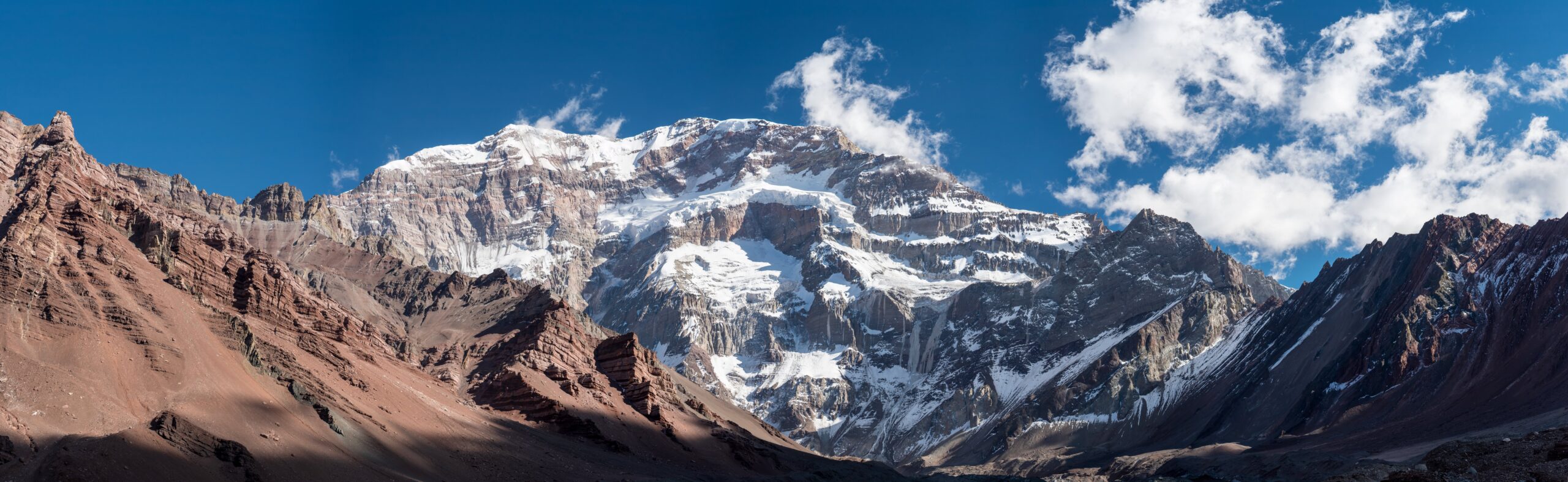
Weather, early exit and missing gear can rewrite the budget.
Aconcagua expenses do not stop when you leave Mendoza. Extra hotel nights, emergency transportation, replacement equipment, porter support, baggage fees and itinerary changes are exactly why a useful budget includes contingency rather than stopping at the operator invoice.
What our January 2024 Aconcagua trip actually cost
Historical spending is valuable when it is labeled as historical—not presented as today’s quote.
US$7,400 operator quote → US$12,800 final spend
Our January 2024 expedition was quoted at approximately US$7,400 per climber for the operator package. By the end of the trip, average total spending was roughly US$12,800 per climber.
That is a difference of about US$5,400, or approximately 73% above the operator quote.
The value of this example is not that every future climber should multiply a quote by exactly 1.73. It is that a brochure number omitted several real costs that still had to be paid.
Historical January 2024 trip quote.
Historical trip expense.
Historical replacement / missing equipment.
Average historical all-in spend per climber.
| Historical 2024 category | Approx. amount | What it teaches today |
|---|---|---|
| Operator quote | $7,400 | The commercial package was only the starting number. |
| Flights | $1,650 | Travel origin can materially change the all-in budget. |
| Mendoza nights / local expenses | $820 | Pre- and post-climb time still costs money. |
| Tipping | $380 | Tip policy should be known before arrival. |
| Insurance | $350 | Coverage is a real expedition cost, not an optional afterthought. |
| Gear gaps | $1,100 | Owning “most gear” can still leave expensive high-altitude gaps. |
| Training / prep travel | $1,100 | Preparation can be a meaningful part of the true project cost. |
Eight categories belong in the budget before you book
The exact amount can change. The categories do not.
Expedition operator
Guides, tents, meals, mule logistics, transportation and hotel coverage vary. Read the actual inclusion list rather than comparing company prices in isolation.
Provincial climbing permit
Route, nationality, sales channel and season can affect the fee. Until Mendoza publishes the 2026–27 tariff, carry a buffer rather than one assumed number.
International travel
Airfare, baggage, domestic Argentina connections, airport transfers and schedule changes can move rapidly.
Mendoza accommodation & meals
Determine exactly how many pre-climb nights are included and assume you may need extra nights after an early exit.
Guide & staff gratuities
Ask the operator for its current written tipping guidance. Avoid copying another company’s tipping schedule onto your own expedition.
Insurance
The policy must match the altitude, mountaineering activity, search/rescue exposure and trip value you need covered.
Gear
Cold-weather boots, sleeping bag, parka, mittens and high-camp systems can create a much larger gap than expected.
Contingency
Extra hotels, baggage, medical evaluation, early transport, porter changes and trip disruption deserve their own reserve.
What should you check before deciding one operator is cheaper?
Two US$7,000 packages can create very different final bills.
| Cost item | May be included | May be excluded / limited | Question to ask |
|---|---|---|---|
| Park permit | Sometimes processing assistance. | Government fee often separate. | Does the package price include the permit itself? |
| Mendoza hotel | Often one or two nights before the climb. | Post-climb and early-exit nights frequently separate. | Exactly which calendar nights are paid? |
| Mules | Base-camp approach support common. | Weight limits and extra loads vary. | How many kilograms of personal equipment are included? |
| High-camp porter support | Some group gear may be carried. | Personal loads or upgrades may cost extra. | What am I personally expected to carry on each move? |
| Meals | Usually included on the mountain. | Mendoza meals and post-climb food vary. | When exactly does meal coverage begin and end? |
| Airport transfer | Arrival transfer may be included. | Final airport return may not be. | Are both arrival and departure transfers covered? |
| Early exit | Rarely fully included. | Mules, hotel, transport and meals can become personal costs. | What does it cost if I leave the team five days early? |
| Tips | Usually not. | Client expense. | What is your current recommended tipping range? |
Horcones and Vacas are not financially identical
Approach valley affects permit history, transport, mule logistics, itinerary and commercial product design.
Horcones
Usually the simplest commercial structure and the clearest choice for a first Aconcagua expedition. The last official international advance-sale permit reference was US$980.
Vacas Valley
Longer approach and different logistics. The last official international advance-sale permit reference was US$1,200.
Polish Glacier
Technical equipment, guide ratios and route-specific support can change the commercial package materially. Do not use a Normal Route budget for a direct glacier objective.
Compare the full route architecture in Aconcagua Routes Compared .
Do not budget insurance as an optional checkbox
The correct policy depends on both government requirements and what financial risk you want transferred.
Read the limit
A policy that covers trekking to 4,000 or 5,000 m is not automatically suitable for an attempt at 6,961 m.
Search and evacuation
Verify whether the policy actually pays operational search, ground rescue and helicopter costs in Aconcagua Provincial Park.
Cancellation & interruption
Medical evacuation coverage and reimbursement of a lost US$10,000–US$15,000 trip are different insurance problems.
Use the Mountaineering Insurance Above 6,000 m guide before choosing coverage.
Build the budget in the right sequence
Paying the operator before understanding the permit, insurance and total cost stack creates avoidable surprises.
Decide whether the trip is Normal Route/Horcones, Vacas/360 or a technical route before comparing prices.
Capture itinerary length, guide ratio, porter/mule limits, hotel nights, transfers, meals, permit treatment and early-exit terms.
Use the current official Mendoza tariff when published. Do not pay based on an old blog’s prior-season figure.
Confirm altitude, mountaineering, rescue and trip-cost coverage before final non-refundable payments.
Identify what you already own, what the operator supplies, what can be rented and what requires purchase.
Add international airfare, baggage and enough pre-trip margin to protect the expedition from a delayed arrival.
Carry money for an early exit, additional hotel night, luggage issue, replacement equipment or schedule disruption.
Separate efficient spending from false economy
The question is not whether a choice is cheaper. It is what capability or flexibility you give up to get the saving.
Cut friction, not expedition margin
- Compare local Argentine specialists with international retail programs.
- Use early-booking discounts when cancellation terms are acceptable.
- Share pre- and post-climb hotel rooms.
- Rent selected high-altitude equipment if fit and quality are verified.
- Own the equipment you will repeatedly use on later expeditions.
- Book airfare early enough to preserve arrival margin.
Do not buy a weaker expedition just to lower the spreadsheet
- Do not remove needed acclimatization days solely to save hotel or guide cost.
- Do not carry inadequate insurance to save a few hundred dollars.
- Do not use poorly fitting boots because they are cheaper.
- Do not assume all operators provide identical high-camp support.
- Do not book a route you are not prepared for because its promotional price looks attractive.
- Do not spend the entire travel budget before keeping an emergency reserve.
Aconcagua cost questions
Prices change. The budget structure is more durable than any one number.
How much does Aconcagua cost all-in?
A practical current guided planning range is roughly US$10,000 to US$17,000 or more. A climber with most gear already owned and an efficient local operator can land near the lower end. Premium guiding, private support, expensive travel or major equipment purchases push the total higher.
What is the 2026–27 Aconcagua permit price?
We had not located an official Mendoza 2026–27 summer tariff when this page was verified on September 15, 2026. The last official advance-sale references from 2025–26 were US$980 for an international Horcones ascent and US$1,200 for an international Vacas ascent. Those are not being presented as the new season’s fee.
How much does an Aconcagua guide cost?
Current 2026–27 examples include Inka’s Normal Route at US$6,295 during early booking against a listed US$7,260 price, and Alpine Ascents at US$7,800. Compare inclusions before deciding which is cheaper.
Is the climbing permit included in the guide price?
Not necessarily. Alpine Ascents explicitly excludes it. Inka lists assistance obtaining the permit, which should not automatically be interpreted as the government fee itself being included. Get the answer in writing.
Why did Global Summit Guide raise its all-in planning range?
Current operator prices alone are already in roughly the US$6,300–US$7,800 range before permit, airfare, insurance, tips, gear and contingency. A five-figure all-in budget better reflects what the climber actually has to fund.
How much did your 2024 Aconcagua trip cost?
Our historical January 2024 reference averaged about US$12,800 per climber against a US$7,400 operator quote. It is preserved here as a first-hand example of the gap between brochure price and total trip spending, not as a current quote.
Does the Vacas route cost more?
It can. The last official advance-sale permit schedule charged international climbers US$1,200 via Vacas versus US$980 through Horcones, and the approach has different logistics. Commercial package pricing does not always mirror the permit difference.
How much emergency money should I carry?
There is no universal figure, but the plan should be able to absorb an early exit, additional Mendoza hotel nights, local transportation, baggage problems or replacement gear without putting the climber in financial difficulty.
Where each number comes from
Government owns the permit. Operators own their current commercial price. Global Summit Guide owns the all-in planning model and first-hand historical reference.
2025–26 Advance Permit Sale
Official advance-sale permit rates, nationality categories, Horcones/Vacas distinction, Aconpass/provider process and evacuation-insurance requirement.
Open official Mendoza source →Inka Expediciones
Current 2026–27 Normal Route, Extended Normal Route and 360° pricing, departure dates and advertised early-booking discounts.
Open current Inka pricing →Alpine Ascents International
Current US$7,800 Normal/Vacas price, major inclusions and explicit exclusion of the park permit.
Open current Alpine Ascents pricing →Aconcagua Permit Guide
Detailed permit architecture, nationality categories, booking process, insurance and the current-season update location.
Open permit guide →Build the complete Aconcagua budget
This page owns the all-in cost question. Use the supporting pages below for live permits, operator comparison, route choice and preparation.