
Last updated September 10, 2026

Kumano Kodo vs Camino de Santiago: Which Pilgrimage Should You Walk First?
For most first-time long-distance pilgrims, walk the Camino first; for strong hikers with limited time or a Japan-centered trip, walk the Kumano Kodo first. The two journeys share deep pilgrimage identity and a formal Dual Pilgrim partnership, but their day-to-day experience is very different. The Camino is longer, more social, more flexible and easier to improvise. Kumano is shorter, steeper, quieter, wetter and much more dependent on advance lodging. The reason to become a Dual Pilgrim is not that the trails are interchangeable. It is that they are complementary.
Walk the Camino First for the Pilgrim Community. Walk Kumano First for the Mountain Journey.
The Camino de Santiago is easier to enter as a first pilgrimage because its infrastructure is unusually forgiving. On major routes such as the Francés and Portugués, you can adjust stage length, stop early, stay in an albergue, buy food through the day and make decisions as your feet change. The walking can still be physically demanding, but the logistics usually give you options.
Kumano Kodo asks more from the itinerary before you start. The Nakahechi crosses steep forested terrain in the Kii Mountains. Twenty kilometres can feel substantially harder than a 20-km Camino day because of roots, stone, wet descents and repeated climbing. Small villages may have only a handful of inns, meal service is often tied to the reservation, and you should not assume another bed or café appears five kilometres later.
That difference makes Kumano better for the hiker who wants a compact, intensely scenic pilgrimage and the Camino better for the traveler who wants a long social journey with room to improvise. If you ultimately want Dual Pilgrim status, either order works. The official program specifically says you can complete the routes in either sequence—and a Camino from years earlier can still count if you have suitable proof.
Do not optimize the entire journey around the certificate. The shortest qualifying Kumano option is intentionally accessible, but the more satisfying first Kumano experience is usually the Nakahechi from Takijiri-oji to Kumano Hongu Taisha, roughly 38 km, or the longer five- to six-day extension through Koguchi to Nachi. On the Camino side, walking only the qualifying final 100 km is valid, but a longer route may better deliver the pilgrim rhythm you came for.
Denser infrastructure, more social contact and easier day-to-day flexibility.
Strong mountain walking, sacred landscape and a complete experience in under a week.
More vertical, more technical underfoot and more wilderness-like than most Camino stages.
The Dual Pilgrim concept works because the two routes are different, not because one substitutes for the other.
Kumano Is the Steeper Pilgrimage. The Camino Is the Longer Pilgrimage.
Distance alone is a poor proxy for effort. Kumano compresses more climbing and trail difficulty into fewer kilometres.
| Factor | Kumano Kodo | Camino de Santiago | Edge |
|---|---|---|---|
| Best first route | Nakahechi | Francés or Portugués | Depends on goal |
| Typical first trip | 3–6 walking days | 5 days to 5+ weeks | Camino for range |
| Daily terrain | Steep forest, roots, stone, mountain passes | Roads, farm tracks, paths, rolling hills; mountain sections vary | Camino easier overall |
| Daily flexibility | Lower; limited village lodging | High on major routes | Camino |
| Lodging | Ryokan, minshuku, guesthouses; reserve early | Albergues, pensions, hotels; mix reservable + walk-in | Camino for spontaneity |
| Meals | Often integrated with lodging; fewer spontaneous stops | Cafés, bars, pilgrim menus, supermarkets widely available on major routes | Camino |
| Social experience | Quiet, intimate, lower-volume | Highly communal on popular routes | Camino |
| Sacred landscape | Shinto-Buddhist sacred mountains, shrines, oji, waterfalls, onsen | Christian pilgrimage toward Santiago, churches, villages, cathedrals and historic roads | Different traditions |
| Waymarking | Strong on Nakahechi, but remote mountain sections demand attention | Excellent shell/yellow-arrow culture on major routes | Camino |
| Best season | Spring / autumn | Depends on route; spring / autumn often strongest | Tie |
| Certificate strategy | Five Dual Pilgrim qualifying options | 100 km foot/horse or 200 km bicycle for Dual Pilgrim | Both required |

Santiago Gives Thousands of Different Journeys One Shared Arrival.
The Camino is a network of routes with one gravitational center. That shared destination creates a communal rhythm unlike Kumano’s dispersed sacred geography. You repeatedly meet people moving toward the same city, then arrive together in a plaza where the route suddenly ends.
Twenty Kilometres on Kumano Is Not Twenty Kilometres on the Camino.
The biggest physical-planning mistake is comparing daily mileage without comparing vertical gain and footing.
This is a planning model, not a measured scientific score. Specific Camino routes vary enormously: the Primitivo is much more mountainous than the final 100 km of the Francés.
Shorter but More Concentrated
On the Nakahechi, wet stone, roots, stair-like climbing and repeated descents slow the day. Poles and traction matter more than a high average walking speed.
Longer and More Repetitive
The challenge is often accumulation: 20–30 km day after day, blister management, heat, road walking and staying healthy for weeks.
Camino Fitness Helps; Kumano Demands Trail Legs
A Camino veteran already understands pacing and recovery. Add hill training and wet-trail confidence before assuming the same mileage will transfer directly.
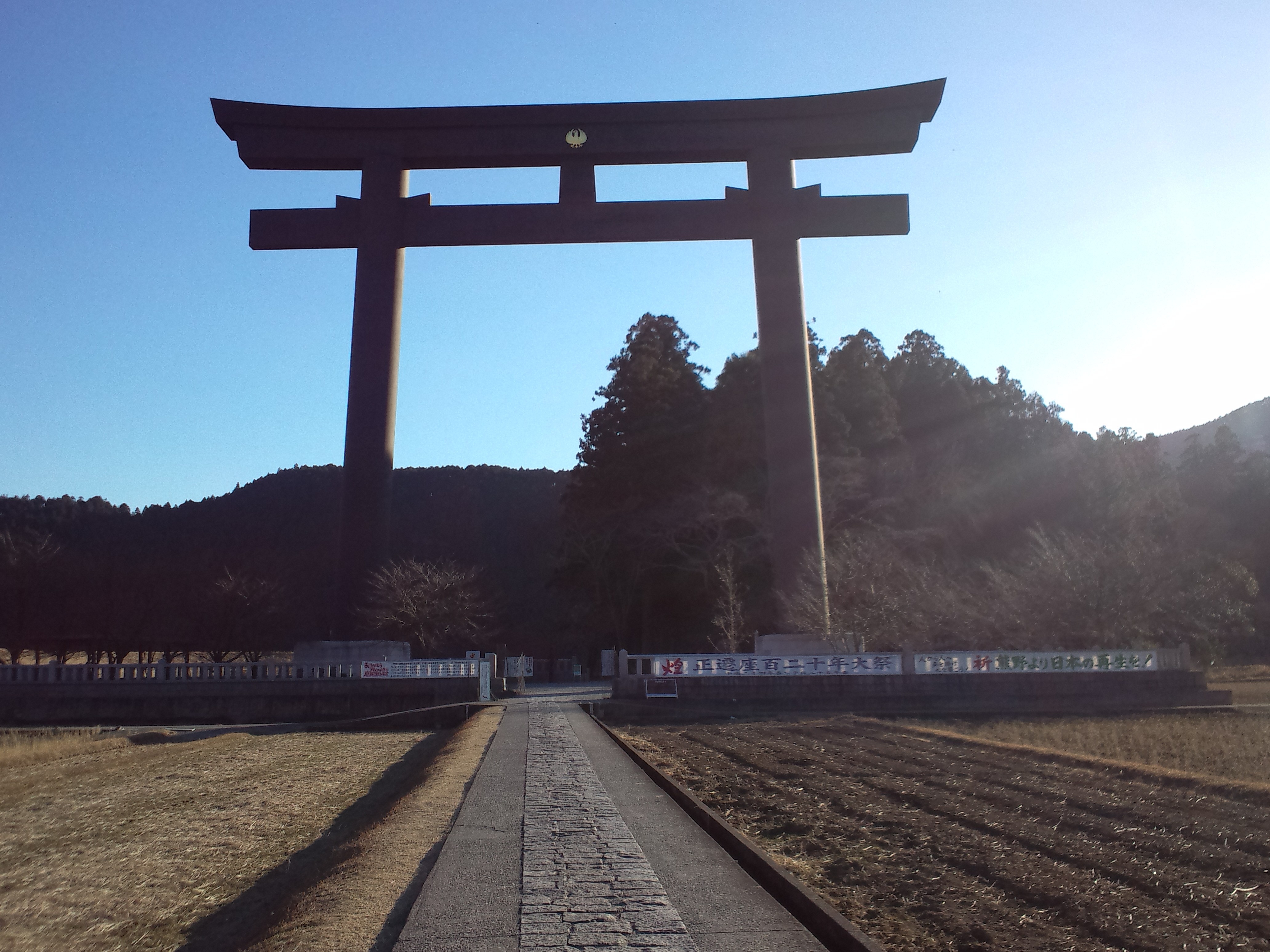
The Destination Is a Sacred Landscape, Not Only an Endpoint.
The giant torii at Oyunohara marks the former site of Kumano Hongu Taisha. Kumano’s pilgrimage identity unfolds through shrines, oji, mountains, river valleys, waterfalls and onsen. That dispersal is one reason the walk feels more contemplative and less like a long funnel toward one city.
Kumano Rewards Reservations. The Camino Rewards Flexibility.
This is probably the most important logistical difference for a traveler who has walked one and is planning the other.
Small Inventory
Village guesthouses and inns may have very few rooms. Dinner and breakfast are often part of the booking, so an accommodation choice also determines your food plan.
A Whole Lodging Ecosystem
Public, municipal, private and parochial albergues coexist with pensions and hotels. On dense routes you can mix reservation certainty with walk-in nights.
Do Not Bring Camino Spontaneity to Rural Kumano
If your preferred Kumano inn is full, the next alternative may require a bus or materially different stage. Reserve the Nakahechi earlier than you would a month-long Francés.

The Camino Shell and Kumano’s Three-Legged Crow Meet in the Dual Pilgrim Logo.
The official Dual Pilgrim mark combines the scallop shell associated with the Camino and the three-legged crow, Yatagarasu, associated with Kumano. The program is more meaningful when those symbols remain rooted in their own traditions rather than being flattened into generic adventure branding.
They Are Both Pilgrimages—but They Do Not Ask You to Experience Sacred Space the Same Way.
You do not need to share a formal religious belief to walk respectfully. You do need to understand what the sites mean to the traditions that created the routes.
Shinto-Buddhist Sacred Landscape
The Kii Mountains developed as a landscape of pilgrimage in which Shinto nature worship and Buddhism interacted over centuries. The Three Grand Shrines, subsidiary oji, waterfalls, forests and purification traditions are part of the journey. Walking is one way of moving through that sacred geography.
Christian Pilgrimage Toward St. James
The Camino leads toward Santiago de Compostela and the traditional tomb of St. James. Churches, monasteries, pilgrim blessings, the credential and the cathedral preserve that Christian structure even though modern walkers arrive with religious, cultural, athletic and personal motivations.

On Kumano, an Onsen Night Can Be Part of the Pilgrimage Rather Than a Luxury Add-On.
Yunomine’s hot springs have long been associated with purification before worship at Kumano Hongu Taisha. That is a very different recovery culture from the Camino albergue—but both create rituals that mark the transition from today’s walking to tomorrow’s stage.
Kumano Fits Inside One Week. The Camino Can Become a Season of Your Life.
This is the strongest practical reason to choose one before the other.
| Available walking time | Kumano option | Camino option | Best choice |
|---|---|---|---|
| 3 days | Takijiri → Hongu at a strong pace | Too short for most qualifying Camino plans | Kumano |
| 5–7 days | Excellent Nakahechi through Hongu and toward Nachi | Camino Inglés or final qualifying section of another route | Either |
| 10–14 days | Kumano plus broader Japan travel | Portugués, Primitivo or longer section | Camino if pilgrimage is primary |
| 30–40 days | Far more time than normal first Nakahechi needs | Full Francés or other major long route | Camino |
Kumano Costs More Per Walking Day. The Camino Usually Costs More in Total Because It Lasts Longer.
The comparison changes depending on whether you measure cost per day or cost per pilgrimage.
Higher Nightly Spend
Small inns, included meals, luggage logistics and Japan transport tend to raise the daily spend. The benefit is that lodging can become part of the cultural experience.
Lower Budget Floor
Albergues, supermarkets and pilgrim menus allow a much lower daily floor, though private rooms and restaurant meals can push the budget substantially higher.
Duration Wins the Math
A five-day Kumano can still cost less overall than a five-week Francés even when every Kumano night costs more.

The Camino’s Cheap Bed Is Part of Why the Social Network Forms So Quickly.
Albergues repeatedly put walkers in the same dorms, kitchens and common rooms. Kumano’s smaller guesthouses can be intimate, but the experience is not the same mass social rhythm. If meeting dozens of pilgrims each day is part of your goal, the Camino has the stronger advantage.
Dual Pilgrim Is a Real Qualification Program With Specific Completion Rules.
The Tanabe City Kumano Tourism Bureau and Santiago partnership launched the program on February 1, 2015.
Official qualification structure reviewed September 10, 2026. Always recheck the Tanabe City Kumano Tourism Bureau page before travel in case registration locations or administrative details change.
100 km Walking / Horse or 200 km Bicycle
The Dual Pilgrim program uses the familiar Camino distance framework. Complete the qualifying Camino and retain your credential or other proof.
Choose One of Five Options
Only walking qualifies on the Kumano side. The classic Takijiri-oji → Kumano Hongu Taisha option is roughly 38 km.
Register After Both
The program provides Dual Pilgrim recognition and a limited-edition pin badge after registration at a designated location.
You Do Not Have to Complete Both Sides of the Same Booklet.
This is one of the most useful official clarifications for travelers who already walked one route.
Free
The official Dual Pilgrim credential has one side for Kumano and one for the Camino and is available at designated locations in Japan, Santiago and through Kumano Travel options.
Your Old Credential Can Count
The official FAQ says you do not need both pilgrimages in the same Dual credential. Another recognized Camino credential and Kumano stamp record can be used.
Do Not Risk the Original
Current Tanabe guidance says a digital copy or image of Camino proof is acceptable when registering in Japan. Keep a secure scan before traveling.

Nachi Is Worth Reaching Even When Your Qualification Could Be Shorter.
Dual Pilgrim status can be earned through a relatively compact Kumano option. That is useful for accessibility, but it should not convince a capable hiker to skip the richer landscape. The Hongu-to-Nachi extension adds two of the Nakahechi’s strongest mountain days and finishes among the shrine, temple and waterfall complex at Nachi.
Choose the First Pilgrimage Based on the Skill You Want to Learn.
The order does not affect official Dual Pilgrim eligibility, so let the experience—not bureaucracy—decide.
If You Are New to Multi-Day Walking
The Camino teaches pacing, blister prevention, daily recovery, shared lodging and the emotional rhythm of getting up and walking again without requiring every lodging night to be perfectly planned.
If You Already Hike and Only Have a Week
Strong day-hikers can transfer their trail fitness into a short but meaningful pilgrimage without needing several weeks away from work or family.
If Japan or Spain Is Already the Trip
Do not force the opposite continent first just to follow an imagined order. The official program says either sequence qualifies.
Build Two Good Trips, Not One Certificate Chase.
Final 100 km Camino + Qualifying Kumano Option
Use this when time is genuinely constrained. It can satisfy the program, but choose enough Kumano walking to feel like a pilgrimage rather than merely collecting stamps.
Portugués or Francés Section + Nakahechi
Walk a 1–2 week Camino first, then a 4–6 day Kumano trip. The contrast between social road pilgrimage and mountain pilgrimage becomes part of the experience.
Full Camino Francés + Full Nakahechi Extension
If time allows, give each tradition room. Walk the Camino long enough for the repeated daily rhythm to change you, then let Kumano compress that same pilgrim attention into a smaller sacred landscape.
Use the Official Program for Qualification Rules—and the Route Hubs for the Trips.
Tanabe City Kumano Tourism Bureau
Qualification options, free credential, stamps, registration locations and current program statistics.
Open official Dual Pilgrim rules →Global Summit Guide Kumano Kodo
Nakahechi stages, difficulty, Grand Shrines, season, lodging, luggage transfer and route maps.
Open Kumano Kodo guide →Global Summit Guide Camino
Choose the route, time, stage style, credential, albergue system and arrival strategy.
Open Camino hub →Kumano Kodo vs Camino FAQ
What is a Dual Pilgrim?
A Dual Pilgrim is someone who completes a qualifying section of both the Kumano Kodo in Japan and the Way of St. James, or Camino de Santiago. The official program began in 2015 and recognizes completion after registration at an approved location.
Which should I walk first, Kumano Kodo or the Camino de Santiago?
For most first-time long-distance pilgrims, the Camino is easier to learn because lodging, food and route infrastructure are denser and daily footing is generally less demanding. Strong hikers with limited time or a Japan-focused trip may prefer the Kumano Kodo first.
How much of the Camino do I need for Dual Pilgrim status?
The official Dual Pilgrim program accepts at least the last 100 km on foot or horseback, or at least the last 200 km by bicycle, on the Way of St. James.
How much of the Kumano Kodo do I need for Dual Pilgrim status?
There are five qualifying Kumano options. The most straightforward full walking option for many visitors is Takijiri-oji to Kumano Hongu Taisha, roughly 38 km. Other qualifying options include the Hongu-Nachi traverse, a short Hosshinmon-Hongu walk combined with visits to all three Grand Shrines, Kohechi from Koyasan, and a qualifying Ohechi combination.
Do I have to use the Dual Pilgrim credential on both routes?
No. The official program says you may use another accepted Camino credential or Kumano stamp book. The free Dual Pilgrim credential is convenient because it has one side for each pilgrimage, but completing both sides of that exact booklet is not mandatory.
Does it matter which pilgrimage I complete first?
No. The official program says the order does not matter. A Camino completed years earlier can still qualify if you can provide or affirm suitable proof when registering.
Where do I register as a Dual Pilgrim?
After completing both qualifying pilgrimages, registration is available in Santiago de Compostela or in Tanabe City, Japan. In Japan, current registration locations include the Kumano Hongu Heritage Center and TANABE Tourist Information Center.
How many Dual Pilgrims are there?
The Tanabe City Kumano Tourism Bureau reported 17,683 registered Dual Pilgrims from 85 countries through August 31, 2026.
Plan Each Pilgrimage as a Complete Journey Before You Connect Them.
The two parent guides below own the route planning. These related pages help with credentials, route choice, accommodation and the wider pilgrimage context.
Do Not Look for the “Japanese Camino.” Walk Kumano Because It Is Not the Camino.
The Camino teaches the social rhythm of long pilgrimage: walk, eat, share a table, sleep, repeat, and watch the same faces move toward Santiago. Kumano compresses pilgrimage into steep forest, shrine approaches, small inns, onsen and sacred mountain geography. If you are new to multi-day pilgrimage, start with the Camino. If you already have hiking legs and only a week, Kumano is an exceptional first choice. Then walk the other one. Dual Pilgrim status is a meaningful recognition—but the real value is experiencing two traditions that use walking to create very different relationships with place.
Was this helpful?
Global Summit Guide is an independent mountaineering resource founded in 2026. The team combines first-hand trekking and climbing experience with in-depth research and professional health and nutrition review to help climbers choose objectives, prepare properly, and stay safe.
Health, altitude, and nutrition content is reviewed by Taylor Ludlow (Registered Nurse) and Brigg Hoopes (Nutritionist).
What We Don't Know Yet
Mountain information changes quickly. This box explains the limits of what this page can responsibly promise.
- Comparisons simplify complex decisions; the better mountain depends on current conditions, skills, timing, budget, and risk tolerance.
- Route conditions, snowpack, closures, and weather can change quickly after this page is updated.
- Permit rules, fees, quotas, and reservation windows may change between review cycles.
- Operator availability, pricing, guide ratios, and cancellation terms can change by season.
- Your fitness, altitude response, risk tolerance, and experience level may change what is safe or realistic.
Verify current conditions with official land managers, guide services, local forecasts, and current route reports before booking or climbing.
Mountaineering, rock and ice climbing, glacier travel, and high-altitude activity are inherently dangerous and can result in serious injury or death. The information on Global Summit Guide is provided for general informational and educational purposes only and is not a substitute for professional instruction, qualified guiding, proper equipment, or your own judgment and experience.
Route conditions, weather, snowpack, permits, regulations, and hazards change constantly and may differ from what is described here. Details may be incomplete, out of date, or contain errors. Always verify current information with local authorities, certified guides, and official sources before making any decision in the mountains.
Nothing on this site is medical, legal, or financial advice. Our fitness, acclimatization, altitude, and nutrition content is general in nature; consult a qualified physician before beginning any strenuous exercise program or exposing yourself to high altitude.
You are solely responsible for your own safety and decisions. To the fullest extent permitted by law, Global Summit Guide and its team accept no liability for any loss, injury, damage, or expense arising from use of, or reliance on, this information. By using this site you acknowledge these risks and accept these terms.
Some links on this site may be affiliate links. If you buy through them we may earn a small commission at no extra cost to you; this never affects our recommendations.
Global Summit Guide recommendation path
Next Best Mountain to Research
Use these recommendations to continue the right planning path instead of stopping on one page.
Use current permit, weather, route, and operator information before booking or climbing.
Search Flights, Hotels & Rental Cars
Have the mountain or destination picked? Use Expedia to compare the flights, lodging and rental cars that fit your actual trip dates. For mountain travel, consider arriving early enough for delays and adding a buffer night after the climb before a fixed flight home.
Compare current flight, hotel and car options.
Affiliate disclosure: Global Summit Guide may earn a commission if you book through this link, at no additional cost to you.