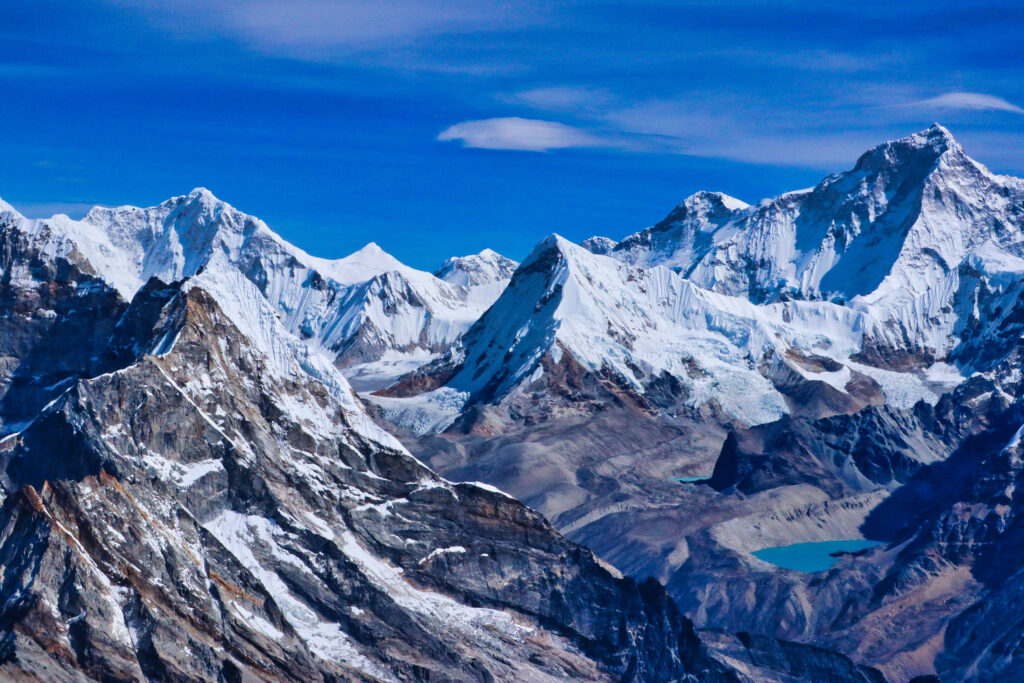
Baruntse is a serious Himalayan expedition peak reached most often by the South/Southeast Ridge. It combines genuine 7,000-meter altitude, glacier travel, fixed-line climbing, steep snow and ice, remote Hinku-Hongu Valley logistics, and a long expedition rhythm that makes it a meaningful step beyond Nepal’s 6,000-meter trekking peaks.
7,129 m / 23,389 ftSouth / Southeast Ridge$800 spring royaltyfirst ascent: May 30, 1954
Research-based guide · Last verified September 17, 2026 · Current rules should always be reconfirmed with Nepal’s Department of Tourism and your licensed expedition operator.
Direct answer
How hard is Baruntse?
Baruntse is not a trekking peak and should not be treated as a simple altitude extension of Mera Peak. The normal South/Southeast Ridge is the established expedition line, but climbers still need glacier competence, fixed-rope efficiency, crampon confidence on steep snow and ice, sound cold-weather systems, and enough altitude experience to function above 6,500 meters. Commercial descriptions vary in their formal grade, which is one reason this guide focuses on the actual terrain and skills rather than a single letter grade.
The key planning point
Baruntse is best understood as a bridge from advanced 6,000m objectives into full Himalayan expedition climbing—not as an Everest prerequisite. Nepal’s proposed prior-7,000m Everest eligibility rule remains part of pending Tourism Bill legislation as of September 2026.
7,129 melevation
1954first ascent
SE Ridgenormal line
$800spring royalty
25–35 dtypical programs
On this page
Build the Baruntse decision in the right order.
Route first, then access and rules, then readiness, season, cost and operator support. That sequence prevents a cheap quote or a dramatic summit photo from becoming the planning framework.
The value of Baruntse is not that it is “easy for 7,000 meters.” It is that the expedition forces a climber to combine altitude, cold, glacier travel, technical systems, multiple camps, weather waiting and descent discipline on one objective.
Photo: SummitClimb / Wikimedia Commons, CC BY-SA 4.0.
01 · Orientation
Where Baruntse sits—and why the approach matters.
Baruntse lies in eastern Nepal between the Everest-Lhotse region and Makalu, bordered by major glacier systems and approached through remote high valleys rather than the main Everest Base Camp trail.
Baruntse · Eastern Nepal
Approximate summit orientation: 27.87° N, 86.98° E. Use expedition mapping and operator route data—not this orientation map—for navigation.
Geographic context
Three planning consequences
Remote approach: Baruntse is outside the busiest Khumbu trekking corridor, so weather and transport delays can compound.
Natural Mera pairing: many itineraries use the Mera/Hinku-Hongu corridor to build acclimatization before Baruntse.
Multiple access concepts: modern commercial programs vary in exact approach, camp placement and return logistics; compare the itinerary rather than assuming every Baruntse trip follows one identical line.
The South / Southeast Ridge is the normal expedition line.
Historical accounts describe the 1954 first ascent by the south ridge; modern operators commonly call today’s normal line the Southeast Ridge. Exact camps and snow/ice difficulties vary by season.
1Base CampUsually around the mid-5,000m range depending on operator placement and approach.
2Glacier / ColRoped glacier travel and fixed sections establish access to the upper mountain.
3Camp 1Commonly placed around 6,100m; exact location varies with conditions.
4Camp 2Often around 6,400m before the steeper upper snow-and-ice terrain.
5SummitSteeper fixed-line climbing and an exposed high ridge lead to 7,129m.
Do not plan around one published grade. Current commercial descriptions range from roughly PD+/PD++ to AD-type language. A grading label does not capture snow condition, serac exposure, fixed-line quality, crowding, weather or the effect of 7,000m altitude.
Baruntse from the Hongu Valley. Photo: Mathias Zehring / Wikimedia Commons (GFDL).
Upper terrain
Steep snow and ice
Operator route descriptions consistently identify a prominent steep upper section/ice cliff as a crux. Treat the exact angle and location as condition-dependent rather than a permanent fixed number.
Summit day
Altitude amplifies everything
Tasks that feel routine at 5,000–6,000m become slower above 6,500m. Efficiency clipping fixed lines, managing gloves and transitions, eating, drinking and descending matters.
Descent
The summit is halfway
Fatigue, cold and deteriorating weather often accumulate after the summit. A strong Baruntse plan gives descent systems the same attention as the climb up.
High-Himalaya context
The mountain is part of a glacier system, not an isolated summit.
Planning needs to account for crevasses, snow bridges, changing glacier surfaces and the remoteness of the Hongu/Imja-Barun landscape—not just the summit ridge.
Photo via Wikimedia Commons; see source file for license and attribution details.
03 · Current rules
Use the 2025 royalty schedule—not the old $500 figure.
Nepal’s Department of Tourism updated foreign-climber royalties effective September 1, 2025. Baruntse falls in the 7,001–7,500m band.
Item
Current planning figure
What it means
Foreign royalty — spring
$800 per climber
Official DoT schedule for 7,001–7,500m peaks.
Foreign royalty — autumn
$400 per climber
Half the spring royalty.
Foreign royalty — winter/summer
$200 per climber
Lowest seasonal royalty; not a statement about conditions.
Guide requirement
At least one guide for the team
Nepal’s amended mountaineering rules require a guide on peaks below 8,000m.
Search-and-rescue equipment
Required on 6,000m+ expeditions
RECCO reflectors are one compliant SAR option; operator paperwork should confirm the exact equipment requirement.
Everest prior-7,000m rule
Pending / proposed
Still tied to the Tourism Bill; do not treat Baruntse as a legally required Everest qualifier yet.
Important 2026 legal-status correction: Parliament’s own tracker still shows the Tourism Bill without House passage or authentication, and the House committee was still holding stakeholder discussions in August 2026. The proposed prior-summit requirement should therefore be described as pending legislation, not current law.
Mera is useful because acclimatization and logistics overlap.
Many commercial Baruntse itineraries use the Lukla–Hinku Valley–Mera corridor, then continue into the Hongu Valley. Others package the route differently, including helicopter exits or alternative passes.
Acclimatize around Khare/Mera La; some programs climb Mera Peak.
Continue through the Hongu Valley to Baruntse Base Camp.
Establish or use upper camps and complete rotations.
Wait for a workable summit window.
Summit and descend through the same upper system.
Return by trek, pass crossing or operator-planned helicopter transfer.
Why program length varies
25 days and 35 days can both be real Baruntse itineraries.
Current 2026 programs range from roughly 25 to 35 days because operators package acclimatization, Mera Peak, weather contingency, guide ratios and return transport differently. A shorter itinerary is not automatically better or worse—the question is what acclimatization and contingency time was removed.
Compare day-by-day altitude gain, rest days, summit contingency and emergency exit plans before comparing price.
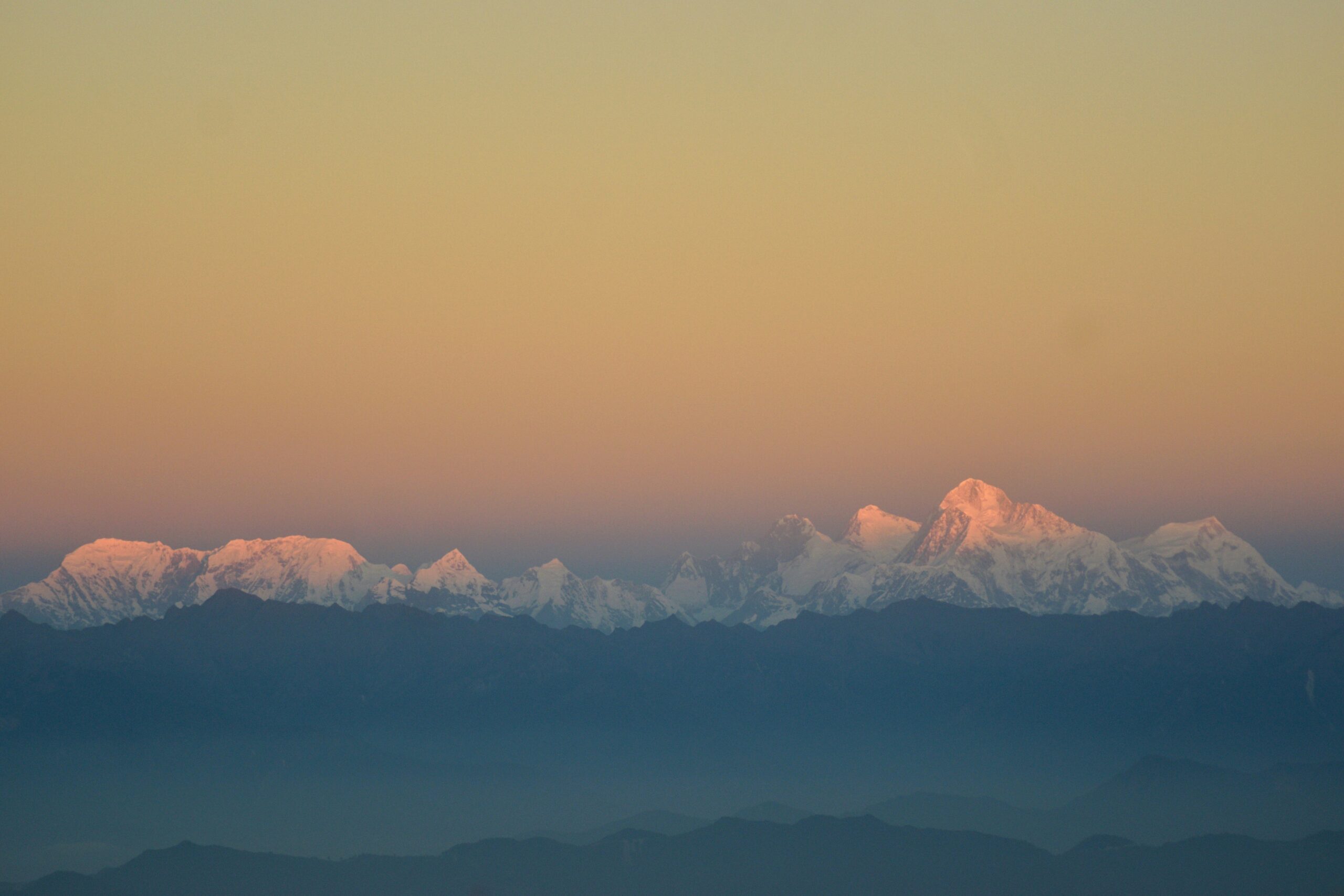
Regional high-Himalaya panorama from Island Peak, with Baruntse among the surrounding peaks. Wikimedia Commons; see file page for license details.
05 · Hazard framework
The risk comes from systems stacking together.
No single Baruntse hazard explains the mountain. Seriousness comes from altitude, glacier travel, avalanche/serac exposure, steep snow and ice, cold, weather, remoteness and the long descent operating at the same time.
Altitude
7,129 meters
Acclimatization errors can become life-threatening. Worsening neurologic or respiratory symptoms require descent and professional medical judgment—not a schedule-driven summit push.
Snow & ice
Condition-dependent cruxes
Steep fixed sections change character with snowpack, ice quality and recent storms. Training on fixed lines needs to be automatic before expedition day.
Glacier
Crevasse exposure
Roped glacier systems and rescue competence matter on approach and upper mountain. “Fixed ropes on summit day” do not replace glacier skills.
Avalanche / serac
Objective hazard
Fresh snowfall, wind loading and warming can change exposure quickly. Route condition and timing decisions belong with experienced local expedition leadership.
Weather
Wind and cold
High winds and extreme cold can make an otherwise climbable line unworkable. Schedule flexibility is a safety resource.
Descent
Fatigue after success
Summit euphoria can hide exhaustion. The descent demands careful fixed-line transitions, hydration, pace and willingness to stop at a high camp when needed.
Planning principle: Baruntse should be judged against your recent experience—not your lifetime résumé. A climber who was strong at 6,000m three years ago but has not used crampons, ascenders and rappels recently still has a systems gap to close.
Scale
Remote terrain changes the consequence of small mistakes.
Baruntse is close to famous mountains on a map but still operates as a remote expedition. Weather, evacuation limits and long approach logistics should shape the plan before deposits are paid.
ISS Expedition 66 image via Wikimedia Commons; see source file for licensing details.
06 · Readiness
Baruntse is a progression mountain, not a first high-altitude climb.
Use prior peaks to prove specific capabilities: acclimatization, glacier travel, fixed-line movement, technical snow/ice efficiency, expedition recovery and judgment in bad weather.
Spring and autumn are both used—but the expedition must be condition-led.
Commercial Baruntse programs operate in both pre-monsoon spring and post-monsoon autumn. The royalty is higher in spring; that does not mean autumn is automatically the better climbing window.
Spring · March–May
The classic pre-monsoon window
Often favored by expedition operators for stable high-altitude climbing cycles and longer daylight as the season advances. Current foreign-climber royalty: $800.
Autumn · September–November
A strong second window
Post-monsoon visibility can be excellent and multiple current operators schedule October departures. Current foreign-climber royalty: $400.
Do not book by royalty discount. A $400 permit difference is minor compared with the total expedition cost. Route condition, operator experience, contingency days and the team’s readiness matter far more.
08 · Cost & support
The quote range is wide because the product is not standardized.
Current advertised 2026 Baruntse packages range from roughly the high-$7,000s to nearly $20,000, with major differences in Mera inclusion, guide ratio, helicopter return, international leadership, high-camp support and contingency.
2026 example
Advertised price
Why it is not directly comparable
Meroway
from about $7,600
25–30 day program; support package differs by operator.
SummitClimb
$10,450
31 days; Baruntse + Mera Peak program.
Namas Adventure
$12,500
Autumn program with 1:1 Sherpa/client ratio and helicopter return from BC.
“Guided” can mean very different staffing models. Ask who is with you above Base Camp, who fixes/maintains ropes and who makes weather/turnaround decisions.
Protect
Contingency
A cheaper program can become expensive if it strips weather days, helicopter contingencies or acclimatization time from the itinerary.
The meaningful comparison is support above Base Camp, guide ratio, fixed-line responsibilities, acclimatization design, emergency plan, weather-day flexibility and exactly what happens if the mountain does not cooperate.
09 · History
Baruntse links the Hillary era to modern alpine climbing.
The mountain’s history is unusually rich for a peak often discussed mainly as an 8,000m preparation objective.
1954
Todd & Harrow
Colin Todd and Geoff Harrow made the first ascent on May 30 during the New Zealand Alpine Club expedition led by Edmund Hillary. Bill Beaven and George Lowe repeated the ascent on June 1.
1980
East Ridge
A Spanish-led team made the second ascent by a new East Ridge route. The American Alpine Journal records steep ice and mixed terrain above the upper camps.
2021
Heavenly Trap
Marek Holeček and Radek Groh climbed the West Face route Heavenly Trap in alpine style, a very different undertaking from the commercial normal route.
Baruntse and the Makalu region. Wikimedia Commons; see source file for attribution/license details.
Historical accuracy note: contemporary AAC material describes the 1954 ascent as the south ridge and confirms Todd and Harrow on May 30, followed by Beaven and Lowe on June 1. Modern commercial operators commonly refer to the standard line as the Southeast Ridge.
Methodology
What this guide treats as current—and what it does not.
Mountaineering information decays quickly. Fees, legal requirements, operator prices and expedition access are current-data questions; route history and first-ascent records are historical-source questions.
Current rules
Primary-source first
Nepal Department of Tourism royalty schedule and Nepal Parliament/Law Commission status were used for current regulatory claims.
Route & history
Cross-source verification
American Alpine Journal records were used for the 1954 first ascent, the 1980 East Ridge and the 2021 Heavenly Trap route. Current operator descriptions were used only for modern logistical patterns.
Conditions, camp locations, operator inclusions and prices can change after publication. Use the official Nepal sources for legal/permit matters and the contracted operator for the exact expedition plan.
Nepal · 6,000m to 8,000m progression · Related guides
Continue From Baruntse Into the Right Planning Page
Use these links by decision: acclimatization, technical progression, larger expedition goals, or deep planning.
Direct answers to the questions most likely to change whether Baruntse is the right next objective.
How high is Baruntse?
Global Summit Guide uses 7,129 meters (23,389 ft), the figure commonly used by Nepal-focused mountain references and current commercial expeditions. Some historical climbing literature reports slightly different elevations.
What is the normal route on Baruntse?
The normal expedition line is generally called the South or Southeast Ridge. The 1954 first-ascent record describes a south-ridge ascent; modern commercial programs commonly use “Southeast Ridge” for the standard line.
How much is the Baruntse climbing royalty?
Under Nepal’s royalty schedule effective September 1, 2025, foreign climbers on 7,001–7,500m peaks pay $800 in spring, $400 in autumn and $200 in winter/summer.
Is a guide mandatory for Baruntse?
Yes. Nepal’s current mountaineering rules require at least one mountain guide for expedition teams on peaks below 8,000 meters. Your operator should confirm the exact staffing and permit documentation for your team.
Does Baruntse currently qualify you legally for Everest?
Baruntse is excellent 7,000m preparation, but the proposed prior-summit requirement for Everest remains tied to pending Tourism Bill legislation as of September 2026. It should not be presented as a current legal prerequisite.
What experience should I have first?
Recent 6,000m experience, strong crampon and fixed-line technique, glacier familiarity and multi-day expedition fitness are more useful benchmarks than a simple summit-count threshold. Mera, Lobuche East and Ama Dablam can each test different parts of that progression.
When is Baruntse climbed?
Commercial expeditions operate mainly in spring and autumn. Spring is the classic pre-monsoon window; autumn also has current commercial departures. Exact conditions matter more than a generic “best month.”
How much does a 2026 Baruntse expedition cost?
Advertised 2026 programs span a wide range, from roughly $7,600 to $19,500 or more. The support model, guide ratio, Mera Peak inclusion, expedition length, helicopter return, leadership and contingency days explain much of the difference.
About the editor
Travis Ludlow · Global Summit Guide
This is a research-based Baruntse guide. The route history, current royalty schedule and legislative status are separated by source type so historical facts are not mixed with changing permit rules or commercial claims.
The planning rule
Choose Baruntse for the experience it builds—not for the label it earns.
The mountain makes sense when your recent altitude, glacier and fixed-line experience already support the objective and when the expedition structure gives you enough acclimatization, weather flexibility and descent margin to use those skills well.
Global Summit Guide is an independent mountaineering resource founded in 2026. The team combines first-hand trekking and climbing experience with in-depth research and professional health and nutrition review to help climbers choose objectives, prepare properly, and stay safe.
Travis LudlowFounder & Head of Research · Master's in Business
Dawson LudlowClimbing & Mountaineering Lead
Walker LudlowClimber & Contributor
Health, altitude, and nutrition content is reviewed by Taylor Ludlow (Registered Nurse) and Brigg Hoopes (Nutritionist).
?
What We Don't Know Yet
Mountain information changes quickly. This box explains the limits of what this page can responsibly promise.
Permit availability, reservation windows, quotas, and official fee rules may change after this page is updated.
Route conditions, trailhead access, crevasse exposure, stream crossings, and rescue access may vary from published planning guidance.
Visa, passport, vaccination, border, insurance, and local transportation rules may change before your trip.
Confidence: Medium
Verify current conditions with official land managers, guide services, local forecasts, and current route reports before booking or climbing.
Safety, medical & liability disclaimer
Mountaineering, rock and ice climbing, glacier travel, and high-altitude activity are inherently dangerous and can result in serious injury or death. The information on Global Summit Guide is provided for general informational and educational purposes only and is not a substitute for professional instruction, qualified guiding, proper equipment, or your own judgment and experience.
Route conditions, weather, snowpack, permits, regulations, and hazards change constantly and may differ from what is described here. Details may be incomplete, out of date, or contain errors. Always verify current information with local authorities, certified guides, and official sources before making any decision in the mountains.
Nothing on this site is medical, legal, or financial advice. Our fitness, acclimatization, altitude, and nutrition content is general in nature; consult a qualified physician before beginning any strenuous exercise program or exposing yourself to high altitude.
You are solely responsible for your own safety and decisions. To the fullest extent permitted by law, Global Summit Guide and its team accept no liability for any loss, injury, damage, or expense arising from use of, or reliance on, this information. By using this site you acknowledge these risks and accept these terms.
Some links on this site may be affiliate links. If you buy through them we may earn a small commission at no extra cost to you; this never affects our recommendations.
Global Summit Guide recommendation path
Next Best Mountain to Research
Use these recommendations to continue the right planning path instead of stopping on one page.
Use current permit, weather, route, and operator information before booking or climbing.
Book the Travel
Search Flights, Hotels & Rental Cars
Have the mountain or destination picked? Use Expedia to compare the flights, lodging and rental cars that fit your actual trip dates. For mountain travel, consider arriving early enough for delays and adding a buffer night after the climb before a fixed flight home.