
Last updated May 24, 2026
Climbing Ama Dablam: Mother’s Necklace & the Matterhorn of the Himalayas
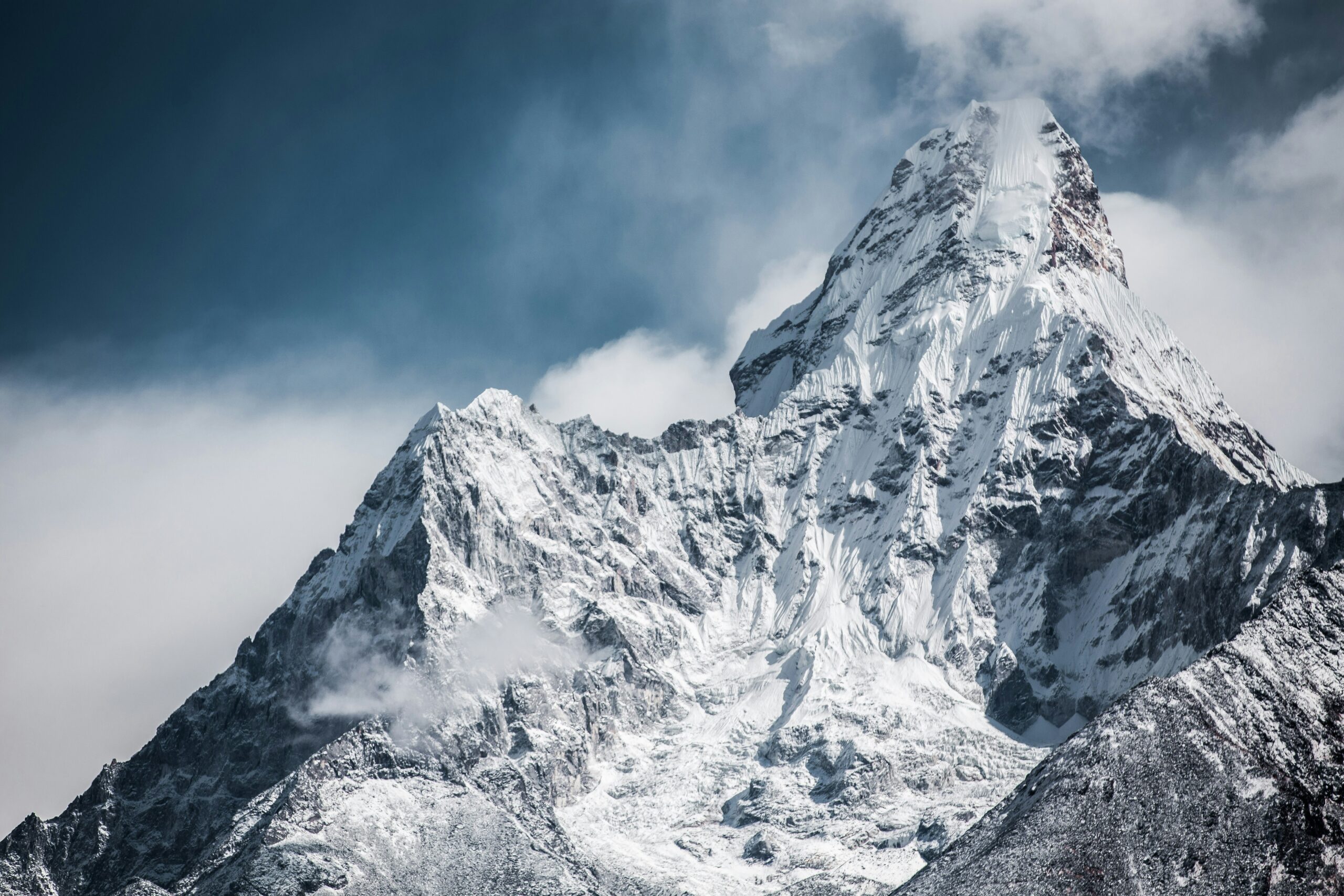
At 6,812 meters (22,349 ft), Ama Dablam is arguably the most iconic technical 6,000m peak in the Himalaya — a sharp granite pyramid in the Khumbu region of Nepal whose distinctive shape dominates the eastern sky for anyone trekking toward Everest Base Camp. The name Ama Dablam means “Mother’s Necklace” in the Sherpa language — the long ridges on each side like a mother’s protective arms, the hanging glacier resembling the traditional double-pendant dablam worn by Sherpa women containing sacred images of gods. The peak features on the one rupee Nepalese banknote. The first ascent was accomplished on March 13, 1961 at 1:00 PM by an international four-person team — Mike Gill (NZ), Barry Bishop (US), Mike Ward (UK), and Wally Romanes (NZ) — during Sir Edmund Hillary’s 1960-61 Silver Hut scientific expedition. The climb was unauthorized (the expedition’s permit was for Makalu), and briefly created diplomatic tension for Hillary. Modern climbers follow the same Southwest Ridge route (graded VI 5.9 60° 1500m) with the infamous Yellow Tower 5.10 rock crux between Camps 1 and 2. The November 13-14, 2006 serac collapse from the hanging glacier killed six climbers at Camp 3 and fundamentally reshaped commercial climbing protocols — operators now skip Camp 3 entirely, pushing directly from Camp 2 to the summit. Nepal’s September 1, 2025 permit fee revision increased the Ama Dablam foreign climber royalty to $1,000 in spring/autumn, $500 in off-seasons. This guide covers the Southwest Ridge route in detail, the 1961 Silver Hut first ascent story, the 2006 serac disaster’s legacy, 2026 permit and expedition logistics, and why Ama Dablam remains the definitive technical Himalayan training peak for climbers progressing toward 8,000m objectives.
(22,349 ft)
Gill · Bishop · Ward · Romanes
Southwest Ridge route
(spring/autumn)
Ama Dablam Location & Base Camp Weather
Live 7-day forecast at Ama Dablam Base Camp (4,600m) — the grassy meadow staging point beneath the west face — plus interactive terrain map of the mountain’s position in the Khumbu region of Nepal’s Sagarmatha National Park.
Ama Dablam · Khumbu Region
27.86°N, 86.86°EBase Camp Weather
Elev: 4,600 m · Base CampAma Dablam is the most photographed technical peak in the Himalaya and arguably the most recognizable 6,000m mountain in the world. Its distinctive pyramid shape — sharp summit, sweeping ridges, hanging glacier suspended beneath the summit block — has made it the iconic image of Himalayan climbing beyond the 8,000m giants. For mountaineers progressing toward 8,000m objectives, Ama Dablam represents the definitive technical Himalayan training peak: high enough at 6,812m to test altitude tolerance, technical enough to demand genuine rock and mixed climbing skills, expeditionary enough to practice the logistics of Nepal Department of Tourism permits, Sherpa support, and Base Camp infrastructure. The Southwest Ridge standard route — graded VI 5.9 60° 1500m — climbs the same line pioneered on March 13, 1961 by Mike Gill (NZ), Barry Bishop (US, National Geographic photographer), Mike Ward (UK, expedition physiologist), and Wally Romanes (NZ) during Sir Edmund Hillary’s legendary 1960-61 Silver Hut Expedition. The climb’s technical signature is the infamous Yellow Tower — a near-vertical granite wall at approximately 5,900m between Camp 1 and Camp 2, rated 5.10 YDS when climbed with full expedition gear at altitude. The November 13-14, 2006 serac collapse from the hanging glacier killed six climbers (three European, three Nepalese) at Camp 3 and fundamentally reshaped commercial climbing — operators now skip Camp 3 entirely, pushing directly from Camp 2 to the summit in 10+ hour days. Nepal’s September 1, 2025 permit fee revision raised the Ama Dablam foreign climber royalty to $1,000 for spring and autumn seasons, $500 for summer and winter — a significant increase from the previous $400 rate. Total 2026 expedition cost runs $7,000-$15,000+ for commercial programs. This guide covers the Southwest Ridge route including the Yellow Tower crux, the 1961 Silver Hut first ascent history, the 2006 serac disaster’s ongoing safety legacy, current Nepal DoT permit requirements, complete 4-6 week expedition logistics, and how Ama Dablam fits into a mountaineering progression toward Everest and the 8,000m peaks.
On the night of November 13-14, 2006, a large piece of the hanging glacier (the Dablam) broke free and swept through Camp 3, killing six climbers (three European, three Nepalese). Eyewitness testimony indicated Camp 3 had not been sited in an unusual or abnormally dangerous spot — the serac fall was of such magnitude that specific tent placement was irrelevant. This incident fundamentally reshaped commercial climbing protocols on Ama Dablam: essentially all major operators now skip Camp 3 entirely, pushing directly from Camp 2 (6,000m) to the summit in 10+ hour summit days to minimize exposure below the hanging glacier. Climbers should verify their operator’s current camp strategy — reputable operators in 2026 will confirm no-Camp-3 protocols. See the Hanging Serac hazard section for detailed analysis of objective hazards and operator protocols.
All 2026 figures in this guide — permit fees, operator programs, expedition logistics, and regulatory changes — were verified against current publications from Nepal Department of Tourism (DoT), the Nepal Mountaineering Association (NMA), and major commercial operators including Alpine Ascents International, International Mountain Guides (IMG), Mountain Trip, Furtenbach Adventures, 8K Expeditions, Seven Summit Treks, Mountain Madness, Mountain Rock Treks, and Namas Adventure. Historical first ascent data draws on the 1960-61 Silver Hut Expedition records, Mike Ward’s physiology research documentation, and ExplorersWeb’s 65-year anniversary coverage of the 1961 first ascent. 2025 Nepal permit fee changes confirmed against Alan Arnette’s September 3, 2025 analysis and the Nepal Ministry of Culture, Tourism and Civil Aviation’s Sixth Amendment Mountaineering Regulations 2081. 2006 serac collapse information sourced from contemporary ExplorersWeb reporting and subsequent commercial operator protocol documentation. Fact-check date: April 20, 2026.
Ama Dablam at a Glance
Before diving into routes, permits, and 2026 expedition logistics, here are the essential facts every climber should know about the Matterhorn of the Himalayas.
Why Ama Dablam Is the Definitive Technical Himalayan Training Peak
Ama Dablam occupies a unique position in Himalayan mountaineering — high enough to test altitude tolerance, technical enough to demand real skill, commercial enough to be accessible with proper preparation, but serious enough that it has killed experienced climbers. Understanding what makes Ama Dablam distinctive is essential preparation for any climber considering the peak.
The Yellow Tower — Real 5.10 Rock Climbing at Altitude
The Yellow Tower between Camp 1 and Camp 2 is a vertical granite wall (80-90 degrees) rated 5.10 YDS when climbed with full mountaineering gear at approximately 5,900m altitude. This is not theoretical difficulty — it’s genuine outdoor rock climbing at near-vertical angles in mountaineering boots, with pack and sometimes gloves, at altitude where oxygen is scarce. Climbers without prior outdoor multi-pitch rock climbing experience often struggle or turn back here. Gym climbing at 5.10 does not translate directly to Yellow Tower conditions. Fixed ropes are maintained by commercial operators, but the feature remains the filter separating prepared from unprepared climbers.
Hanging Glacier Serac Risk — Remains After 2006
The hanging glacier (the Dablam) that gives the mountain its name is also its defining objective hazard. The November 13-14, 2006 serac collapse killed six climbers at Camp 3 — eyewitness testimony indicated Camp 3 was not in an unusual spot, the serac fall was simply massive enough that specific placement was irrelevant. Modern operators skip Camp 3 entirely, climbing directly from Camp 2 to summit. However, any route section under the hanging glacier carries residual serac risk that cannot be eliminated — only minimized through time management and avoiding exposed bivouacs. This is objective hazard that climbing skill cannot mitigate.
Exposed Knife-Edge Ridge Climbing
The Southwest Ridge features extended sections of knife-edge terrain with hundreds of meters of exposure on both sides. Unlike 8,000m peaks where the technical difficulty is concentrated in specific cruxes, Ama Dablam’s character is sustained technical climbing — ridge traversing, mixed rock and ice, ascending and descending using fixed ropes on near-vertical terrain. Between Camp 1 and Camp 2, climbers spend hours on exposed ridges in strong winds. The psychological challenge matches the physical — climbers uncomfortable with exposure struggle even when technical skills are adequate.
Genuine Altitude at 6,812m
While not among the 14 eight-thousanders, Ama Dablam’s 6,812m is high enough to produce serious altitude sickness in climbers without proper acclimatization. HAPE (High Altitude Pulmonary Edema) and HACE (High Altitude Cerebral Edema) cases occur. Climbers attempting Ama Dablam without prior 6,000m+ experience face substantially elevated altitude risk — this is why most commercial programs pair Ama Dablam with preliminary ascents of Island Peak (6,189m) or Lobuche East (6,119m). The rapid altitude gain from Camp 2 (6,000m) direct to summit (6,812m) compresses acclimatization dangerously for the unprepared.
Perfect Preparation for 8,000m Peaks
Ama Dablam serves as the definitive technical training peak for climbers progressing toward 8,000m objectives like Everest, Manaslu, or Cho Oyu. The combination of genuine altitude, technical rock and ice, expedition logistics, Sherpa coordination, and Nepal Department of Tourism permit navigation closely mirrors 8,000m peak requirements on a compressed scale. Many successful 8,000m climbers cite Ama Dablam as their most important training peak. Guide services often require Ama Dablam (or equivalent) before confirming Everest applications. The peak’s role in the Himalayan climbing progression is structural rather than accidental.
Nepal DoT Permit System Complexity
Ama Dablam requires a Department of Tourism climbing permit — not an NMA trekking peak permit — placing it in the same bureaucratic category as 8,000m expedition peaks despite being under 7,000m. The September 1, 2025 permit fee revision raised foreign climber royalties to $1,000 spring/autumn ($500 off-season) — a significant increase from the previous $400 NMA-era rate. Additional required fees include Sagarmatha National Park entry, Khumbu Pasang Lhamu Rural Municipality fee, $2,000 garbage deposit, and liaison officer costs. The permit process teaches climbers the Nepal DoT system they will use for all future expedition peaks.
Lukla Flight Reliability Risk
Access to Ama Dablam requires flying to Lukla (Tenzing-Hillary Airport, 2,860m) — famously one of the world’s most dangerous airports due to its short runway carved into the mountain. Flights are frequently delayed or cancelled for weather, sometimes adding 5-10 days to expedition timelines unexpectedly. In peak trekking seasons (autumn-spring), operations shift to Ramechhap Airport requiring a 4-6 hour drive from Kathmandu. Climbers should budget 2-3 weeks buffer beyond scheduled return — return flights from Lukla can be especially problematic. This is a logistics reality affecting every Khumbu expedition, not specific to Ama Dablam.
Iconic Cultural & Photographic Status
Ama Dablam is the most photographed technical peak in the Himalaya — its distinctive pyramid shape appears in countless mountaineering magazines, Nepal tourism materials, and climbing documentaries. The mountain is featured on the one rupee Nepalese banknote, and a stylized representation was used as the UK-based Invesco Perpetual logo before being adopted by Invesco worldwide. For climbers, the cultural significance means Ama Dablam is not just a technical challenge but an iconic personal achievement. The summit photographs — with Everest, Lhotse, and Makalu visible on the eastern horizon — are among the most sought-after in mountaineering. This iconic status also creates crowding during peak seasons.
Who Can Realistically Climb Ama Dablam?
Ama Dablam is not a beginner Himalayan peak despite being under 7,000m. Commercial operators screen climbers carefully, and a realistic assessment of skill requirements is essential before booking. The mountain’s combination of technical rock, sustained ridge climbing, and altitude demands genuine mountaineering preparation.
Minimum Experience Prerequisites
Reputable Ama Dablam operators typically require the following experience:
- Prior 6,000m+ altitude experience — Summits on Island Peak, Lobuche East, Mera Peak, or equivalent. Aconcagua (6,961m) counts. Attempts without prior 6,000m experience are increasingly rare among premium operators
- Outdoor rock climbing experience — Multi-pitch climbing at 5.9+ YDS. Gym climbing alone is insufficient — the Yellow Tower demands real outdoor rock skill
- Fixed-rope ascending proficiency — Ascender/jumar use on steep rock (not just snow slopes)
- Rappelling fluency — Multiple rappels required on descent from Yellow Tower and summit ridge
- Ice and mixed terrain skills — Crampon technique on 55-65 degree slopes, ice axe self-arrest, mixed climbing fundamentals
- Expedition fitness — 4-6 weeks sustained endurance, 10+ hour summit day at altitude
- Cold weather experience — Comfort camping in sub-zero temperatures, hands-on winter camping fundamentals
- Altitude tolerance demonstration — Previous time above 5,000m without HAPE/HACE symptoms
- Physical conditioning — Cardiovascular endurance for sustained altitude work, upper body strength for fixed-rope ascending
- Financial capacity — $12,000-$20,000 total expedition budget including gear and travel
Ama Dablam Is Appropriate For:
Climbers preparing for 8,000m peaks. Ama Dablam is the definitive technical training peak for progression toward Everest, Manaslu, Cho Oyu, and other 8,000m objectives. Many successful 8,000m climbers cite Ama Dablam as their most important pre-Everest preparation.
Technical rock climbers entering Himalayan mountaineering. Climbers with strong outdoor rock backgrounds who want to add high-altitude technical experience find Ama Dablam an excellent introduction. The Yellow Tower offers genuine rock climbing at altitude; the ridge traversing tests alpine technical skills; the expedition format introduces Himalayan logistics.
Experienced mountaineers seeking the iconic Matterhorn of the Himalayas. Climbers who have completed 6,000m trekking peaks and Aconcagua-level altitude expeditions find Ama Dablam the natural progression — genuinely harder, more technical, more photogenic, and more culturally significant than typical trekking peaks.
Seven Summits climbers as Everest preparation. Climbers pursuing the Seven Summits often use Ama Dablam as their final preparation peak before attempting Everest — the technical and altitude combination is excellent training for the upper Everest route.
Ama Dablam Is NOT Appropriate For:
Climbers without outdoor rock climbing experience. The Yellow Tower 5.10 rock section requires genuine rock climbing ability. Climbers whose only climbing experience is indoor gym or snow-based mountaineering will struggle or turn back at this feature.
Climbers without prior 6,000m+ altitude experience. Pairing Ama Dablam with Island Peak or Lobuche East as acclimatization climbs is strongly recommended — attempting Ama Dablam as a first high-altitude objective produces elevated altitude sickness risk and low summit success rates.
Climbers uncomfortable with exposure. Sustained knife-edge ridge climbing with hundreds of meters of exposure on both sides is psychologically demanding. Climbers who struggle with exposure on the fixed ropes of 5,000m peaks will find Ama Dablam extremely stressful.
Budget-limited climbers. The $7,000-$15,000 commercial cost plus international travel, gear, and insurance makes Ama Dablam a substantial financial commitment. Climbers cannot adequately climb Ama Dablam on minimal budgets without compromising safety.
Most successful Ama Dablam climbers arrive with a specific progression: (1) introduction altitude climbs on peaks like Kilimanjaro (5,895m) or similar non-technical 5,000m+ summits; (2) trekking peak experience on Island Peak (6,189m), Lobuche East (6,119m), or Mera Peak (6,476m) for 6,000m altitude exposure and basic Himalayan logistics; (3) outdoor rock climbing practice — multi-pitch trad or sport climbing at 5.9+ YDS grade, fixed-rope skills on rock, rappelling fluency; (4) Aconcagua (6,961m) or equivalent expedition experience for multi-week altitude tolerance. Climbers following this progression typically arrive at Ama Dablam Base Camp with success probabilities substantially higher than climbers attempting the peak as their first serious technical objective. Many operators will pair Ama Dablam with an Island Peak or Lobuche East acclimatization climb as part of the same 4-6 week expedition. See our Seven Summits Path planning tool for sequence recommendations incorporating Ama Dablam.
Ama Dablam in the Himalayan Mountaineering Progression
Ama Dablam occupies a specific structural position in modern Himalayan mountaineering — not as a destination peak for its own sake, but as the definitive bridge between trekking-peak experience and 8,000m expeditions. Understanding where Ama Dablam fits in a climbing progression helps climbers plan realistic mountaineering careers.
The Khumbu Region’s Mountaineering Progression
Nepal’s Khumbu region offers the world’s most structured mountaineering progression — climbers can ascend the same valley from trekking peaks (Island Peak, Lobuche East, Mera) to technical 6,000m peaks (Ama Dablam) to 8,000m giants (Everest, Lhotse) without leaving the watershed. This progression has shaped commercial mountaineering for over 40 years. Ama Dablam’s position as the definitive technical 6,000m peak makes it the natural bridge — higher than trekking peaks, lower than 8,000m expeditions, but technically demanding enough to prepare climbers for the upper Everest route. Guide services like Alpine Ascents, Mountain Trip, International Mountain Guides, and Furtenbach Adventures explicitly build Himalayan progressions around Ama Dablam as the technical filter. Climbers who successfully summit Ama Dablam have demonstrated the rock, ice, altitude, and expedition skills necessary for 8,000m consideration. The progression isn’t universal — some climbers skip Ama Dablam for direct 8,000m attempts — but the structured pathway produces higher overall success rates and lower accident rates.
Ama Dablam’s Role in the Broader Mountaineering Progression
Ama Dablam sits at specific intersections of multiple climbing progressions:
- Seven Summits progression: Ama Dablam often serves as the final technical preparation before Everest — climbers use it to test altitude tolerance and technical skills before the largest Seven Summit commitment
- Himalayan 8,000m progression: The standard filter peak between 6,000m trekking peaks and 8,000m expeditions. Most commercial operators require Ama Dablam or equivalent before confirming 8,000m applications
- Technical mountaineering progression: For climbers from rock climbing backgrounds, Ama Dablam introduces Himalayan logistics and altitude while maintaining the technical rock character they’re familiar with
- Expedition experience progression: Nepal DoT permits, Sherpa coordination, Base Camp logistics, Lukla flight management — all skills climbers will use repeatedly on future Himalayan expeditions
When to Climb Ama Dablam in Your Project
Strategic considerations for timing Ama Dablam within a mountaineering progression:
- After trekking peak experience: Island Peak, Lobuche East, or Mera Peak first — altitude and logistics introduction
- Before 8,000m attempts: Ama Dablam provides the technical and altitude preparation essential for 8,000m success
- Combined with Island Peak or Lobuche East: Many operators offer combined expeditions — acclimatization climb + Ama Dablam in a single 4-6 week program
- Before Everest: The technical skills and altitude tolerance developed on Ama Dablam directly transfer to the upper Everest route
- As progression capstone: For climbers not pursuing 8,000m peaks, Ama Dablam can serve as the definitive high-altitude technical achievement
Ama Dablam History: From “Unclimbable” to Commercial Classic
Ama Dablam’s climbing history spans just over six decades — from 1958 reconnaissance expeditions that considered it “unclimbable” to contemporary commercial programs that see hundreds of summiters per year. The defining chapters: the 1961 first ascent during Hillary’s Silver Hut scientific expedition, the solo South Face ascent that pushed alpine boundaries, and the 2006 serac collapse that reshaped modern commercial protocols.
1958-1959: The “Unclimbable” Reputation
By early 1961, the 8,000m giants of the Khumbu had already been climbed — Everest in 1953, Cho Oyu in 1954, Lhotse in 1956, and even smaller peaks like Island Peak and Lobuche had seen climbers on their summits. But Ama Dablam remained untouched. Its sharp ridges and steep granite walls caused many to consider the peak almost unclimbable or too difficult.
Two serious attempts preceded the first ascent:
- Autumn 1958: British-Italian party led by Alfred Gregory attempted the Southwest Ridge but abandoned the climb at 6,000m due to technical difficulties
- Spring 1959: UK party led by J. H. Emlyn Jones attempted the North Ridge-Northeast Spur. The team included Jones, George Fraser, Mike Harris, Frederick Jackson, Nea Morin, Ted Wrangham, and Sherpas Annulu and Urkien. In May 1959, Fraser and Harris — two of Britain’s finest climbers — were last seen at 6,400m on the mountain’s north ridge, but never returned. Their fate remains uncertain — decades later, Jones sent letters to the Himalayan Database suggesting Fraser and Harris may have reached the summit before falling on descent, though the Himalayan Database simply notes “Fraser and Harris disappeared on way to summit (fall?)”
The 1960-61 Silver Hut Expedition
The first successful ascent emerged from an unlikely context — Sir Edmund Hillary’s 1960-61 Silver Hut Expedition, primarily a scientific expedition studying high-altitude physiology, not a climbing expedition.
The Silver Hut itself was a prefabricated laboratory plopped at 19,000 feet (5,800 meters) on the Mingbo Glacier, directly in the shadow of Ama Dablam. For a full winter, a team of scientists and climbers lived and worked in this hut, studying the effects of extreme altitude on the human body. This was pioneering physiology work — pushing the boundaries of altitude research, acclimatization, and high-altitude survival.
Climbing was secondary to the research — a way to test their physiological research and keep elite climbers engaged during the scientific winter. The core team combined brilliant scientific minds with hardened mountaineers, creating the perfect environment for the climbing idea to emerge.
March 13, 1961: The Summit Day
The first ascent team was a carefully selected four:
- Mike Gill (New Zealand) — Doctor and formidable climber
- Barry Bishop (United States) — Geographer and photographer for National Geographic
- Mike Ward (United Kingdom) — Doctor and the expedition’s lead physiologist
- Wally Romanes (New Zealand) — An incredibly strong and experienced mountaineer
Their strategy was meticulous. Using the Silver Hut as their base at 5,800m, they established a series of camps up the Southwest Ridge, fixing ropes on the most difficult sections. The team’s months of living and working together at extreme altitude paid off with exceptional acclimatization.
The climb was a vertical puzzle. Camp 1 was established in a relatively safe saddle. The route to Camp 2 involved navigating tricky rock towers — what is now known as the Yellow Tower. The section leading to Camp 3, high on the mountain’s shoulder, was a steep and exposed traverse under the massive hanging glacier (the Dablam). An ice cave was established at around 6,400m.
From their final camp, the four men set out for the summit on March 13, 1961. The last section was a grueling climb up a 50-degree ice slope. Exhausted but determined, they pushed onward, sharing the lead. At 1:00 PM on March 13, 1961, they stood on the summit of Ama Dablam.
To their surprise, the summiters found a plateau at the top. They expected a sharp point, but there was enough space to walk around — contrasting nicely with the knife-edge reputation of the ridges below. Barry Bishop captured the moment on film, documenting the breathtaking panorama of the Himalayas stretching out around them, with Everest, Lhotse, and Makalu dominating the horizon. They had done it. They had climbed the “unclimbable” peak.
The descent was costly but successful — the climbers got down safely, but Gumen Dorje, who was a vital part of the support team and worked as a high-altitude Sherpa, broke his leg on the way down when struck by a rock. Mike Ward later described the intense wind and the constant danger of a fall into the Mingbo Valley.
The Unauthorized Ascent & Diplomatic Aftermath
The team’s triumph was quickly overshadowed by a political storm. The expedition’s official climbing permit was for Makalu, not Ama Dablam. Word of the unauthorized ascent reached Kathmandu, and the Nepalese government was furious. The entire expedition faced the threat of expulsion from the country, and the climbers faced a potential lifetime ban from climbing in Nepal.
The diplomatic situation was eventually resolved, but created significant tension for Hillary — whose reputation had previously been unassailable in Nepal. The incident foreshadowed the complex permit system that would later govern all Nepalese climbing, including the current 2025-2026 Department of Tourism fee structure.
1979: Jeff Lowe’s Solo South Face — A Landmark Ascent
In 1979, American Jeff Lowe completed a solo ascent of the South Face, a landmark achievement in alpine-style climbing. The route, now known as the Lowe Route, is graded VI AI4 M5 — a 1,200-meter technical climb demonstrating extraordinary skill and mental fortitude. This ascent elevated Ama Dablam’s reputation from challenging peak to world-class technical objective.
Also in 1979, a French expedition led by Raymond Renaud and Yvan Estienne showcased the mountain’s capacity for large-scale operations. Their team placed 14 French climbers and 4 Nepalese Sherpas on the summit over three consecutive days via the North Ridge, proving Ama Dablam could accommodate substantial expeditions.
1996: Furlan & Humar’s Piolet d’Or
Slovenian climbers Vanja Furlan and Tomaž Humar made their 1996 ascent of the Northwest Face, earning the Piolet d’Or — mountaineering’s highest honor. Their route, later named the Stane Belak Šrauf Memorial Route, required 1,650 meters of sustained technical climbing at grades reaching VI 5.7 AI5 A2+. This achievement demonstrated how modern alpine-style tactics could unlock previously impossible lines on Ama Dablam.
November 13-14, 2006: The Serac Collapse That Changed Commercial Climbing
On the night of November 13-14, 2006, a large serac collapse occurred from the hanging glacier, sweeping away several tents at Camp 3 and killing six climbers (three European, three Nepalese). Eyewitness testimony indicated that Camp 3 had not been sited in an unusual or abnormally dangerous spot, and that the serac fall was of such magnitude as to render the specific placing of the tents at Camp 3 irrelevant.
The November 2006 serac collapse fundamentally reshaped Ama Dablam commercial climbing protocols. Prior to the disaster, climbers typically set up three camps along the ridge, with Camp III just below and to the right of the hanging glacier. After 2006, climbers now prefer to set just two camps to minimize risk — climbing directly from Camp 2 (6,000m) to summit (6,812m) in a single 10-14 hour summit day, avoiding extended exposure at Camp 3 below the hanging glacier. Any ice that calves off the glacier typically goes left, away from the camp positions, but the 2006 event demonstrated that serac falls can exceed historical patterns. Climbers booking Ama Dablam expeditions in 2026 should verify their operator explicitly uses the two-camp protocol — reputable operators (Alpine Ascents, Mountain Trip, IMG, Furtenbach, 8K, Seven Summit Treks) all follow this approach.
Modern Era: 2010s-2026
Ama Dablam’s commercial climbing era has matured significantly since 2006:
- 2010s: Two-camp commercial protocols become standard. Nepal DoT expedition permit structure stabilizes at $400 per foreign climber
- 2021: Nadhira Al Harthy becomes the first Arab woman to summit Ama Dablam. Asma Al Thani becomes the first Qatari woman to summit shortly after
- 2023: French mountain guide Mathéo Jacquemoud completes a notable ascent
- 2024: Laura Dahlmeier sets the women’s speed record at 12 hours 1 minute, demonstrating how modern training methods and equipment continue pushing the boundaries
- September 1, 2025: Nepal Ministry of Culture, Tourism and Civil Aviation implements the Sixth Amendment Mountaineering Regulations 2081, raising Ama Dablam foreign climber permit fees to $1,000 in spring/autumn, $500 in summer/winter — a significant increase from the previous $400 rate
- 2026: Commercial operators run programs at adjusted fee structures. Autumn and spring seasons continue as dominant climbing windows
Cultural Legacy
Ama Dablam’s cultural status extends beyond mountaineering. The peak is featured on the one rupee Nepalese banknote, and a stylized representation was originally used by Invesco Perpetual as its UK branding logo — since adopted by the Invesco group worldwide. The mountain’s visibility from the Everest Base Camp trek (from Namche Bazaar onward) has made it one of the most photographed peaks in trekking culture, not just climbing culture.
Ama Dablam Climbing Routes: Southwest Ridge & Technical Alternatives
Ama Dablam has one dominant commercial route — the Southwest Ridge following the 1961 first ascent line — and several highly technical alternatives climbed only by elite alpinists. This section covers the standard route in detail plus the two most significant alternatives.
| Route | Character | Technical Grade | Duration | Share | First Climbed |
|---|---|---|---|---|---|
| Southwest Ridge (Normal) | Standard · fixed ropes · Yellow Tower crux | VI 5.9 60° · 5.10 crux | 4-6 week expedition | ~98% | Mar 13, 1961 Gill/Bishop/Ward/Romanes |
| Lowe Route (South Face) | Solo alpine-style technical | VI AI4 M5 · 1,200m | Multi-day alpine | <1% | 1979 Jeff Lowe (solo) |
| Northwest Face (Šrauf Route) | Piolet d’Or alpine-style | VI 5.7 AI5 A2+ · 1,650m | Multi-day alpine | <1% | 1996 Furlan/Humar (Slovenia) |
| North Ridge | Long scrambling alternative | Moderate · long | Multi-day · rarely climbed | <1% | 1979 French expedition |
Southwest Ridge (Normal Route)
The Southwest Ridge follows the 1961 Silver Hut Expedition first ascent line and accounts for essentially all modern commercial Ama Dablam ascents. The route is graded VI 5.9 60° 1500m overall, with a 5.10 crux at the Yellow Tower between Camps 1 and 2.
Step-by-step route breakdown:
Base Camp (4,600m / 15,100 ft)
Grassy meadow setting beneath the west face of the mountain, accessed via a 4-7 day trek from Lukla through Namche Bazaar, Tengboche Monastery, and Pangboche. A cell tower near Base Camp provides inconsistent internet access. An old yak hut has been transformed into a tea house, which is a short walk from the main camping area. Commercial expeditions establish spacious camping with dining tents, kitchens, and support infrastructure. Climbers typically spend several days here acclimatizing and performing final preparations before climbing rotations begin.
Base Camp to Camp 1 (5,800m / 19,000 ft) — 5-6 hours
The first day of climbing involves rocky boulder terrain and an exposed, somewhat loose ridge approach. Climbers may encounter Yak Camp along the way, which can serve as an advanced base camp for gear staging, though water availability is limited and most teams don’t use it as a permanent camp. The route to Camp 1 is typically dry during the autumn season, making it technically straightforward — essentially a steep hike with some scrambling. Climbers face their first altitude test here, and rotations between Base Camp and Camp 1 are a standard part of acclimatization.
Camp 1 to Camp 2 (6,000m / 19,685 ft) — 4-6 hours — The Yellow Tower
This is the technical crux of the route. After leaving Camp 1, climbers clip into fixed ropes and traverse a steep ridge exposed on both sides. The route climbs through rock and snow terrain to approach the Yellow Tower — a vertical rock wall at 80-90 degrees graded 5.10 YDS when climbed with full expedition gear (mountaineering boots, harness, pack, potentially mittens) at 5,900m altitude.
Climbers ascend the Yellow Tower using fixed ropes with ascenders (jumars). The feature is named for its distinctive yellow-gold granite color. On busy autumn days, climbers may queue at the Yellow Tower base waiting for ropes to clear — adding cold exposure time at altitude. During the 1961 first ascent, this section was Mike Ward’s responsibility, and it required extensive piton placement and technical climbing.
Camp 2 sits on a small, exposed ledge accommodating only 7-8 tents. During busy season, the camp fills quickly and additional makeshift camps may be set up on ledge edges — not suitable for those easily intimidated by exposure. The camp offers breathtaking views of the surrounding Himalayan peaks.
Camp 2 to Summit (6,812m / 22,349 ft) — 10-14 hours round trip (skipping Camp 3)
Since the 2006 serac collapse, most commercial operators skip the traditional Camp 3 (6,300m) entirely and push directly from Camp 2 to summit. The summit day begins in the pre-dawn hours (typically 1-3 AM departure).
The route climbs a steep couloir and continues up the ridge, passing the old Camp 3 area and reaching the base of the summit pyramid. From here, the final stretch involves 55-65 degree snow and ice slopes to the summit. The Dablam hanging glacier sits directly to the right (climber’s left) — the serac that collapsed in 2006.
The summit itself is a broad plateau — a surprise to first-time Ama Dablam climbers who expect a sharp peak. There is room to walk around at the top. On clear days, climbers see Mount Everest, Makalu (8,463m), and Baruntse (7,129m) ranges stretching across the eastern horizon.
Descent retraces the route with multiple rappels on the Yellow Tower and fixed-rope work throughout. Total summit day including return to Camp 2: 10-14 hours typical. Many teams descend to Base Camp the following day.
Fixed ropes: Commercial operators maintain fixed ropes on most technical sections during spring and autumn climbing seasons. Climbers must be proficient with ascender (jumar) use on both rock and ice, and rappel technique for descent.
Old Camp 3 area (6,300m): The traditional Camp 3 location just below the hanging glacier is where the November 2006 serac collapse killed six climbers. Some operators still briefly stop here during summit pushes, but essentially no operators camp overnight at this location since 2006.
Lowe Route (South Face)
The Lowe Route — named for Jeff Lowe who completed the first ascent as a solo alpine-style climb in 1979 — stands as one of mountaineering’s most audacious achievements. The route climbs 1,200 meters of sustained technical climbing on the South Face, rated VI AI4 M5.
Lowe’s 1979 solo ascent demonstrated extraordinary skill and mental fortitude. Climbing alone on what was then considered virgin and extremely difficult terrain, he elevated Ama Dablam’s reputation from challenging commercial peak to world-class technical objective. The route has rarely been repeated and remains a landmark in alpine-style mountaineering history.
The Lowe Route is not accessible through commercial guiding services. Climbers attempting it must organize private expeditions with extensive technical rock and mixed climbing experience. The route combines steep ice climbing (AI4), mixed climbing (M5), and sustained rock sections at altitude — a combination requiring elite alpinist skills.
Northwest Face (Šrauf Memorial Route)
Vanja Furlan and Tomaž Humar (Slovenia) made their landmark ascent of the Northwest Face in 1996, earning the Piolet d’Or — mountaineering’s highest honor. Their route, later named the Stane Belak Šrauf Memorial Route after a Slovenian climbing legend, required 1,650 meters of sustained technical climbing at grades reaching VI 5.7 AI5 A2+.
This achievement demonstrated how modern alpine-style tactics could unlock previously impossible lines on Ama Dablam. The climb combined sustained rock climbing at moderate technical grades (5.7) with steep ice (AI5) and aid climbing sections (A2+). The Slovenian team’s approach emphasized speed, light weight, and minimal fixed gear — the opposite of the expedition-style climbing that characterized earlier Ama Dablam ascents.
Like the Lowe Route, the Šrauf Memorial Route is not accessible through commercial services. It demands elite alpinist skills, extensive Himalayan experience, and the comfort to climb unsupported at altitude. The route has seen few repeats.
2026 Ama Dablam Access: Nepal DoT Permits & Expedition Logistics
Ama Dablam access in 2026 requires navigating the Nepal Department of Tourism (DoT) expedition permit system, with significantly increased fees following the September 1, 2025 regulatory revision. Understanding the current permit requirements and the Khumbu access logistics is essential for expedition planning.
Effective September 1, 2025, Nepal’s Ministry of Culture, Tourism and Civil Aviation implemented the Sixth Amendment Mountaineering Regulations 2081, raising Ama Dablam permit fees for foreign climbers to $1,000 in spring/autumn seasons and $500 in summer/winter seasons. This represents a significant increase from the previous $400 rate that applied under the NMA Group A classification. Climbers booking 2026 expeditions should verify whether their operator’s published price includes the updated $1,000 fee or whether it will be added separately. Permits issued before September 1, 2025 were honored at the old $400 rate, but all 2026 expedition permits fall under the new fee structure.
Nepal Department of Tourism Climbing Permit
Ama Dablam requires a climbing permit issued by the Nepal Department of Tourism (DoT) — not a Nepal Mountaineering Association (NMA) trekking peak permit, despite some older sources still referencing the NMA Group A category. The 2026 foreign climber royalty structure:
- Spring (March-May): $1,000 USD per foreign climber
- Autumn (September-November): $1,000 USD per foreign climber
- Summer (June-August): $500 USD per foreign climber
- Winter (December-February): $500 USD per foreign climber
Nepalese climbers pay substantially reduced rates (NPR 8,000 for spring/autumn). SAARC climbers (citizens of India, Pakistan, Bangladesh, Bhutan, Maldives, Sri Lanka) receive preferential rates between Nepali and foreign tiers.
Additional Required Fees
- Sagarmatha National Park Entry: 3,000 NPR (~$22 USD) per foreign visitor. Paid at the park entrance near Monjo on the trekking route
- Khumbu Pasang Lhamu Rural Municipality Fee: 2,000 NPR (~$15 USD) per visitor
- Garbage Deposit: $2,000 USD per expedition (refundable if waste is removed properly from the mountain)
- Liaison Officer: Required for expedition peaks; typical costs $2,000-$5,000 for the expedition period
- TIMS Card: Trekkers’ Information Management System card for the trekking portion of the journey
Documentation Requirements
Climbers must provide to their expedition operator:
- Passport copies (valid for 6+ months beyond return date)
- Passport-sized photographs (4-6 copies typical)
- Health certificate from a physician
- Personal bio-data and climbing experience documentation
- Insurance documentation with helicopter evacuation and high-altitude climbing coverage
- Emergency contact information
The 2026 Expedition Access Process
- International flight to Kathmandu (KTM) Tribhuvan International Airport
- 2-3 days in Kathmandu for permit processing with Nepal DoT, gear check, briefings, and last-minute supply purchases
- Domestic flight Kathmandu to Lukla (Tenzing-Hillary Airport, 2,860m) — 35-minute flight on small aircraft. Famously weather-dependent; frequent delays. In peak seasons, flights may operate from Ramechhap Airport instead of Kathmandu, requiring a 4-6 hour drive
- Trek through the Khumbu valley: Lukla (2,860m) → Phakding (2,610m) → Namche Bazaar (3,440m, 2 nights for acclimatization) → Tengboche Monastery (3,870m) → Pangboche (3,985m) → Ama Dablam Base Camp (4,600m). Total 4-7 days depending on acclimatization schedule
- Base Camp establishment at the grassy meadow site
- Acclimatization rotations between Base Camp, Camp 1 (5,800m), and Camp 2 (6,000m) over 10-14 days
- Summit push window waiting for weather (2-7 days)
- Summit push typically Camp 2 → summit → Base Camp over 1-2 days
- Return trek Base Camp → Lukla (2-4 days)
- Flight Lukla → Kathmandu (weather-dependent; budget 2-5 extra days)
- Kathmandu departure formalities and international flight home
2026 Commercial Operators
Major operators running Ama Dablam programs in 2026:
- Alpine Ascents International (US): Premium Western operator, typically $15,000-$18,000 range
- Mountain Trip (US): Established Seven Summits operator with Ama Dablam programs
- International Mountain Guides (IMG): Long-established Everest/Ama Dablam operator
- Mountain Madness (US): Ama Dablam expeditions with combined Island Peak options
- Furtenbach Adventures (Austria): European premium operator with hypoxic pre-acclimatization options
- 8K Expeditions (Nepal): Nepali operator with competitive pricing and local expertise
- Seven Summit Treks (Nepal): Major Nepali operator with Ama Dablam, Lobuche combined programs
- Elite Exped (Nimsdai): Nirmal Purja’s operator with premium Seven Summits programs
- Mountain Rock Treks (Nepal): Budget-tier Nepali operator from $4,850 all-inclusive
- Namas Adventure (Nepal): Mid-tier Nepali operator with technical expedition focus
- Himalayan Ascent (Australia/Nepal): Guided technical expeditions
Ama Dablam Climbing Costs in 2026
Ama Dablam 2026 expedition costs run from $4,850 (budget Nepali operators) to $18,000+ (Western premium operators) with most climbers spending $12,000-$20,000 total including flights, gear, and contingency. The September 2025 permit fee increase adds approximately $600 to expedition costs compared to previous years.
Primary Expedition Cost: $4,850-$18,000+
Published 2026 Ama Dablam expedition costs from major operators:
- Mountain Rock Treks (Nepal): All-inclusive packages from $4,850 — budget tier with Nepali Sherpa guides
- 8K Expeditions (Nepal): Mid-tier pricing $7,000-$10,000 range
- Seven Summit Treks (Nepal): Competitive Nepali pricing $8,000-$12,000
- Namas Adventure (Nepal): Technical-focused programs $8,000-$12,000
- Mountain Madness (US): Standard program $10,000-$14,000
- International Mountain Guides (IMG): Established program $12,000-$16,000
- Mountain Trip (US): Western premium $14,000-$17,000
- Alpine Ascents International: Premium tier $15,000-$18,000+
- Furtenbach Adventures: European premium with hypoxic options $16,000-$20,000+
- Elite Exped (Nimsdai): Premium Seven Summits tier $15,000-$20,000+
What Expedition Cost Includes
- Nepal DoT climbing permit fee ($1,000 spring/autumn in 2026)
- Sagarmatha National Park entry fee and municipal fees
- Kathmandu hotel accommodation (2-3 nights before and after expedition)
- Domestic flights Kathmandu-Lukla-Kathmandu (weather-dependent)
- All meals during trek and expedition
- Teahouse accommodation during trek (Lukla to Base Camp)
- Tent accommodation and meals at Base Camp (tent with insulated sleeping)
- Sherpa guides and climbing leaders (1:1 or 1:2 ratios depending on tier)
- Porters for trekking and Base Camp gear transport
- Fixed-rope infrastructure (group climbing gear)
- Base Camp cooking and dining staff
- Basic medical support
- Garbage deposit (handled by operator; refundable)
- Liaison officer fees
Required Additional Costs
- International flights to Kathmandu: $1,000-$2,000 from Europe, $1,500-$3,000 from North America, $800-$1,500 from Asia-Pacific
- Nepal tourist visa: $30-$125 depending on duration (15/30/90 days available on arrival or pre-arranged)
- Travel and climbing insurance: $300-$1,500 — must include helicopter evacuation and high-altitude climbing coverage. Not all standard travel policies cover Himalayan mountaineering
- Personal climbing equipment: $3,000-$4,000 if purchasing new ($2,000+ if renting in Kathmandu) — see gear section for detailed list
- Gratuities for Sherpa support: $500-$1,000 typical for successful expeditions
- Lukla flight buffer costs: 2-5 extra days potential accommodation ($100-$500) due to weather delays
- Helicopter options: $500-$1,500 per flight for helicopter descent from Base Camp to Lukla or Kathmandu (saves 2-5 days)
- Personal expenses and incidentals: $500-$1,500 including Kathmandu meals, local transport, laundry, souvenirs
Total Cost Scenarios
Scenario 1: Budget-conscious climber with Nepali operator
- Mountain Rock Treks expedition: $4,850
- International flights (from US): $1,800
- Gear purchase: $3,000 (if new)
- Insurance: $500
- Gratuities and incidentals: $800
- Total: approximately $10,950 USD
Scenario 2: Standard Western commercial climber
- IMG or Mountain Trip expedition: $14,000
- International flights: $2,000
- Gear (partial purchase, some rental): $2,500
- Insurance: $800
- Gratuities and incidentals: $1,200
- Total: approximately $20,500 USD
Scenario 3: Premium Seven Summits preparation climber
- Alpine Ascents or Furtenbach expedition: $17,500
- International flights (business class or flexibility): $3,500
- High-end gear (all new): $4,000
- Comprehensive insurance: $1,200
- Gratuities, Lukla buffer, helicopter descent: $2,500
- Total: approximately $28,700 USD
Ama Dablam Gear Checklist
Ama Dablam gear requirements combine technical rock climbing equipment with expedition mountaineering gear — more technical than most trekking peaks, less extreme than 8,000m expeditions. The combination is specific to Ama Dablam’s character and should be assembled carefully.
Technical Climbing Equipment
- Climbing harness (adjustable, fits over multiple layers)
- Climbing helmet (mountaineering type, rock impact rated)
- Ascender (jumar) for fixed rope climbing — critical for Yellow Tower and summit push
- Belay/rappel device (ATC or equivalent)
- 8-10 locking carabiners + 6-8 non-locking
- 2-3 prusik cords (6mm, different lengths)
- Personal anchor system / daisy chain
- Double-length sling (120cm) for anchor backup
- Cordelette (triple-length 7mm accessory cord)
Snow & Ice Climbing Gear
- Ice axe (70cm general mountaineering length)
- Crampons (12-point, compatible with mountaineering boots, anti-balling plates)
- Second ice tool (short axe) for steeper sections
- Snow picket or ice screw (2-3) for emergency anchors
Footwear
- Double-layer mountaineering boots (rated to -20°C or colder; La Sportiva Nepal, Scarpa Phantom 6000, or equivalent)
- Approach shoes or trekking boots for the Lukla-Base Camp trek
- Camp booties / down booties for Base Camp
- 6-8 pairs thick wool/synthetic climbing socks
- Gaiters (mountaineering type)
Clothing Layering System
- Base layers (3-4 sets merino or synthetic)
- Mid-weight fleece or synthetic insulation
- Heavy down jacket (800+ fill, rated for -30°C summit conditions)
- Hard-shell jacket (Gore-Tex or equivalent)
- Hard-shell pants (waterproof)
- Soft-shell climbing pants
- Down pants or synthetic insulated pants
- Balaclava and warm hats
- Buff / neck gaiter
- Glove system: liner gloves, climbing gloves, heavy down mittens
Sleep System
- Expedition sleeping bag rated to -30°C minimum (800+ fill down recommended)
- Compression stuff sack
- Inflatable sleeping pad (R-value 5+)
- Foam pad or second pad for Base Camp and Camp 2
- Sleeping bag liner (adds 5-10°C warmth)
Packs
- Summit pack (35-45L) for climbing rotations and summit day
- Larger duffel (90L+) for international transport to Kathmandu
- Porter-ready duffel for trek to Base Camp (your large duffel)
- Dry bags (multiple sizes) for weather protection
- Small daypack for trek travel days
Navigation, Power & Communication
- High-quality headlamp (300+ lumens) plus backup
- Extra batteries (cold performance essential)
- Power bank (20,000 mAh+) for device charging at Base Camp
- Nepal plug adapter (Type C/D/M) — 230V/50Hz
- Satellite communicator (Garmin inReach or similar) for emergency messaging
- Mobile phone with local Nepali SIM card (coverage at Namche and some points)
Health, Documentation & Miscellaneous
- Personal first aid kit including altitude medications (Diamox, Dexamethasone, Nifedipine per physician prescription)
- Prescription medications with extras
- Water treatment (SteriPEN, tablets, or filter)
- Water bottles (2L insulated + hydration bladder)
- High-SPF sunscreen and lip balm
- Category 4 glacier glasses
- Ski goggles for windy conditions
- Valid passport (6+ months validity)
- Nepal tourist visa documentation
- Climbing permits (operator-carried but keep copies)
- Travel insurance documents with emergency numbers
- Cash (USD and Nepali Rupees) for trek expenses, tips, incidentals
- High-altitude food supplements and energy bars
- Camera with cold-weather batteries
- Quick-dry trekking towel
- Toilet paper and hygiene items
Hanging Serac & Khumbu Weather Hazard Management
Ama Dablam’s defining hazard is the hanging glacier (the Dablam) that gives the mountain its name. The November 2006 serac collapse that killed six climbers at Camp 3 produced lasting protocol changes, but the objective hazard cannot be eliminated — only managed through time exposure minimization and camp placement. Understanding the specific hazards and their management is essential preparation.
The Hanging Glacier (Dablam) Serac Hazard
The hanging glacier on Ama Dablam’s south face is the feature that gives the mountain its name and character — and its defining danger. Serac (ice cliff) collapse is the highest-consequence objective hazard on the standard Southwest Ridge route.
The 2006 event: On the night of November 13-14, 2006, a large piece of the hanging glacier broke free and swept through Camp 3, killing six climbers (three European, three Nepalese). Eyewitness testimony indicated Camp 3 had not been sited in an unusual or abnormally dangerous spot — the serac fall was of such magnitude that specific tent placement was irrelevant.
Modern risk management: Post-2006 commercial protocols minimize exposure:
- Skip Camp 3 entirely — Climb directly from Camp 2 (6,000m) to summit (6,812m) in 10-14 hour summit day, avoiding overnight exposure below the hanging glacier
- Minimize time in exposed zones — Move efficiently through the sections under the glacier during summit push and descent
- Early morning climbing — Pre-dawn summit pushes mean climbers are beyond the exposed zones before afternoon temperatures destabilize the glacier
- Historical calving patterns — Any ice that calves off the glacier typically goes left (west), away from the climbing route — but the 2006 event demonstrated that massive falls can exceed historical patterns
Operator verification: Climbers booking 2026 expeditions should explicitly verify their operator uses the two-camp protocol. Reputable operators (Alpine Ascents, Mountain Trip, IMG, Furtenbach, 8K, Seven Summit Treks, Mountain Madness) all follow this approach. Budget operators or uncertified operators may still use Camp 3 — this is a red flag that should eliminate them from consideration.
Avalanche & Rockfall Hazards
Beyond the hanging glacier, other objective hazards include:
- Avalanche risk on summit slopes — 55-65 degree snow and ice slopes can slide after heavy snowfall. Operators monitor conditions and delay summit pushes if necessary
- Rockfall on lower sections — The rocky ridge between Base Camp and Camp 1 can produce rockfall, particularly during warming periods. The 1961 first ascent support Sherpa Gumen Dorje broke his leg on descent when struck by a rock
- Ice calving on fixed rope sections — Smaller ice releases can occur on fixed rope sections, particularly during afternoon warming
Khumbu Weather Window Management
Ama Dablam weather follows Khumbu patterns with specific considerations:
- Spring (April-May): Pre-monsoon stability, longer days, warmer temperatures; typical summit windows 3-5 days
- Autumn (September-November): Post-monsoon stability is ideal; October is peak month; November shorter days but often excellent conditions
- Monsoon (June-August): Heavy rain and snow, poor visibility, rarely climbed
- Winter (December-February): Extreme cold, strong winds, short windows — rarely attempted commercially
- Weather windows: Typical clear weather windows last 2-7 days; operators monitor forecasts and coordinate summit pushes
- Wind exposure: The Southwest Ridge is exposed to high winds, particularly on Camp 2 ledge and summit pyramid. Operators cancel summit pushes for high wind events
Altitude-Related Medical Emergencies
Despite being under 7,000m, Ama Dablam has seen HAPE and HACE cases:
- HAPE (High Altitude Pulmonary Edema): Fluid in lungs; symptoms include severe breathing difficulty, productive cough, pink frothy sputum. Fatal if untreated
- HACE (High Altitude Cerebral Edema): Fluid on brain; symptoms include severe headache, confusion, ataxia (loss of coordination). Fatal if untreated
- Acute Mountain Sickness (AMS): Common; headache, nausea, fatigue, sleep difficulty. Usually manageable with descent and medication
- Frostbite: Extremities exposed during Camp 2 stays and summit push; cold weather glove systems essential
- Snow blindness: UV reflection off snow; Category 4 glacier glasses mandatory
Response protocols:
- Descent is the definitive treatment for HAPE and HACE
- Dexamethasone and Nifedipine medications can buy time for descent
- Helicopter evacuation from Base Camp is possible and covered by good travel insurance
- Operators carry portable altitude chambers (Gamow bags) for emergency use
- Base Camp typically has basic medical support; serious emergencies require Kathmandu evacuation
Technical Climbing Fall Hazards
- Yellow Tower falls: The 5.10 vertical rock section produces occasional falls — usually caught by fixed rope, but injuries occur
- Ridge exposure falls: Knife-edge sections with hundreds of meters of exposure; climbers must maintain fixed-rope discipline
- Descent fatigue falls: Post-summit descent produces elevated fall risk due to exhaustion; descent technique on steep terrain is harder than ascent
- Rappel accidents: Multiple rappels required on descent; climbers must be fluent with rappel technique at altitude with fatigue
Hazard Management Principles
- Choose operators with post-2006 protocols — verify two-camp strategy explicitly
- Pair with acclimatization climbs — Island Peak or Lobuche East dramatically reduces altitude risk
- Develop rock climbing skills before departure — Yellow Tower 5.10 demands real outdoor rock experience
- Carry comprehensive insurance — helicopter evacuation coverage is essential for any serious altitude emergency
- Respect weather windows — don’t push in marginal conditions; summit opportunities return
- Maintain fixed-rope discipline — always clip into correct rope; watch for old vs. new fixed lines
- Minimize exposure time — particularly in zones below the hanging glacier
- Accept turnaround decisions — when guides call retreat due to conditions, comply
Ama Dablam Safety, Fatality Record & Risk Management
Ama Dablam has a mixed safety record — commercial climbing success rates are reasonable (50-70%) with most climbers reaching the summit safely, but the peak has produced notable fatalities including the 2006 serac disaster, the 1959 Fraser/Harris disappearance, and occasional technical falls throughout the commercial era.
Historical Fatality Patterns
Ama Dablam fatalities have occurred from:
- Serac and avalanche events — Most prominently the 2006 disaster (6 killed); smaller individual events throughout history
- Falls on technical terrain — Yellow Tower, summit ridge, descent sections. Fixed ropes reduce but don’t eliminate fall risk
- Disappearances on alternative routes — May 1959 George Fraser and Mike Harris, last seen at 6,400m on the North Ridge; bodies never recovered; fate uncertain (summit success followed by descent fall most likely)
- Altitude emergencies — HAPE and HACE cases have killed climbers with inadequate acclimatization
- Weather-related incidents — Exposure deaths during storm events trapping climbers on exposed ridges
- Descent fatigue — Post-summit falls during exhausted descent
Commercial Success Rates
Commercial operator success rates on Ama Dablam vary significantly:
- Premium Western operators (Alpine Ascents, Mountain Trip, IMG): 60-75% success for adequately prepared climbers
- Mid-tier operators: 50-65% success
- Budget operators: Variable 40-60% success, more weather-dependent
- Overall peak: Typical 50-70% commercial success range
- Primary failure modes: Weather windows closing, altitude sickness, technical inability at Yellow Tower, storm cancellations, fitness issues
Climbers who pair Ama Dablam with Island Peak or Lobuche East acclimatization climbs show substantially higher success rates — often 70-80% on subsequent Ama Dablam attempts.
Safety Comparison With Other Peaks
Ama Dablam safety profile relative to other technical mountains:
- Safer than K2, Annapurna, Nanga Parbat — all 8,000m peaks with higher fatality rates
- Similar to Cho Oyu, Manaslu — 8,000m peaks with established commercial climbing
- More dangerous than Kilimanjaro, Aconcagua — non-technical Seven Summits
- More dangerous than most 6,000m trekking peaks (Island Peak, Lobuche East) due to technical terrain
- Less dangerous than Everest in pure mountaineering terms, though Everest has more climbers and absolute higher death count
Safety Recommendations
- Select reputable operators with verified post-2006 protocols — two-camp strategy is non-negotiable
- Pair with acclimatization climbs — Island Peak or Lobuche East before Ama Dablam dramatically improves outcomes
- Develop outdoor rock climbing skills before departure — gym climbing does not prepare climbers for the Yellow Tower
- Respect weather windows — don’t push in marginal conditions
- Carry comprehensive insurance with helicopter evacuation and high-altitude climbing coverage
- Budget flexibility — Lukla flight delays and weather windows require 2-3 weeks buffer
- Monitor altitude symptoms honestly — report symptoms early; descent is always an option
- Respect turn-around decisions — the summit will be there for another attempt
- Maintain Sherpa communication — climbing leaders monitor team members and make calls based on experience
- Pre-acclimatization training — hypoxic tents or altitude training at home substantially improves success
When to Climb Ama Dablam
Ama Dablam has two primary climbing seasons with distinct characteristics: autumn (September-November) is the traditional favorite, and spring (April-May) is the alternative preferred by climbers combining with Everest-season logistics.
Autumn Season (September-November) — Primary Window
Autumn is the traditional dominant Ama Dablam season:
- September: Early season with some monsoon residue; fewer climbers; weather stabilizing
- October: Peak month; highest commercial operator presence; most reliable weather; Camp 2 crowded
- November: Shorter days but often excellent conditions; less crowded than October; colder temperatures
- Lukla flight reliability: Generally better in autumn than spring
- Route conditions: Typically dry on lower sections, making rock climbing easier
- Camp 2 crowding: 7-8 tent capacity fills quickly during peak weeks; book early
Spring Season (April-May) — Alternative Window
Spring offers different characteristics:
- April: Pre-monsoon stability beginning; longer days; warmer temperatures
- May: Peak spring month; more stable weather; fewer climbers than autumn
- Snow cover: More snow on routes; better ice protection but slippery rock
- Everest season combination: Climbers can combine with Everest spring logistics
- Warmer temperatures: Generally warmer than autumn at equivalent elevations
Off-Seasons (June-August Monsoon & December-February Winter)
Off-season climbing is rare but possible:
- Monsoon (June-August): Heavy rain and snow at altitude; poor visibility; operators rarely schedule programs; permit fees 50% off at $500 but weather makes success unlikely
- Winter (December-February): Extreme cold (summit temperatures -30 to -40°C); strong winds; short windows; very rare commercial programs; permit fees 50% off but not worth the weather risk for most climbers
Practical Timing Recommendations
- First-time Ama Dablam climbers: October (peak autumn) offers most reliable conditions and operator presence
- Experienced climbers seeking fewer crowds: Late November or early September shoulder periods
- Everest preparation climbers: April-May to combine with Everest spring logistics
- Budget climbers seeking fee savings: Not practical — monsoon/winter weather makes the 50% fee reduction not worthwhile
- Combining with Island Peak/Lobuche East: Pair during the same 4-6 week expedition in October or May for efficient logistics
- Photography priority: October-November offers clearest views of Everest, Lhotse, Makalu from summit
Booking Lead Time
- Premium Western operators: Book 6-12 months ahead for peak October-November windows
- Mid-tier Nepali operators: 3-6 months ahead typical
- Budget Nepali operators: 1-3 months ahead possible, especially for spring season
- Camp 2 capacity: Weekly capacity limits can force date shuffling during peak October
- Seven Summits coordination: Many climbers book Ama Dablam in a specific sequence with other peaks; plan overall project timeline before booking individual peaks
Combining Ama Dablam With Other Peaks
- Island Peak + Ama Dablam: 4-5 week combined expedition; Island Peak provides excellent acclimatization; adds ~$500-$1,500 to costs
- Lobuche East + Ama Dablam: Similar combination with Lobuche East as technical and altitude warm-up
- Ama Dablam + Baruntse (7,129m): Extended 6-7 week expedition via Amphu Lhabtsa pass; serious commitment for experienced climbers seeking 7,000m progression
- Ama Dablam + Makalu (8,463m): Ambitious 8-9 week linkup through the Makalu-Barun valley
- Ama Dablam as Everest preparation: Climbers often complete Ama Dablam 1-2 years before their Everest attempt as technical and altitude training
Ama Dablam Through the Commercial Climbing Era: Landmark Expeditions
Ama Dablam’s commercial climbing era spans over six decades, with specific landmark expeditions shaping the mountain’s reputation, safety protocols, and cultural significance. Unlike 8,000m peaks with annual headline expedition seasons, Ama Dablam’s story is defined by individual milestones and protocol-changing events.
Silver Hut Expedition First Ascent — March 13, 1961
First ascent · landmarkMike Gill (NZ), Barry Bishop (US), Mike Ward (UK), and Wally Romanes (NZ) summited Ama Dablam at 1:00 PM on March 13, 1961 via the Southwest Ridge — the route that remains the commercial standard today. The ascent was part of Sir Edmund Hillary’s 1960-61 Silver Hut Expedition, primarily a high-altitude physiology research project based at 5,800m on the Mingbo Glacier. The climb was unauthorized (permit was for Makalu) and briefly created diplomatic tension for Hillary. Support Sherpa Gumen Dorje broke his leg on descent. To climbers’ surprise, the summit was a broad plateau rather than the expected sharp point. The team’s exceptional acclimatization from months in the Silver Hut proved decisive in conquering what many had considered the “unclimbable” peak.
November 13-14, 2006 Serac Collapse Disaster
6 fatalities · protocol changeA massive serac collapse from the hanging glacier swept through Camp 3 in the overnight hours of November 13-14, 2006, killing six climbers — three European and three Nepalese. Eyewitness testimony indicated Camp 3 had not been sited in an unusual position; the fall was simply of such magnitude that specific tent placement was irrelevant. The disaster fundamentally reshaped commercial climbing protocols: essentially all major operators now skip Camp 3 entirely, pushing from Camp 2 directly to summit in 10-14 hour summit days. The 2006 event remains the single most consequential incident in Ama Dablam commercial climbing history, and its protocol legacy continues in 2026.
Nadhira Al Harthy — First Arab Woman Summit
First Arab womanNadhira Al Harthy became the first Arab woman to summit Ama Dablam in 2021. Her ascent represented significant visibility for Arab women in Himalayan mountaineering and inspired subsequent ascents. Qatari climber Asma Al Thani followed shortly after, becoming the first Qatari woman to summit Ama Dablam. The two ascents brought new attention to Gulf region mountaineering and demonstrated the increasingly international character of Ama Dablam’s commercial climbing community. Both climbers used standard commercial operator support and followed the post-2006 two-camp protocol.
Laura Dahlmeier Women’s Speed Record — 12h 01m
Speed record · 12h 01mGerman biathlon Olympic champion turned mountaineer Laura Dahlmeier set the women’s speed record on Ama Dablam in 2024 with a time of 12 hours 1 minute round trip. Her record demonstrates how modern training methods, technical skills, and lightweight equipment continue pushing the boundaries of what’s possible on this technical peak. Dahlmeier’s ascent represents a new generation of athletic mountaineers approaching technical Himalayan peaks with speed-climbing objectives rather than traditional expedition styles. The women’s record attracted significant attention in European mountaineering media.
September 1, 2025: Permit Fee Revision
Regulatory shiftThe Nepal Ministry of Culture, Tourism and Civil Aviation implemented the Sixth Amendment Mountaineering Regulations 2081 effective September 1, 2025, raising Ama Dablam foreign climber permit fees to $1,000 in spring/autumn seasons and $500 in summer/winter — a significant increase from the previous $400 rate. The revision moved Ama Dablam firmly into the Department of Tourism expedition peak category, separate from NMA trekking peaks. The change affects all 2026 expeditions and shifts the cost calculus for commercial operators. Alan Arnette’s September 3, 2025 analysis documented the changes and their impact on Nepal’s broader climbing economy. Commercial operators adjusted pricing for 2026 seasons to accommodate the new fee structure.
Lessons from Ama Dablam’s Climbing History
- Scientific expeditions can produce climbing breakthroughs. The Silver Hut’s primary purpose was physiology research, but the exceptional acclimatization it produced enabled the first ascent. Modern hypoxic training echoes the Silver Hut’s approach — preparing climbers physiologically before ascent
- Objective hazards cannot be eliminated, only managed. The 2006 serac collapse demonstrated that skill and camp placement experience could not prevent disaster. Modern protocols minimize exposure time but cannot eliminate risk
- Technical standards evolve. The Yellow Tower was cutting-edge technical climbing in 1961; the Lowe Route and Šrauf Memorial Route pushed technical boundaries further; modern speed climbers like Dahlmeier represent yet another evolution
- Commercial climbing reshaped the mountain. From “unclimbable” in 1961 to hundreds of summits per year in 2026, Ama Dablam demonstrates how infrastructure, guiding services, and permit systems transform remote peaks into accessible technical objectives
- Cultural inclusivity continues expanding. The 2021 first Arab woman summit and continued diversification of climbers demonstrates the mountain’s role as a global mountaineering achievement rather than a Western-dominated objective
- Regulatory changes affect expedition economics. The 2025 permit fee revision is part of a broader Nepal government strategy to increase revenue from expedition climbing — climbers should expect periodic fee increases rather than stable long-term rates
Plan Your Ama Dablam Expedition: Route, Permits & Preparation Resources
Ama Dablam requires substantial planning 6-12 months before departure. The guides below cover the primary decision areas for climbers planning their Ama Dablam expedition and integration into a broader Himalayan mountaineering progression.
Complete Base Camp → Camp 1 → Camp 2 → Summit breakdown including the Yellow Tower 5.10 crux. Post-2006 two-camp protocol with 10-14 hour summit day direct from Camp 2.
View route details →$4,850-$18,000+ commercial range. Three scenarios: budget with Nepali operator ($10,950), standard Western commercial ($20,500), premium Seven Summits prep ($28,700).
See cost details →Autumn (September-November) primary with October peak; spring (April-May) alternative for Everest-season logistics; off-seasons rare. Book 6-12 months ahead for premium operators.
View timing details →Complete 8-category gear list including technical climbing equipment, ice and snow gear, expedition boots, layering system, sleep system, and documentation essentials.
View gear list →Interactive planning tool. Ama Dablam typically sits between 6,000m trekking peaks (Island Peak, Lobuche East) and 8,000m expeditions (Cho Oyu, Everest) in mountaineering progressions.
Plan your progression →Hypoxic training, pre-acclimatization tents, and fitness preparation for 6,812m altitude. Essential reading for climbers without prior 6,000m+ experience before Ama Dablam.
Read preparation guide →Frequently Asked Questions About Climbing Ama Dablam
How much does it cost to climb Ama Dablam in 2026?
A 2026 Ama Dablam expedition costs $7,000-$15,000+ per climber for a commercial guided trip depending on operator tier and service level. Budget Nepali operators like Mountain Rock Treks offer all-inclusive packages from $4,850. Premium Western operators (Alpine Ascents, Mountain Trip, International Mountain Guides) typically run $10,000-$18,000. The Nepal Department of Tourism (DoT) permit fee was increased effective September 1, 2025 to $1,000 per foreign climber for spring (March-May) and autumn (September-November) seasons, $500 for summer and winter — a significant increase from the previous $400 rate. Additional required costs include: Sagarmatha National Park entry fee (3,000 NPR / approximately $22 USD); Khumbu Pasang Lhamu Rural Municipality fee (approximately 2,000 NPR); garbage deposit of $2,000 per expedition (refundable if waste is removed properly); liaison officer fees; domestic flights Kathmandu-Lukla ($180-$350 return, notoriously unreliable due to weather); Sherpa support and climbing leaders; Base Camp infrastructure; fixed-rope costs; personal climbing equipment ($3,000-$4,000 if purchasing new, $2,000+ if renting in Kathmandu); international flights to Kathmandu ($1,000-$2,000 from Europe, $1,500-$3,000 from North America); travel and climbing insurance with helicopter evacuation coverage ($200-$800); hotel accommodation in Kathmandu before/after expedition ($200-$500). Total realistic all-in cost for a quality commercial Ama Dablam expedition: $12,000-$20,000 for most climbers. The increased 2026 permit fee is separate from operator packages — check whether your chosen operator’s published price includes the updated $1,000 fee.
Who was the first person to climb Ama Dablam?
The first ascent of Ama Dablam was accomplished on March 13, 1961 at 1:00 PM by a four-person international team: Mike Gill (New Zealand, doctor and formidable climber), Barry Bishop (United States, geographer and National Geographic photographer), Mike Ward (United Kingdom, doctor and the expedition’s lead physiologist), and Wally Romanes (New Zealand, strong experienced mountaineer). The team summited via the Southwest Ridge — the route that remains the standard commercial climbing route today. The first ascent was part of the 1960-61 Silver Hut Expedition led by Sir Edmund Hillary (who did NOT summit Ama Dablam himself). The expedition’s primary purpose was scientific — studying the effects of extreme altitude on human physiology at the ‘Silver Hut,’ a prefabricated laboratory at 5,800m (19,000 ft) on the Mingbo Glacier below Ama Dablam. The team wintered over in the Silver Hut, providing exceptional acclimatization. The Ama Dablam climb was secondary to the research but became the expedition’s most famous achievement. Critically, the climb was UNAUTHORIZED — the expedition’s official climbing permit was for Makalu, not Ama Dablam. When the Nepalese government learned of the unauthorized ascent, the entire expedition faced threat of expulsion and the climbers faced potential lifetime climbing bans in Nepal. The diplomatic situation was resolved but created tension for Hillary. The first ascent involved technical rock climbing up the ‘Yellow Tower’ (now Camp 2 area), fixed ropes on the steepest sections, and a 50-degree ice slope for the final summit push. The Silver Hut, which had no summit aspirations when it was built, remains one of the most influential high-altitude physiology research projects in history. Two earlier attempts had failed — a 1958 Alfred Gregory-led British-Italian reconnaissance abandoned at 6,000m due to technical difficulties, and a 1959 J. H. Emlyn Jones-led UK party attempted the North Ridge-Northeast Spur but lost climbers George Fraser and Mike Harris, last seen at 6,400m on the mountain’s north ridge.
What is the best route to climb Ama Dablam?
The Southwest Ridge (graded VI 5.9 60° 1500m) is the standard commercial route up Ama Dablam, accounting for essentially all modern commercial ascents and following the original 1961 first ascent line. Route breakdown: Base Camp (4,600m / 15,100 ft) — grassy meadow beneath the west face with cell tower and tea house infrastructure. Camp 1 (5,800m / 19,000 ft) — 5-6 hours from Base Camp up rocky boulders and exposed ridge, typically dry in autumn. Camp 2 (6,000m / 19,685 ft) — 4-6 hours from Camp 1; features the infamous Yellow Tower, a vertical wall at 80-90 degrees requiring 5.10-grade rock climbing with full gear. Camp 2 only accommodates 7-8 tents on a small exposed ledge; makeshift camps sometimes set up on ledge edges during busy season. Camp 3 (6,300m / 20,670 ft) — sits just below the hanging glacier (the Dablam). Before the November 13-14, 2006 serac collapse killed six climbers at Camp 3, this was the traditional final staging camp. Post-2006, most operators skip Camp 3 entirely and push directly from Camp 2 to summit (10+ hour summit day) to minimize exposure below the hanging glacier. Summit push involves 55-65 degree mixed ice and snow slopes, reaching a broad summit plateau (surprising climbers who expect a sharp point). Fixed ropes are maintained on most technical sections during commercial seasons. Alternative routes exist but are rarely climbed: Lowe Route on South Face (VI AI4 M5, Jeff Lowe 1979 solo), North Ridge (1979 French ascent placed 14 climbers on summit), Northwest Face (Stane Belak Šrauf Memorial Route, Furlan/Humar 1996 Piolet d’Or). Commercial climbers use the Southwest Ridge exclusively.
How dangerous is Ama Dablam?
Ama Dablam is a serious technical climbing peak with real fatality risk despite being substantially safer than 8,000m peaks. The defining historical incident was the November 13-14, 2006 serac collapse when a large piece of the hanging glacier (the Dablam) broke free and swept through Camp 3, killing six climbers (three European, three Nepalese). Eyewitness testimony indicated Camp 3 had not been sited in an unusual or abnormally dangerous spot — the serac fall was simply of such magnitude that specific tent placement was irrelevant. This incident fundamentally reshaped commercial climbing protocols — operators now skip Camp 3 entirely, climbing directly from Camp 2 to summit. Ongoing hazard categories: (1) Hanging glacier (Dablam) serac collapse — the primary objective hazard that can kill climbers regardless of skill; mitigated by avoiding Camp 3 but never eliminated on any route under the glacier. (2) Technical climbing falls — Yellow Tower 5.10 rock section, knife-edge ridges with hundreds of meters of exposure, summit push on 55-65 degree mixed terrain. (3) Altitude sickness — HAPE and HACE cases occur despite 6,812m being ‘moderate’ by Himalayan standards. Climbers without proper acclimatization on nearby peaks (Island Peak, Lobuche East) face elevated risk. (4) Weather windows — spring and autumn offer stable windows but sudden storms can trap climbers on exposed ridges. (5) Descent fatigue — post-summit exhaustion during technical down-climbing of Yellow Tower and ridge sections produces falls. Historical notable incidents beyond 2006: May 1959 George Fraser and Mike Harris disappeared at 6,400m on north ridge during J. H. Emlyn Jones expedition, bodies never recovered; various technical falls over commercial era; occasional altitude emergencies. Commercial success rates run 50-70% depending on weather and operator. Deaths since 2006 have been less frequent due to improved protocols, but the mountain demands respect — Ama Dablam is genuinely harder and more dangerous than climbers expecting a ‘smaller Himalayan peak’ often anticipate.
How long does an Ama Dablam expedition take?
A typical Ama Dablam expedition takes 26-35 days total from arrival in Kathmandu through return, with 4-6 weeks being the standard range. Standard itinerary: Days 1-3 Kathmandu arrival, permit processing, gear check. Days 4-11 approach trek Lukla → Namche Bazaar → Tengboche Monastery → Pangboche → Ama Dablam Base Camp (4,600m), with acclimatization days en route. Days 12-14 Base Camp arrival, rest days, final preparation. Days 15-24 climbing period with rotation camps — acclimatization rotations between Base Camp, Camp 1 (5,800m), and Camp 2 (6,000m), gradually building altitude tolerance. Days 25-28 summit push window — climbers wait for weather and conditions, then execute summit push typically from Camp 2 directly to summit (skipping Camp 3 since 2006), with 10+ hour summit day followed by descent to Base Camp over 1-2 days. Days 29-32 return trek Base Camp → Lukla, flight Lukla → Kathmandu (weather-dependent, frequently delayed). Days 33-35 Kathmandu departure formalities. Shortened expeditions are possible with helicopter access from Base Camp to Lukla or Kathmandu (saves 3-5 days) or with hypoxic pre-acclimatization training before arrival, allowing speed ascents in 21-day programs. Extended expeditions can combine with Baruntse (7,129m) via Amphu Lhabtsa pass for 15 additional days, or chain into Makalu expeditions for 20-25 additional days. Climbers should budget 2-3 weeks buffer for Lukla flight delays — Tenzing-Hillary Airport weather closures are common and can add 5-10 days unexpectedly. The overall length makes Ama Dablam a substantial commitment but still shorter than most 8,000m peak expeditions.
What experience do I need to climb Ama Dablam?
Ama Dablam demands genuine mountaineering experience beyond ‘trekking peak’ level — it is NOT a beginner Himalayan objective despite being under 7,000m. Required experience levels: (1) Prior high-altitude experience — ideally 6,000m summits on trekking peaks like Island Peak (6,189m), Lobuche East (6,119m), Mera Peak (6,476m), or Aconcagua (6,961m). Climbers attempting Ama Dablam without prior 6,000m+ experience face elevated altitude sickness risk and often fail. (2) Technical rock climbing ability — comfort with 5.9+ YDS rock (the Yellow Tower section is rated 5.10 with full climbing gear and high altitude). Ideally multi-pitch outdoor trad or sport climbing experience. (3) Fixed-rope ascending proficiency — comfortable with ascender/jumar use on steep rock and ice, not just snow slopes. (4) Rappelling fluency — multiple rappels required on descent from summit; technical down-climbing under fatigue. (5) Ice and mixed terrain skills — 55-65 degree snow slopes to summit, mixed rock/ice/snow throughout, crampon and ice axe proficiency. (6) Physical conditioning — sustained 10+ hour summit day at altitude, 4-6 weeks overall expedition endurance. (7) Altitude tolerance demonstration — previous time spent above 5,000m without HAPE/HACE symptoms. (8) Cold weather experience — sub-zero temperatures, wind exposure on ridge camps, cold-weather expedition camping. (9) Team climbing ethics — willingness to clip correct fixed ropes, respect camp etiquette, turn around when conditions dictate. Climbers often use Ama Dablam as technical preparation for 8,000m peaks — the combination of altitude, technical terrain, and expedition complexity makes it an excellent bridge from 6,000m trekking peaks to 8,000m+ objectives. Commercial operators may decline applicants without adequate experience; premium operators like Alpine Ascents verify climbing history before confirming participation.
When is the best time to climb Ama Dablam?
Ama Dablam has two primary climbing seasons: autumn (September-November) and spring (April-May), with autumn being the traditional favorite and more commercially popular. Autumn (September-November) characteristics: typically considered the primary Ama Dablam season; post-monsoon stable weather; clear skies and views of Everest, Lhotse, Makalu from summit; October is peak month with highest commercial operator presence; November has shorter days but often excellent conditions; Lukla flight reliability generally better than spring; route typically dry on lower sections making rock climbing easier; Camp 2 can become overcrowded during peak October-November with 7-8 tent capacity filling quickly. Spring (April-May) characteristics: pre-monsoon climbing window; March 13 first ascent date is at the very start; April-May more stable; warmer temperatures; longer days; snow cover on routes can provide better ice protection but slippery rock; fewer climbers than autumn but still substantial commercial presence; allows combining with nearby Everest spring season expedition logistics. Summer (June-August) and Winter (December-February): climbing possible but rare due to monsoon (summer) and extreme cold (winter); Nepal DoT permit fees are 50% off for these off-seasons ($500 vs $1,000), but weather windows are minimal and operators rarely schedule programs. Commercial operator scheduling: essentially all major operators run October-November and April-May expeditions. Alpine Ascents, Mountain Trip, International Mountain Guides, Mountain Madness, 8K Expeditions (Nepal), Seven Summit Treks, Furtenbach Adventures, and Elite Exped all schedule both autumn and spring programs. Book 6-12 months ahead for autumn programs — Camp 2 capacity limits total climbers during peak weeks. Climbers pairing Ama Dablam with Everest training often choose spring to allow time for Everest preparation ascents. Combining Ama Dablam with Island Peak or Lobuche East acclimatization climbs adds 1 week and dramatically improves summit success rates.
How do I get to Ama Dablam Base Camp?
Ama Dablam access follows the classic Everest Base Camp trek route through Nepal’s Khumbu region. Step 1: International flight to Kathmandu (KTM) Tribhuvan International Airport. Step 2: 2-3 days in Kathmandu — permit processing with Nepal Department of Tourism, gear check, briefings. Step 3: Domestic flight from Kathmandu to Lukla (Tenzing-Hillary Airport, 2,860m) — 35-minute flight on small aircraft, famously dangerous due to short mountain runway. Flights frequently delayed or cancelled for weather; climbers should budget 2-5 extra days for potential delays. In peak trekking season (autumn-spring), flights often operate from Ramechhap Airport instead of Kathmandu requiring a 4-6 hour drive. Step 4: Trek from Lukla through the Khumbu valley: Lukla (2,860m) → Phakding (2,610m) → Namche Bazaar (3,440m, 2 nights for acclimatization) → Tengboche Monastery (3,870m) → Pangboche (3,985m) → Ama Dablam Base Camp (4,600m). Total trek 4-7 days depending on acclimatization schedule. Step 5: Base Camp establishment — grassy meadow site with cell tower providing inconsistent internet, old yak hut converted to tea house, spacious camping for commercial expeditions. Step 6: Acclimatization rotations between Base Camp, Camp 1 (5,800m), and Camp 2 (6,000m) over 10-14 days before summit push. Helicopter alternatives: helicopter from Lukla to Kathmandu for descent saves days but costs $500-$1,500 per person per flight. Some operators offer helicopter extraction from Base Camp to Lukla or direct to Kathmandu after successful summit — reduces expedition by 3-5 days. Required permits: Nepal climbing permit from Department of Tourism ($1,000 foreign climber spring/autumn 2026); Sagarmatha National Park entry (3,000 NPR); Khumbu Pasang Lhamu Rural Municipality fee (2,000 NPR); TIMS (Trekkers’ Information Management System) card for the trekking portion. Operators arrange all permits for commercial climbers.
What is the Yellow Tower on Ama Dablam?
The Yellow Tower is Ama Dablam’s most famous technical climbing feature — a vertical 80-90 degree rock wall rated 5.10 YDS that climbers must ascend on the route between Camp 1 and Camp 2. Named for its distinctive yellow-gold granite color, the Yellow Tower is approximately a pitch-length of near-vertical limestone/granite climbing that represents the crux of the Southwest Ridge standard route. Characteristics: located on the Southwest Ridge between Camp 1 (5,800m) and Camp 2 (6,000m); at an altitude of approximately 5,900m — making technical rock climbing substantially harder than at lower elevations; graded 5.10 YDS when climbed with full climbing gear at altitude (mountaineering boots, harness, crampons, pack, potentially mittens); fixed ropes maintained by commercial operators during climbing seasons, with climbers jumar-ing up using ascenders; requires rappelling on descent (commercial operators maintain rappel stations); can become icy in cold conditions, significantly increasing difficulty; historically a significant turn-around point for climbers discovering their rock climbing skills are insufficient. The Yellow Tower represents why Ama Dablam demands genuine technical rock climbing preparation — gym climbing at 5.10 is substantially easier than actual outdoor 5.10 with expedition gear at 5,900m altitude. Climbers without outdoor multi-pitch rock climbing experience often struggle here. Commercial operators typically provide Yellow Tower practice sessions at Base Camp using the same technique climbers will use on the actual route. The feature was present in the 1961 first ascent but has become more documented and photographed as commercial climbing developed. On busy autumn days, climbers may queue at the Yellow Tower base waiting for ropes to clear — adding cold exposure time at altitude. Success on the Yellow Tower is often cited as the technical filter separating prepared from unprepared Ama Dablam climbers.
Why is Ama Dablam called ‘Mother’s Necklace’?
‘Ama Dablam’ literally means ‘Mother’s Charm Box’ or ‘Mother’s Necklace’ in the Sherpa language. The name derives from the mountain’s distinctive features: ‘Ama’ means ‘mother’ in Sherpa; ‘Dablam’ refers to the traditional double-pendant charm box worn by Sherpa women containing pictures of gods and sacred Buddhist imagery. The mountain’s two long ridges sweep down on either side of the central peak like a mother’s arms protecting her child, while the hanging glacier (the central ice feature on the mountain’s south face) represents the dablam — the sacred pendant hanging from the mother’s necklace. This naming reflects the deep cultural and spiritual significance of the mountain to the Sherpa people of the Khumbu region. Ama Dablam is visible for many days during the Everest Base Camp trek — from Namche Bazaar onward, the mountain’s distinctive pyramidal shape dominates the eastern sky. Sherpa communities have revered the peak for generations, viewing it as a protective mother figure watching over the Khumbu valley. The mountain is featured on the one rupee Nepalese banknote — a recognition of its cultural importance beyond its mountaineering significance. The Matterhorn of the Himalayas nickname applies to Ama Dablam’s visual similarity to the Swiss Alps’ iconic Matterhorn — sharp pyramid shape with steep ridges and faces. However, the Sherpa name Ama Dablam has deeper cultural resonance, connecting the mountain to family, protection, and religious iconography that predates Western climbing interest by generations. Modern climbers should approach Ama Dablam with awareness of this cultural context — the mountain is not simply a technical climbing objective but a sacred landmark to the Sherpa people whose ancestors guided Hillary’s 1961 Silver Hut Expedition to the first ascent.
Related Himalayan Peaks, Climbing Skills & Planning Guides
Ama Dablam’s role as the definitive technical Himalayan training peak means most climbers approach it within a structured mountaineering progression from trekking peaks through 8,000m objectives. The guides below support comprehensive Himalayan expedition planning and technical climbing preparation.
Plan Your Path From Trekking Peaks to 8,000m
Ama Dablam is the definitive technical bridge in a Himalayan progression — between 6,000m trekking peaks (Island Peak, Lobuche East, Mera) and 8,000m expeditions (Cho Oyu, Everest). Use our interactive path tool to plan your progression, sequence peaks strategically, and determine where Ama Dablam fits in your Seven Summits or Himalayan climbing project.
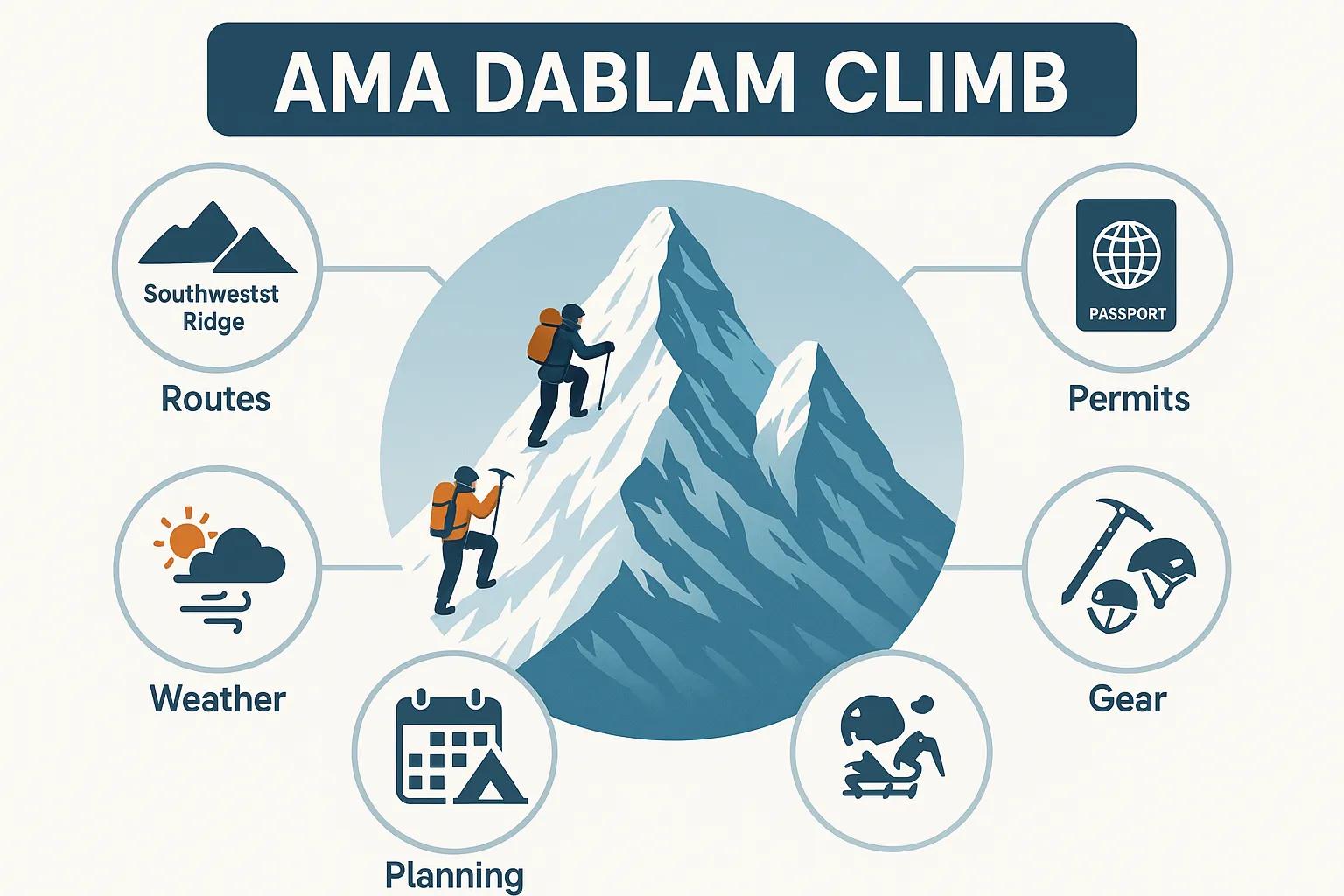
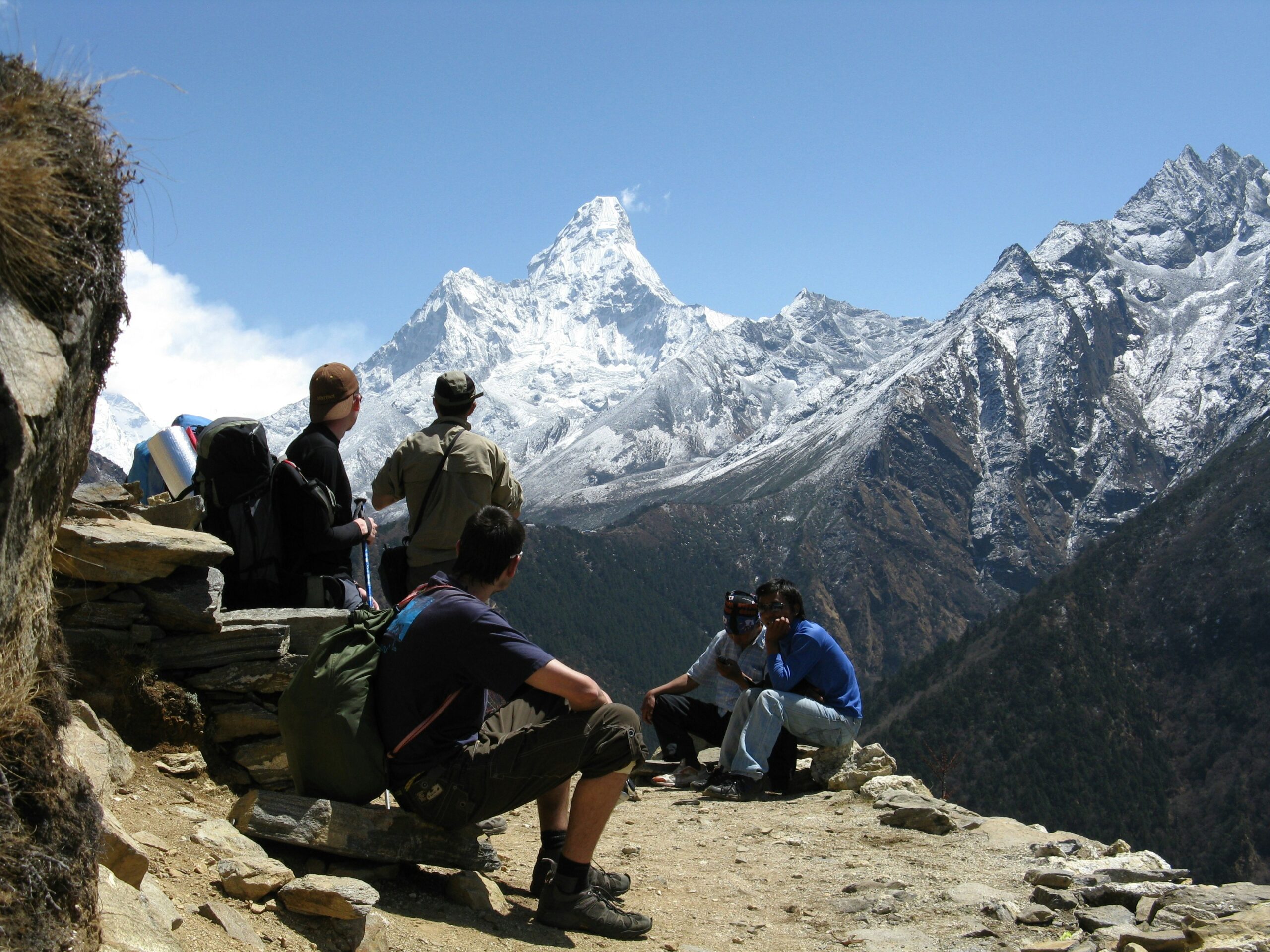
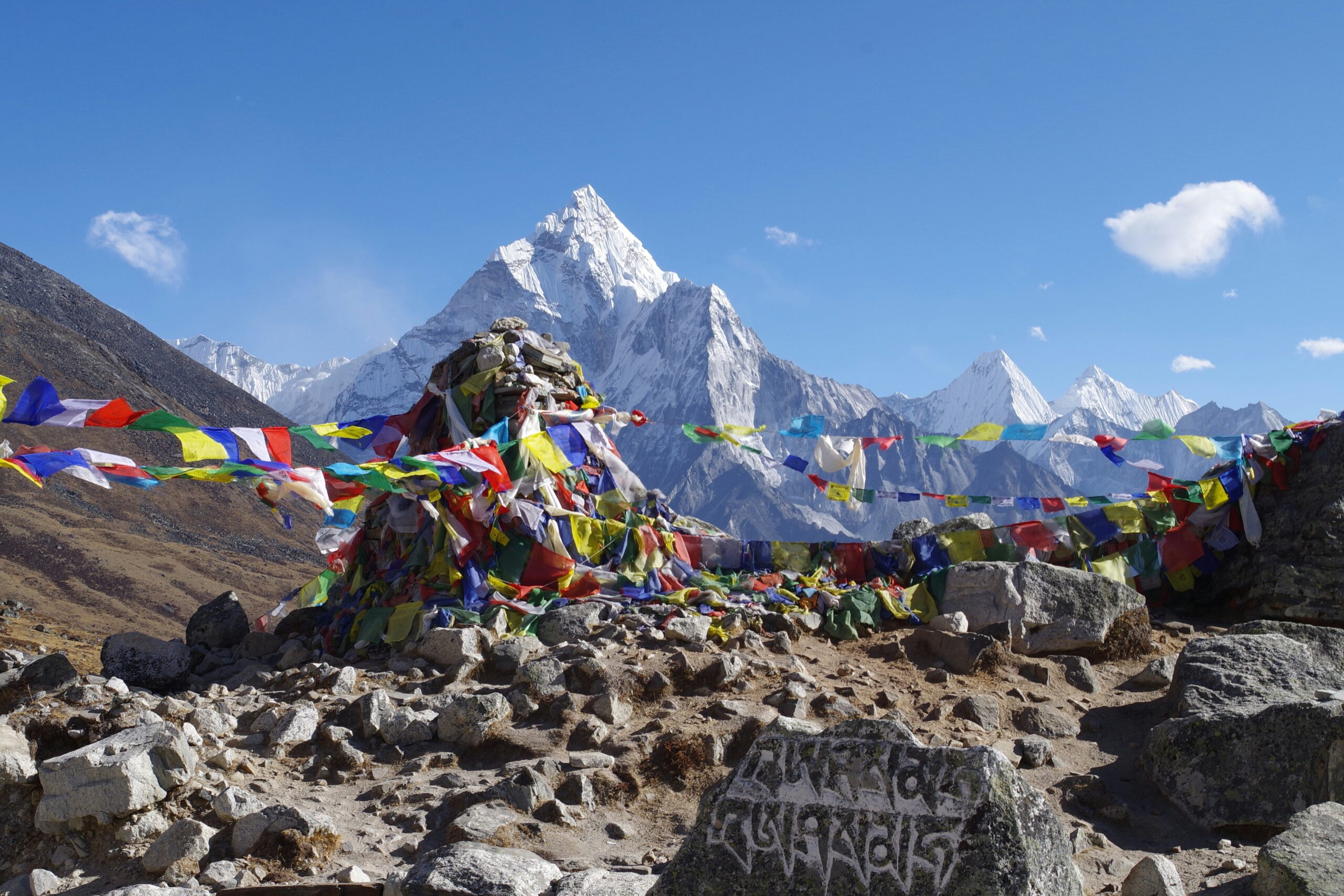
Was this helpful?
🏔Related peaks nearby
🧭Explore & compare
Global Summit Guide is an independent mountaineering resource founded in 2026. The team combines first-hand trekking and climbing experience with in-depth research and professional health and nutrition review to help climbers choose objectives, prepare properly, and stay safe.
Health, altitude, and nutrition content is reviewed by Taylor Ludlow (Registered Nurse) and Brigg Hoopes (Nutritionist).
What We Don't Know Yet
Mountain information changes quickly. This box explains the limits of what this page can responsibly promise.
- Permit availability, reservation windows, quotas, and official fee rules may change after this page is updated.
- Guide-company prices, departure dates, guide ratios, included services, and cancellation rules can change without notice.
- Route conditions, trailhead access, crevasse exposure, stream crossings, and rescue access may vary from published planning guidance.
- Total trip cost can change with flights, lodging, guide pricing, permits, gear rentals, transportation, and exchange rates.
- Fitness and altitude response vary by person; no guide, itinerary, or training plan can guarantee acclimatization or summit success.
Verify current conditions with official land managers, guide services, local forecasts, and current route reports before booking or climbing.
Mountaineering, rock and ice climbing, glacier travel, and high-altitude activity are inherently dangerous and can result in serious injury or death. The information on Global Summit Guide is provided for general informational and educational purposes only and is not a substitute for professional instruction, qualified guiding, proper equipment, or your own judgment and experience.
Route conditions, weather, snowpack, permits, regulations, and hazards change constantly and may differ from what is described here. Details may be incomplete, out of date, or contain errors. Always verify current information with local authorities, certified guides, and official sources before making any decision in the mountains.
Nothing on this site is medical, legal, or financial advice. Our fitness, acclimatization, altitude, and nutrition content is general in nature; consult a qualified physician before beginning any strenuous exercise program or exposing yourself to high altitude.
You are solely responsible for your own safety and decisions. To the fullest extent permitted by law, Global Summit Guide and its team accept no liability for any loss, injury, damage, or expense arising from use of, or reliance on, this information. By using this site you acknowledge these risks and accept these terms.
Some links on this site may be affiliate links. If you buy through them we may earn a small commission at no extra cost to you; this never affects our recommendations.
Global Summit Guide recommendation path
Next Best Mountain to Research
Use these recommendations to continue the right planning path instead of stopping on one page.
Use current permit, weather, route, and operator information before booking or climbing.
Search Flights, Hotels & Rental Cars
Have the mountain or destination picked? Use Expedia to compare the flights, lodging and rental cars that fit your actual trip dates. For mountain travel, consider arriving early enough for delays and adding a buffer night after the climb before a fixed flight home.
Compare current flight, hotel and car options.
Affiliate disclosure: Global Summit Guide may earn a commission if you book through this link, at no additional cost to you.