
Last updated September 7, 2026
Ama Dablam Weather & Best Climbing Season 2026: Complete Month-by-Month Guide (Autumn vs Spring)
The definitive 2026 Ama Dablam weather and climbing season guide for the iconic 6,812m / 22,349 ft Himalayan peak in Nepal’s Khumbu region. Complete month-by-month conditions, autumn October-November (400+ permits in 2025) vs spring April-May comparison, Himalayan jet stream analysis, summit wind chill (-30 to -40°C), weather hazards, professional expedition meteorologist services ($300-$600), and strategic summit window planning.
This Ama Dablam weather and best season guide synthesizes the most authoritative Himalayan climbing meteorology sources: Nepal Mountaineering Association (official Nepal authority on Himalayan climbing); Sagarmatha National Park (the park containing Ama Dablam); Karl Gabl (the legendary Austrian meteorologist whose Himalayan summit forecasts have been used by elite expeditions for decades); Meteogroup Mountain weather services; verified 2025 climbing season permit data showing 400+ autumn permits issued; published expedition reports from major Ama Dablam operators including Madison Mountaineering, Adventure Consultants, Imagine Nepal Trek and Expedition, and Climbing the Seven Summits.
Specifically, all monthly weather characterizations, jet stream behavior descriptions, temperature ranges, and operational details are cross-referenced against multiple sources. This page contains no affiliate revenue from any guide services, meteorologist services, or operators mentioned.
📚 Research-Based Content — Honest Framing
Ama Dablam itself is outside our editorial team’s direct climbing experience to date. This weather and season guide is built from authoritative published sources: Nepal Mountaineering Association data, Sagarmatha National Park operational records, Karl Gabl Himalayan meteorology reports, verified 2025 season permit data (400+ autumn permits), Meteogroup Mountain forecasts, and published Ama Dablam expedition company reports. Travis Ludlow has personally climbed Mount Kilimanjaro (5,895m altitude trekking experience) and Mount Rainier-class glaciated alpine peaks (technical alpine weather experience) — these inform our understanding of high-altitude weather principles and summit window decision-making, but Ama Dablam’s specific Himalayan technical environment is research-based, not first-hand. Generally, we believe this honest framing is more useful than pretending uniform expertise — Himalayan climbers should treat this as a research synthesis and supplement with current operator briefings.
⚡ The Verdict in One Sentence
October-November (autumn post-monsoon) is the best time to climb Ama Dablam by a wide margin — this is the primary climbing season when 400+ permits were issued in 2025, delivering the most reliable summit weather windows of the entire Himalayan calendar. Specifically, the autumn window combines: post-monsoon dry stable air, favorable Himalayan jet stream positioning (shifted north of the mountain), 3-5 multi-day summit windows in October, full commercial operator infrastructure, and historically higher success rates than the spring April-May secondary season.
The decision framework: If you want the highest probability of summit success and don’t mind crowds → autumn (October mid-to-late ideal). If you want fewer teams and longer days but accept compressed weather windows and lower success odds → spring (mid-to-late April ideal). Winter (December-March) is not realistically climbable; monsoon (June-September) eliminates all expedition activity. Professional expedition meteorologists ($300-$600) are standard practice and essential for summit window decisions.
Autumn (Oct-Nov)
Post-Monsoon · Dry · Stable
- Post-monsoon dry stable air
- Favorable jet stream positioning
- 3-5 multi-day summit windows in Oct
- 400+ permits issued (2025)
- Full operator infrastructure
- Higher historical success rates
- More crowded (bottlenecks possible)
- Cold increases through November
Spring (Apr-May)
Pre-Monsoon · Compressed Window
- Fewer teams (smaller crowds)
- Longer days, warming temps
- Pre-monsoon instability increases
- Compressed weather windows
- Lower success rates than autumn
- More personal summit experience
- Mid-to-late April best within season
- Window degrades fast as monsoon approaches
📑 On This Page
- When Is the Best Time to Climb Ama Dablam?
- Ama Dablam Weather Overview
- Autumn Primary Season Deep Dive
- Spring Secondary Season Deep Dive
- Month-by-Month Conditions
- The Himalayan Jet Stream
- Summit Window Analysis
- Weather Hazards Table
- Professional Expedition Meteorologist
- Daily Weather Routine on Expedition
- 2025 Season Lessons
- Temperature by Elevation
- Monsoon & Winter — Why You Can’t Climb
- Choosing Your Season
- FAQ
- Methodology + Sources
⚡ Quick Answer: Ama Dablam Weather & Season Essentials
Best time to climb? October-November (autumn post-monsoon). Why? Post-monsoon dry stable air, favorable jet stream, 3-5 summit windows per October. 2025 permit volume? 400+ in autumn vs ~100-150 in spring. Summit temperatures? -15°C to -25°C ambient, wind chill to -40°C. Jet stream? Year-round factor; worst Dec-Mar (sub-7,000m); favorable Oct-Nov (shifted north). Wind speeds? 100+ km/h when jet stream impacts summit; impossible to climb in such conditions.
Spring alternative? April-May (mid-late April best); fewer teams, compressed windows, lower success odds. Winter? Not realistically climbable (Dec-Mar). Monsoon? No climbing (June-Sept). Daily pattern? Morning clarity, afternoon cloud buildup — summit pushes start 10 PM-midnight from C3. Professional meteorologist? Standard practice; $300-$600 for expedition forecast; identifies summit windows. Expedition length? 20-30 days total including weather buffer.
Ama Dablam Weather and Best Climbing Season refers to the Himalayan meteorological patterns governing summit attempts on this iconic 6,812m (22,349 ft) technical peak in Nepal’s Khumbu region. Specifically, the climbing calendar is dominated by Nepal’s monsoon cycle (June-September) which eliminates all climbing activity, the Himalayan jet stream behavior (December-March winter establishment, October-November autumn favorable, April-May spring transitional), and the daily weather pattern of morning clarity transitioning to afternoon cloud buildup. Generally, two distinct climbing seasons exist: autumn (October-November) is the primary season when post-monsoon dry stable air combines with favorable jet stream positioning to deliver the most reliable summit windows of the year; spring (April-May) is the secondary season with fewer teams but compressed weather windows as pre-monsoon instability builds toward monsoon onset. Notably, 2025 saw 400+ foreign permits issued for the autumn season, confirming this is when the vast majority of climbers attempt Ama Dablam — winter and monsoon are not realistically climbable for commercial or independent expeditions. Specifically, summit-level weather at 6,812m must be tracked separately from valley weather in Lukla — professional expedition meteorologists providing altitude-specific forecasts are standard practice on this mountain.
Key Takeaways
- October-November is the primary season — 400+ permits in 2025
- April-May is the secondary season — fewer teams, compressed windows
- Winter (Dec-Mar) not realistically climbable
- Monsoon (Jun-Sep) eliminates all expedition activity
- Jet stream is the primary weather driver — winds 100+ km/h on summit
- Summit wind chill reaches -30°C to -40°C even on good days
- Daily pattern: morning clarity, afternoon cloud buildup
- Standard summit push begins 10 PM-midnight from Camp 3
- Professional meteorologist standard practice ($300-$600)
- Expedition length: 20-30 days with weather buffer
✓ Editorial Trust Signals
- Research-based: Ama Dablam outside team experience
- Primary source: Nepal Mountaineering Association
- Authority: Karl Gabl Himalayan meteorology
- Authority: Sagarmatha National Park
- 2025 data: 400+ permits verified
- WFA reviewed: Dawson Ludlow
- Honest framing: Disclosed throughout
- Last verified: June 15, 2026
When Is the Best Time to Climb Ama Dablam?
October-November (autumn post-monsoon) is the best time to climb Ama Dablam by a wide margin — this is the primary climbing season when 400+ permits were issued in 2025. Specifically, autumn delivers the most reliable summit weather windows of the entire Himalayan calendar.
The 7 Reasons Autumn Dominates
- Post-monsoon dry stable air — Nepal’s monsoon withdraws in late September, leaving exceptionally clear conditions.
- Favorable jet stream positioning — the Himalayan jet stream typically sits north of Ama Dablam during October, allowing summit attempts.
- Dry air — humidity drops dramatically post-monsoon, improving visibility and reducing cloud formation.
- Stable weather patterns — more predictable than pre-monsoon spring instability.
- Reliable summit windows — October typically delivers 3-5 multi-day weather windows in the month.
- Record permit volumes — 400+ permits issued in 2025 autumn confirm operator/climber confidence.
- Commercial infrastructure — rope-fixing teams, commercial operators, and base camp services are fully operational.
Mid-to-late October is the sweet spot for Ama Dablam summit attempts. Specifically, this 3-4 week window combines: maximum jet stream displacement north, stable post-monsoon patterns, manageable cold (vs late November), full operator presence, and the highest historical summit success rates. Generally, climbers target October 15-30 for their summit push window. Notably, the 2025 autumn fatalities occurred in late October, reminding climbers that even peak season demands constant weather monitoring and conservative decisions.
Ama Dablam Weather Overview
Ama Dablam’s weather is dominated by the Himalayan jet stream and shows two distinct climbing seasons separated by monsoon (June-September). Specifically, the year-round pattern:
| Period | Weather Character | Climbing Possible? |
|---|---|---|
| December-March | Deep winter; jet stream at summit altitude; sustained 100+ km/h winds; -40°C ambient | NO — not commercially climbable |
| April-May | Spring secondary season; pre-monsoon instability; compressed weather windows | YES — secondary season |
| June-September | Monsoon; heavy precipitation; snow on upper mountain; poor visibility | NO — no expedition activity |
| October-November | Autumn primary season; post-monsoon dry stable air; jet stream shifted north | YES — PRIMARY SEASON |
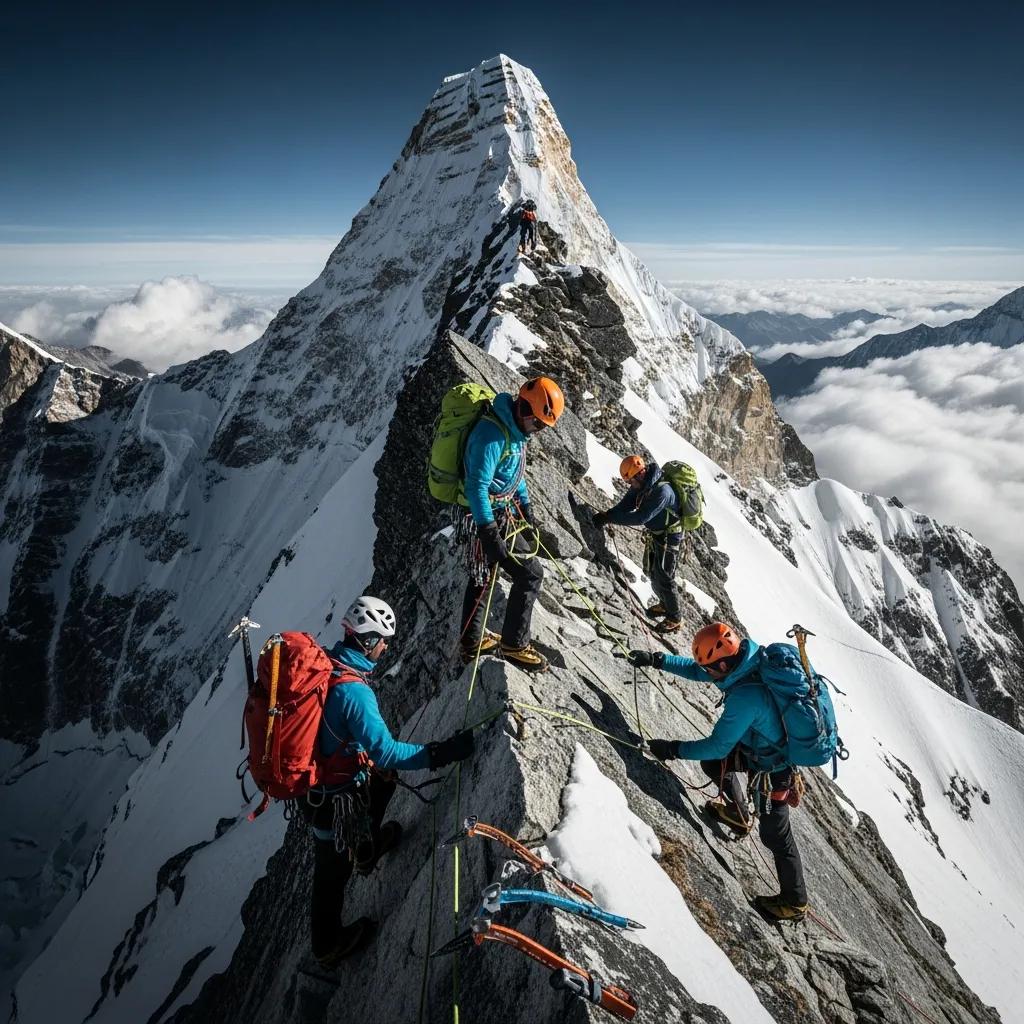
Daily weather on Ama Dablam during climbing seasons typically shows morning clarity with afternoon cloud buildup and spindrift. Specifically, the pattern: (1) MORNING CLARITY — 4 AM to roughly 10 AM offers the most stable summit conditions; (2) MIDDAY CLOUD BUILDUP — cumulus and convective clouds develop from late morning onward; (3) AFTERNOON SPINDRIFT — snow particles blow across the upper ridge from early afternoon; (4) EVENING CLEARING — conditions often improve after sunset. Generally, this pattern explains why standard summit pushes begin 10 PM-midnight from Camp 3 (6,400m) to summit by 8-10 AM and return to Camp 3 by early afternoon before standard deterioration. Notably, exceptions exist — extended high-pressure systems can deliver stable conditions throughout the day.
Autumn Primary Season Deep Dive (October-November)
Autumn is Ama Dablam’s dominant climbing season for multiple compounding reasons. Specifically, the autumn window from October 1 to roughly November 15 delivers the highest probability of summit success of any time of year.
What Makes October Special
| Factor | October Detail |
|---|---|
| Air mass | Post-monsoon continental high pressure dominates |
| Humidity | Drops sharply from monsoon levels — air becomes crystal clear |
| Jet stream | Positioned favorably north of the Himalayan crest |
| Weather windows | 3-5 multi-day windows of stable summit conditions typical |
| Temperatures (Camp 3, 6,400m) | -10°C to -20°C overnight |
| Summit temperatures | -15°C to -25°C ambient; -30°C wind chill possible |
| Visibility | Exceptional — Himalayan peaks visible 100+ km |
| Precipitation | Minimal — occasional brief snow showers |
| Permit volume | ~300+ permits issued (peak of autumn season) |
The Late November Trade-off
| Factor | November Detail |
|---|---|
| Temperatures | Significantly colder than October — summit drops to -25°C ambient |
| Wind | Increasing as winter jet stream begins establishing |
| Windows | 1-3 windows in early-to-mid month; degrades fast after mid-November |
| Crowds | Reduced from October peak |
| Permit volume | ~100+ permits typically issued in November |
| Late November cutoff | Most teams must summit by mid-month or face winter conditions |
| Risk | Higher cold injury risk; reduced rescue availability |
The late-October 2025 season included two foreign climber fatalities — one struck by falling ice while descending, one collapsed while climbing higher on the mountain. Specifically, these incidents underscore that even Ama Dablam’s reliable autumn season cannot eliminate the mountain’s objective hazards. Generally, climbers should not interpret autumn’s weather reliability as climbing safety guarantee — falling ice, descent fatigue, technical exposure, and altitude effects all remain serious throughout peak season. Notably, the strategic implication is that even climbers selecting the best season for weather must still execute conservatively on technical terrain.
Spring Secondary Season Deep Dive (April-May)
Spring is Ama Dablam’s secondary climbing season. Specifically, while fewer teams attempt the peak in spring, the conditions are real and viable for prepared climbers willing to accept the trade-offs.
What Spring Offers
| Factor | Spring (April-May) Detail |
|---|---|
| Team volume | ~100-150 permits — significantly fewer than autumn’s 400+ |
| Crowds | Substantially less crowded; fewer bottlenecks |
| Days | Longer daylight than autumn |
| Temperatures | Generally warmer than autumn (less extreme cold) |
| Best window | Mid-to-late April typically delivers best summit windows |
| Window duration | 1-3 day windows typical (shorter than autumn’s 2-5 day windows) |
| Pre-monsoon instability | Wind and cloud build earlier in the day than autumn |
| May trade-off | Window compresses rapidly as monsoon approaches |
| Visibility | Good but more variable than autumn |
Spring offers fewer crowds and longer days in exchange for compressed weather windows and lower success odds. Specifically, the calculus: (1) FEWER CROWDS — significant advantage on a mountain known for fixed-line bottlenecks; (2) LONGER DAYS — more flexibility for summit push timing; (3) WARMER TEMPERATURES — less extreme cold injury risk; (4) BUT SHORTER WINDOWS — 1-3 days vs autumn’s 2-5; (5) BUT LOWER SUCCESS — pre-monsoon instability reduces summit probability; (6) BUT RAPID DEGRADATION — May windows degrade fast as monsoon approaches. Generally, spring suits experienced parties who prioritize a quieter experience and have flexibility to wait or pivot. Notably, first-time Ama Dablam climbers generally choose autumn for the higher success odds.
Month-by-Month Conditions
Complete breakdown of climbing conditions throughout the year:
Deep Winter
Extreme cold, high winds, jet stream fully established at summit altitude. No expedition climbing. Upper mountain closed by wind and cold. Ambient temperatures at summit reach -35°C to -40°C; wind chill far worse.
Deep Winter Continues
Continued winter conditions. Jet stream remains on summit altitude. No commercial expedition activity. Some elite alpine-style winter ascents have been attempted but these are specialized achievements outside commercial climbing.
Transitional Month
Jet stream still active on upper mountain. Spring expeditions begin approach logistics but summit attempts are premature. Teams arriving for April windows begin the Lukla approach and acclimatization treks in late March.
Spring Window Opens
Jet stream shifting north. Summit windows increasingly available. Fewer teams than autumn. Pre-monsoon instability can create wind and cloud earlier in the day. Best spring summits typically occur mid-to-late April. Camp 2 and Camp 3 fully operational.
Compressing Window
Late spring with pre-monsoon instability increasing. Reliable windows become shorter and less frequent. Teams must be high on the mountain by early May to maximize success odds. Window degrades rapidly toward month’s end as monsoon onset approaches.
Monsoon Onset
Nepal monsoon begins. Heavy precipitation, snow accumulation on upper mountain, poor visibility, frequent storms. No technical climbing season. No expedition activity.
Peak Monsoon
Heaviest monsoon precipitation. Lukla flights frequently delayed or canceled. No climbing possible. Trekking routes in lower Khumbu remain active but technical climbing is impossible.
Continued Monsoon
Monsoon continues. Heavy rainfall in lower Khumbu, heavy snow above 5,000m. Rope-fixing teams begin preparation in late August for the autumn season but no actual climbing activity.
Transitional Late Monsoon
Monsoon withdraws through the month. Climbers begin trek approach late September for early October expeditions. Rope-fixing teams prepare to install fixed lines as conditions allow. Climbing not yet viable but preparation accelerates.
The Primary Climbing Window
Post-monsoon dry and stable. Best summit weather windows of the year. High permit volume — 400+ in 2025. Most teams target mid-to-late October summit dates. Rope-fixing teams complete fixed line installation by mid-October. 3-5 multi-day summit windows typical. The single best month to climb Ama Dablam.
Window Closing
Good conditions into early November. Cold and increasingly windy by late month as winter patterns establish. Teams targeting November summit must complete by mid-month. After November 15-20, winter conditions establish rapidly. Lower permit volume than October.
Season Ends
Winter establishing. Temperatures dropping sharply, jet stream re-establishing at summit altitude. No meaningful summit windows. Season ends. Commercial operators have closed; base camp services dismantled.
The Himalayan Jet Stream — Primary Weather Driver
The Himalayan jet stream is the single largest weather factor affecting Ama Dablam summit attempts — when it sits at or below 6,812m, winds can exceed 100 km/h, making climbing impossible and potentially fatal.
What the Jet Stream Is
The subtropical jet stream is a high-altitude wind belt that flows west-to-east across the Himalaya at approximately 9,000-12,000m altitude during summer. Specifically, the jet stream’s seasonal position is the primary determinant of which months allow Himalayan summit attempts.
Seasonal Jet Stream Position
| Season | Jet Stream Position | Ama Dablam Impact |
|---|---|---|
| December-March (Winter) | Descends to 5,500-6,000m | Sustained 100+ km/h winds at summit — impossible to climb |
| April-May (Spring) | Shifting north toward summer position | Variable; periodic summit windows as jet stream lifts |
| June-September (Summer/Monsoon) | Far north; monsoon dominates lower atmosphere | Climbing impossible due to monsoon — jet stream irrelevant |
| October-November (Autumn) | South-shifting from summer position | Favorable; jet stream typically north of summit allowing windows |
Visual Indicators the Jet Stream Is Active
| Sign | What It Means |
|---|---|
| Lenticular cloud over summit | High-altitude wind compressing moisture into cloud — strong upper-level winds |
| Powder plume visible from base camp | Snow being lifted off the summit by wind — direct visual confirmation of high winds |
| Forecast 60+ km/h at 6,000-7,000m | Jet stream impacting climbing altitude — NO-GO |
| Rapidly moving high cirrus | Upper-level jet activity even if surface is calm |
| “Banner cloud” off summit | Persistent cloud streaming from the summit indicates sustained high winds |
Do NOT attempt the summit when the jet stream is below 7,000m or when forecasts show 60+ km/h winds at 6,000-7,000m altitude. Specifically, the wind shear and exposure on the upper ridge become impossible to climb safely in such conditions. Generally, professional expedition meteorologists track jet stream position at 6,000-7,000m specifically to identify summit windows. Notably, the visual signs (lenticular cloud, powder plume, banner cloud) provide on-mountain confirmation of forecast conditions — even without forecasts, these signs are unambiguous NO-GO indicators.
Summit Window Analysis
Ama Dablam’s climbing windows are short — typically 2-5 days of stable summit conditions per multi-day weather window. Specifically, the window analysis:
Daily Summit Push Window
| Time | Activity | Conditions Target |
|---|---|---|
| 10 PM (previous day) | Begin summit push from Camp 3 (6,400m) | Clear sky; minimal wind; cold but manageable |
| 2 AM | Climbing through Mushroom Ridge | Cold (-20°C+); stable conditions essential |
| 6-8 AM | Approaching summit | Morning clarity peak; lowest wind of day typically |
| 8-10 AM | Summit (6,812m) | Target window for summit |
| 10 AM – 2 PM | Descending to Camp 3 | Conditions may deteriorate; spindrift develops |
| 2-6 PM | Camp 3 rest or further descent | Afternoon weather pattern unstable |
Multi-Day Weather Window Frequency
| Period | Typical Window Frequency | Window Duration |
|---|---|---|
| October (peak) | 3-5 windows per month | 2-5 days each |
| Early November | 1-3 windows | 2-4 days each |
| Late November | 0-2 windows | 1-3 days each (degrading) |
| April (spring peak) | 2-3 windows | 1-3 days each |
| Early May | 1-2 windows | 1-3 days each |
| Late May | 0-1 windows | 1-2 days each (degrading) |
Weather Hazards Table
| Weather Hazard | Season | Signs | Response |
|---|---|---|---|
| Jet Stream Wind | Year-round; worst Dec-Mar | Lenticular cloud over summit; powder plume from BC; forecast 60+ km/h at 6,000-7,000m | NO summit attempts when jet stream is below 7,000m; wait for calm window |
| Extreme Cold | Oct-Nov summit season | Wind chill below -30°C on upper mountain; extremity numbness | -40°C-rated sleeping system; full layering; turn around if extremity sensation lost |
| Afternoon Spindrift | Any season — most afternoons | Cloud building from late morning; spindrift on upper ridge | Standard summit push begins 10 PM-midnight from C3 to summit before afternoon deterioration |
| New Snow on Route | Any month — after storm | Fresh snow on fixed lines; avalanche risk; buried anchors | Wait 24-48 hours after significant snowfall before committing to upper mountain |
| Falling Ice | Year-round; worst during freeze-thaw | Ice debris on glacier; visible ice fall during day | Move quickly through exposed zones; helmet always required; particularly cautious during descent |
| Whiteout | Storm conditions any season | Visibility under 50m; no horizon reference | Stay in place; do not navigate technical terrain in whiteout |
| Electrical Storm | Pre-monsoon May; brief October events | Building thunderheads; static charge; thunder audible | Descend immediately from exposed terrain; do not climb metal-rich fixed lines during electrical activity |
Using a Professional Expedition Meteorologist
Using a professional expedition meteorologist is standard practice on Ama Dablam, costing $300-$600 for full expedition forecast service. Specifically, this is considered the highest-ROI investment in your expedition budget.
What Professional Meteorologists Provide
| Service | What You Get |
|---|---|
| Daily summit-level forecasts | Specifically calibrated for 6,812m altitude (not Lukla valley weather) |
| Jet stream tracking | Position monitoring at 6,000-7,000m with 3-7 day forecast horizon |
| Wind speed predictions | Layered forecasts for camp altitudes (BC, C1, C2, C3, summit) |
| Summit window identification | Specific calls on multi-day weather windows for summit pushes |
| Personalized briefings | Direct communication with expedition leaders during summit push phase |
| Temperature forecasts | Camp-specific ambient and wind chill predictions |
| Precipitation timing | When snow/rain will arrive and clear |
Major Services
| Service | Notes | Cost Range |
|---|---|---|
| Karl Gabl | Legendary Austrian Himalayan meteorologist; decades of summit window calls for elite expeditions | $400-$600 expedition |
| Meteogroup Mountain | UK-based specialized mountain forecasting service | $300-$500 expedition |
| Mountain-Forecast.com | Free public altitude-specific forecasts; useful baseline but less personalized | Free |
| Operator-included | Most commercial operators include meteorologist service in expedition pricing | Included |
On a mountain where the wrong call means exposure to 100+ km/h wind at 6,800m, $300-$600 for professional meteorology is the highest-ROI expedition expense. Specifically, the comparison: total expedition cost is $12,000-$25,000 — meteorologist service is 2-3% of that budget but informs the single most important go/no-go decision of the entire trip. Generally, climbers who skip meteorologist service rely on generic mountain forecasts that lack altitude-specific resolution for technical 6,000m+ peaks. Notably, commercial expeditions almost always include this service; solo or DIY climbers should specifically budget for it.
Daily Weather Routine on Expedition
Throughout the 20-30 day expedition, climbers follow a daily weather monitoring routine. Specifically, the typical daily pattern:
- 5-6 AM: Check overnight temperatures and morning sky conditions; observe any banner clouds or lenticular formations on Ama Dablam.
- 7 AM: Receive meteorologist morning briefing via satellite or radio; review 48-72 hour forecast trajectory.
- Mid-morning: Discuss the day’s climbing plan based on conditions; verify wind speed forecasts at climbing altitudes.
- Climbing day: Continuous observation while moving; lookout for changing cloud patterns, building thunderheads, increasing wind.
- Camp 3 days: Particular attention to summit-altitude forecasts; check jet stream position at 6,000-7,000m altitude.
- Summit push decision: Made 24-48 hours before push based on multi-day forecast stability.
- Evening: Updated forecast review; check tomorrow’s weather window status.
2025 Season Lessons
The 2025 Ama Dablam climbing seasons (spring April-May and autumn October-November) provided important lessons about weather, summit windows, and the mountain’s enduring seriousness.
2025 Spring Season Highlights
| Aspect | Detail |
|---|---|
| Rope-fixing | Sherpa team opened the South West Ridge route on April 2, 2025 |
| Snowy Horizon expedition | April 26, 2025 — 15-member team, 7 summit successes (47%); descent challenges noted |
| 14 Summits expedition | May 4, 2025 — 15-member team, only 2 summit successes (13%); selective conditions |
| Key lesson | Even strong well-supported teams faced selective summit outcomes; mountain rewards conservative decision-making |
2025 Autumn Season Highlights
| Aspect | Detail |
|---|---|
| Permit volume | 400+ foreign permits — confirming autumn as the dominant season |
| Rope-fixing | Sherpa rope-fixing team topped out in mid-October establishing the season |
| Commercial wave | Commercial climbers followed soon after, creating high traffic on fixed ropes |
| Late-October fatalities | October 27, 2025 — two foreign climbers died in separate incidents (falling ice + medical collapse) |
| Key lesson | Popularity and fixed ropes do not reduce technical seriousness; descent demands as much respect as summit push |
The 2025 season reinforced that even Ama Dablam’s reliable autumn weather window cannot eliminate the mountain’s objective hazards. Specifically: (1) FIXED ROPES do not make this a casual peak — the route still demands technical skill, exposure tolerance, and clean systems; (2) THE DESCENT deserves as much respect as the summit push — fatigue, rappels, traverses, and changing conditions can make the way down the most dangerous part; (3) AUTUMN IS NOT AUTOMATICALLY SAFE — popularity can make the mountain feel routine when it is anything but routine; (4) WEATHER AND CONDITIONS CAN CHANGE — frozen ropes, hard blue ice, fresh snow, and high winds all change movement speed; (5) TURNAROUND DISCIPLINE — Ama Dablam rewards climbers willing to sacrifice a summit rather than force movement on a mountain that rarely forgives bad decisions.
Temperature by Elevation
Temperatures vary dramatically by altitude on Ama Dablam. Specifically, climbers progress through significant temperature gradients during the climb:
| Location | Elevation | Autumn Temp Range (Oct-Nov) | Wind Chill Potential |
|---|---|---|---|
| Lukla | 2,860m / 9,383 ft | 5°C to -5°C overnight | Modest |
| Namche Bazaar | 3,440m / 11,286 ft | 2°C to -8°C overnight | Modest |
| Tengboche | 3,860m / 12,664 ft | 0°C to -10°C overnight | Increasing |
| Base Camp | 4,570m / 15,000 ft | 5°C to -10°C overnight | Significant |
| Camp 1 | 5,800m / 19,029 ft | 0°C to -10°C | Severe potential |
| Camp 2 | 5,950m / 19,521 ft | -5°C to -15°C | Severe |
| Camp 3 | 6,400m / 21,000 ft | -10°C to -20°C | -30°C+ possible |
| Summit | 6,812m / 22,349 ft | -15°C to -25°C ambient | -30°C to -40°C with wind |
Monsoon & Winter — Why You Can’t Climb
Monsoon (June-September)
Nepal’s monsoon brings heavy precipitation, snow accumulation on the upper mountain, persistent poor visibility, and frequent storms throughout June, July, August, and into September. Specifically: (1) Lukla flights are frequently delayed or canceled due to weather; (2) trekking routes in lower Khumbu become slippery and muddy; (3) snow accumulation above 5,000m makes technical climbing impractical; (4) leech activity in lower elevations creates additional discomfort; (5) no commercial operators run monsoon expeditions. Generally, monsoon eliminates all expedition climbing activity on Ama Dablam.
Winter (December-March)
Winter is technically the off-season but represents conditions that are not practical for commercial climbing. Specifically: (1) the Himalayan jet stream descends to summit altitude with sustained 100+ km/h winds; (2) ambient summit temperatures reach -40°C with wind chill to -60°C+; (3) no rope-fixing teams operate; fixed lines are not maintained; (4) commercial operators do not offer winter expeditions; (5) base camp services do not run. Generally, Ama Dablam has been climbed in winter as exceptional alpine-style expeditions by elite climbers, but these are specialist achievements outside commercial possibilities. Notably, no climbers should consider winter Ama Dablam without elite Himalayan winter experience.
Choosing Your Season — Decision Framework
(1) This is your first Ama Dablam attempt. (2) You prioritize summit success over solitude. (3) You can accept higher crowds and fixed-line bottlenecks. (4) You have flexibility for a 20-30 day expedition timeline. (5) You want full commercial operator infrastructure. (6) You can tolerate cold (-30°C+ wind chill on upper mountain). (7) You want the highest probability of summit windows. This is the default recommendation for most climbers.
(1) You’ve climbed Ama Dablam before via autumn. (2) You prioritize solitude and a quieter climbing experience. (3) You accept lower summit success odds for fewer crowds. (4) You want longer days and warmer temperatures. (5) You have flexibility to wait for compressed windows. (6) You’re an experienced Himalayan climber. (7) You want a different angle on the same peak. The aesthetic choice for experienced climbers.
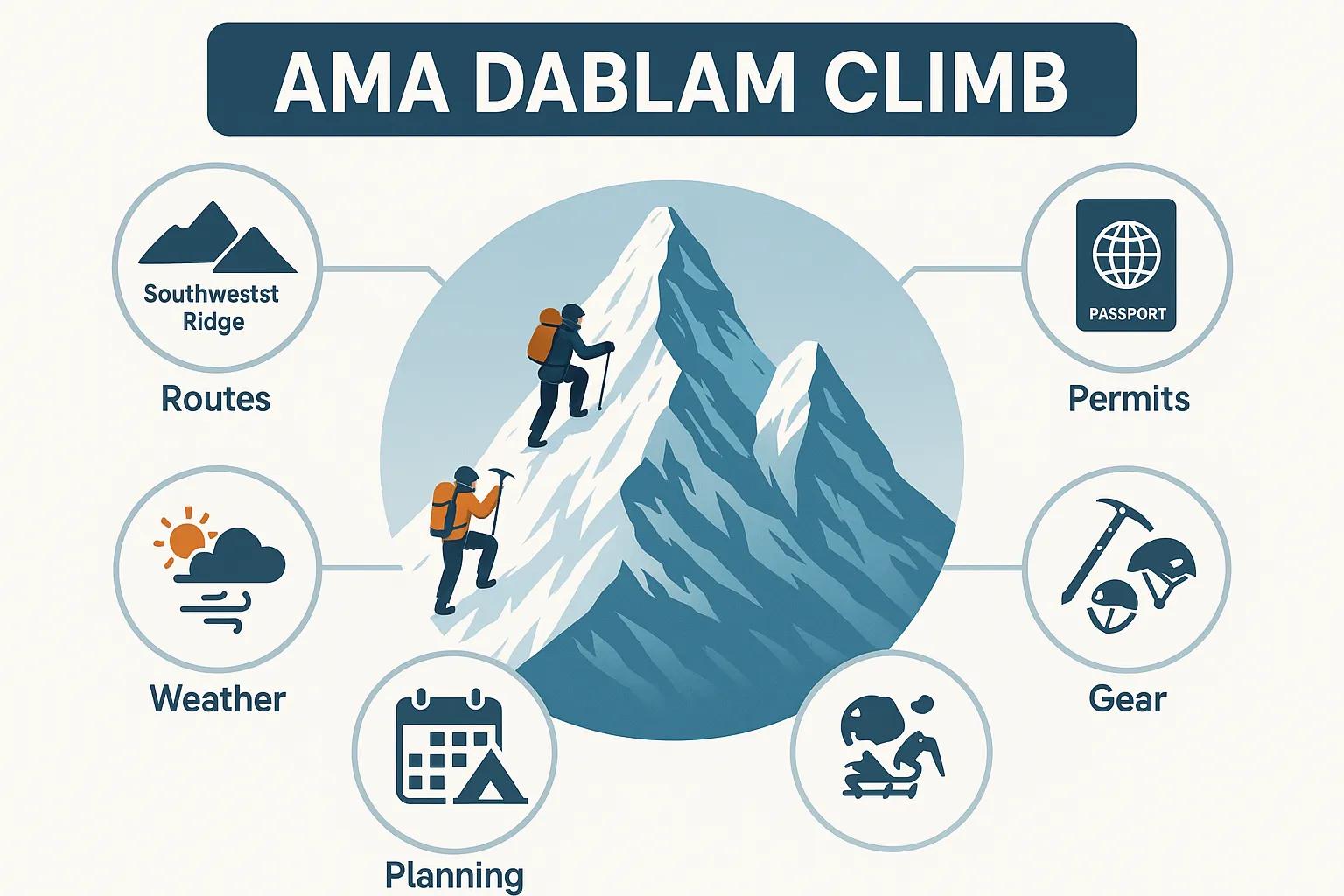
Frequently Asked Questions: Ama Dablam Weather & Season
When is the best time to climb Ama Dablam?
October-November (autumn post-monsoon) is the best time to climb Ama Dablam by a wide margin — this is the primary climbing season when 400+ permits were issued in 2025. Autumn benefits include: post-monsoon dry stable air; favorable jet stream positioning (shifted north of the mountain); 3-5 multi-day summit windows in October; full commercial operator infrastructure; historically higher success rates than the spring April-May secondary season. Mid-to-late October typically delivers the best summit windows. April-May is the secondary season but the window is more compressed with pre-monsoon instability creating wind and cloud. The 2025 autumn season saw 400+ foreign permits issued, confirming this is when the vast majority of climbers attempt Ama Dablam.
What is the weather like on Ama Dablam?
Ama Dablam’s weather is dominated by the Himalayan jet stream and shows two distinct climbing seasons separated by monsoon (June-September). AUTUMN PEAK SEASON (October-November): dry, stable post-monsoon air with summit temperatures of -15°C to -25°C ambient, wind chill to -30°C to -40°C in worst case. WINTER (December-March): jet stream fully established with winds exceeding 100 km/h; no expedition climbing. SPRING SECONDARY SEASON (April-May): summit windows open but pre-monsoon instability creates wind and cloud. MONSOON (June-September): heavy precipitation, snow on upper mountain, poor visibility; no climbing activity. Summit-level conditions at 6,812m are very different from valley weather in Lukla — climbers must use altitude-specific forecasts. The daily pattern during climbing seasons typically shows morning clarity with afternoon cloud buildup and spindrift.
Why is October-November the best season for Ama Dablam?
October-November is Ama Dablam’s best season because it delivers the most reliable summit weather windows of the entire Himalayan calendar — combining post-monsoon clarity, favorable jet stream positioning, and stable conditions. Seven reasons autumn dominates: (1) POST-MONSOON CLARITY — Nepal’s monsoon withdraws in late September leaving exceptionally clear conditions; (2) FAVORABLE JET STREAM — the Himalayan jet stream typically sits favorably north of Ama Dablam during October; (3) DRY AIR — humidity drops dramatically post-monsoon improving visibility; (4) STABLE PATTERNS — weather systems are more predictable than pre-monsoon spring; (5) RELIABLE WINDOWS — October typically delivers 3-5 multi-day summit windows in the month; (6) RECORD PERMIT VOLUMES — 400+ permits in 2025 autumn confirm climber confidence; (7) COMMERCIAL INFRASTRUCTURE — rope-fixing teams and commercial operators fully operational. November shifts toward colder conditions but maintains reasonable windows through mid-month before winter patterns establish. Climbers targeting October have approximately 2-3x better success odds than spring attempts.
How cold does Ama Dablam get during climbing season?
Ama Dablam summit temperatures during the October-November climbing season range from -15°C to -25°C ambient, with effective wind chill reaching -30°C to -40°C even on good weather days. Temperature gradient by elevation: Base Camp (4,570m) typically 5°C to -5°C overnight; Camp 1 (5,800m) 0°C to -10°C; Camp 2 (5,950m) -5°C to -15°C; Camp 3 (6,400m) -10°C to -20°C; Summit (6,812m) -15°C to -25°C ambient; With wind, even moderate winds (20-40 km/h) push wind chill to -30°C to -40°C on the upper mountain. This is cold that kills inadequately dressed climbers within hours. Climbers MUST use full expedition layering systems with -40°C-rated sleeping bags, double-layer insulated mittens, double mountaineering boots, and full down suit for summit push. Climbers experiencing loss of extremity sensation must turn around.
What is the Himalayan jet stream and how does it affect Ama Dablam?
The Himalayan jet stream is the single largest weather factor affecting Ama Dablam summit attempts — when it sits at or below 6,812m, winds can exceed 100 km/h making climbing impossible and potentially fatal. The subtropical jet stream is a high-altitude wind belt that flows west-to-east across the Himalaya at approximately 9,000-12,000m altitude. SEASONAL POSITION: during winter (December-March) the jet stream descends to lower altitudes, sometimes reaching 5,500-6,000m on Himalayan peaks; during summer monsoon (June-September) it shifts far north. IMPACT ON AMA DABLAM: at 6,812m, Ama Dablam is in the jet stream’s striking range during winter months and the shoulder seasons. WIND SPEEDS: when the jet stream impacts the summit, sustained winds of 60-100+ km/h with gusts to 150+ km/h are common. MONITORING: professional expedition meteorologists track jet stream position at 6,000-7,000m specifically to identify summit windows. DECISION RULE: climbers should NOT attempt the summit when forecast shows 60+ km/h winds at 6,000-7,000m altitude.
How long does the climbing window last on Ama Dablam?
Ama Dablam’s climbing windows are short — typically 2-5 days of stable summit conditions per multi-day weather window, with 3-5 such windows during the October peak season and fewer during November and spring. DAILY WINDOWS: standard summit pushes begin 10 PM-midnight from Camp 3 and aim to summit by 8-10 AM, descending to Camp 3 by early afternoon before standard afternoon weather deterioration. MULTI-DAY WINDOWS: typical autumn weather windows last 2-5 days with stable conditions. OCTOBER FREQUENCY: peak season typically delivers 3-5 multi-day summit windows in October. NOVEMBER FREQUENCY: 1-3 windows in early-to-mid November before winter establishes. SPRING WINDOWS: April-May delivers fewer, shorter windows due to pre-monsoon instability. The expedition timeline of 20-30 days includes weather buffer for waiting on summit windows. Missing a window can mean waiting 5-10 days for the next one.
Do I need a professional weather forecaster for Ama Dablam?
Yes — using a professional expedition meteorologist is standard practice on Ama Dablam, costing $300-$600 for full expedition forecast service and considered the highest-ROI investment in your expedition budget. WHAT THEY PROVIDE: daily summit-level forecasts at 6,812m altitude (not Lukla valley weather), jet stream position tracking at 6,000-7,000m, wind speed predictions, summit window identification, and personalized briefings during summit push phase. MAJOR SERVICES: Meteogroup Mountain (UK-based), Karl Gabl (legendary Austrian Himalayan meteorologist), and other specialized expedition forecasters. COST: typically $300-$600 for full expedition forecast service spanning the 20-30 day expedition. WHY IT MATTERS: generic mountain weather sites lack the altitude-specific resolution needed for technical 6,000m+ peaks; the difference between “breezy” and “80 km/h” at the summit is the difference between life and death. Commercial expeditions almost always include meteorologist service in their pricing — solo or DIY climbers should specifically budget for this service.
What weather hazards are most dangerous on Ama Dablam?
The four most dangerous weather hazards on Ama Dablam are: jet stream winds, extreme cold, afternoon spindrift, and fresh snow on the route. JET STREAM WINDS: year-round but worst December-March; signs include lenticular cloud over summit, powder plume visible from base camp, and forecasts showing 60+ km/h at 6,000-7,000m; response is to NOT attempt summit when jet stream is below 7,000m. EXTREME COLD: primarily October-November summit season; wind chill below -30°C on upper mountain causes extremity numbness within minutes; response requires -40°C-rated sleeping system, full layering, and immediate turnaround if extremity sensation is lost. AFTERNOON SPINDRIFT: any season but most afternoons; cloud builds from late morning, spindrift develops on upper ridge; response is the standard summit push timing of 10 PM-midnight start from Camp 3. NEW SNOW ON ROUTE: any month after storms; signs include fresh snow on fixed lines, avalanche risk, buried anchors; response is to wait 24-48 hours after significant snowfall. Even autumn season requires constant weather monitoring and conservative decision-making.
Can you climb Ama Dablam in winter?
No — winter climbing of Ama Dablam (December-March) is not realistically practiced and is not offered by commercial operators due to extreme conditions. JET STREAM POSITION: winter brings the jet stream down to summit altitude with sustained 100+ km/h winds. TEMPERATURES: ambient winter summit temperatures reach -40°C with wind chill to -60°C. NO INFRASTRUCTURE: rope-fixing teams do not operate, fixed lines are not maintained, base camp services do not run. COMMERCIAL UNAVAILABILITY: no commercial operators run Ama Dablam winter expeditions. WINTER FIRST ASCENTS: Ama Dablam has been climbed in winter as exceptional alpine-style expeditions by elite climbers, but these are rare specialist achievements not commercial possibilities. PERMIT AVAILABILITY: technically possible to obtain winter permits but no operator support means logistics are extremely difficult. Even very experienced climbers should not consider winter Ama Dablam without specialist expedition planning and elite-level Himalayan winter experience. The closest “shoulder season” alternative for climbers seeking less crowded conditions is late November, but this requires accepting cold and increasing wind risk.
What is autumn vs spring like on Ama Dablam?
Autumn (October-November) and spring (April-May) are the two climbing seasons on Ama Dablam, with autumn being dramatically more popular and reliable. AUTUMN ADVANTAGES: post-monsoon dry stable air; favorable jet stream positioning; 3-5 reliable summit windows in October; 400+ permits issued (2025); higher historical success rates; full commercial operator infrastructure; predictable patterns. AUTUMN DISADVANTAGES: significantly more crowded; competition for camp space; bottlenecks at fixed lines; cold increases through November. SPRING ADVANTAGES: fewer teams (smaller crowds); potentially more personal summit experience; longer days; warming temperatures (less extreme cold). SPRING DISADVANTAGES: pre-monsoon instability creates wind and cloud earlier than autumn; compressed weather windows; fewer summit attempts; lower historical success rates; weather can become unsuitable faster as monsoon approaches. PERMIT VOLUMES: autumn 2025 saw 400+ permits; spring typically sees 100-150 permits. Climbers prioritizing summit success choose autumn; climbers prioritizing solitude choose spring. Professional guide companies recommend autumn for first-time Ama Dablam climbers.
Methodology and Editorial Standards
How This Weather Guide Was Built
1. Research-Based Approach (Honest Framing)
Ama Dablam is outside our editorial team’s direct climbing experience to date. This weather and best season guide is built from authoritative published sources rather than first-hand experience. Travis Ludlow has personally climbed Mount Kilimanjaro (5,895m altitude trekking experience) and Mount Rainier-class glaciated alpine peaks (technical alpine weather experience) — these inform our understanding of high-altitude weather principles and summit window decision-making, but Ama Dablam’s specific Himalayan technical environment is research-based. We believe this honest framing is more useful than pretending uniform expertise.
2. Authoritative Sources
Primary sources: Nepal Mountaineering Association (official Nepal authority on Himalayan climbing); Sagarmatha National Park (containing Ama Dablam); Karl Gabl Himalayan meteorology reports; Meteogroup Mountain weather services; verified 2025 climbing season permit data showing 400+ autumn permits issued; published expedition reports from major Ama Dablam operators including Madison Mountaineering, Adventure Consultants, Imagine Nepal Trek and Expedition, Climbing the Seven Summits, and Alpine Ascents International; Mountain-Forecast.com altitude-specific Ama Dablam data; American Alpine Club accident reports.
3. 2026 Verification
All seasonal patterns, permit fee structures, operator pricing, and current operational details verified June 2026. The 2025 autumn season saw 400+ permits issued (verified figure). The late-October 2025 fatalities (October 27, 2025) are incorporated as recent context for the mountain’s enduring seriousness.
4. Editorial Independence
No affiliate partnerships with guide services, meteorologist services, gear brands, or operators influence this comparison. GSG does not earn commission from any bookings or referrals. Revenue is via Google AdSense display ads only.
5. Update Cycle
Updated annually following each climbing season. Next scheduled review: November 2026 (post-autumn season).
Sources and References
Numbered Source References
- Nepal Mountaineering Association · nepalmountaineering.org — Official Nepal mountaineering organization with climbing guidance and rules.
- Sagarmatha National Park — Ama Dablam · snp.gov.np — Official park page confirming Ama Dablam’s location and basic mountain context.
- Nepal Tourism Board — Trekking in Nepal · ntb.gov.np — Official travel-planning resource for Nepal’s trekking regions.
- Karl Gabl Meteorology — Legendary Austrian Himalayan meteorologist providing summit forecasts to elite expeditions for decades.
- Meteogroup Mountain — Specialized mountain weather forecasting service used by professional expeditions.
- Mountain-Forecast.com — Free altitude-specific forecasts for Ama Dablam at 6,812m.
- Madison Mountaineering — Premium Ama Dablam operator with published expedition reports.
- Adventure Consultants — International guiding company with Ama Dablam programs.
- Imagine Nepal Trek and Expedition — Nepal-based operator running Ama Dablam expeditions.
- American Alpine Club Publications · publications.americanalpineclub.org — AAC accident reports.
Methodology note. Annual review cycle — next review November 2026. Permit fees, operator pricing, and meteorologist services may change. Always verify current rates and consult professional expedition meteorologists for summit window decisions.
About the Author
Continue Your Ama Dablam Research
Plan Your Ama Dablam Expedition
Ama Dablam’s weather and season choice is the single most important planning decision affecting your summit odds. Generally, the keys to a successful Ama Dablam climb: (1) Choose autumn (October-November) for best summit windows and reliable conditions; (2) Budget $300-$600 for professional expedition meteorologist service; (3) Plan a 20-30 day expedition with weather buffer built in; (4) Target mid-to-late October for the prime weather window; (5) Be prepared to wait for meteorologist-identified summit windows. Specifically, climbers who optimize their season choice and weather monitoring dramatically improve summit success odds.
Ama Dablam Climb Guide →Mountain Weather Skills →Ama Dablam: Season, Route & the Nepal Ladder
Weather is one piece of an Ama Dablam climb. See the full guide and the Nepal trekking-peak progression below.
Was this helpful?
🏔Related conditions
🧭Explore & compare
Global Summit Guide is an independent mountaineering resource founded in 2026. The team combines first-hand trekking and climbing experience with in-depth research and professional health and nutrition review to help climbers choose objectives, prepare properly, and stay safe.
Health, altitude, and nutrition content is reviewed by Taylor Ludlow (Registered Nurse) and Brigg Hoopes (Nutritionist).
What We Don't Know Yet
Mountain information changes quickly. This box explains the limits of what this page can responsibly promise.
- Permit availability, reservation windows, quotas, and official fee rules may change after this page is updated.
- Guide-company prices, departure dates, guide ratios, included services, and cancellation rules can change without notice.
- Weather, snowpack, avalanche risk, road access, and route conditions can change quickly and may be different on your climbing dates.
- Route conditions, trailhead access, crevasse exposure, stream crossings, and rescue access may vary from published planning guidance.
- Fitness and altitude response vary by person; no guide, itinerary, or training plan can guarantee acclimatization or summit success.
Verify current conditions with official land managers, guide services, local forecasts, and current route reports before booking or climbing.
Mountaineering, rock and ice climbing, glacier travel, and high-altitude activity are inherently dangerous and can result in serious injury or death. The information on Global Summit Guide is provided for general informational and educational purposes only and is not a substitute for professional instruction, qualified guiding, proper equipment, or your own judgment and experience.
Route conditions, weather, snowpack, permits, regulations, and hazards change constantly and may differ from what is described here. Details may be incomplete, out of date, or contain errors. Always verify current information with local authorities, certified guides, and official sources before making any decision in the mountains.
Nothing on this site is medical, legal, or financial advice. Our fitness, acclimatization, altitude, and nutrition content is general in nature; consult a qualified physician before beginning any strenuous exercise program or exposing yourself to high altitude.
You are solely responsible for your own safety and decisions. To the fullest extent permitted by law, Global Summit Guide and its team accept no liability for any loss, injury, damage, or expense arising from use of, or reliance on, this information. By using this site you acknowledge these risks and accept these terms.
Some links on this site may be affiliate links. If you buy through them we may earn a small commission at no extra cost to you; this never affects our recommendations.
Global Summit Guide recommendation path
Next Best Mountain to Research
Use these recommendations to continue the right planning path instead of stopping on one page.
Use current permit, weather, route, and operator information before booking or climbing.
Explore Travel Options for Your Destination
Once your mountain, dates and route are taking shape, compare flights, hotels and other travel options that fit the trip.
Affiliate link. We may earn a commission at no additional cost to you.