
Last updated April 20, 2026
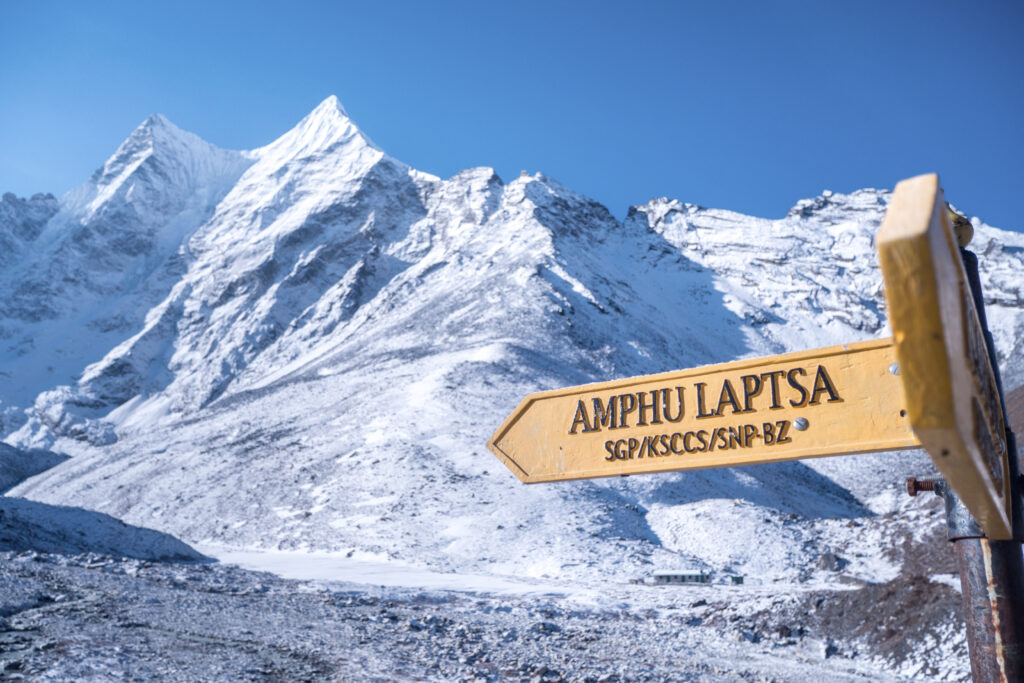
Climbing Pumori: Everest’s Daughter & the Classic 7,000m Khumbu Peak
At 7,161 meters (23,494 ft), Pumori — the “unmarried daughter” of the Sherpa language and widely called “Everest’s Daughter” — sits just 8.5 km west of Mount Everest in Nepal’s Khumbu region, straddling the Nepal-China (Tibet) border. Named by George Mallory during the 1921 British reconnaissance expedition, Pumori’s first ascent was accomplished on May 17, 1962 by German climber Gerhard Lenser, who summited solo after the rest of his German-Swiss expedition (led by Dr. Herbert Tichy) turned back from altitude sickness. Pumori is the ideal 7,000m preparation peak — less technical than Nuptse, accessible via Gorak Shep (5,164m), with a 1,000m summit wall of glacial blue ice on 50-70° slopes. The primary hazard is avalanche danger, not technical difficulty. In 2017, Pakistani mountaineer Muhammad Ali Sadpara completed the first winter ascent — a landmark before his tragic 2021 death on K2. Nepal’s September 2025 permit fee revision raised the 2026 DoT royalty for 7,001-7,500m peaks to approximately $1,250 per foreign climber for spring. Summit views include Everest, Lhotse, Makalu, and Cho Oyu — four 8,000m giants.
(23,494 ft)
Gerhard Lenser (solo)
1,000m blue ice wall
(spring, DoT)
Pumori Location & Base Camp Weather
Live 7-day forecast at Pumori Base Camp (5,300m) — just beyond Gorak Shep — plus interactive terrain map showing Pumori’s position 8.5 km west of Everest.
Pumori · Mahalangur Himal
28.01°N, 86.83°EBase Camp Weather
Elev: 5,300 m · Base CampPumori is the definitive 7,000m training peak for climbers progressing toward 8,000m Himalayan objectives. Named by George Mallory during the 1921 British reconnaissance, the peak’s first ascent came on May 17, 1962 by German climber Gerhard Lenser, who summited solo after his teammates turned back from altitude sickness. The standard Southeast Ridge route climbs from Base Camp (5,300m) through camps at 5,700m, 6,200m, and 6,500m to a 1,000m summit wall of glacial blue ice on 50-70° slopes. Pumori’s access is efficient — Gorak Shep (5,164m) provides wooden lodges, cafe, and helipad just a day from Base Camp. The 2017 first winter ascent by Muhammad Ali Sadpara remains the mountain’s most remarkable achievement. Total 2026 expedition cost runs $9,000-$25,000 for commercial programs.
Pumori’s reputation as less technical than Nuptse is accurate (Class 3 easiest route), but the mountain carries significant avalanche risk across all routes and seasons. The 1,000m summit wall of glacial blue ice produces serious avalanche and fall hazard. See the Avalanche Hazard section.
All 2026 figures verified against Nepal Department of Tourism and operators including Satori Adventures, 8K Expeditions, Seven Summit Treks, Swotah Travel, Skyline Treks, Peak Promotion Nepal, and Enepal Expedition. 1962 first ascent records from Dr. Herbert Tichy’s documentation. 1921 Mallory naming from Everest expedition archives. 2017 Sadpara winter ascent from Pakistani alpine journalism. 2025 permit fee changes verified against Sixth Amendment Mountaineering Regulations 2081. Fact-check: April 20, 2026.
Pumori at a Glance
Why Pumori Is the Ideal 7,000m Preparation Peak
1,000m Blue Ice Summit Wall
The final push is a 1,000-meter wall of glacial blue ice with sustained 50-70 degree slopes — hours of steep ice climbing at altitude without the extreme difficulty of Nuptse.
Class 3 With Avalanche Danger
The Southeast Ridge is graded Class 3 as the easiest technical line, but avalanche danger is the primary hazard — a combination typical of 7,000m peaks teaching climbers to respect objective risk.
Shared Everest Trek Approach
Pumori access uses Gorak Shep (5,164m) as the logistics base — wooden lodges, cafe, helipad less than a day from BC. Eliminates separate infrastructure that Nuptse or Everest require.
Mallory’s 1921 Naming Heritage
Named by George Mallory during the 1921 British reconnaissance — the first Europeans to see Lingtren, Pumori, and Nuptse. Links Pumori to the foundational era of Himalayan climbing.
Ali Sadpara’s 2017 Winter First
Muhammad Ali Sadpara’s 2017 first winter ascent remains the mountain’s most remarkable achievement — a landmark Pakistani feat before his tragic 2021 death on K2.
Ideal 8,000m Preparation
The definitive 7,000m training peak — genuine altitude, sustained ice climbing, expedition logistics closely mirror what climbers face on Cho Oyu, Manaslu, or Everest.
Rockfall on Steep Faces
Beyond avalanche, rockfall hazards occur during warming — particularly on the East Face (1986 Japanese route) and South Face (1996 Czech route). Helmets essential.
September 2025 Permit Hike
Nepal’s Sixth Amendment Mountaineering Regulations 2081 raised 7,001-7,500m peak fees to $1,250 spring / $625 autumn / $300 off-season — up from $500/$250/$125.
Who Can Realistically Climb Pumori?
Pumori requires genuine mountaineering experience but is more accessible than Nuptse or 8,000m peaks.
Minimum Experience Prerequisites
- Prior 6,000m+ experience (Island Peak, Lobuche East, Mera Peak, or Ama Dablam)
- Basic technical skills — comfort with 50-70° ice and snow
- Fixed-rope ascending and rappelling proficiency
- Crampon and ice axe skills on sustained slopes
- 30-day expedition endurance
- Cold weather expedition experience
- Altitude tolerance above 5,000m without HAPE/HACE
- Financial capacity $18,000-$35,000 total
Pumori Is Appropriate For
Climbers preparing for 8,000m peaks. The most common profile — climbers who completed Ama Dablam seeking 7,000m altitude experience before Cho Oyu or Everest.
Experienced mountaineers seeking accessible 7,000m. Pumori offers genuine 7,000m climbing without Nuptse’s technical demands.
Seven Summits climbers adding Himalayan experience. 30-35 day expedition shorter than most 8,000m projects.
Pumori Is NOT Appropriate For
First-time high-altitude climbers. Without 6,000m experience, unacceptable altitude risk.
Climbers unfamiliar with avalanche hazard. Objective rather than technical hazard demands experience.
Budget-constrained climbers. $18,000-$35,000 total commitment.
Typical progression: (1) 5,000m peaks like Kilimanjaro; (2) trekking peaks Island Peak, Lobuche East, Mera Peak; (3) technical 6,000m Ama Dablam; (4) Pumori as 7,000m altitude capstone; (5) 8,000m Cho Oyu or Manaslu. See our Seven Summits Path tool.
Pumori in the Khumbu Region & Mahalangur Himal
Pumori and the Mahalangur Himal
Pumori sits 8.5 km west of Everest in the Mahalangur Himal, straddling the Nepal-China border. From Pumori’s summit, climbers see Everest, Lhotse, Makalu, and Cho Oyu — four 8,000m giants on a clear day. Kala Patthar (5,643m), the famous EBC trek viewpoint, is technically an outlier of Pumori — a “big brown bump” below the south face. The Khumbu enables climbers to progress through trekking peaks → technical 6,000m → 7,000m training → 8,000m expeditions in the same valley.
Pumori History: From Mallory’s 1921 Naming to Sadpara’s 2017 Winter Ascent
1921: Mallory Names Pumori
The peak was named by George Mallory during the 1921 British Everest reconnaissance expedition. Mallory’s team were the first Europeans to see Lingtren, Pumori, and Nuptse — crucial mapping work enabling the 1953 Everest first ascent. In Sherpa, Pumo means young girl or daughter and Ri means mountain — “mountain daughter” or “unmarried daughter.” The nickname “Everest’s Daughter” became the peak’s popular identity.
May 17, 1962: Gerhard Lenser’s Solo First Ascent
First ascent by German climber Gerhard Lenser as part of a German-Swiss expedition led by Dr. Herbert Tichy. Lenser summited solo after teammates turned back from altitude sickness. The Southeast Ridge route remains the standard commercial line. Approximately 600 summits recorded since 1962.
December 3, 1986: Japanese East Face
Japanese climbers Yoshiki Sasahara and Hiroshi Aota completed an East Face alternate route on December 3, 1986 in 3 days — opening alternative climbing lines.
1996: Czech South Face
Czech climbers Leopold Sulovsky and Zdenek Michalec completed a new South Face route in 1996.
2017: Ali Sadpara’s First Winter Ascent
Muhammad Ali Sadpara, the legendary Pakistani mountaineer, completed the first winter ascent of Pumori in 2017 — a landmark achievement. Winter features -30 to -40°C, high winds, minimal weather windows. Sadpara’s resume included the 2016 first winter ascent of Nanga Parbat. He died in February 2021 during a K2 winter attempt. His Pumori winter ascent remains among the mountain’s most remarkable achievements.
September 1, 2025: Permit Fee Revision
Nepal’s Sixth Amendment Mountaineering Regulations 2081 raised Pumori permit fees to $1,250 spring / $625 autumn / $300 off-season — a 2.5x increase from $500/$250/$125.
Pumori Climbing Routes
| Route | Character | Grade | Share | First Climbed |
|---|---|---|---|---|
| Southeast Ridge (Normal) | Standard · 1,000m blue ice summit wall | Class 3 · 50-70° | ~95% | May 17, 1962 Gerhard Lenser (solo) |
| East Face (Japanese) | 1986 alternate · 3-day technical | Technical alpine | <2% | Dec 3, 1986 Sasahara/Aota |
| South Face (Czech) | 1996 new route · technical | Technical alpine | <2% | 1996 Sulovsky/Michalec |
Southeast Ridge (Normal Route)
The Southeast Ridge follows Gerhard Lenser’s 1962 solo first ascent line and accounts for essentially all modern commercial Pumori ascents.
Base Camp (5,300m): Located approximately 1 km beyond Gorak Shep (5,164m), the last lodge settlement. Reached via 7-9 day trek Lukla → Namche → Tengboche → Dingboche → Lobuche → Gorak Shep. Gorak Shep provides wooden lodges, cafe, and helipad.
Camp 1 (5,700m) — 4-5 hours from BC: Route crosses glaciers and a sharp ridge.
Camp 2 (6,200m): Climb involves 40-60 degree slopes crossing a snow barrier.
Camp 3 (6,500m): Final staging camp with icy barriers. High wind exposure. Supplemental oxygen sometimes used from here.
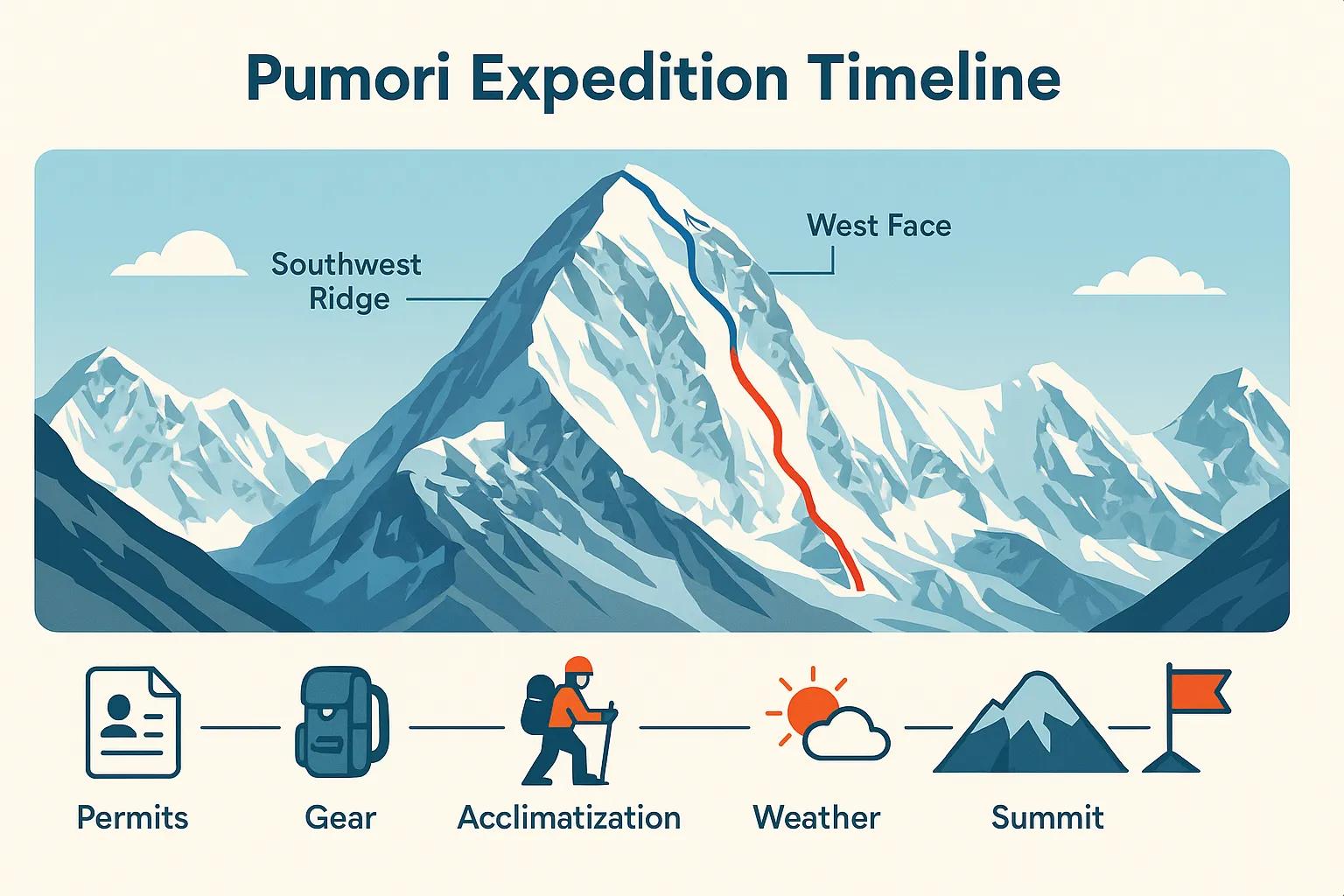
Summit Push (6,500m → 7,161m): The final 1,000 meters is a wall of glacial blue ice with sustained 50-70° slopes. Fixed ropes on technical sections. Summit day 8-12 hours RT.
Summit views: Everest, Lhotse, Makalu, Cho Oyu — four 8,000m peaks.
East Face (Japanese Route)
Japanese climbers Yoshiki Sasahara and Hiroshi Aota completed this East Face route on December 3, 1986 in 3 days. Technical alpine skills required. Not accessible through commercial services.
South Face (Czech Route)
Czech climbers Leopold Sulovsky and Zdenek Michalec completed this South Face route in 1996. Elevated rockfall risk. Not accessible through commercial services.
2026 Pumori Access: Nepal DoT Permits & Logistics
Nepal’s Sixth Amendment Mountaineering Regulations 2081 raised permit fees for 7,001-7,500m peaks to $1,250 spring / $625 autumn / $300 off-season — up from $500/$250/$125. Additional 2026 requirements: mandatory GPS trackers and RECCO reflectors; minimum $90,000 insurance; licensed guide required; permit validity 55 days.
Nepal DoT Permit Fees (2026)
- Spring (March-May): ~$1,250 USD per foreign climber
- Autumn (September-November): ~$625 USD
- Summer/Winter: ~$300 USD
Additional Required Fees
- Sagarmatha NP entry: 3,000 NPR (~$22)
- Khumbu Pasang Lhamu: 2,000 NPR (~$15)
- Garbage deposit: $2,000 refundable
- Liaison officer: $2,500-$5,800
- TIMS card for trekking
2026 Access Process
- International flight to Kathmandu
- 2-3 days Kathmandu (permits, gear)
- Domestic flight to Lukla (2,860m)
- 7-9 day trek Lukla → Gorak Shep → Pumori BC (5,300m)
- Base Camp establishment
- Acclimatization rotations BC ↔ C1 ↔ C2 ↔ C3
- Summit push window
- Return trek, Lukla flight
2026 Commercial Operators
Major operators: Satori Adventures, 8K Expeditions, Seven Summit Treks, Swotah Travel, Skyline Treks, Peak Promotion Nepal, Enepal Expedition. Most offer spring (April-May) and autumn (September-November) programs.
Pumori Climbing Costs in 2026
Pumori 2026 expedition costs run $9,000-$25,000+, total all-in $18,000-$35,000.
Expedition Cost Tiers
- Budget Nepali: $9,000-$15,000 — basic infrastructure
- Mid-tier: $15,000-$20,000 — standard programs
- Premium: $20,000-$25,000+ — enhanced Sherpa support
Required Additional Costs
- International flights: $1,000-$3,000
- Nepal visa: $60-$120
- Insurance ($90,000+ coverage): $400-$1,200
- Personal equipment: $3,500-$5,500
- Sherpa tips: $800-$1,500
- Lukla buffer: $200-$500
- Personal expenses: $500-$1,500
Total Cost Scenarios
Budget: Expedition $12,000 + flights $2,000 + gear $4,000 + insurance $500 + tips $1,000 + incidentals $800 = ~$20,300
Standard: Expedition $18,000 + flights $2,500 + gear $5,000 + insurance $800 + tips $1,200 + buffer $1,000 = ~$28,500
Premium: Expedition $24,000 + flights $3,500 + gear $6,000 + insurance $1,200 + tips $1,500 + buffer $2,000 = ~$38,200
Pumori Gear Checklist
Technical Climbing Equipment
- Climbing harness (fits over layers)
- Climbing helmet
- Ascender (jumar) + backup
- Belay/rappel device
- 8-10 locking carabiners + 6-8 non-locking
- 2-3 prusik cords
- Personal anchor system
- Double-length sling and cordelette
Snow & Ice Climbing
- Ice axe (70cm)
- Crampons (12-point, 8,000m boot compatible)
- Second ice tool for steep sections
- 2 snow pickets
- 2 ice screws
- Avalanche probe and shovel
Footwear
- 8,000m expedition boots (La Sportiva Olympus Mons, Scarpa Phantom 8000)
- Approach shoes for trek
- Camp booties / down booties
- 6-8 pairs expedition socks
- Gaiters
Clothing System
- Base layers (3-4 sets)
- Mid-weight fleece
- Heavy down jacket (800+ fill, -30°C)
- Down or insulated pants
- Hard-shell jacket and pants
- Soft-shell climbing pants
- Balaclava, buff, warm hats
- Glove system: liner, climbing, mittens
Sleep System
- Sleeping bag -30°C (800+ fill)
- Inflatable pad R-value 5+
- Second foam pad
- Sleeping bag liner
Navigation & Safety
- GPS tracker (2026 mandatory)
- RECCO reflector (2026 mandatory)
- Satellite communicator
- Headlamp 300+ lumens + backup
- Power bank 20,000+ mAh
- Category 4 glacier glasses
- Ski goggles
Packs
- Summit pack 35-45L
- Medium pack 60-70L
- Larger duffel 90L+
- Porter-ready duffel
- Dry bags
Documentation & Miscellaneous
- Valid passport (6+ months)
- Nepal visa and permit documents
- Insurance ($90,000+ coverage)
- Personal first aid kit
- Altitude medications
- Water treatment
- 2L insulated bottles
- High SPF sunscreen
- Cash (USD + NPR)
Avalanche & Pumori Steep Ice Hazard Management
Pumori’s primary hazard is avalanche danger rather than pure technical difficulty.
Avalanche Danger
Significant avalanche risk across all routes and seasons. The 1,000m summit wall produces serious hazard. Loaded snow slopes after storms release; cornice-triggered slides occur on summit approaches. Operators manage through weather monitoring and summit timing — but hazard cannot be eliminated.
Steep Ice Terrain
1,000m blue ice summit wall demands sustained ice climbing. Falls typically fatal without effective self-arrest. Climbers must be proficient with front-pointing and ice tool placement under altitude stress.
Rockfall Hazards
Steep faces produce rockfall during warming. East Face and South Face carry elevated risk. Commercial climbers on Southeast Ridge experience less exposure but helmets essential.
Altitude Risks at 7,161m
HAPE and HACE cases occur. Summit temperatures -20 to -35°C. Altitude judgment impairment above 6,500m. Supplemental oxygen sometimes used from Camp 3.
Weather Exposure
Weather windows close suddenly. Storm fronts develop quickly. Summit pushes 1-3 AM to beat afternoon instability. Whiteout on summit wall can be fatal.
Hazard Management Principles
- Choose reputable operators
- Respect weather windows
- Start summit pushes 1-3 AM
- Carry GPS tracker and RECCO reflector
- $90,000+ insurance with helicopter evacuation
- Pre-acclimatization training
- Respect turnaround decisions
- Report altitude symptoms immediately
- Budget 2-5 extra days for Lukla
Pumori Safety & Success Rates
Commercial success rates 50-70% depending on weather, conditions, and acclimatization.
Historical Fatality Patterns
Primary causes: avalanche releases on loaded snow; falls on steep summit wall; altitude emergencies; weather-related incidents; descent fatigue; rockfall during warming.
Commercial Success Rates
Southeast Ridge 50-70%. Primary failures: weather windows closing, avalanche conditions, altitude sickness, Lukla flight delays.
Safety Comparison
Pumori is more dangerous than Ama Dablam (greater altitude, avalanche); less technical than Nuptse; less dangerous than 8,000m peaks; comparable to Baruntse as 7,000m training peak.
When to Climb Pumori
Spring (April-May) — Primary
- Post-winter snow consolidated
- Monsoon not yet arrived
- Longer daylight
- Warmer temperatures
- Permit fee ~$1,250
Autumn (September-November) — Alternative
- Post-monsoon stable weather
- Clearer skies, fewer crowds
- Colder temperatures
- Permit fee ~$625
Winter (December-February) — Rare
Ali Sadpara completed the first winter ascent in 2017 — demonstrating feasibility and extreme danger. -30 to -40°C temperatures, minimal windows. Permit fee ~$300.
Monsoon (June-August)
Rarely attempted due to heavy snow and poor visibility.
Booking Lead Time
Book 6-12 months ahead for spring programs.
Pumori Through the Climbing Era: Landmark Expeditions
1921 — Mallory Names Pumori
Historic namingGeorge Mallory and the 1921 British Everest reconnaissance were first Europeans to see Lingtren, Pumori, and Nuptse. Mallory named the peak “Pumori” from Sherpa pumo (young girl) + ri (mountain) — “mountain daughter.” Links Pumori to the foundational era of Himalayan climbing.
May 17, 1962 — Lenser’s Solo First Ascent
First ascent · soloGerhard Lenser summited Pumori solo after the rest of his German-Swiss team (led by Dr. Herbert Tichy) turned back from altitude sickness. The Southeast Ridge route Lenser established remains the standard commercial line. ~600 summits since.
December 3, 1986 — Japanese East Face
Alternate routeYoshiki Sasahara and Hiroshi Aota completed an East Face alternate route in 3 days. Significant technical achievement opening alternative climbing lines. Minimal repeats since.
1996 Czech South Face
Technical alpineLeopold Sulovsky and Zdenek Michalec completed a new South Face route in 1996 — establishing Pumori’s South Face as viable technical objective despite rockfall hazards.
2017 — Ali Sadpara’s First Winter Ascent
First winter ascentPakistani mountaineer Muhammad Ali Sadpara completed the first winter ascent — landmark achievement. -30 to -40°C temperatures, high winds, minimal windows. Sadpara died February 2021 during K2 winter attempt. His Pumori winter ascent remains among the mountain’s most remarkable achievements.
Lessons from Pumori’s Climbing History
- Solo first ascents are still possible — Lenser 1962
- Cultural heritage matters — Mallory’s 1921 naming links Pumori to Everest’s foundational era
- Winter ascents extreme but possible — Sadpara 2017
- Objective hazards cannot be eliminated — avalanche remains defining
- Permit costs escalate — September 2025 fees doubled
- Pumori as progression bridge — definitive 7,000m preparation peak
Plan Your Pumori Expedition
Complete BC → C1 → C2 → C3 → Summit breakdown. 1,000m blue ice at 50-70°. 8-12 hour summit day.
View route details →$9,000-$25,000 commercial. Budget ($20,300), standard ($28,500), premium ($38,200) scenarios.
See cost details →Spring (April-May) primary; autumn alternative. Winter rare (2017 Sadpara first).
View timing →8-category list including 8,000m boots, -30°C bag, avalanche gear, GPS tracker, RECCO reflector.
View gear →Pumori sits between Ama Dablam (6,000m) and Cho Oyu (first 8,000m).
Plan progression →September 2025 revision: $1,250 spring / $625 autumn / $300 off-season.
See permits →Frequently Asked Questions About Climbing Pumori
How much does it cost to climb Pumori in 2026?
A 2026 Pumori expedition costs $9,000-$15,000 for budget Nepali operators and $20,000-$25,000+ for premium tier. Total all-in including flights, gear, and contingency: $18,000-$35,000. Following the September 1, 2025 Nepal permit fee revision, the DoT royalty for 7,001-7,500m peaks increased to approximately $1,250 per foreign climber for spring, $625 autumn, $300 off-seasons. Additional costs: Sagarmatha National Park entry 3,000 NPR; Khumbu Pasang Lhamu fee 2,000 NPR; garbage deposit $2,000 refundable; liaison officer $2,500-$5,800; Sherpa support; $90,000+ insurance. Primary operators: Satori Adventures, 8K Expeditions, Seven Summit Treks, Swotah Travel, Skyline Treks, Peak Promotion Nepal, Enepal Expedition.
Who was the first person to climb Pumori?
Pumori was first climbed on May 17, 1962 by German climber Gerhard Lenser as part of a German-Swiss expedition led by Dr. Herbert Tichy. Lenser notably summited SOLO after the rest of the team turned back due to altitude sickness. The expedition climbed the Southeast Ridge — the route that remains the standard commercial climbing line today. Approximately 600 summits of Pumori have been recorded since the 1962 first ascent. The mountain was named ‘Pumori’ meaning ‘unmarried daughter’ or ‘mountain daughter’ by British climber George Mallory during the 1921 British reconnaissance expedition to Everest. Notable later ascents: Yoshiki Sasahara and Hiroshi Aota’s 1986 East Face alternate route (December 3, 1986, 3 days); Leopold Sulovsky and Zdenek Michalec’s 1996 South Face new route; most significantly Muhammad Ali Sadpara’s 2017 first winter ascent.
What is the best route to climb Pumori?
The Southeast Ridge is the standard commercial climbing route, following Gerhard Lenser’s 1962 first ascent line. Route breakdown: Base Camp 5,300m reached via trek through Gorak Shep (5,164m); Camp 1 at 5,700m (4-5 hours from BC across glaciers and sharp ridge); Camp 2 at 6,200m (40-60 degree slopes crossing snow barrier); Camp 3 at 6,500m (icy barriers, final staging). Summit push involves a 1,000-meter wall of glacial blue ice with sustained 50-70 degree slopes. Graded Class 3 as easiest line, but avalanche danger is the primary hazard. Summit views: Everest, Lhotse, Makalu, Cho Oyu — four 8,000m peaks visible. Alternative routes: 1986 East Face (Japanese), 1996 South Face (Czech). Commercial climbers use the Southeast Ridge exclusively.
How dangerous is Pumori?
Pumori’s primary hazard is avalanche danger rather than pure technical difficulty. The Southeast Ridge is rated Class 3 as the easiest route, but the mountain carries significant avalanche risk across all routes and seasons. The 1,000-meter summit wall of glacial blue ice with 50-70 degree slopes produces serious fall and avalanche hazard. Additional hazards: rockfall on steep faces during warming; HAPE and HACE risk at 7,161m; cold weather exposure with summit temperatures -20 to -35°C; weather windows can close suddenly; descent fatigue. Commercial success rates run 50-70% depending on weather, conditions, and acclimatization.
How long does a Pumori expedition take?
A typical Pumori expedition takes 30-35 days total — shorter than Nuptse (44-48 days) but longer than Ama Dablam (26-35 days). Standard itinerary: Days 1-3 Kathmandu arrival, permit processing; Days 4-10 approach trek Lukla → Namche → Tengboche → Dingboche → Lobuche → Gorak Shep → Pumori Base Camp; Days 11-13 Base Camp rest; Days 14-26 climbing with acclimatization rotations BC ↔ C1 ↔ C2 ↔ C3; Days 27-29 summit push window; Days 30-33 return trek; Days 34-35 Lukla flight and departure. Gorak Shep provides logistics support (wooden lodges, cafe, helipad) less than a day from Pumori Base Camp.
What experience do I need to climb Pumori?
Pumori requires substantial mountaineering experience but is more accessible than Nuptse or Lhotse. Typical operator prerequisites: prior 6,000m+ altitude experience (Island Peak, Lobuche East, Mera Peak, or Ama Dablam); fixed-rope ascending and rappelling proficiency; crampon and ice axe skills on 50-70 degree slopes; 30-day expedition endurance; cold weather experience. Pumori is often cited as an ideal 7,000m preparation peak for 8,000m climbers seeking altitude experience. Licensed guide mandatory under 2026 rules; GPS trackers and RECCO reflectors required.
When is the best time to climb Pumori?
Spring (April-May) and autumn (September-November) are the primary seasons, with spring slightly preferred for longer daylight and warmer temperatures. Spring: post-winter snow consolidated; monsoon not yet arrived; permit fee ~$1,250. Autumn: post-monsoon stable weather; clearer skies; fewer crowds; colder; permit fee ~$625. Winter rare but notable — Ali Sadpara’s 2017 first winter ascent demonstrated feasibility and extreme danger. Monsoon rarely attempted.
How do I get to Pumori Base Camp?
Pumori access follows the classic Everest Base Camp trek route through Nepal’s Khumbu region, then continues to Pumori Base Camp at 5,300m approximately 1 km beyond Gorak Shep. International flight to Kathmandu; 2-3 days permit processing; domestic flight Kathmandu to Lukla (2,860m); trek Lukla → Phakding → Namche (3,440m, 2 nights) → Tengboche → Dingboche → Lobuche → Gorak Shep (5,164m) → Pumori BC (5,300m). Total trek 7-9 days. Gorak Shep serves as the last lodge settlement with wooden lodges, cafe, and helipad. Required permits: Nepal DoT climbing permit; Sagarmatha NP entry 3,000 NPR; Khumbu Pasang Lhamu 2,000 NPR; TIMS card; licensed guide; GPS tracker and RECCO reflector (2026 mandatory).
Why is Pumori called ‘Everest’s Daughter’?
The name Pumori was given by British climber George Mallory during the 1921 British Everest reconnaissance — the first Europeans to see the peaks Lingtren, Pumori, and Nuptse. In the Sherpa language ‘Pumo’ means young girl or daughter and ‘Ri’ means mountain, so Pumori literally translates to ‘mountain daughter’ or ‘unmarried daughter.’ The mountain is widely called ‘Everest’s Daughter’ in mountaineering literature because of its position 8.5 km west of Everest. Mallory’s naming links Pumori directly to the early Everest reconnaissance that would eventually lead to the 1953 first ascent. Kala Patthar (5,643m) is an outlier of Pumori appearing as a ‘big brown bump’ below the south face.
What was Ali Sadpara’s 2017 Pumori winter ascent?
Muhammad Ali Sadpara, the legendary Pakistani high-altitude mountaineer, completed the first winter ascent of Pumori in 2017 — a landmark achievement in cold-weather Himalayan climbing. Winter ascents of 7,000m+ peaks are extraordinarily dangerous due to extreme cold (-30 to -40°C), high winds, minimal weather windows, and short daylight. Sadpara’s resume included the 2016 first winter ascent of Nanga Parbat. Tragically, Sadpara died in February 2021 during a winter attempt on K2. His 2017 Pumori winter ascent remains one of the most remarkable achievements in the mountain’s climbing history.
Related Himalayan Peaks, Skills & Planning Guides
Pumori’s role as ideal 7,000m preparation peak means most climbers approach it within a structured progression from technical 6,000m peaks toward 8,000m expeditions.
Plan Your Himalayan Progression Strategically
Pumori sits at the bridge between Ama Dablam-class peaks and 8,000m expeditions. Use our progression tool to sequence Pumori strategically within your project toward Everest, Cho Oyu, or Manaslu.
Was this helpful?
🏔Related guides
🧭Explore & compare
Global Summit Guide is an independent mountaineering resource founded in 2026. The team combines first-hand trekking and climbing experience with in-depth research and professional health and nutrition review to help climbers choose objectives, prepare properly, and stay safe.
Health, altitude, and nutrition content is reviewed by Taylor Ludlow (Registered Nurse) and Brigg Hoopes (Nutritionist).
What We Don't Know Yet
Mountain information changes quickly. This box explains the limits of what this page can responsibly promise.
- Permit availability, reservation windows, quotas, and official fee rules may change after this page is updated.
- Guide-company prices, departure dates, guide ratios, included services, and cancellation rules can change without notice.
- Weather, snowpack, avalanche risk, road access, and route conditions can change quickly and may be different on your climbing dates.
- Route conditions, trailhead access, crevasse exposure, stream crossings, and rescue access may vary from published planning guidance.
- Total trip cost can change with flights, lodging, guide pricing, permits, gear rentals, transportation, and exchange rates.
Verify current conditions with official land managers, guide services, local forecasts, and current route reports before booking or climbing.
Mountaineering, rock and ice climbing, glacier travel, and high-altitude activity are inherently dangerous and can result in serious injury or death. The information on Global Summit Guide is provided for general informational and educational purposes only and is not a substitute for professional instruction, qualified guiding, proper equipment, or your own judgment and experience.
Route conditions, weather, snowpack, permits, regulations, and hazards change constantly and may differ from what is described here. Details may be incomplete, out of date, or contain errors. Always verify current information with local authorities, certified guides, and official sources before making any decision in the mountains.
Nothing on this site is medical, legal, or financial advice. Our fitness, acclimatization, altitude, and nutrition content is general in nature; consult a qualified physician before beginning any strenuous exercise program or exposing yourself to high altitude.
You are solely responsible for your own safety and decisions. To the fullest extent permitted by law, Global Summit Guide and its team accept no liability for any loss, injury, damage, or expense arising from use of, or reliance on, this information. By using this site you acknowledge these risks and accept these terms.
Some links on this site may be affiliate links. If you buy through them we may earn a small commission at no extra cost to you; this never affects our recommendations.
Global Summit Guide recommendation path
Next Best Mountain to Research
Use these recommendations to continue the right planning path instead of stopping on one page.
Use current permit, weather, route, and operator information before booking or climbing.
Search Flights, Hotels & Rental Cars
Have the mountain or destination picked? Use Expedia to compare the flights, lodging and rental cars that fit your actual trip dates. For mountain travel, consider arriving early enough for delays and adding a buffer night after the climb before a fixed flight home.
Compare current flight, hotel and car options.
Affiliate disclosure: Global Summit Guide may earn a commission if you book through this link, at no additional cost to you.