Utah field report · Wasatch Range · North Ridge · August 2026
Pfeifferhorn North Ridge: Sawyer Shawd & Dawson Ludlow Climb a Utah Classic
Pfeifferhorn is famous as one of the Wasatch’s great scrambling summits. Sawyer Shawd and Dawson Ludlow chose the other side of the mountain: the technical North Ridge, an aesthetic alpine line above the Red Pine–Maybird country of Little Cottonwood Canyon.
A Different Pfeifferhorn Than Most Utah Hikers See
Sawyer Shawd and Dawson Ludlow climbed Pfeifferhorn by the North Ridge, choosing a technical alpine-rock line rather than the mountain’s standard Red Pine / East Ridge hiking route.
That distinction matters. The familiar Pfeifferhorn summit day is already one of the Wasatch’s classic strenuous hikes and scrambles. The North Ridge adds technical climbing, route-finding, exposure and a much more serious alpine character.
MountainPfeifferhorn
RouteNorth Ridge
ClimberSawyer Shawd
ClimberDawson Ludlow
RangeWasatch
StateUtah
Field-report boundary: this article records the climb and explains the route’s character. It does not invent a pitch-by-pitch account, exact equipment list, total ascent time or move-by-move beta that the climbers did not provide. Published route information is labeled as such.
August 2026 · Utah
Sawyer Shawd & Dawson Ludlow on Pfeifferhorn’s North Ridge
A local Wasatch objective with much bigger alpine character than its proximity to Salt Lake City suggests.
Pfeifferhorn has a silhouette that makes it look like it belongs much farther from a major city. Rising to roughly 11,326 feet in the central Wasatch, it is sometimes called the “Little Matterhorn,” and the standard East Ridge scramble is one of northern Utah’s most recognizable summit days.
But the North Ridge is a different objective. Instead of approaching the summit primarily as a strenuous hike with scrambling, the route follows the mountain’s sharper northern architecture through technical rock, exposed ridge terrain and sections where alpine judgment matters as much as fitness.
That is the line Sawyer Shawd and Dawson Ludlow chose. The photographs from the climb show the kind of field experience Global Summit Guide wants to preserve in its Trip Reports collection: local climbers moving beyond a familiar hiking summit and seeing the same mountain through a much more technical lens.
The value of a report like this is not that every climber should immediately try to duplicate the route. It is that Pfeifferhorn demonstrates how quickly the Wasatch progression changes. A peak that can be reached by a strong hiker on one side can become a legitimate technical alpine climb on another.
ObjectivePfeifferhorn North Ridge
LocationWasatch Range, Utah
Field climbersShawd + Ludlow
Report typePhoto field report
The climbers
Follow Sawyer & Dawson
Link the climb back to the climbers who were actually on the mountain.
Climber
Sawyer Shawd
Sawyer Shawd joined Dawson Ludlow for the Pfeifferhorn North Ridge climb featured in this report.
Why Pfeifferhorn’s North Ridge Is a Serious Wasatch Route
The route’s published character helps explain why this ascent is different from the normal summit hike.
Long-standing North Ridge descriptions classify the route as a technical rock / mixed alpine climb, commonly around 5.5 and Grade II–III. Published descriptions also emphasize loose rock, exposure and the fact that parties can encounter substantially different conditions depending on season.
One route source describes the full ridge as roughly a mile of technical ridge terrain with about 1,300 feet of climbing from the lower route, while older Utah climbing coverage describes a longer technical experience when the full approach and ridge are considered together. Those differences are exactly why numbers should be treated as route-context estimates rather than a substitute for current local beta.
Historically, the North Ridge has also been climbed as a winter mountaineering objective because cold conditions can freeze some of the loose rock in place. That does not make winter automatically safer: snow, ice and avalanche terrain add entirely different hazards. A dry-season ascent and a winter ascent can feel like different routes.
The common thread is the ridge itself—an aesthetic line that turns Pfeifferhorn from a hiking summit into a technical Wasatch alpine objective.
Do not confuse proximity with simplicity.
Pfeifferhorn is close to Salt Lake City, but the North Ridge belongs in the technical-climbing category. It should be evaluated by route conditions, protection, exposure and party competence—not by how quickly you can drive to the trailhead.
Original field images
Pfeifferhorn North Ridge Photo Story
Four images supplied from Sawyer Shawd and Dawson Ludlow’s climb.
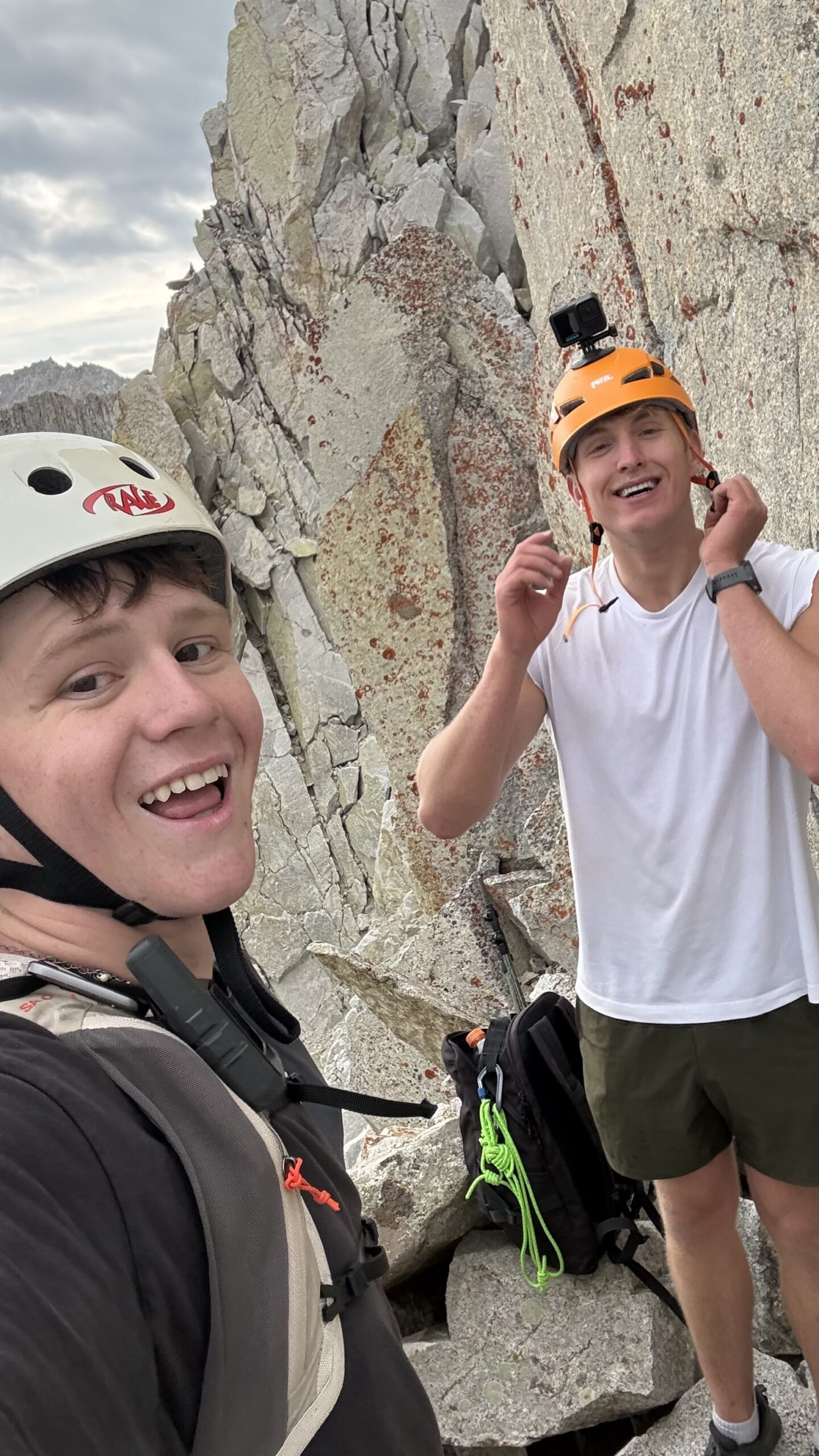
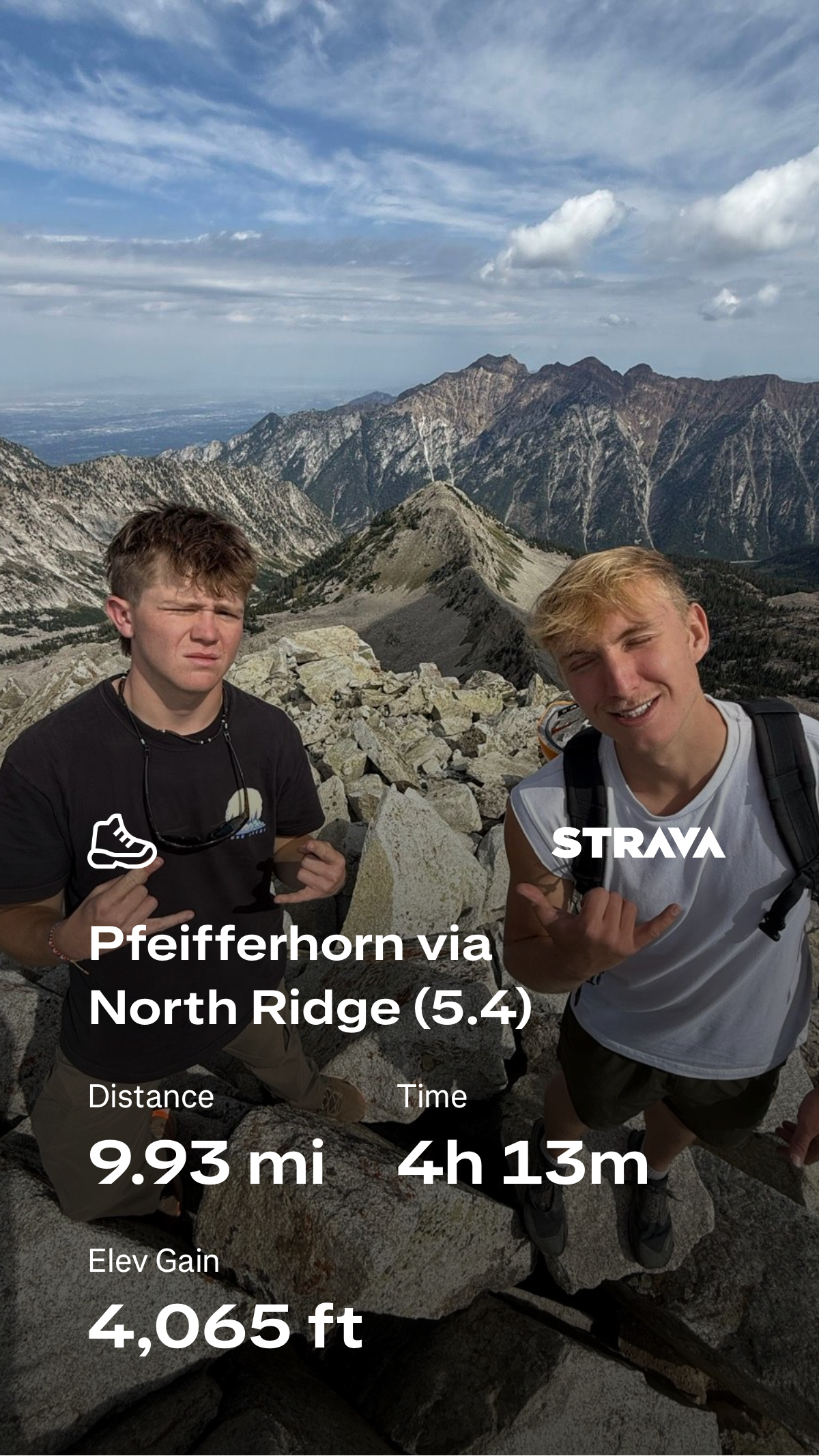
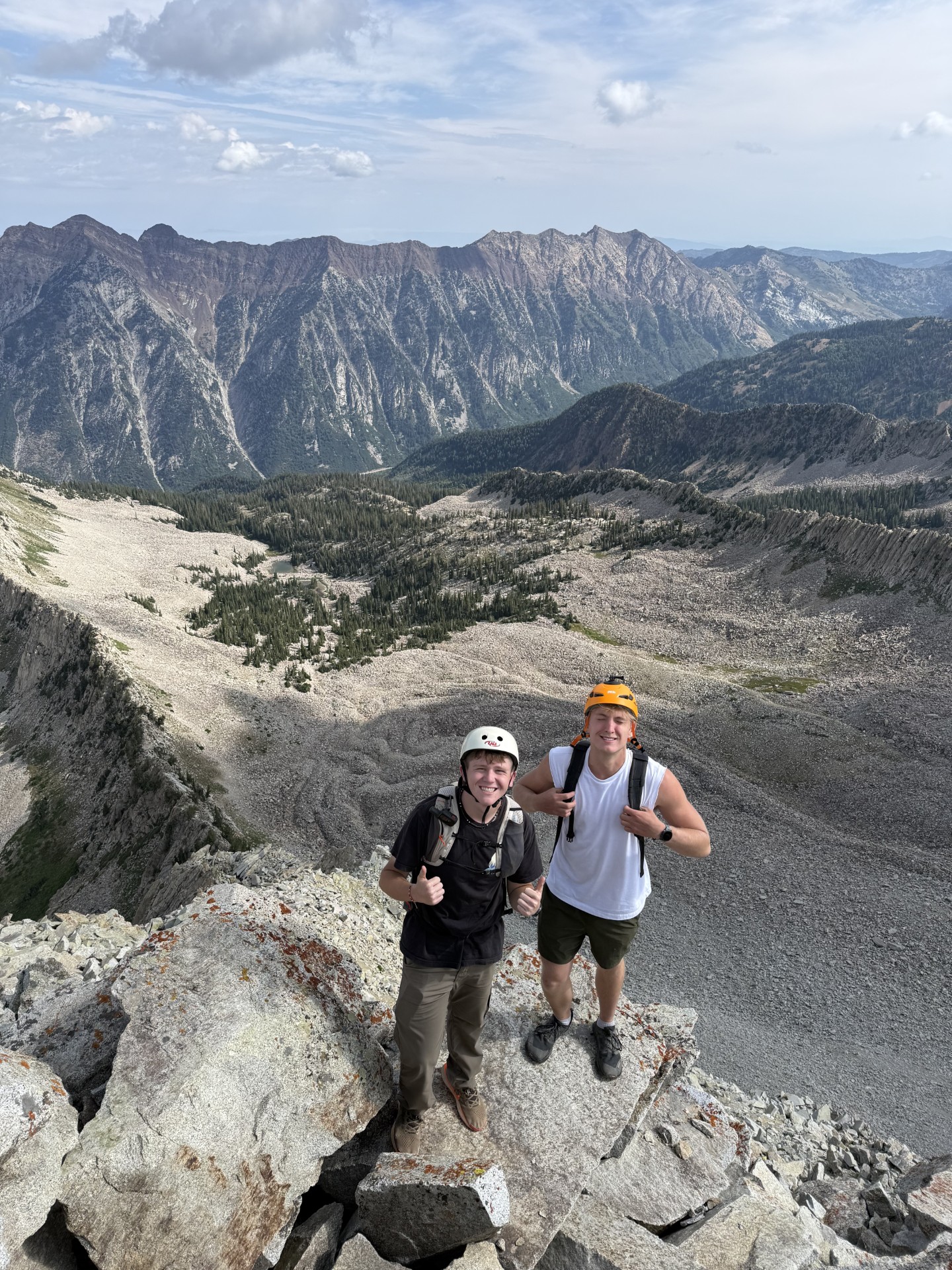
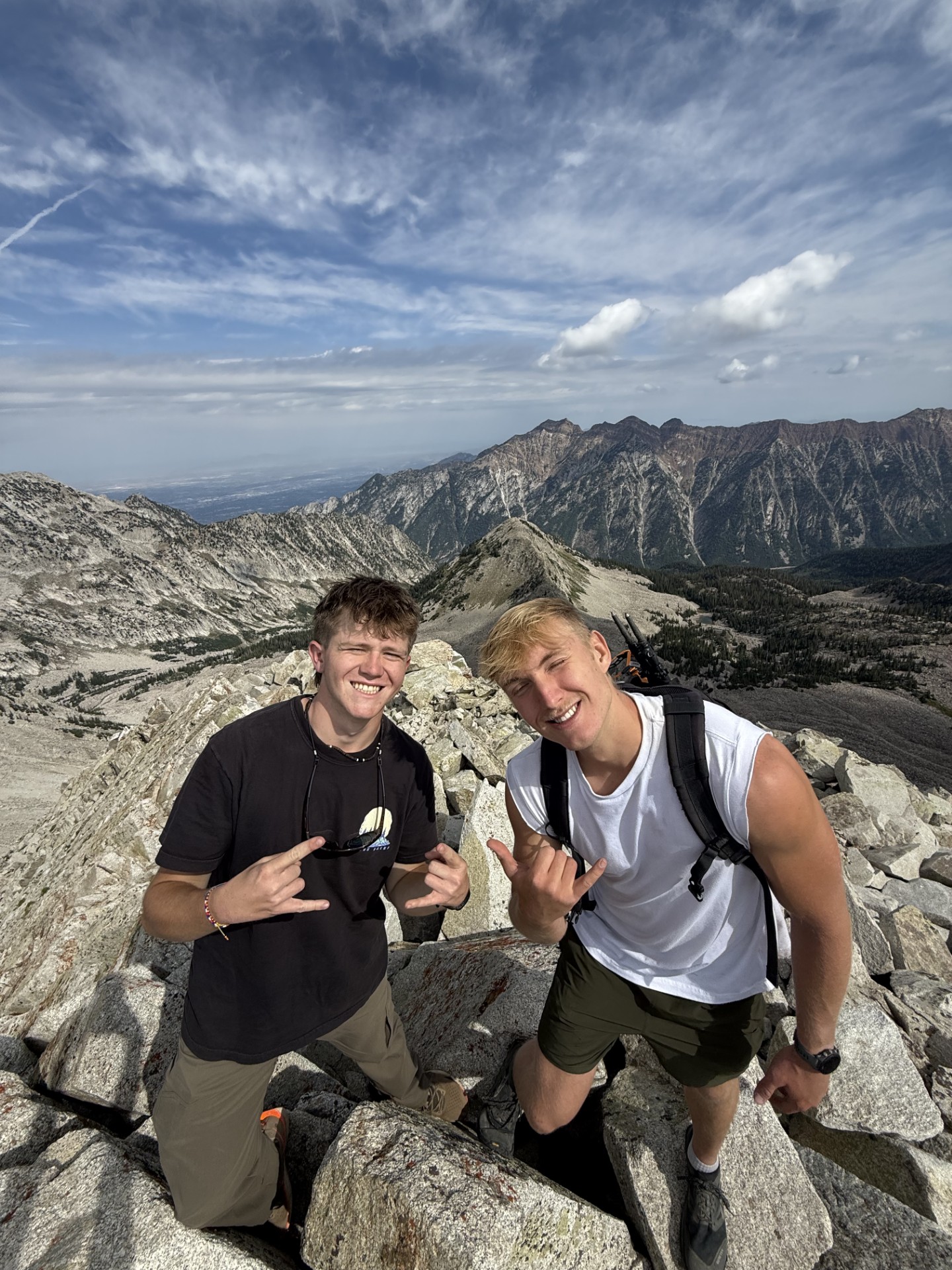
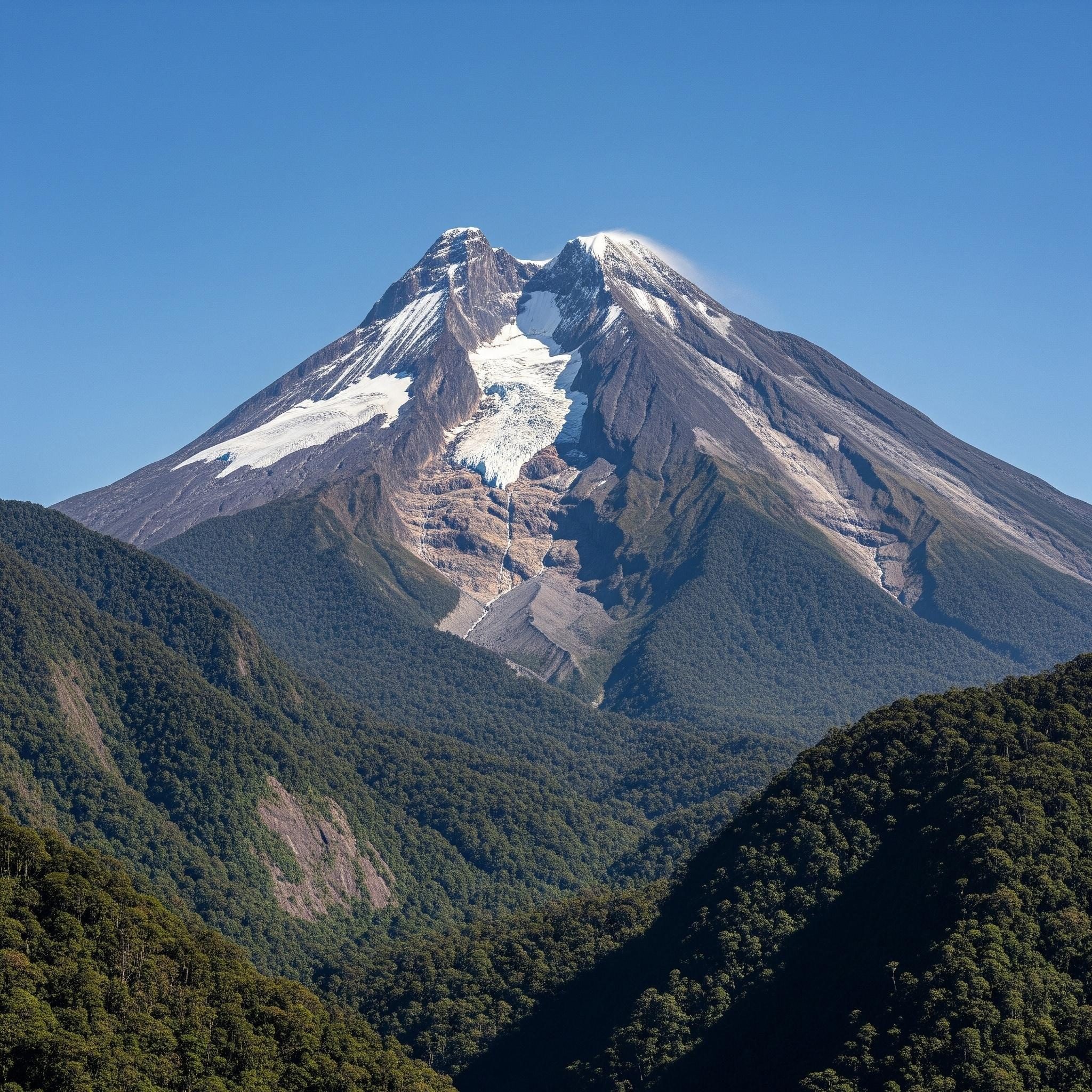
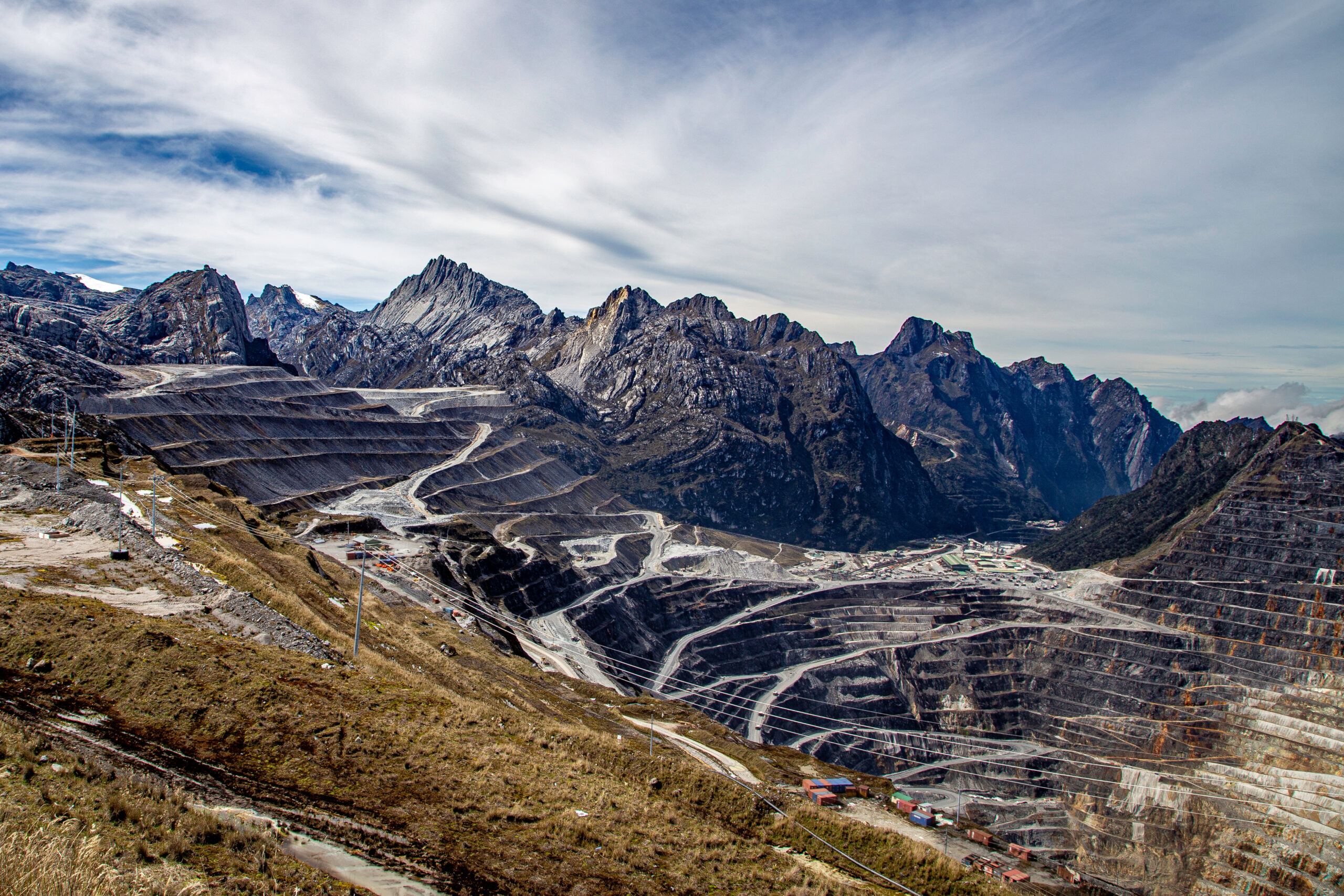
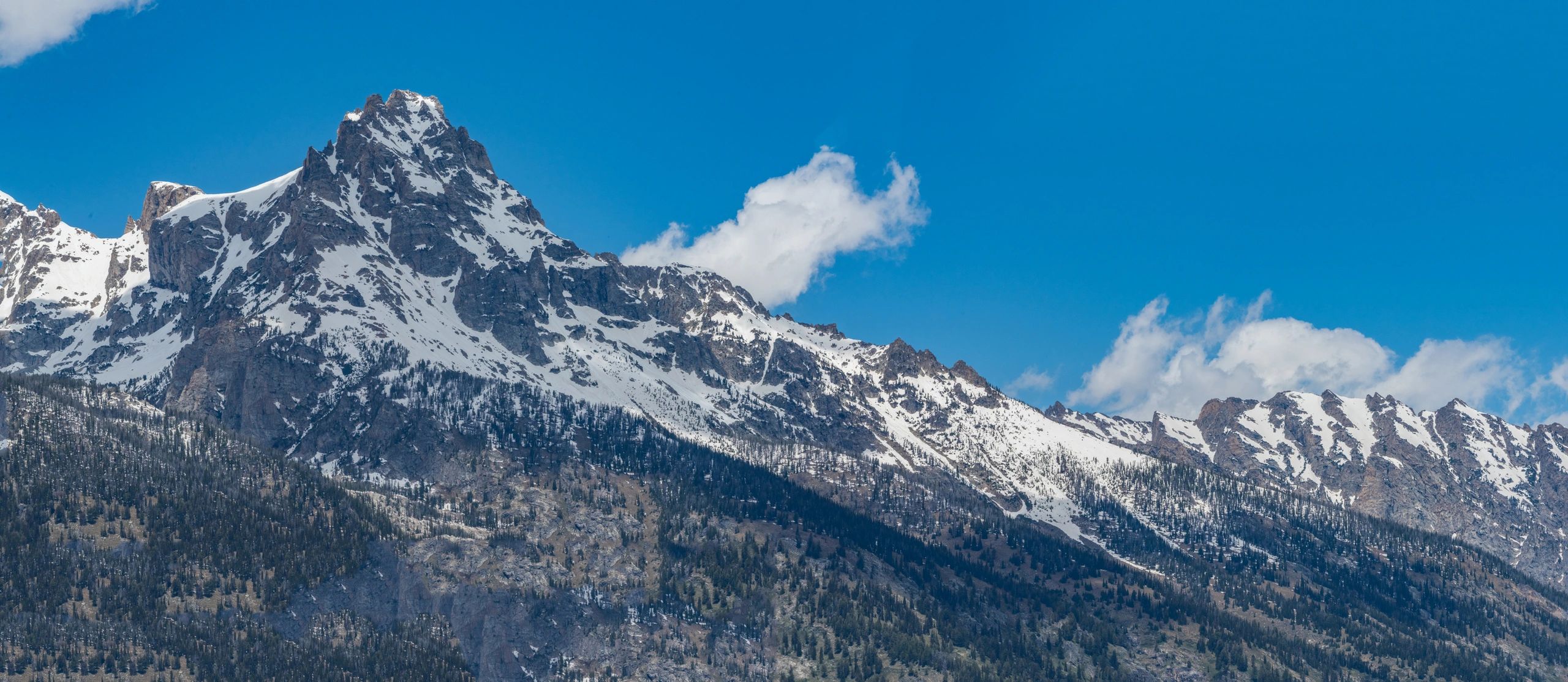
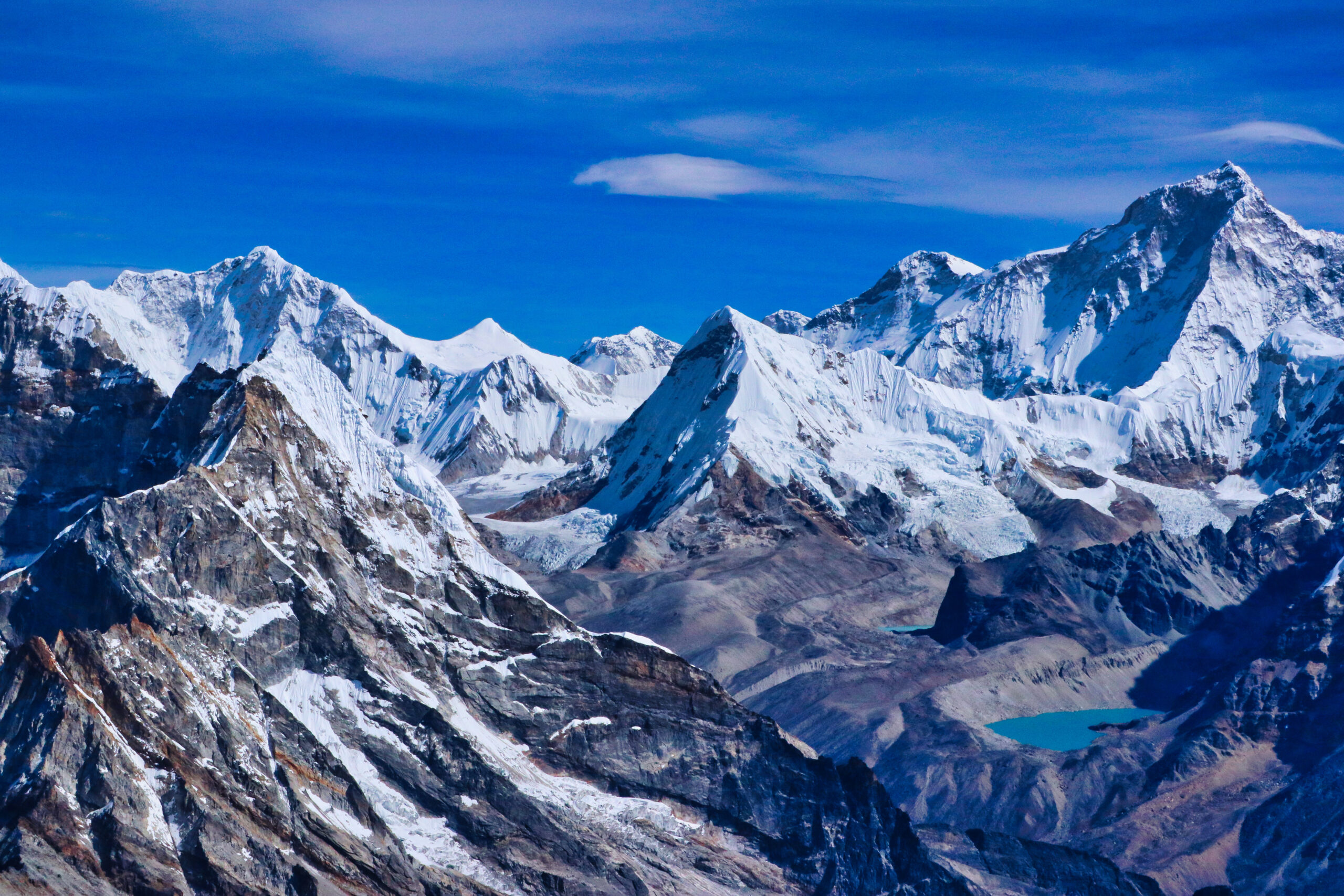
Original field media supplied from the North Ridge climb. Global Summit Guide does not infer a specific pitch or location from the image alone.North Ridge field image from Pfeifferhorn in Utah’s Wasatch Range.Field image from Sawyer Shawd and Dawson Ludlow’s Pfeifferhorn North Ridge ascent.
Same summit · very different day
North Ridge vs the Standard Pfeifferhorn Route
Understanding the difference keeps this field report from being mistaken for normal hiking beta.
The standard route is already substantial. Utah trail sources commonly put the normal Pfeifferhorn day around 9–10 miles round trip with roughly 3,700–3,900 feet of gain. The ridge above Red Pine includes boulder scrambling and a short Class 3 section before the summit.
The North Ridge changes the category. A climber who is comfortable hiking the normal Pfeifferhorn should not assume that experience automatically transfers to a technical line on the other side of the mountain.
Wasatch progression
Where Pfeifferhorn Fits in Utah Climbing
One of the best things about the Wasatch is the density of progression: hiking, scrambling and technical climbing can exist on neighboring peaks—or the same peak.
Pfeifferhorn belongs in the conversation with the Wasatch’s best local mountains because it can meet climbers at multiple levels. The standard East Ridge introduces strong hikers to exposed scrambling; the North Ridge pushes into technical alpine climbing; neighboring Little Cottonwood and Lone Peak terrain can extend that progression much farther.
The new Best Hikes in Utah parent serves a different purpose: it compares statewide hiking, from Zion and Moab to Timpanogos, Nebo and Kings Peak. This field report sits on the technical-climbing side of that Utah ecosystem.
Planning context
What Future North Ridge Parties Should Take From This Report
The lesson is route selection and preparation—not imitation of an undocumented pitch sequence.
01
Know which Pfeifferhorn you are climbing
East Ridge and North Ridge are not interchangeable descriptions. Confirm the line before using any distance, difficulty or equipment information.
02
Conditions can change the route category
Dry rock, snow, ice, thawing rock and avalanche terrain create very different North Ridge problems. Current conditions outrank old trip reports.
03
Loose rock is part of the reputation
Published North Ridge descriptions repeatedly warn about loose rock. Helmets, spacing and protection decisions should reflect that reality.
04
Have a descent plan before starting
A summit is only the midpoint. Know the intended descent and how changing weather or darkness affects the route home.
05
Use technical progression, not summit familiarity
Having hiked Pfeifferhorn does not qualify someone for the North Ridge. Build climbing systems and alpine judgment on appropriate objectives first.
06
Keep route reports current
Wasatch conditions move quickly. Local reports, forecasts and current route observations are essential before committing to technical terrain.
What we do not claim: this article does not state Sawyer and Dawson’s exact climb date, car-to-car time, rack, rope system, pitch count, exact variation, weather, protection strategy or descent timing because those details were not supplied with the field report. Add those later only if the climbers confirm them.
Pfeifferhorn North Ridge questions
Frequently Asked Questions
Keep the technical North Ridge distinct from the mountain’s standard hiking route.
Is the Pfeifferhorn North Ridge the standard hiking route?
No. The normal summer route approaches through Red Pine Lake and uses the East Ridge, with a short Class 3 scrambling section. The North Ridge is a technical alpine-rock route and should not be confused with the standard Pfeifferhorn hike.
How high is Pfeifferhorn?
Published route references place Pfeifferhorn at roughly 11,326 feet in Utah's Wasatch Range.
How difficult is the North Ridge?
Published North Ridge descriptions commonly place the route around 5.5 and Grade II–III. Conditions, exact variation, loose rock, snow or ice, and party experience can materially change the seriousness.
Where does the usual Pfeifferhorn approach begin?
The standard summit approach uses the White Pine / Red Pine trail system in Little Cottonwood Canyon. North Ridge parties commonly use the Red Pine–Maybird area to reach the technical ridge.
Who climbed the route in this report?
Sawyer Shawd and Dawson Ludlow are the climbers featured in this August 2026 Global Summit Guide field report.
Is this post a pitch-by-pitch route guide?
No. It is a field report and photo story. It gives enough route context to understand why the North Ridge is significant while directing climbers to current route-specific sources and their own judgment for technical planning.
Utah field report
One Mountain. Two Very Different Ways to Experience It.
Pfeifferhorn’s standard route is a Wasatch hiking classic. The North Ridge shows what happens when the same summit becomes a technical alpine objective.
Iceland in March is the last true month of winter. Beautiful, empty, and windier than any blog seems willing to admit.
Trip Reports · Iceland
Iceland in March: what hikers should actually expect (and what the travel blogs get wrong)
We went to Iceland in March and based ourselves in Vik, on the south coast. It was cold. More than that, it was windy, and then it was cold again. The scenery was worth every gust, but almost nothing about the trip matched the green, sunlit hiking photos that fill the travel blogs. Here is the honest version, so you can plan around the Iceland that actually shows up in March.
By Travis Ludlow, Founder & Head of Research · Global Summit Guide
Published Jul 20, 2026 · Trip report · ~9 min read
First-hand trip report. Written from our own March trip to Iceland’s south coast, based in Vik, and cross-checked against current conditions, daylight, and road-closure information. Iceland’s weather changes fast, so always check vedur.is, safetravel.is, and road.is before you head out.
There is a version of Iceland that lives on travel blogs: emerald valleys, a lone hiker on a ridge in a light jacket, waterfalls under a midnight sun. It is real, and it is wonderful. It also does not exist in March. What exists in March is a low, silver light, black-and-white coastlines, and a wind that turns a short walk to a waterfall into a genuine physical effort. We loved it. But we loved it because we went in knowing what it was, and plenty of visitors do not. So before you book, here is what hiking in Iceland in March is actually like.
The honest verdict
March is winter day-hiking, not summer trekking. Plan for wind above all.
The Highlands and all the famous multi-day treks are closed and snowbound until summer. What you get instead is spectacular winter day-hiking near the open roads, the northern lights, and almost no crowds. The single biggest thing the blogs undersell is the wind, which matters more than the temperature and can flatten your plans entirely.
Go in expecting that, and Iceland in March is superb. Expect the summer postcard, and you will be cold, frustrated, and locked out of half your itinerary.
-2 to 3 C
Coastal temps
28 to 37 F, but the wind chill is the real story.
10-13 hrs
Daylight
Rising fast through the month; not the polar night.
Not lies, exactly. Just summer photos attached to a winter month.
The myth
“Iceland is a hiker’s paradise”
In summer, absolutely. In March, the interior Highlands, where the iconic multi-day treks live, are completely snowbound and the roads to them are legally closed. The hiking that remains is winter day-hiking near the coast. It is beautiful, but it is a different sport.
The myth
“It’s cold, so pack warm layers”
True but incomplete. The temperature is manageable, often hovering near freezing on the coast. The wind is what defines the day. It drives the wind chill down hard and, in a storm, can stop you walking outright. Check the wind speed as carefully as the temperature.
The myth
“Winter means barely any daylight”
That is December, not March. Daylight expands quickly through March, from about 10 hours early in the month to roughly 13 by the end, with the equinox around the 21st. You have ample time for day hikes, and the dark evenings still deliver the northern lights.
The myth
“Just follow the itinerary”
Iceland does not care about your itinerary in March. Storms close roads and cancel tours at short notice, and the local saying that if you do not like the weather you should wait five minutes is not a joke. Flexibility is not a nice-to-have. It is the plan.
The weather, honestly
March is the last true winter month, and it behaves like one.
On the south coast, where we were, daytime temperatures mostly sat between about -2 and 3 C (28 to 37 F). That sounds mild, and on a still day it is. But still days are rare. The wind is nearly constant, and it turns a pleasant reading on the thermometer into something that bites through anything not properly windproof. We had snow, rain, and sudden sun within the same hour more than once, which is entirely normal here. Inland and up high it is far colder, with the Highlands sitting well below -10 C (14 F) and storms adding snow by the metre. If you take one thing from this report, let it be that in Iceland in March you dress for and plan around the wind first, and the temperature second.
Snow, rain, and sun in the same hour is normal in March. Waterproof and windproof shells are not optional here; they are the difference between a good day and a miserable one.
What’s open and closed
The single most important planning fact: the interior is shut.
The main roads do the heavy lifting in March. The Ring Road, the Golden Circle, and the South Coast route are usually kept open and cleared, though storms can close sections temporarily and without much warning. What is firmly closed is the entire Highland interior: every F-road stays shut until summer, typically not reopening until June or July, because of deep snow and ice. That closure is what rules out the famous treks. Laugavegur, Fimmvorduhals, and the other classic multi-day hut routes are summer-only, and in March they are buried and inaccessible. If a Highland hut trek is your dream, that is a July-to-September trip, and our guides to the best first hut-to-hut hikes and one-week circuits cover Laugavegur for when you go back in the right season.
What you can actually hike
Plenty, as long as you think day hikes near the open roads, and carry traction.
South Coast waterfalls: Seljalandsfoss and Skogafoss
Short walks to two of Iceland’s great waterfalls, both just off the South Coast road. Expect sheet ice on the paths and spray that freezes fast, so microspikes and a windproof shell are essential. The staircase beside Skogafoss may be icy or partly closed.
Reykjadalur hot-spring valley
A popular day hike up a geothermal valley to a warm bathing river, doable in winter but often snowy and icy underfoot. A rewarding half day with traction and a check of conditions first.
Coastal walks near Vik: Dyrholaey and Reynisfjara
The black-sand coast around Vik is dramatic in winter and easy to reach. But treat Reynisfjara with real caution: its sneaker waves are powerful, unpredictable, and have killed visitors. Stay well back from the water and never turn your back on the sea.
Solheimajokull glacier (guided only)
You can walk on a glacier tongue in March, but only on a guided tour with crampons and a certified guide. Do not venture onto glacier ice alone; crevasses and thin snow bridges make it lethal without training and gear.
Mount Esja, near Reykjavik
The capital’s local mountain is a popular hike, but in March it is a genuine winter ascent: snow, ice, and wind increase with height. Fine for a lower stretch with traction; the full climb needs winter skills and honest judgment about conditions.
⚠ Two hazards the blogs skip
Sneaker waves. On south-coast beaches like Reynisfjara, surges rush far up the sand without warning and drag people in. People die here most years. Keep a big margin from the water.
Wind and storms. If the forecast shows a storm, do not hike, and do not drive to a trailhead to “see how it is.” Iceland’s emergency services repeat the same message every winter: when the weather says stay put, stay put.
What to bring
Get the shell and the traction right and the rest follows.
March hiking kit for Iceland
A fully windproof and waterproof shell – jacket and trousers. This is the most important item.
Microspikes or trail crampons – paths, car parks, and trails are routinely iced over.
Warm insulating layers – merino base, mid-layer, insulated jacket; wind drives the real cold.
Hat, warm gloves, and a buff – wind protection for hands and face.
Sturdy waterproof boots – with good tread under the spikes.
Daily weather and road checks – vedur.is for weather, safetravel.is for alerts, road.is for closures.
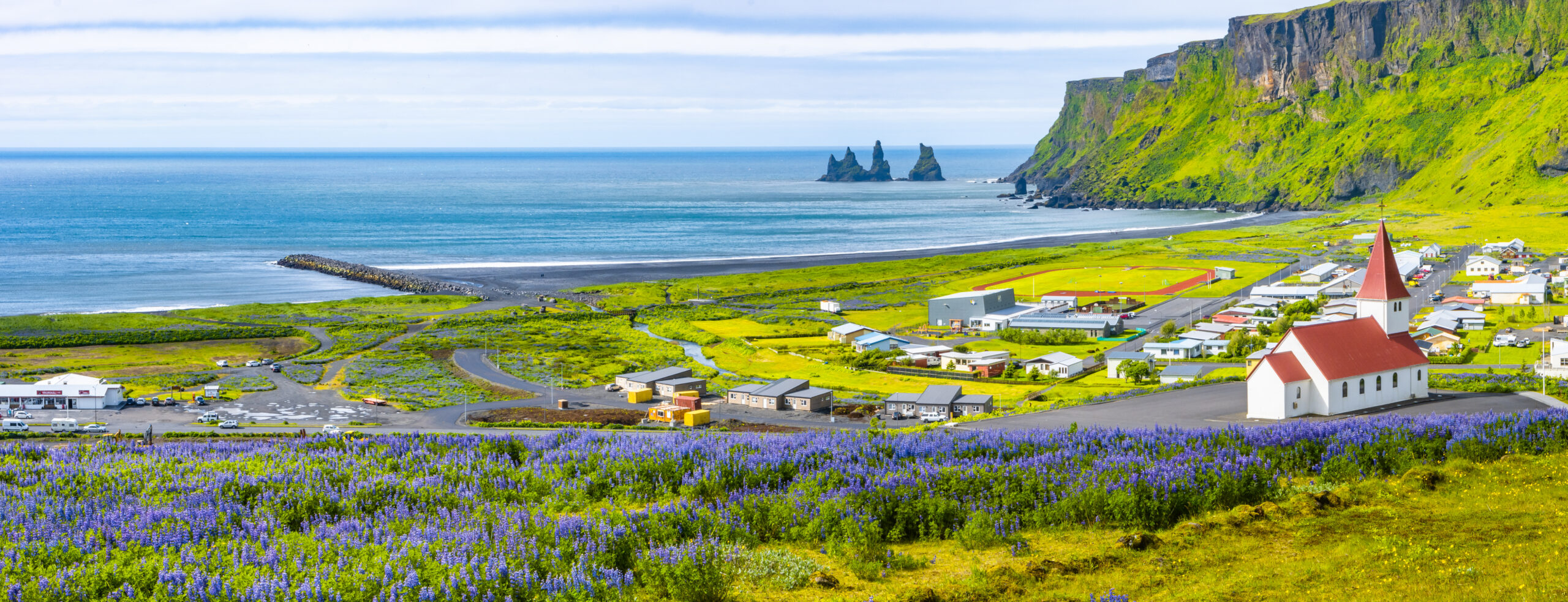
Vik, our base on the south coast. A small, snug town within easy reach of the waterfalls, black beaches, and glacier tours, and a good place to wait out a storm.
Base yourself well. We stayed in Vik and loved it. As a small south-coast town, it puts the waterfalls, black beaches, and glacier tours within an easy drive, and it is a snug place to retreat to when a storm rolls through. Pair this trip with our mountain weather and navigation guides, and browse the wider best hiking regions for when you plan the summer return.
Plan the trip
Where to stay on the south coast
Basing yourself in a town like Vik or Reykjavik keeps you close to the open roads and gives you somewhere warm to wait out a storm. Booking flexible lodging and your flights early makes a weather-dependent trip far less stressful.
Disclosure: the link below is an affiliate link. If you book through it, Global Summit Guide may earn a small commission at no extra cost to you. It does not affect what we recommend.
The questions hikers ask most before a March trip.
Can you hike in Iceland in March?
Yes, but it is winter day-hiking, not summer trekking. The Highlands and all F-roads are closed until summer, so multi-day routes like Laugavegur are out. You can do day hikes and walks near the open main roads, mostly along the South Coast and around Reykjavik, with traction for ice and a close eye on the weather.
How cold is Iceland in March?
Coastal temperatures hover around -2 to 3 C (28 to 37 F), but wind is relentless and the wind chill makes it feel far colder. The Highlands are much colder, often -10 to -20 C (14 to -4 F). The wind matters more than the number on the forecast.
How much daylight does Iceland get in March?
Far more than its reputation suggests: about 10 hours early in the month rising to around 13 by the end, with the equinox near March 21. That is plenty for day hikes, and the dark evenings still offer the northern lights, especially early in the month.
Is the Laugavegur trek open in March?
No. Laugavegur and the other famous Highland treks are summer routes, typically walkable only from around late June to September. In March the interior is snowbound and the F-roads are closed. For a hut trek, come back in summer.
Do you need microspikes or crampons?
Yes. Trails, paths, and even car parks are frequently iced over, so microspikes or trail crampons over sturdy waterproof boots are close to essential, paired with a fully windproof and waterproof shell. Wind protection matters as much as insulation.
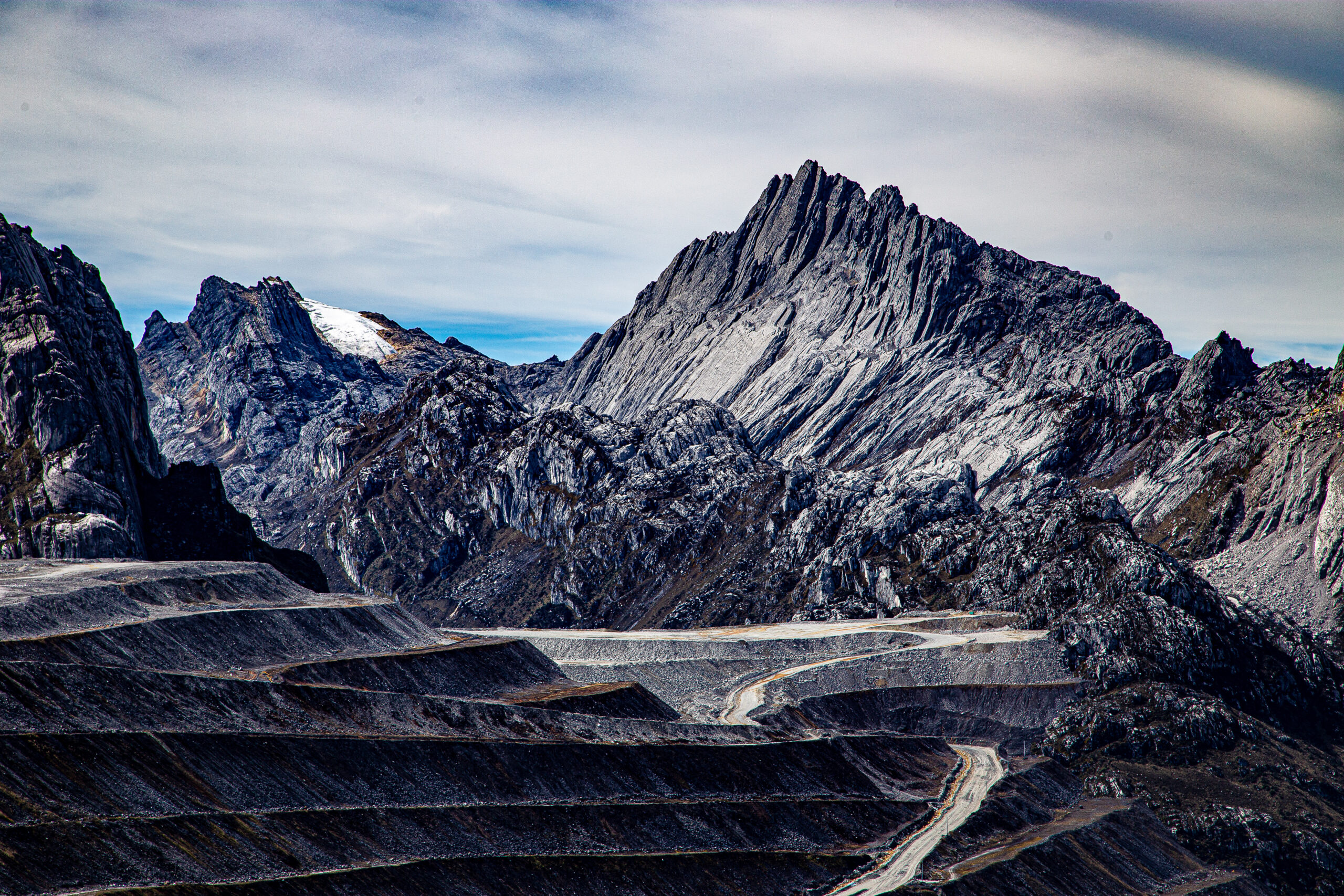
Puncak Jaya · Adobe Stock · Global Summit Guide media library
Carstensz Pyramid · Central Papua · Permit and access report
Puncak Jaya 2026: Permit Realities, Helicopter Access and the Go/No-Go Decision
Carstensz Pyramid is not reliably “open” or “closed” in the way a normal park trail is. In 2026, legal access depends on an Indonesian operating partner, overlapping permissions, a functioning helicopter plan, local security approval and conditions that may change after you pay.
Built from current government travel guidance, Indonesian immigration information, commercial schedules and operator-published logistics. Global Summit Guide has not climbed Puncak Jaya.
Template 5.0 current-status reviewVerified July 18, 2026
Next scheduled review: September 2026 or immediately after a material access change.
2026 status
Conditional commercial access exists—but approval and departure are never guaranteed.
At least one major international operator has published a sold-out October 2026 departure, and Indonesian-supported commercial programs continue to market helicopter access. That means the mountain is not universally closed. It does not mean a climber can independently obtain a ticket, arrive in Timika and proceed to base camp.
The accurate planning phrase is: operator-managed access may operate when permits, security authorization, helicopters and weather align.
Current government warning
Puncak Jaya is in Central Papua. As of July 7, 2026, the U.S. Department of State says “Do Not Travel” to Central Papua and Highland Papua. The United Kingdom also advises against all travel to those provinces. Those warnings are broader than one climbing route and must be considered before booking, especially because consular and emergency assistance may be limited.
4,884 mSummit elevation
Level 4U.S. Central Papua advisory
HelicopterDominant 2026 access
TimikaMain staging city
ConditionalOperational status
This page owns
Permit workflow, current access, security advisories, helicopter logistics, insurance exclusions, booking terms and the go/no-go checklist.
The parent guide owns
Elevation, history, general difficulty, standard summit-day overview and the complete Carstensz Pyramid climb guide.
There is no stable public gate status that guarantees a foreign climber can reach the mountain.
On many mountains, “open” means the national park has published a season and the permit website is accepting reservations. Puncak Jaya works differently. The mountain sits inside a politically sensitive part of Central Papua, close to major mining and security infrastructure. A commercial expedition is viable only when the Indonesian operating partner can coordinate the necessary permissions, transport and local acceptance for that specific team and date.
A scheduled departure is therefore evidence of an operator’s intent—not proof that final permission has already been issued. A client may sign a contract months before the final document package is complete. Security officials can also restrict movement or suspend operations closer to departure.
Scheduled
An operator has advertised dates and is collecting deposits. This is the weakest level of certainty.
Permit processing
Passport details and team documents have been submitted through the Indonesian operating structure.
Operationally confirmed
The operator confirms final permission, aircraft availability, local security acceptance and a current departure plan.
Best wording for your own planning Do not ask only, “Is Carstensz open?” Ask, “Does my named Indonesian operating company have a current legal and operational path for my exact team, date, access method and landing area?”
The 2026 permit reality: a package, not one document
The commercial product is an operator-managed authorization chain rather than a simple climbing permit.
Public operator descriptions commonly refer to overlapping national, security, police, provincial and local authorizations. Some commercial materials name Indonesian intelligence, military, foreign-affairs, tourism, national-police and Papua-level approvals. Global Summit Guide treats those agency lists as operator-described permit frameworks, not as a complete public legal checklist that an individual foreigner should attempt to reproduce.
The practical conclusion is more important than the agency vocabulary: a foreign climber should use an experienced Indonesian operator that accepts written responsibility for the complete access package. Western Seven Summits companies normally depend on Indonesian local partners for this work because the permissions, helicopter coordination and regional relationships cannot be delivered from outside Indonesia.
Layer
What it controls
What to ask the operator
Common failure
Immigration
Legal entry and stay in Indonesia
Which visa category fits the expedition and who advises on it?
Assuming an e-VOA is a mountain-access permit
National expedition approval
Foreign team activity and expedition purpose
Which Indonesian entity files the team and when?
No named responsible legal operator
Security clearance
Movement in a sensitive region
What security approvals are included and when are they final?
Partial documents accepted by a sales agent but rejected locally
Police and local coordination
Checkpoint, local movement and team verification
Who meets the team in Timika and handles verification?
Arriving with copies that cannot be confirmed locally
Provincial or regional permission
Central Papua operational acceptance
Is authorization valid for the exact approach and landing area?
A permit package naming the mountain but not the actual access plan
Aviation and landing logistics
Aircraft, passenger manifest and base-camp movement
Which helicopter provider, luggage limit and contingency arrangement apply?
Permits complete but no flyable aircraft or landing authorization
Do not buy a “permit-only” promise without an operating structure. A collection of PDF approvals has little value if no licensed Indonesian company is responsible for your team, no aircraft is committed and no one can resolve a checkpoint or local authorization problem in real time.
How far in advance should the process begin?
Operator timelines vary. The safest planning assumption is several months, not several weeks. Even when a company markets a shorter nominal processing window, it still needs passport data, photographs, team details, planned dates, access method and internal coordination. Permit timing may also determine when large nonrefundable helicopter or partner payments are released.
Ask when your documents will be submitted, when the operator expects preliminary acceptance, when final confirmation normally arrives and what happens if approval is still pending when your balance is due.
Your Indonesian visa is separate from Carstensz permission
Immigration approval answers “May you enter Indonesia?”—not “May you enter a restricted Central Papua expedition area?”
Indonesia’s Directorate General of Immigration publishes tourist visa and electronic visa-on-arrival options for eligible nationalities. A B1 visitor visa, for example, permits tourism and an initial stay of up to 30 days under its conditions. That can solve the ordinary immigration requirement for many travelers.
It does not replace the mountain-access package. A climber can be lawfully present in Bali, Jakarta or Timika and still lack permission to proceed toward Puncak Jaya. Conversely, an operator cannot fix an incorrect immigration status merely by holding mountain approvals.
Climber responsibility
Valid passport and correct personal information
Appropriate Indonesian visa or entry status
Return or onward travel documentation where required
Compliance with visa conditions
Operator responsibility
Complete expedition and regional permission package
Security and local coordination
Helicopter manifest and operational documents
Current confirmation that the team may proceed
Request one written document checklist Your operator should distinguish documents you personally obtain from documents it obtains on your behalf. Every line should show the responsible party, submission deadline, expected confirmation point and refund consequence if the item is denied.
Puncak Jaya’s position above equatorial forest creates a rare combination of tropical access, high-altitude rock climbing and weather-dependent aviation. Adobe Stock · Global Summit Guide WordPress media library
Helicopter access is the dominant commercial model
For international 2026 programs, Timika-to-base-camp aviation replaces the traditional multi-day overland approach.
Major commercial programs describe charter flights into the Papua highlands followed by helicopter movement to the Yellow Valley base-camp area. One established international operator markets a fly-in, fly-out itinerary and says it uses helicopters because they reduce dependence on local trekking logistics, health exposure and limited emergency options. Indonesian specialists similarly describe helicopter access from Timika as their standard operating model.
The flight itself may be short, but the operational chain is not. Clouds can close the route. Helicopters may be committed elsewhere. Passenger and luggage limits can force multiple rotations. A team may reach base camp while its baggage is delayed—or wait in Timika while mountain weather appears perfectly clear from a forecast model.
Before departure
Confirm the staging city, hotel, internal flight, baggage transfer and exact point where the operator assumes responsibility.
Flight day
Expect last-minute changes based on cloud, visibility, aircraft readiness and security approval.
After the summit
A successful climb does not guarantee an immediate flight out. Keep food, medication and schedule margin for a delayed extraction.
Questions that expose a weak helicopter plan
Is the helicopter included round-trip in the quoted price?
Which company provides the aircraft?
Is the price based on a minimum number of clients?
Who pays if an extra rotation is needed?
What is the personal and group baggage limit?
How many weather days are included?
What accommodation and meals are covered during delays?
What happens if the aircraft cannot reach base camp?
Is a delayed extraction included or billed separately?
Can the operator substitute another aircraft provider?
A helicopter is an access method—not a safety guarantee. Cloud, rain, visibility, aircraft availability and regional security can prevent evacuation. The team still needs communications, medical capability, additional food and a realistic plan for waiting at altitude.
The jungle approach: historically real, operationally different in 2026
Do not choose an itinerary merely because it advertises the “authentic” overland experience.
The traditional Carstensz approach crossed remote Papuan highlands and rainforest through local communities. It became part of the mountain’s identity: mud, rivers, cultural negotiations, porter logistics and many days of travel before the rock climbing began.
That route is no longer the normal choice for mainstream international expeditions. Several operators explicitly say they do not offer it because of political instability, dangerous river crossings, porter complications, checkpoint risk and the near absence of dependable emergency assistance. The United Kingdom’s travel guidance also notes attacks on aircraft, armed clashes and an unpredictable situation in Central and Highland Papua.
This does not prove that no local journey will occur anywhere in the region. It does mean a foreign client should treat any advertised jungle approach as a materially different risk product. The operator should identify the current route, communities, security plan, evacuation method, local permissions and recent successful team history.
Issue
Helicopter program
Traditional overland approach
Typical international use in 2026
Dominant commercial model
Limited and operator-specific
Duration
Short mountain program plus weather buffers
Several additional approach and return days
Main dependency
Flyable weather and aircraft
Security, local relations, rivers, porters and route access
Medical exposure
Rapid move from low elevation to base camp
Tropical illness, foot problems and prolonged remote travel
Evacuation
Still weather-dependent
Extremely limited along remote approach sections
Client suitability
Experienced Seven Summits climbers with rock skills
Only clients accepting substantially higher logistical and security uncertainty
Security advisories are not a footnote
They may affect the decision to travel, insurance validity, employer rules and the ability to obtain help.
The U.S. State Department’s July 7, 2026 advisory places Central Papua and Highland Papua at Level 4: Do Not Travel because of civil unrest. It says conflict is sporadic but persistent, armed groups have kidnapped foreign nationals and the U.S. government has limited ability to provide emergency services. The United Kingdom advises against all travel to the same provinces and describes regular clashes, attacks involving remote aircraft and a situation that can change quickly.
These are official national risk assessments, not a statement that every village or landing zone is experiencing active fighting at every moment. An operator may reasonably judge that a specific helicopter corridor and mountain program can operate. A traveler may also reasonably decide that the government warning exceeds their acceptable risk.
What an operator can manage
Local intelligence and current communication
Security coordination and checkpoint documents
Choice of access corridor
Schedule changes and cancellation
What an operator cannot eliminate
Regional conflict and government restrictions
Kidnapping or unrest risk
Limited consular assistance
Insurance exclusions written by third parties
Mining and security infrastructure near Puncak Jaya shape modern access. The mountain cannot be planned like an isolated public trailhead. Adobe Stock · Global Summit Guide WordPress media library
Insurance: the policy wording matters more than the logo
A standard high-altitude policy may still exclude the exact reason your Carstensz trip fails.
Climbers often focus on the 4,884-meter elevation and helicopter evacuation limit. Those are important, but Carstensz creates additional questions: civil unrest, warlike activity, kidnapping, government closure, political evacuation, travel against official advice and cancellation after a permit denial.
Some insurers will cover medical treatment while excluding trip cancellation caused by civil unrest. Others may exclude all losses in a destination under a Level 4 advisory. A helicopter benefit may cover medical rescue but not the charter cost of returning a healthy climber after weather or security disruption.
Ask the insurer these exact questions
Is Central Papua covered despite current government advice?
Does traveling against a Level 4 advisory void any benefit?
Are civil unrest and political violence excluded?
Is kidnapping included or excluded?
Does cancellation cover government permit denial?
Does interruption cover a regional closure after arrival?
Is nonmedical helicopter extraction covered?
What altitude limit applies to medical evacuation?
Are technical rock climbing and fixed ropes covered?
Is the full prepaid expedition value insurable?
Obtain answers in writing and keep the policy wording—not merely a salesperson’s email. Use the dedicated mountaineering insurance comparison to understand high-altitude exclusions, then verify the Papua-specific issues directly with the insurer.
Protect your payment before permits are final
The largest financial risk may occur before you reach Indonesia.
Carstensz prices reflect helicopter chartering, specialized permissions, local partnerships and small-group operations. These costs can require early nonrefundable commitments. One large international operator currently lists a $26,000 program with a $5,000 nonrefundable deposit and a nonrefundable balance due 120 days before departure.
That structure may be commercially understandable, but the client should know who bears the loss if permits are denied, the province closes, the Indonesian partner cannot operate or the helicopter plan collapses. “Nonrefundable” is especially consequential when the access environment is politically volatile.
Permit denial
Does the operator refund, postpone, issue credit or keep all committed local costs?
Government closure
Is a closure treated as force majeure, operator cancellation or client cancellation?
Helicopter failure
Who pays for additional hotel days, internal flights, replacement aircraft or a second attempt?
Credit is not the same as a refund. A future-expedition credit may expire, require the same operator, exclude new helicopter surcharges or become unusable if access remains unstable. Read the rescheduling language before paying.
The seven-step go/no-go verification process
Use this sequence before committing a nonrefundable balance.
Name the Indonesian operator
Identify the legal Indonesian company responsible for permits, local movement and aviation. A Western brand may be the seller while an Indonesian company is the actual operator.
Demand the permit scope in writing
Ask what authorizations are included, which are pending, who issues them and what exact activity, team, date and landing zone they cover.
Confirm the visa separately
Use official Indonesian immigration guidance. Do not assume that the visa recommended for a normal holiday automatically fits the operator’s expedition structure.
Audit the helicopter plan
Confirm aircraft provider, minimum group size, luggage, included rotations, delay costs, buffer days and extraction obligations.
Read advisories and insurance together
Compare government warnings with the policy exclusions. Obtain written coverage answers for Central Papua, unrest, kidnapping and political cancellation.
Audit cancellation terms
Separate permit denial, government closure, operator failure, client cancellation, weather delay and helicopter cancellation. They may produce different refunds.
Reconfirm 14 days and 72 hours before departure
Request written confirmation that the expedition remains authorized and operational. Continue monitoring official advisories and be prepared to cancel despite sunk costs.
Green-light standard Proceed only when the named Indonesian operator confirms the team’s permissions, the access method is scheduled, the insurance position is understood, the cancellation exposure is acceptable and the traveler independently accepts the official security warning.
Continue the Carstensz planning sequence
This access page is one part of the cluster. Use the exact page that owns your next decision.
Direct answers to the most important 2026 access questions.
Is Puncak Jaya open for climbing in 2026?
Commercial departures are being scheduled, so the mountain is not universally closed. Access remains conditional on the specific team’s permits, local security acceptance, helicopter logistics and current operational decision.
Can a foreign climber obtain the permit independently?
A practical public self-service system does not exist for the complete 2026 access package. Use a qualified Indonesian operating company that accepts responsibility for permits, regional coordination and transport.
Is a tourist e-VOA enough?
No. Immigration status and expedition access are separate. Follow official Indonesian immigration guidance for entry, while the operator manages the mountain and restricted-area approvals.
Is helicopter access mandatory?
It is the dominant international commercial method rather than a universal legal rule. Several established programs use helicopters exclusively because the overland approach carries substantially greater security and evacuation uncertainty.
Can insurance cover travel to Central Papua?
Possibly, but never assume it. Some policies exclude travel against official advice, civil unrest, political evacuation or kidnapping. Obtain written confirmation referencing Central Papua and your technical climbing activity.
How many buffer days should I keep?
Keep several days beyond the operator’s ideal itinerary. Equatorial cloud can delay the flight in or out, and political or document verification can also alter the schedule.
What we can and cannot verify
There is no single public government page that displays the live approval status for every foreign Carstensz team. Commercial permit descriptions come largely from operators and may use different agency names or package structures. This article therefore distinguishes official travel and immigration guidance from operator-reported mountain procedures.
Confidence: High for current U.S./UK travel warnings, immigration separation and published helicopter programs. Medium for the precise agency-by-agency permit chain because public regulatory transparency is limited and operator descriptions differ.
Last checked: July 18, 2026. Next review: September 2026 or immediately after a government advisory or access change.
Plan the Indonesia travel portion separately
Expedition permits and helicopters should remain under the climbing operator. Hotels and ordinary travel before or after the expedition can be compared separately, provided the bookings remain flexible.
Global Summit Guide separates facts that are publicly verifiable from operator claims and estimates. For Carstensz, that distinction is essential: official governments publish travel and immigration rules, while the practical mountain-access chain is usually described by commercial operators.
Do not book Carstensz on the strength of a date and price alone.
The decision is complete only after you understand who holds the permits, how the helicopter is secured, what the government advisory means for you, which losses insurance excludes and what happens to your money if access changes.
💬 Reader Stories · Tier A Engagement · Wasatch Wisdom
What Mountain Was Your Biggest Mistake?
I made a serious mistake on a Wasatch peak a few years back. Here’s what happened, what I learned, and the question I want you to answer in the comments.
By Travis Ludlow, Editor · Global Summit Guide · Published July 1, 2026 · Reading time 9 minutes
It was 1:47pm when I realized I had made a serious mistake.
The sky over the Wasatch had been clear blue all morning — and then, in the span of about twenty minutes, it wasn’t anymore. Cumulus clouds piled up over the summit ridge while I was still a quarter mile below it, and I could already feel the static in the air. The kind of static that means lightning is building somewhere I couldn’t yet see.
I had three choices. Turn around and descend. Push hard for the summit and gamble on outrunning the storm. Find shelter and wait it out.
I made the wrong choice.
The Mistake
I started Mount Timpanogos from the Aspen Grove trailhead that morning at 7am. The standard advice for Timp in summer is a 4am or 5am start — get to the summit by 10am, off the ridge by noon. I knew this rule. Every Utah hiker knows this rule. But the weather forecast looked clean, my friend and I had been talking about climbing Timp for months, and we figured a 7am start would still get us to the top by 11am or noon.
We were wrong about the time. The Aspen Grove route is about 15 miles round trip with nearly 5,000 feet of gain — and we were both more tired than we expected. By 1pm we were still half a mile below the summit ridge.
That’s when the clouds started building.
Cumulus clouds over a Wasatch summit ridge are not “maybe” thunderstorms. They are “definitely, within the next hour” thunderstorms. The discipline most Utah climbers eventually learn is to treat a single cumulus cloud over the ridge as a turnaround signal — not a “let me push another 15 minutes and see” signal.
What Summit Fever Sounds Like in Your Head
Here’s the part I want to be honest about. When you’re 500 feet below the summit of a peak you’ve been planning for months, your brain stops thinking clearly. It starts running internal arguments that sound reasonable but aren’t:
“We’re so close — just push to the top.”
“The storm might not actually break here.”
“We can outrun it on the descent.”
“This far up, turning around feels worse than the risk.”
None of these arguments are real arguments. They are summit fever — the cognitive bias that makes climbers throw away good judgment because they’ve invested time and effort and want the reward. Summit fever has killed more people than any other psychological factor in mountaineering. It killed climbers on Everest in 1996. It kills hikers in the Wasatch every summer. And it almost cost me that day.
We pushed on. We made the summit at 1:30pm. By 1:47pm we were on the descent and the first real thunder cracked maybe two ridges to our north.
⚠ The Storm — What Happened Next
We got caught above treeline on the exposed ridge for about 25 minutes. The storm itself was brief but intense — hail, wind, lightning striking somewhere I couldn’t see but could feel in the static and hear in the thunder cracks 4-7 seconds away. We hunkered down behind a cluster of boulders, crouched low with feet together, kept distance from each other. The storm moved through. We descended fast. We got down safely.
It could have ended very differently. The standard fatality scenario in the Wasatch is one I narrowly avoided. People die on these peaks every summer doing exactly what I did.
What I Should Have Done
Lesson 1
Started Three Hours Earlier
A 4am start with headlamps for the first hour would have put us on the summit at 9am — well before the cloud buildup began. Headlamps are uncomfortable. Storms are dangerous. The trade is obvious in retrospect.
Lesson 2
Turned Around at the First Cloud
The Wasatch summer thunderstorm cycle is one of the most predictable weather patterns in North American mountaineering. When cumulus clouds appear over the ridge, you have maybe 60-90 minutes before the storm breaks. Treat the first cloud as a hard turnaround signal — not a “let me see how the next 20 minutes goes” signal.
Lesson 3
Recognized Summit Fever as a Bias
The “we’re so close” argument is the most dangerous sentence in mountaineering. The mountain will be there next weekend. The mountain will be there next year. There is no mountain worth dying for, and there is no summit worth crossing the line where a 25-minute thunderstorm above treeline could end the climb permanently.
Lesson 4
Built in a Hard Turnaround Time
The discipline I now apply is to set a turnaround time before the climb starts. If we haven’t summited by 11am on a Wasatch peak, we turn around no matter how close we are. Hard rule. No exceptions for “I feel fine” or “the weather looks ok.” Turnaround times work because they remove the decision from the moment when summit fever is loudest. The decision was made hours earlier when you were thinking clearly.
Pre-dawn starts mean watching the sunrise from a high vantage instead of from below. The discipline trade-off in Wasatch climbing is a few hours of sleep against the lightning that builds three to four hours later. The trade favors the early starters every single time.
Five Common Mountain Mistakes I See Other Climbers Making
My Timpanogos mistake fits a pattern. Talk to enough climbers and you start hearing the same handful of mistakes repeated across different mountains, different conditions, and different experience levels. Here are five I’ve seen most often:
1. Starting Too Late
The universal beginner mistake. Especially in the Wasatch, the Colorado Rockies, and any peak with predictable afternoon weather. The fix is the cheapest one in mountaineering: set the alarm earlier.
2. Ignoring the First Weather Signal
The first cumulus cloud. The first wind shift. The first temperature drop. Experienced climbers treat early signals as hard data. Newer climbers treat them as “we’ll see how this develops.” The data wins more often than the wait-and-see approach.
3. Underestimating Water and Food
Most people carry about 30% less water than they actually need. Bonking at 12,000 feet on a Wasatch peak turns a manageable climb into a desperate descent. Carry more than you think you need. Drink more than you think you should.
4. Going Without a Map and Compass
Phones run out of battery. GPS apps lose signal in canyon shadows. Smartwatch trails disappear behind a cracked screen. A paper map and a compass weigh almost nothing and don’t fail. Carry both. Know how to use them.
5. Climbing With the Wrong Partner
The partner who pushes when you should turn around. The partner whose ego won’t accept a retreat. The partner whose fitness level is so different from yours that one of you suffers the whole way up. Climbing partners matter more than gear, more than fitness, sometimes more than experience. Choose carefully.
Most mountain mistakes are not gear mistakes — they are judgment mistakes. The five common patterns above repeat across every range, every difficulty level, and every experience tier. Climbers who learn to recognize their own patterns improve faster than climbers who blame their equipment.
A Word From Dawson
I asked my brother Dawson (the Wilderness First Aid certified one in our family, with first-hand Kilimanjaro Lemosho 2024 and Mount Hood 2026) what his biggest mountain mistake was. His answer:
— Dawson Ludlow, on Kilimanjaro
“My mistake on Kilimanjaro was pushing through mild AMS symptoms on Day 4 instead of telling the guides. I had a headache and some nausea but figured I could tough it out. I summited, but I felt worse than I had to for the next two days. The smarter move would have been a quick word to the guide, an extra dose of Diamox earlier in the day, and slower pacing on the next climb segment. AMS is a system you negotiate with, not a system you tough out.”
Two very different mistakes — mine was time and judgment, his was communication and ego. Both classic. Both fixable. Both stories thousands of other climbers will recognize from their own climbs.
Now — What’s Your Story?
What was your biggest mountain mistake? The peak that nearly broke you. The bad call you got away with. The lesson you learned the hard way.
Drop it in the comments below. Specific is better than general. Honest is better than polished. The best comments here will become an entire follow-up post in two weeks — and we want yours in it.
📝 Tell us: the mountain, what happened, what you should have done, and what you learned. Two paragraphs is plenty.
Common Questions
What is the biggest mistake beginners make on mountains?
The single biggest mistake beginners make is starting too late. Afternoon weather windows close fast on alpine peaks — Wasatch summer thunderstorms typically build between noon and 2pm, and getting caught above treeline with lightning building is the most dangerous situation a Utah hiker can be in. Pre-dawn starts solve most of this. The second biggest mistake is summit fever: continuing toward the summit when conditions clearly say turn around. Mountains will be there next weekend. Climbers who develop the discipline to turn around live longer than climbers who do not.
Why are Utah Wasatch peaks dangerous in summer afternoons?
Utah Wasatch peaks are dangerous in summer afternoons because of the predictable thunderstorm cycle. Warm air rises from the valley floor through the morning hours. By late morning, cumulus clouds start building over the Wasatch crest. Between noon and 2pm those cumulus clouds become thunderstorms with lightning, hail, and sometimes brief but intense rainfall. Hikers caught above treeline (around 10,000 feet in the Wasatch) face direct lightning exposure with limited shelter. The standard discipline is summit by 10am, off the ridge by noon. Climbers who ignore this rule sometimes get away with it. Sometimes they do not.
How early should I start a Wasatch peak in summer?
Start a Wasatch peak between 4am and 6am in summer depending on the route length. Mount Timpanogos via Aspen Grove (about 15 miles round trip with 4,900 feet of gain) demands a 4am-5am start to summit by 10am. Mount Nebo (about 8 miles with 3,500 feet of gain via North Peak) can start at 5am-6am. Pfeifferhorn from White Pine trailhead (about 10 miles with 4,000 feet of gain) needs a 5am start. The principle is consistent: be off the exposed ridge before noon. Headlamps for the first hour of the climb are a small inconvenience compared to the alternative.
What should I do if I get caught in a thunderstorm on a mountain?
If you get caught in a thunderstorm above treeline, immediately descend below ridgelines and summits. Lightning strikes the highest point in the area — your job is to no longer be that point. Find a low spot if possible. Crouch low with feet together to minimize ground contact in case of a nearby strike. Stay away from metal objects (trekking poles, ice axes, climbing gear). Do not shelter under isolated trees, in shallow caves, or against rock walls. Spread out from your group so that a single strike cannot incapacitate everyone. Wait for the storm to pass — most Wasatch summer thunderstorms move through in 20-40 minutes — then descend immediately. Do not attempt to resume the climb.
About The Author
Travis Ludlow
Editor, Global Summit Guide · Nephi, Utah · First-hand: Pico de Orizaba 5,636m + Iztaccíhuatl 5,230m + Utah-Wasatch alpine
Travis Ludlow edits Global Summit Guide from Nephi, Utah, where the Wasatch and surrounding ranges have provided most of his first-hand climbing education — including the mistake described in this post. He has first-hand mountaineering experience on Pico de Orizaba (Mexico’s highest peak, 5,636m), Iztaccíhuatl (5,230m), and Utah-Wasatch alpine rock and snow climbing. The editorial team includes Dawson Ludlow (Wilderness First Aid certified, Kilimanjaro Lemosho 2024 first-hand, Mount Hood South Side 2026 first-hand) and Walker Ludlow (gear reviewer), plus the Ludlow family Torres del Paine W Trek east-to-west 2025 first-hand Patagonia coverage.
What Mountain Was Your Biggest Mistake? · Tier A engagement post · v4.0 build · Published July 1, 2026 · Travis Ludlow, Editor · First-person voice with reader comment invitation · Plan a follow-up post in 2 weeks featuring the best reader stories from this comment thread
Kings Peak via Henrys Fork: Our 3-Day Backpack to Utah’s Highest Summit | Global Summit Guide
Trip Reports / Utah
Kings Peak via Henrys Fork: our 3-day backpack to Utah’s highest summit
Written byGlobal Summit Guide Editorial Team
ClimbedAugust 2023 · Summited Day 2
Reading time14 minutes
13,528 ft
Utah high point
29 mi
Round trip
3 days
Standard itinerary
~4,100 ft
Total elevation gain
★Part of the HubThis Kings Peak trip report sits inside our master mountaineering reference covering routes, training, gear, and trip guides for every major peak and high-point objective.Visit the Hub →
If you live in Utah and you are serious about mountains, Kings Peak is the rite of passage. At 13,528 feet it is the state high point, it is non-technical, and the Henrys Fork approach is the cleanest route in. We had done bigger peaks (Aconcagua, Kilimanjaro) but had somehow never climbed our own state’s high point until late August 2023. Three days, 29 miles, one boulder field that lasts an hour and a half, and a summit ridge with views all the way into Wyoming. This is the unedited trip report. What worked, what we underestimated, and what we would do differently next time we drove the 3 hours up from Salt Lake. The full peak-by-peak progression framework that this trip slots into lives in our master mountaineering hub.
The route at a glance
Kings Peak sits at the eastern edge of the Uinta Mountains in the High Uintas Wilderness of northeastern Utah. The Uintas are the only east-west running major mountain range in the lower 48, a strange geographic detail that becomes obvious once you are standing on Anderson Pass looking down into both Painter Basin (south) and Henrys Fork Basin (north). The mountain is approached from three sides: Henrys Fork from the north (the most popular), Yellowstone Creek from the south (longer, less traveled), and the Uinta River drainage from the southeast (rarely used). Henrys Fork is the standard route because it is the shortest at 29 miles round trip and the trailhead at 9,400 feet starts you within reach of a single backpacking day to Dollar Lake.
The trailhead is in Wyoming, which surprises first-time visitors. You drive 3 hours from Salt Lake City east on I-80 across the state line, exit at Lyman, drop south through Mountain View on Wyoming 410, and then follow the dirt Forest Road 17 for the final 15 miles to the Henrys Fork Trailhead in the Ashley National Forest. No fees, no permits, just a self-registration kiosk at the trailhead. From there, the trail follows Henrys Fork creek upstream through forest and meadow for 8 miles to Dollar Lake at roughly 10,800 feet, then continues another 4 miles climbing through Gunsight Pass into Painter Basin and up to Anderson Pass at 12,800 feet. From Anderson Pass, the summit ridge runs 1.5 miles of class 2 boulder hopping to the 13,528-foot summit.
Phase 1: the drive and the trailhead (Day 0)
Day 0
Salt Lake City to Henrys Fork Trailhead
3 hours driving, 9,400 ft trailhead
FridayTrailhead camp
We left Salt Lake at 2 PM on Friday and rolled into the Henrys Fork Trailhead campground around 5:30 PM. The drive is straightforward until the last 15 miles, which run on dirt Forest Road 17 from Mountain View, Wyoming. The road is passable by any car in dry conditions but becomes hard work after rain. There is no cell signal from Mountain View onward, so download offline maps before you leave.
The trailhead has a small campground with vault toilets and primitive sites scattered along the access road. Cost is around $10 per night per site. We grabbed a spot, set up the tent, and ate a quick dinner at the truck. The mosquitoes were thick at the trailhead in late August (this was a wet year), and we burned through more bug spray in 30 minutes at the trailhead than we did the entire rest of the trip above tree line. Recommendation: pack permethrin-treated layers if you are going during peak mosquito season, which in the Uintas is roughly mid-July through mid-August.
Phase 2: backpacking in to Dollar Lake (Day 1)
Day 1
Henrys Fork Trailhead to Dollar Lake
8 miles, 1,400 ft gain
Saturday5-6 hours backpacking
We started hiking at 8 AM. The first 3 miles climb gently through lodgepole pine forest along Henrys Fork creek, gaining about 600 feet to Elkhorn Crossing. The trail crosses the creek twice in the first 4 miles. In late August the water level was low enough to rock-hop both crossings without changing footwear. In early summer (June and early July), expect to wade or use stepping logs that are often submerged. The trail is well-maintained, well-marked, and easy to follow.
Past Elkhorn Crossing the forest opens into the broad Henrys Fork meadows. This is the visual payoff of the approach: the upper Uinta basin stretching south, the cathedral walls of Henrys Fork Peak on the right (the rounded high mountain that frames the basin), and Kings Peak itself visible far to the south as a dark, blocky summit. Dollar Lake sits at about 8 miles in, roughly 10,800 feet, on a small bench just east of the main trail. Most people camp here. Some push 1 to 2 miles further to Henrys Fork Lake at 10,900 feet for a shorter summit-day approach. We chose Dollar Lake for the views. The backpacking kit that makes a trip like this work is detailed in our expedition pack guide, our layering systems article, our trekking poles guide, and the broader gear context in our crampons and ice axes guide for the snow conditions that linger early season.
Dollar Lake, ~3 PM Saturday afternoon
We had been climbing for six hours, complaining the whole time about pack weight. Then we crested the small ridge above the lake, and Kings Peak was sitting right there at the south end of the basin, perfectly framed between the ridgelines. Suddenly nobody was complaining anymore.
Camp setup at Dollar Lake means following standard High Uintas Wilderness regulations: camp at least 200 feet from water, no campfires above 10,800 feet (Dollar Lake is right at that line, so practically no fires), and pack out all waste including used toilet paper. The mosquito situation was much better than at the trailhead. The afternoon thunderstorms missed us, but we could see lightning on the ridges to the east starting around 4 PM. We ate dinner early, did our gear prep for summit day, and were asleep by 9 PM.
Phase 3: summit day (Day 2)
Day 2
Dollar Lake to Kings Peak summit and return
14 miles, 2,700 ft gain
Sunday~10 hours total
We left camp at 5:00 AM in headlamp light. The summit day timing is the single most important decision of the trip: be off the exposed summit ridge before 1:00 PM, when the standard Uinta afternoon thunderstorms start firing. We aimed for a 10 AM summit, which gave us 3 hours of buffer to be back below Anderson Pass before the lightning risk built up. Some groups push for a 9 AM summit. Either works. A noon summit attempt is asking for trouble.
The trail from Dollar Lake climbs gradually through Henrys Fork Basin for the first 2 miles to Henrys Fork Lake (10,900 feet). From there it steepens toward Gunsight Pass at 11,888 feet. The view from Gunsight Pass is one of the highlights of the whole trip: looking south into Painter Basin and the upper Uinta drainage with Kings Peak rising at the southwest corner. The boulder field on the summit ridge is visible from here, which is sobering. From Gunsight Pass, the trail drops 300 feet into the basin then climbs steadily for the next 1.5 miles to Anderson Pass at 12,800 feet.
Anderson Pass is where the trail ends and the route begins. The summit ridge runs 1.5 miles roughly west to the Kings Peak summit, all of it class 2 boulder hopping over car-sized blocks of quartzite. There is no exposure (the ridge is wide and the drops on either side are gentle), but the cumulative fatigue is significant. We averaged about 0.7 miles per hour on the boulder section. Trekking poles helped on the easier parts and were a nuisance on the larger blocks. Most experienced hikers stow them after the first 10 minutes of bouldering.
Kings Peak summit, 10:15 AM
The summit register is bolted to a USGS marker on a flat slab at the high point. We signed our names, took the obligatory summit photographs, and looked east. The view stretches all the way into Wyoming, out to the Wind River Range, with the entire eastern Uinta basin spread out below. The most striking thing is how flat the surrounding terrain is once you are this high: Kings Peak is meaningfully taller than anything around it for fifty miles in any direction.
We spent 25 minutes on the summit, ate a quick lunch, and started the descent at 10:45 AM. The boulder hop on the way down was actually harder than the way up: tired legs, less concentration, more weight on the knees with each step. Two of our group rolled ankles within the first 20 minutes. We slowed the pace, took breaks every 15 minutes, and reached Anderson Pass at 12:15 PM. Lightning was visible on the high ridges to the east as we descended, which validated the early-start strategy. We rolled back into camp at Dollar Lake at 3:30 PM, exhausted but with the summit secured. The altitude physiology that makes a 13,528 foot summit meaningful even for Utah-acclimated hikers is detailed in our altitude acclimatization explainer, with the symptoms framework in our altitude sickness guide and the broader peak progression context in our conquer-peaks mountaineering hub.
Phase 4: packing out (Day 3)
Day 3
Dollar Lake to Henrys Fork Trailhead
8 miles, mostly downhill
Monday4-5 hours backpacking
The pack out is the easiest day of the trip. We broke camp at 7:30 AM, hiked the 8 miles back to the trailhead by noon, and were sitting in a diner in Mountain View by 1:30 PM eating something that involved bacon. The 3-hour drive back to Salt Lake got us home by 5:30 PM, exactly 72 hours after we had left on Friday.
The descent through Henrys Fork basin in the morning light is beautiful in a different way than the inbound trip. The angle of light hits the wildflower meadows from the east instead of overhead, and the entire basin glows for the first hour after sunrise. The mosquitoes at the trailhead were just as aggressive on the way out as they had been on Friday, which was a fitting reminder of where we had been.
What it actually cost us
Per-person spending for the 3-day Kings Peak trip
Total: roughly $150 to $250 per person for 3 days. Kings Peak is one of the cheapest meaningful peak experiences in the American West, mostly because the trailhead is free, the wilderness is free, and the distance from Salt Lake (3 hours) keeps fuel costs low. The biggest variable is gear: if you already own backpacking equipment, the trip is essentially food, fuel, and the trailhead campground. Solo hikers spend more (no shared fuel or food), groups of 4 to 6 share most costs.
Line item
Per person
What it covered
Gas (Salt Lake to Henrys Fork, round trip)
~$35
~360 miles total, shared 4 ways
Trailhead campground (1 night)
$3
$10 site shared 4 ways
Permits and park fees
$0
None required
Food (3 days backpacking)
$45
Mix of dehydrated meals and snacks
Fuel (canister) and shared cooking
$8
Half canister per person
Diner stop on the way home
$25
Real food in Mountain View
Bug spray and odds and ends
$10
Permethrin spray, batteries
ALL-IN PER PERSON
~$126
3-day trip total
Add gear if you do not already own it: a 3-season backpacking tent ($200-$500), a 60-70L pack ($200-$350), a 20-degree sleeping bag ($150-$350), a sleeping pad ($80-$150), a stove and pot system ($60-$120), and trekking poles ($60-$150). A complete kit from scratch runs $750-$1,600. Most Utah backpackers build this kit incrementally over a few seasons. The full backpacking and climbing kit framework lives in our expedition gear list, with the specialized items broken out in our boots guide and our sleeping bags article.
What we would do differently
Six honest takeaways from our trip that we wish someone had told us:
Camp closer to Anderson Pass if you can. We camped at Dollar Lake (8 miles in, 10,800 feet). Several groups we passed had pushed another 2 to 3 miles to camps at Henrys Fork Lake or even higher in the basin. The summit day from Henrys Fork Lake is roughly 2 hours shorter round trip, which means a 7 AM start gets you the same 10 AM summit window with less pre-dawn hiking. Trade-off is a heavier first day and a slightly less scenic camp.
Treat the mosquitoes seriously. Permethrin-treat your hiking pants and long-sleeve shirts before you leave. DEET works in the moment but wears off. A bug net hat saves the morning and evening hours at camp. We did not do enough on this and paid for it.
Start summit day at 5 AM, not 6. An extra hour of buffer before the 1 PM thunderstorm window is the difference between a relaxed summit and a frantic descent. Headlamps are a small investment for a much bigger margin of safety.
Watch your knees on the boulder descent. The summit ridge boulder field is harder on the descent than the ascent. We had two ankle rolls within 20 minutes. Take breaks, slow down, and consider knee braces if you have any history of knee issues.
Bring more water than you think. The trail crosses Henrys Fork creek several times and there is water at Dollar Lake and Henrys Fork Lake. From Anderson Pass to the summit there is no water, and the round-trip from camp to summit and back is 6 to 8 hours. We each carried 3 liters and that was barely enough on a hot August day.
Check trail conditions before going. Snow lingers on the north-facing slopes into early July, and the Gunsight Pass area can hold snow even later in cool years. Check the High Uintas Wilderness reports on the Ashley National Forest website before you commit to dates. The mountain weather framework that helps with this decision is in our mountain weather guide.
The thunderstorm risk that locals take seriously
The standard Uinta afternoon thunderstorm pattern is predictable and dangerous. Through July and August, daytime heating in the basins drives convective storms that build over the high ridges starting around 1 PM and peak between 3 PM and 6 PM. Kings Peak sits at the highest point for fifty miles in any direction, which means it attracts lightning preferentially when the storms come through. Hikers have died on the summit ridge from electrical strikes within the past two decades, and the local search-and-rescue teams in Daggett and Summit counties know the pattern well. The protocol is simple: be off the summit by 1 PM. Anyone you meet on the trail going up after 11 AM is taking unnecessary risk.
The good news is that thunderstorm risk is forecastable. The National Weather Service Salt Lake City office issues thunderstorm probability forecasts for the High Uintas zone, and the percentages are usually accurate within plus or minus 20 percent. A day with 40% afternoon thunderstorm probability means most groups have a clean weather window before 1 PM. A day with 70% probability means many groups end up in storms by mid-afternoon. We did not climb on a 70% day. If you are flexible on dates, watching the forecast for a low-thunderstorm-probability window is the highest-impact preparation decision you can make. The cold-weather and storm-safety context that applies above tree line is in our frostbite prevention article and the broader high-altitude framework in our high-altitude training program.
Kings Peak in the broader peak-bagging context
Kings Peak is the second-easiest state high point west of the Mississippi (after Black Mesa in Oklahoma at 4,975 feet). The 50 US state high points are a peak-bagging objective that draws thousands of completers each year, with Kings Peak typically attempted as one of the western Rocky Mountain group. The harder state high points (Denali in Alaska at 20,310 feet, Granite Peak in Montana at 12,799 feet with technical climbing, Gannett Peak in Wyoming at 13,809 feet) require expedition-level commitment. Kings Peak is the gateway state high point that introduces hikers to multi-day backpacking at meaningful elevation without requiring technical climbing skills. The bigger 50-state high point progression and the global 7-Summits framework that often parallels it lives in our Seven Summits guide and our master mountaineering hub.
For Utah climbers, Kings Peak is also the entry point into the High Uintas Wilderness as a backpacking destination beyond a single peak. The Uintas hold dozens of peaks above 12,000 feet, hundreds of alpine lakes, and roughly 1,000 miles of trail. Kings Peak is the most-climbed peak in the range but represents a small fraction of what the wilderness offers. Hikers who complete Kings Peak and want more typically progress to Gilbert Peak, Mount Lovenia, Mount Emmons, or the Painter Basin and West Fork Whiterocks loop. The Uintas reward repeat visits and are the most underrated multi-day wilderness in the lower 48.
After Kings Peak: where to go next
Kings Peak is a great stepping stone if your bigger ambition is high-altitude expedition climbing. The skills it builds (multi-day pack carrying, camping above 10,000 feet, navigating exposed terrain above tree line, managing thunderstorm risk) are foundational for objectives like Mount Whitney (14,505 feet) and the broader Sierra high country. From Whitney the natural progression is Aconcagua, the South American 7-Summits peak we have covered in detail in our Aconcagua trip report and Aconcagua routes guide. The decision framework for picking the next mountain after Kings Peak depends on whether you want to stay in the western US (Whitney, then Rainier or Hood) or skip directly to international objectives (Kilimanjaro or Aconcagua). The framework for that decision is in our Kilimanjaro vs Aconcagua first-7-summit framework.
The bottom line on Kings Peak
Kings Peak is the right first multi-day peak experience for Utah hikers who want to step up from day-hiking. The trail is straightforward, the elevation is real but manageable, the cost is minimal, and the payoff (standing on the highest point in Utah with the entire eastern half of the state spread out below) is genuinely meaningful. The two structural risks (afternoon thunderstorms and the boulder field) are well-understood and avoidable with reasonable planning. Pick a low-thunderstorm-probability window in late July or August, start your summit day at 5 AM, treat your bug spray seriously, and you will likely have a great trip. The cross-region peak progression context that places Kings Peak alongside other mountain objectives lives in our master mountaineering hub, with the broader trekking and expedition framework in our mountaineering for beginners guide.
★ Master Resource
Plan your next mountain trip
Routes, training timelines, gear lists, cost frameworks, and trip reports from every major peak and high-point objective we cover.
Kings Peak via Henrys Fork is moderate for fit backpackers and challenging for casual hikers. The route is 29 miles round trip with roughly 4,100 feet of total elevation gain across 3 days. The trail is non-technical (no ropes, no exposure beyond class 2 boulder hopping on the summit ridge), but the distance, altitude (summit at 13,528 feet), and weather exposure above tree line make it a real undertaking. Most people complete it as a 3-day trip with one night each at Dollar Lake or nearby.
How long does it take to hike Kings Peak?
The standard itinerary is 3 days: Day 1 backpack 8 miles in to Dollar Lake, Day 2 summit (12 to 14 miles round trip including the summit ridge), Day 3 pack 8 miles out. Strong hikers can complete it as a 2-day trip with one night at Dollar Lake or higher. The single-day push (29 miles in one day) is done by experienced peak baggers but is not recommended for first-timers due to elevation exposure and storm risk above tree line.
When is the best time to climb Kings Peak?
Late July through mid September is the standard window. Snow lingers on north-facing slopes and at the higher passes into early July. After mid September, the weather becomes unpredictable and the first snow storms typically hit by late September. Peak conditions are usually the first three weeks of August: trail snow-free, mosquitoes diminishing, and afternoon thunderstorm risk still present but more predictable. Avoid August weekends if you want solitude.
Where is the Henrys Fork Trailhead and how do you get there?
The Henrys Fork Trailhead is at 9,400 feet in the Ashley National Forest, accessed via Mountain View, Wyoming (despite climbing Utah’s high point). Drive from Salt Lake City takes 3 to 3.5 hours: I-80 east into Wyoming, exit at Lyman, drive south on Wyoming 410 to Mountain View, then continue on Forest Road 17 to the trailhead. The last 15 miles of dirt road is passable by 2WD in dry conditions but becomes difficult after rain. No fees, no permits required for the trailhead.
How dangerous are the afternoon thunderstorms on Kings Peak?
Significant. The exposed summit ridge above Anderson Pass is the highest terrain for many miles in any direction and attracts lightning strikes during the afternoon thunderstorm pattern that hits the Uintas almost daily in summer. Standard protocol is to be off the summit by 1:00 PM, which means starting the summit push from Dollar Lake by 5:00 AM or earlier. Hikers caught above tree line during electrical storms have died on Kings Peak. The risk is real and locally well-known.
What is the boulder field on the summit ridge like?
The summit ridge from Anderson Pass to Kings Peak is roughly 1.5 miles of class 2 boulder hopping. The boulders are car-sized in places and require continuous attention to foot placement. No exposure (the ridge is wide), no climbing skill required, but the cumulative fatigue of two solid hours of boulder hopping after a long approach is what wears most hikers down. Trekking poles are mixed: useful for balance but a pain to manage on the larger blocks. Most experienced hikers stow them on the boulder section.
Do you need any permits for Kings Peak?
No permits required. Henrys Fork Trailhead is on Ashley National Forest land with no fees, no quota system, and no advance registration. Standard wilderness regulations apply: groups limited to 14 people, camp at least 200 feet from water, no campfires above 10,800 feet in the High Uintas Wilderness, and pack out all waste. The free trailhead self-registration at the kiosk is for trail counts and search-and-rescue purposes.
Patagonia in 10 Days: Torres del Paine, Perito Moreno, and Mount Fitz Roy | Global Summit Guide
Trip Reports / Patagonia
Patagonia in 10 days: Torres del Paine, Perito Moreno, and Mount Fitz Roy
Written byGlobal Summit Guide Editorial Team
TraveledMarch 28 – April 6, 2025
Reading time16 minutes
10 days
Total trip length
2 countries
Chile + Argentina
4 parks
National parks visited
~$2.8K
Per person all-in
★Part of the HubThis Patagonia trip report sits inside our master mountaineering reference covering routes, training, gear, and travel guides for every major peak and region.Visit the Hub →
We had been talking about Patagonia for years before we actually booked it. The reality of getting there from Salt Lake City is what keeps most people away: it takes nearly 24 hours of flying to land in Punta Arenas, and the trip needs to be at least 8 days to justify the travel. We carved out 10 days at the end of March 2025, picked up Taylor and Helena in Santiago on Day 3, and ran the Chilean and Argentine highlights back to back: Torres del Paine for two days, Perito Moreno glacier, then Mount Fitz Roy from El Chaltén. This is the unedited trip report. What we actually paid, what we wish we had done differently, and the moment at Laguna de los Tres that none of us will forget. The broader expedition context for South American climbing lives in our master mountaineering hub, with the Andes climbing arc in our Aconcagua routes guide.
The route at a glance
Patagonia is two countries: Chilean Patagonia (Torres del Paine, Puerto Natales, Punta Arenas) and Argentine Patagonia (El Calafate, Perito Moreno, El Chaltén, Mount Fitz Roy). The standard 10-day trip works one country at a time, crossing the border at Cancha Carrera between Days 5 and 6. We flew into Santiago, transferred south to Punta Arenas the same day Taylor and Helena landed (Day 3), drove 2.5 hours to Puerto Natales, spent 2 full days in Torres del Paine, drove 3.5 hours across the Argentine border to El Calafate on Day 6, ran Perito Moreno on Day 7, drove 3 hours to El Chaltén for Day 8, then reversed back to Punta Arenas and Santiago for the return. Total ground covered: roughly 1,400 km of driving, two international border crossings, and four national parks.
If you only have a week, pick one country. The Chile-only version (Torres del Paine focus) is roughly 7 days and skips El Calafate and Fitz Roy. The Argentina-only version (Perito Moreno plus El Chaltén) is also 7 days and skips Torres del Paine. Doing both in under 10 days is possible but feels rushed. Ten days was the right amount of time for our group, with one buffer day for weather or fatigue.
Phase 1: getting there (Days 1-3)
Day 1
Salt Lake City to Santiago, Chile
Direct LATAM flight, 11 hours
Friday11:35 AM departure
The LATAM nonstop from Salt Lake to Santiago is the cleanest US-Patagonia routing if you live in the Mountain West. It is an 11-hour overnight flight that lands at 6:40 AM the next morning, putting you on the ground with most of Day 2 still ahead. We left SLC on Friday, March 28 at 11:35 AM and landed in Santiago at 6:40 AM Saturday morning. We had pre-booked the Holiday Inn Santiago Airport for an early check-in so we could clean up and grab a few hours of horizontal sleep before exploring.
Day 2
Recovery day in Santiago
Santiago, Chile
SaturdayBuffer day
We took the Day 2 buffer instead of trying to push straight to Patagonia. After the overnight flight, the smart play is to use the half-day to walk around Santiago (Plaza de Armas, Cerro San Cristóbal, the Bellavista neighborhood) and reset your sleep cycle before heading south. The Holiday Inn Santiago Airport made airport return easy the next morning. We slept early to be ready for the Day 3 departure to Punta Arenas.
Day 3
Santiago to Puerto Natales
LATAM SCL-PUQ, then 2.5h drive
Sunday12:40 PM departure
Taylor and Helena landed in Santiago at 8 AM after their overnight flight from Salt Lake. We met at the gate, grabbed lunch at the airport, and flew LATAM to Punta Arenas (PUQ) departing at 12:40 PM. The flight is a one-stop, just under 5 hours total. Punta Arenas is the southernmost city of Chile and the gateway to Torres del Paine. We picked up the rental VW at the airport (booked through Expedia for the week), grabbed dinner at La Forastera Burgers in Puerto Natales (closes at 9:30 PM), stopped at the local grocery store for breakfast and lunch supplies, and checked into our Airbnb in Puerto Natales.
The 2.5-hour drive from Punta Arenas to Puerto Natales runs through open Patagonian steppe. Guanacos grazing along the road, the occasional rhea, and very little traffic. The terrain feels like Wyoming high plains turned up to a different scale. We arrived in Puerto Natales just before sunset and the light over Lago Sofía was the first proper “we are in Patagonia” moment of the trip.
Phase 2: Torres del Paine (Days 4-5)
Day 4
Base Torres Hike: the three towers
Torres del Paine NP, ~20 km, 800m gain
Monday8 hours total
This was the hike we had come for. The Base Torres trail starts at the Hotel Las Torres parking area (1.5-hour drive from our Airbnb in Puerto Natales, including the park entry on the 3-day pass we had bought online). The hike is roughly 20 km round trip with 800 meters of elevation gain. The first two-thirds is moderate climbing through Patagonian beech forest along the Ascencio river. The final hour is a steep rock and boulder scramble up to the lake at the base of the towers. The payoff is one of the most photographed views on the planet, and it earns its reputation.
We started at 7:30 AM, hit the lake around 11:30 AM, spent 90 minutes at the towers, and were back at the car by 4 PM. The wind on the final scramble was strong enough that we hunched against the gusts on the way up. The towers themselves emerged from morning cloud cover at the exact moment we crested the final ridge, which felt cinematic in a way we did not deserve. The three granite spires (Torre Norte, Torre Central, Torre Sur) rising vertically out of the lake do not photograph the way they feel in person. The scale is the part that surprises everyone.
The Base Torres viewpoint, around 11:30 AM
We had been climbing for four hours, mostly looking at our feet on the final scramble. Then the trees opened, the wind hit us square, and the three towers were just there. Right there. No filter, no edit, no zoom. The kind of view that makes you sit down on a rock for ten minutes before you can talk about anything else.
The descent was harder than the ascent on the knees. We were grateful for poles. Back in Puerto Natales by 6 PM, we ate at a restaurant on Avenida Manuel Bulnes and were asleep by 9. The full Torres del Paine route framework and the broader peak-by-peak hiking arc lives in our mountaineering for beginners guide, our expedition gear list, and the multi-day trek preparation framework in our EBC and trekking training plan. The cross-region mountain travel context lives in our master mountaineering hub.
Day 5
Grey Glacier boat excursion
Lago Grey, Torres del Paine NP
Tuesday2h drive each way
The Grey Glacier boat tour through Fiordos del Sur was the right Day 5 choice. It is a 2-hour drive from Puerto Natales to the boat dock at Lago Grey, then a 3-hour boat journey across Lago Grey to the glacier face. The boat costs about 100 to 110 USD per person and you book online ahead of time. We saw icebergs floating in the lake on the inbound leg, watched the boat thread between bergs the size of houses, and reached the 30-meter ice wall at the glacier face about 90 minutes in. The crew handed out whiskey on the rocks (literal glacier ice in the glass) and we stood on deck in the cold wind for the better part of an hour just watching.
The drive back to Puerto Natales runs through the heart of the park. We stopped at the Mirador Salto Grande for the waterfall view, drove past Lago Pehoé and Lago Nordenskjöld, and hit the Mirador Condor overlook for a panoramic view of the Paine Massif at sunset. The Paine Horns, the dark sedimentary spires that the park is famous for beyond the Towers, are unreal in late-afternoon light. By the time we got back to Puerto Natales for dinner, we had spent nearly 12 hours seeing the park from a different angle than Day 4, and it felt complete.
Phase 3: crossing into Argentina (Days 6-8)
Day 6
Puerto Natales to El Calafate
3.5-hour drive, Cancha Carrera border
WednesdayBorder crossing
The drive from Puerto Natales to El Calafate runs through the Cancha Carrera-Cerro Castillo border crossing between Chile and Argentina. Plan for 60 to 90 minutes at the border on top of the driving time. The actual paperwork is straightforward for US citizens (no visa for either country, just stamps in and out), but the queues can be slow and the two countries each have separate posts on either side of the dirt road. We left Puerto Natales at 8 AM, cleared both borders by 11 AM, and rolled into El Calafate around 1 PM.
El Calafate is a tourist town built around Perito Moreno tourism. The main street, Avenida del Libertador, has restaurants, gear shops, and tour offices. We checked into our El Calafate Airbnb, explored the main strip, ate dinner at one of the parrilla restaurants, and called it an early night to be ready for the Perito Moreno full-day on Day 7.
Day 7
Perito Moreno Glacier full day
Los Glaciares NP, 1.5h drive each way
Thursday~10 hours
Perito Moreno is the headline attraction of Argentine Patagonia and it earned the billing. The glacier is one of the only major glaciers in the world that is still advancing rather than retreating, and the calving events (where house-sized chunks break off the 70-meter ice face) happen every 30 to 60 minutes during daytime. We drove from El Calafate at 8 AM, reached the park entrance gates around 9:30, and spent the next 5 hours on the boardwalk system that gives you multi-angle viewing of the glacier face.
The Nautical Safari boat tour (around 90 USD per person, also booked through the official site) takes you within 200 meters of the south face of the glacier. The boat journey is about 1 hour. We stood on the deck the entire time, listened to the ice crack like artillery, and watched a piece the size of a small apartment building fall into the water in front of us. The wave it made traveled across the entire channel and rocked the boat noticeably ten seconds later. We were back at our Airbnb in El Calafate by 7 PM.
From the boardwalk above the south face
The cracking sound is what surprises you. Not a chunk falling, just the ice itself flexing under its own weight. Like a building working in a thunderstorm. You stand there long enough, you start to hear the glacier as a living, breathing thing rather than a postcard image.
Day 8
Laguna de los Tres at Mount Fitz Roy
El Chaltén, 25 km, 800m gain
Friday8-9 hours
The 3-hour drive from El Calafate to El Chaltén runs along Ruta 40 with the Southern Patagonian Ice Field on the horizon for the last hour. El Chaltén is a small mountain town at the trailhead for Mount Fitz Roy and Cerro Torre. We arrived at 9 AM, parked at the southern trailhead, and started the Laguna de los Tres hike at 9:30. The trail runs 12 km one-way through forest, then opens onto an exposed Patagonian valley, and finishes with the most brutal final climb of the entire trip: roughly 400 meters of vertical gain in the last 1.5 kilometers, on loose rock and scree, almost straight up to the lake at the base of Fitz Roy.
The view at the top is the reason we came. Mount Fitz Roy is one of the most dramatic mountain spires on Earth, a vertical granite tooth rising 1,500 meters above the Laguna de los Tres lake. The three peaks (Aguja Saint Exupery, Fitz Roy itself, and Aguja Poincenot) form a continuous ridge that looks impossible to scale. On a clear day the reflection in the lake doubles the drama. We had two hours of clear weather before clouds rolled in, which was enough.
Laguna de los Tres, ~1:30 PM
Dawson opened his mission call at the lake. We had carried the envelope all the way up from El Chaltén, sealed and folded in his pack, waiting for the moment. With Fitz Roy reflected in the water behind him and our group standing around in the wind, he read the assignment out loud. The kind of moment that makes a place mean something for the rest of your life.
The descent took us four hours. We were back at the car by 6 PM, drove the 3 hours back to El Calafate, and rolled into the Airbnb around 9:30 PM. Easily the longest single day of the trip but the highest-payoff hike of the ten days. The full peak-by-peak hiking framework that prepares climbers for days like this is detailed in our high-altitude training program, with the cold-weather kit context in our layering systems guide.
Phase 4: the return (Days 9-10)
Day 9
El Calafate to Punta Arenas to Santiago
5-6h drive plus evening flight
SaturdayTravel day
We left El Calafate at 8 AM, drove back through the Cancha Carrera border (90 minutes total this direction), reached Puerto Natales for lunch, and drove the final 2.5 hours to Punta Arenas to drop the rental car. The 5:10 PM LATAM flight from Punta Arenas to Santiago lands at 8:35 PM. From Santiago, we caught the 11:05 PM LATAM flight back to Salt Lake City. A long travel day, but the only one of the trip where every hour was transit rather than experience.
Day 10
Landing in Salt Lake City
SCL to SLC, 1 PM arrival
SundayTrip complete
The LATAM flight from Santiago arrived in Salt Lake City at 1 PM on Sunday. Total trip time door to door: 10 days. We were home before dinner with photographs we still look at every week, a rental car in our driveway that needed unloading, and a sense that we had done Patagonia about as efficiently as a 10-day itinerary allows.
What it actually cost us
Our per-person all-in spending, March 28 – April 6, 2025
Total: roughly $2,800 to $3,200 per person for 10 days. The breakdown below is what we actually paid for our group of family and friends, with a shared rental car and shared Airbnbs distributing the lodging cost. Solo travelers should expect to pay 30-40% more on lodging and transport. Couples land in the same per-person range as our group of 5.
Line item
Per person
What it covered
International airfare (LATAM SLC-SCL)
$1,483
Round trip, direct nonstop
Domestic flight (Santiago-Punta Arenas)
$297
LATAM, one stop, ~5 hours
Airbnb lodging (shared, 7 nights)
$361
Puerto Natales + El Calafate
Rental car (VW, shared 5 ways, 6 days)
$166
Punta Arenas pickup and return
Torres del Paine 3-day pass
$50
pasesparques.cl online
Grey Glacier boat tour
$105
Fiordos del Sur 3-hour boat
Perito Moreno Nautical Safari
$90
Boat tour to glacier face
Los Glaciares NP entry (2 days)
$40
El Chaltén + Perito Moreno
Food, snacks, dinners (10 days)
~$350
Mix of groceries and restaurants
Hotel night in Santiago + transit incidentals
~$90
Holiday Inn airport
ALL-IN PER PERSON
~$3,030
10-day trip total
The two biggest cost levers are international airfare (40-50% of the total) and group size (the rental car and lodging savings from sharing 5 ways were significant). If you can find shoulder-season airfare under $1,200, or if you travel as a group of 4-6, your per-person all-in can drop to $2,500. Going solo or paying peak summer airfare can push it past $4,000. The broader expedition cost reference framework lives in our mountain climbing costs guide, and the comparable South American expedition cost in our Aconcagua cost breakdown.
What we would do differently
Five honest takeaways from our trip that we wish someone had told us before we booked:
Start the Base Torres hike earlier. We started at 7:30 AM and that was good. Hikers who start at 9 AM hit the final scramble in the heat of the day and run out of time for photographs. The towers light up best in the morning. Aim for a 7 AM start at the trailhead.
Build in a weather buffer day. We were lucky. The weather held for both Torres del Paine and Fitz Roy days. The standard pattern is roughly 60% of days have good visibility on the Towers and 40-50% on Fitz Roy. If we had hit two consecutive cloudy days, our highlights would have been cancelled. Future trips, we would build in one extra day in each location as weather buffer.
Pack for wind, not just for cold. Patagonia is windy in a way that surprises Mountain West hikers. Wind chill on the Base Torres scramble was meaningfully colder than the temperature alone suggested. Bring a windproof shell layer even if the forecast looks mild.
Do not skip the Grey Glacier boat. A surprising number of trip reports skip this in favor of more hiking. It is genuinely one of the highlights of the trip. The boat tour gives you a perspective on the Patagonian Ice Field that you cannot get from any trail.
Stay in El Chaltén overnight for Fitz Roy. We day-tripped from El Calafate and it worked, but driving 3 hours each way on Day 8 with the Laguna de los Tres climb in the middle was punishing. If we had built one more night into the itinerary and stayed in El Chaltén, we could have done the hike fresher and had time for a second hike (Laguna Capri or Cerro Torre viewpoint).
Weather and what we actually packed
Late March is the beginning of Southern Hemisphere autumn in Patagonia. Daytime highs in Torres del Paine and El Chaltén ran 8 to 14°C (mid 40s to high 50s Fahrenheit). Nights dropped to 0 to 4°C in the parks, slightly warmer in the towns. The wind was constant, especially on Day 4 at the Base Torres viewpoint and on Day 8 above tree line near Laguna de los Tres. Rain showed up exactly twice on our 10 days and never enough to cancel anything.
What we packed and used heavily: lightweight wool base layers (top and bottom), a midweight fleece, a windproof shell jacket, water-resistant hiking pants, gloves and a warm hat for the Base Torres scramble, leather hiking boots that were already broken in (not the lightweight trail runners some people recommend; the rocks and roots punish thin soles), trekking poles for the descents, a 35L day pack, a 1L water bottle plus 1L collapsible refill, sun glasses and high-SPF sunscreen (UV is intense even in autumn), and a phone with offline maps from Maps.me downloaded for the Torres del Paine and Los Glaciares park areas. The full gear breakdown that applies to trips like this is in our expedition gear list, our mountaineering boots guide, and our trekking poles guide.
Patagonia in the broader South American climbing arc
Patagonia is not Aconcagua. The two regions get conflated by climbers planning their first South American trip, and they should not be. Patagonia is a hiking, glacier, and photography destination with technical climbing reserved for the world’s best mountaineers (Fitz Roy, Cerro Torre, Torres del Paine main faces are not commercial peaks). Aconcagua is a high-altitude expedition climb on a non-technical route. A 10-day Patagonia trip is the right introduction to South American mountain travel for hikers and photographers. Aconcagua is the introduction to South American high-altitude expedition climbing for mountaineers. Many climbers do both across multiple trips. Our team’s Aconcagua experience is in our Aconcagua summit trip report, with the route framework in our Aconcagua routes guide and the cost breakdown in our Aconcagua expedition cost breakdown.
The decision logic for picking between a Patagonia trip and an Andes expedition like Aconcagua is essentially: how much altitude exposure, technical mountaineering, and commitment are you ready for? Patagonia is the lower commitment with photography-grade payoff. Aconcagua is the higher commitment with 7-Summits resume payoff. Both are worthwhile. The bigger 7-Summits framework that puts both in context lives in our Seven Summits guide, our Kilimanjaro vs Aconcagua first-7-summit framework, and the entry-point trekking option in our Kilimanjaro climbing guide. The cross-peak peak progression reference lives in our conquer-peaks mountaineering hub.
The bottom line on a 10-day Patagonia trip
If you have the budget and you have 10 days, do Patagonia. It is the most photogenic mountain region we have visited, the autumn shoulder season is the ideal time to go, and the logistics work cleanly from the Mountain West with the LATAM direct routing. Plan for at least one weather buffer day, start hikes early, do not skip the Grey Glacier boat tour, and consider staying overnight in El Chaltén for the Fitz Roy day. The full peak-by-peak travel framework that places this trip alongside other major mountain travel destinations lives in our master mountaineering hub, with the broader expedition planning context across the global mountain ranges in our mountaineering for beginners guide.
★ Master Resource
Plan your next mountain trip
Routes, training timelines, gear lists, cost frameworks, and trip reports from every major mountain region we cover.
Ten days is the minimum to see both the Chilean and Argentine highlights without rushing. Our trip covered Santiago arrival, Torres del Paine for two full days (Base Towers hike plus the Grey Glacier boat), El Calafate and Perito Moreno, and El Chaltén for the Mount Fitz Roy area. If you have less time, pick one country. If you have 14 days, add the W Trek in Torres del Paine and one extra Fitz Roy area hike.
What is the best month to visit Patagonia?
We went in late March and early April (Southern Hemisphere autumn) and the weather was outstanding. Crowds were noticeably lighter than peak summer (December to February), trails were still fully open, and autumn colors on the Patagonian shrub were vivid red and orange. December to February is the most stable weather window but draws the largest crowds. Late March through mid-April is the sweet spot for fewer people with still-stable weather.
How much does a 10-day Patagonia trip cost per person?
Our group spent approximately 2,800 to 3,200 USD per person all-in for 10 days. The breakdown: international airfare from Salt Lake City around 1,483, domestic flights Santiago to Punta Arenas around 297, lodging across Airbnbs roughly 361, shared car rental around 166 per person, park passes and boat tours around 250, and food across 10 days around 350. Solo travelers spend more (no shared lodging or car), couples land in the same per-person range as groups.
Do you need a car to see Patagonia?
Yes for the way we did it, no if you book guided tours. We rented a VW in Punta Arenas and used it for the Torres del Paine days and the cross-border transit to El Calafate. Without a car, you can use Buses Fernandez between Puerto Natales and El Calafate (about 5 to 6 hours), and book Torres del Paine day tours from Puerto Natales. The car gives flexibility on hike start times and saves on tour booking costs.
What is the Base Torres hike actually like?
The Base Torres hike is an 8-hour out and back to the three iconic granite towers and their reflective lake. About 20 km round trip with roughly 800 meters of elevation gain. The final climb to the lake is a steep, rocky scramble that takes 1 to 1.5 hours. Most hikers underestimate the descent (especially knees) and run out of time if they leave the trailhead after 9 AM. We started at 7:30 AM and were back at the car by 4 PM.
Is the Perito Moreno Glacier worth the day trip?
Yes. Perito Moreno is one of the few glaciers in the world that is still advancing rather than retreating, and the calving events (where house-sized chunks of ice break off the face) happen visibly every 30 to 60 minutes during daytime. The walkways give you 3 to 4 hours of multi-angle viewing time. The nautical safari boat tour adds another perspective at close range for about 90 USD per person. Plan a full day from El Calafate.
Which Fitz Roy hike should you do: Laguna de los Tres or Laguna Capri?
Laguna de los Tres if you have the day and the fitness (8 to 9 hours, 25 km round trip, brutal final climb in the last hour). Laguna Capri if you want the views with less commitment (about 4 hours total, easier terrain, still excellent Fitz Roy panorama). We did Laguna de los Tres and it was worth every step, but the final climb is genuinely hard and most hikers do not warn you adequately about it.
Inside the Everest Climbing Season: 65 Days on the South Col, Day by Day | Global Summit Guide
Trip Reports / Everest
Inside the Everest climbing season: 65 days on the South Col, day by day
Written byGlobal Summit Guide Editorial Team
PublishedApril 27, 2026
Reading time14 minutes
8,849m
Summit elevation
65 days
Standard timeline
3 rotations
Before summit push
~62%
Summit success rate
★Part of the HubThis day-by-day Everest timeline sits inside our master mountaineering reference covering routes, training, gear, and budget for every major peak.Visit the Hub →
Most Everest first-timers picture the summit push and skip everything else. The reality is the opposite: a standard South Col commercial expedition runs 65 days, of which only four to six are summit-related. The other 59 days are flights, treks, base camp acclimatization, three high-camp rotations, weather watching, and recovery. This editorial composite walks through what those 65 days actually look like, drawn from operator schedules across seven major Everest companies and from recent climber accounts spanning the 2023 to 2025 spring seasons. The goal is to give prospective climbers an honest picture of the rhythm, the boredom, the danger windows, and the moments that the summit photograph never shows. The full route framework sits in our Everest climbing guide, with cost in our 2026 Everest cost breakdown, and the broader peak progression in our master mountaineering hub.
The structure of the season at a glance
Spring on Everest runs from late March (early arrivals) through early June (latest summits). Most commercial teams target a late-April arrival at Everest Base Camp, with the summit window typically falling between May 14 and May 26. The season is divided into five distinct phases: arrival and approach (Days 1 to 14), acclimatization rotations (Days 15 to 42), pre-summit rest (Days 43 to 50), summit push (Days 51 to 58), and descent and departure (Days 59 to 65). The exact day numbers shift slightly between operators, but the structure is remarkably consistent across the industry.
What makes Everest different from other major expeditions is the sheer time investment in acclimatization. Climbers spend roughly 50 of their 65 days at or above 5,300m. The body does not adapt to that altitude on a normal schedule. Three to four rotations, each pushing slightly higher than the last, build the physiological reserves needed for summit night. Skip a rotation and the summit success probability drops dramatically. The biology of this is covered in our altitude acclimatization guide and in our high-altitude training program. The peak-by-peak context for how Everest fits the broader 7-Summits ladder lives in our master mountaineering hub and our Seven Summits guide.
Phase 1: arrival and approach (Days 1-14)
Day 1-3
Kathmandu arrival and gear check
Kathmandu, 1,400m
1,400mHotel + briefings
Climbers fly into Kathmandu, check into the operator’s designated hotel (typically Hyatt Regency, Yak & Yeti, or Aloft for international teams), and spend three days on logistics. Day one is registration with the Nepal Ministry of Tourism and the climbing permit ceremony. Day two is the gear check with the lead guide, where the entire personal kit gets reviewed item by item. Day three is acclimatization day in Kathmandu (1,400m feels low, but most climbers arrive jet-lagged and benefit from the buffer).
The team meets formally at the welcome dinner. This is the first time most climbers see who they will be living with for the next two months. The composition typically includes 8 to 14 client climbers, 1 to 3 Western lead guides, and the Nepalese ground operator’s senior staff. The dynamics established at this dinner often persist through summit day. The full kit list that gets reviewed during the gear check sits in our expedition gear list, with deep-dive context on the highest-stakes items in our 8000m boots guide and layering systems for mountaineering.
Day 4
Lukla flight and trek to Phakding
Kathmandu to Phakding, 2,610m
+1,210m2.5h trek + flight
The Lukla flight is the first real Everest moment. The 35-minute Twin Otter or Dornier flight from Kathmandu lands at Tenzing-Hillary Airport, one of the most challenging airstrips in commercial aviation. Pilots aim for the 527m runway carved into a mountainside at 2,860m, and weather routinely cancels or delays flights. Most teams budget two days of buffer for Lukla weather. From Lukla, the team treks three hours to Phakding for the first night on the trail.
Day 5-7
Phakding to Namche Bazaar to Tengboche
2,610m to 3,440m to 3,860m
+1,250m3 days, ~25km
The trek through the Khumbu valley is the gentlest part of the entire expedition. Climbers pass through Sagarmatha National Park entry, cross several suspension bridges over the Dudh Kosi river, and arrive at Namche Bazaar (3,440m), the regional Sherpa capital. Most teams spend two nights at Namche for acclimatization, with day hikes to Everest View Hotel (3,880m) for the first views of the summit. Day 7 reaches Tengboche Monastery, traditionally the team’s first cultural blessing.
Quoted from a 2024 climber account
The first time you see Everest on the Namche acclimatization hike, it does not look like the highest mountain in the world. It looks small, distant, and almost unimpressive. Then someone explains the perspective and you realize what you are looking at.
Day 8-13
Pheriche, Lobuche, Gorak Shep, and arrival at base camp
3,860m to 5,364m base camp
+1,500m6 days approach
The remaining six days slowly walk the team up the Khumbu valley to Everest Base Camp at 5,364m. Pheriche (4,371m), Lobuche (4,940m), and Gorak Shep (5,164m) each get one or two nights for staged acclimatization. By Day 13, the team arrives at base camp, the first sight of which is one of the most photographed moments of any expedition. The rocks, the prayer flags, the colored mess tents, the seracs of the Khumbu Icefall just beyond. This is home for the next six weeks.
Day 14
Base camp setup and orientation
Everest Base Camp, 5,364m
5,364mSettling in
Base camp life starts with the puja ceremony, the Buddhist blessing in which the lead Sherpas, the lama from Pangboche or Tengboche, and the climbing team gather around the chorten built specifically for the season. Junipers are burned, mantras are chanted, and the climbing gear (boots, crampons, ice axes) is blessed. No serious team climbs without the puja. The route through the icefall traditionally does not open until the puja is complete.
Phase 2: the three rotations (Days 15-42)
The acclimatization rotations are the heart of the expedition. Each rotation pushes the team progressively higher into the mountain’s death zone before retreating to base camp to recover. The pattern across most operators is consistent: Rotation 1 reaches Camp 1 or low Camp 2, Rotation 2 sleeps multiple nights at Camp 2, Rotation 3 reaches Camp 3 on the Lhotse Face. Some operators add a fourth rotation that touches Camp 4 at the South Col before retreating, though this is increasingly rare due to the additional Khumbu Icefall risk it adds.
The high camps on Everest
Camp 1 sits at 6,065m above the Khumbu Icefall. Camp 2 at 6,400m in the Western Cwm is sometimes called Advanced Base Camp. Camp 3 at 7,162m clings to the Lhotse Face. Camp 4 at 7,925m on the South Col is the launch pad for summit night. The deeper geography of these camps, including the route’s technical challenges and timing comparisons with the North Ridge alternative, sits in our Everest South Col vs North Ridge analysis.
Day 15-22
Rotation 1: into the Khumbu Icefall
Base camp to Camp 1 (6,065m) and return
+700m8 days total
The Khumbu Icefall is the most dangerous single section of the South Col route. The icefall moves visibly: the Khumbu Glacier flows downhill at roughly 1m per day, and seracs (towering ice columns) collapse without warning. Most teams do their first icefall traverse between Days 15 and 18, departing base camp at 1:00 to 3:00 AM to clear the most active sections before sunrise softens the ice. The route is fixed by the Icefall Doctors, a team of elite Sherpas who maintain the ladders and ropes throughout the season.
The first Camp 1 arrival is a milestone. Climbers spend one or two nights, then descend back to base camp for recovery. Some teams push to low Camp 2 on this rotation. The full kit testing happens here: high-altitude boots, crampons, harness setup, oxygen mask fit. Anything that does not work gets fixed at base camp before the next rotation.
Day 23-30
Rotation 2: sleeping at Camp 2
Base camp to Camp 2 (6,400m), 2-3 nights
+1,036m8 days total
The second rotation builds on the first. Teams move through the icefall again to Camp 1, then traverse the relatively flat Western Cwm to Camp 2. Most teams spend two or three nights at Camp 2 to allow deeper acclimatization. The Western Cwm at 6,400m is famous for its surprising heat: the bowl-shaped valley reflects sunlight, and midday temperatures can exceed 30°C. Climbers travel before sunrise and after sunset to avoid the worst heat.
From Camp 2, some teams do a touch-and-return to the lower Lhotse Face (Camp 3 base) without sleeping at Camp 3. This builds the altitude exposure needed for the third rotation. After three to five days of total time at Camp 2 across one or more visits, the team returns to base camp for a full recovery cycle.
Day 31-40
Rotation 3: the Lhotse Face and Camp 3
Base camp to Camp 3 (7,162m) and return
+1,798m10 days total
The third rotation is the most physically demanding pre-summit work. The Lhotse Face is a 1,000m wall of blue ice that climbs from 6,500m to over 7,500m at a continuous 40 to 50 degree slope. Climbers ascend on fixed lines using jumars, with full crampons and ice axes. The Lhotse Face is exposed: rockfall and icefall from above hit the route every climbing season, and several climbers die on the face each decade. The full fixed-line technical context lives in our altitude sickness symptoms guide and our breathing techniques explainer.
Camp 3 sits perched on a small ledge cut into the face at 7,162m. Climbers spend one night, often using supplemental oxygen for the first time, before descending. Some operators add a Camp 4 touch (no sleep, just touch the South Col) for additional altitude exposure. After this rotation, the team returns to base camp for an extended rest before the summit push.
Phase 3: pre-summit rest and weather watching (Days 43-50)
The week before the summit push is psychologically the hardest of the expedition. The body needs the rest. The mind hates the wait. Teams typically descend to lower elevations (Pheriche, 4,371m, or even Namche, 3,440m) for two to four days of recovery, returning to base camp around Day 47 to wait for the summit weather window. The weather watching is constant: lead guides cycle through forecasts from MeteoMatics, MountainWeather Service, and Meteotest, looking for the 36 to 72 hour window of low jet stream winds that signals “go”.
Quoted from a 2024 base camp manager
The waiting week breaks more climbers than the rotations do. By Day 45 the team is fit, acclimatized, ready, and stuck. Some climbers lose 2 to 4 kg just from anxiety. The lead guide’s job in this phase is more therapy than coaching.
Most operators establish a clear go-no-go protocol for the summit push. The weather window is identified, the gear is staged at high camps, the oxygen supplies are pre-positioned, and the team gets 48 hours notice before departure. False starts happen: a window that looked good 5 days out can collapse 2 days out, sending teams back to base camp to wait for the next opportunity. The 2019 and 2023 seasons each saw 2 to 3 windows; the 2022 season had only one good window, with most successful teams summiting in a tight 48-hour band on May 12 and 13. The full mountain weather forecasting framework is in our mountain weather guide, with the rescue insurance that backs the summit push covered in our mountain climbing insurance article.
Phase 4: the summit push (Days 51-58)
Day 51
BC to Camp 2: through the icefall a final time
5,364m to 6,400m
+1,036m9-12 hours
The summit push begins with the same pre-dawn icefall traverse the team has done three times before. This time, however, no return to base camp is planned. Climbers move steadily through the icefall, up through Camp 1, and into the Western Cwm to Camp 2. Most teams reach Camp 2 by mid-afternoon and rest the remainder of the day. Sleep is poor at 6,400m even after three rotations.
Day 52
Camp 2 to Camp 3: the Lhotse Face on oxygen
6,400m to 7,162m
+762m5-7 hours
Most teams switch to supplemental oxygen at the base of the Lhotse Face on summit push day. The oxygen flow is set to 1 to 2 liters per minute on the climb, sufficient to roughly drop the perceived altitude by 1,500m. The Lhotse Face climb from Camp 2 takes 5 to 7 hours, depending on traffic on the fixed lines. Climbers arrive at Camp 3 in the early afternoon and rest with oxygen on through the night.
Day 53
Camp 3 to Camp 4: into the death zone
7,162m to 7,925m, the South Col
+763m5-8 hours
The traverse from Camp 3 to Camp 4 crosses the Yellow Band (a section of yellowish limestone) and the Geneva Spur (a rocky rib at 7,800m), then descends slightly onto the South Col, the saddle between Everest and Lhotse. The South Col is the death zone proper: at 7,925m, the body is no longer able to acclimatize. Every hour spent at this altitude depletes physiological reserves. Climbers arrive at Camp 4 in the late afternoon, rest for 4 to 6 hours, eat what little food they can manage, and prepare for summit night.
Day 53-54
Summit night: South Col to summit and return
7,925m to 8,849m and back
+924m10-14 hours total
Summit night begins between 9:00 PM and midnight. Climbers leave Camp 4 in headlamp light, traversing the upper South Col toward the Balcony (8,400m), where the route turns north onto the Southeast Ridge. The Balcony is reached around 3:00 to 5:00 AM. From there, the route climbs the Southeast Ridge, crosses the South Summit (8,748m), traverses the Cornice Traverse, and reaches the Hillary Step (8,790m), a roughly 12m rock and ice section that is the last technical obstacle before the summit ridge.
The summit itself is typically reached between 7:00 and 11:00 AM. Climbers spend 15 to 30 minutes on top, taking photographs, the obligatory summit certificate proof, and what is often a brief Buddhist offering. The descent begins immediately. Most climbers arrive back at Camp 4 between 2:00 and 5:00 PM, having been on their feet for 14 to 18 hours.
Quoted from a 2023 summit climber
The summit photograph is the part nobody warns you about. You have practiced for years to be there. You arrive. You take the photograph. And then the only thing in your head is the descent, because the summit is exactly half the mountain.
Day 54-58
Descent through the camps to base camp
7,925m to 5,364m
-2,561m3-5 days
The descent from Camp 4 to base camp typically takes three days. Most climbers sleep at Camp 4 the night after summit, then descend to Camp 2 on Day 55. From Camp 2, the team moves through the Western Cwm and back through the Khumbu Icefall one final time, reaching base camp on Day 56 or 57. The icefall on the descent is psychologically the worst section of the entire expedition: climbers are exhausted, the ice is in late-season melt condition, and the cumulative serac risk is at its highest.
Phase 5: descent and departure (Days 59-65)
The final week is the easiest of the expedition. Teams break down base camp, host the closing puja and tipping ceremony, and trek back down the Khumbu valley. Most operators offer a helicopter shuttle from base camp to Lukla (1 hour) or directly to Kathmandu (90 minutes) for climbers willing to pay the additional cost. The standard trek-out takes three days, with overnight stops at Pheriche, Namche, and Lukla.
The Kathmandu return includes the celebration dinner, summit certificate ceremony from the Nepal Ministry of Tourism, and team farewells. Most climbers fly home within 48 hours of arriving back in Kathmandu. The post-expedition recovery, both physical and psychological, often takes 2 to 4 weeks. Weight loss of 5 to 10 kg is common. Frostbite check-ups, dental review (cracked teeth from cold and oxygen mask use are common), and HACE/HAPE residual screening should happen within the first 2 weeks of returning home, with the recovery details covered in our frostbite prevention and treatment article. The Sherpa labor and porter context that runs the entire Khumbu logistics chain is profiled in our analysis of mountain porter labor systems, and the arc that brought most climbers to Everest typically begins with a journey like our Aconcagua trip report.
The numbers behind the season
The 2024 Everest spring season by the numbers
Total permits issued: 478. Climbers who summited: 296 (62 percent success rate). Deaths during season: 7 (1.5 percent fatality rate per attempt). Largest single-day summit count: 113 climbers on May 21. Helicopter rescues: 39 (mostly for HAPE, frostbite, and exhaustion). The full historical context across multiple peaks is profiled in our Seven Summits guide.
Two patterns deserve attention. First, the summit success rate of 62 percent is dramatically higher than the historical average. Twenty years ago, the per-attempt success rate hovered around 30 to 40 percent. The improvement reflects better fixed lines, better weather forecasting, better operator infrastructure, and higher Sherpa-to-client ratios. Second, the fatality rate has held steady around 1 to 1.5 percent per attempt despite the success rate increase, suggesting that the marginal climber being added to the mountain (those who would have failed in earlier eras) is being protected by the system rather than dying at higher rates.
Who actually climbs Everest in 2026
The composition of an Everest climbing team has shifted noticeably over the past decade. The current commercial expedition demographic skews male (roughly 75 to 80 percent), middle-aged (median age 42), professional (lawyer, doctor, executive, or financially independent), and Western-origin (60 to 70 percent), with a growing minority of climbers from China, India, and the Middle East. Most climbers have completed at least one prior 7,000m or 8,000m climb (Aconcagua, Denali, Cho Oyu when available, or one of the smaller 8,000m peaks). The decision framework for getting to that level of preparation is detailed in our Aconcagua vs Denali decision guide and our Kilimanjaro vs Aconcagua first-7-summit framework.
The first-time international 8,000m climber making Everest their first-ever 8,000m attempt is increasingly common, though still controversial within the climbing community. Operators differ in their willingness to accept these climbers. Premium operators typically require a documented 7,000m+ summit; budget Nepalese operators are more flexible. The argument continues: how much pre-experience is enough? The middle-of-distribution climber today has Aconcagua plus one or two 6,000m+ Nepalese trekking peaks (Lobuche East, Island Peak), and that combination produces summit success rates within 5 percentage points of the more heavily-experienced cohort. The structured training arc that gets a climber from sea level to ready-for-Everest sits in our 8-month Everest training plan and the broader peak progression in our master mountaineering hub.
The bottom line on the timeline
The Everest expedition is dramatically longer, slower, and more rest-heavy than most first-time climbers expect. The summit push is dramatic, but it represents 6 percent of the total expedition time. The remaining 94 percent is approach, acclimatization, rest, and weather watching. Climbers who arrive expecting constant climbing burn out by Day 30. Climbers who arrive expecting long stretches of boredom and slow progress (and who plan accordingly with books, satellite communication, base camp friendships, and patience) summit at noticeably higher rates. The expedition rewards endurance, not intensity. The full peak-by-peak preparation framework that prepares climbers for this rhythm is in our conquer-peaks mountaineering hub, with the cost picture in our full Everest 2026 cost breakdown and the route choice in our South Col vs North Ridge comparison.
★ Master Resource
Build your full Everest preparation plan
Routes, training timelines, gear lists, cost frameworks, and the full peak progression that leads to a successful Everest attempt.
How long does an Everest expedition actually take?
A standard South Col commercial expedition runs 60 to 65 days from arrival in Kathmandu to departure. Of that, climbers spend roughly 50 days at or above 5,300m, with three to four acclimatization rotations through the high camps before a summit attempt that itself spans four to six days from base camp departure to base camp return.
What does a typical Everest day look like at base camp?
Base camp days follow a predictable rhythm: 6:30 AM tea call, 7:30 breakfast, equipment work and route briefings until 11:30, lunch, afternoon rest or short walks to acclimatization points, 6:00 dinner, evening team briefings, and lights out by 9:00 PM. Between rotations, base camp life can feel monotonous, which surprises most first-time climbers.
How many acclimatization rotations does Everest require?
Most commercial expeditions complete three full rotations before the summit push. Rotation 1 takes climbers through the Khumbu Icefall to Camp 1 (sometimes Camp 2) and back. Rotation 2 reaches Camp 2 with at least one overnight. Rotation 3 climbs to Camp 3 on the Lhotse Face, with some operators including a Camp 4 touch at the South Col before retreating to base camp for the summit push.
What is the Khumbu Icefall actually like to climb?
The icefall is climbed in pre-dawn darkness, with most teams departing base camp between 1:00 and 3:00 AM to clear the most active sections before sunrise softens the ice. The route uses fixed lines and dozens of aluminum ladder bridges installed and maintained by the Icefall Doctors. The traverse takes 5 to 8 hours uphill and 3 to 5 hours coming down.
How does the summit window timing actually work?
Operators monitor weather forecasts from multiple providers (Meteotest, MountainWeather, MeteoMatics) and time the summit push to coincide with low jet stream winds, typically a 36 to 72 hour window in mid to late May. The push from base camp to summit typically takes four days: BC to Camp 2, Camp 2 to Camp 3, Camp 3 to Camp 4, and the summit night ascent and return.
What does a climber eat during the expedition?
Base camp food is high-quality and varied (operators bring full kitchens with cooks). High camp food becomes increasingly limited: dehydrated meals, instant noodles, hot drinks, energy gels, and high-calorie snacks. By Camp 4 and summit night, climbers operate primarily on liquids, gels, and occasional bites of solid food, with most reporting they eat 30 to 40 percent below normal at altitude.
Do climbers actually summit on the day they planned?
Roughly 60 to 65 percent of climbers who reach Camp 4 in their planned summit window do summit on schedule. The other 35 to 40 percent face delays from weather (unexpected wind shifts), traffic congestion (especially near the Hillary Step in busy years), or personal medical issues at the South Col. Some teams summit one or two days later than planned, often after retreating to a lower camp to wait.
What is the descent actually like after the summit?
The descent from summit to Camp 4 takes 3 to 5 hours, with most climbers exhausted and oxygen-depleted by this point. Most teams sleep at Camp 4 or descend to Camp 3 the same day. The full descent to base camp typically takes 2 to 3 days. The Khumbu Icefall return is timed early-morning again, often the most dangerous traverse of the entire expedition due to climber fatigue.
We Summited Aconcagua in January: Here’s What No One Tells You (2026) | Global Summit Guide
Trip Reports / Aconcagua
We summited Aconcagua in January. Here’s what no one tells you.
Written byGlobal Summit Guide Editorial Team
PublishedApril 26, 2026
Reading time22 minutes
6,961m
Summit altitude
21 days
Expedition length
4 of 4
Team summit rate
Jan 2024
Climb date
★Part of the Master GuideThis trip report is part of our comprehensive mountaineering reference. Browse all guides from one hub.Visit the Hub →
Most Aconcagua trip reports skip the parts that actually matter. They tell you the days, the camps, the altitudes, and the summit photo. They don’t tell you how it felt to lie awake at 5,500m with a heart rate of 110 trying to catch your breath, or how the mules at Plaza de Mulas would walk through your tent vestibule at 4 a.m. looking for food, or how the Canaleta is one of the few places on a non-technical mountain where you genuinely think about whether you have the legs left to finish. This is a January 2024 expedition told the way it actually happened, with the parts most articles leave out. For the route comparison and broader 7-Summits decision context, our Aconcagua routes guide, our Seven Summits guide, and the master mountaineering hub set the broader frame.
Why January
The expedition booked for January 8-30, 2024. We picked January for the same reason most climbers do. December and January are the prime weather windows in the Argentine summer, and the upper-mountain temperatures are tolerable rather than vicious. The tradeoff is that you share Plaza de Mulas with 200 other climbers and the upper camps feel busy. We accepted that tradeoff. February is colder, March is essentially closed, and earlier than December the weather windows are unpredictable.
Our team was four climbers and two guides. Two of us had been on Kilimanjaro the previous year, one had climbed Mont Blanc, and one had done Rainier and Hood multiple times. Reasonable preparation, no Everest veterans. The full background context for picking the second 7-Summit lives in our Kilimanjaro vs Aconcagua comparison.
Mendoza, the permit, and the strange luxury before the climb
Mendoza in January feels nothing like a high-altitude staging town. The full Mendoza guide-economy backstory lives in our Aconcagua Mendoza guide economy story. It’s hot, wine country, sidewalk cafés open until midnight, lined with sycamore trees. We spent two days there picking up our climbing permits at the provincial office (a one-hour bureaucratic slog), eating ribeye and Malbec, and adjusting to the time zone. The permit cost in 2024 was around 800 USD for the high season, paid in cash and in pesos at official exchange rates. By 2026 the figure has shifted with Argentina’s currency adjustments. Anyone reading this should verify the current high-season rate at the Mendoza tourism office before flying. The full pre-departure planning framework lives in our master mountaineering hub.
The strange thing about Mendoza is that it lulls you. You forget you’re going to be cold for three weeks. You eat too much. You stay up too late. We had a guide who’d done Aconcagua 18 times tell us, on day two, to go home and sleep. He was right. That advice ranks among the most useful we got on the entire trip.
The approach: Penitentes to Plaza de Mulas
Day 03 · Approach
Penitentes to Confluencia (3,400m)
Start: 2,700mEnd: 3,400mDistance: 14 kmTime: 5 to 6 hr
The bus drops you at Punta de Vacas. You shoulder a daypack, hand your duffels to the mule team, and start walking up the Horcones Valley. The first day is gentle. Wide open valley, the Vacas River alongside the trail, occasional llamas grazing in the distance. We reached Confluencia camp by mid-afternoon and pitched tents in the operator’s allocated zone. There’s a permanent ranger station here. They check your permit, check your insurance, and ask how you’re feeling.
The acclimatization day at Confluencia is non-negotiable. We did the standard hike up to Plaza Francia (4,200m) the next morning, returning to Confluencia to sleep. This is climb-high-sleep-low protocol applied early, and it pays off three weeks later when summit night is the only night above 6,000m.
Day 05 · Approach
Confluencia to Plaza de Mulas (4,300m)
Start: 3,400mEnd: 4,300mDistance: 17 kmTime: 8 to 9 hr
The long approach day. You walk for nine hours through a barren, rocky, increasingly thin-aired landscape, climbing roughly 900m of net elevation across switchbacks and boulder fields. Most of it is exposed to direct sun and the Andean wind. You arrive at Plaza de Mulas tired, dusty, and slightly headachy. This is where the expedition starts in earnest.
Plaza de Mulas in season is essentially a small city. There are 8-12 operator camps, a permanent ranger station, a high-altitude medical post, communal dining tents, and at certain operators hot showers. The internet works most of the time. There is a small store where you can buy candy bars and Nesquik and lukewarm beer for prices that would horrify you at sea level. The mules walk freely through camp.
The acclimatization rotations: where most climbs are won
Day 06 · Rest at base
First rest day at Plaza de Mulas
Camp: Plaza de Mulas, 4,300mActivity: Rest, gear sort
You have to resist the urge to do something. The brain wants to climb higher, faster. The body needs to adjust. We slept 11 hours, drank water until our cheeks hurt, ate everything the dining tent put in front of us, and did almost nothing physical. By evening the headaches that some of us had on arrival had faded. Pulse oximeter readings ranged 78-86% across the team, which is normal at this altitude.
Day 07 · Acclim rotation 1
Carry to Camp Canada (5,050m), descend to base
Climb to: 5,050mSleep at: 4,300mLoad: 35 lb
The first carry day. You take a 35-pound load up to Camp Canada, leave it cached, and descend back to Plaza de Mulas to sleep. Carry-high, sleep-low again. The full physiology of why this protocol works is in our altitude acclimatization explainer. The altitude hits at Camp Canada in a way it didn’t at Plaza de Mulas. Your breathing is fast. Your heart rate is high even when you stop. You think about whether you really need everything you packed. Spoiler: you don’t, and shaving 5 lb off your high-camp kit between Plaza de Mulas and the actual carry days is something experienced climbers do quietly while their first-time partners pack everything.
Day 08 · Rest day
Second rest at Plaza de Mulas
You sleep, eat, and force water. The mules outside the tent are louder than you expect. The medical staff make their rounds and check pulse-ox readings. One person on our team had readings dropping into the low 70s and was placed on Diamox at higher dose. The medical infrastructure at Plaza de Mulas is genuinely good, run by experienced high-altitude doctors. Our altitude acclimatization explainer covers the physiology of why these rotation rest days matter so much.
Day 09 · Move up
Plaza de Mulas to Camp Canada (5,050m), sleep there
Up to Camp Canada with the rest of our gear. This is the first night above 5,000m for the trip. Sleep was rough. Heart rates stayed elevated, breathing was light and frequent, and several team members reported the strange dreams that come with altitude. By morning everyone was functional but no one felt rested.
Day 10 · Acclim rotation 2
Carry to Nido de Cóndores (5,560m), return to Camp Canada
Climb to: 5,560mSleep at: 5,050m
The second carry day. Climbing 500m above Camp Canada, dropping the load at Nido de Cóndores, then descending. The route is straightforward terrain but the altitude is doing things to your body that you can feel. Headaches return mid-afternoon. Appetite continues to fade. Two team members had mild AMS symptoms that evening and dosed extra hydration with Diamox unchanged. Standard protocol. Detailed symptom progression sits in our altitude sickness guide.
Day 11 · Move up
Camp Canada to Nido de Cóndores (5,560m)
Moving up with our remaining gear. We slept at Nido that night. The wind picked up around 6 p.m. and pushed past 50 mph by midnight. The tent walls hammered. Sleep was effectively zero. By 4 a.m. the wind dropped, and by 7 we were able to cook breakfast and reassess. Aconcagua weather doesn’t broadcast itself politely. It announces.
Day 12 · Rest day
Rest at Nido de Cóndores
A rest day at 5,560m is not really a rest day. Your body is working at maximum just to maintain itself. We ate, drank, slept in fits, and waited for the next weather forecast from base camp radio check. The forecast called for a possible summit window in 3 days, with a marginal day in 5. Our guides started talking about contingencies.
By day 12 you stop counting the days. You count the meters above sea level you can sleep at without your heart rate spiking. The mountain has become a series of breathing problems to solve.
Day 13 · Move up
Nido de Cóndores to Camp Cólera (5,970m)
The push to high camp. Camp Cólera sits just below 6,000m and is the staging point for summit night. The terrain is straightforward but the altitude is brutal. Each step requires a deliberate breath. We carried lighter loads up, having cached at Nido, but everyone arrived spent. The wind at Cólera was constant, the temperatures had dropped past freezing during the day, and the night ahead was the coldest we’d faced.
Day 14 · Rest before push
Resting at Camp Cólera, summit attempt tomorrow
The day before summit night. You can’t sleep, you can’t eat much, you can’t really do anything productive. You melt snow. You sort gear. You re-pack your summit pack four times. The forecast is now firmly green for tomorrow. Wind under 30 mph, temperatures of -25°C at the summit, light cloud expected by mid-afternoon. Our guides briefed us on the timeline and turn-around protocols. Wake up at 5 a.m., depart at 6, summit by 1-2 p.m., back at Cólera by 6 p.m. Anything outside that envelope and we descend.
Summit day
Day 15 · Summit attempt
Camp Cólera to Aconcagua summit (6,961m), and back
Start: 5,970mSummit: 6,961mTotal time: 12 hours
The 5 a.m. wake-up was rougher than expected. Sleep was maybe 90 minutes total. The vestibule of the tent was glazed in ice. The water bottle next to the sleeping bag had partially frozen overnight despite being inside the tent. We boiled water for instant oatmeal nobody really wanted, drank as much as we could force down, and were on the trail by 6:10 a.m.
The first three hours climb steady switchbacks above Cólera, gaining 400m to a feature called Independencia (6,400m), where there’s a wrecked emergency shelter. The wind here was around 25 mph, biting through every layer of the system covered in our layering systems for mountaineering guide. Hands cycled between cold and warm depending on whether they were buried in mittens or holding a trekking pole. We did not stop long. The traverse from Independencia to the base of the Canaleta is a long, rising, exposed slope above 6,500m. You can see the summit pyramid the entire time. It does not get visibly closer for what feels like an hour. Cold-injury risk at this altitude in this wind is real, and our frostbite prevention guide covers the specific signs to watch for.
And then the Canaleta. The final 200m up Aconcagua is a steep gully of loose scree and snow, frequently described as the hardest hour of any of the 7 Summits’ standard routes. You take three steps, you slide back one. Your lungs are operating at 40% of their normal effective oxygen. The slope is around 35-40 degrees and your body weight is fighting you the whole way. Two members of the team shifted to a step-and-rest pattern: 10 steps, then breathe for 15 seconds. The guides did not. They moved at a pace that seemed inhuman. They were not fitter than us. They were just acclimatized differently and had done this 18 times.
We summited at 1:42 p.m., behind schedule but inside the turn-around envelope. The summit itself is small. There’s a Catholic cross. There’s a worn metal box with summit register cards. The view across the Andes runs in every direction and is genuinely stunning, though by then the cognitive bandwidth to appreciate it is limited. We took photos. We hugged. We started down within 20 minutes because that’s the rule and because the team understood that the summit isn’t the goal. The descent is the goal.
The descent of the Canaleta was almost as difficult as the ascent. Loose scree under tired legs, fading cognition, the body just wants to sit down. By the time we reached Cólera at 6:30 p.m., we’d been moving for 12 hours straight at altitude. We ate, drank, and crawled into sleeping bags. Whether we slept or not, no one is sure.
The descent
You descend Aconcagua fast once the summit is done. We went Cólera to Plaza de Mulas the next day, a 1,700m drop in five hours. Your body recovers visibly with each elevation step down. By the evening at base camp you can eat real food again. Plaza de Mulas to Penitentes the day after is another long walk but at lower altitude, and the bus to Mendoza puts you back in restaurants and beds within 36 hours of the summit. The whiplash from 6,961m to a sidewalk café is psychologically strange.
What worked, what we’d change
Looking back, three things worked. The acclimatization rotation profile was conservative and paid off. Every team member who summited had used carry-high-sleep-low protocols across all three rotations. The gear was right. Double boots, a good parka, mittens with hand warmers, and a -20°F bag let us function in summit-night cold that would have ended a lighter kit. Our gear breakdown lives in the complete climbing gear list, with detailed boot guidance in the mountaineering boots guide. And the team had honest conversations about turn-around criteria before the summit attempt, which made the actual day calmer than it could have been.
What we’d change. Pack lighter for the upper mountain. We carried 5-7 lb more gear than necessary above Camp Canada and paid for it on summit day. The right pack-selection framework is laid out in our expedition pack guide, and our sleeping bags for altitude guide covers the bag rating tradeoffs that matter at Aconcagua high camps. Train more for the Canaleta specifically. The slog at the top was the section we were least prepared for, and the only training that simulates it is sustained uphill scree-work at altitude. And spend an extra rest day at Plaza de Mulas. We had a 2-day rest at base camp; we’d take 3 next time. The cumulative deficit of inadequate sleep at 4,300m amplified everything that came later. Detailed Aconcagua-specific training adjustments live in our high-altitude training program, and the master hub indexes related guides.
The honest summary
Aconcagua is the hardest non-technical climb most recreational mountaineers will ever do. It is not technically demanding the way Everest or Denali are. It is logistically demanding, weather-dependent, cold, and long. The summit success rate of 30-40% is not an accident. It reflects what the mountain actually requires. Anyone walking into an Aconcagua expedition expecting it to be a bigger Kilimanjaro is going to find themselves at Camp Cólera wondering what they got themselves into.
That said, it is summittable. The single most common failure point for first-time Aconcagua climbers is detailed in our Camp 2 mistake guide, with cost reality in our Aconcagua cost breakdown. With the right preparation, the right operator, the right gear, and a willingness to turn around when conditions don’t cooperate, the success rate climbs to 50-60%. Our January 2024 expedition put 4 of 4 climbers on the summit. The mountain doesn’t owe you that, but the preparation puts the odds in the right place. The complete operator-selection and expedition-planning framework lives in the master mountaineering hub, with peak-specific costs in our complete mountain climbing costs reference.
★ Master Resource
Plan your Aconcagua expedition with the full guide
The complete reference covers operator selection, training timelines, gear lists, permit logistics, and the full 7-Summits progression framework all in one hub.
January is the second-best month behind December. Days are long, temperatures at high camps run -10°C to -20°C rather than the -30°C of November or February shoulder weeks, and summit windows tend to come every 4-6 days. The tradeoff is crowding. Plaza de Mulas runs at full capacity in January, permit costs are at peak season rates, and the upper camps can feel busy. Climbers seeking quieter conditions go in late February, accepting colder weather and fewer summit windows.
How long does an Aconcagua expedition take?
A standard Normal Route expedition runs 18-21 days door-to-door. The breakdown looks like 2 days approach trek to Plaza de Mulas, 6-9 days of acclimatization rotations, 2-4 day weather window for the summit attempt, and 2 days descent and exit. Add 2-3 days on each side for Mendoza logistics and recovery. The trip rarely runs short. It often runs long when weather windows close.
What’s the success rate on Aconcagua?
Aconcagua’s overall summit success rate runs 30-40% across all climbers. Quality guided expeditions push that to 50-60%. Independent climbers without local support and previous high-altitude experience often see rates below 25%. The mountain’s success rate is a function of altitude exposure, weather windows, and the willingness to turn around when conditions don’t cooperate.
What was the hardest part of the climb?
Summit night, by a wide margin. The day starts around 5 a.m. at Camp Cólera (5,970m), runs roughly 9-12 hours of climbing in temperatures of -20°C to -30°C with wind, includes the steep Canaleta scree gully in the final 200m, and ends with a long descent in oxygen-starved exhaustion. The Canaleta itself is the section most climbers describe as the hardest single hour of any 7-Summits climb.
Did you carry your own gear?
Yes, above Plaza de Mulas. The mules carry duffels to base camp at 4,300m. Above that, climbers carry their own loads of 35-50 lb between camps in coordinated team rotations. Most climbers cache gear at Camp 1 or Camp 2 on a carry day, descend to a lower camp for an extra acclimatization night, then return to the higher camp the next day with the next load.
What was the food like?
At Plaza de Mulas, the operator dining tent serves three hot meals a day cooked by base camp staff. Pasta, rice, soups, fresh meat, vegetables, fresh bread. The food is a real morale boost. Above base camp, the food shifts to dehydrated meals, oatmeal, soups, instant noodles, candy bars, and whatever each climber packed for snacks. Appetite collapses above 5,500m.
What gear made the biggest difference?
Three items stood out. The double mountaineering boots (La Sportiva G2 Evo in our case) kept feet warm through summit night when single boots would have frozen. The expedition mittens with hand warmers were the only thing that prevented cold-injury risk on the Canaleta. The -20°F sleeping bag made the difference between sleeping at high camps and shivering through nights.
Should I climb Aconcagua before or after Kilimanjaro?
After. Kilimanjaro is the introduction to high-altitude climbing. Aconcagua is the test of whether your body works at expedition altitudes for 3 weeks at a time. Climbers who do Kilimanjaro first arrive at Aconcagua with the altitude tolerance already proven and the camp craft skills already developed.
Written byGlobal Summit Guide Editorial Team Climbed
Kilimanjaro Lemosho Route Trip Report: 7 Days with Peak Planet (July 2025) | Global Summit Guide
Trip Reports / Kilimanjaro
Kilimanjaro Lemosho Route: our 7-day trip report with Peak Planet
Written byGlobal Summit Guide Editorial Team
ClimbedJuly 2025 · Summited July 25
Reading time22 minutes
7
Days on the Mountain
5,895m
Uhuru Peak Summit
70km
Total Distance
−15°C
Summit Night Cold
★Part of the Master GuideThis trip report is part of our comprehensive mountaineering reference — browse all guides across 12 clusters from one hub.Visit the Hub →
In July 2025 we climbed Kilimanjaro via the Lemosho route with Peak Planet, summiting Uhuru Peak at sunrise on July 25. This is the day-by-day account of how that climb actually unfolded — what worked, what we didn’t expect, what surprised us, and the small details (frozen water bottles, the food, the exact moment summit night gets hard) that the guidebooks tend to skip. If you’re planning a Kilimanjaro climb on Lemosho or considering Peak Planet as your operator, our hope is that this report gives you the real version, not the marketing one. For the full route comparison and planning context, see our Kilimanjaro climbing guide and the broader master mountaineering hub.
RouteLemosho · 7 days
OperatorPeak Planet
SeasonJuly 2025 · dry
Summit dateJuly 25, 2025
ResultUhuru Peak reached
ConditionsClear · −15°C summit
Why we chose Lemosho
Kilimanjaro has seven established routes, and the choice between them is the single biggest decision a climber makes after picking an operator. We spent weeks comparing options before landing on Lemosho. The decision came down to three factors: success rate, scenery, and acclimatization profile. Lemosho approaches from the west across the Shira Plateau, which means more days at moderate altitude before the summit push. Statistically, that translates to one of the highest success rates of any Kilimanjaro route — around 90% on the 8-day version, mid-80s on the 7-day. We’ve broken down all the route tradeoffs in our how long does it take to climb Kilimanjaro guide, but the short version: Lemosho’s longer approach is what makes it work.
The scenery argument is real too. Lemosho passes through five distinct ecosystems on the ascent: rainforest, heather, moorland, alpine desert, and arctic summit zone. We’d read trip reports describing the Shira Plateau as one of the most beautiful walks in African mountaineering, and that turned out to be accurate.
Our Operator
Peak Planet — what they got right
Peak Planet runs guided Kilimanjaro climbs with a focus on small group sizes, strong guide-to-climber ratios, and KPAP-verified porter wages. We climbed with them in July 2025 and they were genuinely excellent. The food was consistently good. The guides knew the mountain at the level you want — they read altitude symptoms in our group accurately, paced the climb with the right kind of “pole pole” patience, and made the summit night decisions confidently. Communication before the trip was clear, gear lists were comprehensive, and the team was visible and present at every camp.
Group sizeSmall group format
Porter ethicsKPAP-verified wages
Guide qualityWilderness First Responder certified
FoodHot meals at every camp
We don’t earn anything from this recommendation — we paid the same price any other client pays. But after climbing with them and watching how they treated their porter teams, how their guides handled altitude problems in the group, and how the kitchen team produced quality meals at 4,600m, we’d recommend them without reservation to anyone considering Kilimanjaro.
Day-by-day: how the climb unfolded
The Peak Planet 7-day Lemosho itinerary follows the standard camp progression: Mti Mkubwa (Big Tree) → Shira 1 → Shira 2/Moir Hut → Barranco → Karanga or Barafu → Barafu summit night → Uhuru → Mweka. Here’s how each day actually felt.
I
Londorossi Gate to Mti Mkubwa Camp
Rainforest ascent · 6 km · 4 hours
2,360m → 2,780m+420m gain
The first day is more about logistics than altitude. We met the team at the hotel in Moshi, did the long drive around the western side of the mountain to Londorossi Gate (about 3 hours from town), and then sorted permits and porter loads for what felt like another hour. The actual hike from the trailhead to Mti Mkubwa Camp is short but immersive — dense rainforest with colobus monkeys, dripping moss, and the kind of humid green light you only get inside an equatorial forest.
By the time we rolled into camp, the porter team had already pitched our tents, laid out the mess tent, and started water boiling for tea. We’d been told this would happen but seeing it the first time still felt remarkable — that team carries everything in on foot, gets there ahead of you, and has camp standing when you arrive. Dinner was hearty: soup, a hot main course, fresh fruit. We slept well at 2,780m, which is barely altitude — for context on what altitude actually does to the body once you’re climbing higher, see our altitude sickness guide.
II
Mti Mkubwa to Shira 1 Camp
Rainforest to moorland · 8 km · 5–6 hours
2,780m → 3,505m+725m gain
The day where the landscape transformed completely. We climbed steadily out of the rainforest into the heather and moorland zones, with the trees getting shorter and shorter until they disappeared entirely and we were walking across open ground covered in giant lobelia and senecio plants — the strange tree-ferns that look prehistoric. By midday we were on the Shira Plateau, which is genuinely one of the most beautiful walks any of us had ever done. Open sky in every direction, Kibo (the summit cone) visible for the first time across the plateau, and a sense of scale that no photograph captures.
This was also the first day where we started feeling altitude. Nothing dramatic — slight breathlessness on steeper sections, a mild headache that passed with hydration and a ginger tea — but enough to remember we were moving toward 4,000m fast. Shira 1 sits at 3,505m and we slept comparatively well there, with a “climb high, sleep low” acclimatization built into the route’s design. Our acclimatization approach, including the climb-high-sleep-low principle, is covered in detail in our altitude acclimatization guide.
III
Shira 1 to Shira 2 / Moir Hut
Plateau crossing · 11 km · 5–6 hours
3,505m → 3,900m+395m gain
A long, gentle day across the Shira Plateau itself. The walking was easy — the trail rolls more than climbs — but the altitude started becoming a more consistent presence. By late morning most of us were on a slower cadence than we’d kept the previous days, breathing deliberately and drinking constantly. The guides set a pace that felt almost glacial at first (“pole pole” — slowly, slowly, in Swahili) and we resisted it for the first day before realizing it was the exact right speed. Climbers who push faster on these middle days are the ones who blow up on summit night.
We arrived at Shira 2 in the early afternoon and had an acclimatization walk up to about 4,200m before returning to camp for dinner. The group was tightening up — by Day 3 you know who’s strong, who’s struggling, who eats well, who doesn’t. We were eating well, which mattered more than we realized at the time.
IV
Shira 2 to Barranco Camp via Lava Tower
Climb high, sleep low · 10 km · 6–7 hours
3,900m → 4,640m → 3,960m+740m / −680m
The hardest acclimatization day on the Lemosho route, and intentionally so. We climbed through the alpine desert zone up to Lava Tower at 4,640m, ate lunch there in cold wind with the air noticeably thinner, and then descended a long, knee-pounding 700 meters down to Barranco Camp at 3,960m. Climbing high and sleeping low forces your body to start producing more red blood cells without sustained altitude exposure that would risk acute mountain sickness. Done correctly, it’s the day that makes the rest of the climb work.
It also felt rough. The combination of altitude at Lava Tower, the long descent on tired legs, and the cumulative fatigue of three previous days hit pretty much everyone at some point. But by the time we got to Barranco — sitting in a beautiful cirque under the Western Breach with the Barranco Wall rising directly behind camp — most of us felt better than we had at lunch. The tent and a hot dinner repaired a lot. For climbers who want to understand the physiology behind why this day works, our high-altitude training program covers acclimatization principles in detail.
V
Barranco to Karanga Camp via Barranco Wall
Wall scramble + ridges · 5 km · 4–5 hours
3,960m → 3,995m+35m net (deceptive)
The Barranco Wall is famous and deserves it. From Barranco Camp the trail climbs straight up a 250-meter rock and dirt face that requires hands-on scrambling in places — nothing technical, but more vertical than anything we’d done so far. There’s a section called the Kissing Rock where you press your chest against a vertical face to shuffle around an exposed corner. The whole wall takes about 90 minutes from camp to top.
What makes the day tough isn’t the wall itself — it’s everything after. From the top of the wall, the trail rolls across a series of ridges and valleys with substantial up-and-down before reaching Karanga Camp. The net elevation gain is almost zero on paper, but the actual day involves probably 600-700m of cumulative climbing. We were tired by the time we got to Karanga, more tired than we’d been on Day 4. Karanga is also where appetites started visibly dropping in the group — a few people ate light at dinner, which is a warning sign at this altitude. Frostbite risk also starts becoming real here as temperatures drop overnight; our frostbite prevention guide covers the warning signs that matter most.
VI
Karanga to Barafu Camp · Rest before summit night
Approach to summit base · 4 km · 3–4 hours
3,995m → 4,673m+678m gain
Short day, deliberately. The hike from Karanga to Barafu Camp climbs through the alpine desert across exposed scree slopes, with views of the summit cone looming closer with every hour. Barafu means “ice” in Swahili, and the camp sits on a rocky shoulder at 4,673m where the wind never really stops. We rolled in around 1pm, ate lunch, and were told to sleep until dinner.
That’s the recipe for summit night: arrive at Barafu with as much daylight rest as you can bank, eat a substantial dinner around 5–6pm, sleep again until 10:30pm, then wake to start the climb at 11pm or midnight. We managed maybe two hours of patchy sleep total across the afternoon and early evening. The wind buffeted the tent the whole time. Nobody slept well.
VII
Summit night · Barafu to Uhuru Peak to Mweka
The day that decides everything · 21 km · 14+ hours
4,673m → 5,895m → 3,100m+1,222m / −2,795m
We left Barafu just after 11pm on July 24 in a line of headlamps moving slowly upward through the dark. The temperature dropped fast above camp — we’d started the climb in three layers and were in five by 5,000m. The route from Barafu to Stella Point follows scree slopes that switchback up the southern flank of Kibo for about 1,000 vertical meters. There’s nothing technical about it. What makes it hard is the combination of altitude, cold, sleep deprivation, and the duration: six to eight hours of unbroken upward movement in the coldest hours of the night.
Around 5,500m the wind picked up. The cold became something we were managing actively rather than passively — wiggling toes on every break, keeping water bottles inside our parkas, switching gloves before fingers numbed. By the time we reached Stella Point at 5,756m, the sun was just starting to lighten the eastern horizon over the curve of Mawenzi peak.
A moment we won’t forget
“At Uhuru Peak just after sunrise on July 25, 2025, the first thing we did was reach for water — and discovered that both of our insulated Nalgene bottles had frozen completely solid. We’d put them away two hours earlier still liquid. The cold at the summit was different from anything below — not just numbers on a thermometer, but a specific, hostile quiet that made you understand immediately why Kilimanjaro guides obsess about summit night gear.”
From Stella Point, the trail rolls along the crater rim for about 45 minutes to Uhuru Peak — Kilimanjaro’s true summit at 5,895m, the highest point in Africa. We summited in clear conditions just after sunrise, with views all the way down to the savannah and across to Mt. Meru in the distance. The summit signs were exactly as photographed by every Kilimanjaro climber before us. We took the same photos. We hugged the guides who got us there. The sense of standing on the highest point in Africa is hard to put into words, but for the broader 7-Summits context Kilimanjaro fits into, our Seven Summits guide covers how each continental high-point relates to the others.
The descent is its own challenge. From Uhuru you retrace the route to Stella Point, then descend the scree slopes back to Barafu — 1,200 vertical meters down on tired knees. We arrived at Barafu around 10:30am, ate a late breakfast, packed up, and continued descending another 1,500m to Mweka Camp at 3,100m for the night. By the time we collapsed into our tents at Mweka, we’d been moving for roughly 14 hours and descended close to 2,800 vertical meters. Sleep came easily.
Frozen water on summit night
Our biggest practical lesson from the climb: even insulated Nalgenes inside packs will freeze on summit night. Hot water from camp before the 11pm start, bottle-cap-down storage so the cap stays liquid, and a wool sock around each bottle is the standard summit-night protocol. Hydration bladders freeze in the hose within 20 minutes — bottles only. We’ll be more aggressive with hot fills next time.
What worked, what we’d do differently
Looking back across the seven days, a handful of decisions and details stand out. Some we got right by luck or guidance; some we’d change for next time. The full breakdown of expedition prep we used is in our master mountaineering guide.
+ What worked
Pole pole pacing from Day 1
Resisting the urge to push faster on early days kept us all eating, sleeping, and acclimatizing well. Climbers who pushed pace on Days 2–4 were the ones who struggled later. Our altitude breathing techniques guide covers why slow cadence works.
+ What worked
Eating beyond appetite
Above 4,000m, appetite drops hard. We made it a rule to finish the protein and starch on every plate even when we weren’t hungry. Energy on summit night came directly from the calories banked at Karanga and Barafu.
+ What worked
Hydration discipline
Three to four liters per day, every day. Headaches that started on Day 2 disappeared after we got serious about fluid intake. Tea at every meal helped enormously.
+ What worked
Trusting Peak Planet’s guides
The guides paced summit night, called turn-around points for one climber who needed to descend, and read the group’s altitude symptoms accurately. Their judgment carried us when ours was compromised by exhaustion.
− What we’d change
Bring expedition mittens, not just gloves
Our heavyweight gloves were sufficient down to about −10°C. Above 5,500m we wished for mittens with hand warmers. Layered gloves are a compromise; mittens are the right answer for Kilimanjaro summit night.
− What we’d change
Hot water in thermoses for summit
We carried Nalgenes filled with hot water and they still froze. Next time we’d use a vacuum-insulated thermos for at least one of the summit-night liquids — the kind that keeps water hot for 12+ hours.
− What we’d change
One more day of acclimatization
The 7-day Lemosho works, but the 8-day version with a Karanga rest day produces meaningfully better summit success and a less brutal summit night. If we did Kilimanjaro again, we’d take the extra day.
− What we’d change
More rest at Barafu
The wind made sleep at Barafu nearly impossible. Earplugs and a real eye mask would help. Even an extra hour of horizontal time before summit night would have made the climb easier.
The food, the team, the parts you don’t see in trip reports
Most Kilimanjaro trip reports focus on the trail, the summit, and the gear. The thing that quietly defined our climb was the team that made it possible — the porters, cooks, and guides who turn a wilderness into a livable expedition.
The food on Peak Planet’s climb was genuinely good. Hot soups for lunch every day, even at 4,600m. Hearty breakfasts of porridge, eggs, sausage, fresh fruit, and tea. Dinners that included a real protein (chicken, beef, or fish), a starch (rice, pasta, ugali), and vegetables. Birthday cake — actual cake — produced from a kitchen tent at 3,900m on a teammate’s birthday. We have no idea how the cook team baked a cake at altitude, and we never asked because the answer would somehow have made it less magical.
The porter team carried our duffel bags, the tents, the kitchen equipment, the food, the water — everything. They moved faster than we did, set camp before we arrived, and then carried it all again the next morning. Peak Planet runs KPAP-verified porter wages, which means the team is being paid the standard the Kilimanjaro Porters Assistance Project considers ethical. This matters. The Kilimanjaro porter system has a complicated history we’ll cover in detail in a future story-cluster post, but for the climber considering an operator: ask whether the company is KPAP-registered before you book.
What this climb cost and what we’d budget for next time
We’ve broken down Kilimanjaro costs in detail in our dedicated Kilimanjaro cost guide, but here’s the rough shape of what a Peak Planet 7-day Lemosho climb runs in 2025-2026 dollars: $2,500-3,500 per climber for the climb itself (depending on group size), plus $300-500 in mandatory tipping for guides and porters, plus international flights and Tanzania visa, plus 1-2 nights in Moshi or Arusha before and after, plus gear (rented or owned). Total trip cost from a North American departure typically lands in the $4,500-6,500 range.
The hidden costs — the ones we’d flag for first-time Kilimanjaro climbers — are the gear category and the post-trip fatigue. Quality gloves, a real summit parka, properly broken-in boots, and a good headlamp are not optional. Renting some items in Moshi works for some pieces (down jackets, gaiters) but not for boots and gloves. We covered the full kit in our mountain climbing gear list, the boot-specific tradeoffs in our mountaineering boots guide, and the layering strategy in our layering systems guide. For climbers thinking about Kilimanjaro as their first major peak in a longer mountaineering journey, our master mountaineering hub indexes everything from beginner trekking peaks through 8,000m expeditions.
Continue reading: our full Kilimanjaro coverage
This trip report is one piece of our broader Kilimanjaro content. If you’re planning a climb, these are the guides we’d recommend reading next:
This Lemosho trip report is part of a comprehensive mountaineering reference covering gear, training, altitude, routes, peak-specific planning, and field reports across all 7-Summits and beyond. Our master hub indexes every guide in one place.
Frequently asked questions about climbing Kilimanjaro Lemosho
How long is the Lemosho route on Kilimanjaro?
The Lemosho route runs 70 kilometers (43 miles) round-trip from the Londorossi Gate trailhead at 2,360m to Uhuru Peak at 5,895m and back down to Mweka Gate at 1,640m. Most operators run Lemosho as either a 7-day or 8-day itinerary. The 8-day version adds an acclimatization day at Karanga Camp and produces meaningfully higher summit success rates. Our trip ran the 7-day Peak Planet itinerary.
What is the success rate on the Lemosho route?
Lemosho is one of Kilimanjaro’s highest-success-rate routes because of its long approach and natural acclimatization profile. Operators report 90-95% success rates on the 8-day version and 85-90% on the 7-day version, compared with 60-65% on the 5-day Marangu route. The route’s western approach across the Shira Plateau gives climbers two extra days above 3,500m before the summit push.
How cold is Kilimanjaro on summit night?
Kilimanjaro summit night temperatures typically run between -7°C and -20°C (20°F to -4°F) at Uhuru Peak depending on the season, with wind chill pushing the felt temperature significantly lower. Our July 2025 summit had cold enough conditions that water bottles froze solid at the top despite being inside packs. Insulated bottles or hot water in thermoses are essential. Hydration bladders freeze in the hose almost immediately on summit night.
Why did our water bottles freeze on Kilimanjaro?
Water bottles freeze on Kilimanjaro summit night because temperatures at Uhuru Peak routinely drop to -10°C to -20°C and the summit push lasts 6-8 hours. Even insulated Nalgenes inside backpacks can freeze in this combination of extreme cold and prolonged exposure. The standard solution is filling bottles with hot water before the 11pm-midnight start, carrying them inside a parka, and storing them upside-down so the cap stays liquid even as the bottom begins to ice.
Is Peak Planet a good Kilimanjaro operator?
Peak Planet is a well-regarded mid-tier Kilimanjaro operator with consistent reviews for guide quality, food, and porter treatment. Our July 2025 climb with them was excellent — knowledgeable guides, generous portions of locally-cooked food, and clear safety protocols throughout. They run KPAP-verified porter wages, which matters ethically. Pricing sits in the $2,500-3,500 range per climber depending on group size and itinerary length.
What should you eat on Kilimanjaro?
Kilimanjaro climbing diets emphasize easily-digested carbohydrates, mild flavors that work for upset altitude stomachs, and high caloric density. Quality operators serve cooked meals in mess tents at every camp — typically pasta, rice, soups, stews, eggs at breakfast, and copious tea. As altitude increases above 4,000m, appetites suppress significantly — climbers should eat what they can even when not hungry to maintain energy reserves for summit night.
What’s the best month to climb Kilimanjaro?
July through October is the most popular Kilimanjaro climbing window because it falls in Tanzania’s dry season with stable weather, clear summit views, and minimal trail rain. January and February offer warmer temperatures and less crowded trails. March-May (long rains) and November (short rains) have meaningfully wetter conditions and lower success rates. Our July climb had ideal conditions throughout.
What gear is essential for Kilimanjaro summit night?
Kilimanjaro summit night essentials include a heavyweight down or synthetic parka, insulated mountaineering pants, four-layer top system, balaclava, expedition-weight gloves with liner gloves (mittens are better), double-layer socks, a sub-zero rated headlamp, and insulated water bottles or thermos. Hand and toe warmers are practical insurance. The summit push leaves Barafu Camp around 11pm-midnight and reaches Uhuru just after sunrise, meaning you climb in the coldest hours of the night for 6-8 hours straight.
Climb Mount Fuji 2026: Complete Guide to Routes, Fees & Sacred Summit | Global Summit Guide {“@context”:”https://schema.org”,”@type”:”Article”,”headline”:”Climb Mount Fuji 2026: Complete Guide to Routes, Fees & Sacred Summit”,”description”:”Complete Mount Fuji climbing guide covering all 4 trails, 2026 mandatory ¥4,000 fee, daily climber caps, mountain hut requirements, goraiko sunrise tradition, and Japan’s sacred peak.”,”image”:”https://globalsummitguide.com/wp-content/uploads/2026/04/climb-mount-fuji.jpg”,”author”:{“@type”:”Organization”,”name”:”Global Summit Guide Editorial Team”,”url”:”https://globalsummitguide.com/about/”},”publisher”:{“@type”:”Organization”,”name”:”Global Summit Guide”,”url”:”https://globalsummitguide.com”,”logo”:{“@type”:”ImageObject”,”url”:”https://globalsummitguide.com/wp-content/uploads/2026/02/global-logo-new-2.png”,”width”:”300″,”height”:”100″}},”datePublished”:”2026-04-15T08:00:00-07:00″,”dateModified”:”2026-04-19T12:00:00-06:00″,”mainEntityOfPage”:{“@type”:”WebPage”,”@id”:”https://globalsummitguide.com/climb-mount-fuji-your-journey-to-the-summit-awaits/”},”isPartOf”:{“@type”:”CollectionPage”,”@id”:”https://globalsummitguide.com/conquer-peaks-global-summit-guide-for-mountain-climbing/#hub”,”name”:”Conquer Peaks: Your Global Summit Guide for Mountain Climbing”}} {“@context”:”https://schema.org”,”@type”:”FAQPage”,”mainEntity”:[
{“@type”:”Question”,”name”:”How much does it cost to climb Mount Fuji in 2026?”,”acceptedAnswer”:{“@type”:”Answer”,”text”:”Climbing Mount Fuji in 2026 has a mandatory ¥4,000 (~$27 USD) entry fee on all four trails — a major regulatory change implemented in 2025. The fee applies uniformly across Yoshida, Subashiri, Fujinomiya, and Gotemba trails. Additional costs to budget: (1) Mountain hut reservation: ¥10,000-¥17,600 ($70-$120) per night for dormitory-style accommodation with dinner and breakfast. Summit sunrise viewing essentially requires overnight hut stay. (2) Transportation from Tokyo: ¥3,000-¥5,000 ($20-$35) for highway bus to 5th Station, or ¥3,500-¥7,000 for train + bus combination. (3) Gear rental in Tokyo: ¥5,000-¥15,000 ($35-$100) for full kit including rain gear, boots, headlamp, trekking poles. (4) Food and water on mountain: ¥2,000-¥5,000 ($15-$35) for meals and drinks at mountain huts (everything costs more at altitude). (5) Optional guided tour: ¥20,000-¥45,000 ($140-$300) for English-speaking guide services. Total budget for a 2-day Mount Fuji climb from Tokyo: typically $200-$450 per person including hut, transport, fees, and food. Luxury guided tours can exceed $500. Day-climbers who refuse to book huts will be denied entry during restricted hours (14:00-03:00 on Yoshida), forcing overnight stays for sunrise viewing.”}},
{“@type”:”Question”,”name”:”When is the Mount Fuji climbing season?”,”acceptedAnswer”:{“@type”:”Answer”,”text”:”The official Mount Fuji climbing season runs from early July to early September 2026. Specific 2026 trail opening dates: (1) Yoshida Trail (Yamanashi side): Opens July 1, 2026 — the most popular route with 70% of climbers. (2) Subashiri Trail (Shizuoka side): New for 2026, opens July 1 (previously July 10). (3) Fujinomiya Trail (Shizuoka side): Opens July 10, 2026. (4) Gotemba Trail (Shizuoka side): Opens July 10, 2026. (5) Summit crater rim walk (Ohachimeguri): Opens July 10, 2026. All trails close on September 10, 2026 for the season. Peak climbing dates: Late July through late August (Japanese school holidays). Obon holiday week in mid-August sees maximum crowds — Yoshida Trail daily limit of 4,000 climbers may sell out. Shoulder season timing: Early July has fewer crowds but less stable weather; early September has reducing crowds but some facilities closing. Off-season climbing (September 11 through June 30) is officially discouraged and extremely dangerous — trails unmaintained, huts closed, extreme weather including snow, ice, high winds, and avalanche risk. Local authorities actively prevent winter climbing attempts. Fuji is strictly a summer mountain for safety reasons.”}},
{“@type”:”Question”,”name”:”What is the best trail to climb Mount Fuji?”,”acceptedAnswer”:{“@type”:”Answer”,”text”:”The Yoshida Trail is widely considered the best Mount Fuji trail for most climbers, especially international visitors and first-time Fuji climbers. Yoshida Trail advantages: (1) Most infrastructure — 16+ mountain huts, 2 first aid stations, separate ascent and descent paths. (2) Best English support — signage, hut staff, and emergency services more English-accessible. (3) Easiest transportation from Tokyo — direct express bus from Shinjuku to Fuji Subaru Line 5th Station in 2.5 hours. (4) Gentlest gradient — 5-7 hour ascent, 3-5 hour descent. (5) Highest starting point among trails with good infrastructure — 2,305m. Drawbacks: (1) Most crowded — 70% of all climbers use Yoshida. (2) Daily cap of 4,000 climbers enforced. (3) Can feel commercial with many huts and vendors. Alternative best choices: (a) Fujinomiya Trail — shortest direct route (4-7 hours), closest 5th Station to summit at 2,400m, fewer crowds, ideal for fit climbers. (b) Subashiri Trail — beautiful forested lower sections, famous ‘Osunabashiri’ sand descent where you can run down, moderate crowds, joins Yoshida at 8th Station. (c) Gotemba Trail — longest route at 7-10 hours ascent from only 1,440m start, experienced climbers only, lowest crowds, sand-run descent. First-time Fuji climbers: choose Yoshida Trail unless crowds are a dealbreaker. Return climbers: explore Fujinomiya or Subashiri for variety.”}},
{“@type”:”Question”,”name”:”Do I need to book Mount Fuji in advance?”,”acceptedAnswer”:{“@type”:”Answer”,”text”:”Yes, booking Mount Fuji in advance is now essentially mandatory under 2026 regulations. Three key advance bookings required: (1) Entry slot and fee — Yoshida Trail requires online reservation at fujisan-climb.jp (official Japanese portal). Fujinomiya/Subashiri/Gotemba trails require pre-registration via FUJI NAVI smartphone app. All trails: ¥4,000 fee paid in advance online. 2026 registration opens April-June typically. (2) Mountain hut reservation — critical if attempting sunrise summit. Huts book 2-6 months in advance. Reservations typically open April-June 2026. Popular huts like Goraikokan, Horeikan, Hakuunso fill within hours of opening. Book via hut websites directly or services like Japan Mountain Huts. (3) Transportation — highway bus tickets from Shinjuku to 5th Station sell out during peak season (late July/August). Book 2-4 weeks ahead for summer weekends. Booking timeline recommendations: (1) 4-6 months ahead: hut reservation, especially for weekends and Obon week. (2) 2-3 months ahead: transportation from Tokyo, gear rental if needed. (3) 1-2 months ahead: entry fee payment and trail slot reservation. (4) Check weather 3-5 days before climb and be prepared to reschedule if typhoons approach. Walk-up climbing is officially allowed when daily capacity hasn’t been reached, but Yoshida weekend walk-ups are extremely risky — popular days sell out within minutes of reservations opening.”}},
{“@type”:”Question”,”name”:”Is Mount Fuji difficult to climb?”,”acceptedAnswer”:{“@type”:”Answer”,”text”:”Mount Fuji is moderately difficult — challenging but achievable for reasonably fit adults without technical climbing experience. Difficulty factors: (1) No technical climbing required — Fuji is a strenuous hike, not a mountaineering route. No ropes, crampons, or technical gear needed. (2) Elevation challenge — Summit at 3,776m (12,388 ft) causes altitude sickness in 10-20% of climbers. Less severe than Kilimanjaro’s 5,895m but still significant. (3) Total hiking time — 8-12 hours round trip depending on trail and pace. (4) Steep volcanic terrain — loose scree, lava rock, switchbacks. Trekking poles essential. (5) Weather extremes — summit temperatures drop to 0°C (32°F) even in summer; wind speeds regularly reach 40-60 km/h. (6) Overnight component — most climbers do 2-day climbs staying in mountain huts for sunrise. Fitness requirements: ability to hike 6-8 hours with moderate elevation gain (1,500m typical). Training recommendations: regular hiking for 2-3 months before climb, stair climbing, cardio exercise. Compared to other peaks: (1) Easier than Kilimanjaro (5,895m) — half the elevation gain, shorter duration. (2) Similar difficulty to popular European peaks like Triglav or Mt. Triglav. (3) Harder than Japan’s other sacred peaks like Mt. Takao. (4) Much easier than any technical mountain. Success rate: approximately 70-80% of climbers reach the summit. Main failure causes: altitude sickness, weather, underestimating the climb, inadequate gear. Proper preparation leads to high success probability.”}},
{“@type”:”Question”,”name”:”What gear do I need for Mount Fuji?”,”acceptedAnswer”:{“@type”:”Answer”,”text”:”Mount Fuji requires specific gear — improper equipment will get you turned away at the trailhead gate under 2026 regulations. Mandatory gear (checked at trailhead, enforced): (1) Proper hiking boots or shoes — no sneakers, sandals, or fashion footwear. Waterproof hiking boots preferred. (2) Two-piece rain gear — separate waterproof jacket AND waterproof pants. Poncho alone is insufficient. (3) Warm clothing layers — base layer, insulating mid-layer, warm jacket. Summit temperatures reach 0°C even in summer. Essential additional gear: (4) Headlamp with extra batteries — essential for pre-dawn summit push. Phone flashlights inadequate. (5) Trekking poles — reduce knee stress especially on descent. Highly recommended. (6) Sun protection — SPF 50 sunscreen, UV 400 sunglasses, sun hat. UV exposure intense at altitude. (7) Hydration — 2-3 liters water capacity. Bottles preferred over bladders (can freeze on summit). (8) Snacks — 500-800 calories for the climb (high-energy, easy to eat in cold). (9) Daypack — 20-30 liter with rain cover. (10) Warm hat and gloves — summit cold is dramatic. (11) Cash (yen) — huts and summit stores don’t always accept cards. (12) Medical supplies — personal medications, blister treatment, ibuprofen. Gear rental in Tokyo: Full rental kits available at Shinjuku gear shops for ¥5,000-¥15,000 ($35-$100). Quality adequate for climb. Buy in Tokyo: Mont-bell and other Japanese outdoor stores have excellent mid-priced gear. UNIQLO HEATTECH base layers work well for budget climbers.”}},
{“@type”:”Question”,”name”:”Can you see the sunrise from Mount Fuji?”,”acceptedAnswer”:{“@type”:”Answer”,”text”:”Yes, sunrise from Mount Fuji summit is one of the most famous mountaineering experiences in the world — called ‘goraiko’ (御来光, ‘arrival of light’) in Japanese. Goraiko specifics: (1) Sunrise time: approximately 04:30-05:00 depending on date (earlier in July, later in September). (2) Required to begin climbing previous afternoon, stay in 7th or 8th Station mountain hut, wake at 00:00-02:00, summit push 3-4 hours. (3) Success rate for clear summit sunrise: approximately 30-40% depending on season — clouds frequently obscure views. (4) Peak viewing season: Late July through early August has most reliable weather. (5) Recommended hut locations: 7th Station (2,700-3,000m) or 8th Station (3,100-3,400m) for optimal timing. 8th Station huts allow shorter summit push but higher altitude makes sleep harder. (6) Cultural significance: goraiko viewing has been a pilgrimage tradition for centuries. Many Japanese climbers light prayer candles and make ceremonial offerings. (7) Crowds: popular huts and summit areas fill with fellow sunrise viewers. Expect hundreds of climbers near the summit at dawn during peak season. Under 2026 regulations: (a) ‘Bullet climbing’ (overnight rush without hut stay) is banned — you cannot summit for sunrise without booking a mountain hut. (b) Yoshida gate closes 14:00-03:00 unless you have hut reservation. (c) This rule specifically exists to prevent sunrise attempts without proper acclimatization rest. Alternative sunrise viewing: Chureito Pagoda with Fuji background is accessible year-round without climbing — iconic shot of cherry blossom and Fuji.”}},
{“@type”:”Question”,”name”:”What is the spiritual significance of Mount Fuji?”,”acceptedAnswer”:{“@type”:”Answer”,”text”:”Mount Fuji has been sacred to Japanese people for over 1,400 years, representing one of the world’s most spiritually significant mountains. Cultural and religious significance: (1) Shinto tradition — Fuji is considered sacred to the kami (spirit) of fire, particularly the goddess Konohanasakuya-hime. Her main shrine, Sengen Shrine, sits at Fuji’s base. (2) Buddhist influence — Fuji represents a mandala of spiritual ascent; climbing is a meditation journey. (3) Fujiko pilgrimage tradition — dating from the 17th century, religious groups dedicated to Fuji worship. Thousands of adherents made annual pilgrimages to the summit. (4) Women long prohibited — climbing Fuji was forbidden to women until 1872. First woman to summit (1832) was Lady Takayama Tatsu, disguised as a man. (5) UNESCO World Heritage — designated in 2013 as ‘Fujisan, sacred place and source of artistic inspiration.’ Recognition encompasses the mountain plus 25 associated religious sites. (6) Artistic importance — Hokusai’s ‘Thirty-Six Views of Mount Fuji’ series (1830s) made the mountain globally iconic. Featured in countless Japanese paintings, poems, and religious art. (7) National symbol — Fuji appears on Japanese currency, represents Japan internationally, often shown with cherry blossoms or torii gates. Cultural etiquette while climbing: (1) Respect pilgrim traditions — some climbers still wear white robes and ring bells. (2) Bow at summit shrine (Kusushi Jinja) regardless of personal belief. (3) Purchase walking staff ‘kongozue’ and receive stamps at each station (¥200-¥500 per stamp) as traditional pilgrimage practice. (4) Respectful silence in shrine areas. (5) No trash left behind — the mountain is sacred. The climbing experience extends beyond physical challenge into 1,400 years of spiritual tradition.”}}
]} *,*::before,*::after{box-sizing:border-box;margin:0;padding:0}
:root{–pine:#0a1929;–forest:#122a44;–mist:#dde5ee;–snow:#f4f6f9;–stone:#485460;–pebble:#8a95a3;–ink:#0f1a26;–cream:#fafaf7;–white:#ffffff;–gold:#d4913a;–gold-light:#f5e4c8;–denali-mid:#2e5986;–denali-light:#e8eef5;–ready:#2d6e4e;–ready-light:#e8f1ec;–caution:#b86a15;–caution-light:#f7ece0;–danger:#a83a2b;–danger-light:#f5e8e5;–sakura:#e8a9b4;–sakura-light:#fce4e8;–serif:’DM Serif Display’,Georgia,serif;–sans:’Outfit’,system-ui,sans-serif}
html{scroll-behavior:smooth}
body{font-family:var(–sans);background:var(–cream);color:var(–ink);line-height:1.75;font-size:17px;-webkit-font-smoothing:antialiased}
h1,h2,h3,h4{font-family:var(–serif);font-weight:400;line-height:1.2}
a{color:var(–denali-mid);text-decoration:underline;text-underline-offset:3px;transition:color .15s}
a:hover{color:#b8701f}
.btn{display:inline-flex;align-items:center;gap:8px;padding:13px 26px;border-radius:6px;font-size:15px;font-weight:500;text-decoration:none;transition:all .2s}
.btn-primary{background:var(–gold);color:var(–pine)}
.btn-primary:hover{background:#bd8030;transform:translateY(-1px);text-decoration:none}
.breadcrumb{background:var(–pine);padding:10px 0;font-size:13px}
.breadcrumb__inner{max-width:1200px;margin:0 auto;padding:0 24px;display:flex;align-items:center;gap:8px;color:rgba(255,255,255,.5);flex-wrap:wrap}
.breadcrumb a{color:rgba(255,255,255,.65);text-decoration:none}
.breadcrumb a:hover{color:var(–gold)}
.breadcrumb__sep{color:rgba(255,255,255,.25)}
.breadcrumb__current{color:rgba(255,255,255,.85)}
.article-header{background:linear-gradient(135deg,var(–pine),var(–forest));padding:52px 0 44px;color:var(–white)}
.article-header__inner{max-width:1200px;margin:0 auto;padding:0 24px}
.article-header__label{font-size:11px;font-weight:600;letter-spacing:.14em;text-transform:uppercase;color:var(–gold);margin-bottom:18px;display:flex;align-items:center;gap:10px}
.article-header__label::before{content:”;width:36px;height:2px;background:var(–gold)}
.article-header h1{font-size:clamp(30px,4.4vw,52px);color:var(–white);max-width:1000px;margin-bottom:20px}
.article-header h1 em{font-style:italic;color:var(–gold)}
.article-header__sub{font-size:17px;color:rgba(255,255,255,.82);font-weight:300;max-width:900px;line-height:1.7;margin-bottom:28px}
.byline{display:flex;flex-wrap:wrap;align-items:center;gap:20px 28px;padding:18px 22px;background:rgba(255,255,255,.06);border:1px solid rgba(255,255,255,.1);border-radius:10px;margin-bottom:28px;font-size:13.5px}
.byline__item{display:flex;align-items:center;gap:8px;color:rgba(255,255,255,.85)}
.byline__item strong{color:var(–white);font-weight:500}
.byline__label{font-size:10px;letter-spacing:.1em;text-transform:uppercase;color:var(–gold);font-weight:600;margin-right:4px}
.byline__item a{color:rgba(255,255,255,.85);text-decoration:underline;text-underline-offset:2px}
.byline__item a:hover{color:var(–gold)}
.hero__stats{display:grid;grid-template-columns:repeat(4,1fr);gap:18px;max-width:900px}
.hero__stat{padding:16px 20px;background:rgba(10,25,41,.4);border:1px solid rgba(255,255,255,.12);border-radius:10px}
.hero__stat-num{font-family:var(–serif);font-size:30px;color:var(–gold);line-height:1;margin-bottom:4px}
.hero__stat-lbl{font-size:11px;letter-spacing:.08em;text-transform:uppercase;color:rgba(255,255,255,.72);font-weight:500}
.hub-strip{background:var(–gold-light);border-bottom:1px solid rgba(212,145,58,.3);padding:12px 0}
.hub-strip__inner{max-width:1200px;margin:0 auto;padding:0 24px;display:flex;align-items:center;gap:16px;flex-wrap:wrap;font-size:13px}
.hub-strip__label{font-family:var(–serif);color:var(–pine);font-weight:600;font-size:14px;display:flex;align-items:center;gap:8px}
.hub-strip__label::before{content:’★’;color:var(–gold);font-size:13px}
.hub-strip__cluster{color:var(–stone);font-weight:400}
.hub-strip__cluster strong{color:var(–pine);font-weight:600}
.hub-strip__link{margin-left:auto;color:var(–pine);font-weight:500;text-decoration:none;font-size:11px;letter-spacing:.08em;text-transform:uppercase;padding:6px 12px;background:var(–white);border:1px solid rgba(212,145,58,.35);border-radius:6px;transition:all .15s}
.hub-strip__link:hover{background:var(–pine);color:var(–gold-light);border-color:var(–pine)}
@media(max-width:700px){.hub-strip__link{margin-left:0}.hub-strip__inner{gap:10px}}
.page-wrap{max-width:1200px;margin:0 auto;padding:0 24px;display:grid;grid-template-columns:1fr 300px;gap:56px;align-items:start}
.sidebar{padding-top:52px}
.sidebar__block{background:var(–white);border:1px solid var(–mist);border-radius:12px;padding:22px;margin-bottom:20px}
.sidebar__block–dark{background:var(–pine);color:var(–white);border-color:var(–pine)}
.sidebar__block–dark .sidebar__label{color:rgba(255,255,255,.4)}
.sidebar__block–gold{background:var(–gold-light);border-color:rgba(212,145,58,.3)}
.sidebar__toc{position:sticky;top:24px;max-height:calc(100vh – 48px);overflow-y:auto}
.sidebar__label{font-size:11px;font-weight:600;letter-spacing:.1em;text-transform:uppercase;color:var(–pebble);margin-bottom:14px}
.toc-list{list-style:none;display:flex;flex-direction:column;gap:2px}
.toc-link{display:block;padding:7px 10px;border-radius:6px;text-decoration:none;color:var(–stone);font-size:13px;border-left:2px solid transparent;transition:all .15s;line-height:1.4}
.toc-link:hover{color:var(–denali-mid);background:var(–snow);border-left-color:var(–denali-light);text-decoration:none}
.quickfact-row{display:flex;justify-content:space-between;align-items:baseline;padding:10px 0;border-bottom:1px solid rgba(255,255,255,.08);font-size:13px;gap:12px}
.quickfact-row:last-child{border-bottom:none}
.quickfact-row__name{color:rgba(255,255,255,.72);font-weight:300}
.quickfact-row__val{color:var(–gold);font-weight:500;font-family:var(–serif);font-size:15px;text-align:right}
.sidebar__block–gold h4{font-family:var(–serif);font-size:17px;color:var(–pine);margin-bottom:8px;line-height:1.3}
.sidebar__block–gold p{font-size:13px;color:var(–stone);font-weight:300;margin-bottom:14px;line-height:1.55}
.sidebar__cta-btn{display:flex;align-items:center;justify-content:center;gap:6px;padding:11px 16px;background:var(–pine);color:var(–white);border-radius:6px;text-decoration:none;font-size:13px;font-weight:500}
.sidebar__cta-btn:hover{background:var(–denali-mid);color:var(–white);text-decoration:none}
.article{padding:52px 0 80px}
.article section{scroll-margin-top:24px}
.article__lead{font-size:19px;color:var(–stone);font-weight:300;line-height:1.75;border-left:3px solid var(–gold);padding-left:22px;margin-bottom:48px}
.article__lead em{color:var(–pine);font-style:italic}
.article h2{font-size:clamp(24px,3.2vw,34px);color:var(–pine);margin-top:64px;margin-bottom:18px}
.article h2:first-child{margin-top:0}
.article h2 em{font-style:italic;color:var(–denali-mid)}
.article h3{font-size:21px;color:var(–pine);margin-top:32px;margin-bottom:12px}
.article p{color:var(–stone);margin-bottom:18px;font-weight:300}
.article p strong{color:var(–ink);font-weight:500}
.article p em{color:var(–pine);font-style:italic;font-weight:400}
.article ul,.article ol{color:var(–stone);font-weight:300;margin:0 0 20px 22px}
.article li{margin-bottom:8px;line-height:1.7}
.section-rule{border:none;border-top:1px solid var(–mist);margin:48px 0}
.callout{border-radius:10px;padding:22px 24px;margin:28px 0;display:flex;gap:18px;align-items:flex-start}
.callout–insight{background:var(–denali-light);border:1px solid rgba(46,89,134,.15)}
.callout–gold{background:var(–gold-light);border:1px solid rgba(212,145,58,.25)}
.callout–caution{background:var(–caution-light);border:1px solid rgba(184,106,21,.25)}
.callout–danger{background:var(–danger-light);border:1px solid rgba(168,58,43,.2)}
.callout–methodology{background:#e8e3d8;border:1px solid rgba(43,35,24,.2)}
.callout–sakura{background:var(–sakura-light);border:1px solid rgba(232,169,180,.3)}
.callout__icon{flex-shrink:0;font-size:22px;line-height:1}
.callout__body{flex:1}
.callout__title{font-family:var(–serif);font-size:17px;margin-bottom:6px;color:var(–pine)}
.callout__text{font-size:14.5px;color:var(–stone);font-weight:300;line-height:1.7;margin:0}
.callout__text a{color:var(–denali-mid);font-weight:500} /* Trail cards */
.trail-card{background:var(–white);border:1px solid var(–mist);border-radius:14px;padding:28px 32px;margin:22px 0;border-left:4px solid var(–gold)}
.trail-card–yoshida{border-left-color:var(–denali-mid)}
.trail-card–fujinomiya{border-left-color:var(–gold)}
.trail-card–subashiri{border-left-color:var(–ready)}
.trail-card–gotemba{border-left-color:var(–caution)}
.trail-card__header{display:grid;grid-template-columns:auto 1fr auto;gap:18px;align-items:baseline;margin-bottom:14px;padding-bottom:12px;border-bottom:1px solid var(–mist)}
.trail-card__num{font-family:var(–serif);font-style:italic;font-size:40px;color:var(–gold);line-height:1;opacity:.7}
.trail-card__titleblock{min-width:0}
.trail-card__label{font-size:10px;letter-spacing:.12em;text-transform:uppercase;color:var(–gold);font-weight:700;margin-bottom:4px}
.trail-card__name{font-family:var(–serif);font-size:22px;color:var(–pine);margin-bottom:4px;line-height:1.2}
.trail-card__name em{font-style:italic;color:var(–denali-mid)}
.trail-card__tag{font-size:13px;color:var(–pebble);font-weight:500;font-style:italic}
.trail-card__color{width:16px;height:16px;border-radius:50%;margin-right:6px;display:inline-block;vertical-align:middle}
.trail-card__body{font-size:14.5px;color:var(–stone);font-weight:300;line-height:1.7;margin-bottom:14px}
.trail-card__body p{margin-bottom:10px}
.trail-card__body strong{color:var(–ink);font-weight:500}
.trail-card__body em{color:var(–pine);font-style:italic;font-weight:400}
.trail-card__stats{display:grid;grid-template-columns:repeat(4,1fr);gap:10px 18px;padding:14px 18px;background:var(–snow);border-radius:10px;font-size:12.5px}
.trail-card__stat{display:flex;flex-direction:column;gap:2px}
.trail-card__stat-label{font-size:10px;letter-spacing:.08em;text-transform:uppercase;color:var(–pebble);font-weight:700}
.trail-card__stat-val{font-family:var(–serif);font-size:13px;color:var(–pine);font-weight:600} /* Sacred callout */
.sacred{background:linear-gradient(135deg,#fdf5e8,var(–gold-light));border:1px solid rgba(212,145,58,.3);border-left:4px solid var(–gold);border-radius:14px;padding:28px 32px;margin:28px 0}
.sacred__label{font-size:10px;letter-spacing:.2em;text-transform:uppercase;color:var(–gold);font-weight:700;margin-bottom:8px}
.sacred__phrase{font-family:var(–serif);font-style:italic;font-size:clamp(24px,3.2vw,32px);color:var(–pine);line-height:1.2;margin-bottom:12px}
.sacred__phrase small{display:block;font-family:var(–sans);font-style:normal;font-size:13px;color:var(–pebble);font-weight:500;letter-spacing:.05em;text-transform:uppercase;margin-top:8px}
.sacred__body{font-size:14.5px;color:var(–stone);font-weight:300;line-height:1.75} /* Comparison table */
.compare-wrap{overflow-x:auto;margin:28px 0 36px;border-radius:14px;border:1px solid var(–mist);box-shadow:0 4px 24px rgba(11,31,53,.05)}
.compare-table{width:100%;border-collapse:collapse;font-size:14px;min-width:680px;background:var(–white)}
.compare-table thead th{text-align:left;padding:14px 12px;font-size:10px;font-weight:700;letter-spacing:.08em;text-transform:uppercase;color:var(–white);background:var(–pine);white-space:nowrap}
.compare-table thead th:first-child{padding-left:22px}
.compare-table tbody tr{border-bottom:1px solid var(–mist)}
.compare-table tbody tr:last-child{border-bottom:none}
.compare-table tbody tr:nth-child(even){background:var(–snow)}
.compare-table tbody td{padding:14px 12px;color:var(–stone);vertical-align:top;font-weight:300;line-height:1.5}
.compare-table tbody td:first-child{padding-left:22px;font-weight:500;color:var(–ink);font-family:var(–serif);font-size:14.5px} .faq{margin:28px 0}
.faq__item{background:var(–white);border:1px solid var(–mist);border-radius:10px;margin-bottom:12px;overflow:hidden;transition:border-color .15s}
.faq__item:hover{border-color:rgba(46,89,134,.35)}
.faq__item[open]{border-color:var(–denali-mid);box-shadow:0 4px 20px rgba(11,31,53,.06)}
.faq__summary{padding:18px 24px;cursor:pointer;font-family:var(–serif);font-size:17px;color:var(–pine);display:flex;justify-content:space-between;align-items:center;gap:16px;list-style:none;user-select:none}
.faq__summary::-webkit-details-marker{display:none}
.faq__summary::after{content:’+’;font-family:var(–sans);font-size:24px;color:var(–denali-mid);font-weight:300;line-height:1;transition:transform .2s}
.faq__item[open] .faq__summary::after{content:’−’}
.faq__body{padding:0 24px 22px}
.faq__body p{font-size:15px;color:var(–stone);font-weight:300;line-height:1.75;margin:0}
.internal-links{background:var(–snow);border-radius:12px;padding:28px 30px;margin:32px 0}
.internal-links__label{font-size:11px;font-weight:600;letter-spacing:.1em;text-transform:uppercase;color:var(–pebble);margin-bottom:16px}
.internal-links h3{font-family:var(–serif);font-size:22px;color:var(–pine);margin-bottom:8px;margin-top:0}
.internal-links__grid{display:grid;grid-template-columns:repeat(2,1fr);gap:12px;margin-top:20px}
.internal-link{display:flex;align-items:center;padding:14px 16px;background:var(–white);border:1px solid var(–mist);border-radius:8px;font-size:14px;font-weight:500;color:var(–denali-mid);text-decoration:none;transition:all .15s}
.internal-link:hover{border-color:var(–denali-mid);background:var(–denali-light);transform:translateX(2px);text-decoration:none}
.internal-link::after{content:’→’;margin-left:auto;color:var(–pebble)}
.internal-link:hover::after{color:var(–denali-mid)}
.internal-link–hub{background:var(–gold-light);border-color:rgba(212,145,58,.3);color:var(–pine);font-weight:600}
.internal-link–hub::before{content:’★’;color:var(–gold);margin-right:8px}
.internal-link–hub:hover{background:var(–pine);color:var(–gold-light);border-color:var(–pine)}
.related-grid{display:grid;grid-template-columns:repeat(3,1fr);gap:18px;margin:28px 0}
.related-card{background:var(–white);border:1px solid var(–mist);border-radius:12px;padding:22px;text-decoration:none;display:block;transition:all .2s}
.related-card:hover{border-color:rgba(46,89,134,.35);box-shadow:0 4px 20px rgba(0,0,0,.06);text-decoration:none}
.related-card__type{font-size:10px;font-weight:600;letter-spacing:.1em;text-transform:uppercase;color:var(–pebble);margin-bottom:8px}
.related-card__title{font-family:var(–serif);font-size:17px;color:var(–pine);margin-bottom:6px;line-height:1.3}
.related-card__desc{font-size:13.5px;color:var(–stone);font-weight:300;line-height:1.55}
.guide-cta{background:linear-gradient(135deg,var(–pine),#1e3a5c);border-radius:16px;padding:44px;margin:48px 0;display:grid;grid-template-columns:1fr auto;gap:32px;align-items:center}
.guide-cta__label{font-size:11px;font-weight:600;letter-spacing:.12em;text-transform:uppercase;color:var(–gold);margin-bottom:12px}
.guide-cta h2{font-family:var(–serif);font-size:clamp(22px,2.8vw,30px);color:var(–white);margin:0 0 12px;padding:0}
.guide-cta p{font-size:15px;color:rgba(255,255,255,.72);font-weight:300;line-height:1.7;margin:0}
.guide-cta p a{color:var(–gold)}
.sources-block{background:var(–snow);border-radius:12px;padding:28px 32px;margin:32px 0;border:1px solid var(–mist)}
.sources-block h3{font-family:var(–serif);font-size:20px;color:var(–pine);margin-top:0;margin-bottom:12px}
.sources-block p{font-size:14.5px;color:var(–stone);line-height:1.7;margin-bottom:16px;font-weight:300}
.sources-block ul{margin:0;padding-left:22px;font-size:13.5px;color:var(–stone);font-weight:300;line-height:1.7}
.sources-block li{margin-bottom:6px}
.sources-block a{color:var(–denali-mid);font-weight:500}
.sources-block__meta{display:flex;flex-wrap:wrap;gap:16px 24px;padding-top:16px;margin-top:16px;border-top:1px solid var(–mist);font-size:12.5px;color:var(–pebble)}
.sources-block__meta strong{color:var(–ink);font-weight:500}
@media(max-width:960px){.page-wrap{grid-template-columns:1fr}.sidebar{display:none}.hero__stats{grid-template-columns:repeat(2,1fr)}.trail-card{padding:22px}.trail-card__header{grid-template-columns:auto 1fr;gap:14px}.trail-card__stats{grid-template-columns:repeat(2,1fr)}.internal-links__grid,.related-grid{grid-template-columns:1fr}.guide-cta{grid-template-columns:1fr}.byline{gap:12px 18px}}
@media(max-width:600px){.hero__stats{grid-template-columns:1fr 1fr}.trail-card__num{font-size:32px}}
Cluster 11 · Japan & Local · Anchor · Updated April 2026
Climb Mount Fuji: Your Journey to the Summit Awaits
The complete 2026 Mount Fuji climbing guide — Japan’s sacred 3,776-meter peak. All four trails, the new ¥4,000 mandatory fee, mountain hut requirements, the goraiko sunrise tradition, and everything you need to plan climbing Japan’s most iconic mountain.
Global Summit GuideAnchor guide for Cluster 11 · Japan & LocalView master hub →
Mount Fuji — Fujisan — is Japan’s highest peak and one of the most culturally significant mountains on Earth. At 3,776 meters, it rises as a near-perfect volcanic cone above the Kantō Plain, visible from Tokyo 100km away on clear days. Over 300,000 climbers attempt the ascent annually, drawn by the mountain’s sacred Shinto heritage, the famous goraiko sunrise from the summit, and the profound experience of climbing a mountain that Japanese pilgrims have revered for over 1,400 years. In 2025, Japan implemented major new regulations — mandatory fees, daily caps, bullet climbing bans — that reshape how you plan a 2026 Fuji climb. This guide covers everything current climbers need.
⊛
How this guide was built
Content reflects 2026 regulations from Yamanashi and Shizuoka Prefectural Governments as published at fujisan-climb.jp (official portal). Trail data verified against Japan Meteorological Agency weather records and UNESCO World Heritage designation materials. Cultural context draws from Sengen Shrine records and scholarly works on Fujiko pilgrimage tradition. 2025 fee structure and daily caps confirmed from Yamanashi Prefecture Tourism Division. Reviewed by Japanese mountain guides and Japan Mountain Guide Association members. Fact-check date: April 19, 2026.
Mount Fuji: What You’re Climbing
Mount Fuji is a stratovolcano located on Honshu Island, straddling Yamanashi and Shizuoka Prefectures about 100km southwest of Tokyo. Its nearly symmetrical cone rises from 800m foothills to 3,776m summit — creating the iconic silhouette visible throughout much of central Japan.
Cultural Name
富士山 · Fujisan“The mountain that never dies” — sacred Shinto peak since at least 663 CE
In Japanese tradition, the kanji for Fuji can be read as “immortal” or “peerless.” The mountain has been a sacred site for over 1,400 years, dedicated to the Shinto goddess Konohanasakuya-hime. Since the Heian period, climbing Fuji has been a spiritual pilgrimage. The mountain became a UNESCO World Heritage Site in 2013, recognized as “sacred place and source of artistic inspiration.” Climbing Fuji connects you to a tradition far older than modern mountaineering — a journey of meaning as much as of altitude.
Key geographic facts
Elevation: 3,776m (12,388 ft) at Kengamine Peak (highest point on crater rim)
Type: Active stratovolcano, last erupted 1707 (Hoei eruption)
Prominence: 3,776m — one of Japan’s most topographically prominent peaks
First recorded ascent: 663 CE by the monk Enno Ozunu (En no Gyōja), Japan’s legendary founder of Shugendō
Annual climbers: Approximately 300,000-400,000 during the 2-month climbing season
UNESCO status: World Heritage Site 2013 (cultural site, not natural)
2026 Regulations: What Changed in 2025
Japan implemented major new regulations for Mount Fuji climbing starting in 2024 and expanded in 2025, responding to overtourism, environmental damage, and climber safety concerns. All 2026 climbers face these rules:
Mandatory entry fee — ¥4,000 all trails
The ¥4,000 (~$27 USD) climbing fee is mandatory on all four trails — Yoshida, Fujinomiya, Subashiri, and Gotemba. This is a regulatory change from previous years when only voluntary conservation donations applied. Fees fund trail maintenance, rescue operations, restroom facilities, and ranger staffing.
Yoshida Trail daily limit — 4,000 climbers
The popular Yoshida Trail caps daily climbers at 4,000 people. Walk-ups denied when cap is reached. Must reserve online at fujisan-climb.jp in advance. Mountain hut reservations exempt you from the cap. Peak dates (Obon week August 13-17, summer weekends) sell out within minutes of reservations opening.
Bullet climbing banned
“Bullet climbing” — attempting sunrise summit without overnight hut stay — is now prohibited. Yoshida Trail gate closes 14:00-03:00 daily. Only climbers with confirmed mountain hut reservations can pass during restricted hours. Fujinomiya, Subashiri, and Gotemba trails have similar pre-registration requirements via the FUJI NAVI app.
Equipment checks at trailhead
Rangers verify climbers have mandatory gear at the 5th Station gates:
Proper hiking footwear — no sneakers, sandals, or dress shoes
Two-piece waterproof rain gear — jacket AND pants (ponchos rejected)
Warm clothing layers — down jacket or equivalent insulation
Inadequately equipped climbers turned away at the gate. Gear rental available in Tokyo and near the 5th Stations.
▲
Why these regulations exist
Previous Fuji climbing had problems: overcrowding (221,000+ on Yoshida in 2023), environmental damage, climbers dying from hypothermia attempting sunrise without huts, trash accumulation, and trail erosion. The 2024-2025 regulatory changes — expanded for 2026 — target overtourism while preserving Fuji’s sacred character. Japanese authorities estimate the fee structure funds approximately $8-10 million annually in trail maintenance and safety operations. Budget and plan accordingly; attempting to bypass these rules is not an option.
The Four Fuji Trails: Detailed Comparison
01
Most Popular · 70% of Climbers · Yellow Markings
Yoshida Trail (吉田ルート)
Yamanashi Prefecture · Best for first-timers
The Yoshida Trail is Mount Fuji’s most popular route — accounting for approximately 70% of all climbers. Starts at Fuji Subaru Line 5th Station (2,305m) on the north side, accessible by direct express bus from Tokyo’s Shinjuku in 2.5 hours. Best infrastructure of any route: 16+ mountain huts, 2 first aid stations, separate ascent and descent paths, best English signage.
Daily cap of 4,000 climbers enforced. Gate closes 14:00-03:00 except for hut-reservation holders. Perfect for first-time Fuji climbers seeking maximum support and infrastructure. Crowded during peak periods but the camaraderie is part of the experience.
5th Station2,305 m
Ascent5-7 hours
Descent3-5 hours
Daily cap4,000
02
Shortest Direct Route · Blue Markings
Fujinomiya Trail (富士宮ルート)
Shizuoka Prefecture · Fit climbers’ choice
Fujinomiya is the shortest and steepest route to the summit, starting at the highest 5th Station (2,400m). Direct south-side approach with 4-7 hour ascent — the fastest route but steepest gradient. 7 mountain huts along the way. Fewer crowds than Yoshida, no daily cap, pre-registration required via FUJI NAVI app.
Access from Shin-Fuji or Mishima stations (reachable by Shinkansen from Tokyo in 1-2 hours). Ideal for fit climbers with limited time. Steep grade means more physical demand per kilometer than Yoshida. Best second-choice trail if Yoshida dates are full.
5th Station2,400 m
Ascent4-7 hours
Descent2-4 hours
Daily capNone
03
Forest Start · Red Markings
Subashiri Trail (須走ルート)
Shizuoka Prefecture · Scenic approach
Subashiri offers the most scenic approach — starting in a beautiful forest zone before emerging above the tree line. Joins Yoshida Trail at the 8th Station for the summit push. Less crowded than Yoshida’s lower sections. Famous descent feature: “Osunabashiri” — a long stretch of deep volcanic sand where climbers can practically run down the mountain, covering descent in 2-3 hours of exhilarating sliding.
New for 2026: Subashiri opens July 1 (previously July 10), aligning with Yoshida’s earlier opening. Pre-registration via FUJI NAVI app required. Good choice for climbers wanting varied scenery and the unique sand-run descent experience.
5th Station2,000 m
Ascent5-8 hours
Descent3-5 hours
Daily capNone
04
Longest Route · Green Markings
Gotemba Trail (御殿場ルート)
Shizuoka Prefecture · Experienced climbers only
Gotemba is Fuji’s longest and lowest-starting route — from 1,440m 5th Station, climbers gain 2,336m to reach the summit. Ascent takes 7-10 hours, making it physically most demanding. Only 4 mountain huts on the entire route, widely spaced. Fewest crowds of any trail — often feels remote and wild.
Known for the famous “Osunabashiri” (big sand run) descent, even more dramatic than Subashiri’s. Descent covers 6km of deep volcanic sand where climbers run/slide down in about 3 hours. Recommended only for experienced hikers due to length and minimal infrastructure. Pre-registration required.
5th Station1,440 m
Ascent7-10 hours
Descent3-6 hours
Daily capNone
Trail comparison at a glance
Trail
5th Station
Ascent
Huts
Best For
Yoshida
2,305 m
5-7 hrs
16+ huts
First-timers, maximum support
Fujinomiya
2,400 m
4-7 hrs
7 huts
Fit climbers, less time
Subashiri
2,000 m
5-8 hrs
9 huts
Scenic variety, sand descent
Gotemba
1,440 m
7-10 hrs
4 huts
Experienced, solitude
Goraiko: The Sacred Sunrise Tradition
Goraiko (御来光) — literally “the arrival of light” — is the centuries-old tradition of watching sunrise from Mount Fuji’s summit. For Japanese climbers, this is the spiritual climax of the Fuji pilgrimage. For international visitors, it’s one of the world’s most famous mountaineering experiences.
The goraiko timing
Sunrise timing varies by date. For the 2026 climbing season:
Early July: Sunrise approximately 04:30 AM
Late July: Sunrise approximately 04:40 AM
Mid-August: Sunrise approximately 05:00 AM
Early September: Sunrise approximately 05:20 AM
How to plan goraiko timing
Under 2026 regulations, overnight mountain hut stays are required. Recommended sequence:
Day 1 morning-afternoon: Travel from Tokyo to 5th Station, begin ascent 11:00-13:00
Day 1 afternoon: Reach 7th or 8th Station hut by 17:00-18:00 (4-5 hours climbing)
Day 1 evening: Dinner at hut, early sleep 19:00-20:00
Day 2 pre-dawn: Wake 00:00-02:00, begin summit push in darkness with headlamp
Day 2 summit: Reach summit before sunrise (3 hours from 8th Station typical)
Day 2 goraiko: Watch sunrise, visit Kusushi Jinja shrine at summit, optional crater walk
Day 2 descent: Begin descent 06:00-07:00, reach 5th Station by 10:00-12:00
☀
Sunrise success rates
Clear summit sunrise occurs approximately 30-40% of climb attempts depending on season. Clouds frequently obscure views at summit elevation. Best odds: late July to early August during stable weather windows. Worst odds: early July (rainy season tail) and late September (typhoon season). Check multiple weather sources 3-5 days before climb. Even with clouds, the experience of being at 3,776m during dawn is memorable — watching sky transition from black to deep blue to golden is worthwhile regardless of direct sun visibility.
Mountain Huts: Your Acclimatization and Sleep Option
Mount Fuji’s mountain huts (yamagoya 山小屋) are essential infrastructure — they make overnight climbs possible and are now effectively required for sunrise attempts.
What huts provide
Dormitory sleeping: Shoulder-to-shoulder on wooden bunks in sleeping bags (not provided; bring your own or rent). Privacy minimal.
Dinner: Usually Japanese curry rice, sometimes udon or other basics. Included in most hut prices.
Breakfast: Packed bento box for early morning, sometimes hot meal.
Basic amenities: Toilets (cost ¥100-¥300 per use), limited water supply, drink/snack sales.
NOT included: Hot showers, private rooms (some exceptions at premium huts), internet, heating (limited).
2026 hut pricing
Elevation
Hut Examples
Price Range (weekday)
7th Station (2,700-3,000m)
Toyokan, Kamaiwakan, Fuji Ichikan
¥7,700-¥16,200
8th Station (3,100-3,400m)
Ganso Muro, Taishikan, Fujisan Hotel
¥10,000-¥17,600
Weekend premium
All locations
+¥1,000-¥2,000
Booking huts
2026 hut reservations typically open April through June depending on specific hut. Popular huts like Goraikokan, Horeikan, and Hakuunso sell out within hours. Booking timeline:
Book 4-6 months ahead for weekend and Obon week dates
Book 2-3 months ahead for shoulder season weekdays
English-friendly booking services: Japan Mountain Huts, Fuji Mountain Guides, Voyagin
Direct booking: Many huts have websites (some Japanese-only)
Typical requirement: Full payment in advance, strict cancellation policies
Getting to Mount Fuji from Tokyo
Mount Fuji is remarkably accessible from Tokyo — the main reason for its high climber volume.
To Yoshida Trail (Fuji Subaru Line 5th Station)
Direct express bus from Shinjuku (Busta Shinjuku): Fujikyuko Bus, approximately 2.5 hours, ¥3,500 one-way. Most efficient option.
Train + bus: JR Chuo Line to Otsuki, Fujikyu Railway to Mt. Fuji Station or Kawaguchiko, bus to 5th Station. 3-4 hours, ¥3,000-¥4,500.
To Fujinomiya Trail (5th Station)
Shinkansen + bus: JR Tokaido Shinkansen to Shin-Fuji Station (1.5 hours), bus to 5th Station (2 hours). Total ~¥7,000.
Shinkansen + bus alternative: Shinkansen to Mishima, bus to 5th Station. Similar cost and time.
To Subashiri and Gotemba Trails
Gotemba Line: Tokaido Shinkansen to Mishima, JR Gotemba Line to Gotemba, local bus to 5th Station.
Direct bus from Shinjuku: Some seasonal services during peak climbing season.
How much does it cost to climb Mount Fuji in 2026?
Climbing Mount Fuji in 2026 has a mandatory ¥4,000 (~$27 USD) entry fee on all four trails — a major regulatory change implemented in 2025. The fee applies uniformly across Yoshida, Subashiri, Fujinomiya, and Gotemba trails. Additional costs to budget: (1) Mountain hut reservation: ¥10,000-¥17,600 ($70-$120) per night for dormitory-style accommodation with dinner and breakfast. Summit sunrise viewing essentially requires overnight hut stay. (2) Transportation from Tokyo: ¥3,000-¥5,000 ($20-$35) for highway bus to 5th Station, or ¥3,500-¥7,000 for train + bus combination. (3) Gear rental in Tokyo: ¥5,000-¥15,000 ($35-$100) for full kit including rain gear, boots, headlamp, trekking poles. (4) Food and water on mountain: ¥2,000-¥5,000 ($15-$35) for meals and drinks at mountain huts (everything costs more at altitude). (5) Optional guided tour: ¥20,000-¥45,000 ($140-$300) for English-speaking guide services. Total budget for a 2-day Mount Fuji climb from Tokyo: typically $200-$450 per person including hut, transport, fees, and food. Luxury guided tours can exceed $500. Day-climbers who refuse to book huts will be denied entry during restricted hours (14:00-03:00 on Yoshida), forcing overnight stays for sunrise viewing.
When is the Mount Fuji climbing season?
The official Mount Fuji climbing season runs from early July to early September 2026. Specific 2026 trail opening dates: (1) Yoshida Trail (Yamanashi side): Opens July 1, 2026 — the most popular route with 70% of climbers. (2) Subashiri Trail (Shizuoka side): New for 2026, opens July 1 (previously July 10). (3) Fujinomiya Trail (Shizuoka side): Opens July 10, 2026. (4) Gotemba Trail (Shizuoka side): Opens July 10, 2026. (5) Summit crater rim walk (Ohachimeguri): Opens July 10, 2026. All trails close on September 10, 2026 for the season. Peak climbing dates: Late July through late August (Japanese school holidays). Obon holiday week in mid-August sees maximum crowds — Yoshida Trail daily limit of 4,000 climbers may sell out. Shoulder season timing: Early July has fewer crowds but less stable weather; early September has reducing crowds but some facilities closing. Off-season climbing (September 11 through June 30) is officially discouraged and extremely dangerous — trails unmaintained, huts closed, extreme weather including snow, ice, high winds, and avalanche risk. Local authorities actively prevent winter climbing attempts. Fuji is strictly a summer mountain for safety reasons.
What is the best trail to climb Mount Fuji?
The Yoshida Trail is widely considered the best Mount Fuji trail for most climbers, especially international visitors and first-time Fuji climbers. Yoshida Trail advantages: (1) Most infrastructure — 16+ mountain huts, 2 first aid stations, separate ascent and descent paths. (2) Best English support — signage, hut staff, and emergency services more English-accessible. (3) Easiest transportation from Tokyo — direct express bus from Shinjuku to Fuji Subaru Line 5th Station in 2.5 hours. (4) Gentlest gradient — 5-7 hour ascent, 3-5 hour descent. (5) Highest starting point among trails with good infrastructure — 2,305m. Drawbacks: (1) Most crowded — 70% of all climbers use Yoshida. (2) Daily cap of 4,000 climbers enforced. (3) Can feel commercial with many huts and vendors. Alternative best choices: (a) Fujinomiya Trail — shortest direct route (4-7 hours), closest 5th Station to summit at 2,400m, fewer crowds, ideal for fit climbers. (b) Subashiri Trail — beautiful forested lower sections, famous ‘Osunabashiri’ sand descent where you can run down, moderate crowds, joins Yoshida at 8th Station. (c) Gotemba Trail — longest route at 7-10 hours ascent from only 1,440m start, experienced climbers only, lowest crowds, sand-run descent. First-time Fuji climbers: choose Yoshida Trail unless crowds are a dealbreaker. Return climbers: explore Fujinomiya or Subashiri for variety.
Do I need to book Mount Fuji in advance?
Yes, booking Mount Fuji in advance is now essentially mandatory under 2026 regulations. Three key advance bookings required: (1) Entry slot and fee — Yoshida Trail requires online reservation at fujisan-climb.jp (official Japanese portal). Fujinomiya/Subashiri/Gotemba trails require pre-registration via FUJI NAVI smartphone app. All trails: ¥4,000 fee paid in advance online. 2026 registration opens April-June typically. (2) Mountain hut reservation — critical if attempting sunrise summit. Huts book 2-6 months in advance. Reservations typically open April-June 2026. Popular huts like Goraikokan, Horeikan, Hakuunso fill within hours of opening. Book via hut websites directly or services like Japan Mountain Huts. (3) Transportation — highway bus tickets from Shinjuku to 5th Station sell out during peak season (late July/August). Book 2-4 weeks ahead for summer weekends. Booking timeline recommendations: (1) 4-6 months ahead: hut reservation, especially for weekends and Obon week. (2) 2-3 months ahead: transportation from Tokyo, gear rental if needed. (3) 1-2 months ahead: entry fee payment and trail slot reservation. (4) Check weather 3-5 days before climb and be prepared to reschedule if typhoons approach. Walk-up climbing is officially allowed when daily capacity hasn’t been reached, but Yoshida weekend walk-ups are extremely risky — popular days sell out within minutes of reservations opening.
Is Mount Fuji difficult to climb?
Mount Fuji is moderately difficult — challenging but achievable for reasonably fit adults without technical climbing experience. Difficulty factors: (1) No technical climbing required — Fuji is a strenuous hike, not a mountaineering route. No ropes, crampons, or technical gear needed. (2) Elevation challenge — Summit at 3,776m (12,388 ft) causes altitude sickness in 10-20% of climbers. Less severe than Kilimanjaro’s 5,895m but still significant. (3) Total hiking time — 8-12 hours round trip depending on trail and pace. (4) Steep volcanic terrain — loose scree, lava rock, switchbacks. Trekking poles essential. (5) Weather extremes — summit temperatures drop to 0°C (32°F) even in summer; wind speeds regularly reach 40-60 km/h. (6) Overnight component — most climbers do 2-day climbs staying in mountain huts for sunrise. Fitness requirements: ability to hike 6-8 hours with moderate elevation gain (1,500m typical). Training recommendations: regular hiking for 2-3 months before climb, stair climbing, cardio exercise. Compared to other peaks: (1) Easier than Kilimanjaro (5,895m) — half the elevation gain, shorter duration. (2) Similar difficulty to popular European peaks like Triglav or Mt. Triglav. (3) Harder than Japan’s other sacred peaks like Mt. Takao. (4) Much easier than any technical mountain. Success rate: approximately 70-80% of climbers reach the summit. Main failure causes: altitude sickness, weather, underestimating the climb, inadequate gear. Proper preparation leads to high success probability.
What gear do I need for Mount Fuji?
Mount Fuji requires specific gear — improper equipment will get you turned away at the trailhead gate under 2026 regulations. Mandatory gear (checked at trailhead, enforced): (1) Proper hiking boots or shoes — no sneakers, sandals, or fashion footwear. Waterproof hiking boots preferred. (2) Two-piece rain gear — separate waterproof jacket AND waterproof pants. Poncho alone is insufficient. (3) Warm clothing layers — base layer, insulating mid-layer, warm jacket. Summit temperatures reach 0°C even in summer. Essential additional gear: (4) Headlamp with extra batteries — essential for pre-dawn summit push. Phone flashlights inadequate. (5) Trekking poles — reduce knee stress especially on descent. Highly recommended. (6) Sun protection — SPF 50 sunscreen, UV 400 sunglasses, sun hat. UV exposure intense at altitude. (7) Hydration — 2-3 liters water capacity. Bottles preferred over bladders (can freeze on summit). (8) Snacks — 500-800 calories for the climb (high-energy, easy to eat in cold). (9) Daypack — 20-30 liter with rain cover. (10) Warm hat and gloves — summit cold is dramatic. (11) Cash (yen) — huts and summit stores don’t always accept cards. (12) Medical supplies — personal medications, blister treatment, ibuprofen. Gear rental in Tokyo: Full rental kits available at Shinjuku gear shops for ¥5,000-¥15,000 ($35-$100). Quality adequate for climb. Buy in Tokyo: Mont-bell and other Japanese outdoor stores have excellent mid-priced gear. UNIQLO HEATTECH base layers work well for budget climbers.
Can you see the sunrise from Mount Fuji?
Yes, sunrise from Mount Fuji summit is one of the most famous mountaineering experiences in the world — called ‘goraiko’ (御来光, ‘arrival of light’) in Japanese. Goraiko specifics: (1) Sunrise time: approximately 04:30-05:00 depending on date (earlier in July, later in September). (2) Required to begin climbing previous afternoon, stay in 7th or 8th Station mountain hut, wake at 00:00-02:00, summit push 3-4 hours. (3) Success rate for clear summit sunrise: approximately 30-40% depending on season — clouds frequently obscure views. (4) Peak viewing season: Late July through early August has most reliable weather. (5) Recommended hut locations: 7th Station (2,700-3,000m) or 8th Station (3,100-3,400m) for optimal timing. 8th Station huts allow shorter summit push but higher altitude makes sleep harder. (6) Cultural significance: goraiko viewing has been a pilgrimage tradition for centuries. Many Japanese climbers light prayer candles and make ceremonial offerings. (7) Crowds: popular huts and summit areas fill with fellow sunrise viewers. Expect hundreds of climbers near the summit at dawn during peak season. Under 2026 regulations: (a) ‘Bullet climbing’ (overnight rush without hut stay) is banned — you cannot summit for sunrise without booking a mountain hut. (b) Yoshida gate closes 14:00-03:00 unless you have hut reservation. (c) This rule specifically exists to prevent sunrise attempts without proper acclimatization rest. Alternative sunrise viewing: Chureito Pagoda with Fuji background is accessible year-round without climbing — iconic shot of cherry blossom and Fuji.
What is the spiritual significance of Mount Fuji?
Mount Fuji has been sacred to Japanese people for over 1,400 years, representing one of the world’s most spiritually significant mountains. Cultural and religious significance: (1) Shinto tradition — Fuji is considered sacred to the kami (spirit) of fire, particularly the goddess Konohanasakuya-hime. Her main shrine, Sengen Shrine, sits at Fuji’s base. (2) Buddhist influence — Fuji represents a mandala of spiritual ascent; climbing is a meditation journey. (3) Fujiko pilgrimage tradition — dating from the 17th century, religious groups dedicated to Fuji worship. Thousands of adherents made annual pilgrimages to the summit. (4) Women long prohibited — climbing Fuji was forbidden to women until 1872. First woman to summit (1832) was Lady Takayama Tatsu, disguised as a man. (5) UNESCO World Heritage — designated in 2013 as ‘Fujisan, sacred place and source of artistic inspiration.’ Recognition encompasses the mountain plus 25 associated religious sites. (6) Artistic importance — Hokusai’s ‘Thirty-Six Views of Mount Fuji’ series (1830s) made the mountain globally iconic. Featured in countless Japanese paintings, poems, and religious art. (7) National symbol — Fuji appears on Japanese currency, represents Japan internationally, often shown with cherry blossoms or torii gates. Cultural etiquette while climbing: (1) Respect pilgrim traditions — some climbers still wear white robes and ring bells. (2) Bow at summit shrine (Kusushi Jinja) regardless of personal belief. (3) Purchase walking staff ‘kongozue’ and receive stamps at each station (¥200-¥500 per stamp) as traditional pilgrimage practice. (4) Respectful silence in shrine areas. (5) No trash left behind — the mountain is sacred. The climbing experience extends beyond physical challenge into 1,400 years of spiritual tradition.
Authoritative Sources & Further Reading
Content reflects current 2026 regulations and authoritative Japanese sources:
Official Mt. Fuji Climbing Portal — fujisan-climb.jp — Government regulations and reservation system
Yamanashi Prefectural Government — Mt. Fuji Tourism Promotion Division
Shizuoka Prefecture — Mt. Fuji World Heritage Division
Japan Meteorological Agency — jma.go.jp — Summit weather forecasts
UNESCO World Heritage Centre — Fujisan designation details (2013)
Sengen Shrine — Primary Fuji religious site at mountain base
Hokusai, Thirty-Six Views of Mount Fuji (1830s) — iconic artistic interpretation
Reference texts: Climbing Mount Fuji: A Complete Guide (Brad Towle), Fuji: An Illustrated Mountain History
This guide is one of 71 across 12 thematic clusters on Global Summit Guide. The master hub organizes every guide by experience tier, specific peak, skill area, and region.