
Last updated September 1, 2026

Mont Blanc Gear List: Complete Climbing & Packing Checklist
Pack Mont Blanc as a lightweight hut-based glacier climb—not a Himalayan expedition. For a normal summer ascent, the core kit is a 30–40 L alpine pack, rigid high-mountain boots, fitted crampons with anti-balling plates, a straight alpine axe, helmet, harness, trekking poles, waterproof shells, warm insulation, two glove systems, Category 4 glacier glasses, goggles, headlamp, hut liner and enough food and drink for summit day. Guided climbers can often rent much of the technical hardware.
What Gear Do You Need for Mont Blanc?
Bring the personal items that must fit you or protect you from weather; rent technical hardware when it makes sense; let the guide or independent rope team control group rescue systems. Your exact equipment list should be confirmed against the current route, forecast and guide-company instructions immediately before departure.
The biggest correction to older gear lists is that a normal summer Mont Blanc program does not universally require double boots or fully automatic C3 crampons. Current Chamonix-area professional lists specify rigid high-mountain boots compatible with crampons and commonly semi-automatic crampons with anti-balling plates. Fit and compatibility matter more than chasing the most technical equipment category.
What to Bring, Rent or Let the Guide Supply
This is the most useful packing distinction for a typical guided Mont Blanc climber. Independent teams need a different technical-rescue layer.
| Item | Bring / buy | Often rentable | Guide / team responsibility | Mont Blanc note |
|---|---|---|---|---|
| High-mountain boots | Best if already fitted and broken in | Yes | — | Rigid, warm enough for forecast, compatible with exact crampons |
| Crampons | Optional ownership | Yes | Guide checks fit / suitability | Anti-balling plates are standard guidance; semi-automatic common |
| Ice axe | Optional ownership | Yes | Guide chooses route-appropriate tool expectations | Straight general-mountaineering axe is common on normal guided programs |
| Helmet | Optional ownership | Yes | Guide requires / checks | Essential; required on current guided lists reviewed |
| Harness | Optional ownership | Yes | Guide checks fit and rope system | Alpine harness that works with layers and crampons |
| Trekking poles | Useful personal item | Yes | — | Current lists specify telescopic poles; snow baskets may be requested |
| Shell + insulation | Bring | Some shops rent shells | — | Personal fit, layering and cold tolerance matter |
| Gloves / mitts | Bring | Rarely worth renting | — | Light dexterity pair + warm waterproof pair |
| Glacier glasses / goggles | Bring | Usually personal | — | Category 4 glasses appear on current Chamonix guide lists |
| Headlamp | Bring | Possible but unnecessary | — | Fresh battery + spare power for pre-dawn climbing |
| Rope / rescue hardware | Independent teams only | Possible | Guide/team controls | Do not build a guided-client pack around independent-team hardware |
| Sleeping liner | Bring | Sometimes available locally | — | Current hut-program lists specify a liner rather than a full sleeping bag |
Verdict: if you are flying to the Alps for one guided climb, renting boots only after a careful fit check and renting crampons, axe, helmet and harness can be sensible. If these are tools you already use regularly, bringing your own familiar system usually reduces uncertainty.
Complete Mont Blanc Packing Checklist
Use this as the planning layer, then let your guide’s final list and the actual weather window override it.
Climbing system
Weather protection
Cold + solar protection
Small essentials
Add team systems
Independent teams must add the rope and rescue system appropriate to the route, current glacier conditions and team competence. That can include rope, locking carabiners, slings, prusiks, pulley / hauling components and navigation / emergency communications.
This page intentionally does not prescribe a universal rescue-rack recipe. Carrying hardware without competent rope-team and crevasse-rescue skills does not solve the problem.
Do not pack an expedition
- Tent on normal staffed-hut itinerary.
- Expedition stove / full cook kit.
- Full expedition sleeping bag on reviewed guided hut programs.
- Oversized 60–80 L expedition pack.
- Multiple redundant heavy insulation pieces without forecast justification.
- Technical ice-climbing tools unless your actual route requires them.
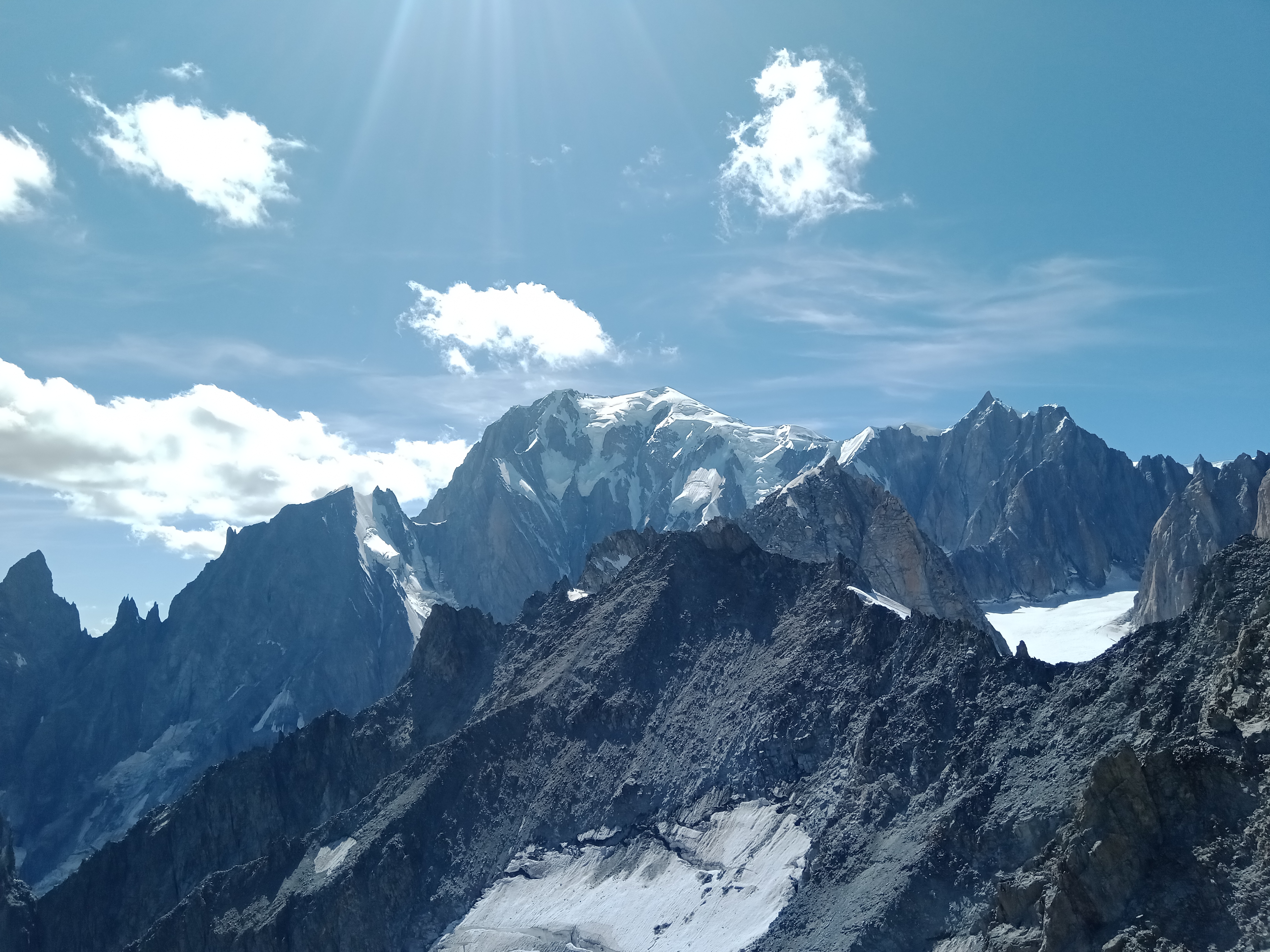
Every Item Has to Earn Its Place at 4,800 Metres.
The Mont Blanc packing problem is a balance: carry enough protection for cold, wind and a delayed descent, but avoid expedition-style bulk that makes the climb slower. Current Chamonix Guides guidance explicitly emphasizes the weight-to-comfort tradeoff.
Photo: Rémih / Wikimedia Commons · CC BY-SA 4.0
Mont Blanc Boots & Crampons
The current professional lists are more useful than forcing every climber into a rigid B2/B3 or C2/C3 prescription.
Rigid, warm and compatible
Compagnie des Guides currently specifies high-mountain boots with rigid soles compatible with crampons. Chamonix Guides lists high-altitude mountaineering boots and notes that they can be rented.
- Heel should stay locked without crushing toes.
- Leave room for warm socks and foot swelling.
- Test downhill toe clearance before summit day.
- Do not rent an unfamiliar boot and discover the fit at the hut.
Fit beats category labels
Compagnie des Guides specifies semi-automatic crampons with anti-balling plates; Chamonix Guides also requires anti-balling plates. The exact crampon must lock securely to the boot you are actually wearing.
- Fit both crampons to both boots before the trip.
- Check heel lever / toe-bail or strap compatibility.
- Know how to put them on with gloves and in darkness.
- Inspect anti-balling plates and bindings before departure.
Ice Axe, Helmet, Harness & Rope Equipment
| Item | Guided climber | Independent team | Why it matters |
|---|---|---|---|
| Ice axe | Straight alpine axe commonly listed; often rentable | Bring route-appropriate axe and know self-arrest / movement systems | Snow travel, security and route-specific movement |
| Helmet | Required on current programs reviewed; often rentable | Essential alpine protection | Rockfall and climbing terrain; especially relevant on Goûter approach |
| Harness | Required; often rentable | Bring harness suitable for glacier and alpine use | Roped glacier travel and guide/team systems |
| Rope | Guide/company controls the rope system | Team supplies an appropriate rope | Glacier travel, team security and rescue |
| Rescue hardware | Guide controls team system; ask what personal pieces are needed | Team builds and practices full rescue system | Crevasse rescue cannot be improvised from a generic checklist |
Independent climbers should use the Glacier Travel Basics and Crevasse Rescue Basics pages as education layers—but formal instruction and current practice remain more important than owning hardware.
Mont Blanc Layering System
Chamonix Guides explicitly warns that conditions can vary from warm approach temperatures to roughly -15°C at the summit. Build a system you can vent while moving and reinforce quickly when exposed.
Move moisture away
Use synthetic or wool base layers rather than cotton. A long-sleeve top is the standard foundation for summit day; lower base layers depend on pants and forecast.
Fleece / active insulation
A fleece or similar breathable mid-layer should add warmth without turning every uphill section into a sweat problem.
Down or synthetic jacket
Current guide lists include a down layer. The exact weight depends on personal cold tolerance and forecast; avoid using one generic temperature rating as a universal answer.
Waterproof + windproof
Bring a genuine alpine shell jacket and over-trousers. Chamonix-area guides specifically distinguish technical shells from bulky ski jackets.
Two glove systems
Current Compagnie des Guides guidance calls for one light pair plus one warm waterproof pair. This preserves dexterity without sacrificing summit protection.
Glasses + goggles
Category 4 glacier glasses protect in intense high-altitude sun. Goggles cover high wind, snowfall and low-visibility conditions that glasses handle poorly.
Open High-Altitude Layering →What to Pack for the Mont Blanc Huts
Bring a liner—not an expedition sleeping system.
Current Compagnie des Guides equipment guidance says to bring a sleeping liner and explicitly states that no sleeping bag is needed on the reviewed hut itinerary. Staffed huts provide the shelter and bedding layer that eliminates the need for a tent, stove and expedition sleep kit.
Keep the overnight kit deliberately small: liner, headlamp, minimal hygiene items, required documents, phone / power, medication, earplugs if useful and whatever cash or payment method the refuge currently accepts.
How the Gear List Changes by Route
This section stays deliberately concise so the gear page does not compete with the dedicated route-comparison URLs.
Optimize for hut efficiency
Use the standard lightweight hut-based setup. Helmet importance is obvious on the rocky approach and Grand Couloir zone. Prioritize reliable crampon fit, cold summit layers and a pack light enough for sustained vertical movement.
Conditions drive technical detail
The core gear remains similar, but steeper glacier terrain, serac exposure and route condition can change the guide’s expectations. Do not copy a Goûter list blindly if your route plan changes.
Longer + more remote
The same alpine foundation applies, but the route’s length and remoteness make food, hydration, pack organization and contingency margin more significant.
For the route decision itself, use Mont Blanc Route Comparison and the Mont Blanc Routes Guide.

Pack for the Route You Will Climb—and the Forecast You Actually Have.
A static checklist is only the starting point. Warm approaches, summit cold, wind, fresh snow, hard ice and route changes all alter the final gear decision. Recheck the list with your guide or team after the route and weather window are known.
Photo: Guilhem Vellut / Wikimedia Commons · CC BY 2.0
How Heavy Should Your Mont Blanc Pack Be?
The best target is not one universal kilogram number. The guide-company lists instead converge on a compact 30–40 L pack and repeatedly stress weight efficiency.
Weather margin
Do not remove waterproofs, warm gloves, insulation, goggles or essential hydration just to hit an arbitrary weight target. The correct pack still protects against the forecast’s realistic downside.
Duplicate comfort items
Extra casual clothing, oversized toiletries, multiple heavy mid-layers, expedition sleep gear and “just in case” gadgets are common places to save weight without removing alpine protection.
Avoid flying bulky duplicates
Technical rentals can make sense for a one-time Alps trip, especially when the guide company already has relationships with local equipment partners. Boots are the exception: fit matters enough to test them carefully.
Use the guide briefing
The final briefing is the time to remove gear the guide is supplying, add weather-specific protection and make sure technical items work together before you leave the valley.
What Should You Own Before Mont Blanc?
| Category | Usually worth owning | Often reasonable to rent | Why |
|---|---|---|---|
| Fit-sensitive personal gear | Base layers, socks, gloves, eyewear, shell, insulation | Some shells possible | Personal fit and familiar layering matter more than convenience |
| Boots | Own if you climb regularly | Yes for one-off trip, after careful fitting | Bad boot fit can end the climb; rental is viable only if tested properly |
| Crampons | Own if you practice regularly | Yes | Local rental can simplify travel, but they must fit your boots exactly |
| Axe / helmet / harness | Own for ongoing mountaineering | Yes | Common rental items on current Chamonix programs |
| Team rescue system | Independent teams should own / know it | Equipment can be rented | Competence and team standardization are more important than possession |
If Mont Blanc is part of a larger Alps progression rather than a one-time trip, owning and practicing with your boots, crampons, harness and axe becomes more valuable because familiarity transfers to Gran Paradiso, Monte Rosa and future glacier objectives.
The Gear Page Owns Packing—Other Pages Own the Other Decisions.
Use this URL to finalize equipment. Then route weather, current conditions, route choice, acclimatization and guide selection to their dedicated owners rather than duplicating them here.
Finish the Mont Blanc Gear Decision
Mont Blanc Climbing Guide
Routes, huts, cost, preparation and the overall mountain decision.
Open parent →RoutesMont Blanc Routes
Goûter, Trois Monts, Gonella and route-family context.
Compare routes →Route decisionGoûter vs Trois Monts vs Italian Route
Choose the route before making route-specific gear adjustments.
Open comparison →WeatherMont Blanc Weather & Best Season
Use the actual forecast and seasonal conditions to tune layers and gloves.
Check season →SafetyMont Blanc Difficulty & Safety
Understand why a modest technical grade still requires real glacier and alpine equipment.
Assess difficulty →AltitudeMont Blanc Acclimatization
Keep altitude planning separate from packing while connecting both to summit-day performance.
Build acclimatization →Gear hubMountaineering Gear Checklist
Use the broader gear system for equipment categories that extend beyond Mont Blanc.
Open gear checklist →Deep recovery 1Mountaineering Boots Guide
Understand boot stiffness, crampon compatibility, fit and single-vs-double design.
Choose boots →Deep recovery 2Glacier Travel Basics
Know what the technical equipment is supporting before you step onto a rope team.
Review glacier travel →Deep recovery 3High-Altitude Layering
Build a modular clothing system for warm approaches, summit cold, wind and precipitation.
Build layers →How This Mont Blanc Gear List Was Built
What we preserve from the existing page
- Mont Blanc as a hut-based alpine climb rather than a full expedition.
- Boots, crampons, axe, helmet and harness as the technical core.
- Shell, insulation, gloves, eyewear and headlamp as summit essentials.
- Sleeping liner and compact overnight kit.
- Guided vs independent rope-system distinction.
What we corrected
- Removed universal B2/B3 + C2/C3 prescription.
- Removed the claim that double boots are standard for guided summer parties.
- Changed helmet wording from universal legal claim to essential / guide-required.
- Clarified that current reviewed hut lists say no full sleeping bag is needed.
- Removed false precision around one universal pack-weight target.
- Moved exact guide-company requirements above generic editorial preference.
Mont Blanc Gear List FAQ
What gear do I need to climb Mont Blanc?
For a normal summer hut-based ascent, use a 30–40 L pack, rigid high-mountain boots, fitted crampons with anti-balling plates, a straight alpine axe, helmet, harness, poles, waterproof shells, warm insulation, two glove systems, Category 4 glacier glasses, goggles, headlamp, hut liner, food and roughly 1.5–2 L of drink capacity. Confirm the final list with your guide or team.
Can I rent crampons, an ice axe, helmet and harness in Chamonix?
Yes, often. Chamonix Guides currently lists boots, poles, crampons, helmet, harness and straight ice axe among rentable items. Compagnie des Guides also points clients to local rental partners for technical equipment.
What boots should I use for Mont Blanc?
Use rigid high-mountain mountaineering boots that fit well, are warm enough for the expected summit conditions and are fully compatible with your exact crampons. Current professional guide lists do not make double boots a universal requirement for a normal summer climb.
Do I need automatic crampons for Mont Blanc?
Not universally. Compagnie des Guides currently specifies semi-automatic crampons with anti-balling plates for the program reviewed here. The correct choice depends on your boot, route and guide requirements.
Do I need a sleeping bag in the Goûter or other Mont Blanc huts?
Current professional equipment lists reviewed for this page call for a sleeping liner and indicate that a full sleeping bag is not needed on the hut itinerary. Check the exact refuge and current guide instructions before leaving.
How big should my backpack be?
Current guide lists cluster around 30–40 liters. Compagnie des Guides lists 30–40 L and Chamonix Guides lists 35 L. That is enough for a compact technical and overnight kit without turning the climb into an expedition carry.
Do I need a helmet on Mont Blanc?
Yes, treat a helmet as essential. It is included on the professional guide lists reviewed for this page. Rather than claiming a universal legal rule for every route and circumstance, follow your route and guide requirements.
Should I bring a rope if I am climbing with a guide?
Normally the guide company controls the rope system and team technical equipment. Ask what personal carabiners or slings, if any, it wants you to carry. Independent teams need their own complete rope and rescue system and the competence to use it.
Do I need a tent or stove?
Not on a normal staffed-hut itinerary such as the classic Goûter program. Your route and overnight plan determine whether any emergency shelter or additional equipment is appropriate.
Do I need Category 4 glacier glasses?
Current Chamonix Guides equipment guidance specifically lists Category 4 sunglasses, and professional lists also include goggles for snow, wind and poor visibility.
Image credits
Hero: “Climbing Mont Blanc,” Hugh Llewelyn, Wikimedia Commons, CC BY-SA 2.0.
Mont Blanc from Pointe Helbronner: Rémih, Wikimedia Commons, CC BY-SA 4.0.
Mont Blanc from Pointe Percée: Guilhem Vellut, Wikimedia Commons, CC BY 2.0.
Preferred publishing option
If Global Summit Guide has licensed Mont Blanc photography in its WordPress Media Library, replace the three Commons image URLs with GSG-hosted copies while retaining the existing image classes, alt text structure and aspect treatment.
Bring Personal Protection. Rent Smart. Let the Route Decide the Rest.
Mont Blanc rewards a compact, familiar system: boots and crampons that fit, layers that work together, warm hands, protected eyes, reliable lighting and enough hut simplicity to keep the pack light. The final list belongs to the actual route, weather window and guide briefing—not a generic checklist written months earlier.
Was this helpful?
🏔Related gear guides
🧭Explore & compare
Global Summit Guide is an independent mountaineering resource founded in 2026. The team combines first-hand trekking and climbing experience with in-depth research and professional health and nutrition review to help climbers choose objectives, prepare properly, and stay safe.
Health, altitude, and nutrition content is reviewed by Taylor Ludlow (Registered Nurse) and Brigg Hoopes (Nutritionist).
What We Don't Know Yet
Mountain information changes quickly. This box explains the limits of what this page can responsibly promise.
- Guide-company prices, departure dates, guide ratios, included services, and cancellation rules can change without notice.
- Route conditions, trailhead access, crevasse exposure, stream crossings, and rescue access may vary from published planning guidance.
- Gear requirements can change by season, route variation, weather window, personal cold tolerance, and guide-service requirements.
Verify current conditions with official land managers, guide services, local forecasts, and current route reports before booking or climbing.
Mountaineering, rock and ice climbing, glacier travel, and high-altitude activity are inherently dangerous and can result in serious injury or death. The information on Global Summit Guide is provided for general informational and educational purposes only and is not a substitute for professional instruction, qualified guiding, proper equipment, or your own judgment and experience.
Route conditions, weather, snowpack, permits, regulations, and hazards change constantly and may differ from what is described here. Details may be incomplete, out of date, or contain errors. Always verify current information with local authorities, certified guides, and official sources before making any decision in the mountains.
Nothing on this site is medical, legal, or financial advice. Our fitness, acclimatization, altitude, and nutrition content is general in nature; consult a qualified physician before beginning any strenuous exercise program or exposing yourself to high altitude.
You are solely responsible for your own safety and decisions. To the fullest extent permitted by law, Global Summit Guide and its team accept no liability for any loss, injury, damage, or expense arising from use of, or reliance on, this information. By using this site you acknowledge these risks and accept these terms.
Some links on this site may be affiliate links. If you buy through them we may earn a small commission at no extra cost to you; this never affects our recommendations.
Global Summit Guide recommendation path
Next Best Mountain to Research
Use these recommendations to continue the right planning path instead of stopping on one page.
Use current permit, weather, route, and operator information before booking or climbing.