
Last updated June 8, 2026
Gasherbrum II Climb Guide: The Most Approachable Karakoram 8000er & the Southwest Ridge (2026)
On 7 July 1956, three Austrians — Moravec, Larch, and Willenpart — summited Gasherbrum II after a setback that would have ended most expeditions: their Camp 1 and all supplies were buried by an avalanche. They pushed on anyway. Today G2 has ~930 summits against just 21 deaths — a 2% fatality rate that makes it the safest 8000er alongside Cho Oyu. But the 2025 season produced zero confirmed summits. Even the easiest 8000er is weather-dependent. Here’s the verified 2026 planning data.
The History of K4
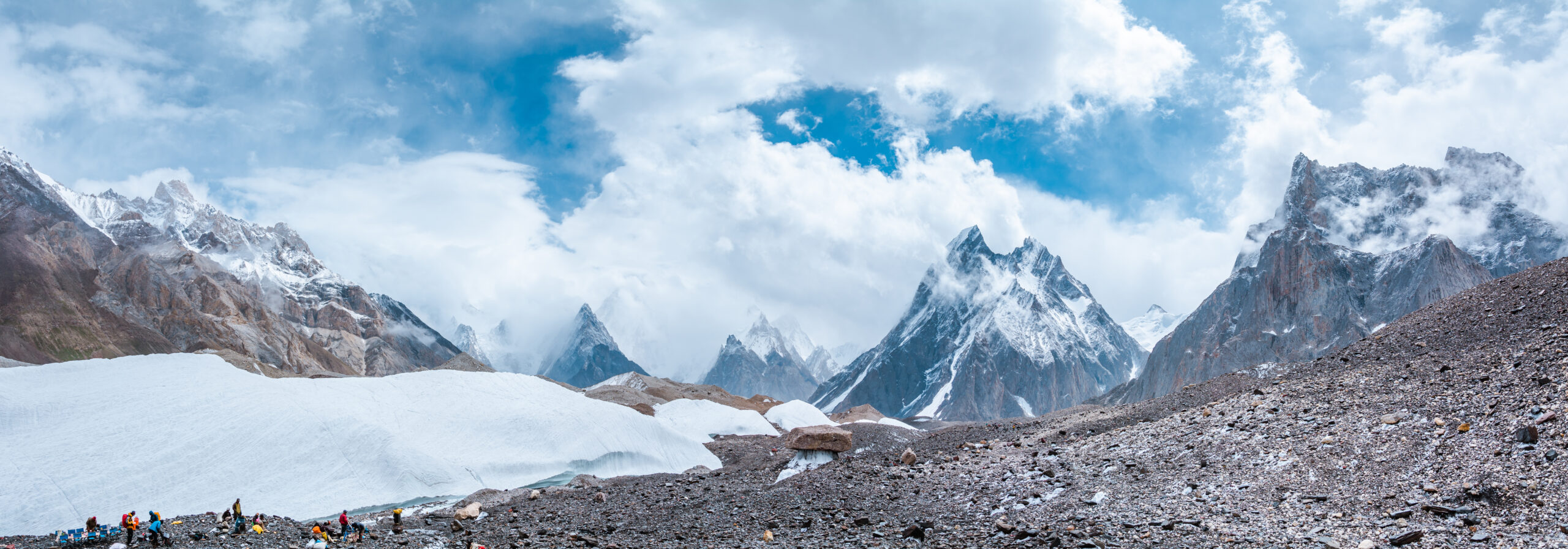
Gasherbrum II sits in the central Karakoram on the Pakistan-China border in the Baltoro Muztagh subrange. The mountain was first identified as K4 (the fourth peak of the Karakoram) by T.G. Montgomerie in 1856 during the British Great Trigonometric Survey of India. The name Gasherbrum comes from the Balti language, often translated as “beautiful mountain” or “shining wall.” G2 shares its base camp with Gasherbrum I — uniquely among 8000er pairs — at 5,150m on the South Gasherbrum Glacier.
1909: Abruzzi and Sella Reconnaissance
The Gasherbrum Massif as a whole was first explored by Luigi Amedeo, Duke of the Abruzzi, and photographer Vittorio Sella in 1909 during the Italian Karakoram expedition. The Abruzzi Glacier, a tributary of the Baltoro, is named after the Duke. Sella’s photographs from this expedition remain some of the most celebrated mountain images of the 20th century.
1934: Dyhrenfurth’s International Expedition
In 1934, Günter Dyhrenfurth’s International Himalayan Expedition — including Swiss climber André Roch — explored Gasherbrum I and II, reaching 6,250m on Gasherbrum II. The expedition established that G2 would be climbable but would require a serious expedition commitment.
7 July 1956: Austrian First Ascent — The Avalanche-Survived Summit
The successful first ascent came on 7 July 1956 by an Austrian expedition. Fritz Moravec, Josef Larch, and Hans Willenpart reached the summit via the Southwest Ridge at 11:30 AM — which remains the standard commercial route today.
The climb was extraordinary for an unusual reason. After establishing Camp 1, the Austrians descended to Base Camp. When they returned, they found Camp 1 and all its supplies and food buried by an avalanche. Rather than abandon the expedition, the team decided to make a quick summit attempt with the limited supplies they had. They opened a route up the ridge, left Camp 3, spent the night in a bivouac sack, and reached the summit the next morning.
Gasherbrum II became the eleventh 8000-meter peak to be climbed, following K2 (1954) and preceding Broad Peak (1957) and Gasherbrum I (1958) in the Karakoram. The ascent demonstrated that determined climbers could succeed on 8000m peaks with relatively modest logistics — a lesson that would influence Karakoram climbing for decades.
The Golden Age context: The July 1956 summit made Gasherbrum II the eleventh of the 14 eight-thousanders to receive a first ascent, following Annapurna (1950), Everest (1953), Nanga Parbat (1953), K2 (1954), Cho Oyu (1954), Makalu (1955), Kangchenjunga (1955), Lhotse (1956), and Manaslu (1956). Broad Peak followed in 1957, Gasherbrum I in 1958. The rapid succession during 1950-1964 is known as the “Golden Age of Himalayan mountaineering.”
1975: The Breakthrough Season — Including Wanda Rutkiewicz
In 1975, four separate expeditions successfully climbed Gasherbrum II — a remarkable concentration of activity for the era. Among them: a French expedition led by Jean-Pierre Fresafond, a Polish group under Janusz Onyszkiewicz, and a Polish women’s expedition that included Wanda Rutkiewicz. Rutkiewicz became one of the most prominent women in Himalayan history — she would later become the third woman (and first European woman) to summit Everest (1978) and the first woman to summit K2 (1986). She died on Kangchenjunga in 1992.
1982: Messner’s Solo Ascent
Reinhold Messner climbed Gasherbrum II solo in 1982 as part of an extraordinary year in which he summited three 8000ers — a feat documented in his book 3 x 8000: Mein grosses Himalaja-Jahr. This was Messner’s ongoing project to climb all 14 8000ers, which he completed in 1986 as the first person ever.
July 1984: Messner-Kammerlander G2 → G1 Alpine Traverse
In July 1984, Reinhold Messner and Hans Kammerlander linked Gasherbrum II and Gasherbrum I in a single alpine-style push without returning to base camp — one of the most celebrated achievements in Karakoram climbing history. They climbed G2 first, traversed across to G1, and summited both peaks in a continuous push lasting approximately one week.
The traverse demonstrated that two skilled climbers could move efficiently between 8000ers using only what they carried — extending the alpine-style ethic Messner had pioneered on G1 in 1975. The G2-to-G1 traverse has rarely been repeated and remains a benchmark for alpine-style ambition in the Karakoram.
1986 & 1997: Speed Climbing Records
In August 1986, a Slovene expedition summited G2 in just 32 hours from base to peak with only 22 hours of climbing — one of the fastest 8000m ascents ever recorded. In 1997, Kazakh-Russian climber Anatoli Boukreev completed a solo speed ascent from Advanced Base Camp at 5,800m to the summit in 9 hours 30 minutes. Such records would be impossible on Annapurna or K2 — they reveal G2’s distinctively accessible character.
2 February 2011: First Winter Ascent — The Avalanche Survival
On 2 February 2011, American photographer Cory Richards, Russian-Kazakh Denis Urubko, and Italian Simone Moro completed the first winter ascent — without supplemental oxygen. Gasherbrum II became the second 8000er to receive a winter ascent after Everest (1980) and the first Karakoram 8000er climbed in winter.
During the descent, all three climbers were caught in a class-four avalanche. Remarkably, all three survived. Cory Richards’ documentary photography from the climb — including footage taken in the immediate aftermath of being avalanched — won him the National Geographic Adventurer of the Year award. The 2011 winter ascent stands as both a landmark first and one of the most famous survival stories in modern mountaineering.
22 July 2011 — Leila Esfandyari descent fatality. Just months after the winter triumph, Iranian climber Leila Esfandyari died on G2’s descent after a successful summit. She had become the first Iranian woman to summit any 8000er. The 2011 summer death is a reminder that even on the “safest” 8000er, descent discipline matters — most G2 fatalities historically have occurred on descent rather than ascent.
2019: Nimsdai’s Project Possible
On 18 July 2019, Nirmal Purja (Nimsdai) summited Gasherbrum II as part of Project Possible — his record-breaking effort to climb all 14 8000m peaks in under seven months. He completed the project in just 6 months and 6 days.
The G1 + G2 Doubleheader — Why Climbers Bundle These Peaks
Gasherbrum I and Gasherbrum II share the same base camp on the South Gasherbrum Glacier — uniquely among the 8000er pairs. The 90-100 km Baltoro Glacier approach is the major time-and-money commitment of any Karakoram expedition: 9-10 days of porter-supported trekking, military escort, jeep transport from Skardu, and full Pakistani permit logistics. Adding a second 8000er to your trip costs an additional permit ($2,500) plus marginal time at altitude — but you’ve already paid for the approach and base camp.
The typical sequence: G2 first (less technical, used as acclimatization) → rest at base camp → G1 summit push via the Japanese Couloir. Most operators running the doubleheader build the full expedition around this rhythm. The complete G1 + G2 program runs 55-65 days total.
The cost math: Combined G1 + G2 permit is approximately $5,000 per climber. Operator pricing typically adds 30-50% to a single-peak fee for the second peak. For climbers chasing the 14 eight-thousanders, this is one of the best-value combinations on earth — two 8000ers, one Baltoro approach, one base camp, one expedition.
Operators known for the doubleheader: SummitClimb, 8K Expeditions, Seven Summit Treks, Furtenbach Adventures, and Imagine Nepal all run combined G1+G2 programs. The 2025 season was difficult for both peaks, but the doubleheader remains a popular target for Karakoram climbers.
Gasherbrum II Climbing Timeline
T.G. Montgomerie identifies the peak during the British Great Trigonometric Survey of India.
Duke of the Abruzzi and Vittorio Sella explore the Gasherbrum massif. Abruzzi Glacier named after the Duke.
International Himalayan Expedition reaches 6,250m on G2. Establishes the mountain is climbable.
Moravec, Larch, Willenpart summit at 11:30 AM via SW Ridge after their Camp 1 was buried by an avalanche. G2 becomes the 11th 8000er climbed.
Four expeditions summit in a single season. Polish women’s expedition includes Rutkiewicz, who later becomes the first woman to summit K2 in 1986.
Reinhold Messner climbs G2 solo as one of three 8000ers he summits in a single year. Documented in his book 3 x 8000.
Messner and Kammerlander link G2 and G1 in alpine style without returning to base camp — one of the most celebrated Karakoram achievements ever.
Slovene team summits in 32 hours from base camp — one of the fastest 8000m ascents ever recorded.
Anatoli Boukreev solo speed ascent from Advanced Base Camp at 5,800m to summit in 9 hours 30 minutes.
Richards, Urubko, Moro summit without oxygen. All three survive a class-four avalanche on descent. Richards wins Nat Geo Adventurer of the Year.
Iranian climber Leila Esfandyari dies on descent after summiting. First Iranian woman to summit any 8000er.
Nirmal Purja summits G2 as part of his 14-in-7-months record (completed in 6 months 6 days).
Both Karakorum Expeditions and Summit Karakoram called off summit bids due to weather. Zero confirmed G2 summits in the entire 2025 season — a striking reminder that even the easiest 8000er depends on conditions.
The Climbing Routes
Gasherbrum II’s Southwest Ridge — the 1956 Austrian first-ascent line — accounts for over 95% of modern summits. A few alternate lines have been climbed but none has commercial traffic. The route is moderate by 8000m standards but still demands serious 8000m experience and the long Baltoro approach.
| Route | Country Access | First Ascent | Status |
|---|---|---|---|
| Southwest Ridge (Standard) | Pakistan / Baltoro | 7 July 1956 (Austrian) | ● Open · Standard (95%+) |
| East Ridge variations | Pakistan | Various | ● Open · Rare |
| Messner-Kammerlander 1984 traverse | Pakistan | July 1984 (with G1) | ● Open · Elite Only |
| North Side (Chinese) | China | Rare | ● Open · Very Rare |
Southwest Ridge — The Commercial Standard
Approach: From Islamabad, fly to Skardu (or drive ~24 hours on the Karakoram Highway if flights cancelled — frequent in summer). From Skardu, jeep to Askole. From Askole, a 9-10 day trek of approximately 90-100 km up the Baltoro Glacier through Paiju, Urdukas, Goro, and Concordia to Gasherbrum Base Camp at 5,150m on the South Gasherbrum Glacier. Same base camp as Gasherbrum I.
Route character: From base camp, the route crosses the South Gasherbrum Glacier with significant crevasse exposure to reach the base of the Southwest Ridge. Camp 1 at ~5,900m sits at the start of the ridge proper. Camp 2 at ~6,500m is on a flatter section. Camp 3 at ~7,000m is the primary high camp. Camp 4 at ~7,400m is sometimes established for the summit push, though many teams summit directly from Camp 3.
Technical character: Sustained snow slopes at 35-45° with shorter sections approaching 50°. Alpine AD difficulty — moderate by 8000m standards. Fixed lines are typically installed on the steeper sections by lead operators. The route is technically less demanding than Gasherbrum I’s Japanese Couloir or Broad Peak’s 1.5km summit ridge traverse.
Summit day: Typically 10-14 hours round trip from Camp 3 or Camp 4. Climbers depart around midnight and aim to summit by mid-morning. The summit ridge is unexceptional — no false-summit trap like Broad Peak, no technical crux like K2’s Bottleneck.
Used by: All commercial G2 operators (SummitClimb, 8K Expeditions, Seven Summit Treks, Furtenbach Adventures, Adventure Consultants, Madison Mountaineering, Imagine Nepal).
Messner-Kammerlander 1984 G2 → G1 Alpine Traverse
Character: In July 1984, Reinhold Messner and Hans Kammerlander linked Gasherbrum II and Gasherbrum I in a single continuous alpine-style push without returning to base camp. They climbed G2 first via the standard SW Ridge, descended partway, then traversed across the shared Gasherbrum massif to climb G1 via the Japanese Couloir before returning to base camp.
Significance: One of the most celebrated alpine-style achievements in Karakoram history. The traverse demonstrated that two skilled climbers could link 8000ers using only what they carried — extending the alpine-style ethic Messner had pioneered on G1 in 1975.
Modern status: Open but rarely repeated. Requires elite alpine skills, full self-sufficiency at altitude for 7+ days, and weather windows on both peaks. Several elite alpinists have attempted it in subsequent decades; few have succeeded.
Speed Climbing on G2
Character: Gasherbrum II’s moderate technical difficulty and well-acclimatized base camp position have made it a target for speed climbing records that would be impossible on more demanding 8000ers.
1986 Slovene 32-hour ascent: A Slovene team summited from base to peak in just 32 hours with only 22 hours of actual climbing — one of the fastest 8000m ascents ever recorded.
1997 Boukreev 9h30min: Anatoli Boukreev completed a solo speed ascent from Advanced Base Camp at 5,800m to the summit in 9 hours 30 minutes.
2006 Haag-Böhm double: Sebastian Haag and Benedikt Böhm climbed G2 twice within a week, skiing down both times — a feat that would be inconceivable on Annapurna or K2.
Modern status: Speed climbing on G2 continues; the mountain remains a target for alpinists pushing 8000m ascent times. Such achievements only happen on a peak with G2’s character.
Southwest Ridge Camp Structure
Modern commercial expeditions establish three to four high camps above base camp. Most teams summit from Camp 3 or 4 depending on weather and team strength.
The 2025 lesson: Despite G2’s reputation, the 2025 season produced zero confirmed summits. Per Alan Arnette’s Karakoram coverage, both Karakorum Expeditions and Summit Karakoram called off their summit bids due to weather. The 2025 season is a reminder that “approachable” doesn’t mean “guaranteed.” Climbers who book G2 expecting reliable success are wrong — some years produce 50+ summits, others produce zero. Your operator selection, weather luck, and personal fitness all matter, but no operator can deliver weather that doesn’t materialize.
Permits, Fees & Pakistan Logistics
Gasherbrum II falls under the Gilgit-Baltistan Tourism Department’s expedition permit system — the same framework as K2, Broad Peak, G1, and Nanga Parbat. After the contentious 2024-2025 fee-revision dispute (originally proposed at $4,000/climber), authorities settled on the following structure, confirmed unchanged for 2025 and 2026:
| Item | Cost (USD) | Notes |
|---|---|---|
| Climbing permit — Summer (June-Aug) | $2,500 per climber | Confirmed 2025-2026 rate; primary climbing season |
| Climbing permit — Spring/Autumn | $1,500-1,875 per climber | 40% discount range; rarely used |
| Climbing permit — Winter (Dec-Feb) | ~$600 per climber | 95% discount; only attempted by elite teams |
| Combined G1 + G2 permit | $5,000 per climber | Standard doubleheader pricing; shared base camp |
| Rescue bond | $10,000 per team (refundable) | Refunded if not used during expedition |
| Environmental fee | $68 per team | Gilgit-Baltistan environmental compliance |
| Service fee | $300 per team (non-refundable) | Tour operator administrative fee |
| Liaison officer | ~$1,500-2,500 per expedition | Pakistani military assignment; meals/accommodation by team |
| Military escort (Karakoram Highway) | Included in operator fee | Mandatory for foreign expeditions |
| Pakistan visa | ~$60-200 | Trekking and mountaineering visa available |
| Budget guided expedition | $18,000-22,000 | Pakistani-operated, basic logistics, partial oxygen |
| Mid-tier guided expedition | $24,000-32,000 | Western/Pakistani combo, full oxygen, dedicated Sherpa |
| Premium guided expedition | $35,000-48,000+ | Furtenbach, Madison — high Sherpa ratios, weather forecasting |
| Rapid-ascent program (Alpenglow) | $45,000-55,000 | 32-day program requires pre-acclimatization via hypoxic tent (4-6 weeks before) |
G2 vs Nepal-side first 8000ers: The post-September 2025 Nepal permit fees ($3,000 for Manaslu) are now higher than Pakistan’s G2 permit ($2,500). The cost difference at the permit level is modest, but the overall expedition equation changed in 2025: G2 became more cost-competitive with Manaslu and Cho Oyu as a first 8000er. Pakistan’s logistics complexity (Baltoro approach, military escort, less commercial infrastructure) still favors Nepal for climbers seeking the most predictable first-8000er experience, but Karakoram experience now has price parity with Nepal experience.
Best Time to Climb & Weather Windows
Gasherbrum II is a summer-season mountain. Pakistan’s Karakoram is monsoon-protected by the main Himalayan crest, so peak climbing runs late June through mid-August. Same season as K2, Broad Peak, G1, and Nanga Parbat — and opposite of Nepal’s spring-dominant 8000ers.
| Season | Window | Conditions | Watch For |
|---|---|---|---|
| Summer | Late June – Mid August | Primary season; ~95% of attempts | Short summit windows (5-10 days); weather-dependent reliability |
| Spring (Pre-Monsoon) | April – Early June | Cold, less stable | High winds, frigid temperatures, rarely climbable |
| Autumn | September – Early October | Rare | Operators focus on summer Karakoram; little autumn traffic |
| Winter | December – February | Elite alpinists only | Climbed in winter once (2 February 2011) — class-four avalanche on descent |
The 2025 zero-summit lesson: Per Alan Arnette’s Karakoram season coverage, the 2025 season produced zero confirmed Gasherbrum II summits. Both Karakorum Expeditions and Summit Karakoram called off their G2 bids due to weather. This after several years of successful seasons that produced 30-50+ summits each. The 2025 season is a stark reminder: even on the “easiest” Karakoram 8000er, the weather decides. Climbers planning G2 should book with operators who have flexibility to abort gracefully and treat any single season as a 60-70% probability of weather cooperation.
Essential Gear Checklist
Gasherbrum II gear requirements match standard Karakoram 8000-meter expedition kit. The moderate technical difficulty means slightly less technical hardware than the Japanese Couloir on G1, but the cold, long Baltoro approach, and remote rescue limitations mean gear redundancy still matters more than on Nepal’s 8000ers.
High-Altitude Clothing
- 8000m down suit OR expedition parka + down pants (-40°C rated)
- Base layers (3 sets), heavyweight fleece, windproof shell
- Expedition mitts + liner gloves (3 pairs)
- Balaclava + buff + goggles (2 pairs, including summit-clear lens)
- Glacier sunglasses (Category 4)
Boots & Foot Systems
- 8000m triple boots (La Sportiva Olympus Mons, Millet Everest, Scarpa Phantom 8000)
- Mid-altitude double boots for Baltoro approach and rotations
- Crampons with anti-balling plates (Petzl Lynx, Grivel G14)
- Trekking boots for the 9-10 day Baltoro approach
- Multiple sock systems with vapor barrier
Technical Hardware
- Harness (full strength, sized over down suit)
- Helmet (essential — rockfall on lower route sections)
- Ice axe (single tool sufficient for SW Ridge)
- Ascender + descender + 4 locking carabiners
- 2 prusik cords + 2 slings; crevasse-rescue gear (Gasherbrum Glacier approach)
Expedition & Comms
- Headlamp + 4 spare battery sets (cold-rated lithium)
- Personal first-aid + frostbite prevention kit
- Garmin inReach Mini 2 or sat phone
- Power bank + solar panel for base camp
- Pakistan visa, military escort documents
Difficulty & The Approachable 8000er Paradox
Gasherbrum II is statistically the safest 8000er alongside Cho Oyu: approximately 930 summits against 21 deaths gives a fatality rate of around 2%. For comparison, Annapurna runs ~32%, K2 ~24%, Nanga Parbat ~22%, and Broad Peak ~8-9%. The Alpine AD technical rating on the Southwest Ridge is significantly less demanding than the Japanese Couloir on Gasherbrum I or Broad Peak’s 1.5km summit ridge traverse. But “easiest 8000er” comes with three honest caveats:
1. The 2% fatality rate reflects climber self-selection. G2 attracts experienced 8000m climbers and those building toward more technical objectives. Operators screen clients for prior 7,000m experience. If the same demographic that attempts Manaslu attempted G2 at the same rates, the fatality rate would likely be higher. The statistic measures both mountain character and climber preparation.
2. The Baltoro approach is the longest of any 8000er. 9-10 days of trekking from Askole to base camp. Climbers who arrive at base camp depleted from the approach struggle on the climb itself. The 2011 winter team (Richards, Urubko, Moro) spent significant time on the approach before their successful summit — and were caught in a class-four avalanche on descent. Even on the “easiest” 8000er, the approach matters.
3. Descent fatalities dominate G2 deaths. Most G2 fatalities historically have occurred on descent rather than ascent. Leila Esfandyari’s 22 July 2011 death after a successful summit is the pattern. The Gasherbrum Glacier crevasse field between base camp and Camp 1 has claimed climbers across decades. Conservative descent discipline — including roped travel on the glacier and conservative turnaround times — matters more on G2 than on the more technical 8000ers where climbers are already pre-disposed to caution.
What G2 rewards: Climbers with prior 7000m experience (Ama Dablam, Spantik, Baruntse, Muztagh Ata, or Denali), strong fixed-line technique, patient acceptance of the long Baltoro approach, and weather flexibility. As a first 8000er it’s appropriate for the right candidate. As a step toward G1, Broad Peak, or K2 in subsequent seasons it’s ideal. The 2011 winter survival story and the 1956 avalanche-then-summit story both prove the same thing: G2 rewards climbers who keep moving when conditions go sideways.
Featured Expedition Operators
The operators below run established Gasherbrum II programs. When evaluating, ask specifically about: combined G1+G2 doubleheader packages (the best value), crevasse-rescue protocols on the lower glacier, oxygen strategy on summit day, weather forecasting partners (most use Karl Gabl or Marc DeKeyser), and 2025 season performance after the difficult zero-summit year.
SummitClimb
International mountaineering company that explicitly structures G1 + G2 doubleheader programs and Karakoram circuits. Smaller team sizes than Seven Summit Treks; structured itineraries. Mid-tier pricing. Strong record on first-8000er climbers transitioning from 7000m peaks. summitclimb.com
8K Expeditions
Kathmandu-based operator focused on 8000m peak programs. Runs G2 as part of broader Karakoram circuit including K2, Broad Peak, and G1. Active Sherpa coordination across Pakistan peaks. 8kexpeditions.com
Seven Summit Treks
Kathmandu-based operator with the largest operational footprint on Pakistan’s 8000ers. Coordinates rope-fixing and Sherpa logistics across all five Pakistan 8000ers. Multiple service tiers from budget to premium. Strong G1 + G2 doubleheader programs from the shared base camp. sevensummittreks.com
Furtenbach Adventures
Austrian-led operator with strong technology-forward systems including pre-acclimatization, hyperbaric tents, and rigorous weather analysis. Premium-tier pricing with high Sherpa ratios. G2 fits naturally into Furtenbach’s Karakoram rotation. furtenbachadventures.com
Madison Mountaineering
U.S.-based premium operator. Garrett Madison’s team runs G2 programs as part of broader Karakoram operations. Higher Sherpa ratios and structured oxygen strategy. madisonmountaineering.com
Alpenglow Expeditions
U.S.-based operator famous for “Rapid Ascent” programs that compress G2 expeditions to 32 days via hypoxic tent pre-acclimatization 4-6 weeks before departure. Premium pricing reflects the time savings — climbers spend less time in Pakistan but more time preparing at home. Best fit for climbers who can’t commit 6+ weeks but have flexible pre-departure schedules. alpenglowexpeditions.com
Imagine Nepal
Nepali-owned operator run by Mingma Gyalje Sherpa. Significant 8000m record; expanding Pakistan operations including G2 + G1 combined programs. Strong Sherpa support adapted to Pakistan conditions. imaginenepaltreks.com
Frequently Asked Questions
Gasherbrum II is widely considered the most approachable Karakoram 8000er and ranks alongside Cho Oyu as the safest of the 14 eight-thousanders. With approximately 930 successful summits against just 21 deaths historically, G2’s fatality rate is around 2% — compared to Annapurna’s ~32%, K2’s ~24%, and Nanga Parbat’s ~22%. The Southwest Ridge standard route involves moderate snow and ice climbing at Alpine AD difficulty — significantly easier than the Japanese Couloir on Gasherbrum I, Broad Peak’s 1.5km summit ridge, or K2’s Abruzzi Spur. However, the 2025 season produced zero confirmed summits due to weather — even the easiest 8000er depends entirely on conditions.
On 7 July 1956 at 11:30 AM, Austrian climbers Fritz Moravec, Josef Larch, and Hans Willenpart made the first ascent via the Southwest Ridge. The climb was nearly derailed when their Camp 1 and all supplies were buried by an avalanche while the team was at Base Camp. Rather than abandon the expedition, they pushed for the summit with limited remaining supplies, bivouacked above Camp 3, and reached the top the next morning. G2 became the eleventh 8000-meter peak to be first climbed during the 1950-1964 Golden Age of Himalayan mountaineering.
The Pakistan climbing permit is $2,500 per climber in summer season (June-August), confirmed unchanged for 2025 and 2026 after Gilgit-Baltistan authorities revised originally-planned $4,000 fees down following operator protests. Winter season permits cost approximately $600 per climber (95% discount). A guided commercial expedition typically costs $18,000-$48,000 depending on operator and support level. Alpenglow’s Rapid Ascent 32-day program is at the premium end ($45,000-55,000) but requires only 32 days in Pakistan via hypoxic tent pre-acclimatization. Combined G1 + G2 permits run $5,000 per climber.
The Southwest Ridge is the standard commercial route, first climbed by the Austrian team in 1956. From base camp at 5,150m on the South Gasherbrum Glacier (shared with G1), the route ascends through Camp 1 (~5,900m), Camp 2 (~6,500m), Camp 3 (~7,000m), and optionally Camp 4 (~7,400m) before traversing to the summit ridge. Technical difficulty is rated Alpine AD with sustained snow slopes at 35-45° and shorter steeper sections. Fixed lines are typically installed by lead operators on the steeper terrain.
On 2 February 2011, American photographer Cory Richards, Russian-Kazakh Denis Urubko, and Italian Simone Moro completed the first winter ascent — without supplemental oxygen. Gasherbrum II became the second 8000er to receive a winter ascent (after Everest in 1980) and the first Karakoram 8000er climbed in winter. During the descent, all three climbers were caught in a class-four avalanche. Remarkably, all three survived. Cory Richards’ documentary photography from the climb won the National Geographic Adventurer of the Year award.
In July 1984, Reinhold Messner and Hans Kammerlander linked Gasherbrum II and Gasherbrum I in a single alpine-style push without returning to base camp — one of the most celebrated achievements in Karakoram climbing history. They climbed G2 first, traversed across to G1, and summited both peaks in a continuous push lasting approximately one week. The traverse demonstrated that two skilled climbers could move efficiently between 8000ers using only what they carried — extending the alpine-style ethic Messner had pioneered on G1 in 1975 to even more ambitious objectives. The traverse has rarely been repeated since.
G2 is one of the three most common first 8000ers along with Cho Oyu and Manaslu. For climbers with strong 7000m experience (Ama Dablam, Spantik, Baruntse, Muztagh Ata, or Denali), G2 is appropriate. The mountain demands the Baltoro approach experience and Karakoram weather tolerance that Nepal-side peaks don’t require, but offers shared base camp with Gasherbrum I for climbers chasing the 14-peak list. Climbers with only 5,000-6,000m trekking experience (Kilimanjaro, Aconcagua normal route, Island Peak) typically find G2 too demanding. The 2025 zero-summit season is a reminder that even the easiest 8000er depends on weather.
Per Alan Arnette’s 2025 Karakoram coverage, the entire 2025 Gasherbrum II season produced zero confirmed summits. Both Karakorum Expeditions and Summit Karakoram called off their summit bids due to weather. Previous years have produced 30-50+ G2 summits per season. The 2025 outcome doesn’t mean G2 is suddenly dangerous — it means the Karakoram summer weather was uncooperative across all the major peaks. K2 and Broad Peak also had limited summit success in 2025. Climbers booking G2 for 2026 or beyond should treat any single season as having approximately 60-70% probability of weather cooperation — book with operators who can handle abort decisions gracefully.
Gasherbrum II is in the Karakoram Range on the Pakistan-China border in the Baltoro Muztagh subrange. Coordinates: 35.7581°N, 76.6533°E. It is part of the Gasherbrum massif, sharing base camp with Gasherbrum I at 5,150m on the South Gasherbrum Glacier. Access is via the Baltoro Glacier from Askole village — the same 9-10 day approach used for K2, Broad Peak, and Gasherbrum I. The shared base camp with G1 makes G2 the natural pairing for climbers chasing the doubleheader.
Gasherbrum II Map & Live Weather
Gasherbrum II’s summit coordinates: 35°45’29″N 76°39’12″E (35.7581°N, 76.6533°E). The map below shows the summit and the surrounding Baltoro Muztagh region. Gasherbrum I lies just ~3km to the south at the shared base camp area; K2 is ~22km north-northwest; Broad Peak is ~8km from K2.
This peak is one of the 14 mountains on Earth above 8,000 meters
The 14 eight-thousanders are the only mountains on Earth that rise above 8,000m — the altitude where the human body enters the Death Zone. See the complete collection ranked by elevation, with death rates, first ascent history, and the Messner/Kukuczka/Nims Purja completion records.
View All 14 Eight-Thousanders →🏔 Part of the 14 Eight-Thousanders
One of the 14 mountains on Earth above 8,000m. See the complete collection with death rates, first ascents, and the 14 Peaks Challenge history.
View All 14 Eight-Thousanders →Was this helpful?
🏔Related guides
🧭Explore & compare
Global Summit Guide is an independent mountaineering resource founded in 2026. The team combines first-hand trekking and climbing experience with in-depth research and professional health and nutrition review to help climbers choose objectives, prepare properly, and stay safe.
Health, altitude, and nutrition content is reviewed by Taylor Ludlow (Registered Nurse) and Brigg Hoopes (Nutritionist).
What We Don't Know Yet
Mountain information changes quickly. This box explains the limits of what this page can responsibly promise.
- Permit availability, reservation windows, quotas, and official fee rules may change after this page is updated.
- Guide-company prices, departure dates, guide ratios, included services, and cancellation rules can change without notice.
- Weather, snowpack, avalanche risk, road access, and route conditions can change quickly and may be different on your climbing dates.
- Route conditions, trailhead access, crevasse exposure, stream crossings, and rescue access may vary from published planning guidance.
- Total trip cost can change with flights, lodging, guide pricing, permits, gear rentals, transportation, and exchange rates.
Verify current conditions with official land managers, guide services, local forecasts, and current route reports before booking or climbing.
Mountaineering, rock and ice climbing, glacier travel, and high-altitude activity are inherently dangerous and can result in serious injury or death. The information on Global Summit Guide is provided for general informational and educational purposes only and is not a substitute for professional instruction, qualified guiding, proper equipment, or your own judgment and experience.
Route conditions, weather, snowpack, permits, regulations, and hazards change constantly and may differ from what is described here. Details may be incomplete, out of date, or contain errors. Always verify current information with local authorities, certified guides, and official sources before making any decision in the mountains.
Nothing on this site is medical, legal, or financial advice. Our fitness, acclimatization, altitude, and nutrition content is general in nature; consult a qualified physician before beginning any strenuous exercise program or exposing yourself to high altitude.
You are solely responsible for your own safety and decisions. To the fullest extent permitted by law, Global Summit Guide and its team accept no liability for any loss, injury, damage, or expense arising from use of, or reliance on, this information. By using this site you acknowledge these risks and accept these terms.
Some links on this site may be affiliate links. If you buy through them we may earn a small commission at no extra cost to you; this never affects our recommendations.
Global Summit Guide recommendation path
Next Best Mountain to Research
Use these recommendations to continue the right planning path instead of stopping on one page.
Use current permit, weather, route, and operator information before booking or climbing.
Search Flights, Hotels & Rental Cars
Have the mountain or destination picked? Use Expedia to compare the flights, lodging and rental cars that fit your actual trip dates. For mountain travel, consider arriving early enough for delays and adding a buffer night after the climb before a fixed flight home.
Compare current flight, hotel and car options.
Affiliate disclosure: Global Summit Guide may earn a commission if you book through this link, at no additional cost to you.