
Last updated May 28, 2026
Torres del Paine: W Circuit vs O Circuit — Complete 2026 Comparison with Day-by-Day Itineraries, CONAF Permits, Refugio Booking, Costs, and Which Patagonia Trek to Choose
The definitive 2026 comparison of Chilean Patagonia’s two legendary trekking circuits. Generally, the W Circuit is the popular classic — roughly 80 km over 4-5 days hitting the three main highlights (Mirador Las Torres, the French Valley, and Grey Glacier). Specifically, the O Circuit is the complete circumnavigation of the Paine Massif — roughly 130 km over 7-10 days. It adds the remote backside wilderness loop and the dramatic Paso John Gardner crossing with views over the Southern Patagonian Ice Field. Notably, both treks share the same iconic landmarks but deliver fundamentally different experiences. This guide gives you day-by-day itineraries, verified 2026 CONAF fees, the current refugio booking system, full cost breakdowns, and a clear decision framework.
Torres del Paine National Park sits in Chilean Patagonia’s Magallanes Region. It is home to two of the world’s most famous multi-day trekking routes — the W Circuit and the O Circuit. Generally, they share the same iconic destinations (the three granite towers, the French Valley amphitheater, Grey Glacier) but differ fundamentally in scope, duration, and character. Specifically, the W Circuit is the popular classic at roughly 80 km in 4-5 days. The O Circuit is the complete experience at roughly 130 km in 7-10 days, adding the remote backside wilderness loop. Notably, choosing between them is the single most important decision a first-time Patagonia trekker makes.
This guide answers every question first-time Patagonia trekkers ask. How do the two circuits actually compare day by day? What does the 2026 CONAF permit cost and how do you book the refugios? Notably, we cover several concrete topics. First, a master side-by-side comparison of both circuits. Then day-by-day itineraries for the standard W (5 days) and O (8 days). Also the 2026 permit and refugio booking system through Las Torres Patagonia and Vertice. Plus full cost breakdowns from budget camping through guided expeditions. Plus the December-March season analysis and Patagonian weather realities. Finally, a clear decision framework for choosing your circuit.
Torres del Paine at a Glance
| Detail | Information |
|---|---|
| Location | Magallanes Region, Chilean Patagonia (southernmost Chile) |
| Park size | 227,298 hectares (UNESCO Biosphere Reserve, 1978) |
| Annual visitors | ~250,000 (all activities) |
| Highest peak | Paine Grande (3,050 m / 10,007 ft) |
| The three towers | Torre Central 2,850 m · Torre Norte 2,248 m · Torre Sur 2,500 m |
| W Circuit | ~80 km · 4-5 days · ~90% of trekkers |
| O Circuit | ~130 km · 7-10 days · ~10% of trekkers |
| Best season | December – March (Patagonian summer) |
| Gateway town | Puerto Natales (2.5 hr bus to park) |
| Closest airport | Punta Arenas (PUQ), 3 hr bus to Puerto Natales |
| 2026 park entry | $39 USD (under 3 days) · $55 USD (3+ days) |
| Refugio operators | Las Torres Patagonia (formerly Fantastico Sur) + Vertice |
| Wildlife | Guanacos, pumas, Andean condors, foxes, rheas |
W vs O Circuit — The Master Comparison
Before the day-by-day detail, here is the head-to-head comparison that answers most trekkers’ core question. Generally, the W Circuit wins on accessibility, schedule, and success rate, while the O Circuit wins on wilderness, solitude, and the complete-loop experience. Specifically, the table below summarizes every decisive factor. Notably, both circuits hit the same three marquee highlights — the O simply adds the backside wilderness around them.
| Attribute | W Circuit | O Circuit |
|---|---|---|
| Total distance | ~80 km (50 miles) | ~130 km (80 miles) |
| Standard duration | 4-5 days | 7-10 days (standard 8) |
| Daily hiking | 15-20 km · 5-8 hours | 15-20 km · 6-11 hours (pass day longest) |
| Maximum altitude | ~1,000 m at viewpoints | 1,241 m at Paso John Gardner |
| Cumulative gain | ~3,000-4,000 m | ~4,500-5,500 m |
| Signature highlights | Torres base, French Valley, Grey Glacier | All W highlights + Paso John Gardner + backside |
| Infrastructure | Well-developed refugios + camps | W-side refugios + basic backside camps |
| Crowds | Moderate-heavy peak season | Heavy on W section, light on backside |
| Weather exposure | Moderate | High (Paso crossing) |
| Booking lead time | 6-9 months for peak | 9-12 months (backside limited) |
| Typical cost | $800-$2,500 | $1,200-$3,800 |
| Direction | East-to-West or West-to-East | Counter-clockwise only |
| Success rate | 85-90% | 75-80% |
| Share of trekkers | ~90% | ~10% |
| Ideal for | First-time Patagonia, 5-7 days | Experienced trekkers, 8-12 days |
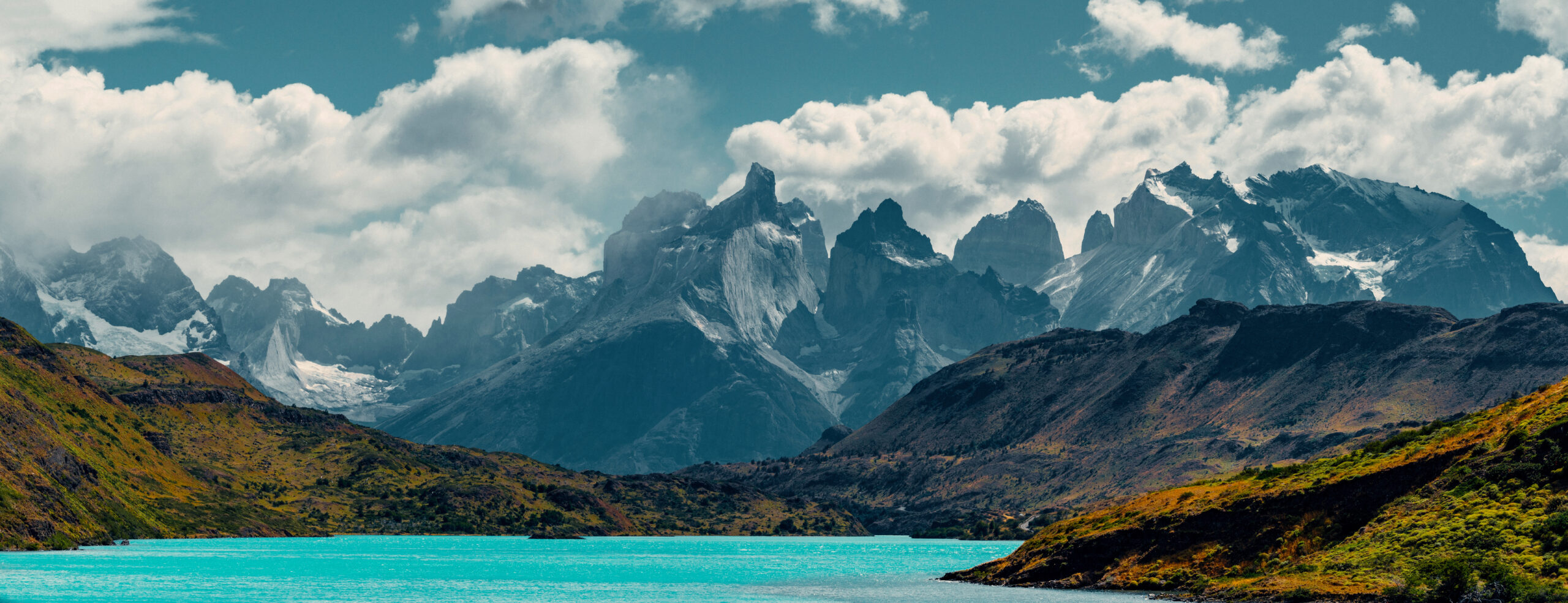
The W Circuit — The Classic Route
W Circuit — 80 km Over 4-5 Days
The W Circuit follows a W-shaped ground plan that connects Torres del Paine’s three main valleys. Generally, these are three valleys. The Ascencio Valley leads to Mirador Las Torres, the iconic three granite towers. The French Valley holds the dramatic Mirador Britanico amphitheater, and the Grey Valley ends at Glacier Grey. Specifically, each leg of the W requires hiking in and out of its respective valley, with connecting sections along Lake Nordenskjold and Lake Pehoe. Notably, this is Patagonia’s most accessible major multi-day trek.
Several features make the W Circuit achievable for fit first-time Patagonia trekkers. These include well-developed refugios with dormitory beds and meals, clearly marked trails, catamaran service across Lake Pehoe, and abundant guided tour options. Generally, around 90% of Torres del Paine multi-day hikers choose the W, and it is overwhelmingly the right choice for most international visitors. Specifically, the main downsides are crowds during peak season (December-February) and the feeling of being on a popular route. Notably, the W hits all three marquee features, and for most trekkers the iconic three-towers sunrise makes any crowd worthwhile.
W Circuit Day-by-Day Itinerary (Standard 5 Days)
The standard 5-day W itinerary runs west-to-east or east-to-west. Generally, the east-to-west direction below starts at the Las Torres sector and finishes at the Lake Pehoe catamaran. Specifically, the towers sunrise hike happens early to maximize the chance of clear weather. Notably, daily distances and times assume moderate fitness and typical Patagonian conditions.
| Day | Route | Distance / Time | Highlight |
|---|---|---|---|
| Day 1 | Puerto Natales bus to park, hike to Las Torres sector | ~7 km · 2-3 hrs | Arrival, settle into Central/Chileno |
| Day 2 | Pre-dawn hike to Mirador Las Torres, then transfer to Los Cuernos/Frances | ~22 km · 8-9 hrs | Three granite towers at sunrise |
| Day 3 | French Valley to Mirador Britanico, move to Paine Grande | ~25 km · 8-9 hrs | French Valley amphitheater |
| Day 4 | Hike to Grey Glacier viewpoint, stay Paine Grande/Refugio Grey | ~22 km · 6-7 hrs | Grey Glacier and icebergs |
| Day 5 | Catamaran across Lake Pehoe, bus to Puerto Natales | ~4 km + ferry | Departure |
W Circuit itinerary variations. Generally, the W flexes from 3 to 6 days. Specifically, a compressed 4-day W skips a rest stop, the standard 5-day W is most common, and a comfortable 6-day W adds a buffer/rest day for weather. Notably, a minimal 3-day W covers only the Torres Base Camp and French Valley, skipping Grey Glacier. The three-towers sunrise is weather-dependent — only 30-50% of trekkers get a clear sunrise on the first attempt, so building in flexibility helps. Compare the W’s difficulty to other classic treks in our Tour du Mont Blanc guide.
The O Circuit — The Full Loop
O Circuit — 130 km Over 7-10 Days
The O Circuit is a complete circumnavigation of the Paine Massif. Generally, it includes all W Circuit highlights plus a backside wilderness loop. The loop runs through Seron, Dickson, and Los Perros camps before crossing the dramatic Paso John Gardner (1,241 m). Specifically, the pass offers sweeping views of the Southern Patagonian Ice Field. It then descends to rejoin the Grey Glacier area. From there you complete the standard W route back to the start. Notably, this backside section sees maybe 10% of park visitors, meaning long stretches of solitude through glaciated valleys and lenga forests.
Paso John Gardner’s crossing day is the trek’s physical and emotional climax. Generally, it is 9-11 hours of hiking culminating in the panoramic ice field view that has become one of Patagonia’s most famous vistas. Specifically, the O Circuit delivers the complete Torres del Paine experience but requires significantly more time, fitness, and advance planning. Notably, the backside camps (Seron, Dickson, Los Perros) are more basic than W Circuit refugios. Weather can close Paso John Gardner for days. Reservations are tighter because of the limited capacity on the backside.
O Circuit Day-by-Day Itinerary (Standard 8 Days)
The O Circuit is hiked counter-clockwise, starting with the backside wilderness loop and finishing on the W section. Generally, this direction is mandatory — park rules require the O to start from Seron and proceed counter-clockwise. Specifically, the standard 8-day itinerary below front-loads the remote camps and saves the iconic towers for the final morning. Notably, Day 4 (the Paso John Gardner crossing) is the longest and hardest day of either circuit.
| Day | Route | Distance / Time | Highlight |
|---|---|---|---|
| Day 1 | Laguna Amarga entrance to Seron camp | ~15 km · 6-7 hrs | Enter the quiet backside |
| Day 2 | Seron to Dickson camp | ~18 km · 7-8 hrs | Remote Lake Dickson |
| Day 3 | Dickson to Los Perros camp | ~12 km · 5-6 hrs | Perros Glacier |
| Day 4 | Los Perros to Grey via Paso John Gardner (1,241 m) | ~15 km · 9-11 hrs | Ice Field view — longest, hardest day |
| Day 5 | Grey to Paine Grande (now on W section) | ~11 km · 4-5 hrs | Grey Glacier |
| Day 6 | Paine Grande to French Valley and Los Cuernos | ~6-7 hrs | French Valley amphitheater |
| Day 7 | Los Cuernos to Chileno | ~6-8 hrs | Position for towers sunrise |
| Day 8 | Pre-dawn Torres Base viewpoint, descend to exit, bus to Puerto Natales | Full day | Three towers at sunrise, departure |
Paso John Gardner weather warning. Generally, the Paso John Gardner crossing is the O Circuit’s crux and its biggest weather risk. Specifically, the 1,241 m pass can close for days when high winds or snow hit — Patagonian wind regularly exceeds 100 km/h at exposed elevations. Notably, the remote Dickson and Los Perros camps have limited exit options, so trekkers caught by weather may need to wait it out. Always build buffer days into an O Circuit plan, and review our mountain weather guide for reading Patagonian forecasts. The O Circuit’s lower 75-80% success rate compared to the W’s 85-90% largely reflects pass closures and the longer, more committing route.
2026 Permits & Refugio Booking
Torres del Paine requires two separate things: a CONAF park entry permit and advance reservations for every overnight refugio or campsite. Generally, dispersed camping is prohibited and advance reservations have been mandatory since October 2016. Specifically, you cannot simply show up and improvise — park rangers check that you are booked at the correct camp for each night. Notably, the booking system involves multiple operators, which makes Torres del Paine’s logistics more complex than the trekking itself.
| Requirement | 2026 Detail | How to Book |
|---|---|---|
| CONAF park entry (under 3 days) | $39 USD foreigners | Online or added to refugio booking |
| CONAF park entry (3+ days) | $55 USD foreigners | Online or added to refugio booking |
| W/O camp + refugio reservations | Mandatory for every night | Las Torres Patagonia + Vertice (two operators) |
| Lake Pehoe catamaran | $30-$40 one way | Book ahead in peak season |
| Puerto Natales to park bus | $15-$25 each way | Bus companies in Puerto Natales |
The Two Refugio Operators (2026)
Two private companies operate all the bookable refugios and campsites along the circuits. Generally, knowing which operator runs which camp is essential because you book directly with each. Specifically, Las Torres Patagonia (formerly named Fantastico Sur) runs the eastern and central camps, while Vertice runs the western and backside camps. Notably, the formerly free CONAF campsites (Paso, Italiano, and the old Torres site) have remained closed since the COVID-19 pandemic with no announced reopening. This closure affects O Circuit itinerary planning.
| Operator | Camps / Refugios Run | Booking Site |
|---|---|---|
| Las Torres Patagonia (formerly Fantastico Sur) | Central, Seron, Frances, Cuernos, Chileno | lastorres.com |
| Vertice Patagonia | Dickson, Los Perros, Grey, Paine Grande | vertice.travel |
| CONAF (closed) | Paso, Italiano, old Torres — closed since COVID | Not currently bookable |
| Aggregator option | Combines both operators’ availability | Booking Patagonia Travel / TorresHike |
How to book for 2026. Generally, reservations for each season typically open in late May or early June, though the 2025/2026 season opened as early as April 1. Specifically, you can book in two ways. Make two separate bookings directly through Vertice and Las Torres for lower cost and more control. Or make one combined booking through an aggregator like Booking Patagonia Travel or TorresHike for convenience, but with a markup. Notably, the O Circuit’s backside camps (Dickson, Los Perros) have limited capacity and fill first. Book the O 9-12 months ahead and the W 6-9 months ahead for peak-season dates. The park entry fee is usually added automatically when booking through an aggregator.
Torres del Paine Costs in 2026
Torres del Paine trek costs vary widely by route, accommodation style, and whether you go self-guided or with a tour. Generally, self-guided camping is the budget approach while guided refugio tours are the premium. Specifically, the largest variables are accommodation choice (camping versus refugio with meals) and guided versus independent. Notably, the table below breaks down realistic 2026 total budgets including the major cost components.
| Trek Style | 2026 Total Cost | What’s Included |
|---|---|---|
| Self-guided W — camping | $800-$1,200 | Park entry + camping + bus/ferry + self-cooked food (with flights) |
| Self-guided W — refugios + meals | $1,800-$2,800 | Park entry + refugio half-board + transport + flights |
| Self-guided O — camping | $1,200-$1,800 | Park entry + camping + transport + self-cooked food |
| Self-guided O — refugios + meals | $2,500-$3,800 | Park entry + refugio half-board + transport |
| Guided W tour | $1,500-$3,000 | Reservations, meals, guide, transport from Puerto Natales |
| Guided O tour | $2,500-$4,500 | All logistics, guide, meals, transport |
| Premium guided (either) | $4,000-$6,500 | Private guide, premium refugios, full service |
Cost Component Detail
| Component | 2026 Cost | Notes |
|---|---|---|
| CONAF park entry | $39 (under 3 days) / $55 (3+ days) | Foreigner multi-day rate |
| Vertice camping | ~$10-$15 / person / night | Dickson, Los Perros, Grey, Paine Grande |
| Las Torres camping | ~$37-$50 / night | Central, Seron, Frances, Cuernos, Chileno |
| Refugio dorm bed | $60-$125 / night | Higher with meals |
| Refugio with half-board | $120-$250 / night | Bed plus breakfast and dinner |
| Refugio meals (a la carte) | $20-$35 / meal | Self-cooking saves ~$10-$15 per meal |
| Bus Puerto Natales to park | $15-$25 each way | 2.5 hour ride |
| Lake Pehoe catamaran | $30-$40 one way | W Circuit west end |
| Bus Punta Arenas to Puerto Natales | $25-$40 each way | 3 hour ride |
| Flight Santiago to Punta Arenas | $100-$250 | LATAM, Sky Airline |
| Gear rental (Puerto Natales) | $15-$30 / day | Tent, sleeping bag, stove available |
Season & Weather Analysis
The Torres del Paine trekking calendar runs December through March — Chilean Patagonia’s summer. Generally, this window offers the warmest temperatures, the longest daylight, and full operation of all refugios, camps, catamarans, and bus transfers. Specifically, from May through September the refugios and camps close, and the full O Circuit plus parts of the W become inaccessible without a certified guide. Notably, Patagonian wind is the defining weather factor and can exceed 100 km/h on any day regardless of season.
| Period | Conditions | Trekking Notes |
|---|---|---|
| December | Summer begins · PEAK season · 17+ hr daylight | Long days · advance reservations essential |
| January | Peak summer · warmest · most crowded | Highest demand · book months ahead |
| February | Continued peak · similar to January | Busy on W · backside still quiet |
| March | Late summer · fewer crowds · cooler | Good balance of weather and quiet |
| November | Spring · wildflowers · refugios opening | Fewer crowds · some camps still closed |
| October | Spring beginning · some refugios opening | Variable · limited services |
| April | Fall · temperatures dropping | Shoulder · services winding down |
| May – September | Winter · refugios and camps closed | Guided winter W only · O Circuit closed |
Temperature and Daylight Reference
| Factor | Summer (Dec-Feb) | Late Summer (Mar) |
|---|---|---|
| Daytime high | 60-75°F (15-24°C) | Cooler · 50-65°F |
| Valley lows | 40-55°F (4-13°C) | Colder nights |
| Daylight | 17+ hours (December) | 13-14 hours |
| Wind | Constant · gusts to 100+ km/h | Can be calmer |
| Rain | Possible any day | Possible any day |
Which Circuit Should You Choose?
The decision between W and O comes down to time available, experience, and what you want from Patagonia. Generally, the W is the right answer for most trekkers, while the O rewards those with more time and experience. Specifically, the decision cards below map common trekker profiles to the recommended circuit. Notably, a realistic progression for many travelers is to do the W first and return for the O on a second Patagonia trip.
First Patagonia Trek
The W Circuit is correct for a first visit. Generally, it includes all three main highlights, offers established infrastructure, has a higher success rate, and requires easier reservations. Specifically, it is a far less intimidating first experience than the remote O Circuit backside.
5-7 Day Schedule
The W fits tight schedules. Generally, a 4-5 day trek plus Puerto Natales travel totals 6-7 days. Specifically, the O Circuit requires a minimum 10-11 day window including travel buffers, which does not fit a one-week trip.
Moderate Fitness
The W suits reasonably fit hikers. Generally, it involves 15-20 km per day over 5-8 hour days with no major pass crossings. Specifically, it is achievable without expedition-level fitness, unlike the O’s 9-11 hour Paso John Gardner day.
Experienced Multi-Day Trekker
The O rewards experience. Generally, prior multi-day treks like Everest Base Camp, the Tour du Mont Blanc, or long Appalachian sections build the right foundation. Specifically, the remote sections and the Paso crossing demand maturity and self-sufficiency.
Wilderness Priority
The O delivers solitude and backside wilderness. Generally, the Dickson and Los Perros camps see only about 10% of park visitors. Specifically, the Paso John Gardner ice field view is a genuine life-list moment that W-only trekkers never experience.
Return Patagonia Visitors
The best approach for repeat visitors is sequential. Generally, do the W first on an initial visit, then return for the O on a second Patagonia trip. Specifically, choosing different seasons (one summer, one shoulder) adds variety to the two experiences.
The first-timer recommendation. Generally, if this is your first Patagonia experience, the W Circuit is almost certainly the right choice. Specifically, it delivers all three of Torres del Paine’s iconic destinations — the three towers, French Valley, and Grey Glacier — with manageable difficulty and well-developed infrastructure. Notably, the O Circuit’s backside adds genuine wilderness character but demands significantly more time, fitness, and planning. Most trekkers return for the O on a second Patagonia trip after building confidence on the W. The W’s popularity should not deter you — it is a world-class trek by any measure, and the three-towers sunrise alone justifies the trip. For the wider Patagonia picture including Argentine options like Fitz Roy, see our Patagonia trekking overview.
Torres del Paine FAQ
Which is better, the W Circuit or O Circuit in Torres del Paine?
The choice depends on available time, fitness, and desired experience. The W Circuit suits first-timers and shorter schedules. The O Circuit suits experienced trekkers wanting the full wilderness experience. The W Circuit works for most trekkers. Its 4-5 days fit tight schedules and its 80 km is manageable. It hits all three main highlights — Mirador Las Torres, French Valley, and Grey Glacier. Roughly 90% of Torres del Paine trekkers choose it. The O Circuit rewards experienced hikers with 7-10 days of deeper immersion across 130 km. It adds the backside wilderness and the Paso John Gardner (1,241 m) crossing with its Southern Patagonian Ice Field view. Only about 10% of visitors attempt it. A practical decision matrix: 5 days available means W, 7-10 days means O; first-timers choose W, experienced trekkers seeking wilderness choose O. A realistic progression is to do the W first and return for the O on a second Patagonia trip.
How long is the W Circuit in Torres del Paine?
The W Circuit is approximately 80 km (50 miles) and typically takes 4-5 days, with variations from 3 to 6 days. The standard 5-day itinerary covers a W-shaped ground plan connecting the three main valleys. Day 1 reaches the Las Torres sector. Day 2 makes the pre-dawn hike to Mirador Las Torres, the three granite towers. Day 3 explores the French Valley to Mirador Britanico. Day 4 reaches the Grey Glacier area. Day 5 returns via the catamaran across Lake Pehoe to Puerto Natales. Maximum altitude is around 1,000 m at the viewpoints, daily hiking runs 4-9 hours, and cumulative elevation gain is approximately 3,000-4,000 m. The trek is moderate — not altitude-challenging but endurance-demanding. Conservative planning budgets 6-7 days total including Puerto Natales arrival and departure, with refugios or camps booked 6-9 months ahead for peak season.
How long is the O Circuit in Torres del Paine?
The O Circuit is approximately 130 km (80 miles) and typically takes 7-10 days, with 8 days standard. It includes all W Circuit landmarks plus the backside wilderness loop, hiked counter-clockwise. The standard 8-day itinerary front-loads the backside. It runs Laguna Amarga to Seron (Day 1), Seron to Dickson (Day 2), and Dickson to Los Perros (Day 3). Day 4 crosses Paso John Gardner at 1,241 m — the longest and hardest day at 9-11 hours. The W section then fills Days 5-8, ending with the pre-dawn Torres Base viewpoint. Maximum altitude is 1,241 m at Paso John Gardner, cumulative elevation gain is approximately 4,500-5,500 m, and the pass can close for days in bad weather. The remote Dickson and Los Perros camps have limited exits, so trekkers should plan a 10-11 day total trip window and book 6-9 months in advance.
How much does the Torres del Paine trek cost in 2026?
Torres del Paine treks cost roughly $500-$2,500 for self-guided trekking depending on route and accommodation, or $1,500-$6,500 for guided tours. The 2026 CONAF park entry fee is $39 USD for visits under 3 days or $55 USD for 3 or more days. Accommodation spans a wide range. Vertice camping runs around $10-$15 per person per night and Las Torres camping around $37-$50. Refugio dormitory beds with half-board reach $120-$250 per night. Transport adds cost. The bus from Puerto Natales to the park runs $15-$25 each way. The Lake Pehoe catamaran is $30-$40 one way, and the bus from Punta Arenas to Puerto Natales is $25-$40. Realistic total budgets: self-guided W camping $800-$1,200 with flights, mid-range W with refugios $1,800-$2,800, self-guided O camping $1,200-$1,800, mid-range O $2,500-$3,800, and premium guided trips $4,000-$6,500.
When is the best time to hike Torres del Paine?
The best time is December through March — Chilean Patagonia’s summer. This window offers the warmest temperatures, the longest daylight (17+ hours in December), and full operation of all refugios, camps, catamarans, and bus transfers. December begins peak season, January and February are the warmest and most crowded months, and March is late summer with fewer crowds and cooler temperatures. From May to September the refugios and camps close and the full O Circuit and parts of the W become inaccessible without a certified guide. Patagonian wind is a constant factor and can exceed 100 km/h any day, especially on the Paso John Gardner crossing on the O Circuit. The iconic three-towers sunrise requires calm pre-dawn weather and sometimes takes 2-3 attempts. Book the W Circuit 6-9 months ahead and the O Circuit 9-12 months ahead for peak-season dates.
How hard is the Torres del Paine trek?
Torres del Paine treks are moderately strenuous — not technically difficult but physically demanding. The W Circuit covers 80 km over 4-5 days, around 16-20 km per day. Maximum altitude is about 1,000 m, so altitude illness is not a concern. Cumulative elevation is 3,000-4,000 m, with daily hiking of 5-9 hours on well-maintained paths. Its success rate is 85-90%. The O Circuit covers 130 km over 7-10 days. Maximum altitude is 1,241 m at Paso John Gardner, with cumulative elevation of 4,500-5,500 m. Daily hiking runs 6-11 hours, and the pass-crossing day stretches to 9-11 hours. Its success rate is 75-80%. Both circuits share Patagonia’s defining physical challenge — wind that regularly exceeds 100 km/h. They also share weather exposure, cumulative fatigue, and steep descents hard on the knees. The W is comparable to the Tour du Mont Blanc in distance but easier in altitude and infrastructure. Three to six months of regular hiking with a weighted pack is good preparation for either circuit.
Do I need a guide for Torres del Paine?
No, you do not legally need a guide for Torres del Paine. Both the W and O Circuits can be hiked independently with proper planning. Roughly 70-80% of trekkers go self-guided. Self-guided trekking works because trails are well-marked, the infrastructure is established for international hikers, English is widely spoken at refugios, and maps and GPS apps are available. Self-guided trekking does require planning. You need advance reservation of refugios and camps 6-12 months ahead for peak season, plus park entry, catamaran, and bus bookings. You also need basic navigation skills and comfort with variable weather. Consider a guided tour if it is your first Patagonia trek, you prefer group travel, you want logistics handled, you have limited Spanish, or you are traveling with family. Guided tours pre-book all reservations, plan meals, provide professional guides and transport, and handle emergency response. Baggage transfer services between refugios are also available for an extra cost. For most trekkers, self-guided Torres del Paine is feasible with 3-6 months of advance reservation planning.
What are the best viewpoints on the W Circuit?
The W Circuit’s three definitive viewpoints are Mirador Las Torres (the iconic three granite towers), Mirador Britanico in the French Valley, and Grey Glacier. Mirador Las Torres sits at about 890 m. It requires a pre-dawn hike from Chileno or Torres Base Camp, 4-5 hours round trip. The three granite towers (Torre Central, Norte, and Sur) glow pink and orange at sunrise. Only 30-50% of trekkers get a clear sunrise on the first attempt. Mirador Britanico in the French Valley is a 5-7 hour round-trip day hike. It enters an amphitheater of the Paine Grande glacier face and hanging glaciers. It is less visited than the towers but equally spectacular. The Grey Glacier area offers views of the 28 km long, 1,200 m deep glacier flowing from the Southern Patagonian Ice Field. Blue icebergs fill Lago Grey, with optional kayaking or boat tours. By trekker consensus, the towers are most photographed, the French Valley most immersive, and Grey Glacier most serene — all three are essential for the complete W experience.
How do I book the Torres del Paine refugios and campsites?
You book Torres del Paine refugios and campsites through two private operators plus the CONAF park entry. Las Torres Patagonia (formerly named Fantastico Sur) runs the Central, Seron, Frances, Cuernos, and Chileno camps. Vertice Patagonia runs the Dickson, Los Perros, Grey, and Paine Grande camps. You can make two separate direct bookings through both operators’ websites for lower cost and more control. Alternatively, use an aggregator like Booking Patagonia Travel or TorresHike that combines availability across both, which is easier but adds a markup. The formerly free CONAF campsites (Paso, Italiano, and the old Torres site) have remained closed since the COVID-19 pandemic. Reservations typically open in late May or early June, though the 2025/2026 season opened as early as April 1. Book the O Circuit 9-12 months ahead because its limited-capacity backside camps fill first, and book the W Circuit 6-9 months ahead for peak-season dates. Advance reservations have been mandatory for every overnight since October 2016, and dispersed camping is prohibited.
Torres del Paine Related Guides
Sources & Verified References
- CONAF (Chile’s National Forest Corporation), conaf.cl — Official park management and 2026 entry fees
- Las Torres Patagonia (formerly Fantastico Sur), lastorres.com — W Circuit east/central refugio operator
- Vertice Patagonia, vertice.travel — W Circuit west side and O Circuit backside operator (2025/26 rates)
- Booking Patagonia Travel / TorresHike — Aggregated reservation platforms and 2026 entry fee data
- Rudolf Abraham, “Torres del Paine: Trekking in Chile’s Premier National Park” (Cicerone) — Authoritative English reference
- Lonely Planet, “Trekking in the Patagonian Andes” — Regional reference
- Chilean Alpine Club (Club Andino de Chile) — Patagonia trekking protocols
- Guide services: Chile Nativo, Quetralahue, Knowmad Adventures, REI Adventures (2026 rates)
- Park reservation regulations effective October 15, 2016 — Mandatory advance reservations and camping rules
Last updated: May 27, 2026. Next scheduled update: September 2026 (pre-season update incorporating 2026/2027 CONAF fees, refugio rates, and booking-window opening dates).
Plan Your Torres del Paine Trek
The W Circuit and O Circuit both deliver Patagonia’s iconic granite towers, French Valley, and Grey Glacier. Generally, the W is the accessible 4-5 day classic for first-timers, while the O adds the wild backside loop and Paso John Gardner for experienced trekkers with 8-10 days. Notably, whichever you choose, book the refugios early and build in buffer days for Patagonian weather.
Explore All Patagonia Routes →Was this helpful?
🏔Related peaks nearby
🧭Explore & compare
Global Summit Guide is an independent mountaineering resource founded in 2026. The team combines first-hand trekking and climbing experience with in-depth research and professional health and nutrition review to help climbers choose objectives, prepare properly, and stay safe.
Health, altitude, and nutrition content is reviewed by Taylor Ludlow (Registered Nurse) and Brigg Hoopes (Nutritionist).
What We Don't Know Yet
Mountain information changes quickly. This box explains the limits of what this page can responsibly promise.
- Comparisons simplify complex decisions; the better mountain depends on current conditions, skills, timing, budget, and risk tolerance.
- Route conditions, snowpack, closures, and weather can change quickly after this page is updated.
- Permit rules, fees, quotas, and reservation windows may change between review cycles.
- Operator availability, pricing, guide ratios, and cancellation terms can change by season.
- Your fitness, altitude response, risk tolerance, and experience level may change what is safe or realistic.
Verify current conditions with official land managers, guide services, local forecasts, and current route reports before booking or climbing.
Mountaineering, rock and ice climbing, glacier travel, and high-altitude activity are inherently dangerous and can result in serious injury or death. The information on Global Summit Guide is provided for general informational and educational purposes only and is not a substitute for professional instruction, qualified guiding, proper equipment, or your own judgment and experience.
Route conditions, weather, snowpack, permits, regulations, and hazards change constantly and may differ from what is described here. Details may be incomplete, out of date, or contain errors. Always verify current information with local authorities, certified guides, and official sources before making any decision in the mountains.
Nothing on this site is medical, legal, or financial advice. Our fitness, acclimatization, altitude, and nutrition content is general in nature; consult a qualified physician before beginning any strenuous exercise program or exposing yourself to high altitude.
You are solely responsible for your own safety and decisions. To the fullest extent permitted by law, Global Summit Guide and its team accept no liability for any loss, injury, damage, or expense arising from use of, or reliance on, this information. By using this site you acknowledge these risks and accept these terms.
Some links on this site may be affiliate links. If you buy through them we may earn a small commission at no extra cost to you; this never affects our recommendations.
Global Summit Guide recommendation path
Next Best Mountain to Research
Use these recommendations to continue the right planning path instead of stopping on one page.
Use current permit, weather, route, and operator information before booking or climbing.
Explore Travel Options for Your Destination
Once your mountain, dates and route are taking shape, compare flights, hotels and other travel options that fit the trip.
Affiliate link. We may earn a commission at no additional cost to you.