
Last updated September 21, 2026

Best Mountains to Build Glacier Travel Experience
Mount Baker is the best overall first true glacier mountain for many developing climbers. Its Coleman-Deming and Easton routes provide long roped glacier travel, active crevasse terrain and established instructional programs without Rainier’s altitude and expedition scale. After Baker, Mount Rainier is the strongest major progression step. In Europe, use Breithorn for the shortest introduction or Gran Paradiso for the fuller hut-and-glacier experience; in Ecuador, Cayambe and Cotopaxi add serious altitude to already-learned glacier systems.
What Is the Best Mountain for Learning Glacier Travel?
For the cleanest first real glacier-learning objective, start with Mount Baker after a hands-on glacier and crevasse-rescue course. Baker gives you enough glacier time for rope spacing, pace, communication, crampon movement, snow camping and crevasse awareness to become a real system—not a ten-minute crossing on the way to a summit.
Then use Mount Rainier to scale the system up. Rainier adds a much larger glacier environment, heavier loads, altitude, a longer summit push and more consequential route management. If your progression is European, Breithorn is the compact introduction and Gran Paradiso is the fuller first Alpine climb. In the Andes, Cayambe and Cotopaxi are better used after the basic rope-team system is already familiar because altitude becomes a major competing demand.
7 Best Mountains for Building Glacier Experience
The strongest learning mountain is not necessarily the highest or hardest. It is the one that gives you enough real glacier exposure to practise the system without burying the lesson under excessive altitude, technical difficulty or consequence.
| Mountain | GSG score | Glacier learning | Crevasse value | Altitude interference | Best use | Logical next step |
|---|---|---|---|---|---|---|
| Mount Baker Best overall | 96 | Excellent | High | Low–moderate | First true glacier mountain after instruction | Mount Rainier |
| Mount Rainier Major progression | 88 | Excellent | Very high | Moderate | Scale glacier systems into a serious expedition climb | Denali / international glaciers |
| Gran Paradiso Best complete Alps first | 80 | Very good | Moderate | Moderate | Hut + glacier + alpine start + full descent | Mont Blanc / Monte Rosa |
| Cayambe Best Andes glacier focus | 72 | Very good | High | High | Glacier route-finding plus 5,700 m altitude | Cotopaxi / Chimborazo |
| Breithorn Shortest Alps intro | 68 | Introductory | Low–moderate | High but brief | First guided rope-team glacier experience | Gran Paradiso |
| Cotopaxi Established Andes | 64 | Good | Moderate | Very high | Combine known glacier systems with 5,897 m altitude | Chimborazo / bigger Andes |
| Mont Blanc Integration objective | 64 | Good | Moderate | High | Integrate Alps systems, altitude, huts and objective hazards | Harder Alpine 4,000ers |
Verdict: Baker is the cleanest skills-first answer. Rainier is the strongest next-step answer. Breithorn and Gran Paradiso split the European first-glacier question: Breithorn is shorter and simpler, Gran Paradiso provides the fuller Alpine learning cycle. Cayambe and Cotopaxi are better once altitude can be added without making the rope-team system itself new.
How the Glacier Learning Score Works
The score is an editorial decision aid—not a scientific safety rating. A higher number means better learning value for the stated purpose, not an easier or safer mountain.
Real glacier time
Does the route keep you roped on glacier long enough to build rhythm and habits rather than briefly crossing snow?
Crevasse learning
Does the terrain make spacing, awareness, route choice and rescue preparation genuinely relevant?
Course / guide fit
Are there established instructional programs that combine training with a real summit objective?
Skill isolation
Can you focus on glacier systems without extreme altitude, technical climbing or expedition complexity dominating the lesson?
Progression transfer
How directly do the habits transfer to Rainier, Denali, Alps 4,000ers, Andes peaks or Himalayan objectives?
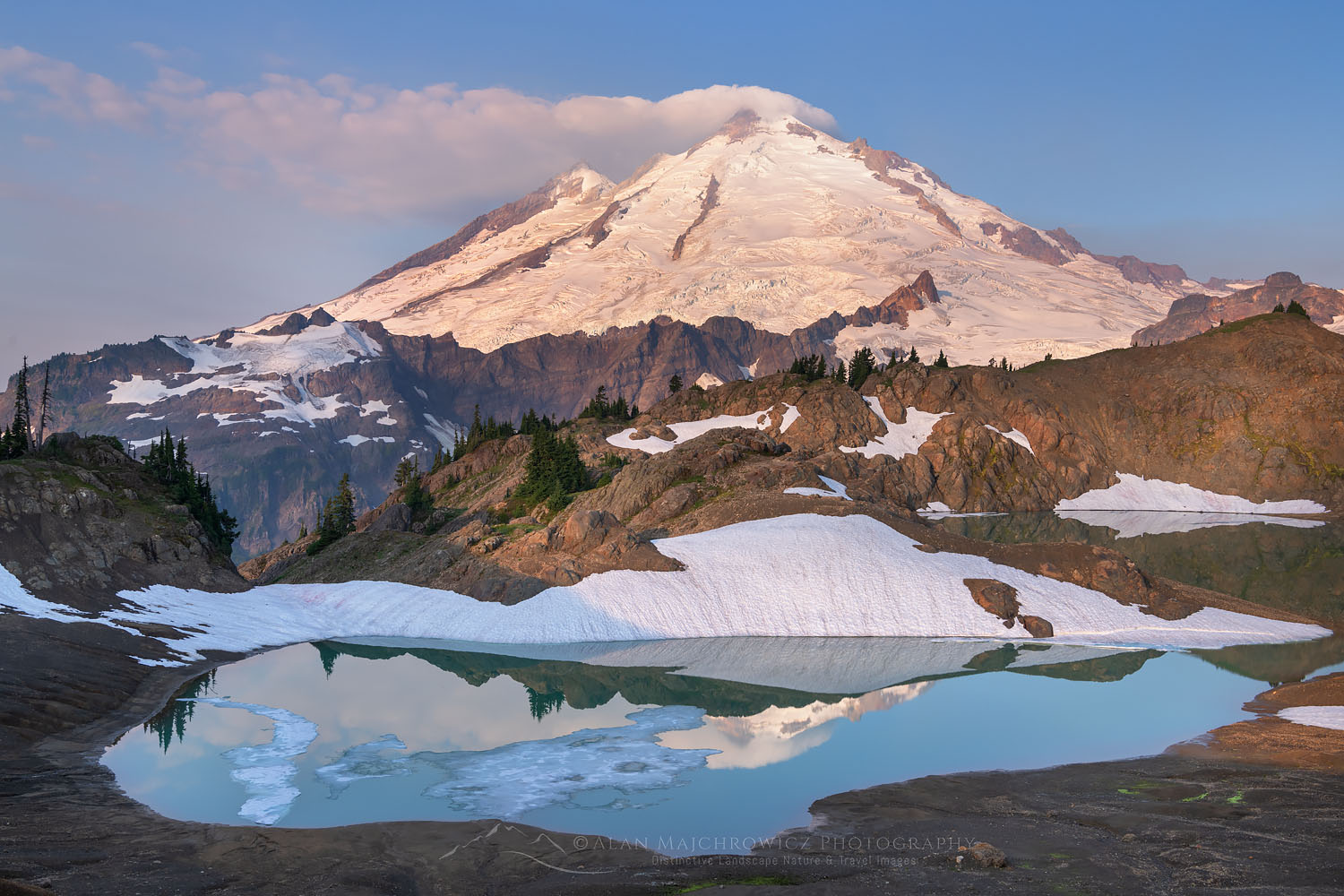
The Best First Glacier Is Big Enough to Teach—and Small Enough to Learn On.
If altitude, extreme cold, technical ice or expedition logistics consume all of your attention, the glacier system becomes one more thing to survive instead of the skill you came to practise. Good progression separates the variables before recombining them later.
The Best Glacier-Experience Mountains, Ranked
Each mountain earns its place for a different reason. Do not turn the ranking into a mandatory checklist.
Mount Baker
Baker remains the strongest all-around answer because the standard glacier routes are serious enough to teach without being overwhelmed by altitude. Coleman-Deming and Easton are widely used for programs that combine rope-team travel, crampon movement, self-arrest, crevasse awareness, rescue practice, camp systems and a real summit.
The important distinction is duration. You do not merely cross a patch of ice. You spend enough time inside the glacier system for spacing, pace, communication and equipment transitions to become part of the climb.
Mount Rainier
Rainier is where the system gets bigger. Every normal summit route crosses active glacier terrain, and the standard climb adds more vertical gain, heavier loads, a midnight summit push, altitude and a descent that remains serious after many hours of effort.
That makes Rainier an excellent progression mountain but a less clean first classroom than Baker. A climber who already understands rope teams and rescue systems can use Rainier to learn what happens when those systems have to survive fatigue, weather, route changes and a larger glacier environment.
Gran Paradiso
Gran Paradiso is stronger than Breithorn when the goal is to learn the full Alpine rhythm rather than simply experience a glacier for a few hours. The typical two-day format adds hut logistics, a predawn start, sustained snow and glacier travel, altitude and a complete descent.
It still belongs on the introductory side of Alpine mountaineering, which is exactly why it works. The climber gets a real 4,000-meter objective without the full complexity of Mont Blanc.
Cayambe
Cayambe earns its position because the glacier component remains central even while the altitude climbs toward 5,800 meters. The standard southwest-glacier climb involves roped crevassed terrain and sustained snow movement, giving experienced developing climbers a meaningful Andean progression.
The limitation is the same thing that makes it valuable: altitude. When a climber is struggling to eat, pace or think clearly above 5,000 meters, technical learning becomes less efficient. Learn the basic systems lower first; use Cayambe to prove they still work high.
Breithorn
Breithorn is the shortest, simplest way to put a fit hiker into a real guided Alpine rope team at 4,000 meters. Zermatt guide programs explicitly pair lower Theodul Glacier instruction with a Breithorn ascent, teaching crampons, rope use, ice axe basics and glacier movement before the summit day.
The weakness is also obvious: the lift removes most of the approach, and the normal route is short. That makes Breithorn an excellent introduction but a limited substitute for longer glacier time.
Cotopaxi
Cotopaxi has an enormous advantage for international climbers: established guide infrastructure around a high, real glacier objective. The standard route combines crampons, rope-team movement, crevasses, a midnight start and altitude near 5,900 meters.
But that combination is why Cotopaxi ranks below Baker as a teaching mountain. A climber learning basic rope systems for the first time should not also be discovering how poorly they function near 6,000 meters. Use Cotopaxi to integrate glacier competence with altitude—not to replace the lower-altitude learning phase.
Mont Blanc
Mont Blanc is enormously valuable in a progression, but not because it is the cleanest place to learn crevasse systems. A normal-route climb combines glacier movement with altitude, long summit-day endurance, refuge logistics, route-specific objective hazards and rapidly changing conditions.
Those extra variables make it a stronger integration test than a first classroom. The climber should arrive with crampon and rope-team familiarity already established, ideally on Breithorn, Gran Paradiso or another comparable glacier objective.
The Glacier Travel Progression Ladder
Good sequencing introduces the system, gives you room to practise it, scales the environment, then integrates altitude and expedition complexity.
Hands-on instruction
Qualified glacier course: rope-team movement, crampons, ice axe, arrest, anchors and crevasse-rescue practice.
First application
Mount Baker, Breithorn or Gran Paradiso depending region and previous mountain experience.
Scale the glacier
Mount Rainier or another longer glaciated objective where route management and fatigue become central.
Add altitude
Cayambe, Cotopaxi or Mont Blanc after the core glacier system is already familiar.
Expedition glacier
Denali or equivalent only after glacier travel, rescue and self-sufficiency are established—not as a classroom.

One Summit Does Not Make Glacier Systems Automatic.
The goal is repeated exposure: roping up, spacing correctly, moving at team pace, watching terrain, managing transitions and rehearsing rescue until the system remains organized when you are cold and tired. Bigger mountains should add difficulty—not introduce every core skill at once.
Best Glacier Mountain by Region & Use Case
Mount Baker
Use Baker when the primary goal is to learn the system itself. Lower altitude than Rainier, real glacier time, established instructional routes and direct transfer to bigger Cascade and Alaska objectives.
Mount Rainier
Use Rainier when Baker-level systems are already familiar and you want a larger glacier, more vertical gain, heavier loads, altitude and a more consequential summit day.
Breithorn
Use Breithorn when you want a compact guide-led first 4,000-meter glacier summit. Pairing it with a separate glacier-skills day makes the experience much more valuable than summit-only guiding.
Gran Paradiso
Use Gran Paradiso when you want the fuller Alpine experience: hut, predawn start, longer glacier travel, altitude and descent rather than a lift-assisted half-day.
Cayambe
Use Cayambe when the climber already understands basic systems and wants more route-finding and crevassed glacier terrain combined with a serious 5,700-meter summit.
Cotopaxi
Use Cotopaxi when a well-established guide network and iconic high-altitude glacier objective matter more than maximizing pure instructional time.
Denali Is What Glacier Training Prepares You For
Denali belongs on this page because it clarifies the purpose of the entire progression—not because it belongs in the beginner ranking.
Do not arrive on the Kahiltna to learn a core glacier skill.
National Park Service guidance says crevasses are an ever-present hazard from the moment climbers step onto the glacier until they step off, and every team member should be well versed in crevasse rescue. On Denali, glacier systems are layered under sled hauling, multi-week camping, severe cold, altitude and expedition fatigue.
That makes the West Buttress an integration objective. The right question before Denali is not “Have I been on a glacier?” It is “Have I travelled roped on glaciers repeatedly, practised rescue hands-on, and remained competent while loaded, cold and tired?”
Glacier Readiness Checklist
The first mountain should apply skills you have already been introduced to—not make the guide teach every system while the team is moving through consequential terrain.
Hands-on systems completed
- Glacier-travel course or equivalent professional instruction.
- Crevasse rescue practiced with a real hauling system.
- Crampon and ice-axe movement practiced before summit day.
- Basic rope-team spacing and communication understood.
Your personal system is familiar
- Boots fit for long uphill and downhill use.
- Crampons fit the exact boots.
- Harness and layers work together.
- Gloves allow you to manage clips and equipment.
You can learn while tired
- Aerobic base supports several steady hours.
- Loaded uphill movement feels controlled.
- Descending in stiff boots is not new.
- You recover well enough for multi-day programs.
You understand what the summit does not prove
- A guide can manage the route without making you independently competent.
- Following a boot track is not route-finding experience.
- One successful day does not equal rescue fluency.
- Independent glacier travel requires a much higher standard than guided participation.
This Page Chooses the Mountain. The Skills Pages Teach the Concepts.
Use this URL to select the right objective. Then move to the training and safety owners for glacier systems, rescue, crampons and first-climb fitness rather than turning one ranking page into a technical manual.
Build the Glacier Progression
Glacier Travel Basics
Crevasses, rope teams, timing and what needs hands-on instruction before you rely on it.
Understand glacier travel →Deep recovery 1Crevasse Rescue Basics
Understand arrest, stabilization, anchors, load transfer and why repeated practice matters.
Review rescue system →TrainingFirst Glacier Climb Training
Build the aerobic, loaded, boot and cold-weather fitness that makes technical learning possible.
Build the training plan →Deep recovery 2Best Mountains for Crampon Skills
Use the narrower crampon-intent page when front-pointing, flat-footing and snow/ice movement are the main gap.
Build crampon skills →First mountainMount Baker
The strongest overall first true glacier mountain in this framework.
Plan Baker →ComparisonMount Baker vs Rainier
Understand exactly why these two Cascade volcanoes belong in sequence rather than as substitutes.
Compare Baker vs Rainier →Major progressionMount Rainier
Scale glacier systems into a bigger, higher and more consequential Cascade objective.
Plan Rainier →Europe introBreithorn
The shortest guided introduction to a real 4,000-meter Alpine glacier summit.
Plan Breithorn →Europe full climbGran Paradiso
A complete first hut-and-glacier Alpine objective before Mont Blanc.
Plan Gran Paradiso →Andes comparisonCotopaxi vs Cayambe
Choose between Ecuador’s established glacier volcano and the more complex Cayambe experience.
Compare Ecuador peaks →Alps integrationMont Blanc
Integrate glacier skills, altitude, hut systems, objective hazards and a bigger summit day.
Plan Mont Blanc →Deep recovery 3Denali Progression Plan
See where glacier competence fits beside cold camps, altitude, sled hauling and expedition judgment.
Build toward Denali →How We Chose These Glacier Mountains
What earns a mountain a place
- Meaningful time travelling roped on real glacier terrain.
- Crevasses or glacier features that make team systems relevant.
- Established qualified guiding or instructional programs.
- A difficulty profile that fits a specific progression stage.
- A clear capability that transfers to a larger objective.
- A role distinct enough that it is not just another famous snowy summit.
What does not earn points
- Height by itself.
- Being famous.
- Having a tiny glacier crossing.
- Following a guide without deliberate skills practice.
- Summiting without understanding team systems.
- Extreme consequence that makes the mountain a poor place to learn.
That is why Denali is excluded from the ranking itself. It has enormous glacier exposure but poor suitability as a learning classroom because prior competence is expected.
Glacier Travel Mountain FAQ
What is the best mountain for learning glacier travel?
Mount Baker is the strongest overall choice for many North American climbers because its standard routes provide sustained real glacier travel, crevasse terrain and established instructional programs without Rainier’s altitude and scale. Use formal hands-on instruction before relying on those systems.
Should I take a glacier course before climbing one of these mountains?
Yes. Glacier travel and crevasse rescue are hands-on systems. Learn them through qualified instruction, practise them, then use a moderate guided climb to build real experience. Reading about the system is not enough.
Is Mount Baker or Rainier better for a first glacier climb?
For most developing climbers, Baker is the better first learning environment. Rainier is the stronger next step because it adds more altitude, larger glacier terrain, heavier loads, a longer summit push and greater overall commitment.
What is the best first glacier mountain in Europe?
Breithorn is the shortest lift-assisted guided introduction. Gran Paradiso is the better complete first Alpine climb because it includes a hut approach, longer glacier travel, a pre-dawn start and a full descent.
Is Cayambe or Cotopaxi better for glacier experience?
Cayambe generally offers the stronger glacier-focused progression because its standard route involves more sustained crevassed glacier terrain. Cotopaxi has the more established guiding infrastructure and is an excellent high-altitude glacier objective. Both are best after the basics are already familiar.
Is Mont Blanc a good place to learn glacier travel?
Mont Blanc is better used to integrate skills than to learn them from scratch. Breithorn or Gran Paradiso provide cleaner first Alpine experiences, allowing the climber to make crampons and rope-team movement familiar before adding Mont Blanc’s altitude, objective hazards and longer summit day.
Is Denali a good glacier-training mountain?
No. Denali is where established glacier competence gets tested under expedition conditions. NPS emphasizes that crevasses are an ever-present hazard and team members should already be well versed in crevasse rescue.
What should I climb before Denali for glacier experience?
A strong progression is a formal glacier course, Mount Baker, Mount Rainier and then Denali-specific preparation. The sequence moves from learning systems, to scaling them, to integrating them with cold, heavy loads and expedition self-sufficiency.
Does summiting a guided glacier mountain mean I can travel independently?
No. A guide can make route-finding, rescue decisions and team management invisible to the client. Independent glacier travel requires a deeper standard: repeated rope-team practice, rescue competence, judgment, navigation and the ability to solve problems without the guide managing the system.
Learn the System Low. Practise It for Real. Add Altitude Later.
The best glacier progression is not a collection of famous snowy mountains. It is a sequence that makes rope-team travel, crampons, crevasse awareness and rescue familiar before bigger peaks add altitude, weather, cold and expedition fatigue. For many North American climbers, that sequence starts with Mount Baker and scales through Rainier before Denali ever enters the plan.
Which Mountain Actually Teaches Which Glacier Skills?
A mountain can be glaciated without being a good place to learn glacier systems. The best progression separates rope-team movement, crevasse awareness, rescue, route management, altitude and expedition complexity so each new objective adds one major layer instead of five at once.
| Mountain | Rope-Team Practice | Crevasse Learning | Route Management | Altitude Load | Best Learning Role |
|---|---|---|---|---|---|
| Mount Baker | Excellent | Excellent | Good | Low–moderate | Best first true glacier mountain after instruction |
| Mount Rainier | Excellent | Excellent | Excellent | Moderate | Best major progression after Baker-level systems |
| Gran Paradiso | Very good | Moderate | Good | Moderate | Best complete first Alpine glacier experience |
| Breithorn | Good | Introductory | Introductory | High but brief | Best compact guided first taste of Alpine glacier travel |
| Cayambe | Very good | Excellent | Very good | High | Best Andes choice for adding altitude to known glacier skills |
| Cotopaxi | Good | Moderate | Good | Very high | Best established guided high-altitude glacier objective |
| Mont Blanc | Good | Moderate | Very good | High | Best integration objective after basic glacier systems are familiar |
Which Glacier Mountain Should You Choose Next?
Take a Course First
Learn rope-team travel and crevasse rescue hands-on before choosing a summit as your classroom. A guided skills-and-summit program on Baker can then provide the first real application.
Choose Mount Baker
Baker gives the cleanest combination of sustained glacier travel, real crevasse terrain and manageable altitude for building repetition.
Move to Rainier
Rainier adds scale, route management, longer glacier exposure, heavier loads and altitude without changing the core rope-team system.
Breithorn or Gran Paradiso
Choose Breithorn for a short guided introduction and Gran Paradiso for the fuller hut-to-glacier learning cycle.
Cayambe or Cotopaxi
These Ecuador peaks work best when basic glacier systems are already familiar and altitude is the new variable being introduced.
Course → Baker → Rainier
Build glacier competence before Denali-specific cold, load hauling and expedition self-sufficiency become part of the problem.
The Best Mountains to Build Glacier Experience
Glacier skill is built on the right peaks. Pair this with the core skills and the glacier training climbs below.
Was this helpful?
🏔Related training
🧭Explore & compare
Global Summit Guide is an independent mountaineering resource founded in 2026. The team combines first-hand trekking and climbing experience with in-depth research and professional health and nutrition review to help climbers choose objectives, prepare properly, and stay safe.
Health, altitude, and nutrition content is reviewed by Taylor Ludlow (Registered Nurse) and Brigg Hoopes (Nutritionist).
What We Don't Know Yet
Mountain information changes quickly. This box explains the limits of what this page can responsibly promise.
- Route conditions, trailhead access, crevasse exposure, stream crossings, and rescue access may vary from published planning guidance.
- Fitness and altitude response vary by person; no guide, itinerary, or training plan can guarantee acclimatization or summit success.
- Comparisons simplify complex decisions; the better mountain depends on current conditions, skills, timing, budget, and risk tolerance.
Verify current conditions with official land managers, guide services, local forecasts, and current route reports before booking or climbing.
Mountaineering, rock and ice climbing, glacier travel, and high-altitude activity are inherently dangerous and can result in serious injury or death. The information on Global Summit Guide is provided for general informational and educational purposes only and is not a substitute for professional instruction, qualified guiding, proper equipment, or your own judgment and experience.
Route conditions, weather, snowpack, permits, regulations, and hazards change constantly and may differ from what is described here. Details may be incomplete, out of date, or contain errors. Always verify current information with local authorities, certified guides, and official sources before making any decision in the mountains.
Nothing on this site is medical, legal, or financial advice. Our fitness, acclimatization, altitude, and nutrition content is general in nature; consult a qualified physician before beginning any strenuous exercise program or exposing yourself to high altitude.
You are solely responsible for your own safety and decisions. To the fullest extent permitted by law, Global Summit Guide and its team accept no liability for any loss, injury, damage, or expense arising from use of, or reliance on, this information. By using this site you acknowledge these risks and accept these terms.
Some links on this site may be affiliate links. If you buy through them we may earn a small commission at no extra cost to you; this never affects our recommendations.
Global Summit Guide recommendation path
Next Best Mountain to Research
Use these recommendations to continue the right planning path instead of stopping on one page.
Use current permit, weather, route, and operator information before booking or climbing.
Search Flights, Hotels & Rental Cars
Have the mountain or destination picked? Use Expedia to compare the flights, lodging and rental cars that fit your actual trip dates. For mountain travel, consider arriving early enough for delays and adding a buffer night after the climb before a fixed flight home.
Compare current flight, hotel and car options.
Affiliate disclosure: Global Summit Guide may earn a commission if you book through this link, at no additional cost to you.