<

Aletschhorn Climb Guide — Switzerland | Global Summit Guide

Global Summit Guide · Bernese Alps · Canton Valais, Switzerland

Aletschhorn — Switzerland

Complete guide: SW Ridge Normal Route via Oberaletsch Hütte & Belalp, Mittelaletsch approach & the NE Ridge — the coldest mountain in the Alps, the finest panoramic view from any Alpine summit, and Europe’s longest glacier at its feet in the UNESCO World Heritage Jungfrau-Aletsch region.

4,193 m / 13,757 ft Bernese Alps, Valais UNESCO Jungfrau-Aletsch Finest Alpine Panorama Aletsch Glacier — Europe’s Longest

Ultimate Aletschhorn Guide: SW Ridge, Glacier World & Full Logistics

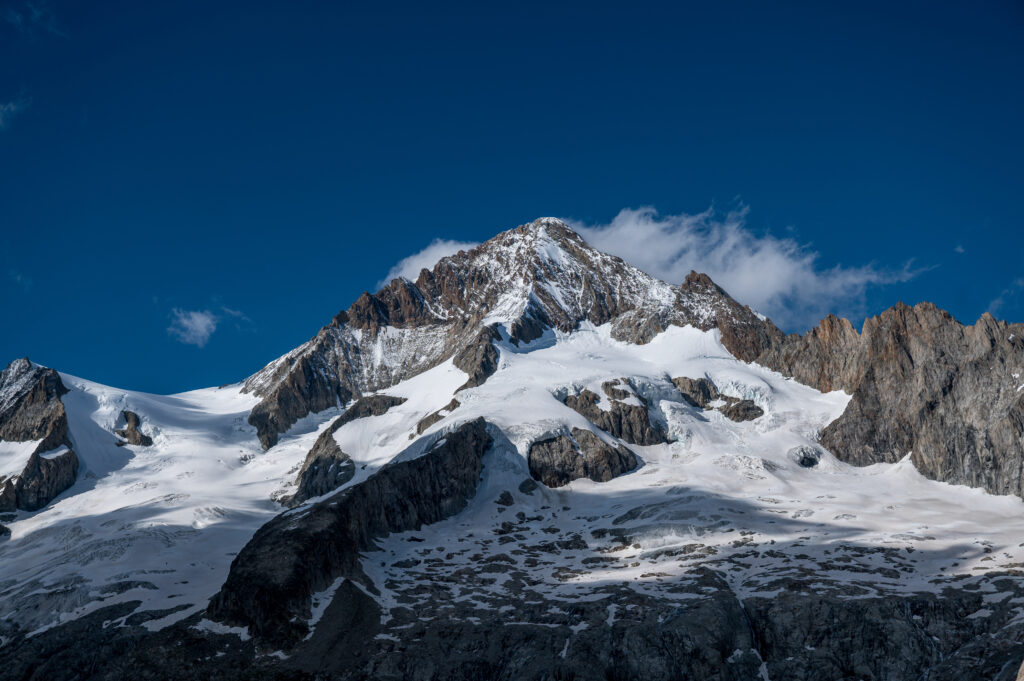
The Aletschhorn (4,193 m / 13,757 ft) stands at a geographic crossroads that no other Alpine 4,000m peak can match: it is the central summit of the Jungfrau-Aletsch UNESCO World Heritage region, surrounded by the largest concentration of glacial ice in the Alps. The Great Aletsch Glacier — 23 km long, 800 m deep at its thickest, containing 10 billion tonnes of ice — flows from the Jungfraujoch directly past the mountain’s northern flank. The Oberaletsch and Mittelaletsch glaciers flank it to the southwest and east. The Aletschhorn rises from this vast frozen landscape like a pyramid throne above the biggest river of ice in Europe.

The mountain holds two claims that define its character. First, it is “often thought to command the finest of all the panoramic views from Alpine summits” (Wikipedia, quoting established mountaineering tradition) — a view that encompasses the entire Bernese Alps chain northward (Eiger, Mönch, Jungfrau, Finsteraarhorn), the Pennine Alps southward (Matterhorn, Weisshorn, Dom, Monte Rosa), and Mont Blanc to the west. Second, it carries the reputation of being the coldest mountain in the entire Alps. Both claims are confirmed by Francis Fox Tuckett who, on his first ascent in 1859, took barometric measurements at the summit and specifically noted the icy temperature and ferocious wind that nearly knocked his party from the ridge.

For mountaineers, the Aletschhorn is defined by its remoteness. SummitPost describes the mountain’s approaches as having “Himalayan dimensions and shapes” — vast flat glacier basins, long approaches on endless moraines, and huts placed so far from the summit and from civilisation that phone signal is absent all day. The SW Ridge Normal Route from the Oberaletsch Hütte involves a 6–8 hour ascent and a 5-hour descent, with a 200-metre roped descent onto the glacier at the start of the summit day that must be reversed at the end of it. This is not a mountain for the hurried. It rewards those who give it the time and preparation it demands.

Aletschhorn Quick Facts

CategoryDetails
Elevation4,193 m / 13,757 ft
LocationBernese Alps, Canton Valais, Switzerland — Jungfrau-Aletsch UNESCO World Heritage region
Rank2nd highest peak in the Bernese Alps (after Finsteraarhorn at 4,274 m) · Only higher Bernese Alps peak entirely in Valais
UNESCO StatusWithin the Jungfrau-Aletsch UNESCO World Natural Heritage Site (designated 2001)
Panorama“Often thought to command the finest of all the panoramic views from Alpine summits”
TemperatureConsidered the coldest mountain in the entire Alps — noted by Tuckett on the first ascent, 1859
RemotenessApproaches described as “Himalayan dimensions and shapes” — long glacier approaches, remote huts, no phone signal on the mountain
The GlacierGreat Aletsch Glacier at its foot — 23 km · 800 m deep · 10 billion tonnes · Europe’s longest glacier
Normal RouteSW Ridge (Suedwestrippe, ZS−/AD) from Oberaletsch Hütte (2,640 m) via Belalp cable car
Hut ApproachBelalp cable car (Blatten near Naters) → Panoramaweg trail → Oberaletsch Hütte (3–4 hrs)
Hut to Summit6–8 hours; 1,700 m gain; 200 m descent then climb to get on/off glacier
All RoutesAll routes are long and strenuous — no easy option exists on the Aletschhorn
NeighborsEiger, Mönch, Jungfrau ~10 km north; Finsteraarhorn to east; Bietschhorn to west
First AscentJune 18, 1859 — Francis Fox Tuckett with guides J.J. Bennen, Victor Tairraz & P. Bohren
First Woman1863 — Emma Winkworth
Best SeasonJune – September

Tuckett & Bennen, 1859 — “The Icy Temperature and the Very Strong Wind”

First Ascent Background — Almost 50 Years After the Jungfrau

The Aletschhorn was first climbed almost 50 years after the first ascent of the Jungfrau (1811) — a remarkable gap given its greater height than the Jungfrau and its prominent central position in the Bernese Alps. The reason is purely geographic: the Aletschhorn is remote. While the Jungfrau could be seen and approached from the densely populated valleys of the Bernese Oberland to the north, the Aletschhorn sat in the heart of a glacier world with no easy valley access. The first Jungfrau climbers in 1811 actually camped at the foot of the Aletschhorn — using the Aletschfirn as their base — on their way to the Jungfrau. They could see the Aletschhorn above them but had neither the time nor the objective to attempt it. The mountain waited 48 more years for its first ascent.

Francis Fox Tuckett — First Ascent, June 18, 1859

Francis Fox Tuckett (1834–1913) was a Bristol-born businessman and Quaker who became one of the most prolific mountaineers of the Golden Age, making first ascents and new routes throughout the Alps and beyond. On the night before the first ascent, his party — Tuckett with guides J.J. Bennen, Victor Tairraz, and P. Bohren — passed the night in holes in the rocks above the Mittelaletsch Glacier on the east side of the mountain. At dawn on June 18, they started the ascent and reached the snow arête connecting the Dreieckhorn with the main peak. The passage along this arête, so early in the year before the snow consolidated, involved real danger: a slope of nevé at 50° requiring careful step-cutting throughout. Tuckett, characteristically, brought a barometer and made scientific observations at the summit. He recorded “the icy temperature and the very strong wind, blowing the snow and threatening to knock over the climbers.” After reaching the summit, Tuckett separated from Bennen and descended via the north face with Bohren and Tairraz, while Bennen took a different descent line — a decision that reflects the mountain’s complex terrain and the freedom of movement experienced guides and capable clients brought to early Alpine ascents.

J.J. Bennen — Two Years Before the Weisshorn, Five Years Before His Death

The guide J.J. Bennen on the Aletschhorn first ascent (1859) is the same J.J. Bennen who partnered John Tyndall on the first ascent of the Weisshorn two years later in 1861 — and who died in an avalanche on the Haut de Cry in February 1864. Bennen is by wide acclaim the greatest mountain guide of the Golden Age — his career concentrated into a single extraordinary decade (roughly 1855–1864) of first ascents, technical innovations, and guiding achievements that set the standard for the era. The Aletschhorn first ascent was part of an extraordinary sequence: Bennen was on the first ascent team of multiple major Alpine summits across the late 1850s and early 1860s before his death ended what would have been the most remarkable guiding career in history.

Emma Winkworth — First Woman, 1863

Four years after the first ascent, Emma Winkworth — daughter of Thomas Thomasson — became the first woman to climb the Aletschhorn in 1863. Her ascent in the same year as the Jungfrau’s first female ascent (also 1863) reflects the extraordinary role women played in Golden Age alpinism — often at the forefront of first ascents, rarely credited in popular history.

Why the Aletschhorn Is “Thought to Command the Finest Panoramic View”

The Aletschhorn’s central position is the key. It stands between the Bernese Alps chain (Eiger, Mönch, Jungfrau, Finsteraarhorn all visible to the north and northeast) and the Pennine Alps chain (Matterhorn, Weisshorn, Dom, Monte Rosa all visible to the south and southeast), with Mont Blanc visible to the west on clear days. The Finsteraarhorn (4,274 m, 10 km east) is the only summit in the entire Bernese Alps that is higher. From the Aletschhorn summit, almost every great Alpine peak from the Bernese Oberland to the Valais is visible simultaneously — an unobstructed 360-degree panorama that few mountains in the Alps can match by reason of their more marginal positioning in the chain.

The Great Aletsch Glacier — Europe’s Longest, at the Mountain’s Feet

🧣 The Great Aletsch Glacier — 23 km · 800 m Deep · 10 Billion Tonnes · UNESCO World Heritage

The Great Aletsch Glacier is the largest and longest glacier in the Alps — by a significant margin. At 23 km in length, it is more than twice the length of any other Alpine glacier. It covers an area of 80 km² and contains an estimated 10 billion tonnes of ice. At its deepest point, the ice is 800 metres thick. The glacier flows from the Konkordiaplatz — the massive confluence of four glacier arms below the Jungfraujoch, called the “largest glacier gathering in the Alps” — down through 23 km of valley before terminating near Brig in the Rhone valley. The Massa River, which originates in the Aletsch Glacier, flows directly into the Rhône. The entire Jungfrau-Aletsch region was designated a UNESCO World Natural Heritage Site in 2001 — one of Europe’s largest protected Alpine areas.

  • The Aletschhorn’s glacier neighbours: The Great Aletsch Glacier flows along the mountain’s northern flank (the Aletschfirn). The Oberaletsch Glacier lies to the southwest — the approach route from the Oberaletsch Hütte crosses its tongue. The Mittelaletsch Glacier lies to the east and provides an alternative approach via the Mittelaletsch Bivouac. Together, these three glaciers make the Aletschhorn the most glacier-encircled 4,000m peak in the Bernese Alps.
  • Climate change and the approaches: The retreat of the Aletsch glaciers in recent decades has significantly affected the approach routes. The Oberaletsch Glacier tongue is now heavily debris-covered — what was once clean ice is now a moraine surface requiring navigation through rocks and scree for kilometres. The 200-metre descent from the Oberaletsch Hütte to the glacier via fixed ropes and ladders exists because the glacier has retreated below the hut’s level. Route conditions change year to year as the glaciers continue to retreat. Check current conditions with the hut warden before your ascent.
  • Konkordiaplatz: The massive glacier junction below the Jungfraujoch visible on clear days from the Aletschhorn’s summit approaches — where the Jungfraufirn, Ewigschneefäld, and other glacier arms converge into a single vast ice river — is one of the great alpine spectacles. The Konkordiaplatz sits at approximately 2,700 m and was used as a base camp for the 1811 Jungfrau first ascent party who camped at the foot of the Aletschhorn.

Belalp & Blatten — The Gateway via Cable Car

The Aletschhorn is accessed from the Belalp ski resort area above the town of Blatten near Naters in the Upper Valais. Blatten and Naters are part of the Brig-Visp agglomeration at the Rhône valley floor — a gateway town served by the main Swiss rail line.

🚌 Getting to Blatten & Belalp

  • By rail to Brig: Brig (Brig-Glis) is on the main Swiss SBB rail network — direct InterCity trains from Zürich (~2 hrs 15 min) and Geneva (~2 hrs 10 min). From Brig station, take a local bus or taxi to Blatten near Naters (approximately 10 km, 15 minutes).
  • By car: From the A9 motorway (Rhône Valley), exit at Brig and follow signs to Naters and Blatten. Free parking is available at Egga on the road to Blatten (avoiding the higher parking charges) with a pleasant larch forest path leading up to the Hotel Belalp. Alternatively, paid parking at Blatten village.
  • Belalp Cable Car (Luftseilbahn Blatten-Belalp): From Blatten, the cable car takes you to Belalp at 2,094 m — the high plateau resort with the historic Hotel Belalp. Operating hours: approximately 8:00 AM to 8:00 PM. One-way fare approximately CHF 20. The last car down at 8:00 PM is a strict constraint for summit day planning. Check current timetables before your trip: the last cable car governs your entire day.
  • Alternative (no cable car): Strong parties can walk from Blatten/Egga to Belalp through larch forests (gaining ~750 m in ~1.5 hours), avoiding the cable car cost and schedule constraints. The larch forest approach is described as beautiful and gives a more complete mountain experience.

The Oberaletsch Hütte Approach — The Panoramaweg

From Belalp (2,094 m), the approach trail to the Oberaletsch Hütte (2,640 m) follows the beautiful Panoramaweg — a high-level path along the meadow terrace on the left bank of the Oberaletsch Glacier with spectacular views across the glacier to the Nesthorn, Breithorn, and the Aletschhorn itself. The path crosses steep rocky cliff via a trail built with explosive charges in 2005 (the old glacier crossing is now awkward and dangerous due to ice retreat), includes an aerial suspension bridge over a glacial stream, and reaches the hut in approximately 3–4 hours from Belalp. The Aletschhorn does not come into full view until quite late on the approach.

All Trails & Routes on the Aletschhorn

The SAC and every guide service that operates on the Aletschhorn states the same warning: all routes are long and strenuous. There is no easy approach and no short day on this mountain. The Aletschhorn’s remoteness from any valley or mechanical uplift means that every route requires a serious multi-day commitment.

#RouteGradeCharacter & Key Notes
1 SW Ridge Normal Route (Südwestrippe) ZS− / AD Standard summer route. Oberaletsch Hütte (2,640 m) → 200 m descent via fixed ropes/ladders to Oberaletsch Glacier → glacier tongue (debris-covered) → SW Ridge base → rock scrambling (II max) → glacier at 3,400 m → steep summit flank (35°+, safety poles) → summit. 6–8 hrs ascent; 5 hrs descent. 1,700 m gain from hut. Accessed via Belalp cable car. “Good rock” on lower ridge; reddish gneiss; grade never exceeds II. 3-day program recommended.
2 NE Ridge via Mittelaletsch Bivouac AD First ascent route (Tuckett, 1859). From Bettmeralp cable car: descend to Aletsch Glacier, cross to Mittelaletsch Glacier, ascend left side to Mittelaletsch Bivouac (4–5 hrs from Bettmeralp). Summit day via NE Ridge snow arête to Dreieckhorn connection → summit. Very long; very remote; 5–6 hrs + 4–5 hrs. Bivouac conditions can be basic. Equal or greater remoteness than SW Ridge approach.
3 NW Ridge (via Hollandia Hütte / Lötschenlücke) AD+ From the Hollandia Hütte (3,239 m) on the Lötschenlücke, west of the mountain. Less frequently climbed; useful only for the NW ridge. Long approach from Lötschen valley. Not the standard summer route. Winter/ski mountaineering potential.
4 North Face (Aletschfirn approach) D · 50° ice Steep north face above the Great Aletsch Glacier (Aletschfirn). Serious ice climbing objective. Approach from Jungfraujoch (by rail), then long descent and approach across the glacier. Significant objective danger. After summit, must ascend 500 m back to Jungfraujoch railway station on return — a major commitment. Rare. For experienced ice climbers.
5 SW Ridge in Winter / Ski ZS / ski mountaineering The SW Ridge is skiable in good snow conditions, though ski depots are used for the upper rocky sections. Access via Belalp lifts and the ski touring terrain above. Switzerland Tourism describes this as an ideal “first 4,000m peak” ski objective for experienced ski mountaineers. Guide essential.

SW Ridge Normal Route & NE Ridge — Full Descriptions

1

SW Ridge — Normal Route (Südwestrippe)

ZS− / AD · 6–8 hrs Ascent · 1,700 m Gain from Hut · 200 m Rope Descent to Glacier
Start
Oberaletsch Hütte (2,640 m)
Glacier Descent
200 m via fixed ropes & ladders at start of day
Glacier at Altitude
Reach glacier at ~3,400 m — upper ice flank
Summit Flank
35°+ with safety poles on upper 450 m
Grade
ZS− / AD · II max on rock
Total Programme
3 days: Belalp → Hut → Summit+Hut → Belalp+cable car
Last Cable Car
~8:00 PM — hard deadline for summit day
  • The pre-dawn departure and the 200 m glacier descent: Summit day starts at approximately 2:00–3:00 AM — unusually early even by alpine standards — because of the distance to be covered. The first challenge is not upward but downward: a 200-metre descent via fixed ropes and vertical ladders from the Oberaletsch Hütte down a steep rock face to the glacier below. The hut sits above the glacier because the ice has retreated far below its historical level. This descent is secured but requires full gear — harness, helmet, crampons ready. The ascent in reverse at day’s end, when parties are exhausted from 10–14 hours on the mountain, is described with conspiratorial good humour in multiple guides: “Don’t forget: there’s another 200-metre climb from the glacier up to the hut at the end.”
  • Glacier tongue — debris-covered and route-finding required: At the base of the ropes, the Oberaletsch Glacier tongue is completely covered in glacial debris. What was once clean ice is now a kilometres-long field of moraine scree. Parties search for the best access route across this — a 2-km trudge on “fairly solid, but potentially icy, footing” as one alpinsight.com trip report describes it. Navigation here is not trivial in the dark; reflective markers on the glacier help guide the way.
  • The moraine and SW Ridge base — rock scrambling begins: Above the glacier tongue, the route climbs steeply through moraine flanks to reach the base of the SW Ridge. A newly-built trail with permanent wands and markers leads up and left to a flat plateau at the ridge base. Above here, the SW Ridge itself begins — described as “entertaining rock scrambling” on good reddish gneiss. The grade never exceeds Class II on rock, but the exposure, altitude, distance, and accumulated fatigue make it demanding. “The astonishingly good rock leads along the ridge.”
  • Reaching the glacier at 3,400 m — the upper ice flank: At approximately 3,400 m the route reaches the glacier on the upper mountain. From here, the final 450 m to the summit is steep ice and rock, requiring full crampon discipline. Safety poles are fixed on the steepest section of the summit flank (35°+) to assist movement and provide protection points. Clip into the poles; do not trust luck on this section.
  • Summit (4,193 m) — the finest Alpine panorama: The summit view is justly celebrated. North: Eiger, Mönch, Jungfrau, Schreckhorn, Finsteraarhorn — the full Bernese Oberland glacier world. South: Matterhorn, Weisshorn, Dom, Breithorn, Monte Rosa. West: Mont Blanc visible on clear days. The view is remarkable for its completeness — the Aletschhorn’s central position between the Bernese and Pennine chains means both great Alpine ridges are simultaneously visible. Below, the full length of the Great Aletsch Glacier unfolds northward — a 23 km river of ice ending 23 km away near Brig.
  • Descent — the 8:00 PM cable car constraint: Descend the exact ascent route. The 200 m re-ascent via fixed ropes to the hut at day’s end is the final test. From the hut, the return to Belalp via the Panoramaweg takes 3–4 hours — and the last Belalp cable car descends at approximately 8:00 PM. This governs the entire day’s timing. A 3-day program with two nights at the Oberaletsch Hütte removes this pressure and allows a leisurely final day walk back to Belalp and the cable car.
2

NE Ridge — First Ascent Route (Tuckett, 1859)

AD · Via Mittelaletsch Bivouac · Very Remote · Bettmeralp Approach
Access
Bettmeralp cable car → Aletsch Glacier crossing → Mittelaletsch Bivouac
Bivouac
Mittelaletsch Bivouac (basic; self-catering)
Approach to Bivouac
4–5 hrs from Bettmeralp
Summit Day
5–6 hrs from bivouac
Grade
AD
Character
Most remote route; Himalayan scale approach
  • Tuckett’s 1859 approach: The first ascent party bivouacked in “holes in the rocks” above the Mittelaletsch Glacier the night before their summit, starting the ascent at dawn on June 18. The approach from the Mittelaletsch side across the vast Aletsch Glacier system is what gives the route its Himalayan character — vast, flat glacier basins, minimal landmarks, and a sense of distance and scale that is almost without parallel in the Alps.
  • Modern approach from Bettmeralp: Take the Bettmeralp cable car from the Rhone valley. From the Bettmeralp station, descend to the Aletsch Glacier, cross it to the opposite side, reach the Mittelaletsch Glacier, and ascend the glacier’s left side following cairns to the Mittelaletsch Bivouac. The bivouac is small, basic, and remote — basic sleeping facilities and no staffing. Total approach: 4–5 hours from Bettmeralp.
  • Summit day via NE Ridge: From the bivouac, ascend the NE ridge to the snow arête that connects the Dreieckhorn with the main summit. The arête in early season (as Tuckett experienced) can be at 50° and demanding step-cutting; in summer it is more consolidated. 5–6 hours from bivouac. The views on this approach are extraordinary — looking directly up the Great Aletsch Glacier toward the Jungfraujoch.
  • Why “Himalayan dimensions”: The Aletsch approaches are described in multiple sources as having Himalayan scale precisely because of routes like this one. The glacier basins are flat and immense. The huts and bivouacs are placed far from both the summit and from any road. Phone signal is absent all day. The sense of being in a truly remote, self-sufficient alpine environment — rare in a country as developed as Switzerland — is the Aletschhorn’s most distinctive character.

Recommended Three-Day SW Ridge Program

The three-day program is strongly recommended over two days — it gives two nights at the Oberaletsch Hütte, removing the cable car time pressure and allowing proper acclimatization and rest for the long summit day.

Day 1 — Belalp to Oberaletsch Hütte

Blatten → Belalp cable car → Hotel Belalp → Panoramaweg → Oberaletsch Hütte (2,640 m) · 3–4 hrs
Take the Belalp cable car from Blatten (or walk up from Egga through larch forests). From Belalp, stop at the famous Hotel Belalp for a cappuccino — where Sir Ernest Cassel hosted Winston Churchill during the Belle Époque. Then follow the Panoramaweg high-level trail along the left bank of the Oberaletsch Glacier. The views across the glacier to the Nesthorn and Breithorn are spectacular. The path crosses steep sections and an aerial bridge before reaching the Oberaletsch Hütte at 2,640 m in 3–4 hours. The hut has 58 places and a beautiful position above the glacier. Dinner, meet your guide, and early to bed.

Day 2, ~2:00 AM — Pre-Dawn Summit Push

200 m descent to glacier → glacier tongue → SW Ridge → upper glacier (3,400 m) → summit (4,193 m)
The very early start is essential for this mountain. Descend 200 m via fixed ropes and ladders to the Oberaletsch Glacier. Navigate the debris-covered glacier tongue. Ascend moraine to the SW Ridge base. Climb the good gneiss of the ridge (entertaining scrambling, max II). Reach glacier at 3,400 m. Ascend the steep summit flank using the safety poles. Summit of the Aletschhorn in the mid-morning with the finest panoramic view in the Alps: the full sweep from Eiger to Monte Rosa, and 23 km of Aletsch Glacier below. Descend the full route. Remember the 200 m re-ascent via fixed ropes back to the hut at the end. Return to hut by early afternoon. Second night at the hut — no cable car pressure.

Day 3 Morning — Oberaletsch Hütte to Belalp & Cable Car

Panoramaweg return to Belalp · 3–4 hrs · Cable car down to Blatten
After a full breakfast and proper rest, return to Belalp via the Panoramaweg (3–4 hours). The views on the return journey — now with summit memories — are even more appreciated. The Aletsch Glacier spread below, the Aletschhorn now behind you, the Valais peaks lining the southern horizon. Take the cable car down to Blatten. Drive or train back to Brig and onward connections. Total programme: three days, entirely self-powered, in one of the most extraordinary mountain landscapes in Europe.

Oberaletsch Hütte & No Climbing Permits Required

ResourceDetailsCost / Booking
Climbing PermitNo permit required for any Aletschhorn routeFree
Oberaletsch Hütte (2,640 m)SAC hut (Section Chasseral); 58 places new hut + 12 old; open spring and summer; multilingual staff (German, English, French, Italian, Japanese). Book in advance for July–August. Phone: +41 27 927 17 67~CHF 60–80/person half board · Book via sac-cas.ch →
Mittelaletsch BivouacSmall basic bivouac on Mittelaletsch Glacier east side — for NE Ridge approach. No warden; self-catering.Low / donation
Hollandia Hütte (3,239 m)On the Lötschenlücke west of mountain — used for NW ridge approach and Bernese Oberland glacier traversesBook via SAC
Belalp Cable CarBlatten near Naters to Belalp (2,094 m). Operating ~8:00 AM to 8:00 PM. Last car down is a hard constraint for summit day timing.~CHF 20 one-way · Check timetable at belalp.ch →
Bettmeralp Cable CarFor Mittelaletsch Bivouac approach from Bettmeralp resortLocal resort pricing

Best Time to Climb the Aletschhorn

SeasonWindowProsWatch-outs
Summer ★ PrimaryLate June – mid-SeptemberOberaletsch Hütte fully open; SW Ridge accessible; consolidated snow on upper flank; long days for the very long summit push; stunning wildflowers on Panoramaweg approachExtremely cold summit even in summer — warmest gear required; afternoon storms possible; debris-covered glacier tongue awkward; glacier conditions change annually; phone signal absent all day
Early June / Winter-Spring SkiMay–JuneExcellent ski mountaineering conditions; clean snow on SW Ridge; Belalp lifts often operational for ski accessHut may not be fully staffed; SW Ridge more demanding in deep snow; crevasse bridges fragile in spring
Late September onwardAfter mid-SeptemberPossible in stable high-pressure conditionsHut closing; new snowfall; shorter days; SW Ridge icy

Essential Gear for the Aletschhorn

⛰ Technical

  • Crampons — mandatory throughout
  • Ice axe — mandatory (35°+ summit flank)
  • Harness + belay device (200 m fixed rope descent)
  • Helmet — mandatory (glacier & upper rock)
  • Rope: 30–50 m shared in team
  • Prussik cords (glacier crevasse rescue)
  • Glacier glasses (UV at 4,193 m in a glacier world)

🍨 Alpine Conditions

  • Maximum warm layers — coldest mountain in the Alps
  • Down jacket (critical; summit can be brutally cold)
  • Waterproof hardshell jacket + pants
  • Expedition-weight gloves + liner gloves
  • Balaclava + warm hat + neckwarmer
  • Stiff alpine boots (crampon-compatible)
  • Sunscreen SPF 50+ (glacier UV reflection)

⛺ Remote Mountain Kit

  • Sleeping bag liner (hut provides blankets)
  • High-calorie food for 10–14 hour summit day
  • 1.5–2 litres water minimum
  • Emergency bivouac sack (remoteness means rescue takes time)
  • Full ten essentials
  • Swiss Franc cash for hut

📡 Navigation (Critical)

  • Headlamp + spare batteries (2:00 AM start)
  • GPS with downloaded SW Ridge route
  • Note: no phone signal all day on the mountain
  • Satellite communicator — strongly recommended
  • Paper topo map (Swiss 1:25,000)
  • SAC Route Portal offline data

Difficulty & Safety Notes

Not for beginners — its difficulty comes from scale, remoteness, and cold

The SW Ridge is graded ZS− / AD — the technical difficulty (max Class II on rock, 35° on the upper flank) is lower than the Weisshorn or Piz Bernina. But the Aletschhorn is emphatically not a beginner objective. Its challenges are different in kind:

  • Extreme cold — the coldest mountain in the Alps: Dress for conditions colder than any other 4,000m objective. Multiple accounts describe the summit as ferociously windy and bitterly cold even in summer. Tuckett’s 1859 barometric readings confirmed the icy temperature; it remains a consistent characteristic. Every climber on the Aletschhorn should have more insulation than they think they need.
  • Complete remoteness and no phone signal: Phone signal is absent for the entire summit day — an unusual situation in Switzerland. All communications should be via satellite communicator. Self-sufficiency is essential; rescue takes time and distance matters here. The mountain genuinely feels “Himalayan” in its isolation for a Swiss alpine objective.
  • The 200 m fixed rope section: Descending 200 m on vertical fixed ropes and ladders at the start of a 6–8 hour summit push — and then reversing this at the end of an exhausting day — requires full gear and careful technique. Do not underestimate this section. It is harder in both directions when you are tired.
  • Cable car timing: The 8:00 PM last cable car from Belalp creates real time pressure on a 2-day program. A missed cable car means a very long walk down to Blatten in the dark. The 3-day program eliminates this risk entirely and is the safer choice.
  • Route-finding on the glacier tongue: The debris-covered Oberaletsch Glacier is confusing in the dark and the route changes annually as the ice retreats. Study the most recent hut trip reports and speak with the hut warden about the current best line across the glacier tongue.
  • Afternoon storms: Standard Alpine summer pattern. Summit before noon. On a mountain this remote, being caught in a severe afternoon storm on the upper ridge is a serious emergency.
Disclaimer: This guide is educational. The Aletschhorn requires full mountaineering preparation. Contact the Oberaletsch Hütte (+41 27 927 17 67) or SAC for current conditions before departure. A satellite communicator is essential given the complete absence of mobile signal on the mountain.

Aletschhorn Guide Services

High Mountain Guides
IFMGA — Bernese Oberland specialist

High Mountain Guides has published a detailed trip report and runs guided Aletschhorn SW Ridge programs from Belalp. Their 2022 report explicitly warns that “a full mountain background is mandatory” and describes the Himalayan-scale remoteness of the approaches. They combine the Aletschhorn with nearby objectives like the Mittellegi Ridge on the Eiger for multi-day Bernese programs.

Visit Website →
Swiss Mountain Guides (SAC)
Switzerland-wide · IFMGA · Bernese Alps specialists

The SAC Route Portal provides the authoritative route description for the Aletschhorn SW Ridge Normal Route and NE Ridge. Local IFMGA-certified guides in the Valais (Brig, Naters area) and Bernese Oberland can be found through the SAC guide network.

SAC Route Portal →

Frequently Asked Questions About the Aletschhorn

The Aletschhorn sits in a uniquely central position between the two great chains of the Swiss Alps. To the north and northeast, the entire Bernese Alps stand visible: Eiger, Mönch, Jungfrau (all ~10 km away), Schreckhorn, and Finsteraarhorn (the only higher Bernese peak). To the south and southeast, the Pennine Alps chain presents: Matterhorn, Weisshorn, Dom, Breithorn, and Monte Rosa. Mont Blanc is visible to the west on clear days. Below in every direction, the vast glacier system of the Jungfrau-Aletsch region spreads out — the Great Aletsch Glacier stretching 23 km northward from the Jungfraujoch. Few summits in the Alps provide both the Bernese Oberland glacier world to the north and the Pennine peaks to the south simultaneously and completely. The completeness of the 360-degree view — not interrupted by a nearby higher summit in any direction — is what gives the Aletschhorn its reputation for the finest Alpine panorama.
The Aletschhorn’s extreme cold is attributed to several factors. Its central position among the largest glacier accumulations in the Alps means the surrounding terrain is entirely ice and snow for kilometres — a vast cold reservoir with no warmth-absorbing rocky or vegetated surfaces nearby. The mountain is also exceptionally exposed to winds funnelled through the Bernese Alps chain: Francis Fox Tuckett noted specifically on the first ascent in 1859 that “the very strong wind” was threatening to knock his party from the ridge. The summit elevation (4,193 m) combined with this exposure and the surrounding glacier environment creates a thermal situation that is consistently described as among the most extreme in the Alps — even colder in practice than higher summits that have some rocky terrain moderating the local microclimate. Pack your warmest gear for the Aletschhorn regardless of summer calendar date.
The “Himalayan dimensions” description (from SummitPost) refers to the scale and character of the approaches, not the mountain’s absolute size. The Oberaletsch and Mittelaletsch glacier basins are “very flat and long” — vast expanses of ice that must be traversed for kilometres before any actual climbing begins. The huts and bivouacs are placed far from both the summit and any valley road or cable car terminus. Phone signal is absent for the entire summit day — unusual in Switzerland and more reminiscent of an 8,000m expedition approach than a typical Alpine day trip. One climber describes the descent to the Oberaletsch Glacier from the hut as entering territory that “feels wild and remote, more Himalayan than Alp-like. It must be one of the most remote places in all of the Alps.” For a country with Switzerland’s infrastructure, this is a remarkable experience.
Johann Josef Bennen was by wide acclaim the greatest mountain guide of the Golden Age of Alpinism (roughly 1855–1864). He was on the first ascent of the Aletschhorn in 1859 with Francis Fox Tuckett, and on the first ascent of the Weisshorn in 1861 with John Tyndall. He died in an avalanche on the Haut de Cry (Valais) in February 1864, aged approximately 37 — five years after the Aletschhorn first ascent. Edward Whymper had sought Bennen as a guide for his Matterhorn attempts; by the time Whymper made the first ascent in 1865, Bennen was gone. Tyndall wrote an extended personal tribute to Bennen after his death. The Aletschhorn first ascent stands as one of the earlier chapters in Bennen’s extraordinary decade-long career, followed by the Weisshorn (1861) — two of the most significant first ascents in Bernese and Valais alpine history respectively.
The Belalp cable car is not strictly essential but is the standard approach for the vast majority of parties. It lifts you from Blatten near Naters (1,327 m) to Belalp (2,094 m), saving approximately 750 m and 1.5 hours of ascent. Without the cable car, the walk from Blatten through larch forests is actually described as beautiful — but adds significantly to an already very long programme. The critical constraint is the last cable car at approximately 8:00 PM: if you are planning a 2-day programme and descending from the summit to the hut and then hiking back to Belalp in Day 2, you must time your descent to catch the last car. A missed last cable car means a walk down to Blatten in the dark after an already exhausting summit day. This is why the 3-day programme (with two nights at the hut) is strongly recommended: it allows a relaxed Day 3 descent without any cable car timing pressure.

Map of the Aletschhorn & Live Weather

Summit location and live weather from the Aletschhorn’s coordinates (46.460°N, 8.000°E). The map shows the summit, Belalp / Blatten near Naters (cable car access), and the Oberaletsch Hütte area above the Oberaletsch Glacier.

Aletschhorn — Summit Conditions

4,193 m / 13,757 ft · Coldest mountain in the Alps · Live from summit coordinates

Loading weather…

At-a-Glance Planning Snapshot

MountainAletschhorn — “finest panoramic view from any Alpine summit”
Elevation4,193 m / 13,757 ft — 2nd highest in Bernese Alps
LocationBernese Alps, Canton Valais — UNESCO Jungfrau-Aletsch World Heritage region
GlacierGreat Aletsch Glacier at its foot — Europe’s longest: 23 km, 800 m deep, 10 billion tonnes
ColdColdest mountain in the Alps — pack maximum warmth regardless of season
Remoteness“Himalayan dimensions” — no phone signal all day — satellite communicator essential
Normal RouteSW Ridge (ZS− / AD) via Oberaletsch Hütte — 6–8 hrs — 200 m fixed rope descent to glacier at start
Cable Car WarningBelalp last car ~8:00 PM — 3-day program avoids this timing pressure
Programme3 days recommended: Belalp → Hut → Summit+Hut → Belalp
PermitNone required
Best SeasonLate June – mid-September
First AscentJune 18, 1859 — Francis Fox Tuckett with J.J. Bennen, V. Tairraz & P. Bohren
First Woman1863 — Emma Winkworth
Bennen connectionJ.J. Bennen: Aletschhorn 1859 → Weisshorn 1861 → killed Haut de Cry 1864