
Last updated July 10, 2026
Climbing Mount Logan: Canada’s Highest Peak
At 5,959 m, Logan is the second-highest mountain in North America and one of the coldest, largest, and most remote expedition peaks on Earth. There’s no trail and no quick summit day — this is a two-to-three-week glacier expedition reached by ski-plane, governed by a strict permit system. Here’s what it actually takes.
Mount Logan (5,959 m) is Canada’s highest peak and second in North America only to Denali. The standard King Trench route isn’t extremely technical — it’s largely a glacier climb — but the mountain’s scale, cold, altitude, and remoteness make it one of the hardest expeditions on the continent. Budget two to three weeks.
You cannot just show up. Everyone needs an Icefields Mountaineering Permit from Parks Canada, mandatory rescue insurance of at least CAD $100,000 per person, and a minimum team of two — solo is not allowed. Access is by ski-plane into the icefields, and the season runs mid-April to late June. This is a peak for experienced, self-sufficient glacier mountaineers or a fully guided team.
On this page
Where it is
Deep in the St. Elias Icefields of the southwest Yukon, near the Alaska border.

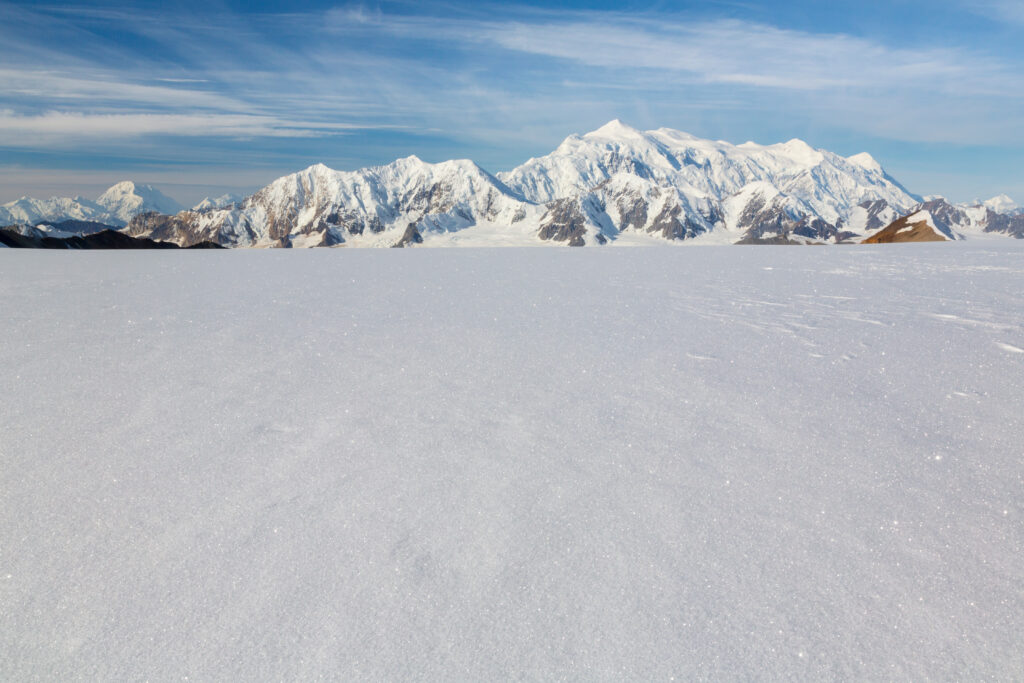
Mount Logan stands in the heart of Kluane National Park and Reserve, in the St. Elias Mountains of the southwest Yukon, about 40 km from the Alaska border. It rises out of the largest non-polar icefield on Earth, and there is no road anywhere near it — reaching the base means an hour-plus ski-plane flight, or one to two weeks of overland travel. Expeditions register in Haines Junction before flying in.
The mountain, in brief
A mountain measured in superlatives.
At 5,959 m (19,551 ft), Logan is the highest point in Canada and the second-highest in North America after Denali. It is also one of the most massive mountains on Earth by bulk, with an enormous base circumference and a broad summit plateau carrying eleven named peaks over 5,000 m. First climbed in 1925 after an epic approach, it remains rarely visited: only a few dozen climbers attempt it in a typical year, and many turn back.
The mountain sits within a UNESCO World Heritage Site shared with Alaska’s Wrangell–St. Elias and Glacier Bay parks and BC’s Tatshenshini–Alsek — one of the largest protected wilderness areas on the planet, co-managed with the Champagne and Aishihik First Nations and the Kluane First Nation. Logan’s high plateau is also one of the coldest places on Earth outside Antarctica, and its summit ice holds climate records that scientists drill as ice cores.
Why Logan is so hard
Not the crux — the campaign.
Logan is as much an expedition-management problem as a climbing one. The King Trench rarely demands hard technical climbing, yet it defeats strong climbers for reasons that have nothing to do with steepness:
| Factor | Why it matters on Logan |
|---|---|
| Cold | One of the coldest non-polar places on Earth; frostbite is a leading cause of evacuation, and storms can bring winds over 160 km/h |
| Scale & duration | A vast mountain climbed over 2–3 weeks; fatigue accumulates long before summit day |
| Altitude | Nearly 6,000 m, with a high plateau that feels higher because of the cold and latitude |
| Remoteness | Rescue depends on flying weather; a team with failed communications may be on its own for days |
| Glacier travel | Extensive roped travel with crevasse hazard, load-carrying, and camp-by-camp progression |
Permits, insurance & the rules
Non-negotiable, and enforced — sort these before anything else.
Parks Canada regulates the Icefield Ranges tightly. You must have all of this in place before you climb:
Aircraft access permit — included in the mountaineering permit; required for every landing in the icefields.
Rescue insurance — each member must carry extraction insurance covering at least CAD $100,000; the permit is not issued without proof.
Minimum team of two — solo attempts on Logan are not allowed.
Season limits — no icefield travel between November 15 and April 9; register in advance and check out with park staff when you finish.
Guiding companies operating in Kluane must be licensed by Parks Canada, so if you go guided, confirm your operator holds a current business licence for the park. Apply early: teams have been turned away for showing up without an approved permit.
Getting there: ski-plane access
The flight in is the first crux — and it’s weather-dependent.
Because no road comes near the mountain, nearly every expedition flies in on a ski-equipped bush plane from the Kluane Lake area to a glacier base camp around 2,750 m. The flight is short but entirely weather-dependent: teams often wait days for a window both to fly in and, crucially, to fly out. Build that uncertainty into your schedule and your food and fuel supply.
The routes
One standard expedition line, and serious alternatives.
The King Trench
The classic and by far the most common line — the route almost every guided team climbs. From the glacier base camp, the expedition works up the King Trench toward King Col and onto the vast summit plateau, moving camps and carrying loads with acclimatization built in. It’s not a technical test-piece, but it is a long, cold, high glacier campaign where the weather and the cold set the pace.
Typical camp progression (King Trench)
| Base camp | ~2,750 m · ski-plane landing on the glacier |
| Lower camps | ~3,000–4,000 m · load carries up the trench |
| King Col | ~4,000 m · gateway to the upper mountain |
| High camp(s) | ~5,000+ m · on the plateau, positioned for a weather window |
| Summit | 5,959 m · the roof of Canada |
Camp elevations vary by team, conditions, and year — treat these as a typical shape, not a fixed plan.
The East Ridge & other hard lines
The East Ridge is Logan’s celebrated hard route — long, technical, and committing, attempted only by highly experienced expedition alpinists with the skills and self-sufficiency to be truly on their own. Several other major lines exist around the massif in the same league. For all but a small group of climbers, the King Trench is the route, and for good reason.
7-day mountain weather
Modeled conditions for the summit area — a sense of scale, not an expedition forecast.
Logan makes its own weather. Positioned near the Gulf of Alaska, it draws violent storms that can pin teams down for days. The widget below is a general modeled forecast for the mountain area — useful for a sense of the cold, but real expeditions rely on specialized high-altitude mountain forecasting.
Mount Logan area — 7-day forecast
Loading live data…When to climb
A short, fixed window — and even then, expect to wait out storms.
The climbing season runs mid-April to late June, opening around April 10; Parks Canada permits no icefield travel between November 15 and April 9. May into June is the heart of the season, offering the longest daylight and the most workable snow, though it is still bitterly cold high on the mountain. Whatever the dates, Logan’s proximity to the Gulf of Alaska means major storms can arrive without much warning, so weather buffer days aren’t optional — they’re part of the plan.
Safety & conditions
The numbers behind Logan’s reputation.
Logan accounts for the majority of mountaineering incidents in Kluane, which is precisely why the two-person minimum and insurance rules exist. Parks Canada’s own figures give the picture: of roughly 4,000 climbers and skiers in the Icefield Ranges between 1973 and 2015, about 15 died in falls and avalanches, with many more evacuated for severe altitude sickness, frostbite, or crevasse falls. Expect to carry loads of 20–40 kg at altitudes from 2,000 to nearly 5,700 m, in conditions swinging from intense snow-glare at up to +30°C to storms with winds over 160 km/h and zero visibility.
What it costs
Driven by the flight and the duration, not park fees.
A guided Mount Logan expedition typically runs well into five figures — roughly US $9,000–$15,000+ — reflecting the ski-plane charter, the two-to-three-week length, and guiding on a serious peak. Independent teams spend less on guiding but still face major costs: the ski-plane flights (the single biggest line item), the mountaineering permit, mandatory rescue insurance, and weeks of food and fuel. Park permit fees themselves are modest; the flights and insurance are what add up. Confirm current pricing directly with operators and Parks Canada, as figures shift year to year.
What to bring
A full polar-grade expedition kit — nothing less.
Logan demands true expedition equipment built for extreme, sustained cold and weeks of self-supported glacier travel. This is not a peak to improvise gear on.
- Extreme-cold clothing system — full down suit or heavy down parka and pants, multiple glove and mitt systems, and full-face protection.
- 8,000 m-capable boots — double or triple mountaineering boots rated for severe cold, with overboots.
- Glacier & crevasse-rescue systems — rope, harness, prusiks/ascenders, snow anchors, and the skills to use them; skis or snowshoes for glacier travel.
- Severe-cold sleeping & shelter — expedition tents built for high wind, and sleeping bags rated well below the coldest temperatures you expect.
- Self-sufficiency — stoves and ample fuel, satellite communication (sat phone / inReach), navigation, and extra days of food for weather delays.
Frequently asked questions
How high is Mount Logan?
5,959 m (19,551 ft) — the highest mountain in Canada and second-highest in North America after Denali, in the St. Elias Mountains of Kluane National Park, Yukon.
Do you need a permit?
Yes — an Icefields Mountaineering Permit from Parks Canada (with an aircraft access permit for each landing), applied for at least a month ahead with your route and proof of insurance. Every climber needs rescue insurance of at least CAD $100,000, and solo attempts aren’t allowed (minimum team of two).
How long does it take?
Two to three weeks. Even the standard route means extensive glacier travel, load carries, acclimatization, and long weather delays. It’s a full expedition, not a summit-day climb.
Is it technical?
The King Trench isn’t extremely technical — parties have even skied to the top. The difficulty is scale, cold, altitude, remoteness, and duration. The East Ridge and other lines are far more technical.
When is the season?
Mid-April to late June (opening ~April 10). No icefield travel is permitted November 15–April 9. Storms off the Gulf of Alaska can hit any time, so weather buffer days are essential.
How much does it cost?
A guided expedition typically runs roughly US $9,000–$15,000+, driven by ski-plane charter and duration. Independent teams still pay heavily for flights, the permit, insurance, and weeks of supplies.
How we built this
Research-based. This guide is compiled from Parks Canada’s Kluane National Park and Reserve mountaineering and permit pages (permit requirements, insurance minimum, two-person rule, season dates, safety statistics), SummitPost, and current 2026 expedition references, cross-checked for elevation and logistics.
Permit procedures, fees, insurance minimums, and access arrangements change, and conditions on Logan are severe and variable. Treat everything here as planning background and confirm current requirements directly with Parks Canada and your operator before committing.
Start with the permit
Logan is a peak you plan months ahead. Read Parks Canada’s Kluane mountaineering rules, line up your rescue insurance and a licensed operator, and build in real weather margin from the start.
Parks Canada — Kluane Mountaineering →Build up via Denali →Was this helpful?
🏔Related peaks nearby
🧭Explore & compare
Global Summit Guide is an independent mountaineering resource founded in 2026. The team combines first-hand trekking and climbing experience with in-depth research and professional health and nutrition review to help climbers choose objectives, prepare properly, and stay safe.
Health, altitude, and nutrition content is reviewed by Taylor Ludlow (Registered Nurse) and Brigg Hoopes (Nutritionist).
What We Don't Know Yet
Mountain information changes quickly. This box explains the limits of what this page can responsibly promise.
- Visa, passport, vaccination, border, insurance, and local transportation rules may change before your trip.
- Route conditions, snowpack, closures, and weather can change quickly after this page is updated.
- Permit rules, fees, quotas, and reservation windows may change between review cycles.
- Operator availability, pricing, guide ratios, and cancellation terms can change by season.
- Your fitness, altitude response, risk tolerance, and experience level may change what is safe or realistic.
Verify current conditions with official land managers, guide services, local forecasts, and current route reports before booking or climbing.
Mountaineering, rock and ice climbing, glacier travel, and high-altitude activity are inherently dangerous and can result in serious injury or death. The information on Global Summit Guide is provided for general informational and educational purposes only and is not a substitute for professional instruction, qualified guiding, proper equipment, or your own judgment and experience.
Route conditions, weather, snowpack, permits, regulations, and hazards change constantly and may differ from what is described here. Details may be incomplete, out of date, or contain errors. Always verify current information with local authorities, certified guides, and official sources before making any decision in the mountains.
Nothing on this site is medical, legal, or financial advice. Our fitness, acclimatization, altitude, and nutrition content is general in nature; consult a qualified physician before beginning any strenuous exercise program or exposing yourself to high altitude.
You are solely responsible for your own safety and decisions. To the fullest extent permitted by law, Global Summit Guide and its team accept no liability for any loss, injury, damage, or expense arising from use of, or reliance on, this information. By using this site you acknowledge these risks and accept these terms.
Some links on this site may be affiliate links. If you buy through them we may earn a small commission at no extra cost to you; this never affects our recommendations.
Global Summit Guide recommendation path
Next Best Mountain to Research
Use these recommendations to continue the right planning path instead of stopping on one page.
Use current permit, weather, route, and operator information before booking or climbing.
Search Flights, Hotels & Rental Cars
Have the mountain or destination picked? Use Expedia to compare the flights, lodging and rental cars that fit your actual trip dates. For mountain travel, consider arriving early enough for delays and adding a buffer night after the climb before a fixed flight home.
Compare current flight, hotel and car options.
Affiliate disclosure: Global Summit Guide may earn a commission if you book through this link, at no additional cost to you.