
Last updated May 29, 2026
Island Peak Summit Success Rate 2026: Why Nepal’s Most Popular Trekking Peak Bridges Trekking and Mountaineering
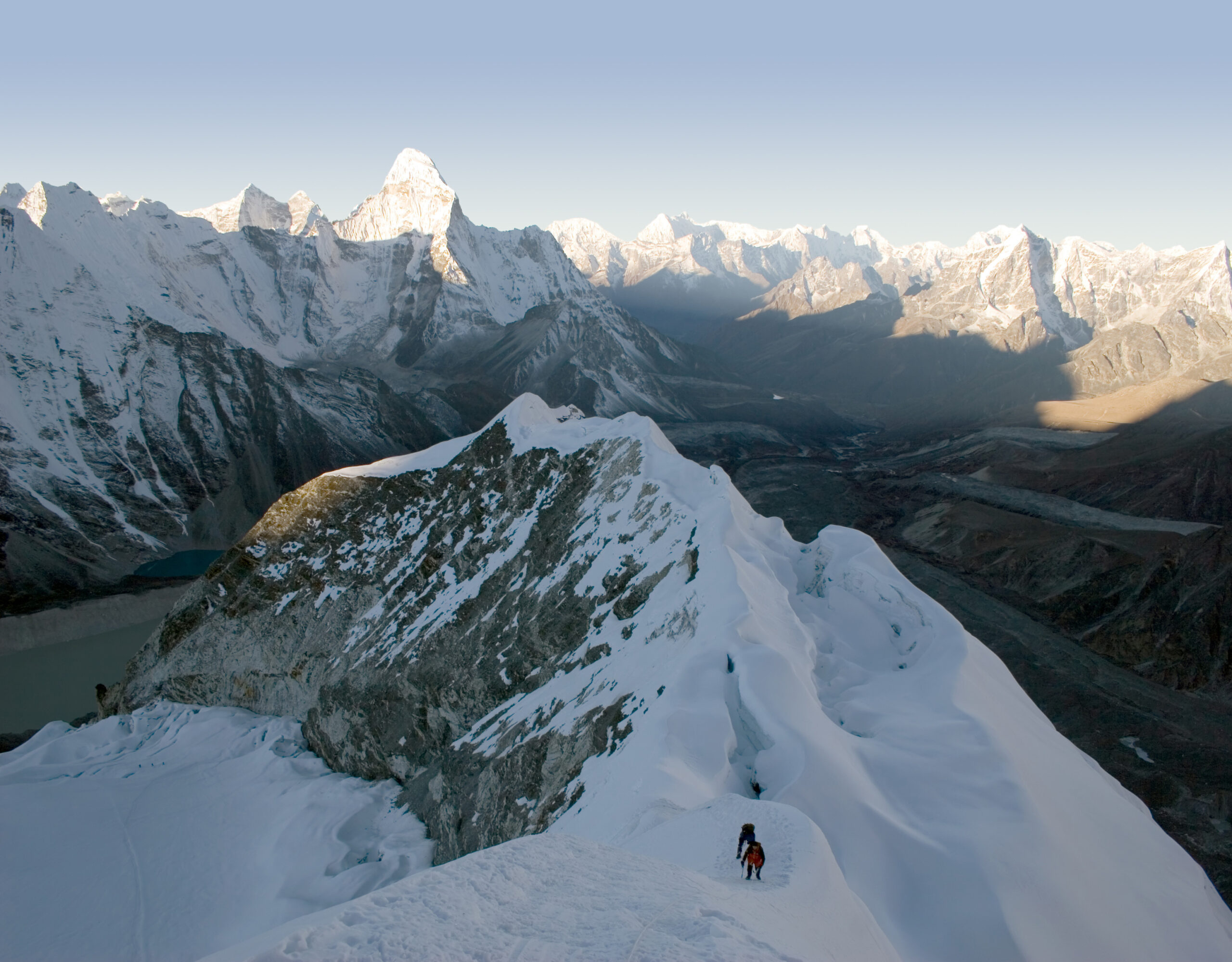
Also known as Imja Tse, Island Peak is the most popular trekking peak in the Everest region. The mountain serves as the ideal stepping stone between Mera Peak and a first 8,000m objective. Generally, its 72 percent success rate reflects a mountain with a genuinely technical summit headwall. The headwall is steeper and more exposed than Mera, but the Khumbu approach and Everest region infrastructure combine to produce consistently strong outcomes. Notably, the headwall is the defining section for every climber regardless of route: 50-60 degrees over 200 metres, demanding confident front-pointing technique at 6,000m.
The Bridge Between Trekking and Mountaineering
Island Peak takes its name from its appearance as seen from Dingboche: a snow dome rising like an island above a sea of glacial moraines. Generally, at 6,189m it sits well above Mera Peak’s altitude but is comparable in technical character — with one critical difference. Specifically, the summit headwall on Island Peak is steeper (50-60 degrees), longer (200m), and more exposed than Mera’s final section. Crampon and ice axe proficiency become genuinely necessary rather than merely helpful. Notably, it is the ideal next step after Mera for climbers building toward their first 8,000m peak.
How to read these numbers. Success is defined as reaching the true summit at 6,189m. Generally, data is sourced from Nepal Mountaineering Association trekking peak permit records and trekking agency summit reports 2008-2025. Specifically, the vast majority of attempts use the Normal Route via the Southeast Ridge from Imja Tse base camp at 5,100m. Notably, Nepal regulations require all permit holders to use a licensed trekking agency. The meaningful service-tier distinction is between full-service guided programs with an experienced summit Sherpa and agency-permit-only arrangements where climbers self-manage the headwall.
The Headline Island Peak Numbers
| Metric | Rate | Notes |
|---|---|---|
| Overall summit success rate | ~72% | All NMA permit holders 2008-2025; weighted across all service tiers |
| 14-day+ EBC-combined itinerary | ~82% | Highest-performing cohort; superior acclimatisation through Namche-Tengboche-Dingboche |
| Full-service guided programs | ~80% | Experienced summit Sherpa, 14+ day Khumbu itinerary |
| Agency permit only / self-managed | ~52% | Agency permit only; climbers self-manage the technical headwall |
| Normal Route (Southeast Ridge) | ~74% | Standard route used by virtually all permit holders |
| Southwest Ridge (Technical) | ~45% | Rarely attempted; experienced alpinists only; very small sample |
| Rescue incident rate | 1 in 105 | Per season; helicopter access to base camp available |
| Fatality rate | 1 in 720 | Among all NMA permit holders |
| Annual permit holders | ~3,500 | Peak October-November and April-May seasons |
| 2026 expedition cost (all-in) | $1.4K-$4.8K | Agency-only floor vs full-service ceiling; EBC trek separate |
Success Rate by Month
Island Peak shares the Khumbu region’s post-monsoon peak season with the Everest Base Camp trek. Generally, October produces the highest success rates with clear skies, consolidated snow on the headwall, and the most stable weather of the year. Specifically, the pre-monsoon April-May window is the strong second season, coinciding with Everest expedition traffic in the region. Notably, June-August monsoon season sees very limited attempts and poor snow conditions. December-February sees experienced mountaineers only due to cold and wind on the headwall.
| Month | Success Rate | Conditions |
|---|---|---|
| April | ~72% | Pre-monsoon window opens; warmer temperatures; some unconsolidated snow on headwall |
| May | ~74% | Peak pre-monsoon; coincides with Everest spring season; busy Khumbu region |
| June-September | ~35% | Monsoon season; very limited attempts; poor snow conditions; not recommended |
| October | ~78% | Statistical peak; best snow consolidation; highest visibility; busiest crowding |
| November | ~76% | Post-monsoon window continues; cooler temperatures; thinning crowds |
| December-February | ~50% | Winter; experienced climbers only; serious cold and wind on the headwall |
October is the standout month, combining the best snow consolidation on the headwall with the highest visibility and the most stable weather windows. Generally, teams combining Island Peak with the Everest Base Camp trek (the most common itinerary) benefit from superior acclimatisation. Specifically, the approach through Namche, Tengboche, and Dingboche before reaching base camp produces the 82 percent rate cited for 14-day-plus itineraries. Notably, climbers on compressed 10-day programs miss this acclimatisation advantage and run closer to 55-60 percent.
Timing strategy. The optimal arrival in Lukla is approximately October 5-15. Generally, this positions a team for the October 18-November 5 prime window, capturing the highest-probability summit days. Specifically, the EBC-combined approach builds in 7-9 days of altitude exposure before base camp, providing strong acclimatisation. Notably, late-October departures benefit from thinning crowds while still benefiting from consolidated headwall conditions. The window is the sweet spot for climbers prioritising both success rate and crowd avoidance.
Success Rate by Route
Island Peak has one primary route used by virtually all permit holders. Generally, the Normal Route via the Southeast Ridge and summit headwall is the standard program offered by every Khumbu-based guiding company. Specifically, the Southwest Ridge is a rarely-attempted technical alternative that joins the Normal Route near the summit. Notably, route selection is not the primary variable on Island Peak. The technical headwall is shared by both routes, and over 99 percent of permit holders take the Normal Route.
The headwall is the defining section of Island Peak for every climber regardless of route. Generally, at 50-60 degrees with fixed ropes over 200 metres, it demands confident front-pointing technique and calm movement on steep snow and ice at 6,000m. Specifically, climbers who have never used crampons on steep terrain before Island Peak regularly find this section at or beyond their comfortable operating range. Notably, this is true regardless of their fitness on the approach — physical conditioning does not substitute for steep-terrain technique.
What makes the headwall the critical section. Generally, the technical demands of the 200m headwall are unfamiliar to climbers whose prior experience is on lower-angle Mera Peak summit slopes or non-glaciated peaks. Specifically, the headwall combines four challenges that compound. The 50-60 degree slope angle and fixed-rope ascender technique combine with serious exposure. A fall on the headwall above a climber on the rope creates significant force on the system. Add the cumulative fatigue of having moved to 6,000m. Notably, climbers who have completed a one-day crampon and steep-snow skills course before departure show meaningfully better outcomes. Those whose first encounter with the technique is at the headwall typically struggle.
Guided vs Agency-Permit Only
Nepal regulations require all Island Peak permit holders to use a licensed trekking agency. Generally, the meaningful distinction here is between programs with an experienced summit Sherpa leading the technical sections and permit-only arrangements where climbers self-manage the headwall. Specifically, the headwall is where this distinction matters most. Notably, the 28-percentage-point gap between full-service and agency-only outcomes is among the largest service-tier gaps in Himalayan trekking peak climbing.
| Factor | Full-Service Guided | Agency Permit Only |
|---|---|---|
| Summit success rate | ~80% | ~52% |
| Summit Sherpa on headwall | Yes; manages rope systems and pace | No; climbers self-manage |
| EBC acclimatisation | Built into 14+ day itinerary | Climber-arranged; often compressed |
| Pulse oximeter monitoring | Standard with quality operators | Climber-arranged |
| Fixed ropes on headwall | Guaranteed in place (operator-managed) | May or may not be in place depending on season |
| Typical itinerary length | 14-18 days from Lukla | 10-14 days from Lukla (often compressed) |
| 2026 typical cost (all-in) | $2,200-$4,800 | $1,400-$2,200 |
| Best for | First-time Himalayan climbers, novice technical skills | Experienced climbers with prior steep snow and ice experience |
The gap between full-service and agency-only reflects three factors that compound across the expedition. Generally, the first is summit Sherpa management of the headwall — pacing, rope work, and real-time decisions on conditions. Specifically, the second is EBC acclimatisation built into the full-service itinerary that agency-only climbers often skip under time pressure. Notably, the third is operational quality — quality operators ensure fixed ropes are in place, manage backup gear, and provide pulse oximeter monitoring at altitude.
Recommendation for first-time Himalayan climbers. Go full-service guided. Generally, the cost differential ($800-$2,600) is small relative to the headline expedition cost, and the 28-point success rate improvement is the highest-ROI investment available. Specifically, quality Khumbu-based operators include Asian Trekking, Mountain Monarch, IMG, Climbing the Seven Summits, and several Sherpa-owned outfits. Notably, see our Island Peak operators comparison for detailed operator evaluation criteria.
Success Rate by Experience Level
Island Peak’s experience data shows a steeper gradient than Mera Peak’s. Generally, this reflects the more demanding headwall — crampon and ice axe confidence on steep terrain is the decisive technical factor. Specifically, even fit, acclimatised climbers without prior steep snow experience frequently find the headwall at or beyond their limit. Notably, the 48-percentage-point gap between altitude-and-technical novices and experienced 6,000m+ climbers is among the steepest experience gradients in trekking peak climbing.
| Prior Experience | Success Rate | Why |
|---|---|---|
| No prior glacier or steep snow experience | 42% | The 200m headwall at 50-60 degrees is genuinely committing without prior steep snow and crampon experience; use a fully guided program and complete a crampon skills session before departure |
| Prior trekking peak (Mera Peak or equivalent) | 68% | Most common and most data-supported pathway; Mera experience provides altitude acclimatisation, crampon confidence, and realistic Khumbu expectations |
| Prior glacier travel and steep snow (45 degree+) | 82% | Strongest technical predictor; prior steep snow and ice experience — Mera, alpine climbing, or ice climbing courses — is decisive on the headwall |
| Prior summit above 6,000m with technical sections | 90% | Best-performing cohort; prior high-altitude technical experience combines altitude physiology and steep-terrain movement efficiency |
Crampon and ice axe confidence on steep terrain is the decisive technical factor on Island Peak. Generally, the headwall demands front-pointing technique and calm rope-work at 6,000m. Specifically, climbers without prior practice find the section physically possible but mentally and technically unfamiliar at the limit of altitude fatigue. Notably, the Mera Peak to Island Peak progression is the most common and most data-supported pathway in Nepal trekking peak climbing. Mera provides altitude acclimatisation and crampon confidence without the steep terrain commitment.
The non-negotiable prep skill: steep snow technique. Generally, the strongest single intervention to improve your Island Peak success rate is gaining steep snow experience before the trip. Specifically, several options work well. Mera Peak in a separate trip is the data-supported pathway. Other options include an alpine glacier course at any IFMGA-certified school in the Alps or Cascades, an ice climbing weekend course, or a guided introduction to crampon technique on Rainier or Mount Baker. Notably, climbers who arrive with even a single day of prior steep snow practice show meaningfully better outcomes. Those whose first encounter is at the headwall typically struggle. The technique is more important than the duration of prior experience.
Most Common Turnaround Reasons
Five dominant turnaround reasons account for nearly all failed Island Peak summits. The data comes from Himalayan Rescue Association reports and trekking agency summit data covering 2012-2025 on the Normal Route. Generally, the headwall technical difficulty is the single biggest factor. Specifically, the failure modes on Island Peak combine technical and altitude-related causes. The mountain uniquely combines the demands of a trekking peak with the technical commitment of a small alpine objective. Notably, each of the five turnaround reasons has prep-time interventions that meaningfully reduce its likelihood.
Headwall technical difficulty — steep snow and ice
The 200m headwall at 50-60 degrees is the primary turnaround point for climbers without prior steep terrain experience. Front-pointing confidence and ice axe technique at 6,000m require prior practice. The headwall is not a place to learn these skills for the first time. Mitigation: complete Mera Peak first, take an alpine glacier course, or do a one-day crampon skills session before departure.
Altitude illness (AMS) from compressed approach
Teams on short 10-12 day programs that skip the Namche and Dingboche acclimatisation nights arrive at base camp underacclimatised for the 6,000m+ summit altitude. AMS headache and nausea at high camp are the most common medical turnaround triggers. Mitigation: use the 14-day+ EBC-combined itinerary; build mandatory acclimatisation days at Namche (3,440m) and Dingboche (4,410m).
Crowding — headwall bottlenecks in peak season
October peak season sees 60-100+ climbers on summit day. The single-file headwall fixed ropes create bottlenecks that cost teams critical time in the morning cold window. Teams departing base camp after 2am regularly find themselves queuing on the headwall as conditions warm. Mitigation: depart base camp by 1am or earlier; choose late-October or early-November dates to avoid the absolute peak crowding window.
Weather — wind on the summit ridge
The summit ridge above the headwall is fully exposed to Khumbu winds. On days with moderate summit wind, the exposed section between the headwall top and the summit becomes dangerously cold. Climbers already fatigued from the headwall ascent face the risk. Mitigation: build flexible summit-day windows into the itinerary; use ALE-equivalent weather forecasting via your operator’s network of Khumbu-based partners.
Equipment — crampon or boot issues
Boot-crampon incompatibility and poorly fitting rental crampons are a common turnaround cause. On a steep headwall with fixed ropes, crampon security is not optional. Equipment should be fitted and tested before the Khumbu approach begins. Mitigation: fit crampons to boots at home or in Kathmandu before flying to Lukla. Verify rental crampon fit at the gear shop, not at base camp.
The 60 percent rule. Headwall technical difficulty (34 percent) and AMS from compressed approach (26 percent) together account for 60 percent of all Island Peak turnarounds. Generally, both are addressable in advance. Specifically, the technical demands respond to prior steep snow practice (Mera Peak or alpine skills course). The AMS demands respond to itinerary length (14-day+ EBC-combined programs vs compressed 10-day timelines). Notably, climbers who optimise across these two factors typically see individual success rates closer to the 90 percent prior-6,000m cohort baseline. The improvement is meaningful versus the 72 percent overall mountain rate.
Rescue Incident Frequency
Island Peak benefits from the Khumbu region’s well-developed rescue infrastructure. Generally, this is the best of any trekking peak in Nepal. Specifically, helicopter access is available to base camp. The Himalayan Rescue Association operates medical posts in the region. Proximity to Lukla airport means evacuation timelines are the shortest of any peak at comparable altitude. Notably, the high density of experienced operators on the Khumbu trail provides additional informal support — ground-team rescue assistance from passing climbing teams is common.
| Safety Metric | Rate | Notes |
|---|---|---|
| Assisted rescue rate | 1 in 105 climbers | Per season; includes helicopter evacuations and ground assistance |
| Fatality rate | 1 in 720 climbers | Among all NMA permit holders 2008-2025 |
| Helicopter evacuation cost | ~$8,500 | Average from base camp area; not covered by standard travel policies |
| Helicopter ceiling | Base camp (5,100m) | Higher rescues require ground team escort |
| Most common rescue scenario | Headwall falls | Almost always among climbers without prior steep terrain experience |
| HRA medical post | Pheriche (4,371m) | Permanent post operates seasonal April-May and October-November |
Falls on the headwall are the primary serious incident type on Island Peak. Generally, these falls occur almost always among climbers without prior steep terrain experience attempting the section without adequate fixed rope confidence. Specifically, helmet use and full crampon-ice axe systems are mandatory with all reputable operators. Notably, travel insurance with helicopter evacuation cover is essential. The $8,500 average evacuation cost is not covered by standard travel policies, and the cost can climb meaningfully higher if multiple flights are required.
Insurance is mandatory. Generally, standard travel insurance does not cover trekking peak climbing at 6,000m. Specifically, dedicated providers offer compliant Island Peak coverage. Options include Global Rescue, World Nomads Explorer Plus, IMG-affiliated insurance, BMC (British Mountaineering Council) membership coverage, and AAC (American Alpine Club) expedition policies. Notably, verify your specific policy explicitly names trekking peak climbing, includes helicopter evacuation to at least 6,000m, and covers Nepal as a destination. See our mountaineering insurance comparison for the full breakdown.
Historical Success Rate Trend
Island Peak’s success rate has remained consistently high but has shown a modest decline since 2018. Generally, the decline is driven primarily by growing permit volumes creating headwall crowding that costs teams critical time in the morning cold window. Specifically, the peak now sees 3,500-plus permit holders annually, and October peak season queuing on the fixed ropes has become the primary operational challenge. Notably, Nepal Mountaineering Association has discussed permit limits for Island Peak but no structural solution has yet been implemented.
| Period | Rolling Avg Success Rate | Key Notes |
|---|---|---|
| 2008-2012 | ~78% | Pre-commercial-explosion era; smaller permit holder pool; less crowding |
| 2013-2017 | ~75% | Peak success era; mature commercial infrastructure; manageable crowds |
| 2018-2021 | ~70% | Crowding becomes structural; headwall bottlenecks reduce success rates |
| 2022-2024 | ~68% | Continued growth; permit volumes hit 3,500+; queuing extends into prime conditions |
The decline since 2018 mirrors the pattern seen on Everest. Generally, growing permit volumes create crowding effects that reduce success rates independently of weather or preparation quality. Specifically, the headwall fixed-rope bottleneck is the structural choke point — a single-file ascent path that cannot absorb 60-100 simultaneous climbers without delaying summit timing. Notably, early departure (before 1am base camp departure) is increasingly the primary operational strategy for avoiding headwall queuing. Quality operators have shifted their itineraries accordingly.
Island Peak Success Rate FAQ
What is the Island Peak summit success rate in 2026?
The Island Peak (Imja Tse) summit success rate in 2026 runs approximately 72 percent across all Nepal Mountaineering Association permit holders for 2008 to 2025. Full-service guided programs with an experienced summit Sherpa reach approximately 80 percent. Agency-permit-only climbers who self-manage the technical headwall reach approximately 52 percent. Teams using the 14-day-plus EBC-combined itinerary reach approximately 82 percent — the highest-performing cohort, driven by superior acclimatisation from the Namche-Tengboche-Dingboche approach. The 72 percent headline reflects the mountain’s dual character. An accessible Khumbu trekking peak approach combines with a genuinely technical 50-60 degree summit headwall that exposes climbers without prior steep snow and ice experience.
Why do climbers fail on Island Peak?
Five main reasons drive Island Peak turnarounds. The 50-60 degree summit headwall technical difficulty accounts for 34 percent of all turnarounds — the steepest section of any standard Nepal trekking peak. Altitude illness from compressed approach itineraries accounts for 26 percent. Headwall crowding during October peak season accounts for 22 percent — 60-100 climbers on summit day creates fixed-rope bottlenecks. Wind on the summit ridge accounts for 12 percent, and crampon-boot equipment issues drive 6 percent. The headwall is the primary turnaround point for climbers without prior steep terrain experience. Front-pointing confidence and ice axe technique at 6,000m require prior practice. The headwall is not a place to learn these skills for the first time.
What month has the best Island Peak summit success rate?
October has the highest Island Peak summit success rate at approximately 78 percent, followed by November at 76 percent and April-May at 72-74 percent. October combines the best snow consolidation on the headwall with the highest visibility and the most stable post-monsoon weather windows. The climbing season has two windows: post-monsoon October-November and pre-monsoon April-May, each running about 6-8 weeks. June-August monsoon season sees very limited attempts and poor snow conditions. December-February drops to approximately 50 percent — only experienced winter mountaineers attempt the headwall in cold and wind. Teams combining Island Peak with the EBC trek benefit from superior acclimatisation, which lifts the typical October success rate to 82 percent for that cohort.
How technical is Island Peak compared to Mera Peak?
Island Peak is meaningfully more technical than Mera Peak. Both peaks share similar altitudes (Island 6,189m vs Mera 6,476m) and Khumbu region logistics, but the technical character of the summit sections differs significantly. The Island Peak headwall is 50-60 degrees over approximately 200 metres of steep snow and ice with fixed ropes. The terrain is genuinely technical front-pointing at 6,000m. Mera Peak’s summit slope is a more moderate 30-40 degrees with shorter exposure. The Mera Peak to Island Peak progression is the most common and most data-supported pathway in Nepal trekking peak climbing. Mera provides altitude acclimatisation and crampon confidence without the steep terrain commitment. Island Peak then adds the technical headwall as a controlled progression toward 8,000m peaks.
Do I need a guide for Island Peak?
Nepal regulations require all Island Peak permit holders to use a licensed trekking agency. The meaningful distinction is between full-service guided programs with an experienced summit Sherpa and agency-permit-only arrangements where climbers self-manage the headwall. Full-service programs cost $2,200-$4,800 all-in and produce 80 percent success rates. Agency-permit-only arrangements cost $1,400-$2,200 all-in and produce 52 percent success rates. The 28-percentage-point gap reflects three factors. Summit Sherpa managing rope systems and pace on the headwall. EBC approach acclimatisation built into the program itinerary. Pulse oximeter monitoring standard with quality operators. For first-time Himalayan climbers, full-service is strongly recommended.
How does prior experience affect Island Peak success rates?
Significantly. The gap between technical novices and experienced climbers runs 48 percentage points. Climbers with no prior glacier or steep snow experience succeed at 42 percent. Climbers with prior trekking peak experience like Mera Peak reach 68 percent. Climbers with prior glacier travel and steep snow experience above 45 degrees succeed at 82 percent. Climbers with a prior summit above 6,000m with technical sections succeed at 90 percent — the strongest predictor of Island Peak success. The decisive technical factor is crampon and ice axe confidence on steep terrain. Even fit, acclimatised climbers without prior steep snow experience frequently find the headwall at or beyond their comfortable operating range.
How long does an Island Peak expedition take?
The standard Island Peak expedition runs 14-18 days from Lukla, depending on the chosen itinerary and acclimatisation schedule. The most common program combines the Everest Base Camp trek with the Island Peak summit attempt over 16-18 days. The itinerary breaks down as follows. Lukla to Namche (2 days), acclimatisation at Namche (1-2 days), Namche to Tengboche to Dingboche (2 days), acclimatisation at Dingboche (1 day). Then continue to Chukhung and Island Peak base camp (2 days), summit attempt and descent (2-3 days), and return to Lukla (2-3 days). Compressed 10-12 day programs that skip the EBC acclimatisation pattern produce much lower success rates (approximately 55-60 percent) due to inadequate altitude preparation.
What is the rescue rate and fatality rate on Island Peak?
Island Peak’s rescue rate runs approximately 1 in 105 climbers per season requiring evacuation, with a fatality rate of approximately 1 in 720 climbers. The mountain benefits from the Khumbu region’s well-developed rescue infrastructure. Helicopter access is available to base camp, and the Himalayan Rescue Association operates medical posts in the region. Proximity to Lukla airport means evacuation timelines are the shortest of any peak at comparable altitude. Falls on the headwall are the primary serious incident type. The falls almost always involve climbers without prior steep terrain experience attempting the section without adequate fixed-rope confidence. Helmet use and full crampon-ice axe systems are mandatory with all reputable operators. Travel insurance with helicopter evacuation cover is essential — the $8,500 average evacuation cost is not covered by standard travel policies.
Sources and Methodology
Data Sources
This page aggregates data across the following authoritative sources:
- Nepal Mountaineering Association (NMA) trekking peak permit records — official data 2008-2025; Island Peak is one of Nepal’s 33 gazetted trekking peaks.
- Himalayan Rescue Association Khumbu reports — annual incident reports and medical post statistics from Pheriche (4,371m).
- Trekking agency consortium summit statistics — aggregated outcomes from Khumbu-based guiding companies.
- Everest region guiding company post-reports — operator-published success rates including IMG, Asian Trekking, Mountain Monarch, Climbing the Seven Summits.
- Sagarmatha National Park entry records — visitor and climber statistics.
- American Alpine Club Accidents in North American Mountaineering — incident analysis for Himalayan expeditions involving Western climbers.
- Wilderness Medical Society — altitude illness incident rates for high-altitude Nepal peaks.
Methodology note. Where operator-reported rates differ meaningfully from aggregate NMA permit data, we use the NMA aggregate as the headline figure and call out operator-specific data separately. Numbers reflect rolling 5-year averages where available, with 2025-26 season data preliminary. Climbers with verified Island Peak expedition results willing to contribute data are invited to contact our editorial team. Published: April 10, 2026. Last updated: May 28, 2026. Next scheduled review: December 2026 (post-2026 autumn season).
Continue Your Island Peak Research
Plan Your Island Peak Climb Around the Numbers
Four climber-controlled variables move Island Peak success rates the most. October timing over June-September monsoon, full-service guided over agency-permit-only, 14-day+ EBC-combined itinerary over compressed 10-day programs, and prior steep snow experience before the trip. Generally, climbers who optimise across all four typically run 90 percent success rates — close to the prior-6,000m experienced cohort.
View the Island Peak Progression Plan →Was this helpful?
🏔Related safety data
🧭Explore & compare
Global Summit Guide is an independent mountaineering resource founded in 2026. The team combines first-hand trekking and climbing experience with in-depth research and professional health and nutrition review to help climbers choose objectives, prepare properly, and stay safe.
Health, altitude, and nutrition content is reviewed by Taylor Ludlow (Registered Nurse) and Brigg Hoopes (Nutritionist).
What We Don't Know Yet
Mountain information changes quickly. This box explains the limits of what this page can responsibly promise.
- Permit availability, reservation windows, quotas, and official fee rules may change after this page is updated.
- Weather, snowpack, avalanche risk, road access, and route conditions can change quickly and may be different on your climbing dates.
- Route conditions, trailhead access, crevasse exposure, stream crossings, and rescue access may vary from published planning guidance.
- Gear requirements can change by season, route variation, weather window, personal cold tolerance, and guide-service requirements.
- Fitness and altitude response vary by person; no guide, itinerary, or training plan can guarantee acclimatization or summit success.
Verify current conditions with official land managers, guide services, local forecasts, and current route reports before booking or climbing.
Mountaineering, rock and ice climbing, glacier travel, and high-altitude activity are inherently dangerous and can result in serious injury or death. The information on Global Summit Guide is provided for general informational and educational purposes only and is not a substitute for professional instruction, qualified guiding, proper equipment, or your own judgment and experience.
Route conditions, weather, snowpack, permits, regulations, and hazards change constantly and may differ from what is described here. Details may be incomplete, out of date, or contain errors. Always verify current information with local authorities, certified guides, and official sources before making any decision in the mountains.
Nothing on this site is medical, legal, or financial advice. Our fitness, acclimatization, altitude, and nutrition content is general in nature; consult a qualified physician before beginning any strenuous exercise program or exposing yourself to high altitude.
You are solely responsible for your own safety and decisions. To the fullest extent permitted by law, Global Summit Guide and its team accept no liability for any loss, injury, damage, or expense arising from use of, or reliance on, this information. By using this site you acknowledge these risks and accept these terms.
Some links on this site may be affiliate links. If you buy through them we may earn a small commission at no extra cost to you; this never affects our recommendations.
Global Summit Guide recommendation path
Next Best Mountain to Research
Use these recommendations to continue the right planning path instead of stopping on one page.
Use current permit, weather, route, and operator information before booking or climbing.