
Last updated September 17, 2026
Mera Peak Summit Success Rate: What the Data Actually Shows
The defensible answer is a range, not a fake-precise percentage. Well-organized Mera Peak trips in the main climbing seasons are commonly reported around 70–80% summit success, but Nepal’s official permit statistics do not provide a directly comparable mountain-wide summit-success percentage that we can verify.
What Is Mera Peak’s Real Summit Success Rate?
Use roughly 70–80% as an industry-reported planning range for well-organized Mera Peak trips in the main spring and autumn seasons—not as an official Nepal-wide success statistic. Multiple commercial and climbing-industry sources converge around that range, and an experienced Nepali guide interviewed by Much Better Adventures put the figure near 80% while identifying altitude sickness as a leading reason for failed attempts.
What we can verify officially is participation. Nepal’s 2025 tourism statistics list 2,633 climbers/permit holders for Mera Peak. That confirms the mountain’s popularity, but permit volume is not the same thing as summit outcome. A permit does not tell us whether the climber reached Khare, left High Camp, turned around for illness, or stood on the top.
That distinction matters because a success percentage is only meaningful when you know its denominator. A company reporting 85% of clients who left High Camp is describing something different from a national statistic based on all permit holders.
The Official Data Tells Us Popularity—Not a Clean Summit Percentage
Permits, operator results, summit certificates and summit attempts are different datasets and should not be blended into one precise number.
| Data point | What we can say | Evidence quality | What it does not prove |
|---|---|---|---|
| 2025 Mera Peak participation | Official Nepal tourism statistics report 2,633 Mera Peak climbers/permit holders. | Official | How many of those climbers reached the summit. |
| Overall summit-success rate | Multiple industry sources commonly report roughly 70–80% in the primary seasons for organized trips. | Reported range | A government-verified national success rate. |
| Altitude as a major limiter | HRA guidance emphasizes gradual acclimatization above 3,000 m, rest, and descent when symptoms worsen. | Authoritative safety guidance | A fixed percentage gain from adding one specific number of days. |
| Best climbing seasons | Commercial schedules strongly cluster in spring and post-monsoon autumn. | Strong operational consensus | That October always has an exact X% success rate. |
| Route character | The standard commercial climb uses glacier travel with crampons and rope systems, plus a short steeper section near the summit. | Route consensus | That every year’s snow slope and fixed-line setup is identical. |
The Approach Is Part of the Acclimatization
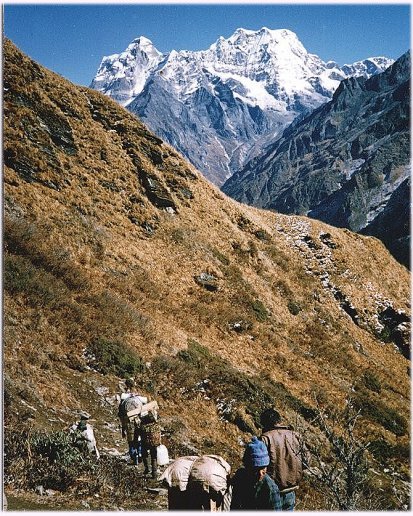
The Hinku Valley is not simply transit to the mountain. How quickly a team gains sleeping altitude on the approach strongly shapes how climbers arrive at Khare and High Camp.
High Camp Changes the Question
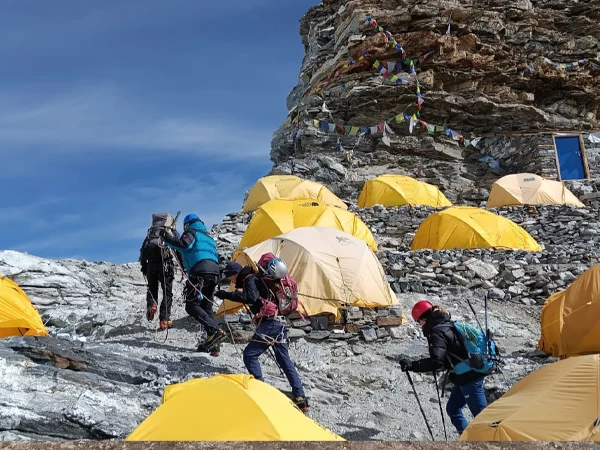
Success statistics based only on climbers who reach High Camp will naturally look better than statistics based on everyone who bought a permit. Always ask which group the percentage describes.
Why We Use 70–80% Instead of “75%”
A single-number headline looks clean, but it implies a level of precision the public data does not support.
Several Sources Converge
Current Nepal climbing and trekking sources commonly publish estimates around 70–80% for properly acclimatized Mera Peak trips. Much Better Adventures also quoted an experienced Nepali guide putting success around 80% and pointing to altitude sickness as a major failure factor.
“Success Rate” Can Mean Different Things
An operator may count only clients who begin summit day. Another source may count everyone who reaches Khare. A permit-based denominator is broader still. Those percentages cannot be compared as if they measure the same thing.
Official Permits Are Not Official Summits
Nepal’s official tourism statistics are excellent for participation and royalty data. They should not be converted into a summit-success percentage unless the corresponding verified summit-outcome field is actually available and comparable.

Mera Peak Is Often Called “Non-Technical.” The Altitude Does Not Care.
The standard route is accessible by Himalayan standards, but the summit sits well above 6,000 meters. Slow acclimatization, conservative pacing and a willingness to descend for worsening altitude symptoms matter more than a marketing label such as “trekking peak.”
External reference image: Everest One. Re-host only with appropriate permission/licensing.
Five Different Numbers Can All Be Called “Success Rate”
Before comparing one Mera Peak operator with another, identify the population each percentage represents.
Everyone who obtained or was recorded under a Mera Peak permit. This is the broadest denominator and includes people who may never make a serious summit attempt.
Removes some approach withdrawals, travel disruptions and early illness. Naturally produces a higher apparent success rate than all permit holders.
Excludes many people already screened out by altitude, illness or schedule. This denominator can make success look very high.
The narrowest common denominator. Excellent for judging summit-day execution, poor for describing the whole expedition’s chance of success.
Can be useful if the company publishes years, client counts and definitions. It is not automatically representative of all Mera Peak climbers.
Six Decisions That Matter More Than the Headline Percentage
There is no formula that turns these into a guaranteed probability. They are the decisions that repeatedly appear in altitude guidance, route descriptions and operator experience.
Buy Time, Not Speed
Choose an itinerary that gains sleeping altitude conservatively and includes real acclimatization time around the upper Hinku Valley. A shorter itinerary may look efficient on paper while giving your physiology less room to adapt.
Protect a Summit Window
A schedule with no contingency day can force a binary choice: climb in marginal conditions or go home without an attempt. Flexibility lets the guide team wait when wind, snowfall or visibility makes the glacier a poor bet.
Arrive With Reserve
Mera is a long expedition before it becomes a summit climb. Training should prepare you for repeated uphill days, not only one hard workout. Arriving depleted at Khare is different from arriving tired but recovering well.
Practice Before 6,000 m
Crampon walking, clipping and unclipping from fixed lines, using a jumar when required, managing gloves and layers, and moving efficiently while roped should not feel brand-new during the summit push.
Choose Conservative Decision-Making
Ask how the team monitors altitude symptoms, who makes turnaround calls, how guides handle slower clients, what emergency oxygen is carried, and what the evacuation plan looks like from the upper valley.
Protect the Descent
The goal is not to convert every possible summit day into a summit. Worsening AMS, unstable weather, equipment problems or a pace that threatens the descent are valid reasons to turn around.
For the full mountain rather than the statistics, use the Mera Peak Climb Guide. For route-specific terrain, see Mera Peak Normal Route vs. West Ridge. For commercial support, compare the Mera Peak operators guide.
Acclimatization: The Part You Should Not Compress
The Himalayan Rescue Association’s guidance is simple: above 3,000 meters, sleeping altitude should generally rise only gradually, and worsening altitude symptoms require rest or descent rather than stubborn forward progress.
Slow the Sleeping-Altitude Gain
HRA advises adjusting the schedule so that above 3,000 meters, sleeping altitude generally rises by only about 300–400 meters from the previous night’s sleeping altitude. Mera’s real-world teahouse geography does not always produce textbook increments, which is why planned rest/acclimatization days matter.
Do Not Summit Through Worsening AMS
Headache, nausea, poor coordination, unusual breathlessness at rest, confusion or a deteriorating overall condition are not obstacles to “push through.” Guides and climbers should treat worsening altitude illness conservatively. Descent remains the definitive response when serious symptoms develop.
When Are Mera Peak Climbers Most Likely to Get a Good Attempt?
The commercial calendar centers on pre-monsoon spring and post-monsoon autumn. Exact monthly percentages are not used because the available public evidence does not support a consistent mountain-wide monthly dataset.
| Period | Typical role | Advantages | What can derail a summit | Planning view |
|---|---|---|---|---|
| April–May | Main spring season | Established commercial operations; warmer than deep winter; regular Nepal climbing logistics. | Fresh snow, warming-cycle changes, cloud, storms, individual acclimatization. | Primary window |
| October–November | Main autumn season | Post-monsoon visibility can be excellent; major operator season; often strong summit panorama conditions. | Wind, cold, crowding at key lodges/camps, early winter transition later in November. | Primary window |
| June–September | Monsoon / low use | Fewer teams. | Cloud, precipitation, travel disruption, unstable snow and poor visibility. | Generally avoid for normal plans |
| December–February | Winter / specialist | Very quiet mountain. | Severe cold, wind, shorter weather windows and reduced support infrastructure. | Experienced teams only |
Summit Days Start Cold and Early
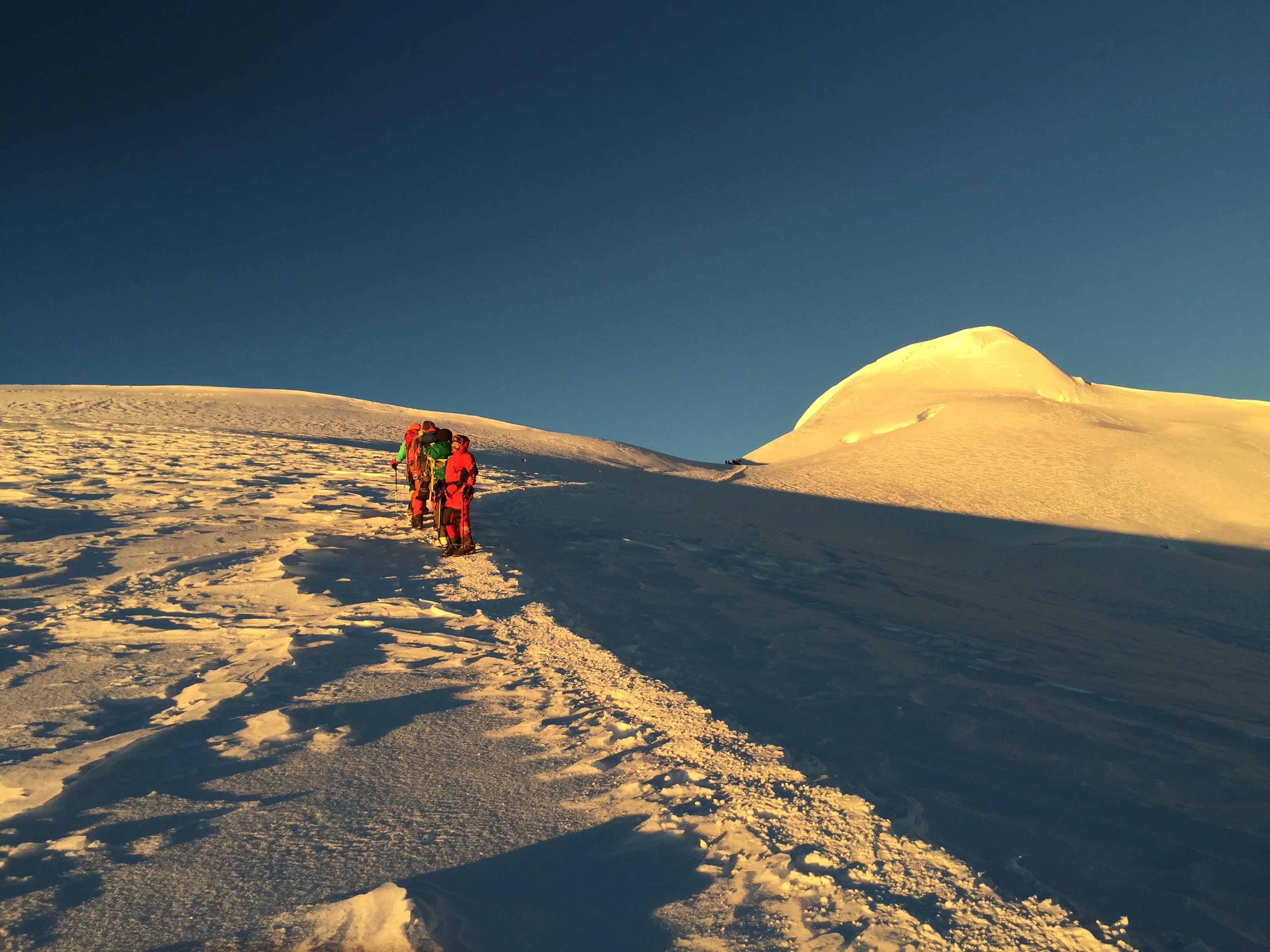
The combination of darkness, cold, wind and altitude magnifies small equipment and pacing mistakes. Practice with the gloves, headlamp, crampon system and layers you will actually use.
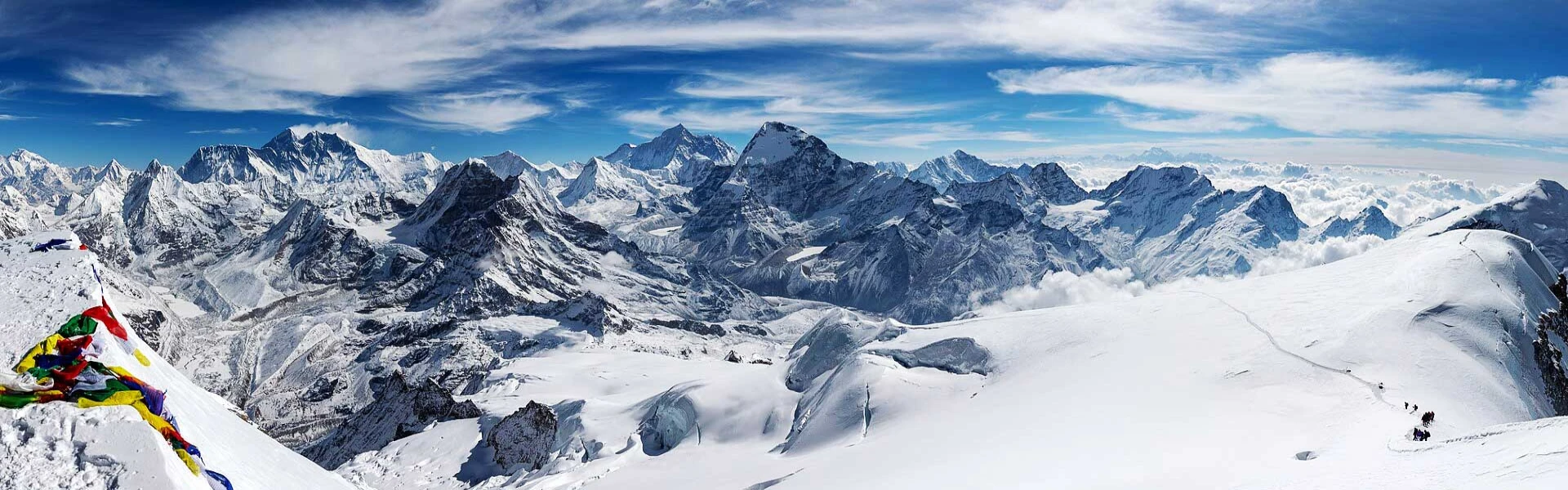
The Reward: Five 8,000-Meter Peaks
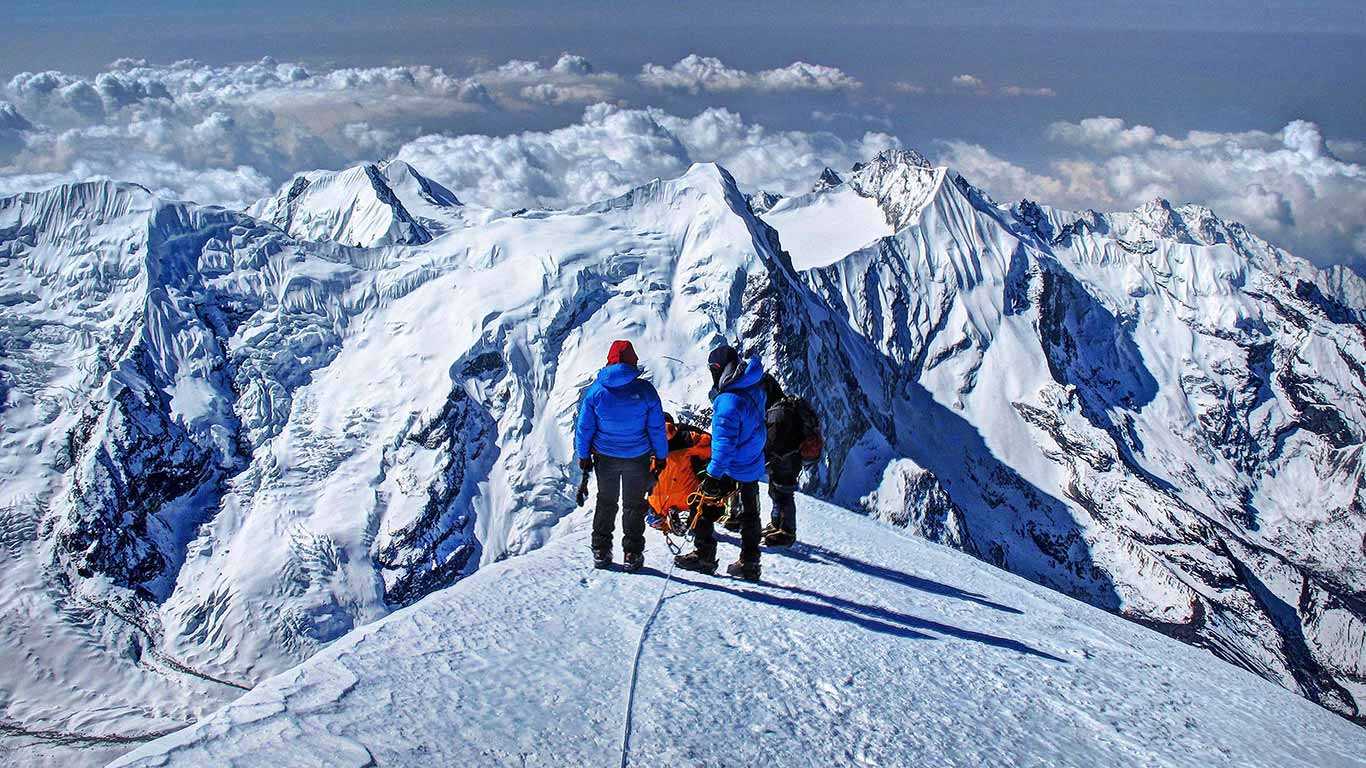
On a clear summit morning, climbers can see Everest, Lhotse, Makalu, Cho Oyu and Kangchenjunga across the horizon—one reason Mera remains one of Nepal’s most popular trekking peaks.
What the Standard Route Actually Requires
Mera’s Normal Route is less technical than many Himalayan climbing peaks, but it is still glaciated mountaineering at extreme altitude.
Hinku Valley to Khare
Most commercial itineraries use the Hinku Valley approach from the Lukla side, reaching Khare at roughly 4,900–5,000 meters. The approach itself should be treated as part of acclimatization, not a race to base camp.
Glacier Travel to High Camp
Above the approach, climbers transition to crampons and roped glacier travel. High Camp is commonly placed around 5,780–5,900 meters depending on operator practice and conditions.
Short Steeper Finish
The final summit terrain is commonly described as a short steeper snow/ice section where fixed lines may be used. Exact angle, snow shape and rope placement vary by season and conditions, so memorize skills—not one diagram.
The Main Turnaround Categories—Without Invented Percentages
Exact shares are not assigned to turnaround causes because a transparent mountain-wide dataset supporting those percentages could not be verified.
AMS and Poor Acclimatization
Altitude illness is repeatedly identified in guide and industry reporting as one of the major reasons Mera Peak climbers stop. The correct response to worsening symptoms is not a probability calculation—it is conservative medical judgment and, when necessary, descent.
Wind, Snow and Visibility
A glaciated summit becomes a different problem in wind, new snow or whiteout. Teams with schedule flexibility can wait; compressed itineraries may lose the summit without ever getting a safe window.
Running Out of Reserve
The summit push arrives after many approach days. Fitness that looks adequate at low altitude can fade sharply above 5,500 meters, especially if sleep, appetite or hydration has already deteriorated.
Slow or Inefficient Rope Movement
Mera does not require elite alpinism, but poor crampon efficiency, awkward transitions and unfamiliar fixed-line systems cost time and energy when the margin is already thin.
Cold Hands, Boots and Crampon Fit
Boot-crampon compatibility, glove dexterity, headlamp reliability and layering choices matter more at 6,000 meters than they did in the gear shop. Test systems before Nepal.
A Turnaround Can Be the Right Outcome
Any success-rate page risks framing the summit as the only acceptable result. It is not. Turning around because the team is too slow, the weather deteriorates or a climber becomes ill is exactly what competent mountain management should do.
The Goal Is a Safe, Well-Timed Attempt.
A good Mera Peak plan increases the chance that you arrive at summit day acclimatized, strong, technically comfortable and backed by conservative guides. It does not erase weather or individual physiology.
Seven Questions to Ask Before Believing a Success Rate
A high percentage is useful only when the company tells you exactly what it measured.
| Ask | Why it matters | Strong answer sounds like |
|---|---|---|
| What years does the rate cover? | One perfect season can distort a small sample. | “Five seasons, 2019 and 2022–2025, with client counts by year.” |
| How many clients are in the sample? | 90% of 10 clients is less informative than 78% of 300. | A real numerator and denominator, not only a percentage. |
| Who counts in the denominator? | Permit holders, arrivals at Khare and summit-day starters are different populations. | “All clients who started the expedition in Lukla.” |
| Do approach turnarounds count? | Excluding early AMS can inflate apparent summit performance. | Yes, with the exact counting rule explained. |
| What is your standard itinerary? | Acclimatization structure may matter more than the headline company rate. | Rest/acclimatization days and weather contingency are explicit. |
| What is the guide-to-client system above Khare? | Slower climbers need monitoring without forcing the entire rope team into unsafe pacing. | Clear summit staffing, turnaround authority and backup plan. |
| What would make you cancel summit day? | Success-minded companies still need conservative stop rules. | Specific weather, altitude, pace and equipment thresholds. |
Use the Global Summit Guide Mera Peak operator comparison for service models, then verify the current itinerary, staffing and safety systems directly before booking.
Mera Peak vs. Island Peak: Do Not Choose by Success Rate Alone
The two peaks build different skills. A single percentage hides that difference.
| Factor | Mera Peak | Island Peak | What it means |
|---|---|---|---|
| Elevation | 6,476 m commonly cited | 6,189 m | Mera provides the greater altitude test. |
| Technical emphasis | Glacier travel with a short steeper summit section | Steeper, more technical summit terrain and fixed-line work | Island Peak usually demands more confident steep-snow technique. |
| Approach character | Hinku Valley; quieter and more remote | Khumbu / EBC corridor | Logistics and trip experience feel different. |
| Best use | First serious 6,000 m altitude objective | Next technical step after strong trekking/glacier basics | Choose the skill gap you need to close. |
| Success-rate caution | Industry estimates vary by denominator | Same problem applies | Do not treat two headline rates as a clean head-to-head ranking. |
See the separate Island Peak summit-success analysis if Island Peak is on your shortlist.
How This Mera Peak Success Estimate Is Built
Official participation data and medical guidance receive more weight here than marketing percentages.
Primary / Authoritative Sources
- Nepal Tourism Board / Ministry tourism statistics: used for official trekking-peak participation data, including the 2025 Mera Peak count of 2,633.
- Himalayan Rescue Association: used for altitude acclimatization guidance and the principle that worsening altitude illness requires rest or descent.
- Nepal Mountaineering Association: used for trekking-peak context and official mountain-administration references where available.
Nepal Tourism Statistics →
HRA Altitude Guidance →
Nepal Mountaineering Association →
Industry / Route Sources
- Multiple current Nepal operators and climbing guides: used only to establish that a 70–80% range is commonly reported—not to label it official.
- Much Better Adventures guide interview: supports the roughly 80% field estimate and altitude-sickness explanation.
- Global Summit Guide Mera Peak guide and route comparison: used for internal consistency on approach, elevation convention and commercial route character.
Operator-published success rates can be valuable, but they are self-reported and may use different denominators. That is why this page keeps the headline as a range.
The Questions Climbers Ask Before Booking
Short answers first; use the sections above when the definition or evidence matters.
What is the Mera Peak summit success rate?
There is no single official Nepal-wide success percentage that Global Summit Guide can verify for all Mera Peak permit holders. Commercial and climbing-industry sources commonly report roughly 70–80% for well-organized trips in the main spring and autumn seasons. Treat that as an informed range, not a guarantee.
How many people climb Mera Peak?
Official Nepal tourism statistics report 2,633 Mera Peak climbers/permit holders in 2025. That makes Mera one of Nepal’s most popular trekking peaks. The official participation number should not be converted into a summit percentage without verified summit-outcome data.
Why do Mera Peak success-rate numbers vary so much?
Different sources count different populations. Permit holders, climbers who reach Khare, climbers who reach High Camp, summit-day starters and one operator’s paying clients can all produce different percentages. Always ask for the denominator.
What most improves my chance of summiting?
Adequate acclimatization, a schedule with weather flexibility, good uphill endurance, practiced crampon/rope skills, reliable equipment and a guide team willing to make conservative turnaround decisions are the strongest controllable advantages.
What is the best season to climb Mera Peak?
The main commercial windows are April–May before the monsoon and October–November after the monsoon. Autumn often delivers excellent visibility, while spring has a strong established climbing season. Weather still varies enough that no month deserves a guaranteed success percentage.
Is Mera Peak technically difficult?
By Himalayan standards the standard route is relatively moderate, but it is still a glaciated 6,000-meter climb. Expect crampons, rope systems, crevasse terrain, cold and a short steeper section near the summit. For many climbers, altitude and endurance are harder than the technical moves.
Is Mera Peak easier than Island Peak?
Mera is higher, while Island Peak is generally more technical near the summit. Mera is often chosen as an altitude-first objective; Island Peak adds a steeper technical component. The better choice depends on the experience you are trying to build.
How should I judge an operator’s claimed 90% success rate?
Ask for the numerator, denominator, years covered, sample size, and whether clients who turned around on the approach are included. Also ask whether the rate is based on all trip starters or only people who began summit day. Without those details, the number is marketing—not comparable evidence.
Mera Peak Is Achievable. The Exact Percentage Is Less Important Than the Plan.
Use 70–80% as a reported planning range, not a promise. The official data confirms that Mera is heavily climbed; the medical guidance confirms that acclimatization deserves respect. Build enough time into the approach, arrive with real endurance and mountain systems, and choose a guide team that treats turnaround decisions as part of success.
Put the Mera Peak Number in Context
Use the mountain guide for the full climb, then compare success-rate pages where the underlying data quality and definitions are clearly explained.
Was this helpful?
🏔Related safety data
🧭Explore & compare
Global Summit Guide is an independent mountaineering resource founded in 2026. The team combines first-hand trekking and climbing experience with in-depth research and professional health and nutrition review to help climbers choose objectives, prepare properly, and stay safe.
Health, altitude, and nutrition content is reviewed by Taylor Ludlow (Registered Nurse) and Brigg Hoopes (Nutritionist).
What We Don't Know Yet
Mountain information changes quickly. This box explains the limits of what this page can responsibly promise.
- Visa, passport, vaccination, border, insurance, and local transportation rules may change before your trip.
- Route conditions, snowpack, closures, and weather can change quickly after this page is updated.
- Permit rules, fees, quotas, and reservation windows may change between review cycles.
- Operator availability, pricing, guide ratios, and cancellation terms can change by season.
- Your fitness, altitude response, risk tolerance, and experience level may change what is safe or realistic.
Verify current conditions with official land managers, guide services, local forecasts, and current route reports before booking or climbing.
Mountaineering, rock and ice climbing, glacier travel, and high-altitude activity are inherently dangerous and can result in serious injury or death. The information on Global Summit Guide is provided for general informational and educational purposes only and is not a substitute for professional instruction, qualified guiding, proper equipment, or your own judgment and experience.
Route conditions, weather, snowpack, permits, regulations, and hazards change constantly and may differ from what is described here. Details may be incomplete, out of date, or contain errors. Always verify current information with local authorities, certified guides, and official sources before making any decision in the mountains.
Nothing on this site is medical, legal, or financial advice. Our fitness, acclimatization, altitude, and nutrition content is general in nature; consult a qualified physician before beginning any strenuous exercise program or exposing yourself to high altitude.
You are solely responsible for your own safety and decisions. To the fullest extent permitted by law, Global Summit Guide and its team accept no liability for any loss, injury, damage, or expense arising from use of, or reliance on, this information. By using this site you acknowledge these risks and accept these terms.
Some links on this site may be affiliate links. If you buy through them we may earn a small commission at no extra cost to you; this never affects our recommendations.
Global Summit Guide recommendation path
Next Best Mountain to Research
Use these recommendations to continue the right planning path instead of stopping on one page.
Use current permit, weather, route, and operator information before booking or climbing.