
Last updated September 18, 2026
Ras Dashen Trek Guide: Ethiopia’s Highest Mountain
Plan Ras Dashen as a complete Simien Mountains journey: route structure, altitude, best trekking season, wildlife, logistics, difficulty and the current travel-security context that must be checked before any booking.
Read This Before Planning a Ras Dashen Trip
Ras Dashen and Simien Mountains National Park are in Ethiopia’s Amhara Region. As of September 17, 2026, the U.S. State Department lists Amhara as “Do Not Travel” because of armed conflict, unrest, kidnapping and crime. This page therefore treats Ras Dashen as a mountain-planning resource, not a current booking recommendation.
Before making deposits, verify your own government’s travel advice, park access, road conditions, operator status, insurance coverage and whether your policy remains valid for the region. Security conditions can change faster than trekking-guide content.
What is climbing Ras Dashen actually like?
Ras Dashen is best understood as a demanding high-altitude trek rather than a technical mountaineering climb. The summit itself is only one part of the experience. Traditionally, trekkers cross the Simien escarpments through camps such as Sankaber, Gich and Chennek before moving toward the higher Ras Dashen side of the massif.
The mountain’s challenge comes from cumulative distance, repeated high days, rough trail, cold nights and a summit effort above 4,500 meters. For most travelers, the full Simien journey is more memorable—and more physically demanding—than the final summit ridge alone.
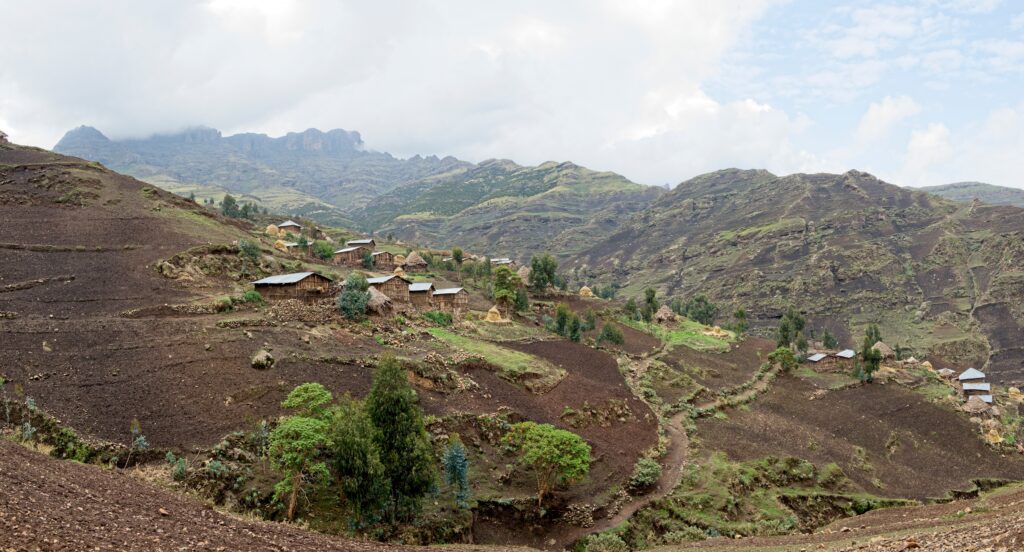
Ras Dashen in the Simien Mountains
The summit lies east of the best-known western escarpment trekking zone. The traditional trip therefore feels like a traverse through an entire mountain landscape rather than a short out-and-back summit hike.
Ras Dashen / Ras Dejen · Ethiopia
Approximate summit marker. Use this map for geographic context only.

Do Not Reduce Ras Dashen to a One-Day Peakbag.
The strongest itinerary links the summit to the Simien escarpments, high camps and wildlife zones. That is what makes Ras Dashen distinct from a simple country-high-point hike.
The Classic Simien-to-Ras-Dashen Progression
This is the traditional trekking structure commonly associated with the full Simien journey. It is not a statement that every segment is currently open or safe in 2026.
Traditional gateway town and park-services base. Historically, many itineraries organize permits, guides, staff and transport here before entering the mountains.
Classic early camp in the western Simien section, with escarpment walking and strong opportunities to encounter geladas.
Highland camp zone used on longer traverses. This section emphasizes plateau walking, viewpoints and gradual acclimatization.
One of the best-known high camps in the park and an important point in the classic eastward progression. Walia ibex habitat is a major part of this area’s appeal.
Traditional summit itineraries continue east toward the Ras Dashen / Ras Dejen sector, often using a higher staging camp or village-based approach depending on the itinerary.
A long high-altitude trekking day with rough terrain and a final rocky summit section. The main challenge is sustained effort above 4,000 meters rather than technical rope work.
Route names are planning language, not a live access guarantee.
Security restrictions, road access and local operating procedures can change the normal trekking structure. Treat the route above as a geographic framework and verify the current itinerary with park authorities and an established local operator before booking.
Non-Technical Does Not Mean Easy
Ras Dashen generally does not require glacier systems, fixed ropes or technical rock climbing on the standard trekking approach. Its difficulty is built from endurance, altitude and remoteness.
4,500-Meter Exposure
Most trekkers sleep and walk high for several consecutive days. Headache, poor sleep and reduced pace can accumulate even before summit day.
Multi-Day Fatigue
The summit often arrives after several long trekking days. Fitness needs to cover the entire traverse, not just one steep ascent.
Rough Highland Trail
Rocky ground, steep escarpments, uneven trail and long descents can be harder on legs than the summit’s elevation profile suggests.
Cold Nights & Rapid Change
High camps can drop below freezing even though the mountain lies near the tropics. Wind and cloud can change conditions quickly.
Limited Easy Exit
The farther east the trek progresses, the more important conservative pacing, guide judgment and contingency planning become.
Security Is Now a Core Planning Variable
In 2026, regional security matters as much as trail difficulty. A technically manageable trek is not automatically a viable trip.

Historically, October Through February Is the Strongest Window
Ethiopia’s wildlife authority describes June to mid-September as the main rainy season and October to February as the preferred trekking period in the Simien Mountains.
| Period | Typical pattern | Planning implication |
|---|---|---|
| October–February | Drier trekking window and the period EWCA identifies as best for Simien trekking. | Historically the first window to research for a full traverse—subject to security and access. |
| March–May | Still within the broader dry-to-shoulder period, with increasing variability as the season progresses. | Can work in some years, but confirm local trail and weather conditions. |
| June–mid-September | Main rainy season; much of annual precipitation falls in this period. | Mud, cloud, wet trail and access complications increase. |
| Night temperatures | High-elevation nights can fall below freezing. | Carry a real cold-weather sleep and layering system even in the preferred season. |

The Simien Mountains Are a Wildlife Journey Too.
UNESCO highlights the park’s global biodiversity importance, including Walia ibex, geladas and Ethiopian wolves. The strongest Ras Dashen itinerary leaves time for the park rather than treating wildlife as a roadside bonus.
Three Ways to Think About a Ras Dashen Trip
There is no single correct duration. The right structure depends on whether the objective is the summit, the full Simien experience or a broader Ethiopia trip.
Shorter Ras Dashen Objective
A compressed plan aims more directly at the high point. It reduces time but gives up some of the classic western escarpment experience and may provide less gradual acclimatization.
6–10 Day Simien + Summit
The strongest all-around concept: western escarpments, high camps, wildlife and the summit as the final objective rather than the only objective.
Full Highland Journey
Build extra days around photography, wildlife, village travel and weather contingency. Best for travelers who value the Simien ecosystem more than a fast high-point tick.
Do not use itinerary length to bypass current security constraints.
In 2026, the first question is not “How many days?” but “Is the trip currently appropriate and insurable?” Only after that should itinerary optimization begin.
Why the Simien Mountains Are Bigger Than Ras Dashen
UNESCO describes a landscape of jagged peaks, deep valleys and cliffs dropping as much as 1,500 meters, with globally important habitat for endemic and threatened wildlife.
Highland Specialists
Large gelada troops are one of the signature wildlife experiences of the western Simien plateau and a major reason to allow time before the summit push.
Found Nowhere Else
UNESCO identifies the Walia ibex as an iconic endemic species. Chennek and surrounding cliffs have long been important habitat.
Rare Afro-Alpine Predator
Another globally threatened species associated with Ethiopia’s high mountain ecosystems, though sightings are much less predictable than geladas.


How the Trip Traditionally Comes Together
EWCA’s park catalogue identifies Gondar as the nearest airport and Debark as the traditional park-headquarters gateway. In 2026, those logistics must be considered together with the regional security picture.
| Planning layer | Traditional structure | What to verify now |
|---|---|---|
| International arrival | Addis Ababa is the main international gateway. | Entry rules, domestic transport and current airline schedules. |
| Domestic access | Gondar has historically been the main air gateway for the Simien Mountains. | Whether travel to/from Gondar and onward road movement is currently operating and appropriate. |
| Park gateway | Debark has traditionally served as the main administrative gateway. | Current park procedures, permits, guide/scout requirements and office operations. |
| Mountain support | Guides, support staff, pack animals and camping logistics are common on longer traverses. | Operator licensing, insurance, evacuation plan and security protocols. |
| Accommodation | EWCA lists lodges plus basic camping facilities at Sankaber, Gich and Chennek. | What is actually open and operating on your dates. |

The Summit Is a Trekking Objective—Altitude Is the Real Technical Problem.
Technical equipment is normally secondary to acclimatization, endurance, footwear, cold management and the ability to keep moving efficiently after several days at elevation.
Pack for High Camps, Not Tropical Latitude
EWCA’s park material notes that high-elevation temperatures can fall below freezing. Your kit should reflect mountain altitude, not Ethiopia’s position near the equator.
Supportive Trekking Boots
Choose footwear that handles rough stone, long descents, wet trail and repeated days rather than lightweight shoes designed for groomed trails.
Real Insulation
Warm layer, hat, gloves and a cold-capable sleeping system are appropriate for high camps where temperatures can fall below freezing.
Waterproof Shell
Even in the preferred trekking months, mountain weather is variable. Rain protection should be carried, not assumed unnecessary.
High-Altitude UV Protection
Sunglasses, sunscreen and a sun hat matter throughout long exposed plateau days.
Water Treatment
Remote trekking requires a clear operator plan for safe drinking water plus your own backup treatment strategy.
Offline Backup
Carry offline maps and key itinerary details even when traveling with a guide. Communications can be disrupted in remote areas.
Why You See Different Ras Dashen Elevations
Published figures vary slightly. That difference matters for editorial accuracy, even though it does not materially change how the trek should be planned.
Around 4,543 m
Ethiopia’s wildlife authority uses an elevation of around 4,543 meters in its protected-area catalogue.
4,543 m
UNESCO background documentation also lists Ras Dashen / Ras Dejen at 4,543 meters.
About 4,533 m
Some current mapping and database sources use 4,533 meters, while travel literature often rounds the summit to roughly 4,550 meters.
Global Summit Guide treatment
For planning, this page uses about 4,543 meters while acknowledging the published range. That is more transparent than presenting one number as universally settled.
Where Ras Dashen Fits Among African Mountain Trips
Ras Dashen’s strongest distinction is not height alone. It combines national-high-point appeal with an unusually rich highland landscape, wildlife and cultural setting.
| Mountain | Style | Main challenge | Why choose it |
|---|---|---|---|
| Ras Dashen | Multi-day highland trek | Altitude + cumulative trekking | Simien landscapes, wildlife and Ethiopia high point. |
| Kilimanjaro | High-altitude trek | Rapid altitude gain | Africa’s highest summit and established trekking infrastructure. |
| Mount Kenya | Trek or technical rock | Route-dependent technicality | Choose Lenana for trekking or Batian/Nelion for technical climbing. |
| Mount Meru | Short high-altitude trek | Steep summit ridge + altitude | Strong Kilimanjaro acclimatization pairing. |
| Karisimbi | Two-day volcano trek | Mud, altitude, steep terrain | Compact Virunga volcano expedition. |
Ras Dashen Trek FAQ
Short answers to the questions that matter most before moving from research into actual trip planning.
Is Ras Dashen currently safe to visit?
As of September 2026, the U.S. State Department advises Do Not Travel to Ethiopia’s Amhara Region, where Ras Dashen and Simien Mountains National Park are located. Travelers should check their own government’s current advice and verify local access before making any booking.
How high is Ras Dashen?
Published elevations vary slightly. Ethiopia’s wildlife authority and UNESCO background material use about 4,543 meters, while some map databases list roughly 4,533 meters and travel literature often rounds the summit to about 4,550 meters.
Is Ras Dashen technical?
The standard trekking objective is generally non-technical. The main demands are altitude, long days, rough trail, cold high camps and cumulative fatigue rather than ropes, glacier systems or sustained rock climbing.
How many days does Ras Dashen take?
A summit-focused trip can be shorter, while a classic Simien traverse with Ras Dashen commonly takes roughly 6–10 days. Longer itineraries provide more time for wildlife, viewpoints and acclimatization.
What is the best season for Ras Dashen?
EWCA identifies October through February as the strongest trekking period in the Simien Mountains. June to mid-September is the main rainy season. Security and access conditions must be checked separately from climate.
Where does a Ras Dashen trek usually start?
Historically, Gondar has been the main air gateway and Debark the traditional park headquarters and trekking gateway. Current transport and park access should be confirmed before travel.
What wildlife can you see in the Simien Mountains?
UNESCO highlights Walia ibex, geladas and Ethiopian wolves among the park’s globally important wildlife. Geladas are often the most visible of the three on classic trekking routes.
Is Ras Dashen harder than Kilimanjaro?
The two mountains are difficult in different ways. Kilimanjaro reaches much higher altitude, while a full Ras Dashen journey can involve more days of rough remote trekking across the Simien Mountains. Current regional security also adds a planning constraint that is separate from physical difficulty.
What This Page Uses—and What It Will Not Pretend to Know
Climate, park geography and conservation context come from official or primary sources. Current security guidance is dated because it can change quickly.
Current-access limitation
This guide intentionally does not publish a “book now” operator recommendation while the Amhara Region is under a current Do Not Travel advisory from the U.S. State Department. Travelers from other countries should check their own government guidance and insurer requirements.

Global Summit Guide
We separate timeless mountain facts from conditions that can change quickly. For Ras Dashen, that means keeping elevation, geography and trekking structure distinct from current regional security and access status.
Ras Dashen: Regional Context, Progression & Planning
Use the parent collections for the big picture, then compare Ras Dashen with the African peaks and planning resources most relevant to this type of trip.

Ras Dashen Is Worth Understanding Even When It Is Not Yet Time to Go.
The summit is only one piece of the Simien Mountains story. Learn the landscape, route and altitude now—and recheck access, security and park operations when conditions change.
This peak is one of Africa’s highest and most notable mountains
Africa’s highest peaks span four regions and host some of the most diverse mountaineering objectives in the world. See the complete collection covering Africa’s Triple Crown (the only three 5,000m+ peaks), all 11 major African peaks with elevations and first ascents, regional groupings, volcanic peaks, and a 6-step climbing progression order from Toubkal through Kilimanjaro.
View All Africa’s Highest Peaks →🏔 Part of Africa’s Highest Peaks
One of Africa’s 11 major climbing peaks across 4 regions. See the full collection with Triple Crown, volcanic peaks, and costs.
View All Africa’s Peaks →Mount Kilimanjaro belongs to both the Seven Summits and Africa’s Highest Peaks
As Africa’s highest peak (5,895m) and the world’s tallest free-standing mountain, Kilimanjaro is the headline summit of two iconic mountaineering collections. The Seven Summits requires climbing the highest peak on every continent; Africa’s Highest Peaks covers all 11 major African peaks across 4 regions including the Triple Crown.
Seven Summits → Africa’s Peaks →Was this helpful?
🏔Related peaks nearby
🧭Explore & compare
Global Summit Guide is an independent mountaineering resource founded in 2026. The team combines first-hand trekking and climbing experience with in-depth research and professional health and nutrition review to help climbers choose objectives, prepare properly, and stay safe.
Health, altitude, and nutrition content is reviewed by Taylor Ludlow (Registered Nurse) and Brigg Hoopes (Nutritionist).
What We Don't Know Yet
Mountain information changes quickly. This box explains the limits of what this page can responsibly promise.
- Weather, snowpack, avalanche risk, road access, and route conditions can change quickly and may be different on your climbing dates.
- Route conditions, trailhead access, crevasse exposure, stream crossings, and rescue access may vary from published planning guidance.
- Visa, passport, vaccination, border, insurance, and local transportation rules may change before your trip.
Verify current conditions with official land managers, guide services, local forecasts, and current route reports before booking or climbing.
Mountaineering, rock and ice climbing, glacier travel, and high-altitude activity are inherently dangerous and can result in serious injury or death. The information on Global Summit Guide is provided for general informational and educational purposes only and is not a substitute for professional instruction, qualified guiding, proper equipment, or your own judgment and experience.
Route conditions, weather, snowpack, permits, regulations, and hazards change constantly and may differ from what is described here. Details may be incomplete, out of date, or contain errors. Always verify current information with local authorities, certified guides, and official sources before making any decision in the mountains.
Nothing on this site is medical, legal, or financial advice. Our fitness, acclimatization, altitude, and nutrition content is general in nature; consult a qualified physician before beginning any strenuous exercise program or exposing yourself to high altitude.
You are solely responsible for your own safety and decisions. To the fullest extent permitted by law, Global Summit Guide and its team accept no liability for any loss, injury, damage, or expense arising from use of, or reliance on, this information. By using this site you acknowledge these risks and accept these terms.
Some links on this site may be affiliate links. If you buy through them we may earn a small commission at no extra cost to you; this never affects our recommendations.
Global Summit Guide recommendation path
Next Best Mountain to Research
Use these recommendations to continue the right planning path instead of stopping on one page.
Use current permit, weather, route, and operator information before booking or climbing.
Explore Travel Options for Your Destination
Once your mountain, dates and route are taking shape, compare flights, hotels and other travel options that fit the trip.
Affiliate link. We may earn a commission at no additional cost to you.