
Last updated September 18, 2026

Carstensz Pyramid Summit Success Rate: What We Actually Know
There is no single independently audited, mountain-wide Carstensz Pyramid summit-success rate that can be responsibly stated as “62%,” “72%,” or any other precise universal number. What we do have is operator reporting, current team results, route evidence and clear success factors. This page separates those evidence types instead of blending them into a false precision.
What is the Carstensz Pyramid summit success rate?
There is no single audited mountain-wide percentage that Global Summit Guide can verify. Public numbers are a mix of operator-specific success claims, expedition-level outcomes, selected team reports and historical estimates that use different denominators. Treating those as one universal “Carstensz success rate” creates false precision.
The strongest current evidence is narrower: experienced operators regularly report successful Carstensz teams; several 2026 commercial teams publicly reported 100% team success; Adventure Indonesia reports a 98% expedition-level success figure across its own long operating history; and International Mountain Guides says it has conducted eleven successful Carstensz trips. Those results show the summit is highly attainable for properly selected, technically prepared teams when access, weather and logistics align—but they do not establish one all-mountain probability.
How to Read Carstensz Success Data
Success Depends on Reaching a Remote Technical Peak in Central Papua
Current Western commercial programs typically stage through Timika and fly by helicopter to a high base camp near 4,200 meters before climbing the North Face / Normal Route.
Timika · Central Papua · Puncak Jaya
The map is for expedition geography, not technical route navigation.
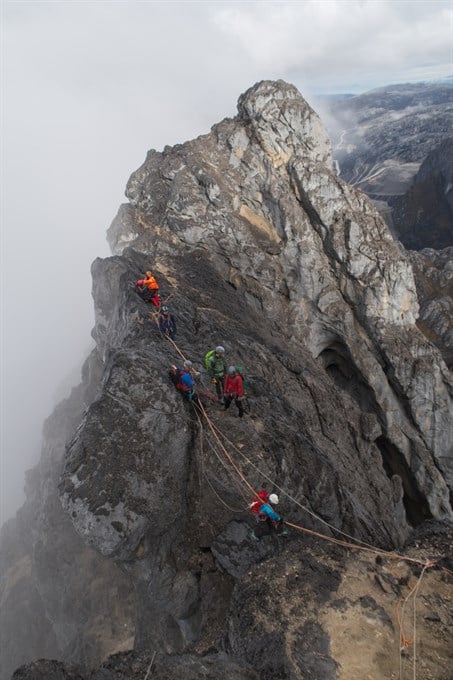
Success Is Not Primarily a Hiking-Fitness Problem.
American Alpine Institute currently asks participants to be proficient on rock up to US 5.8 in mountaineering boots. Fixed ropes reduce some free-climbing demands, but exposed movement, jumaring, cable crossings and repeated rappels remain part of the day.
Four Different Things Get Called a “Success Rate” Online
They are not interchangeable. The denominator must be named before the percentage means anything.
Dated Team Results
A named operator reports whether a specific expedition team summited. Example: Madison Mountaineering publicly reported 100% team success for its March and June 2026 teams.
Operator Track Record
An operator reports its own historical success. This can describe that operator’s process, but it is self-reported and may count expeditions rather than individual climbers.
Successful Trip Count
IMG says it has conducted eleven successful Carstensz trips. That establishes operational experience, not a client-level percentage unless failed trips and participant denominators are also known.
Mountain-Wide Percentage
A claim like “62% overall” requires a complete numerator and denominator across the same population and time period. We could not verify a public dataset that supports that calculation.
Global Summit Guide classification: no single audited mountain-wide rate
The Summit Success Rates hub already uses this rule for mountains where percentages come from operators, selected programs or incompatible sources: if the source cannot tell us who is in the denominator, GSG should not turn the estimate into an official mountain-wide rate.
Precision Without a Reproducible Dataset Is Not Better Data
The previous page published multiple precise percentages that could not be independently reconstructed from public source tables.
| Old claim | Why it is not defensible as a universal rate | Better treatment |
|---|---|---|
| 62% overall success | No public all-climber numerator and denominator were surfaced for the stated 1962–2025 period. | Do not publish one mountain-wide rate until a reproducible dataset exists. |
| 72% helicopter / 48% jungle | Public operator pages confirm both access styles historically, but we could not verify a common dataset supporting those exact percentages. | Describe current access models and their practical tradeoffs without invented probability. |
| 72% guided / 44% permit-only | “Guided” and “permit-only” populations were not publicly defined or counted. | Use operator qualification requirements and current program structure instead. |
| 28% with no rock experience | No public cohort table identifies how many climbers were in that group or how selection bias was handled. | Use current operator prerequisites: recent multi-pitch / fixed-rope rock competence matters. |
| 1 in 180 rescue rate | No auditable rescue numerator and total-exposure denominator were provided. | Discuss rescue complexity qualitatively and use current evacuation planning guidance. |
| ~200 annual permit holders | No current public permit registry was identified supporting that exact annual count. | Do not use annual-volume estimates unless the issuing authority publishes them. |

What Public 2026 Expedition Reports Actually Show
These are real team outcomes. They demonstrate that current commercial Carstensz expeditions can succeed at a high rate when the team is selected and the trip operates—but they still do not create a mountain-wide denominator.
| Operator / date | Public result | What we can infer | What we cannot infer |
|---|---|---|---|
| Adventure Indonesia · Feb. 26, 2026 | Seven named summiteers listed on the operator’s current Carstensz page. | A commercially organized 2026 team reached the summit successfully. | Mountain-wide success across all 2026 teams. |
| Madison Mountaineering · March 2026 | Operator reported 100% team success for its first 2026 expedition. | That Madison team had full-team success. | Success for climbers outside that team or operator. |
| Madison Mountaineering · June 16, 2026 | Operator reported the entire team summited under excellent conditions. | Another current commercial expedition achieved full-team success. | A universal Carstensz probability. |
2026 takeaway: current expeditions are operating and summiting.
That matters because Carstensz has had periods of access disruption. But three successful public reports are still a selected sample. Without a list of every climber who attempted the mountain, every non-start caused by access, and every turnaround, a 2026 mountain-wide percentage would be speculation.
Operator Success Claims Are Useful—When the Unit Is Labeled
Carstensz is a small-volume, operator-mediated mountain. Operator history can therefore be informative, but expedition success and climber success are different metrics.
98% Self-Reported Expedition Success
The operator currently says it has run 211 expeditions / 215 trials since 1998 with four failed, yielding a claimed 98% success rate. The wording appears to describe expedition outcomes, not the percentage of individual clients summiting.
11 Successful Carstensz Trips
IMG states it has conducted eleven successful Carstensz trips via five different approaches. That is strong experience evidence, but not an all-client rate without the total number of attempts and participants.
Current Programs Publish Skills, Not Rates
AAI and Adventure Consultants publish current route demands, high-camp plans and technical prerequisites rather than a universal summit percentage. That is a more reproducible way to evaluate readiness.
Ask one question when an operator advertises “95% success.”
95% of what? Expeditions with at least one summit? Paying clients? All climbers including guides? Climbers who started summit day? The claim only becomes comparable when the denominator and date range are explicit.
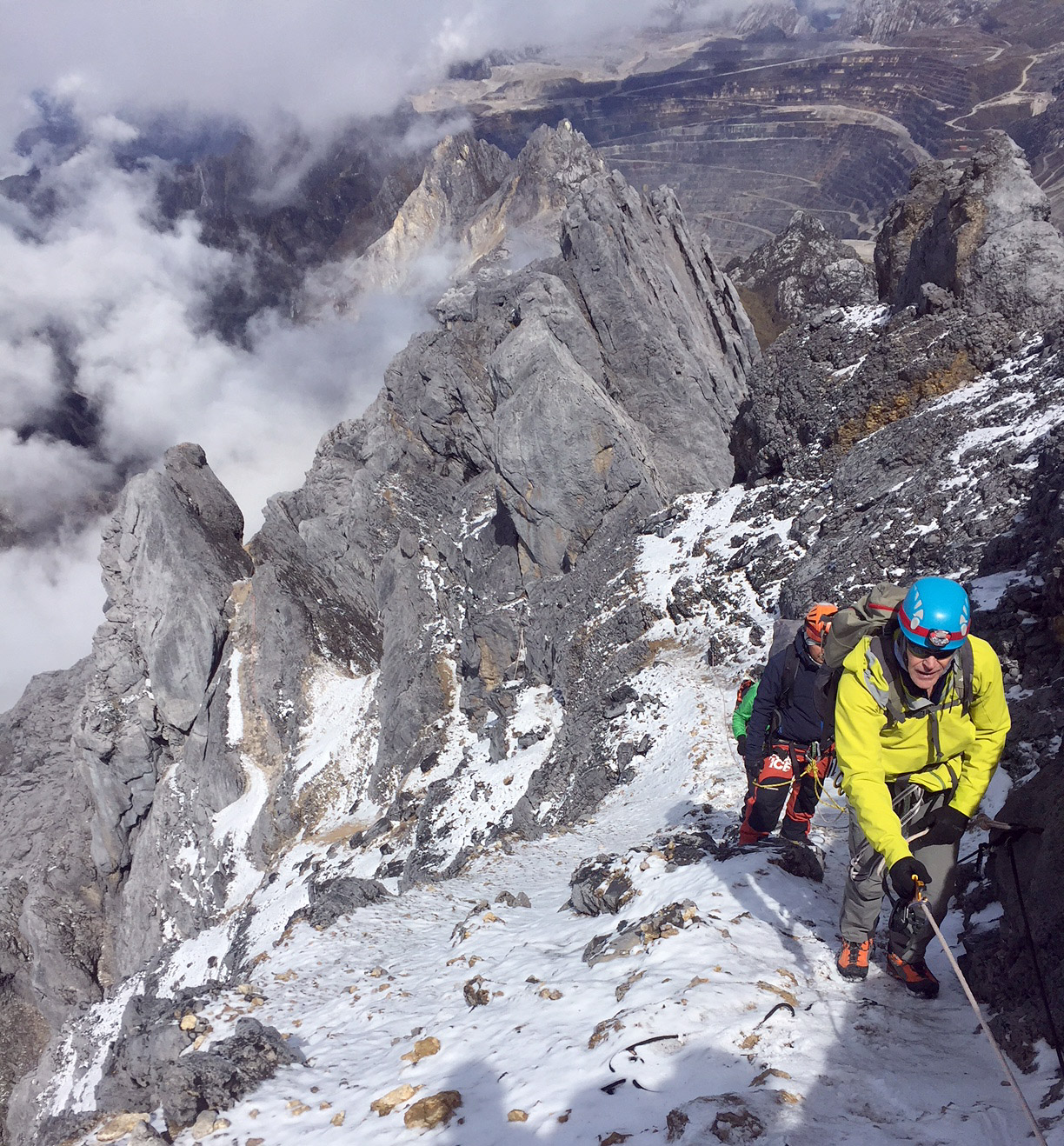
The Useful Question Is Whether You Can Move Efficiently Through the Entire Rope System.
Dry rock grade alone misses the problem. Fixed-rope ascents, exposed ridge movement, cable crossings and a rappel-heavy descent all have to be completed under variable equatorial conditions.
Current Operator Descriptions Put the Harder Rock Around 5.6–5.8
The previous page used 5.2–5.4 as though it were the definitive technical grade. Current guide services describe a broader and generally harder range.
| Source | Current description | Success implication |
|---|---|---|
| American Alpine Institute | Participants should be proficient climbing up to Australian Grade 16 / US 5.8 in mountaineering boots. | Real rock competence is a prerequisite, not an optional advantage. |
| Global Summit Guide route audit | Current commercial descriptions cluster around 5.6–5.8 for harder short sections, with fixed ropes and major exposure. | Efficiency on fixed rope and calm movement matter as much as free-climbing grade. |
| Modern commercial route | North Face / Normal Route, exposed summit ridge, cable or Tyrolean-style crossing, repeated rappels. | Success depends on completing a technical system—not just touching one crux move. |
Altitude Is Not the Main Crux—but It Does Not “Play No Role”
The modern helicopter model creates one of Carstensz’s unusual physiological problems: a very rapid jump from low-elevation Timika to a base camp above 4,000 meters.
Sea Level to ~4,200 m
AAI’s current itinerary flies from Timika to Base Camp at about 4,200 m and then spends several days acclimatizing before the summit bid.
4,884 m Still Matters
Carstensz is far lower than Denali, Aconcagua or Everest, but 4,884 meters can still slow climbing, worsen headache and reduce technical efficiency.
Prior Altitude Helps
AAI says prior altitude experience is not required but recommends it. That is a more accurate framing than saying altitude has no meaningful role.

Wet Limestone Changes More Than the Grade
Carstensz sits in an equatorial mountain environment where cloud, rain and wet rock can quickly change climbing speed and confidence.
Dry coarse limestone can climb well in boots; wet limestone changes foot confidence, hand security and rappel transitions.
Cloud and rain on the exposed ridge make movement, communication and route management slower even when the fixed system remains in place.
Current commercial programs use early starts and contingency days because a technically ready team still needs a usable weather window.
Weather affects both the climb and the aviation system. A summit-ready team can still lose days waiting for a flight into or out of high camp.

Access Is Part of the Success Denominator—If You Define It That Way.
A climber who pays for an expedition that never reaches base camp because of permits, security or aviation has a different outcome from a climber who starts the route and turns around. Any honest success statistic must decide whether those people are included.
Regional Security and Permits Can Determine Whether a Summit Attempt Happens at All
Carstensz is in Central Papua, where current government travel guidance continues to describe elevated and rapidly changing security risk.
Current commercial departures are running, but access is not a normal trailhead transaction.
Australia’s Smartraveller currently advises travelers to reconsider their need to travel to Central Papua because of serious security incidents and potential violence. UK guidance describes regular armed clashes and attacks on aircraft in Central and Highland Papua. These are regional advisories, not mountain-specific closure notices, but they directly affect expedition planning.
At the same time, current operator programs remain active. Madison has another departure scheduled for October 2026, Adventure Consultants publishes an October 2026 trip, and Adventure Indonesia is publishing 2026 schedules. The correct description is access-gated and operator-dependent, not simply “open” or “closed.”
Focus on Variables We Can Defend Without Inventing Percentages
These factors are repeatedly supported by current operator requirements and route descriptions even though their exact probability effect is not quantified.
Arrive as a Rock Climber
Be comfortable on exposed multi-pitch terrain and fixed ropes before Papua. Do not use summit day as your first serious rock-climbing lesson.
Practice Jumaring & Rappels
Fixed-rope transitions, clipping, cable movement and repeated rappels should be routine enough to remain smooth when wet or tired.
Respect the Helicopter Jump
Build enough itinerary time at high camp and arrive with prior altitude exposure if practical.
Verify the Access System
Ask which local partner, permit path, helicopter provider, evacuation plan and refund terms apply to your exact departure.
Keep Real Contingency Days
Do not schedule international travel so tightly that one lost flying day or wet climbing day ends the expedition.
Read Papua Exclusions
Security evacuation, technical climbing, helicopter evacuation and travel-advisory exclusions should be checked in writing.

Carstensz Is Exactly the Kind of Mountain Where “One Number” Can Mislead.
Low traffic, changing access, operator selection, technical prerequisites and a small number of annual commercial teams make a universal success percentage much less stable than it looks.
Carstensz Pyramid Summit Success FAQ
Short answers that distinguish verified results from estimates.
What is the Carstensz Pyramid summit success rate?
There is no single independently audited mountain-wide rate that Global Summit Guide can verify. Public figures come from operator-specific records, selected expedition results and estimates with different denominators.
Is the old 62% Carstensz success rate reliable?
Not as a universal mountain-wide figure. A defensible 62% rate would require a reproducible numerator and denominator across the same climber population and time period. The previous page did not provide a public dataset that allowed that calculation to be checked.
What happened on Carstensz in 2026?
Public operator reporting documents successful commercial teams in 2026. Adventure Indonesia lists seven named summiteers on February 26, while Madison Mountaineering reported 100% team success on its March and June expeditions.
Does Adventure Indonesia have a 98% success rate?
Adventure Indonesia currently self-reports 211 expeditions from 215 trials with four failed, which it labels a 98% success rate. This appears to be an expedition-level operator metric, not an independently audited mountain-wide percentage of all individual climbers.
How technical is Carstensz Pyramid?
Current operator descriptions commonly place the harder short sections around US 5.6 to 5.8, with fixed ropes, exposed ridge movement, a cable or Tyrolean-style crossing and multiple rappels. Exact perceived difficulty changes with the fixed system and wet conditions.
Does altitude matter on Carstensz?
Yes, although it is not the mountain’s primary technical difficulty. Modern helicopter-supported trips commonly fly from low-elevation Timika to a base camp around 4,200 meters, so acclimatization and altitude response still matter.
Is the helicopter approach more successful than the jungle trek?
It may offer practical advantages because climbers avoid a long, fatiguing approach and arrive close to the route, but Global Summit Guide could not verify a public common-denominator dataset supporting the precise 72% versus 48% figures previously published.
What is the most important preparation for Carstensz?
Current guide-service requirements point to outdoor rock competence, fixed-rope efficiency, exposure tolerance, rappel skills, fitness for a long summit day and enough acclimatization time after helicopter arrival at high base camp.
Use Dated Team Results and Labeled Operator Claims
Carstensz is classified as a no-single-audited-rate mountain until a reproducible all-climber dataset is available.
What would change this page?
If an Indonesian authority or credible expedition database publishes a complete table of Carstensz climber attempts and summits using one defined population and date range, Global Summit Guide can calculate a mountain-wide rate. Until then, operator-specific results should remain operator-specific.

Global Summit Guide
The Global Summit Guide team has not climbed Carstensz Pyramid. This page is a source-audit and success-data analysis built from current operator results, government travel information and published route requirements. It does not convert commercial claims into independent mountain-wide statistics.
Puncak Jaya: Route, Access, Operators & Success Data
This page owns the summit-success evidence question. Use the mountain parent and success hub for context, then move into the route, access, timing and operator pages that determine whether a specific expedition is viable.

Carstensz Can Be Highly Summitable for the Right Team Without Having One Honest Universal Percentage.
Track operator-specific outcomes, verify the current access system, arrive with real rock and rope competence, and keep the success statistic tied to a named denominator.
Was this helpful?
🏔Related safety data
🧭Explore & compare
Global Summit Guide is an independent mountaineering resource founded in 2026. The team combines first-hand trekking and climbing experience with in-depth research and professional health and nutrition review to help climbers choose objectives, prepare properly, and stay safe.
Health, altitude, and nutrition content is reviewed by Taylor Ludlow (Registered Nurse) and Brigg Hoopes (Nutritionist).
What We Don't Know Yet
Mountain information changes quickly. This box explains the limits of what this page can responsibly promise.
- Fitness and altitude response vary by person; no guide, itinerary, or training plan can guarantee acclimatization or summit success.
- Visa, passport, vaccination, border, insurance, and local transportation rules may change before your trip.
- Route conditions, snowpack, closures, and weather can change quickly after this page is updated.
- Permit rules, fees, quotas, and reservation windows may change between review cycles.
- Operator availability, pricing, guide ratios, and cancellation terms can change by season.
Verify current conditions with official land managers, guide services, local forecasts, and current route reports before booking or climbing.
Mountaineering, rock and ice climbing, glacier travel, and high-altitude activity are inherently dangerous and can result in serious injury or death. The information on Global Summit Guide is provided for general informational and educational purposes only and is not a substitute for professional instruction, qualified guiding, proper equipment, or your own judgment and experience.
Route conditions, weather, snowpack, permits, regulations, and hazards change constantly and may differ from what is described here. Details may be incomplete, out of date, or contain errors. Always verify current information with local authorities, certified guides, and official sources before making any decision in the mountains.
Nothing on this site is medical, legal, or financial advice. Our fitness, acclimatization, altitude, and nutrition content is general in nature; consult a qualified physician before beginning any strenuous exercise program or exposing yourself to high altitude.
You are solely responsible for your own safety and decisions. To the fullest extent permitted by law, Global Summit Guide and its team accept no liability for any loss, injury, damage, or expense arising from use of, or reliance on, this information. By using this site you acknowledge these risks and accept these terms.
Some links on this site may be affiliate links. If you buy through them we may earn a small commission at no extra cost to you; this never affects our recommendations.
Global Summit Guide recommendation path
Next Best Mountain to Research
Use these recommendations to continue the right planning path instead of stopping on one page.
Use current permit, weather, route, and operator information before booking or climbing.