
Last updated September 16, 2026
Galdhøpiggen Hike: Spiterstulen vs Juvasshytta to Norway’s Highest Summit
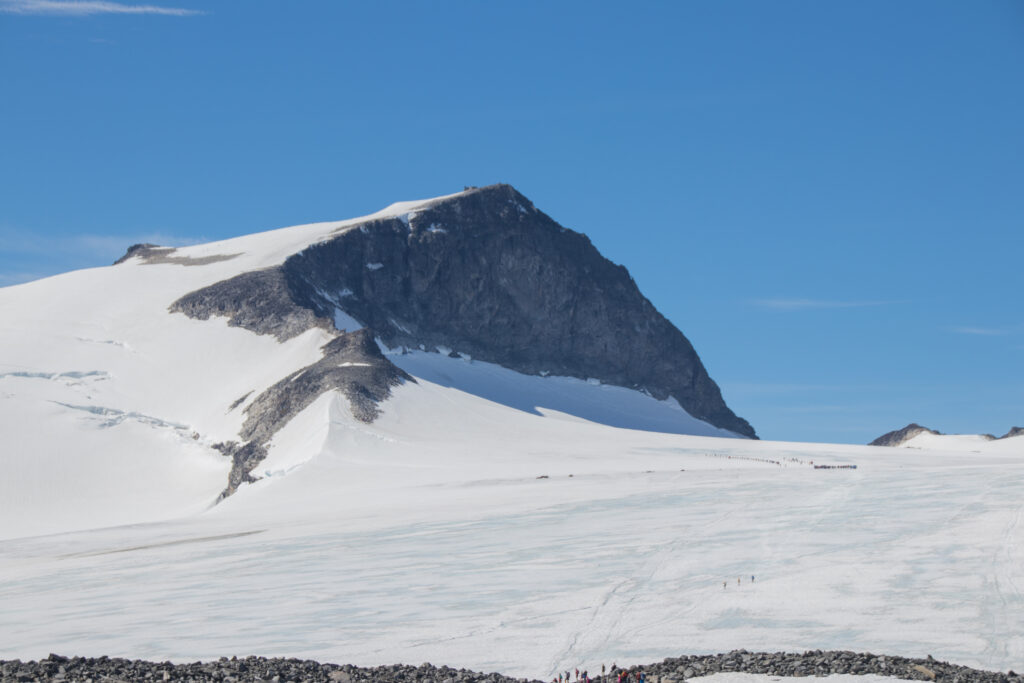
Galdhøpiggen is Norway’s highest mountain at 2,469 m / 8,100 ft, but the real planning decision is not whether you can reach the summit—it is which version of the mountain you want. From Spiterstulen, you get a long, independent, non-glacier mountain hike. From Juvasshytta, you start much higher and cross the crevassed Styggebreen glacier as part of a structured rope-team ascent.
Spiterstulen or Juvasshytta?
Choose Spiterstulen if you are a strong hiker, want to climb independently and would rather accept a much larger physical day than step onto a glacier.
Choose Juvasshytta if you want the shorter, more structured classic summit experience and are comfortable joining a rope team across Styggebreen. The current Juvasshytta program supplies harnesses and crampons when required and organizes the glacier crossing with experienced guides.
Juvasshytta is physically easier for many visitors because the road reaches about 1,840 m, only roughly 630 vertical meters below the summit. But the route is not simply an easy shortcut: it crosses a crevassed glacier where hidden snow bridges are the central hazard.
No glacier crossing on the standard summer trail.
Structured roped crossing of Styggebreen.
About 1,478 m of vertical ascent.
Glacier hazards require rope-team systems and judgment.
Galdhøpiggen at a glance
The mountain is accessible by Norwegian standards, but route choice changes the trip from a pure hiking day into a glacier-travel day.
| Field | Current planning answer | What it means |
|---|---|---|
| Elevation | 2,469 m / 8,100 ft | Highest mountain in Norway and Scandinavia. |
| Region | Jotunheimen | High-alpine mountain environment west of Lom. |
| Main non-glacier route | Spiterstulen | Long, marked mountain hike that can normally be done independently. |
| Main glacier route | Juvasshytta / Styggebreen | Shorter summit day, but roped glacier travel changes the safety system. |
| Primary gateway | Lom / Bøverdalen | Road connections branch toward Spiterstulen and Juvasshytta. |
| Main hiking season | Summer into early autumn | Snow, wind and visibility can remain serious even in midsummer. |
| Summit permit | No standard summit-permit system listed | Practical bookings concern road access, lodging and the guided glacier trip. |
Galdhøpiggen route comparison
There is no universally “easiest” route because the two main options trade endurance against glacier complexity.
Spiterstulen
The cleaner option for strong hikers who want to reach Norway’s highest point without crossing a glacier.
- Marked summer route.
- No glacier crossing on the standard line.
- Passes Svellnose and Keilhaus topp.
- Much larger endurance demand than Juvasshytta.
- Still exposed to high-mountain weather and snow.
Juvasshytta + Styggebreen
The higher start reduces the vertical work dramatically, but the glacier crossing means the trip must be treated as more than a normal hike.
- Crosses crevassed Styggebreen.
- Harness supplied; crampons supplied if required.
- Current guided trip begins at 10:00.
- Minimum age currently 7.
- Group pace matters because the glacier crossing operates as a rope team.
Galdhøpiggen from Spiterstulen
The classic “earn every vertical meter” version of Norway’s highest summit.
Begin from the lodge in Visdalen. Cross the bridge and follow the marked route toward the open mountain.
The route leaves the lower vegetation quickly and becomes a sustained uphill effort over increasingly rocky ground.
One of the high points crossed on the way. Snow can remain along the route even during the summer season.
The route crosses another high summit before the final approach to Galdhøpiggen. The intervening descent means the return journey contains more climbing than a simple summit-to-car profile suggests.
Reach the summit and reverse the same long mountain route. Do not budget energy only for the ascent—the descent still includes rough ground and accumulated fatigue.
The shorter route crosses a real glacier.
Styggebreen may look like a broad snowfield from a distance, but snow can conceal crevasses. Juvasshytta explicitly warns that crossing alone without rope, equipment and glacier experience can be fatal.
Galdhøpiggen from Juvasshytta
This is the structured route for hikers who want a shorter summit day and the experience of crossing Styggebreen.
The current 10:00 trip asks participants to meet 30 minutes before departure for ticket checking, instructions and harness fitting.
The first leg climbs gradually from Juvasshytta. Juvasshytta expects the group to reach the glacier in about an hour.
Participants rope together for the glacier crossing. Juvasshytta estimates roughly 50 minutes across the glacier.
The rope teams come apart after the glacier and the steepest rocky portion of the summit route begins.
Juvasshytta says most participants take roughly half an hour to an hour from Piggura to the summit.
Galdhøpiggen is approachable—not trivial
Elevation alone makes the mountain look easier than many Alpine peaks, but weather and route choice still matter.
Endurance
Nearly 1,500 m of ascent makes this a substantial hiking day even though the standard line avoids technical climbing.
Glacier systems
Physically shorter, but hidden crevasses mean the Styggebreen crossing requires proper roped travel.
Weather
Wind, low cloud, rain, snow and rapid temperature changes can turn a straightforward summer outing into a very different mountain day.
Rock + snow
Expect uneven rock, scree and seasonal snow rather than a smooth trail from start to summit.
Moderate, but noticeable
At 2,469 m, severe altitude problems are much less central than on 4,000–6,000 m peaks, but rapid ascent can still make some visitors feel the elevation.
Save energy
Most hiking injuries and pacing mistakes happen after the summit mindset has relaxed.
When should you climb Galdhøpiggen?
The practical summer season is shaped by lodge operations, road access, snow coverage and the glacier-guiding calendar.
| Period | Spiterstulen | Juvasshytta | Main concern |
|---|---|---|---|
| Late May–June | Possible with substantial seasonal snow | Guided season begins around late May | Snow coverage, cold and changing road conditions |
| July–August | Main hiking period | Core guided glacier season | Crowds, wind, rain and sudden poor visibility |
| Early–mid September | Often still possible | Guided season ends around mid-September | Colder weather, fresh snow and shorter days |
| Late autumn / winter | Separate winter-mountain objective | Summer glacier program closed | Snow, ice, avalanche and winter navigation skills |
Both routes begin at mountain lodges reached from the Lom side
The mountain may be straightforward to locate, but both approaches use private mountain roads with their own operating rules.
Galdhøpiggvegen
The paved private road climbs from roughly 550 m to Juvasshytta at 1,840 m. Juvasshytta lists the road at about 20 km with 1,290 m of vertical rise.
- 2026 passenger-car toll: NOK 150.
- Road can close at short notice because of conditions.
- Caravans are not permitted.
- Seasonal bus service operates during the main summer period.
Visdalsvegen
Visit Jotunheimen describes Visdalsvegen as an approximately 18 km private toll road from the Fv. 55 corridor to Spiterstulen.
- Road operation follows the lodge season.
- Parking is included for overnight lodge guests.
- Day visitors pay the applicable parking charge at Spiterstulen.
- The mountain road is narrow and should be driven conservatively.
How much does it cost to climb Galdhøpiggen?
This is an inexpensive mountain by international summit standards; the meaningful difference is whether you buy the glacier-guiding service.
| Cost | Spiterstulen | Juvasshytta |
|---|---|---|
| Summit permit | No standard summit permit identified | No separate summit permit identified |
| Guide | Optional on standard non-glacier hike | NOK 490 adult / NOK 420 child for current 2026 guided glacier trip |
| Road | Private Visdalsvegen toll applies | NOK 150 current passenger-car Galdhøpiggvegen toll |
| Parking | Included for overnight Spiterstulen guests; day-use fee applies | Use Juvasshytta’s current parking/road arrangements |
| Lodging | Optional Spiterstulen stay | Optional Juvasshytta stay |
| Glacier equipment | Not needed on normal summer hiking line | Harness supplied and crampons supplied when required on guided trip |
Pack for Norwegian high-mountain weather, not valley weather
Both routes can move through cold wind, snow and wet conditions even when lower elevations feel like summer.
Wind + precipitation
- Base layer
- Warm mid-layer
- Waterproof / windproof shell
- Hat and gloves
- Extra insulation for stops
Rock and snow
- Supportive hiking or mountain footwear
- Good tread
- Dry socks
- Gaiters useful in snowy conditions
Independent margin
- Food
- At least adequate hydration
- Navigation backup
- First aid
- Sun protection
Do not let a country-high-point label make the mountain feel automatic
The rebuild intentionally removes the old embedded “current weather” widget. A route page should teach what to evaluate and send you to a live mountain forecast for the actual date.
Cloud changes navigation
Cairns and tracks are much less useful when cloud or blowing precipitation removes the surrounding terrain.
Exposure changes quickly
Summit wind can turn a cool hiking day into a cold-stress problem, especially when clothing becomes wet.
Summer does not guarantee dry trail
Snow can fall high in Jotunheimen outside the winter season and obscure the normal route.
Falling behind is information
A pace that consumes all daylight or weather margin is a route problem—not something to solve by rushing.
Follow guide decisions
On the Juvasshytta program, the guide controls rope teams and can turn participants around when pace or conditions are unsuitable.
The goal includes the descent
A Galdhøpiggen day is successful when the group is safely back at the lodge, not when the summit photo is taken.
Can children climb Galdhøpiggen?
Age tells you much less than endurance, motivation, weather tolerance and experience walking on rough mountain ground.
Current minimum age: 7
The guided glacier service currently sets a seven-year minimum. Children use full-body harnesses and join the same group-paced glacier system as adults.
No shortcut around endurance
The route avoids glacier travel but still involves roughly 12 km and almost 1,500 vertical meters. A child should already have demonstrated comfort on long mountain days before using Galdhøpiggen as the test.
Juvasshytta, Spiterstulen or Lom?
Sleeping near the route improves an early mountain day and removes unnecessary morning driving.
Juvasshytta
Stay here when you are taking the guided glacier route and want the simplest possible morning.
Spiterstulen
Stay at the actual trailhead when the long independent hiking route is the objective.
Lom
Better for broader lodging choice, restaurants and a flexible Jotunheimen road trip, but it adds morning travel before the summit day.
Galdhøpiggen hiking questions
Direct answers to the searches that matter when choosing between the two main routes.
What is the best route up Galdhøpiggen?
Spiterstulen is best for strong hikers who want an independent non-glacier ascent. Juvasshytta is best for hikers who want a shorter summit day and a guided glacier experience.
Is Galdhøpiggen difficult?
It is approachable compared with major technical Alpine peaks, but Spiterstulen requires about 1,478 m of ascent and Juvasshytta crosses a crevassed glacier. Weather and fitness can make either route serious.
Can I hike Galdhøpiggen without a guide?
Yes from Spiterstulen in normal summer conditions. Its standard route does not cross a glacier. The Juvasshytta line crosses Styggebreen and should only be crossed by a properly equipped, competent rope team or through the established guided service.
How long does Galdhøpiggen take from Spiterstulen?
Spiterstulen lists 4–6 hours each way for the 6 km one-way route. Many visitors should therefore think of it as an all-day outing rather than targeting an aggressive turnaround time.
How long does Galdhøpiggen take from Juvasshytta?
Approximately 5–7 hours is a useful planning range for the normal guided trip. Actual timing depends on group pace, glacier conditions and weather.
How much does the Juvasshytta guided trip cost?
Juvasshytta’s current 2026 Norwegian information lists NOK 490 for adults aged 15 and older and NOK 420 for children. Recheck the booking page because prices can change.
What age can children climb from Juvasshytta?
The current minimum age for Juvasshytta’s guided glacier trip is seven.
Is there a permit to climb Galdhøpiggen?
The current route and lodge sources do not describe a separate summit-permit system. The practical fees and bookings concern road access, parking or lodging, and the guided glacier trip if using Juvasshytta.
What is the best month to hike Galdhøpiggen?
July and August give the broadest overlap of lodge operations, guided glacier service and normal summer hiking conditions. That does not guarantee dry trail or good summit weather.
Route providers own the changing details
Use this page to choose the route. Use the current lodge and regional pages to confirm the exact date, road and booking details.
Guided Galdhøpiggen trip
Current season, price, age limit, rope-team procedure, equipment and group-pacing rules.
Open Juvasshytta →Galdhøpiggvegen
Current private-road rules, road toll and vehicle restrictions.
Open road information →Galdhøpiggen route
Current non-glacier route distance, elevation gain, time and season.
Open Spiterstulen →Visdalen
Spiterstulen access, private-road context and the 12 km non-glacier route framework.
Open Visit Jotunheimen →2026 road openings
Seasonal access information for Visdalsvegen and Galdhøpiggvegen.
Open road update →Editorial update
Rebuilt September 15, 2026 to replace the legacy March layout, remove duplicated 2025 material and focus the page on the route-selection query.
Continue from Galdhøpiggen
Use Galdhøpiggen as either a major hiking summit or an introduction to structured glacier travel, then choose the next mountain based on what you actually enjoyed.
Was this helpful?
🏔Related peaks nearby
🧭Explore & compare
Global Summit Guide is an independent mountaineering resource founded in 2026. The team combines first-hand trekking and climbing experience with in-depth research and professional health and nutrition review to help climbers choose objectives, prepare properly, and stay safe.
Health, altitude, and nutrition content is reviewed by Taylor Ludlow (Registered Nurse) and Brigg Hoopes (Nutritionist).
What We Don't Know Yet
Mountain information changes quickly. This box explains the limits of what this page can responsibly promise.
- Route conditions, trailhead access, crevasse exposure, stream crossings, and rescue access may vary from published planning guidance.
- Visa, passport, vaccination, border, insurance, and local transportation rules may change before your trip.
- Route conditions, snowpack, closures, and weather can change quickly after this page is updated.
- Permit rules, fees, quotas, and reservation windows may change between review cycles.
- Operator availability, pricing, guide ratios, and cancellation terms can change by season.
Verify current conditions with official land managers, guide services, local forecasts, and current route reports before booking or climbing.
Mountaineering, rock and ice climbing, glacier travel, and high-altitude activity are inherently dangerous and can result in serious injury or death. The information on Global Summit Guide is provided for general informational and educational purposes only and is not a substitute for professional instruction, qualified guiding, proper equipment, or your own judgment and experience.
Route conditions, weather, snowpack, permits, regulations, and hazards change constantly and may differ from what is described here. Details may be incomplete, out of date, or contain errors. Always verify current information with local authorities, certified guides, and official sources before making any decision in the mountains.
Nothing on this site is medical, legal, or financial advice. Our fitness, acclimatization, altitude, and nutrition content is general in nature; consult a qualified physician before beginning any strenuous exercise program or exposing yourself to high altitude.
You are solely responsible for your own safety and decisions. To the fullest extent permitted by law, Global Summit Guide and its team accept no liability for any loss, injury, damage, or expense arising from use of, or reliance on, this information. By using this site you acknowledge these risks and accept these terms.
Some links on this site may be affiliate links. If you buy through them we may earn a small commission at no extra cost to you; this never affects our recommendations.
Global Summit Guide recommendation path
Next Best Mountain to Research
Use these recommendations to continue the right planning path instead of stopping on one page.
Use current permit, weather, route, and operator information before booking or climbing.