
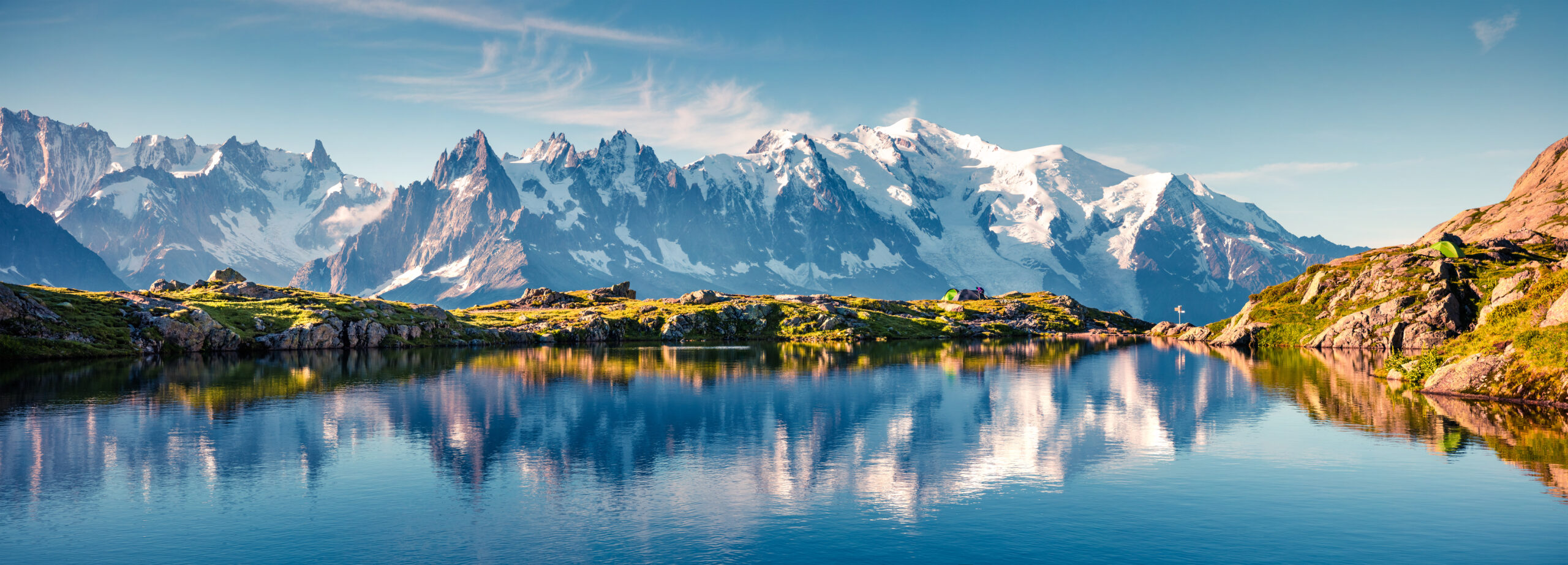
Tour du Mont Blanc: Complete TMB Trek Guide
The Tour du Mont Blanc circles the Mont Blanc massif for roughly 170 kilometres through France, Italy and Switzerland. Most hikers spend 7–11 days crossing Alpine passes, sleeping in refuges and villages, and climbing close to 10,000 metres in total. This guide covers the route, 11-stage itinerary, 2027 refuge booking, cost, difficulty, best season, variants, gear and logistics.
What Is the Tour du Mont Blanc?
The Tour du Mont Blanc—usually shortened to TMB—is a roughly 170 km / 105 mi walking circuit around the Mont Blanc massif. It crosses France, Italy and Switzerland and accumulates close to 10,000 metres / 33,000 feet of ascent. The official TMB organization says most hikers complete the circuit in 7–11 days. The standard route is non-technical in normal summer conditions, but consecutive long climbs, high passes, weather and carrying a pack make it a serious endurance trek rather than an easy walking holiday.
The official TMB refuge system opens bookings for the 2027 season on October 15, 2026. Popular accommodation can fill rapidly, so hikers with fixed dates should build the itinerary around the hardest-to-get beds rather than waiting until spring.
Tour du Mont Blanc Route Map.
The classic counter-clockwise circuit normally begins around Les Houches, passes through the French Val Montjoie, enters Italy at Col de la Seigne, crosses into Switzerland at Grand Col Ferret and returns to the Chamonix Valley via Trient and Col de Balme.
Tour du Mont Blanc 11-Day Itinerary.
This is a classic full-circuit framework rather than a rigid reservation plan. Exact overnight locations vary with availability, route variants and whether you use valley transport or lifts.
| Day | Stage | Country | Key terrain | Planning note |
|---|---|---|---|---|
| 1 | Les Houches → Les Contamines | France | Col de Voza; optional Col de Tricot variant | The first sustained climbing day. Do not make the opening stage a fitness test. |
| 2 | Les Contamines → Les Chapieux / Bonhomme area | France | Col du Bonhomme and Croix du Bonhomme | A major Alpine stage and an early-season snow checkpoint. |
| 3 | Les Chapieux → Rifugio Elisabetta area | France → Italy | Vallée des Glaciers and Col de la Seigne | The first international border crossing and one of the defining TMB days. |
| 4 | Elisabetta / Val Veny → Courmayeur | Italy | Val Veny, Miage glacier views, Mont Blanc’s Italian side | Courmayeur provides hotels, restaurants, supplies and a natural recovery point. |
| 5 | Courmayeur → Rifugio Bonatti | Italy | Mont de la Saxe / Val Ferret | Shorter distance does not mean easy—there is substantial climbing out of Courmayeur. |
| 6 | Bonatti → La Fouly | Italy → Switzerland | Grand Col Ferret, 2,537 m | The highest point of the standard TMB and a long descent into Swiss Val Ferret. |
| 7 | La Fouly → Champex-Lac | Switzerland | Val Ferret villages and forest trails | A comparatively gentler stage between major pass days. |
| 8 | Champex-Lac → Trient | Switzerland | Alp Bovine route or Fenêtre d’Arpette variant | Choose the variant according to weather, snow, energy and mountain experience. |
| 9 | Trient → Tré-le-Champ / Argentière | Switzerland → France | Col de Balme | The circuit crosses back into France with big views toward the Chamonix Valley. |
| 10 | Tré-le-Champ → La Flégère / Lac Blanc area | France | Aiguilles Rouges | One of the best Mont Blanc panorama days; variants and lift access can change the stage. |
| 11 | Flégère / Chamonix side → Les Houches | France | Brévent / Chamonix Valley | Complete the circuit, with route choices depending on accommodation and lift use. |
The official TMB route is normally divided into 10–11 stages, with typical stage distances of roughly 10–20 km and individual days sometimes exceeding 1,000 m of ascent. The exact itinerary should be built around refuge availability and current conditions.

Col de la Seigne Is Where the TMB Becomes an International Journey.
The pass marks the natural border between France and Italy. Behind you is the Vallée des Glaciers; ahead are Val Veny, the glaciers of the Italian side of Mont Blanc and eventually Courmayeur.
Photo: Rémih · Wikimedia Commons · CC BY-SA7 Days, 10 Days or 11–12 Days?
The TMB can be compressed or expanded, but the number of days changes the experience much more than the total route distance changes.
7 Days
Official TMB guidance suggests roughly 24 km and 1,400 m of climbing per day at this pace. It is appropriate for strong hikers who already know they recover well from consecutive mountain days.
10 Days
About 17 km and 1,000 m of ascent per day on average. This is an excellent target for fit hikers who want the full circuit without turning every day into a race.
11–12 Days
Shorter stages create more margin for weather, photographs, long lunches, variants and recovery. This is often the strongest first-TMB format.
How Hard Is the Tour du Mont Blanc?
The official organization identifies cumulative climbing, pack weight and repeated days as the main difficulty rather than technical mountaineering.
Distance is spread across consecutive mountain days rather than one isolated effort.
The vertical total is the number many first-time TMB hikers underestimate.
Grand Col Ferret is high enough for cold wind and lingering early-season snow.
The classic summer route normally requires hiking skills rather than ropes or glacier travel.
The main training target is consecutive climbing days.
A hiker who can complete one large mountain day but cannot recover for another 1,000 metres of climbing the next morning is not yet fully prepared for the TMB. Training should include back-to-back hiking days, long descents and time carrying the same pack weight you intend to use on the circuit.
Clockwise or Counter-Clockwise?
The official TMB organization says counter-clockwise is the most common direction and generally the best marked, while clockwise travel can reduce encounters with the main flow of hikers on some stages.
Counter-Clockwise
Les Houches → Les Contamines → Italy → Switzerland → Chamonix. The classic sequence and the easiest itinerary to compare with mainstream guidebooks.
Clockwise
The same circuit in reverse. It can feel quieter because you meet the main flow rather than moving inside it.
Refuge Availability
If one direction gives you a substantially stronger accommodation sequence for fixed dates, the booking calendar may be more important than tradition.
Tour du Mont Blanc Refuge Booking for 2027.
The TMB’s infrastructure makes the trek accessible, but it also creates a reservation bottleneck. Beds—not trail permits—often determine the final itinerary.
Bookings Open October 15, 2026.
Official systemMember refuges and gîtes become available through the official Tour du Mont-Blanc booking platform.
Book fixed dates earlyThe official organization warns that the most popular accommodation can fill quickly after booking opens.
Build around bottlenecksSecure the hardest nights first, then connect the easier stages around them.
How TMB Refuges Work
Accommodation ranges from traditional mountain refuges and gîtes to hotels in larger villages such as Courmayeur and Chamonix.
- Half-board is common: overnight stay, dinner and breakfast.
- Dormitory half-board: official guidance currently suggests roughly €65–€95 per person per night.
- Accommodation total: roughly €500–€900 for a direct-booked 7–10 day trek is a current official planning range.
- Sleeping bag liner: normally expected in refuges; blankets are supplied.
- Cash: carry euros and Swiss francs for places where cards are unreliable or unavailable.
- Opening dates matter: June and September itineraries should verify that every planned refuge is operating.
Why Rifugio Bonatti Is One of the TMB’s Signature Nights.
Rifugio Walter Bonatti sits above Val Ferret opposite the Mont Blanc massif. It represents the classic TMB refuge experience: walk in, sleep in the mountains, eat communally and begin the next stage already high above the valley floor.
The Bonatti stage is also why accommodation should shape the itinerary early. Highly desired huts can become the fixed points around which the rest of a self-guided circuit is built.
 Rifugio Walter Bonatti · Cboon · Wikimedia Commons · CC BY-SA 3.0
How Much Does the Tour du Mont Blanc Cost?
The clearest way to budget is to separate the unavoidable trail costs from optional comfort and international travel.
Current official planning range per person per night in a dormitory.
Official approximate accommodation range when booking refuges directly.
Private rooms and hotels in Courmayeur or Chamonix can raise the budget significantly.
Guiding, baggage transfer and pre-arranged accommodation trade higher cost for simpler logistics.
Do not compare a dormitory self-guided TMB with an all-inclusive guided package.
They are different products. Add lunches, trail snacks, drinks, local transport, luggage transfer, hotels before or after the trek, Geneva transfers, insurance and international travel before comparing total trip prices.

Grand Col Ferret Is the High Point of the Classic TMB.
The climb from Italian Val Ferret is steady rather than technical, but weather can change the character of the pass quickly. Wind, cloud and lingering snow make an early start and a mountain forecast more important than the altitude number alone.
Photo: Rémih · Wikimedia Commons · CC BY-SABest Time to Hike the Tour du Mont Blanc.
The official classic season is mid-June through mid-September, but the experience changes substantially inside that three-month window.
| Period | Trail conditions | Refuges | Crowds | Main issue |
|---|---|---|---|---|
| Early–mid June | Snow can remain on major passes | Some may not yet be open | Lower | Early-season snow and incomplete services |
| Late June | Usually improving rapidly | Most seasonal systems operating | Moderate | Lingering snow can still affect north-facing terrain |
| July | Prime summer conditions | Fully active | High | Accommodation demand and afternoon storms |
| August | Prime summer conditions | Fully active | Very high | Heat, crowds and booking scarcity |
| Early September | Often excellent, cooler | Generally operating | Lower | Shorter daylight and colder mornings |
| Mid–late September | More variable | Closures begin | Lower | Cold, early snow and reduced infrastructure |
Check the forecast for the passes, not Chamonix.
The official TMB organization specifically recommends watching the freezing level, expected thunderstorm timing and wind at roughly 2,500 metres. Summer storms often develop during the afternoon, making early starts one of the simplest risk-management tools on the circuit.

The TMB’s Best Days Are Often the Traverses Between the Passes.
The trail above Courmayeur and through Val Ferret keeps the Mont Blanc massif directly across the valley. This is why rushing the TMB into the fewest possible days can miss part of the experience: the route is not only a sequence of cols to be crossed.
Photo: Rémih · Wikimedia Commons · CC BY-SATour du Mont Blanc Variants Worth Understanding.
Variants make the TMB unusually flexible, but some require substantially more experience than the standard route.
Col de Tricot
A higher and more mountainous alternative early in the circuit. Weather and snow can make the standard route preferable.
Col des Fours
A high variant around the Bonhomme section that can retain snow early in the season.
Fenêtre d’Arpette
At roughly 2,665 m, this is one of the route’s most demanding popular variants. The official organization recommends it for experienced, fit hikers comfortable on rocky terrain.
Lac Blanc
The Aiguilles Rouges side of the Chamonix Valley provides one of the classic views across to the Mont Blanc massif.
Brévent
A high finish above Chamonix that can be adapted according to weather, energy and lift operation.
Lower Route
Do not treat a high variant as compulsory. Poor visibility, snow, thunderstorms or fatigue are valid reasons to use the standard or lower route.
Self-Guided, Guided or Self-Guided With Luggage Transfer?
The standard TMB does not require a guide in normal summer conditions. The useful question is how much logistics and decision-making you want to manage yourself.
Self-Guided
You reserve beds, manage navigation, choose variants and respond to weather yourself. Strong fit for experienced hikers comfortable traveling independently in the Alps.
Guided
A guide handles route decisions, mountain interpretation and much of the trip structure. Packages may also include luggage transfer and pre-arranged lodging.
Luggage Transfer
Walk independently with a daypack while a transfer service moves a larger bag between selected valley accommodations. Remote refuges may not be reachable by luggage services.

You Are Circling Mont Blanc—not Climbing It.
The TMB is a hiking circuit around the massif. Reaching the 4,800-metre-class summit of Mont Blanc is a completely different mountaineering objective involving glacier travel, altitude and technical skills.
Tour du Mont Blanc Gear List.
The official TMB planning guidance recommends a roughly 35–45 litre pack and a total pack weight around 8–12 kg. Refuge accommodation means you do not need a full expedition camping system for a standard hut-to-hut itinerary.
35–45 Litres
Large enough for layers, food, water and refuge essentials without encouraging unnecessary equipment.
Waterproof + Warm Layer
Carry rain protection and insulation even when the Chamonix Valley forecast looks warm.
Broken-In Footwear
Choose mountain walking footwear you have already tested over long descents and consecutive days.
Sleeping Bag Liner
Refuges supply bedding or blankets; a liner is normally part of the hut system.
Trekking Poles
Particularly useful on the repeated long descents from the major passes.
Offline Map
The route is well established, but mist, snow, variants and closures still require real navigation ability.
How to Get to the Tour du Mont Blanc.
Most international hikers use the Chamonix Valley as their gateway. The circuit is unusually easy to combine with public transportation compared with many world-class mountain treks.
Geneva
Geneva Airport is the primary international gateway for the Chamonix Valley, with scheduled shared and private transfer services.
Les Houches
Les Houches is the standard start and finish for the complete walking circuit and sits immediately down-valley from Chamonix.
Chamonix
Chamonix offers lodging, outdoor shops, transportation, restaurants and easy pre- or post-trek mountain days.
You do not need a rental car to hike the TMB.
A point-to-point transfer from Geneva combined with local valley transportation is normally much more useful than parking a vehicle for more than a week while you walk an international circuit.
Tour du Mont Blanc in the Global Summit Guide Trail System.
The TMB is the flagship Alpine circuit inside our Europe long-distance trail collection. Use the parent hubs for trail selection; use this page when the Tour du Mont Blanc is the chosen route.
Compare the TMB With Europe’s Other Great Long Trails.
The TMB is only one style of European long-distance hike. These six sibling pages cover the other major route systems in the cluster.
Three Planning Guides That Make the TMB Easier to Get Right.
These three supporting guides deepen the specific decisions that matter most on a first Alpine hut-to-hut trek.
Verify the Route With the People Who Run It.
Accommodation, opening dates, snow, trail closures and transport can change between planning and departure. Use current official information immediately before the trek.
Tour du Mont Blanc FAQ.
The main questions hikers need answered before booking the circuit.
How long is the Tour du Mont Blanc?
The Tour du Mont Blanc is approximately 170 kilometres / 105 miles around the Mont Blanc massif through France, Italy and Switzerland.
How many days does the Tour du Mont Blanc take?
The official TMB organization says the circuit is commonly completed in 7–11 days. Seven days creates a fast, athletic schedule; ten days is a balanced pace; and 11–12 days allows shorter stages and more margin.
How much elevation gain is on the Tour du Mont Blanc?
The complete circuit accumulates close to 10,000 metres, or about 33,000 feet, of positive elevation gain.
What is the highest point on the Tour du Mont Blanc?
Grand Col Ferret at 2,537 metres is generally the highest point on the standard classic route. The popular Fenêtre d’Arpette variant rises higher, to about 2,665 metres.
How difficult is the Tour du Mont Blanc?
The classic summer TMB is a non-technical hiking route, but it is physically demanding because of approximately 170 kilometres, close to 10,000 metres of climbing and repeated mountain days. Fitness and recovery matter more than technical climbing skill.
Do you need a guide for the Tour du Mont Blanc?
No guide is required for the classic TMB. Experienced hikers can complete it self-guided in normal summer conditions, provided they can navigate, make weather decisions and manage their own itinerary.
When is the best time to hike the Tour du Mont Blanc?
The normal season runs from mid-June to mid-September. July and August generally provide the fullest refuge and transport infrastructure but also the greatest demand. June can retain snow on high passes, while September brings shorter days and colder weather.
When do 2027 Tour du Mont Blanc refuges open for booking?
The official Tour du Mont-Blanc booking system says participating refuges and gîtes open reservations for summer 2027 on October 15, 2026.
How much do TMB refuges cost?
The official TMB organization currently advises roughly €65–€95 per person per night for dormitory half-board. It estimates approximately €500–€900 in accommodation costs for a directly booked 7–10 day trek.
Do you need to camp on the Tour du Mont Blanc?
No. The classic TMB can be completed using mountain refuges, gîtes and hotels. Camping is therefore not required for a standard hut-to-hut itinerary.
Should you hike the TMB clockwise or counter-clockwise?
Counter-clockwise is the most common direction and is the traditional itinerary used by many guidebooks. Clockwise is also valid and can reduce time spent moving with the main flow of hikers.
Where does the Tour du Mont Blanc start?
Les Houches in the Chamonix Valley is the standard start and finish for the complete circuit, although a circular trail can technically be started from several accommodation areas around the massif.
Is the Tour du Mont Blanc the same as climbing Mont Blanc?
No. The TMB is a hiking circuit around the massif. Climbing Mont Blanc is a high-altitude mountaineering objective involving glacier travel and technical skills. The two should be planned as completely different mountain objectives.
Is the Tour du Mont Blanc good for a first hut-to-hut trek?
For a fit hiker with prior mountain day-hiking experience, the TMB can be an excellent first major hut-to-hut trek because accommodation, food, villages and transportation are unusually well developed. The physical challenge still requires serious preparation.
Book the Beds First. Then Build the Perfect Walking Day Around Them.
The Tour du Mont Blanc is one of the world’s easiest great mountain treks to reach—but one of the easiest to plan badly if accommodation is left too late. Secure the difficult refuge nights, choose a pace you can repeat for more than a week, keep the high variants optional and give mountain weather authority over the original itinerary.
The TMB & the World’s Great Long-Distance Walks
The Tour du Mont Blanc is Europe’s classic multi-day trek – kin to the great pilgrimage routes that cross the same continent. Explore the pilgrimage trails and the Alpine walks below.