
Last updated May 25, 2026
Climbing Mount Belukha 2026: The Sacred Pearl of Siberia, the Akkem-Delone-Berel Route & the Altai’s Highest Summit
At 4,506 meters, Mount Belukha is the highest peak in the Altai Mountains and all of Siberia. Sacred to indigenous Altai peoples as the dwelling place of White Tara, this twin-summit peak rises from the Katunsky Range on the Russia-Kazakhstan border. The classic Normal Route demands ice climbing on the 300-meter Delone Pass, crevassed glacier travel across the Mensu, and a steep snow slope to the Berel Saddle. The complete 2026 climbing guide.
Naturally, Mount Belukha occupies a unique position in world mountaineering. The peak isn’t quite the tallest in Russia — that distinction belongs to Mount Elbrus at 5,642m in the Caucasus, 1,136 meters taller. It isn’t widely known internationally — Belukha rarely appears on commercial climbing itineraries outside of Russia. What Belukha offers, uniquely, is the convergence of three elements. First, status as the highest peak in Siberia — one of the world’s largest geographic regions. Second, genuine alpine climbing on glaciated terrain at modest altitude. Finally, deep cultural significance as a sacred mountain for the indigenous Altai people who consider it the dwelling place of the Buddhist deity White Tara. For climbers seeking a peak that combines real technical content with profound cultural depth, Belukha delivers something genuinely distinctive.
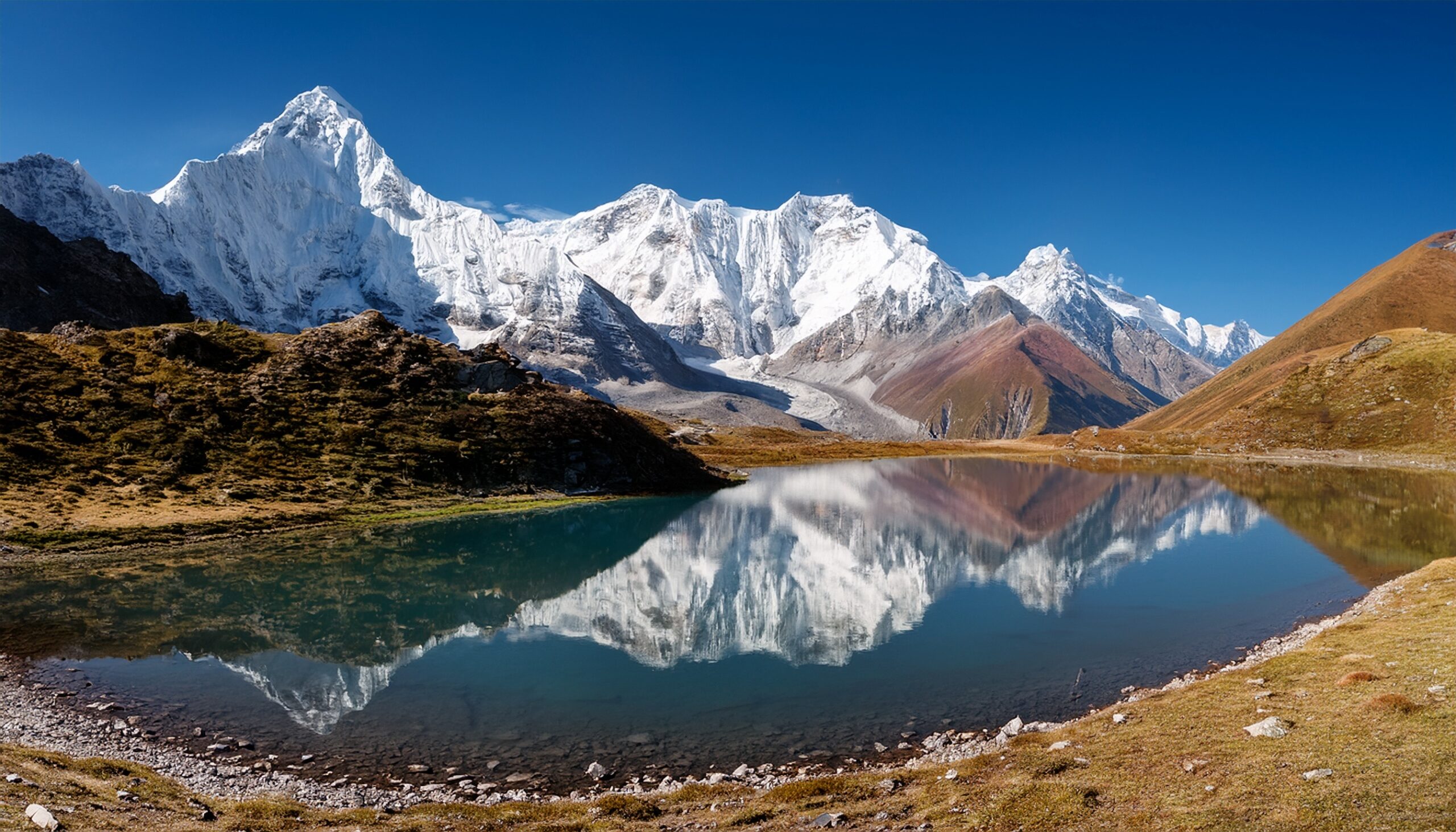
The mountain stands in the Katunsky Range of the Altai Mountains, on the border between Russia’s Altai Republic and East Kazakhstan. The peak forms part of the Golden Mountains of Altai — a UNESCO World Heritage Site designated in 1998 for the area’s exceptional natural and cultural value. The Altai represents a geographic crossroads: where Russia, Kazakhstan, China, and Mongolia meet; where Siberian taiga forests transition to Central Asian steppes; where Russian Orthodox, Buddhist, and indigenous shamanic traditions intersect. Belukha’s twin summits — East Belukha at 4,506m and West Belukha at 4,440m — rise above this culturally complex landscape as the geographic and spiritual high point of an entire region.
However, the climbing itself is moderate in technical demands but serious in commitment. The standard route is graded Russian 3B — equivalent to Alpine PD+ to AD- internationally. The famous Delone Pass provides the route’s defining technical challenge. It features 300 meters of 40-degree ice climbing with belays on ice screws. After descending to Mensu Glacier with serious crevasse hazards, climbers ascend the Berel Saddle snow slope to high camp at 3,800m. Summit day climbs East Belukha via the final ridge — 6-8 hours from camp. The mountain demands real alpine mountaineering competence — crampons, ice axe, rope team skills, and basic ice climbing technique are non-negotiable requirements.

Finally, this guide covers what you need to climb Mount Belukha in 2026. The Normal Route in detail. The cultural significance of the mountain to indigenous Altai peoples and the practical implications for respectful climbing. Border zone permit logistics (mandatory for foreign climbers and requiring 90 days advance application). The horseback approach from Tungur to Akkem Lake. Gear specifications, season analysis, and operator pricing in Euros. And honest assessment of who should attempt this peak. Despite its modest 4,506m elevation, Belukha demands more alpine competence than first-time visitors typically realize. The Altai’s remote setting adds genuine commitment.
Mount Belukha At a Glance
The essential reference facts for Mount Belukha. Detailed sections follow below.
| Summit elevation | 4,506 m (14,783 ft) — East Belukha (main peak) |
|---|---|
| Twin summit | West Belukha 4,440 m (14,567 ft); separated by saddle |
| Location | Border of Altai Republic, Russia and East Kazakhstan |
| Coordinates | 49.8067°N, 86.5894°E |
| Mountain range | Katunsky Range, Altai Mountains |
| Status | Highest peak in the Altai Mountains and all of Siberia |
| UNESCO designation | Golden Mountains of Altai UNESCO World Heritage Site (1998) |
| Cultural significance | Sacred mountain to indigenous Altai people; dwelling place of Buddhist deity White Tara |
| Geographic significance | Sits near the meeting point of four major rivers; equidistant from three oceans |
| First ascent | 1914 — brothers Boris and Mikhail Tronov (Russian) |
| Russian climbing grade | 3B on standard route (equivalent to Alpine PD+ to AD-) |
| Standard route | Normal Route from north via Delone Pass and Berel Saddle |
| Alternative routes | Akkem Wall direct (technical); West Belukha via different approach |
| Key technical features | Delone Pass (300m of 40-degree ice); Mensu Glacier crevasses; Berel Saddle snow slope |
| Base lake | Akkem Lake (2,050 m) — reached by 2-3 days horseback from Tungur |
| High camp | Berel Camp (~3,800 m) on Berel Saddle |
| Expedition duration | 10-14 days from Barnaul/Novosibirsk |
| Summit day length | 6-8 hours from Berel Camp to summit and back |
| Best season | June to September (peak window July-August) |
| Border zone permits | Mandatory for foreign climbers; must apply 90+ days in advance through operator |
| 2026 guided cost | €400-€1,500 EUR depending on operator tier |
| Gateway cities | Barnaul or Novosibirsk; international flights via Moscow |
| Trailhead village | Tungur (Altai Republic) — 1,000+ km from Barnaul/Novosibirsk |
The sacred status of Mount Belukha. Mount Belukha holds deep spiritual significance for the indigenous Altai people, who consider it sacred and the dwelling place of the Buddhist deity White Tara (associated with compassion and protection). The mountain’s name in Altai is Uch-Sumer (meaning “three-peaked”), reflecting its dramatic profile from certain angles. In some Altai traditions, Belukha is considered the navel of the Earth and one of the most spiritually powerful places in the world. Russian Orthodox Old Believers who settled in the Altai region in the 18th-19th centuries also held the mountain in religious regard. Modern climbers visiting Belukha are encouraged to learn about and respect this cultural context. First, avoid disrespectful behavior at the summit. Support local Altai communities through guide hires. Finally, understand that the mountain represents far more than a climbing objective to the peoples who have lived in its shadow for centuries.
Why Mount Belukha Matters in World Mountaineering
Mount Belukha holds a precise position in mountaineering that few peaks match. The mountain combines four distinguishing elements. First, status as the highest peak in all of Siberia — one of the world’s largest geographic regions. Second, genuine ice climbing content on the famous Delone Pass. Third, profound cultural and spiritual significance to indigenous Altai peoples. Finally, access to one of the most remote and culturally complex regions remaining on Earth. For climbers seeking peaks that combine technical climbing with meaningful cultural depth, Belukha delivers something genuinely rare.
The Highest Peak in All Siberia
Siberia spans approximately 13 million square kilometers — roughly 9% of Earth’s land surface. Within this vast geographic region, Mount Belukha is the highest peak. For climbers building lists of regional high points, Siberian climbing achievement requires Belukha. The mountain sits at the geographic core of the Asian continent, far from any ocean. Belukha is one of the points on Earth most distant from any sea. This continental position contributes to the climate that shapes the mountain’s weather patterns. Climbing Belukha represents reaching the geographic high point of an enormous region with profound implications for Russian and broader Asian geography.
The Delone Pass Technical Challenge
The Delone Pass — the route’s defining technical feature — is 300 meters of 40-degree ice with belays on ice screws. The pass connects the Akkem Glacier (climbed during approach) to the Mensu Glacier (descended toward Berel Saddle). The 40-degree gradient is steep enough to demand ice screw belays throughout, but not so steep that competent climbers find the section technically extreme. In summer conditions, fixed ropes are often installed by guides, allowing efficient mass passage of guided groups. The combination of belayed ice climbing at altitude — even at modest 3,700-meter elevation — creates the climbing experience that distinguishes Belukha from non-technical Russian peaks like Mount Elbrus.
The Cultural and Spiritual Depth
Few major climbing peaks carry as much spiritual significance as Belukha. The mountain holds sacred status in Altai indigenous traditions, considered the dwelling place of White Tara — the female Buddhist deity associated with compassion and protection. Some traditions consider Belukha the navel of the Earth itself. The mountain’s spiritual reputation extends beyond Altai indigenous traditions. Russian Orthodox Old Believers who settled the region in the 18th-19th centuries held the mountain in religious regard. Some Russian mystics including Nicholas Roerich considered Belukha a portal to the legendary Shambhala. Climbing Belukha means engaging — whether explicitly or not — with this layered spiritual context.
The Russian Mountaineering Tradition
Belukha occupies a foundational position in Russian climbing culture. The 1914 first ascent by Boris and Mikhail Tronov established the mountain as the proving ground for Russian alpinism. Generations of Soviet and Russian climbers have used Belukha as preparation for harder objectives in the Pamirs, Tien Shan, and beyond. The mountain’s Russian Grade 3B rating sits at a useful difficulty level for climbers building toward harder Russian objectives like Lenin Peak, Korzhenevskaya, or Communism Peak. For climbers seeking insight into Russian climbing tradition, Belukha represents the natural entry point.
The “navel of the Earth” tradition explained. Some Altai spiritual traditions consider Mount Belukha to be the navel — or geographic and spiritual center — of the Earth. This concept relates to the mountain’s location near the meeting point of four major Asian river systems and its position relatively equidistant from three oceans (Pacific, Arctic, and Indian). The traditions also incorporate the Buddhist concept of Mount Meru as the cosmic center of the universe, with Belukha sometimes regarded as its earthly manifestation. While the geographic claims are more spiritual than scientific (Belukha is not literally Earth’s geographic center), the symbolic significance shapes how indigenous Altai peoples relate to the mountain. Russian artist and explorer Nicholas Roerich’s writings about Belukha in the early 20th century introduced these concepts to broader audiences, contributing to the mountain’s enduring spiritual reputation in Russian and international esoteric traditions.
Who Should Climb Mount Belukha?
Mount Belukha sits in a specific middle ground in alpine climbing. The peak is more technically demanding than non-technical peaks like Elbrus, but doesn’t reach the difficulty of major Caucasian or Tien Shan objectives. Honest pre-trip self-assessment matters considerably here, particularly regarding ice climbing comfort and rope team experience.
Mount Belukha Is Appropriate For:
Climbers with basic ice climbing experience. The Delone Pass demands genuine ice climbing competence — belayed ascent on 40-degree ice for 300 meters. Climbers comfortable with crampons, ice axes, ice screw belays, and basic technical ice climbing have the foundation for safe travel.
Climbers seeking Russian mountaineering exposure. For climbers wanting insight into Russian climbing culture or building experience for harder Russian peaks (Lenin, Communism, Korzhenevskaya), Belukha provides ideal preparation with full Russian-style expedition rhythm.
Climbers building toward 6,000-7,000m objectives. Belukha serves as ideal preparation for harder Tien Shan or Pamir objectives. The combination of glacier travel, ice climbing on Delone Pass, multi-day expedition rhythm, and continental climate exposure all transfer directly.
Photographers and culturally-curious adventurers. The Altai region offers some of the most photogenic landscapes in Asia combined with profound cultural depth. Climbers visiting Belukha engage with indigenous Altai peoples, Russian Old Believer communities, and a landscape that bridges Siberian taiga and Central Asian steppes.
Climbers interested in regional high points. For climbers building lists of regional high points, Belukha represents Siberia’s highest peak — a meaningful achievement for the world’s largest geographic subdivision.
Patient, flexible expedition climbers. The 10-14 day expedition duration, multi-day approach, and weather window uncertainty all reward patient climbers willing to commit time to the experience. Climbers seeking rapid summit-and-go programs should look elsewhere.
Mount Belukha Is Not Appropriate For:
Pure trekkers without ice climbing experience. The Delone Pass section requires real ice climbing competence. Pure trekkers should choose Akkem Lake trekking instead — a popular non-climbing alternative that reaches the mountain’s base.
Climbers expecting Western-style logistics. The Altai region’s tourism infrastructure remains genuinely undeveloped. Climbers should expect modest accommodations, limited rescue capability, and reliance on operator support throughout. Climbers wanting polished commercial mountaineering should look at Western peaks.
Climbers on rigid schedules. The 90-day border permit advance requirement and weather window uncertainty make rigid scheduling impractical. Climbers locked into specific timelines face elevated risk of permit issues or weather delays.
Climbers with current Russia/Ukraine geopolitical concerns. The political and travel implications of climbing in Russia have evolved significantly since 2022. Climbers should research current State Department travel advisories and visa requirements before booking, and should consult recent operator information regarding sanctions, payment processing, and travel logistics.
Solo climbers without partners. The technical sections (Delone Pass) require rope team configuration. Solo travel on these sections is genuinely dangerous and isn’t appropriate.
Where Mount Belukha Fits in Your Russian / Asian Climbing Progression
| Stage | Peak / Experience | Elevation | What it builds |
|---|---|---|---|
| Foundation | Multi-day European or Asian hiking | 2,000-3,000m | Multi-day endurance; mountain familiarity |
| First glaciated peak | Mount Elbrus standard route | 5,642m | Cable car-assisted glaciated climbing; basic crampon use |
| Ice climbing introduction | Belukha approach + Akkem Lake trek | 2,050m base | Approach hiking; horseback experience; Altai cultural exposure |
| The Mount Belukha step | Mount Belukha Normal Route | 4,506m | Belayed ice climbing on Delone Pass; Russian expedition rhythm |
| Caucasus peer | Kazbek (Georgia/Russia) | 5,054m | Comparable Caucasian objective with similar technical demands |
| Tien Shan introduction | Khan Tengri base camp; Inylchek Glacier | 4,000-5,500m | Major glacial systems; longer expeditions |
| Pamir introduction | Lenin Peak (Kyrgyzstan/Tajikistan) | 7,134m | First 7,000m peak; Russian/Soviet style expedition |
| Major Pamir objectives | Communism Peak, Korzhenevskaya Peak | 7,105-7,495m | Where Belukha’s lessons fully apply |
The Standard Routes Up Mount Belukha
Three principal route lines exist on Mount Belukha. The Normal Route from the north via Berel Saddle handles approximately 85% of climbers. The Akkem Wall direct route provides a much harder technical alternative. West Belukha via separate approach is a less-climbed objective.
| Route | Side | Russian Grade | Alpine equivalent | Usage |
|---|---|---|---|---|
| Normal Route via Berel Saddle (Standard) | North | 3B | Alpine PD+ to AD- | ~85% of climbers |
| Akkem Wall Direct | North face | 5A-6A | Alpine TD to ED | Elite Russian alpinists only |
| West Belukha | Separate approach | 3A | Alpine PD | Less commonly climbed |
Route 1: Normal Route via Delone Pass & Berel Saddle (Standard — 85% of climbers)
The Normal Route is the standard climbing line on Mount Belukha, used by approximately 85% of summit-bound parties. The route ascends from Tungur village via horseback to Akkem Lake (2,050m). Then climbers trek to Tomsk Bivouac on the Akkem Glacier. The technically demanding Delone Pass follows — 300m of 40-degree ice with belays on ice screws. After descending to Mensu Glacier with crevasse hazards, climbers ascend the Berel Saddle snow slope to high camp at approximately 3,800m. Summit day climbs East Belukha (4,506m) via the final ridge — 6-8 hours round trip from Berel Camp. Total expedition runs 10-14 days from arrival in Barnaul or Novosibirsk.
The Full Route Progression (Standard 12-day Itinerary)
- Day 1 — International flight to Moscow: Arrive Moscow. Hotel night, optional city tour, gear check, briefing.
- Day 2 — Flight to Barnaul + transfer to Tungur: Domestic flight Moscow to Barnaul (~5 hours). Transfer by minibus to Tungur village (1,000+ km, half on dirt roads). Guest house overnight in Tungur.
- Day 3 — Horseback to Karaturek meteostation: Begin horseback travel up the Kucherla Valley. Overnight in tents at Karaturek meteostation. Initial altitude exposure begins.
- Day 4 — Over Karaturek Pass to Akkem Lake: Cross Karaturek Pass (3,060m) for acclimatization. Descend to Akkem Lake (2,050m). Tent camp on lake shore. First close views of Belukha north face.
- Day 5 — Rest and acclimatization at Akkem Lake: Day off for acclimatization. Optional day hikes around the lake basin. Equipment check for technical climbing.
- Day 6 — Trek to Tomsk Bivouac: Hike from Akkem Lake up the Akkem Glacier to Tomsk Bivouac. 6-8 hours of trekking with full pack. Hut accommodation when available; tents otherwise.
- Day 7 — Climbing Delone Pass + Mensu Glacier crossing: Early morning departure from Tomsk Bivouac. Climb the 300m, 40-degree ice slope of Delone Pass using ice screws for belays (often equipped with fixed ropes in summer). Descend to Mensu Glacier — caution required for crevasses. Camp on Mensu Glacier.
- Day 8 — Climbing to Berel Camp: Cross Mensu Glacier toward Berel Saddle. Ascend the snow slope of Berel Saddle to base camp at the first flat area — wide snow saddle to the right of Berel Pass at approximately 3,800m. 1.5-2 hours from Delone Pass.
- Day 9 — SUMMIT DAY: Early morning departure from Berel Camp. Climb the final summit ridge to East Belukha (4,506m). 6-8 hours of climbing. Summit views across Siberia, Altai, and toward Kazakhstan. Descent to Tomsk Bivouac or Akkem Lake same day.
- Day 10 — Descent through Akkem Valley: Horses used for carrying backpacks. Descent toward Tungur via Akkem Valley.
- Day 11 — Return to Tungur and transfer to Barnaul: Final descent to Tungur. Minibus to Barnaul.
- Day 12 — Flight home: Barnaul to Moscow, international flights home.
Strengths
- Siberia’s highest peak summit
- Genuine ice climbing on Delone Pass
- Profound cultural and spiritual setting
- Scenic horseback approach through Altai valleys
- Russian expedition rhythm and culture
- Excellent preparation for harder Russian peaks
Considerations
- Ice climbing competence essential
- Border zone permit 90 days advance
- Mensu Glacier crevasse hazards real
- Limited rescue infrastructure
- Russia geopolitical considerations affect travel
- 1,000 km road travel from Barnaul
Route 2: Akkem Wall Direct (Elite Technical Route)
The Akkem Wall is the dramatic north face of Mount Belukha, presenting one of the most demanding technical climbs in Russian alpinism. The wall has been climbed via multiple routes at Russian Grades 5A through 6A — corresponding to Alpine TD to ED on the international scale. The climbing combines sustained ice, mixed terrain, and technical rock at altitude. Routes are climbed primarily by elite Russian alpinists during national championship events, with extremely few non-Russian parties attempting the wall. The face requires committed alpine climbing competence well beyond standard Normal Route skills. Most international climbers don’t attempt the wall — those who do typically partner with experienced Russian alpinists familiar with the face’s specific challenges.
Route 3: West Belukha Variations
West Belukha (4,440m) — Belukha’s secondary summit — provides a meaningfully different climbing experience from the standard East Belukha objective. The west summit is approached via separate routes that offer less crowded climbing with somewhat easier technical demands. West Belukha is rarely climbed by parties not also doing East Belukha — most climbers visiting the area target the higher East summit. Some experienced parties traverse both summits as a longer combined objective. The west summit doesn’t carry the same cultural significance as East Belukha in indigenous Altai traditions but provides excellent views back to the east summit’s dramatic north face.
Mount Belukha Climbing History: From 1835 to 2026
The Altai region has been continuously inhabited for tens of thousands of years. Indigenous Altai peoples — including the Altai-Kizhi, Telengit, Chelkan, and other groups — have maintained extensive spiritual and territorial connections to Belukha throughout this history. The mountain is known in Altai as Uch-Sumer (meaning “three-peaked”), reflecting its dramatic profile. Sacred status in Altai indigenous traditions long predates any European awareness of the peak. The mountain held spiritual significance as the dwelling place of important deities and as a focus of shamanic practice.
Russian Orthodox Old Believers — religious dissenters fleeing the reforms of Patriarch Nikon — settled extensively in the Altai region during the 17th and 18th centuries. Old Believer communities established villages in the river valleys around what is now the Altai Republic. Some Old Believer traditions held Belukha in religious regard, considering the region a refuge from religious persecution. Old Believer architecture and cultural traditions persist in some Altai villages today.
German-born Russian explorer Friedrich von Gebler made one of the first documented European sightings of Mount Belukha during scientific expeditions in the Altai region in 1835-1836. Gebler measured the mountain’s height (initial estimates were significantly off compared to modern measurements) and named several Altai features. The expedition established Belukha’s place in European geographic awareness of the Russian Far East.
Through the late 19th and early 20th centuries, Russian scientific and exploratory expeditions made multiple attempts on Belukha. Vasily Sapozhnikov led significant expeditions in 1895 and 1897, mapping the Akkem and Katun glacier systems and approaching the upper slopes. Subsequent expeditions through the early 1900s continued attempts but failed to reach the summit. The mountain’s combination of bad weather, ice climbing demands, and remote access defeated party after party.
The first recorded ascent of Mount Belukha was completed in 1914 by brothers Boris and Mikhail Tronov — Russian climbers from Tomsk. The Tronov brothers became foundational figures in Russian alpine mountaineering, with both continuing notable climbing careers. The 1914 ascent established the basic line that became the Normal Route — via Delone Pass and Berel Saddle to East Belukha summit. The achievement occurred just before World War I and the Russian Revolution, making the timing notable in Russian climbing history.
Through the 1920s and 1930s, Soviet climbing organizations established systematic exploration of the Altai region. The Tomsk Bivouac was built during this period to provide shelter for parties climbing Belukha. Soviet alpine clubs began regular expeditions to the mountain, training climbers who would later attempt harder Pamir objectives. Belukha became established as an essential Soviet alpinism training ground.
The first winter ascent of Mount Belukha was completed in 1933 by a Soviet team. The achievement demonstrated that the mountain could be climbed in dramatically harder conditions and established the foundation for winter mountaineering in the Altai region. Winter ascents remain rare today but represent a notable achievement in Russian alpine history.
Russian artist, philosopher, and explorer Nicholas Roerich led significant expeditions through the Altai during the 1920s-1940s, including time spent near Belukha. Roerich’s writings and paintings of the mountain helped establish its mystical reputation in Russian and broader esoteric traditions. His association of Belukha with the legendary Shambhala — a mythical Buddhist kingdom — contributed to the mountain’s enduring spiritual significance beyond purely indigenous Altai traditions. Roerich’s cultural impact on Belukha’s reputation remains genuinely considerable.
The Soviet alpinism era saw Belukha become a standard training peak for Russian climbers preparing for harder Pamir and Tien Shan objectives. The Akkem Wall — the dramatic north face — became established as a national championship climbing venue with multiple major routes climbed during this period. Soviet climbing organizations operated regular instruction programs at Belukha. The mountain’s role in Soviet mountaineering culture parallels the role of peaks like Mont Blanc in Western alpine traditions.
The collapse of the Soviet Union in 1991 brought significant changes to Belukha climbing. The Altai Republic was established as a separate Russian federal subject. International climbing access opened beyond previous Soviet restrictions, though border zone permit requirements continued. UNESCO designated the Golden Mountains of Altai as a World Heritage Site in 1998, recognizing the area’s exceptional natural and cultural value including Belukha and surrounding peaks.
The 2000s brought increasing international climbing interest to Belukha. Russian operators including MCS AlexClimb began offering English-language guided programs targeting international clients. Adventure Peaks and similar Western operators added Belukha to their expedition portfolios. Annual ascent numbers grew, though the mountain remained meaningfully less visited than Mount Elbrus or Kazbek. The Altai region’s tourism infrastructure began developing to support increased visitor numbers.
Through the 2010s, Belukha became firmly established as a commercial climbing destination. Multiple Russian operators ran regular programs through the summer season. The horseback approach from Tungur to Akkem Lake became standardized. International climbers from Europe, Asia, and increasingly the Americas added Belukha to their lists of regional high points. Annual summit numbers reached the hundreds during peak seasons.
The geopolitical context for climbing in Russia has changed significantly since 2022 due to the Russia-Ukraine war. International travel to Russia has become more complex for many nationalities, with sanctions affecting payment processing, flight routes, and various logistics. Some Western operators have suspended Russian programs. However, Belukha climbing has continued with Russian operators and a smaller subset of international climbers. The 2026 climbing season is active, though the political climate continues to influence Western participation. Climbers planning trips should consult current advisories before booking.
Border Zone Permits: The Critical Pre-Trip Logistics
Mount Belukha sits within Russia’s federal border zone with Kazakhstan. Foreign climbers must obtain border zone permits before entering the mountain area — a process requiring significant advance planning that catches first-time visitors off guard.
What the Border Zone Permit Requires
Russia’s Federal Security Service (FSB) administers border zone access throughout the country. The Altai-Kazakhstan border zone includes the entire Belukha massif and most of the approach to Akkem Lake. Foreign climbers must apply for border zone permits well in advance — typically 90 days minimum, sometimes longer for certain nationalities. The application requires passport details, climbing itinerary, dates, and details about supervising operators. Russian climbers face simpler procedures but still require registration.
How the Process Works
| Step | What Happens | Timeline |
|---|---|---|
| Operator submission | Russian operator submits permit application to FSB on your behalf | 90+ days before trip |
| FSB review | Federal Security Service reviews and processes application | 60-90 days typical |
| Permit issuance | Approved permits issued to operator | 30-60 days before trip |
| Climber arrival | Climbers arrive in Russia with documentation; operator provides permits during pre-trip briefing | Day of arrival |
| Checkpoint inspections | Carry permits at all times in the border zone; expect document checks at military checkpoints | Throughout expedition |
Practical Permit Implications
The permit requirement has practical implications for climbing planning. First, the 90-day minimum advance planning means spontaneous Belukha attempts are impossible — climbers must commit to dates months ahead. Second, certain nationalities face additional scrutiny in the FSB review process, with citizens of countries having complex diplomatic relationships with Russia experiencing longer processing times. Third, the application must be submitted through a Russian operator — independent climbers cannot easily obtain permits without operator support. Fourth, permits are specific to dates and routes; significant itinerary changes may require re-application.
Begin permit applications 4-6 months ahead for 2026 climbs. The 90-day minimum is a floor, not a target. Climbers planning Mount Belukha attempts in 2026 should engage with Russian operators 4-6 months before intended climbing dates to allow adequate buffer for permit processing. Operators including MCS AlexClimb explicitly require 90+ day advance booking specifically because of border permit timelines. Operators cannot accelerate FSB processing once applications are submitted. Climbers attempting last-minute Belukha planning typically face denied trips due to permit timing alone. Plan well ahead, work with established operators, and provide accurate passport and itinerary information during application.
Mount Belukha Summit Day Timeline: Hour-by-Hour from Berel Camp
Summit day on Mount Belukha typically runs 6-8 hours round trip from Berel Camp (3,800m) to East Belukha summit at 4,506m and back. Strong, well-conditioned teams complete the round trip in 6-7 hours. Slower parties may take 9-10 hours. The combination of altitude, snow conditions, and route length makes this a meaningful summit day, though shorter than many comparable peaks.
Standard Mount Belukha Summit Day — Berel Camp (3,800m) to East Belukha Summit (4,506m) and Return
Watch the weather window and afternoon Delone Pass descent. Belukha’s continental climate creates relatively stable summer weather but mountain weather can change rapidly. Multi-day weather windows are common during peak summer but unreliable enough to demand discipline. Pre-dawn starts are essential not for thunderstorm avoidance (less of an issue than in the Alps) but for snow conditions. Morning ascent and descent of the Delone Pass is safer than late-afternoon. Snow softening later in the day can compromise ice screw belays. Parties should plan to be off the technical sections by mid-afternoon. Belay technique on Delone Pass matters — competent ice climbing skill isn’t optional. Climbers attempting the route without prior ice climbing experience face genuinely elevated risk.
Which Mount Belukha Approach Fits Your Situation?
The choice on Mount Belukha involves operator selection, expedition length, and timing considerations. Use this matrix to match yourself.
Match Yourself to a Mount Belukha Approach
When to Climb Mount Belukha: Season-by-Season Analysis
June to September: Climbing Season
The Mount Belukha climbing season runs from June through September. July and August represent the peak window with the most stable continental weather, fully accessible mountain trails, fully open horseback transport infrastructure between Tungur and Akkem Lake, and reliable operator programs. June can still have significant snow on the upper mountain and the Delone Pass. September brings cooler temperatures, beautiful autumn colors in the lower valleys, and reduced visitor numbers.
July-August: Peak Window
July and August see the most expedition activity. Weather is most stable. Delone Pass often has installed fixed ropes from regular guided traffic. Akkem Lake camping infrastructure operates at full capacity. Russian operators run their main programs. Daylight hours extend to nearly 18 hours at this latitude during peak summer. Trade-off: most crowds, though “crowded” on Belukha still means modest numbers compared to popular Western peaks.
September: Late-Season Sweet Spot
Many experienced Russian climbers consider September the optimal Belukha window. Conditions remain excellent with slightly cooler temperatures stabilizing snow conditions. Crowds drop noticeably. Autumn colors in the Akkem Valley approach create exceptional photography opportunities. Daylight begins shortening but remains adequate. Some operators continue programs through mid-September; others end at month-end.
October-May: Off-Season
The off-season brings extreme conditions to Belukha. Winter snow accumulates on the upper mountain to significant depths. Avalanche risk increases. Temperatures drop dramatically — daytime highs can stay below -20°C. Daylight reduces to 6-7 hours mid-winter. Most commercial expeditions don’t operate during this period. Winter ascents are serious alpine mountaineering objectives requiring full winter mountaineering experience.
Climbing Mount Belukha in 2026: Cost Breakdown
Mount Belukha offers strong value among major Russian climbing destinations. Russian operator pricing combined with the modest elevation expedition duration keeps total costs notably lower than most Western alpine objectives.
2026 Guided Expedition Pricing
| Operator Tier | 2026 Cost (EUR) | What’s Included |
|---|---|---|
| Russian operator basic program | €400-€600 per person | Russian guide, basic logistics, horseback transport, equipment rental options; 10-12 day program |
| Russian operator full program (MCS AlexClimb, Altai-Guide) | €600-€1,000 per person | IFMGA-certified Russian guide, comprehensive logistics, border permit handling, gear rental included |
| International operator program (Adventure Peaks) | €1,500-€2,500 per person | English-speaking guides, integrated logistics from international arrival, cultural support |
| Private 1:1 or 1:2 guiding | €1,500-€3,500 per person | Custom dates, dedicated guide attention, flexible itinerary |
| Akkem Wall technical guiding | €2,000-€4,000 per person | Specialist guides for advanced routes; limited availability |
2026 Total Trip Budget Breakdown
| Cost Component | 2026 Amount (EUR) | Notes |
|---|---|---|
| Guided expedition (mid-tier Russian operator) | €600-€1,000 | Standard 10-14 day program ex-Barnaul/Novosibirsk |
| International flights to Moscow | €400-€1,200 | Variable depending on departure city; complex routing for some nationalities |
| Moscow to Barnaul (domestic flight) | €100-€250 | Aeroflot or S7 typical; ~5 hours flight |
| Moscow hotel pre/post | €80-€200/night | 1-2 nights typical |
| Border zone permit | €0 | Free but mandatory; processed through operator |
| Tungur guesthouse | €20-€40 | 1 night; usually included in operator package |
| Horseback transport (Tungur-Akkem Lake) | €100-€200 | Usually included in operator package |
| Tomsk Bivouac hut fees | €0-€20 | Variable; usually included |
| Personal climbing gear (if buying) | €0-€1,500 | Crampons, ice axe, harness, rope, technical clothing |
| Russian climbing gear rental | €50-€150 | Most operators offer rental kit; modest pricing |
| Travel insurance | €100-€300 | Russia coverage may require specialty providers given current geopolitics |
| Tips for guides | €50-€100 | Customary in Russian climbing |
| Russian visa | €100-€300 | Tourist visa; processing complexity varies by nationality |
| Realistic 2026 trip budget | €1,500-€3,500 | Including international flights and full preparation |
Belukha value vs other Russian peaks. Mount Belukha offers strong value compared to other major Russian climbing objectives. Mount Elbrus standard route guided programs run €600-€1,500 (similar to Belukha’s mid-tier pricing) but on a non-technical mountain. Lenin Peak (7,134m) in the Pamirs costs €1,500-€3,000 for the standard expedition. Khan Tengri or Pobeda in the Tien Shan run €3,500-€5,500. Belukha sits at the lower end of major Russian peak pricing while still delivering genuine technical climbing on the Delone Pass. For climbers wanting Russian mountaineering exposure without major financial commitment, Belukha provides excellent value. The trade-offs include Russia-specific logistics complexity and political/sanctions considerations affecting travel for Western nationalities.
Gear Checklist for Mount Belukha
Mount Belukha gear requirements emphasize alpine mountaineering kit appropriate for glaciated peaks with technical ice climbing on the Delone Pass. Cold-weather kit is moderate compared to extreme-altitude peaks — temperatures rarely drop below -20°C even on summit day. Russian operators typically provide rental options for major technical equipment.
Technical Climbing Gear
- Crampons (12-point) — essential for glacier travel and Delone Pass — see our Crampons Buyer’s Guide
- Ice axe — straight-shaft general mountaineering axe, 60-70cm — see our Ice Axe Guide
- Climbing harness — adjustable alpine harness
- Helmet — required for the Delone Pass and Mensu Glacier
- Climbing rope (30-50m) — for rope team glacier travel; usually team gear
- Ice screws (2-3 per person) — for Delone Pass belays
- Locking carabiners (3-4)
- Non-locking carabiners (2-3)
- Belay/rappel device
- Ascender / jumar — for fixed rope sections on Delone Pass when installed
- Prusik cord — for crevasse rescue backup
- Slings/runners (2-3)
Footwear
- Mountaineering boots (B2 or B3) — semi-rigid or rigid boots compatible with crampons
- Trekking boots — for the lower approach
- Gaiters — full-length for snow sections
- Trekking socks (4-5 pairs) — merino wool
- Climbing socks (2-3 pairs) — for summit day and high camp
Clothing System
- Base layers (top and bottom) — merino or synthetic; 2 sets for the multi-week expedition
- Hiking pants — quick-drying for the lower valleys
- Soft shell pants — for the technical sections
- Mid-layer fleece — for temperature variability
- Light insulated jacket — synthetic or down sweater
- Heavy down parka — for summit day and Berel Camp; -20°C rating
- Hardshell jacket — Gore-Tex Pro or equivalent
- Hardshell pants — required for technical sections
- Warm hat / balaclava
- Sun hat — Siberian sun at altitude on glacier surprisingly strong
- Light climbing gloves
- Heavy gloves or mittens — for summit conditions
- Glacier glasses (Cat 4) — and backup pair
Sleep & Camp Equipment
- Backpack 55-70L — for the multi-day approach with horseback support
- Sleeping bag rated to -20°C — for Berel Camp
- Sleeping bag liner
- Sleeping pad (insulated) — R-value 4+ for ground insulation
- Insulated water bottles (2L)
- Insulated mug — for hot drinks at camps
- Tent (if not provided) — usually team gear from operator
Personal & Safety
- Headlamp with spare batteries — essential for pre-dawn summit starts
- Sunscreen SPF 50+ and lip balm with SPF — glacier UV reflection significant
- Personal first aid kit — blisters, ibuprofen, basic supplies
- Diamox / acetazolamide — discuss with your doctor for altitude prophylaxis
- Emergency bivy — for unexpected weather delays
- Personal locator beacon (PLB) — useful given limited rescue infrastructure
- Russian visa documentation
- Border zone permit copy — operator provides; carry at all times
- Passport (with multiple-entry visa if applicable)
- Cash (Russian rubles + Euros) — for tips, additional purchases, contingencies
- Travel insurance documentation — verify Russia coverage current
- Russian phrasebook or translation app — Russian-language environment outside major cities
Frequently Asked Questions About Climbing Mount Belukha
How tall is Mount Belukha and where is it located?
Mount Belukha rises to 4,506 meters (14,783 feet) at its highest peak (East Belukha). The mountain sits on the border between the Altai Republic of Russia and East Kazakhstan, in the Katunsky Range of the Altai Mountains. The coordinates are 49.8067°N, 86.5894°E. The peak is the highest summit in the Altai Mountains and the highest in all of Siberia. Belukha features twin summits — East Belukha at 4,506 m (the main objective) and West Belukha at 4,440 m. The mountain is sacred to indigenous Altai people, who consider it the dwelling place of the Buddhist deity White Tara. Belukha forms part of the Golden Mountains of Altai UNESCO World Heritage Site.
How difficult is climbing Mount Belukha?
Mount Belukha is rated Russian Grade 3B on the standard Normal Route — equivalent to Alpine PD+ to AD- on the international UIAA system. The standard route combines glacier travel on the Akkem Glacier, climbing the steep Delone Pass (300m of 40-degree ice with belays on ice screws), crossing the Mensu Glacier with crevasse hazards, and ascending the steep snow slope to Berel Saddle, then the final summit ridge. The technical demands include crampon competence, ice axe self-arrest, rope team glacier travel, basic ice climbing skill, and comfort with fixed-rope ascent. The mountain demands real alpine mountaineering competence — crampons, ice axe, and rope team skills are non-negotiable requirements.
What’s the standard route up Mount Belukha?
The standard route is the Normal Route from the north via Berel Saddle, accessed from Tungur village. Climbers travel from Barnaul or Novosibirsk by road (about 1,000 km) to Tungur. From Tungur, the route uses 2-3 days of horseback travel to Akkem Lake (2,050m), then trek to Tomsk Bivouac on the Akkem Glacier. The technical climb starts with the Delone Pass — a 300m, 40-degree ice slope with belays on ice screws and often fixed ropes. After descending to Mensu Glacier and ascending the Berel Saddle snow slope, climbers reach Berel Camp at approximately 3,800m. Summit day climbs East Belukha via the final ridge — 6-8 hours from camp. Total expedition: 10-14 days.
When is the best time to climb Mount Belukha?
The Mount Belukha climbing season runs from June through September. July and August represent the peak window with the most stable weather, fully accessible mountain trails, and reliable horseback transport infrastructure. June can still have significant snow on the upper mountain and the Delone Pass. September brings cooler temperatures, beautiful autumn colors, and reduced visitor numbers. The Altai’s continental climate creates stable conditions during peak summer but mountain weather can change rapidly. Winter ascents (October-May) are serious alpine mountaineering objectives. Most commercial expeditions operate exclusively during the June-September window.
How much does climbing Mount Belukha cost in 2026?
Guided Mount Belukha expeditions in 2026 typically cost between €400 and €1,500 EUR per person for the standard 10-14 day program from Barnaul or Novosibirsk. Local Russian operators (MCS AlexClimb, Altai-Guide) offer expeditions from €400-€800. International operators (Adventure Peaks) charge €1,500-€2,500 for guided programs. International flights to Moscow, then internal flights to Barnaul, add €600-€1,500. Border zone permits are required for foreign climbers (free but mandatory, applied for 90+ days in advance through operators). The total trip budget per climber including international flights typically runs €1,500-€3,500.
Do I need a permit to climb Mount Belukha?
Yes — Mount Belukha sits within Russia’s federal border zone with Kazakhstan, requiring mandatory border zone permits for foreign climbers. The permits are administered by Russia’s Federal Security Service (FSB) and must be applied for at least 90 days in advance through Russian operators. The application requires passport details, climbing itinerary, dates, and operator details. The permits themselves are free, but the processing time is non-negotiable. Climbers cannot easily obtain permits independently — work through established Russian operators who handle the application process routinely. Carry permit documentation throughout the expedition; expect document checks at military checkpoints in the border zone.
Is Mount Belukha a sacred mountain?
Yes — Mount Belukha holds deep spiritual significance for the indigenous Altai people, who consider it sacred and the dwelling place of the Buddhist deity White Tara (associated with compassion and protection). The mountain’s name in Altai is Uch-Sumer (meaning “three-peaked”). In some Altai traditions, Belukha is considered the navel of the Earth and one of the most spiritually powerful places in the world. Russian Orthodox Old Believers and various Russian spiritual traditions including the followers of Nicholas Roerich also hold the mountain in religious regard. Modern climbers are encouraged to learn about and respect this cultural context. First, support local Altai communities through guide hires. Avoid disrespectful behavior. Finally, understand that the mountain represents far more than a climbing objective to the peoples who have lived in its shadow for centuries.
How does Mount Belukha compare to Mount Elbrus?
Mount Belukha (4,506m) and Mount Elbrus (5,642m) are both major Russian peaks but offer dramatically different experiences. Mount Elbrus is significantly higher and ranks as Europe’s highest peak under the Caucasus geographic interpretation. Elbrus is non-technical with cable car access — climbed by thousands annually as a Seven Summits peak. Belukha is technical (Russian Grade 3B), more rarely climbed, and offers genuine ice climbing on the Delone Pass. Elbrus is generally easier but more crowded and at higher altitude; Belukha is more technical but more culturally rich and significantly less crowded. For Russian climbing experience, the choice depends on whether you want non-technical altitude (Elbrus) or technical mountaineering with cultural depth (Belukha).
What’s the Delone Pass like?
The Delone Pass is the defining technical feature of Mount Belukha’s Normal Route — 300 meters of 40-degree ice with belays on ice screws throughout. The pass connects the Akkem Glacier (climbed during approach) to the Mensu Glacier (descended toward Berel Saddle). The 40-degree gradient is steep enough to demand ice screw belays but not technically extreme by alpine standards. In summer conditions, fixed ropes are often installed by guides, allowing efficient passage of guided groups using ascenders. The pass typically takes 1.5-2 hours to climb. Climbing it in reverse (descent) takes a similar amount of time. The Delone Pass is the climbing experience that distinguishes Belukha from non-technical Russian peaks — climbers without ice climbing competence cannot safely complete this section.
Should I climb Mount Belukha given current Russia situation?
The geopolitical context for climbing in Russia has changed significantly since 2022 due to the Russia-Ukraine war. International travel to Russia has become more complex for many nationalities, with sanctions affecting payment processing, flight routes, and various logistics. Some Western operators have suspended Russian programs. However, Belukha climbing has continued with Russian operators and a subset of international climbers. Climbers considering Belukha should research current State Department travel advisories. First, consult with their bank regarding payment to Russian operators. Verify travel insurance covers Russia. Finally, understand that the political climate continues to influence Western participation. The decision is genuinely personal and depends on individual nationality, risk tolerance, and ethical considerations.
Mount Belukha Planning Resources
Sources & Further Reading
- MCS AlexClimb — Mount Belukha climbing program and technical route descriptions
- Adventure Peaks — Mount Belukha guided expedition program
- SummitPost — Normal (East Belukha) from Russia comprehensive route guide
- SummitPost — Belukha – Uch-Sumer comprehensive mountain reference
- Altai-Guide — Belukha trekking and climbing programs
- UNESCO World Heritage Centre — Golden Mountains of Altai designation
- Russian Federal Security Service (FSB) — border zone permit procedures
- Russian Alpine Federation — Mount Belukha climbing records and route classifications
- Tronov brothers — 1914 first ascent historical documentation
- Vasily Sapozhnikov — 1895/1897 exploratory expedition records
- Nicholas Roerich — Altai writings and paintings featuring Mount Belukha
- Wikipedia — Mount Belukha reference for elevation, geography, and climbing history
Last updated: May 24, 2026. Next scheduled update: March 2027 (pre-season verification of border permit requirements and operator availability).
Planning a Russian Mountaineering Trip?
Mount Belukha is one of Russia’s most distinctive technical peaks and the highest summit in all of Siberia. Ideally combined with cultural exploration of the Altai region. See our complete mountain guides for the broader Russian and Asian climbing picture.
View All Mountain Guides →Was this helpful?
🏔Related peaks nearby
🧭Explore & compare
Global Summit Guide is an independent mountaineering resource founded in 2026. The team combines first-hand trekking and climbing experience with in-depth research and professional health and nutrition review to help climbers choose objectives, prepare properly, and stay safe.
Health, altitude, and nutrition content is reviewed by Taylor Ludlow (Registered Nurse) and Brigg Hoopes (Nutritionist).
What We Don't Know Yet
Mountain information changes quickly. This box explains the limits of what this page can responsibly promise.
- Route conditions, trailhead access, crevasse exposure, stream crossings, and rescue access may vary from published planning guidance.
- Visa, passport, vaccination, border, insurance, and local transportation rules may change before your trip.
- Route conditions, snowpack, closures, and weather can change quickly after this page is updated.
- Permit rules, fees, quotas, and reservation windows may change between review cycles.
- Operator availability, pricing, guide ratios, and cancellation terms can change by season.
Verify current conditions with official land managers, guide services, local forecasts, and current route reports before booking or climbing.
Mountaineering, rock and ice climbing, glacier travel, and high-altitude activity are inherently dangerous and can result in serious injury or death. The information on Global Summit Guide is provided for general informational and educational purposes only and is not a substitute for professional instruction, qualified guiding, proper equipment, or your own judgment and experience.
Route conditions, weather, snowpack, permits, regulations, and hazards change constantly and may differ from what is described here. Details may be incomplete, out of date, or contain errors. Always verify current information with local authorities, certified guides, and official sources before making any decision in the mountains.
Nothing on this site is medical, legal, or financial advice. Our fitness, acclimatization, altitude, and nutrition content is general in nature; consult a qualified physician before beginning any strenuous exercise program or exposing yourself to high altitude.
You are solely responsible for your own safety and decisions. To the fullest extent permitted by law, Global Summit Guide and its team accept no liability for any loss, injury, damage, or expense arising from use of, or reliance on, this information. By using this site you acknowledge these risks and accept these terms.
Some links on this site may be affiliate links. If you buy through them we may earn a small commission at no extra cost to you; this never affects our recommendations.
Global Summit Guide recommendation path
Next Best Mountain to Research
Use these recommendations to continue the right planning path instead of stopping on one page.
Use current permit, weather, route, and operator information before booking or climbing.
Explore Travel Options for Your Destination
Once your mountain, dates and route are taking shape, compare flights, hotels and other travel options that fit the trip.
Affiliate link. We may earn a commission at no additional cost to you.