Best Damavand Operators: 4 Commercial Operators Compared for 2026
Mount Damavand (5,671m / 18,606 ft) is Iran’s highest peak, the Middle East’s highest summit, and Asia’s highest volcano — a majestic stratovolcano in the Alborz Mountain Range approximately 70km northeast of Tehran. The mountain is the 12th most prominent peak in the world and a member of the Volcanic Seven Summits framework. Damavand carries deep cultural significance for Iranian heritage — symbol of resistance and strength in Iranian Shahnameh epic poetry and featured on Iranian banknotes. The standard South Route commercial framework is non-technical from mid-May through end of September with very little snow on routes — accessible without professional or winter gear during the standard summer season. The commercial operator field is structurally constrained to Iranian-direct operators due to US OFAC sanctions framework affecting international commercial operations: Damavand Adventures (Ardeshir Soltani founder, decades experience), Mount Damavand Group (Rasoul team with 2026 fixed-departure framework), IranAmaze (broader Iran cultural integration with American-accessible commercial framework), and Damavand Guide / Arya Poonel Gasht (Homayoun Rishehchi 30+ years experience with full Iranian government licensing).
18,606 ft / Iran’s highest
price range
commercial framework
season (summer)
Damavand occupies a structurally specific position in international commercial mountaineering: Asia’s highest volcano and the Middle East’s highest peak — a member of the Volcanic Seven Summits framework with structurally distinctive 2026 commercial framework constrained to Iranian-direct operators due to US OFAC sanctions affecting international commercial operations on Iran. The mountain’s 5,671m elevation and prominence (12th globally) deliver genuine high-altitude commercial framework while the standard South Route’s non-technical character keeps commercial accessibility broad. The Iranian-direct operator commercial framework is structurally distinctive from European, American, or other international operator commercial structures — Iranian operators (Damavand Adventures, Mount Damavand Group, IranAmaze, Damavand Guide) deliver direct commercial framework with integrated visa coordination, Iranian government licensing, and Iran cultural integration alongside the climbing objective. For climbers building Volcanic Seven Summits portfolio or seeking distinctive high-altitude objective with comprehensive Iran cultural experience, Damavand delivers structurally specific value at meaningfully accessible pricing. This comparison evaluates 4 commercial Damavand operators against the eight criteria framework.
Damavand commercial framework operates within evolving 2026 US OFAC (Office of Foreign Assets Control) Iran sanctions framework. Recent OFAC guidance includes Iran General License W (May 2026), OFAC Alert on Iranian Demands for Strait of Hormuz Passage (May 2026), and ongoing sanctions enforcement framework. Foreign credit cards do not work in Iran due to US OFAC sanctions — Iranian operators provide Iranian SIM cards and arrange Iranian credit/debit card framework for tourist financial coordination. Americans cannot apply for Iranian visa individually — must travel through reliable Iranian tour operator who handles visa application via authorization code framework, and are legally bound to travel with tour guide throughout Iran visit. Climbers from other nationalities (UK, EU, Canadian, Australian) face fewer restrictions but should verify their home country travel advisory framework. Climbers should verify current 2026 OFAC guidance before booking commitment — sanctions framework subject to ongoing modification. Iranian operators maintain awareness of current framework affecting international climber commercial operations.
Damavand carries deep cultural significance for Iranian heritage — symbol of resistance and strength in Iranian Shahnameh epic poetry by Ferdowsi, regarded as the throne of mythological figures including Zahhak (the Persian dragon king) imprisoned in Damavand by hero Fereydun. The mountain appears on Iranian banknotes and is considered the symbolic ceiling of Iran. The name Damavand derives from Persian “Dam” (smoke or cloud) and “Avand” (magical place) — meaning “magical place always covered by cloud.” Iran cultural integration is structurally important for the Damavand commercial framework — most Iranian operators integrate cultural component including Tehran exploration, Larijan Thermal Springs visits, broader Iran cultural tours (Yazd, Shiraz, Persepolis, Isfahan), and Iranian hospitality framework. Iranians are described by international climbers as exceptionally welcoming and naturally curious about international visitors with genuine friendliness regardless of nationality.
4 operators evaluated against the eight criteria framework. Pricing is 2026-estimated and should be verified directly with operators. The structural diversity between operators reflects different Iranian commercial models — established Iranian commercial leaders (Damavand Adventures, Mount Damavand Group), broader Iran cultural integration operators (IranAmaze), and longer-established multi-program operators (Damavand Guide / Arya Poonel Gasht). The 2026 US OFAC sanctions framework structurally constrains the operator field to Iranian-direct commercial frameworks — international operators (American, European, NZ) face structural sanctions barriers to commercial Iran operations. Twice-yearly review cycle. Next scheduled review: September 2026.
Why Damavand? Asia’s Highest Volcano and Volcanic Seven Summits Member
Damavand occupies a structurally distinctive position in international commercial mountaineering:
Iran’s highest peak; Middle East’s highest; Asia’s highest volcano. Damavand (5,671m / 18,606 ft) holds multiple structural distinctions — Iran’s highest peak, the Middle East’s highest summit, and the highest volcano in Asia. The mountain is the 12th most prominent peak in the world and a member of the Volcanic Seven Summits framework alongside Kilimanjaro (Africa), Pico de Orizaba (North America — Wave 3 #4), Elbrus (Europe — Wave 2), Ojos del Salado (South America), Mount Sidley (Antarctica), and Mount Giluwe (Oceania). For climbers building Volcanic Seven Summits portfolio, Damavand is the structural Asian objective.
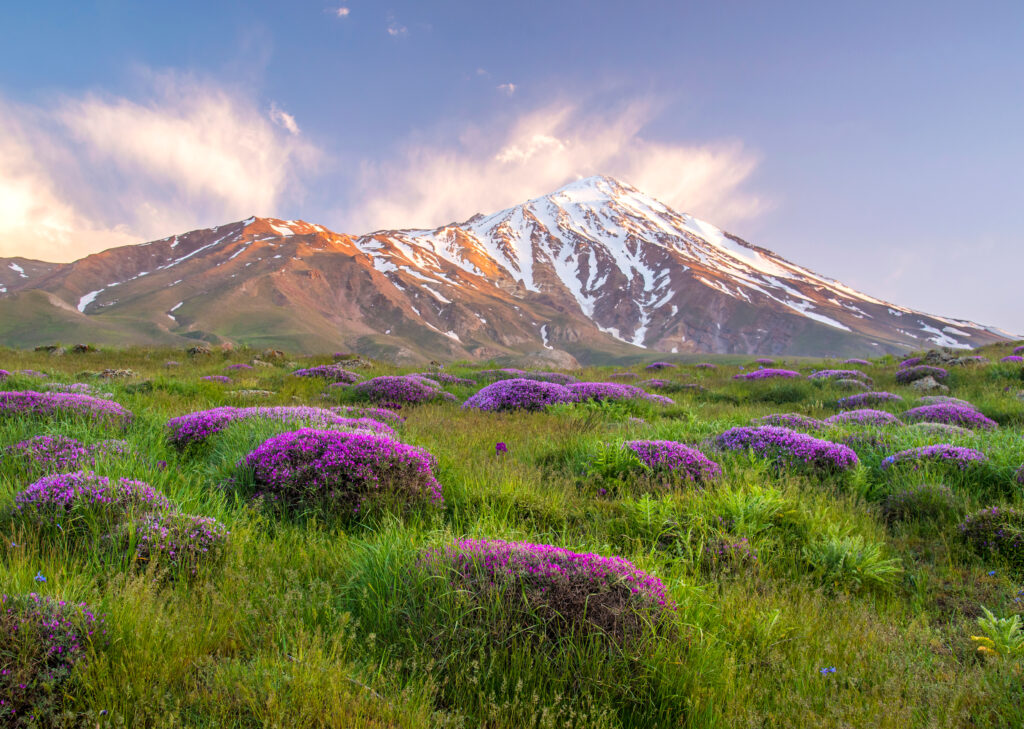
Majestic stratovolcano with 1.8 million-year geological history. Damavand is an extinct volcanic peak built up of alternate layers of lava and ash more than 1.8 million years ago. The mountain is part of the central Alborz Mountain Range approximately 70km northeast of Tehran and 70km south of the Caspian Sea. The volcanic geological history produces structurally distinctive landscape — sulfur deposits near the summit, hot springs at Larijan, and the classic stratovolcano cone shape visible from Tehran on clear days. The mountain’s location 70km from Tehran provides accessible commercial infrastructure framework.
Standard South Route — non-technical commercial framework. The Damavand South Route is the most popular and recommended path for international visitors — non-technical commercial framework accessible without professional or winter gear from mid-May through end of September. The standard four-camp framework:
- Camp 1 (Polour, ~2,200m) — first camp where climbing permits are obtained, Iran Mountaineering and Sport Climbing Federation authorized office
- Camp 2 (Goosfand-Sara / Saheb al-Zaman Mosque, 3,040m) — most accessible base camp with mountain refuge, mosque, and sheepfold facilities; primary base for South Route ascents
- Camp 3 (Bargah-e-Sevvom, ~4,200m) — high camp with old hut and new hut accommodations; staging for summit attempts
- Summit (5,671m) — Damavand summit with small crater for circumnavigation; views to Caspian Sea and Iran central desert
The non-technical South Route framework keeps commercial accessibility broad — climbers with general fitness and altitude tolerance preparation can ascend the mountain in 3-5 day standard commercial programs.
Volcanic Seven Summits framework membership. Damavand is the Asian objective in the Volcanic Seven Summits framework — the seven highest volcanoes on each continent. Many climbers building Volcanic Seven Summits portfolio combine Damavand with other volcanic objectives across multiple expeditions. The Asian highest volcano position produces structurally specific commercial framework demand from Volcanic Seven Summits aspirants regardless of broader Iran commercial framework constraints.
Mid-May through end of September primary climbing season. Damavand’s commercial climbing season runs mid-May through end of September with summer (June-August) offering most favorable conditions. The South Route is accessible without professional or winter gear during this period with very little snow on routes. October ascents are possible but face increasing weather variability and approaching winter conditions. Winter climbs (December-March) are possible but require professional winter mountaineering gear, advanced technical capability, and ski touring framework — many Iranian operators offer specialized winter ski mountaineering programs distinct from standard summer commercial trekking framework. Operators recommend starting climbs on Saturdays to avoid heavy traffic on the Haraz Road approach from Tehran.
Iran Mountaineering and Sport Climbing Federation framework. All foreign climbers must obtain a Damavand climbing permit ($50 USD per person) paid to the Iran Mountaineering and Sport Climbing Federation. The permit is obtained at Camp 1 Polour or pre-paid through commercial operators. The Federation issues climbing permits for any route in any season — South Route, West Route, North Route, Northeast Route. Iranian operators must be licensed by the Iranian Government — reputable operators maintain full government licensing framework. The Federation framework is structurally appropriate Iranian regulatory framework for Damavand commercial operations.
Cultural significance in Persian heritage. Damavand carries deep cultural significance for Iranian heritage — symbol of resistance and strength in Iranian Shahnameh epic poetry by Ferdowsi. The mountain is regarded as the throne of mythological figures including Zahhak (the Persian dragon king) imprisoned in Damavand by hero Fereydun. Damavand appears on Iranian banknotes and is considered the symbolic ceiling of Iran. International climbers should approach the mountain with appropriate cultural awareness of its institutional significance to Iranian heritage.
2026 Damavand Operator Awards
Four operators selected to represent the structural diversity of the Iranian-direct Damavand commercial operator field — established commercial framework leader, fixed-departure structured operator, broader Iran cultural integration operator, and longer-established multi-program licensed operator. Each delivers structurally distinct value for different client priorities within the Iranian commercial framework.
Damavand Adventures
Damavand Adventures delivers structurally distinctive commercial framework as one of the established Iranian commercial leaders for Mount Damavand operations. Founded by Ardeshir Soltani, a veteran Iranian mountain guide and trekking specialist with decades of experience leading expeditions on Mount Damavand and across the Alborz Range, the operator has guided countless international climbers to the summit and is renowned for its deep knowledge of Damavand’s routes, camps, and weather. The operator’s commercial framework spans summer hikes, winter climbs, and ski tours with comprehensive itinerary structure for both experienced climbers and beginners.
The 2026 commercial program portfolio includes: Damavand Economy Tour (€680 budget group tour, 3-day standard program Tehran-Camp 3-summit-descent); Standard 5-7 day commercial programs with full Tehran transfer, Camp 2 acclimatization, comprehensive logistics; Damavand Ski Touring specialized ski expeditions for experienced skiers combining mountaineering challenges with skiing on Iran’s highest peak; Customizable itineraries with additional acclimatization days or shorter schedules including Tehran sightseeing or Larijan Thermal Springs visit. The operator’s commercial framework primarily follows the Damavand South Route. For climbers prioritizing established Iranian commercial leadership with comprehensive program portfolio and decades of cumulative Mount Damavand operational expertise, Damavand Adventures delivers structurally specific value at accessible pricing.
Read Damavand Adventures profile →Mount Damavand Group
Mount Damavand Group (damavand.camp) delivers structurally distinctive commercial framework through 2026 fixed-departure tours framework — the operator released the 2026 Damavand Fixed-Departure Tours schedule in February 2026. The Rasoul team commercial framework includes streamlined trip services: mountain hut booking infrastructure, transportation services including off-road transfers between Camp 1 and Camp 2, pack animal arrangements for luggage transport to Camp 3, airport transfers, equipment provision, and visa application management to accelerate process and increase approval probability.
The operator maintains strong international climber community references from multiple nationalities — Russian, Polish, Italian, Mexican, German, and broader European climbing communities. Climber community testimonials consistently highlight Iranian hospitality framework, Rasoul family team professionalism, and successful summit experiences. The fixed-departure framework provides scheduling certainty for international climbers with rigid travel coordination — climbers can book confirmed departure dates rather than waiting for sufficient group size to confirm. Tour packages designed for individuals, tour agencies, and climbing clubs interested in long-term collaboration. For climbers prioritizing fixed-departure scheduling certainty with structurally distinctive Iranian commercial framework and strong international climber community reputation, Mount Damavand Group delivers structurally specific value.
Read Mount Damavand Group profile →IranAmaze
IranAmaze delivers structurally distinctive commercial framework through broader Iran cultural integration alongside the Mount Damavand climbing objective. The operator’s commercial framework explicitly accommodates American climbers through reliable Iranian tour operator visa coordination — handling complete visa process, providing Iranian SIM cards and credit cards (foreign cards don’t work due to sanctions), and planning entire itinerary from start to finish. Communication via email and WhatsApp works well throughout the commercial framework.
The operator’s structurally distinctive commercial portfolio includes: standalone Mount Damavand tours; Tochal & Damavand & Tehran 6-day combined framework for time-constrained climbers seeking Tehran cultural experience plus Damavand climb; broader Iran cultural tours combining Damavand climbing with Yazd, Shiraz, Persepolis, and Isfahan visits in 2-3 week programs. Tailor-made program coordination provides structural flexibility — operator creates acclimatization program based on physical preparedness and previous climbing experiences. All guides are certified with first aid training. For climbers prioritizing comprehensive Iran cultural experience integrated with Mount Damavand commercial climbing objective and structurally distinctive American-accessible commercial framework, IranAmaze delivers structurally appropriate fit.
Read IranAmaze profile →Damavand Guide (Arya Poonel Gasht)
Damavand Guide is the Incoming Tour Department of Arya Poonel Gasht Tour & Travel Company — a fully licensed Iran adventure tour operator registered with the Iranian Government with over 30 years of expertise in tourism. The operator delivers comprehensive Iranian commercial framework through Mount Damavand operations alongside broader Iran adventure portfolio (AlamKuh, Zagros mountains, desert tours, nomadic experiences). Founder Homayoun Rishehchi maintains strong international climber community reputation built over multiple decades.
The operator’s structurally distinctive value derives from longest-established Iranian commercial framework, full Iranian Government licensing, and broader Iranian adventure portfolio scope. Wide range of summer and winter Iran adventure tours in Mount Damavand, AlamKuh, and Zagros — various itineraries from 3 to 20 days including ski tours, trekking and climbing tours, and city excursion tours. Specialized expertise in Damavand ski tours alongside standard summer commercial framework. For climbers prioritizing longest-established Iranian commercial framework with full government licensing and broader Iranian adventure portfolio continuity (AlamKuh, Zagros, broader Iran cultural and adventure framework), Damavand Guide delivers structurally specific value through institutional Iranian commercial expertise.
Read Damavand Guide profile →2026 Damavand Cost Breakdown
Budget group tours (€680 / ~$750 USD)
Budget group tours through Iranian-direct operators (Damavand Adventures Economy Tour) typically run €680 per person for 3-day standard programs. The framework includes Tehran-Camp 3-summit-Tehran with Tehran transfer to base, trek to high camp (Camp 3 / tent overnight), summit ascent and return to high camp, and descent to base with drive back to Tehran starting point. Standard exclusions: transport to/from IKA Airport Tehran (separate cost), visa support / Iran Visa Authorization Code (typically additional), $50 USD climbing permit, Tehran hotel and city meals, medical/evacuation and trip insurance, personal equipment, porter and mule for extra gear, unscheduled mountain or Tehran nights. Total all-in budget after international travel and ancillary costs typically runs $1,500-$2,500.
Standard 5-7 day commercial programs (€1,200-€1,800)
Standard 5-7 day commercial programs through Iranian-direct operators typically run €1,200-€1,800 per person. The framework includes Tehran airport pickup and accommodation, Tehran-Camp 1 transfer, Camp 1 Polour visit and orientation, Camp 2 Goosfand-Sara acclimatization night, Camp 3 Bargah-e-Sevvom high camp, summit attempt with weather buffer, descent and Tehran return. Comprehensive service inclusions: Iranian guide service, accommodation framework, all meals during trek and climb, airport transfers, $50 USD climbing permit (typically included), Iran Visa Authorization Code coordination, group climbing equipment as needed. Total all-in budget typically runs $2,500-$4,000.
Premium fully-supported programs with cultural integration (€1,800-€2,500)
Premium fully-supported programs with broader Iran cultural integration typically run €1,800-€2,500 per person. The framework includes structured Mount Damavand commercial program plus Tehran cultural exploration, Larijan Thermal Springs visits, broader Iran cultural integration (Tochal-Damavand-Tehran combined frameworks, optional Yazd-Shiraz-Persepolis-Isfahan extensions). Suitable for climbers seeking comprehensive Iran experience integrated with Damavand climbing objective rather than standalone climbing-focused commercial framework. Total all-in budget typically runs $3,500-$5,500 depending on cultural integration scope.
Pricing context within Volcanic Seven Summits framework
Damavand pricing positioning within Volcanic Seven Summits commercial framework:
- Mount Giluwe (Oceania): $1,500-$3,500 (Papua New Guinea, 4,367m)
- Damavand (Asia): €680-€2,500 / ~$750-$2,800 (this comparison; 5,671m)
- Pico de Orizaba (North America): $200-$4,500 (Mexico, 5,636m — Wave 3)
- Mount Elbrus (Europe): $1,200-$5,500 (Russia, 5,642m — Wave 2)
- Mount Kilimanjaro (Africa): $2,000-$8,000 (Tanzania, 5,895m — Wave 1)
- Ojos del Salado (South America): $3,500-$8,500 (Chile/Argentina, 6,893m)
- Mount Sidley (Antarctica): $50,000+ (Antarctic logistics framework)
For climbers building Volcanic Seven Summits portfolio, Damavand delivers structurally accessible Asian objective at pricing comparable to Pico de Orizaba and Elbrus alternatives within the framework. The Iranian commercial framework operator pricing structure produces meaningful cost advantages for the high-altitude commercial framework.
Iran Mountaineering and Sport Climbing Federation permit framework
The Damavand climbing permit framework operates through the Iran Mountaineering and Sport Climbing Federation:
- Climbing permit fee: $50 USD per person for any route in any season
- Payment method: Cash payment to Federation representative at Camp 1 Polour, or pre-payment through commercial operator
- Permit validity: Single ascent attempt; additional attempts require new permit
- Authorized issuance: Mount Climbing Federation of Iran offices at Camp 1 Polour
- Operator coordination: Most commercial operators handle permit acquisition as part of program framework — verify whether permit fee is included or excluded in operator pricing during booking
The Federation permit framework is structurally appropriate Iranian regulatory framework for Damavand commercial operations — accessible pricing structure with clear payment framework.
Who Should Climb Damavand in 2026?
Strong fit — climbers building Volcanic Seven Summits portfolio
For climbers building Volcanic Seven Summits portfolio (the seven highest volcanoes on each continent), Damavand delivers structurally specific value as the Asian objective in the framework. The 5,671m elevation with non-technical commercial framework produces accessible commercial framework for the structurally required Asian volcanic peak alongside Kilimanjaro (Africa), Pico de Orizaba (North America), Elbrus (Europe), Ojos del Salado (South America), Mount Sidley (Antarctica), and Mount Giluwe (Oceania). The Iranian commercial framework provides accessible pricing structure for the framework objective.
Strong fit — climbers seeking high-altitude commercial framework with Iran cultural integration
For climbers seeking high-altitude commercial framework integrated with comprehensive Iran cultural experience, Damavand delivers structurally specific value through Iranian operator commercial framework that integrates Tehran exploration, Larijan Thermal Springs visits, and broader Iran cultural tours alongside the climbing objective. Iranian hospitality framework is structurally distinctive — international climbers consistently report exceptional welcome and naturally curious Iranian engagement. The Iran cultural integration framework matters for climbers prioritizing comprehensive cultural experience rather than purely climbing-focused commercial expedition.
Strong fit — value-conscious climbers prioritizing accessible commercial pricing
For value-conscious climbers prioritizing accessible high-altitude commercial framework, Damavand delivers structurally specific value at €680-€2,500 commercial pricing. The Iranian commercial framework delivers meaningful pricing advantage compared to international operator alternatives across other Volcanic Seven Summits objectives. Combined with the non-technical South Route framework, the value proposition supports climbers building high-altitude experience without commercial commitment exceeding subsequent international expedition investment.
Strong fit — UK, EU, Canadian, Australian climbers (fewer access restrictions)
For UK, EU, Canadian, Australian, and other non-American international climbers, Damavand commercial framework is structurally accessible with fewer access restrictions than American climbers face. Iranian visa framework for non-American international climbers typically operates through standard tourist visa application process with Iranian operator coordination — fewer structural restrictions than American climbers’ mandatory tour guide requirement. Most reputable Iranian operators welcome international climbers from multiple nationalities. Climbers should verify their home country travel advisory framework before booking.
Less optimal — American climbers without flexibility for tour operator framework
American climbers face structurally distinctive Damavand commercial framework due to US OFAC sanctions framework. Americans cannot apply for Iranian visa individually — must travel through reliable Iranian tour operator who handles visa application via authorization code framework, and are legally bound to travel with tour guide throughout Iran visit. Foreign credit cards do not work in Iran — operators must arrange Iranian credit/debit card framework. American climbers without flexibility for the structural tour operator framework requirements should evaluate alternative Volcanic Seven Summits Asian objective options or accept the mandatory tour operator framework. Verify current 2026 OFAC guidance before booking commitment as sanctions framework is subject to ongoing modification.
Less optimal — climbers requiring international operator booking infrastructure
For climbers requiring international operator booking infrastructure with English-language pre-trip preparation through US/UK commercial framework, integrated international travel coordination from US gateway cities, and familiar international operator commercial framework, Damavand is structurally constrained to Iranian-direct commercial framework due to US OFAC sanctions. International operators (American, European, NZ) face structural sanctions barriers to commercial Iran operations — the Iranian-direct commercial framework is the structural commercial foundation for Damavand operations. Climbers should accept the Iranian-direct framework requirement or consider alternative Volcanic Seven Summits objectives within international operator commercial framework.
Less optimal — first-time high-altitude climbers without prior altitude experience
Despite the non-technical South Route commercial framework, Damavand’s 5,671m elevation demands genuine altitude tolerance. Climbers without prior 4,000m+ altitude experience face physiological risk including HAPE and HACE — only 51% of sea-level oxygen at the summit. The standard 3-day Damavand commercial framework provides limited acclimatization — climbers should arrive with prior altitude experience or book extended 5-7 day program with Camp 2 acclimatization night for proper physiological adaptation. The compressed timeline framework matters structurally for climbers with limited altitude experience.
Less optimal — climbers requiring Western emergency response infrastructure standards
Iran’s emergency response infrastructure is structurally different from US/Western infrastructure. Helicopter evacuation coordination capacity for Damavand commercial expeditions operates within Iranian emergency response framework that may not match US/Western standards climbers expect from international expedition operators. Climbers should verify operator emergency response coordination, ensure mountaineering and travel insurance covers helicopter evacuation from remote area, and accept the structurally distinctive emergency response framework. The Iranian commercial framework requires structurally appropriate insurance and emergency planning preparation by climbers.
Frequently Asked Questions About Damavand Operators
How much does Damavand cost in 2026?
Damavand commercial expeditions in 2026 range €680-€2,500 (~$750-$2,800 USD) depending on operator structure and program scope. Budget group tours (Damavand Adventures Economy Tour) typically run €680 per person for 3-day standard programs (Tehran-Camp 3-summit-descent). Standard 5-7 day commercial programs typically run €1,200-€1,800 with full Tehran transfer, accommodation framework, acclimatization, and integrated Iran cultural component. Premium fully-supported programs with broader Iran cultural integration (Tochal-Damavand-Tehran combined frameworks) typically run €1,800-€2,500. The Iran Mountaineering and Sport Climbing Federation climbing permit fee ($50 USD) is paid separately at Camp 1 Polour and may be included or excluded in operator program pricing — verify directly during booking. Total all-in budget after international travel and ancillary costs typically runs $1,500-$5,500 depending on operator framework and cultural integration scope.
Can Americans climb Damavand in 2026?
Yes, Americans can climb Damavand in 2026 but face structurally distinctive access framework. Americans cannot apply for an Iranian visa individually — they must go through a reliable Iranian tour operator who handles the visa application process through the Iran visa authorization code framework. American travelers are legally bound to travel with a tour guide throughout their Iran visit. Foreign credit cards do not work in Iran due to US OFAC sanctions — operators provide Iranian SIM cards and can arrange Iranian credit/debit card framework for tourist financial coordination. Americans should verify current 2026 OFAC guidance before booking — the OFAC sanctions framework is subject to ongoing modification including recent General License W (May 2026) and Strait of Hormuz alerts. Most reputable Iranian operators (Damavand Adventures, Mount Damavand Group, IranAmaze, Damavand Guide) accept American climbers with appropriate visa coordination support.
What is the standard Damavand South Route commercial framework?
The Damavand South Route is the standard commercial framework — most popular and recommended path for international visitors. The route runs from Camp 1 Polour (~2,200m) where climbing permits are obtained, to Camp 2 Goosfand-Sara/Saheb al-Zaman Mosque (3,040m) — the most accessible base camp with mountain refuge, mosque, and sheepfold facilities. From Camp 2, climbers ascend to Camp 3 Bargah-e-Sevvom (~4,200m) for high camp before summit attempt to Damavand summit (5,671m). The standard 3-day program runs Tehran-Camp 3-summit-Tehran; 5-7 day programs include Camp 2 acclimatization night and longer staging. The South Route is non-technical for the standard summer commercial framework — accessible without professional or winter gear from mid-May through end of September with very little snow on routes.
When is the best time to climb Damavand?
Damavand’s primary commercial climbing season runs mid-May through end of September with summer (June-August) offering the most favorable conditions. The South Route is accessible without professional or winter gear during this period with very little snow on routes. October ascents are possible but face increasing weather variability and approaching winter conditions. Winter climbs (December-March) are possible but require professional winter mountaineering gear, advanced technical capability, and ski touring framework — many Iranian operators offer specialized winter ski mountaineering programs distinct from standard commercial trekking framework. Summer climbs are most popular and consequently most crowded. Operators recommend starting climbs on Saturdays to avoid heavy traffic on the Haraz Road approach from Tehran.
What is Iran’s commercial framework for Damavand permits and operations?
Iran’s commercial framework for Damavand is structured through the Iran Mountaineering and Sport Climbing Federation. All foreign climbers must obtain a climbing permit ($50 USD) paid to the Federation at Camp 1 Polour or through their commercial operator. The Federation issues climbing permits for any route in any season. Iranian operators must be licensed by the Iranian Government — reputable operators like Damavand Adventures, Mount Damavand Group, IranAmaze, and Damavand Guide (Arya Poonel Gasht) maintain full government licensing framework. Foreign climbers must obtain Iran visas through approved tour operator visa authorization code framework. Camp 2 Goosfand-Sara and Camp 3 Bargah-e-Sevvom have Iranian mountain refuge accommodations with basic facilities. Iran cultural integration is structurally important — Damavand is symbolic in Iranian Shahnameh epic poetry and appears on Iranian banknotes.
Why are international operators not on this list?
The Damavand commercial operator field is structurally constrained to Iranian-direct operators due to US OFAC sanctions framework affecting international commercial operations on Iran. International operators (American, European, NZ IFMGA) face structural sanctions barriers to commercial Iran operations — the OFAC sanctions framework prevents most international commercial operators from offering direct Damavand commercial programs. The Iranian-direct operator commercial framework (Damavand Adventures, Mount Damavand Group, IranAmaze, Damavand Guide) provides the structural commercial foundation for Damavand operations. International climbers must work directly with Iranian operators rather than through familiar international operator booking infrastructure. The 2026 sanctions framework is subject to ongoing modification — climbers should verify current OFAC guidance before booking commitment.
What is Damavand’s role in Volcanic Seven Summits framework?
Damavand is the Asian objective in the Volcanic Seven Summits framework — the seven highest volcanoes on each continent. The framework includes Damavand (Asia, 5,671m), Kilimanjaro (Africa, 5,895m), Pico de Orizaba (North America, 5,636m — Wave 3), Mount Elbrus (Europe, 5,642m — Wave 2), Ojos del Salado (South America, 6,893m), Mount Sidley (Antarctica, 4,285m), and Mount Giluwe (Oceania, 4,367m). For climbers building Volcanic Seven Summits portfolio, Damavand is the structural Asian objective — the highest volcano in Asia with non-technical commercial framework accessible through Iranian-direct operators. The Volcanic Seven Summits framework produces structurally specific commercial framework demand from aspirants regardless of broader Iran commercial framework constraints.
Damavand (5,671m / 18,606 ft) is Iran’s highest peak, the Middle East’s highest summit, and Asia’s highest volcano — a Volcanic Seven Summits framework member with structurally distinctive 2026 commercial framework constrained to Iranian-direct operators due to US OFAC sanctions affecting international commercial operations on Iran. For climbers prioritizing established Iranian commercial leadership, Damavand Adventures delivers structurally specific value through Ardeshir Soltani founder framework, decades of cumulative Mount Damavand operational expertise, comprehensive program portfolio (Economy Tour €680, standard 5-7 day commercial programs €1,200-€1,800, ski touring specialization, customizable Tehran sightseeing integration). For climbers prioritizing fixed-departure scheduling certainty, Mount Damavand Group delivers 2026 fixed-departure tours framework with Rasoul team commercial structure, streamlined trip services (mountain hut booking, off-road transfers, pack animal arrangements, visa application acceleration), and strong international climber community references from multiple nationalities. For climbers prioritizing broader Iran cultural integration, IranAmaze delivers structurally distinctive American-accessible commercial framework with Tochal-Damavand-Tehran combined programs and broader Iran cultural tour extensions (Yazd, Shiraz, Persepolis, Isfahan). For climbers prioritizing longest-established Iranian commercial framework, Damavand Guide / Arya Poonel Gasht delivers 30+ years tourism expertise with full Iranian Government licensing and broader Iranian adventure portfolio (AlamKuh, Zagros, broader Iran cultural and adventure framework). For Volcanic Seven Summits aspirants, Damavand delivers structurally accessible Asian objective at pricing comparable to Pico de Orizaba and Elbrus alternatives within the framework. The 2026 US OFAC sanctions framework structurally constrains the operator field to Iranian-direct commercial frameworks — verify current OFAC guidance before booking commitment. American climbers face mandatory tour operator framework requirement; UK, EU, Canadian, Australian climbers face fewer access restrictions but should verify home country travel advisory framework. Iran cultural integration is structurally important — Damavand carries deep cultural significance in Iranian heritage (Shahnameh epic poetry, Iranian banknotes, Persian dragon king Zahhak mythology). Verify current 2026 pricing, OFAC guidance, Iran Mountaineering Federation permit framework, and specific program inclusions directly with operators.
Sources and Verification
This comparison was built from publicly available information about Iranian commercial Damavand operators, US OFAC Iran sanctions framework documentation, Iran Mountaineering and Sport Climbing Federation regulatory framework, and standard Damavand reference material. Pricing should be verified directly with operators before booking. The 2026 US OFAC sanctions framework is subject to ongoing modification — verify current guidance close to departure dates. Next scheduled review: September 2026.
- Damavand Adventures — Established Iranian commercial leader with Ardeshir Soltani founder framework.
- Mount Damavand Group — Fixed-departure structured commercial framework documentation.
- IranAmaze — Broader Iran cultural integration with American-accessible framework.
- Damavand Guide (Arya Poonel Gasht) — Longest-established multi-program Iranian licensed operator.
- US OFAC Iran Sanctions — Official OFAC sanctions framework reference.
Fact-checked April 29, 2026 · Next scheduled review: September 2026
Damavand and Volcanic Seven Summits Operator Resources
Damavand: Asia’s Highest Volcano
Damavand delivers structurally specific value as the Asian objective in the Volcanic Seven Summits framework. Combine with Pico de Orizaba (North America), Elbrus (Europe), and Kilimanjaro (Africa) for comprehensive Volcanic Seven Summits commercial portfolio progression.