
Last updated September 15, 2026
Climbing Khan Tengri 2026: The Marble Pyramid of the Tien Shan, the South Inylchek Route & Central Asia’s Most Beautiful Peak
At 7,010 meters, Khan Tengri rises as one of the world’s most aesthetically stunning peaks — a perfect marble pyramid that glows blood-red at sunrise and sunset. Located on the Kyrgyzstan-Kazakhstan border in the Central Tien Shan, the mountain is among the most demanding 7,000m peaks accessible to commercial expeditions. The classic South Inylchek classic route, the technical North Face Solomatov line, the Snow Leopard award context — the complete 2026 climbing guide.
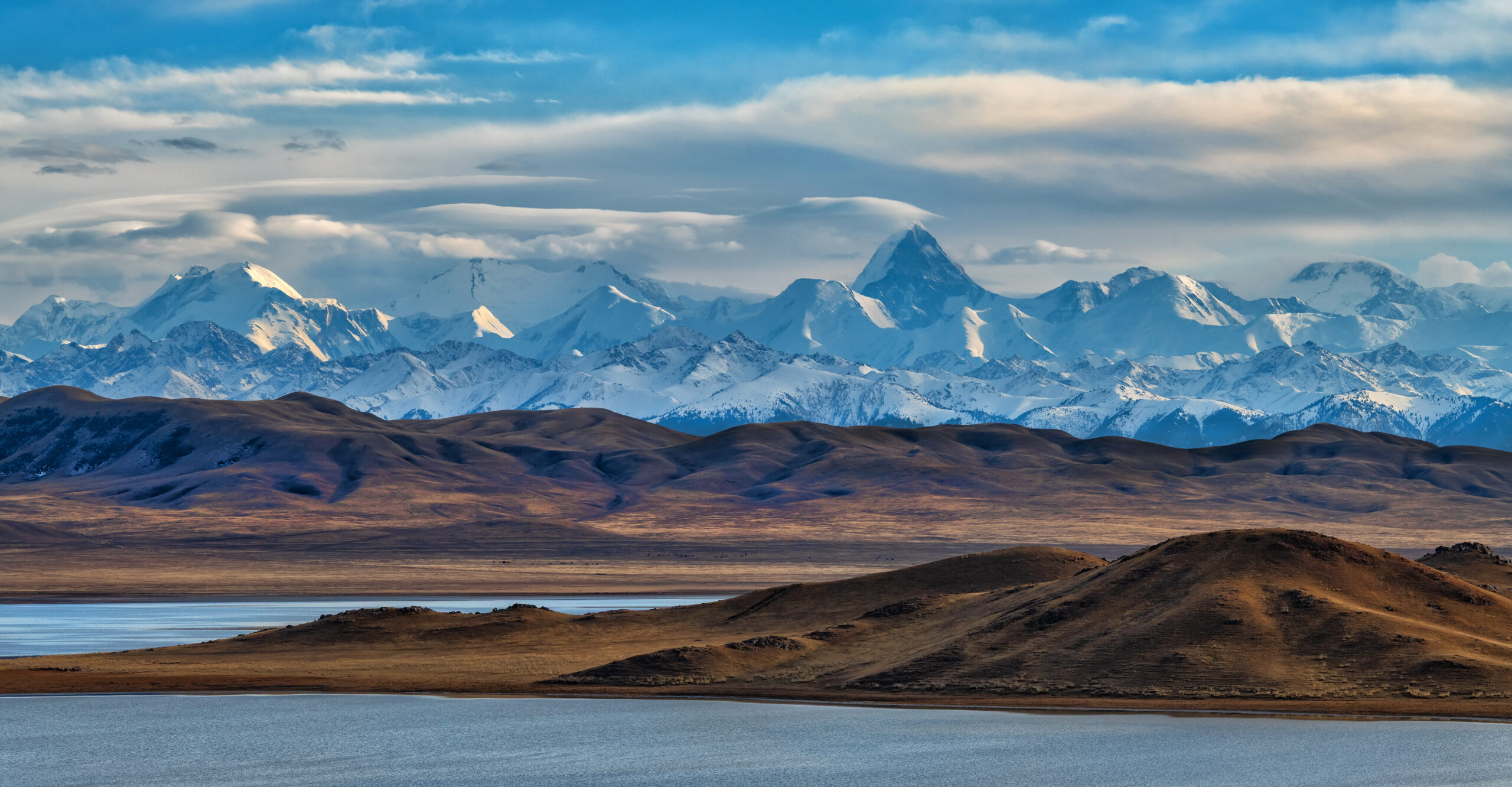
Khan Tengri occupies a singular position in world mountaineering. The peak isn’t the tallest in the Tien Shan — that distinction belongs to Pobeda Peak (Jengish Chokusu) at 7,439m, 429 meters taller. It isn’t even widely known outside Central Asian mountaineering circles — Khan Tengri rarely appears on commercial Western expedition itineraries despite its 7,000m elevation. What Khan Tengri holds, uniquely, is reputation as one of the most aesthetically perfect mountains on Earth. The near-perfect marble pyramid was described by climbing legend Anatoli Boukreev as “perhaps the world’s most beautiful peak.” The mountain’s distinctive pink limestone summit glows blood-red at sunrise and sunset. This phenomenon gave rise to the local Kyrgyz name “Kan-Tau” — blood mountain.
The mountain stands at the heart of the Central Tien Shan range, on the border between Kyrgyzstan and Kazakhstan very near the Chinese border. The peak sits at the head of the South Inylchek and North Inylchek glaciers — among the longest non-polar glaciers on Earth. The Tien Shan range as a whole stretches approximately 2,500 km across Central Asia, with the central portion containing the range’s highest peaks. Khan Tengri rises with extraordinary symmetry from the surrounding glaciated terrain. From the south, the mountain presents the iconic pyramid shape visible from base camp. From the north, the dramatic north face creates one of the most photographed mountain walls in Central Asia.
The climbing itself sets Khan Tengri apart from peer 7,000m objectives. The standard South Inylchek route is rated Russian Grade 5B — equivalent to Alpine D, UIAA IV/V. This makes it one of the most technically demanding 7,000m peaks accessible to commercial expeditions. The North Face Solomatov route, first climbed in 1974 by a Russian team led by Boris Solomatov, is even more demanding. Both routes feature sustained technical climbing on mixed terrain. Long sections of fixed ropes and complex glacier navigation are demanding. Objectively dangerous icefalls add hazards. The brief alpine climbing season is unique to the Central Tien Shan’s continental climate. Many climbers consider Khan Tengri harder than Pobeda Peak’s higher elevation suggests, with the technical demands exceeding what’s typical for 7,000m peaks of comparable height.

This guide covers what you need to climb Khan Tengri in 2026. The South Inylchek classic route in detail. The North Face Solomatov alternative for advanced climbers. The Snow Leopard award context (one of five 7,000m peaks in the former USSR that earns the Soviet/Russian “Snow Leopard” honor). Helicopter access from Karkara airfield. Costs, gear specifications, and operator pricing in USD. And honest assessment of who should attempt this peak. Despite its modest 7,010m elevation compared to Himalayan giants, Khan Tengri demands more technical climbing competence than first-time visitors typically realize. The Central Tien Shan’s remote setting adds genuine commitment.
Khan Tengri At a Glance
The essential reference facts for Khan Tengri. Detailed sections follow below.
| Summit elevation | 7,010 m / 23,000 ft (glacial cap measurement) |
|---|---|
| Rock summit | 6,995 m / 22,949 ft (additional 15m is glacial ice cap) |
| Location | Border of Kyrgyzstan and Kazakhstan, very near Chinese border |
| Coordinates | 42.2089°N, 80.1747°E |
| Mountain range | Central Tien Shan |
| Tien Shan ranking | 2nd highest after Pobeda Peak / Jengish Chokusu (7,439 m) |
| Unique distinction | Among the most beautiful mountains in the world; described by Anatoli Boukreev as perhaps the world’s most beautiful peak |
| Name origin | “Khan Tengri” — Lord of the Sky (Mongolian) |
| Local Kyrgyz name | Kan-Tau — Blood Mountain (for the way marble glows red at sunrise/sunset) |
| Distinctive feature | Perfect marble pyramid shape with pink limestone summit |
| Snow Leopard status | One of five 7,000m+ peaks in former USSR; climbing all five earns the prestigious Snow Leopard award |
| First ascent | 1931 — Ukrainian team led by Mikhail Pogrebetsky (via south side) |
| First north ascent | 1964 — via Kazakhstan north side |
| First solo speed ascent | 1990 — Anatoli Boukreev |
| First documented sighting | 1856 — Russian explorer Piotr Semenov |
| Russian climbing grade | 5B on standard South Inylchek route (Alpine D, UIAA IV/V) |
| Standard route | South Inylchek classic route from Kyrgyzstan side |
| Alternative routes | North Face Solomatov route (1974) from Kazakhstan side |
| Base camp access | Helicopter from Karkara airfield to South Inylchek BC (4,000m) or North Inylchek BC |
| Expedition duration | 25-32 days from Almaty or Bishkek |
| Best season | Late June to mid-August (peak window July to early August) |
| 2026 guided cost | $3,500-$8,500 USD depending on operator tier |
| Mandatory insurance | Mountaineering insurance with minimum $30,000 coverage required |
| Gateway cities | Almaty (Kazakhstan) or Bishkek (Kyrgyzstan) |
Why Khan Tengri is called “perhaps the world’s most beautiful peak”. Anatoli Boukreev — the legendary Kazakh-Russian mountaineer who completed the first solo speed ascent of Khan Tengri in 1990 — described the mountain as perhaps the world’s most beautiful peak. The description captures something genuine about Khan Tengri’s character. The mountain presents near-perfect geometric symmetry — a marble pyramid rising with extraordinary regularity from surrounding glaciated terrain. The summit’s pink limestone composition creates the famous “blood mountain” effect at sunrise and sunset when the marble glows red-orange in alpenglow. The mountain dominates its surroundings visually because no nearby peaks compete with its dramatic profile. Russian explorer Piotr Semenov, in his 1856 first documented sighting, described “a giant snow-white pointed pyramid rising above a magnificent mountain range.” That reputation has only strengthened across nearly two centuries of engagement. For climbers who value mountain aesthetics alongside technical challenge, Khan Tengri delivers something genuinely rare in world mountaineering.
Why Khan Tengri Matters in World Mountaineering
Khan Tengri holds a precise position in world climbing culture that few other peaks match. The mountain combines four distinguishing elements. First, extraordinary aesthetic beauty as a near-perfect marble pyramid. Second, serious technical demands that exceed many higher Himalayan peaks. Third, iconic position in Soviet/Russian alpinism as a Snow Leopard peak. Finally, access to one of the most remote and dramatic mountain ranges on Earth. For climbers seeking peaks that combine genuine technical challenge with profound aesthetic and cultural depth, Khan Tengri delivers something distinctive.
The Aesthetic Singular
Few mountains on Earth match Khan Tengri for sheer aesthetic perfection. The peak rises as a near-perfect geometric pyramid with extraordinary symmetry. Its pink limestone (marble) composition creates the famous “blood mountain” effect during alpenglow. The mountain dominates its surroundings completely — no competing peaks share its visual space. Climbers describe seeing Khan Tengri for the first time as a singular experience in their mountaineering careers. Russian explorer Piotr Semenov’s 1856 description of “a giant snow-white pointed pyramid” captured the impression that has endured across nearly two centuries. For climbers who value aesthetic experience as a meaningful component of mountaineering, Khan Tengri stands apart.
One of the Hardest Accessible 7,000m Peaks
Khan Tengri’s Russian Grade 5B (Alpine D, UIAA IV/V) places the mountain among the most technically demanding 7,000m peaks accessible to commercial expeditions. Many experienced climbers consider Khan Tengri harder than Pobeda Peak (Jengish Chokusu) despite the latter’s 429-meter elevation advantage. The technical demands include sustained ice and mixed climbing, long sections of fixed ropes on demanding terrain, complex glaciation, and objectively dangerous icefalls and avalanche-prone slopes. The climbing style draws on the Soviet/Russian alpine tradition rather than the fixed-rope Himalayan ascent pattern. Climbers building toward harder objectives find Khan Tengri provides ideal preparation that exceeds what easier 7,000m peaks deliver.
The Snow Leopard Award Tradition
The Snow Leopard (Снежный барс / Snezhny bars) is the prestigious mountaineering award given to climbers who have summited all five 7,000m+ peaks in the former Soviet Union. The five peaks include Khan Tengri (7,010m, Kyrgyzstan/Kazakhstan) and Pobeda Peak / Jengish Chokusu (7,439m, Kyrgyzstan/China). Ibn Sina Peak / Lenin Peak is 7,134m (Kyrgyzstan/Tajikistan). Communism Peak / Ismoil Somoni reaches 7,495m (Tajikistan). Finally, Korzhenevskaya Peak is 7,105m (Tajikistan). The award was established by Soviet alpine authorities in the late 1960s. Khan Tengri is widely considered the most aesthetic Snow Leopard objective and one of the most technically demanding. Climbers pursuing the Snow Leopard typically save Khan Tengri or Pobeda Peak for last because of their combined technical and altitude demands.
The Central Tien Shan Setting
The Central Tien Shan ranks among the most remote and dramatic mountain regions on Earth. The range extends approximately 2,500 km across Central Asia. However, the central portion containing Khan Tengri is uniquely concentrated. The world’s longest non-polar glaciers — South Inylchek at over 60 km — flow from the area. The region sits at the geographic crossroads of Russia, China, Kazakhstan, Kyrgyzstan, and historic Silk Road trade routes. Most of the area remains genuinely wild with limited infrastructure. Climbers approaching Khan Tengri experience a setting that few other 7,000m peak destinations match for sheer remoteness and cultural complexity.
The marble that glows red at sunset. Khan Tengri’s distinctive pink color comes from the mountain’s geological composition. The peak is composed of pink limestone (often described as marble) that takes on dramatic color variations under different lighting conditions. At sunrise and sunset, the pink rock catches the low-angle sunlight and glows red-orange — appearing to bleed against the surrounding white snow and ice. This phenomenon gave rise to the local Kyrgyz name “Kan-Tau” — blood mountain. The effect is most dramatic on clear evenings during the July-August climbing season when the sun’s low angle creates extended alpenglow periods. Climbers at South Inylchek base camp regularly photograph the mountain during these moments. The marble composition combined with the geometric pyramid shape and the alpenglow phenomenon together create what many describe as the most photogenic mountain face in Central Asia.
Who Should Climb Khan Tengri?
Khan Tengri sits in a specific position in high-altitude mountaineering progression. The peak is more technically demanding than most commercial 7,000m peaks but doesn’t reach the difficulty of harder 8,000m objectives. Honest pre-trip self-assessment matters considerably here, particularly regarding technical ice climbing competence and high-altitude experience.
Khan Tengri Is Appropriate For:
Climbers with prior 6,000-7,000m experience. Climbers who’ve completed peaks like Aconcagua (6,961m), Denali (6,190m), Mera Peak (6,476m), or Island Peak (6,189m) have the altitude foundation. Khan Tengri’s altitude demands are considerable but achievable for properly acclimatized climbers.
Climbers with technical ice climbing skills. The South Inylchek route demands genuine ice climbing competence — fixed-rope ascent on mixed terrain isn’t the only requirement. Climbers comfortable with WI3-WI4 ice climbing have the technical foundation.
Snow Leopard pursuers. For climbers building toward the Snow Leopard award (five 7,000m+ peaks in the former USSR), Khan Tengri is one of the five required summits. The peak is often climbed third or fourth in the progression, after the more accessible Lenin Peak and Korzhenevskaya Peak.
Climbers building toward 8,000m peaks. Khan Tengri serves as ideal preparation for major Himalayan objectives. The combination of altitude, technical demands, expedition rhythm, and continental climate exposure all transfer directly to Himalayan climbing.
Climbers seeking Russian/Soviet alpinism exposure. For climbers wanting insight into Russian climbing culture or familiarity with Soviet-style expedition logistics, Khan Tengri provides ideal experience. The expedition rhythm, base camp culture, and technical style all reflect the broader Russian alpine tradition.
Patient expedition climbers. The 25-32 day expedition duration combined with weather window uncertainty rewards patience. Climbers committed to the full expedition experience benefit from the time spent in the Central Tien Shan setting.
Khan Tengri Is Not Appropriate For:
First-time high-altitude climbers. Khan Tengri isn’t a first 7,000m peak in most cases. Build experience on Aconcagua, Denali, or easier 7,000m peaks (Mera Peak doesn’t qualify as preparation for Khan Tengri’s technical demands).
Climbers without technical ice climbing experience. The South Inylchek route’s sustained ice and mixed climbing exceeds what pure fixed-rope ascent style supports. Build ice climbing skills before attempting Khan Tengri.
Climbers expecting Western-style logistics. Central Asian operators provide professional services but the cultural and logistical patterns differ from Western Himalayan operations. Climbers wanting polished commercial mountaineering should look at Himalayan options.
Climbers on rigid schedules. The brief July-August climbing season combined with weather window uncertainty makes rigid scheduling impractical. The helicopter access also depends on weather conditions and may delay arrival or departure.
Solo climbers. The technical demands, objective hazards, and remote setting make solo Khan Tengri attempts genuinely dangerous. Most parties operate in teams of 4-6 with operator-provided guides and Sherpa-equivalent support.
Where Khan Tengri Fits in Your High-Altitude Progression
| Stage | Peak / Experience | Elevation | What it builds |
|---|---|---|---|
| Foundation | Mount Elbrus, Kilimanjaro | 5,642-5,895m | Altitude exposure; multi-day rhythm; basic crampon use |
| First major expedition | Aconcagua or Denali | 6,190-6,961m | Extended expedition; technical kit; cold-weather camping |
| Nepal trekking peaks | Mera Peak, Island Peak | 6,189-6,476m | Himalayan logistics; altitude tolerance build |
| Mid-Tien Shan / Pamir entry | Ibn Sina (Lenin) Peak | 7,134m | First 7,000m peak; Russian/Soviet style expedition; standard route |
| The Khan Tengri step | Khan Tengri via South Inylchek | 7,010m | Technical ice climbing at altitude; harder than Lenin Peak’s height suggests |
| Snow Leopard progression | Korzhenevskaya, Communism Peak | 7,105-7,495m | Continued Pamir objectives; Snow Leopard completion |
| Pobeda Peak (hardest) | Jengish Chokusu | 7,439m | Final Snow Leopard peak; one of hardest 7,000m peaks accessible |
| Beyond Snow Leopard | Cho Oyu, Manaslu, Himalayan 8,000m peaks | 8,000m+ | Where Khan Tengri’s lessons apply at extreme altitude |
The Standard Routes Up Khan Tengri
Two principal route lines exist on Khan Tengri. The South Inylchek classic route from Kyrgyzstan handles approximately 70% of climbers. The North Face Solomatov route from Kazakhstan provides a more technical alternative. A third option — climbing both routes in alpine style — is reserved for elite parties.
| Route | Side | Russian Grade | Alpine equivalent | Usage |
|---|---|---|---|---|
| South Inylchek Classic (Standard) | South (Kyrgyzstan) | 5B | Alpine D, UIAA IV/V | ~70% of climbers |
| North Face Solomatov Route | North (Kazakhstan) | 5B | Alpine D-TD, UIAA V | ~25% of climbers |
| Alpine-style variations | Various faces | 5B-6A | Alpine TD+ | Elite parties only |
Route 1: South Inylchek Classic (Standard — 70% of climbers)
The South Inylchek classic route is the standard climbing line on Khan Tengri, used by approximately 70% of summit-bound parties. The route ascends from South Inylchek Base Camp (4,000m) via four progressive camps: Camp 1 at 4,200m, Camp 2 at 5,300m, Camp 3 at 5,900m, and Camp 4 at 6,400m. Summit day climbs from Camp 4 to the summit at 7,010m and returns to a lower camp. The route was first climbed in 1931 by a Ukrainian team led by Mikhail Pogrebetsky, becoming the standard route for subsequent ascents.
The Full Expedition Progression (Standard 28-Day Itinerary)
- Days 1-3 — Arrival and preparation: Arrive Bishkek or Almaty. Hotel night, briefing, gear check, last-minute provisions. Some operators include cultural sightseeing in Bishkek or Almaty.
- Days 4-5 — Transfer to Karkara: Drive from Bishkek or Almaty to Karkara airfield. Border zone formalities. Wait for helicopter weather window.
- Day 6 — Helicopter to South Inylchek Base Camp (4,000m): 40-60 minute helicopter flight from Karkara across the spectacular Central Tien Shan to South Inylchek base camp on the glacier. Establish base camp infrastructure.
- Days 7-10 — Base camp acclimatization: Multiple acclimatization hikes around base camp area. Practice rope work, fixed-rope technique, and crevasse rescue. Gear preparation for upper mountain.
- Days 11-13 — First rotation to Camp 1 (4,200m): Move to Camp 1. Acclimatization night. Touch Camp 2, return to Camp 1 or base camp. Initial altitude adjustment.
- Days 14-17 — Second rotation to Camp 2 (5,300m): Push to Camp 2 with fixed-rope sections. Acclimatization at Camp 2. Touch Camp 3, return to lower camps. Significant altitude exposure.
- Days 18-22 — Third rotation to Camp 3 (5,900m): Higher rotation to Camp 3 with continued technical climbing. Sleep at Camp 3 for full acclimatization. Touch Camp 4 area if conditions permit. Return to base camp for full recovery.
- Days 23-25 — Summit window waiting: Return to base camp. Monitor weather forecasts. Wait for stable summit window — typically 2-4 day windows during peak season. Final gear preparation.
- Day 26 — Move to Camp 2: Begin summit push. Single day to Camp 2.
- Day 27 — Move to Camp 4 (6,400m): Push through Camp 3 to Camp 4 high camp. Demanding altitude gain. Rest at Camp 4 for summit attempt.
- Day 28 — SUMMIT DAY: Pre-dawn departure from Camp 4. Sustained technical climbing through fixed-rope sections to the summit at 7,010m. 8-12 hours total summit day. Stunning views of the Central Tien Shan, Pobeda Peak, and across to the Chinese border. Descent to Camp 4 or lower.
- Days 29-30 — Descent to base camp: Reverse the route through camps. Pack equipment.
- Day 31 — Helicopter to Karkara: Weather-dependent helicopter flight back. Drive to Bishkek/Almaty.
- Day 32 — Departure: International flights home. Total expedition: 25-32 days depending on weather.
Strengths
- Iconic South Inylchek base camp setting
- Helicopter access bypasses long approach
- Most established route with reliable logistics
- Classic Russian/Soviet expedition rhythm
- Approached from Kyrgyzstan side
- Strong commercial guide support available
Considerations
- Sustained technical climbing demanding
- Helicopter weather can delay arrival/departure
- Brief July-August climbing season
- Objective hazards from icefalls real
- Mandatory mountain insurance required
- Russian-language environment for many ops
Route 2: North Face Solomatov Route (Advanced — 25% of climbers)
The North Face Solomatov route ascends Khan Tengri from the Kazakhstan side via the dramatic north face. The route was first climbed in 1964, with the modern Solomatov line established in 1974 by a Russian team led by Boris Solomatov. The route joins the west ridge to the summit at the col between Khan Tengri and Chappaev Peak (6,371m). The climbing demands more technical content than the South Inylchek classic route. Three high camps versus four on the south side reflect the more direct vertical line. The North Face route is often considered the more aesthetic line by experienced alpinists, providing a more direct climbing experience. Helicopter access is from Karkara to North Inylchek base camp. Adventure Alternative and similar operators favor this route for technically experienced clients.
Route 3: Alpine-Style Variations (Elite Only)
Khan Tengri has seen multiple elite alpine-style ascents that bypass the standard expedition rhythm. The most famous is Anatoli Boukreev’s 1990 solo speed ascent — completed in remarkable time without supplementary oxygen and in lightweight style. Various other parties have climbed harder lines on the north and south faces in pure alpine style. These ascents demand genuine elite alpine competence — sustained technical climbing at extreme altitude without expedition support. Commercial guiding doesn’t operate on alpine-style variations. The Boukreev legacy continues influencing modern alpine attempts on Khan Tengri, with the mountain remaining a venue for serious lightweight alpinism.
Khan Tengri Climbing History: From 1856 to 2026
The Central Tien Shan region has been home to Turkic peoples — primarily Kyrgyz and Kazakhs — for many centuries. Khan Tengri held significance in regional traditions long before European contact. The local Kyrgyz name “Kan-Tau” (blood mountain) reflects centuries of observation of the mountain’s distinctive red glow at sunrise and sunset. The Mongolian name “Khan Tengri” (Lord of the Sky) became dominant during the Mongol era when Central Asia was under Mongol political influence. Both names persist in modern usage, reflecting the layered cultural heritage of the region.
Russian explorer and geographer Piotr Semenov made the first documented European sighting of Khan Tengri during his 1856 exploration of the Central Tien Shan. Semenov described “a giant snow-white pointed pyramid rising above a magnificent mountain range.” The description captured the impression Khan Tengri makes on first sight. It has endured across subsequent decades. Semenov later earned the honorary surname “Tian-Shanskii” (of the Tien Shan) for his pioneering exploration of the region. His expedition established Khan Tengri’s place in European geographic awareness of Central Asia.
Through the late 19th and early 20th centuries, Russian and German geographic and scientific expeditions surveyed the Central Tien Shan region. The expeditions established basic geography of the area but didn’t successfully climb Khan Tengri. The mountain’s height was variously measured during this era, with some early estimates significantly different from modern measurements. The Russian Revolution and World War I disrupted further exploration, with serious climbing attempts delayed until the Soviet era stabilized.
The first ascent of Khan Tengri was completed in September 1931 by a Ukrainian Soviet expedition led by Mikhail Pogrebetsky. The team climbed from the south side via what became the South Inylchek classic route. The achievement was significant — Khan Tengri was widely considered impossible to climb due to its technical demands and remote setting. The 1931 expedition established the basic route line still used by most modern parties. The success contributed to growing Soviet alpinism that would shape Central Asian mountaineering throughout the 20th century.
Through the Soviet era, Khan Tengri became firmly established as a major Soviet alpine objective. The Soviet alpine federation organized regular expeditions to the mountain. Soviet climbers developed extensive route knowledge, established multiple camps, and refined the technical approach. The Tomsk Bivouac and other infrastructure supported expeditions. Soviet alpinism reached its high point during this era with Khan Tengri among the most prestigious objectives. Western climbers had no access to the mountain during the Cold War — a situation that persisted until the 1990s.
The first ascent of Khan Tengri from the north (Kazakhstan side) was completed in 1964 by a Soviet team. The achievement opened the dramatic north face to climbing and established the second major route line on the mountain. The north side ascent required different logistical patterns from the south side approach, with helicopter access eventually becoming the standard method for North Inylchek base camp. The 1964 achievement extended Khan Tengri’s appeal across both sides of the international border.
Soviet alpine authorities established the Snow Leopard (Снежный барс) award in the late 1960s — given to climbers who summited all five 7,000m+ peaks in the former Soviet Union. The five peaks include Khan Tengri (7,010m), Pobeda Peak / Jengish Chokusu (7,439m), Ibn Sina / Lenin Peak (7,134m), Communism Peak / Ismoil Somoni (7,495m), and Korzhenevskaya Peak (7,105m). The award became one of the most prestigious in Soviet/Russian alpinism. Khan Tengri’s position as one of the most technically demanding Snow Leopard peaks gave it particular significance in the award’s pursuit.
The modern Solomatov route on Khan Tengri’s north face was established in 1974 by a Russian team led by Boris Solomatov. The route became one of the standard lines for north-side ascents, joining the west ridge to the summit at the col between Khan Tengri and Chappaev Peak. The Solomatov route’s modest 1974 establishment came late in Soviet alpinism’s development. However, the line remains relevant today. Modern operators including Adventure Alternative use the route for technically experienced clients seeking the more direct northern approach.
Kazakh-Russian mountaineer Anatoli Boukreev completed the first solo speed ascent of Khan Tengri in 1990 — a remarkable achievement that established the mountain’s place in modern alpine speed climbing. Boukreev’s ascent demonstrated the mountain could be climbed in lightweight style without expedition support. Boukreev later gained international fame for his 1996 Mount Everest rescues during the disaster that inspired Jon Krakauer’s “Into Thin Air.” His description of Khan Tengri as “perhaps the world’s most beautiful peak” continues shaping its reputation. Boukreev tragically died on Annapurna in 1997.
The collapse of the Soviet Union in 1991 fundamentally changed Khan Tengri access. The newly independent Kyrgyzstan and Kazakhstan opened to international tourism. Western climbers began visiting the mountain for the first time. Russian and Soviet operators evolved into Central Asian commercial guiding services. Annual ascent numbers grew dramatically as helicopter access and improved logistics made the mountain accessible to international clients. The 1990s established the modern commercial era of Khan Tengri climbing.
The 2000s and 2010s saw Khan Tengri become firmly established as a major commercial climbing destination. Multiple operators (ClimberCA, Central Asia Travel, Pamir Travel, Adventure Alternative) ran annual programs through July and August. Helicopter access from Karkara became standardized. Annual summit numbers grew into the hundreds. The Snow Leopard award gained increased international recognition. Khan Tengri became one of the most accessible 7,000m peaks for climbers seeking alternatives to Himalayan objectives.
The COVID-19 pandemic shut down most Khan Tengri climbing in 2020. Kazakhstan and Kyrgyzstan closed to international tourism for most of the year. The 2021 and 2022 climbing seasons operated with reduced expedition numbers and additional health protocols. Some expeditions ran but at significantly reduced scale. Recovery began through 2023 as international travel patterns normalized and operator infrastructure rebuilt.
The 2023-2025 seasons saw return to pre-pandemic Khan Tengri activity levels. ClimberCA International Consortium and other major operators announced 2026 programs with multiple fixed departure dates throughout July and August. Helicopter access from Karkara continues to operate reliably. International climbing interest in Khan Tengri continues growing, particularly among Snow Leopard pursuers and climbers seeking technical 7,000m experience. The 2026 climbing season is currently active with the late June through mid-August window. Mountain insurance requirements have standardized at $30,000 minimum coverage. The mountain continues serving its role as one of Central Asia’s most demanding and beautiful objectives.
The Snow Leopard Award: Khan Tengri’s Soviet Climbing Tradition
Khan Tengri occupies a specific position in the Snow Leopard (Snezhny bars). This prestigious Soviet/Russian mountaineering award goes to climbers who summit all five 7,000m+ peaks in the former Soviet Union. Understanding the Snow Leopard context shapes how serious climbers approach Khan Tengri within broader Russian alpinism.
The Five Snow Leopard Peaks
| Peak | Elevation | Country | Difficulty |
|---|---|---|---|
| Pobeda Peak / Jengish Chokusu | 7,439 m | Kyrgyzstan / China border | Hardest Snow Leopard peak (Russian 5B-6A) |
| Communism Peak / Ismoil Somoni | 7,495 m | Tajikistan | Highest Snow Leopard peak (Russian 5A-5B) |
| Khan Tengri | 7,010 m | Kyrgyzstan / Kazakhstan border | Technically demanding (Russian 5B) |
| Korzhenevskaya Peak | 7,105 m | Tajikistan | Moderate (Russian 5A) |
| Ibn Sina / Lenin Peak | 7,134 m | Kyrgyzstan / Tajikistan border | Easiest Snow Leopard peak (Russian 5A) |
Standard Snow Leopard Progression
Most climbers pursuing the Snow Leopard spread the achievement over multiple seasons. The typical progression starts with Lenin Peak (easiest), followed by Korzhenevskaya Peak (moderate technical demands, often combined with Communism Peak in the same season via shared Pamir base camp). Khan Tengri typically comes third or fourth — saved for after climbers have established their 7,000m experience but before the hardest objective. Pobeda Peak (Jengish Chokusu) is universally saved for last — the peak’s combination of altitude, weather exposure, and technical demands makes it the climax of the Snow Leopard pursuit.
Combined Khan Tengri + Pobeda Peak Season
Some climbers attempt both Khan Tengri and Pobeda Peak in the same July-August climbing season, taking advantage of shared helicopter logistics from Karkara to the same Inylchek base camps. The combination represents an extraordinarily demanding objective — two of the most technically challenging Snow Leopard peaks completed in a single 45-60 day expedition. Operators including ClimberCA offer combined programs. Most climbers find the combined attempt deeply demanding, with success on both peaks rare even for experienced parties. The achievement is significant in modern Snow Leopard pursuit.
The Snow Leopard award continues evolving. The Snow Leopard award originated during the Soviet era when all five 7,000m+ peaks of the former USSR were within a single country. Following Soviet dissolution in 1991, the five peaks span four different post-Soviet states (Kyrgyzstan, Kazakhstan, Tajikistan, and arguably China for Pobeda Peak’s eastern slopes). Modern Snow Leopard awards continue being recognized by the Russian Alpine Federation and various successor organizations. Some climbers also pursue extended versions of the achievement — adding Muztagh Ata (7,546m) in Xinjiang, China, despite not being technically part of the former USSR. The award represents one of the most prestigious recognitions in Russian/Central Asian alpinism, with completed climbers receiving formal certificates and badges from Russian alpine authorities.
Khan Tengri Summit Day Timeline: Hour-by-Hour from Camp 4
Summit day on Khan Tengri typically runs 8-14 hours round trip from Camp 4 (6,400m) to the summit at 7,010m and back. Strong, well-acclimatized teams complete the round trip in 9-11 hours. Slower parties may take 13-15 hours. The combination of technical fixed-rope sections, sustained ice climbing, altitude, and the route’s complexity makes this a demanding summit day.
Standard Khan Tengri Summit Day — Camp 4 (6,400m) to Summit (7,010m) and Return
The South Inylchek glacier crevasses demand attention on approach and descent. The approach to Khan Tengri from South Inylchek base camp involves significant glacier travel with crevasse hazards. The icefalls between camps present objective dangers from serac collapse and snow bridge weakening. Most expeditions schedule glacier travel during the coldest morning hours when snow bridges are most stable. Roped travel is mandatory throughout the glacier sections. The Mensu Glacier and South Inylchek Glacier areas have historically been the site of crevasse accidents on the mountain. Proper rope team configuration and crevasse rescue competence are non-negotiable. Climbers without recent crevasse rescue practice should refresh skills before attempting the route.
Which Khan Tengri Approach Fits Your Situation?
The choice on Khan Tengri involves route selection, operator tier, and timing considerations. Use this matrix to match yourself.
Match Yourself to a Khan Tengri Approach
When to Climb Khan Tengri: Season-by-Season Analysis
Late June to Mid-August: Climbing Season
The Khan Tengri climbing season runs from late June through mid-August. July and early August represent the peak window with the most stable weather and reliable helicopter access. The brief season reflects the Central Tien Shan’s high latitude and continental climate — the mountain experiences extreme winter conditions from September through May. ClimberCA International announces typical 2026 departure dates throughout July and August: July 7, 13, 18-21, 25-27 and August 1-4, 8-10, 15-16, 19, 22-24.
Mid-July to Early August: Peak Window
The optimal Khan Tengri climbing window. Weather is most stable during this period. The continental climate creates relatively predictable patterns despite the mountain’s extreme exposure. Helicopter operations from Karkara run reliably. Base camp infrastructure operates at full capacity. Most commercial expeditions schedule departures during this window. Climbers should expect crowded base camp conditions during peak weeks.
August: Late Season Considerations
August brings increasing precipitation and storm activity in the Central Tien Shan. Afternoon weather changes become more frequent. Despite the increasing instability, many operators continue running programs through mid-August. Climbers attempting late August dates accept somewhat elevated weather risk in exchange for fewer crowded base camp conditions.
September-May: Off-Season
The off-season brings extreme conditions to Khan Tengri. Winter snow accumulates significantly. Temperatures plummet to extreme cold. Helicopter access becomes unreliable or unavailable. Most operators don’t operate during this period. Climbers attempting winter Khan Tengri have committed to genuinely extreme conditions far beyond the summer route’s already serious nature.
Climbing Khan Tengri in 2026: Cost Breakdown
Khan Tengri expeditions offer reasonable value among major 7,000m peak destinations. Central Asian operator pricing combined with the helicopter access bypassing long approaches keeps total costs notably lower than comparable Himalayan objectives.
2026 Guided Expedition Pricing
| Operator Tier | 2026 Cost (USD) | What’s Included |
|---|---|---|
| Central Asian operator (basic) | $3,500-$5,000 per person | Local guide, base camp services, helicopter transfer; ClimberCA, Central Asia Travel tier |
| Central Asian operator (full package) | $5,000-$7,500 per person | IFMGA-certified guides, comprehensive logistics, complete equipment support, integrated services |
| International operator program | $6,500-$9,500 per person | Adventure Alternative, Adventure Consultants tier; English-speaking guides, smaller team ratios |
| Private 1:1 or 1:2 guiding | $10,000-$15,000 per person | Custom dates, dedicated guide attention, flexible itinerary |
| Combined Khan Tengri + Pobeda Peak | $8,500-$14,000 per person | 45-60 day combined program; both peaks in same season; shared helicopter logistics |
2026 Total Trip Budget Breakdown
| Cost Component | 2026 Amount (USD) | Notes |
|---|---|---|
| Guided expedition (mid-tier) | $4,500-$6,000 | Standard 25-32 day program from Almaty/Bishkek |
| International flights to Almaty/Bishkek | $800-$2,000 | Variable by departure city; Turkish Airlines, Aeroflot, others |
| Helicopter transfer (Karkara to base camp) | $1,200-$2,000 | Round trip; major cost component; weather-dependent |
| Almaty/Bishkek hotel pre/post | $60-$150/night | 2-3 nights typical |
| Mandatory mountain insurance | $200-$500 | Minimum $30,000 coverage required by operators; specialty mountain insurance providers |
| Kyrgyz visa (if required) | $0-$80 | Many nationalities visa-free or simple e-visa |
| Kazakh visa (if required) | $0-$80 | Many nationalities visa-free |
| Border zone permit | $0-$50 | Typically handled by operator; included in package |
| Personal climbing gear (if buying) | $0-$2,500 | Double boots, crampons, ice axe, harness, technical clothing, sleeping system |
| Russian climbing gear rental | $100-$300 | Most operators offer rental options for major equipment |
| Tips for guides and helicopter crew | $200-$400 | Customary in Central Asian climbing |
| Meals and incidentals | $200-$500 | Restaurant meals in Almaty/Bishkek, snacks, drinks |
| Realistic 2026 trip budget | $6,500-$13,000 | Including international flights and full preparation |
Khan Tengri value vs other 7,000m peaks. Khan Tengri offers strong value compared to other major 7,000m peak objectives. Himalayan 7,000m peaks like Pumori, Ama Dablam, or comparable objectives typically cost $15,000-$30,000 for guided programs. Pamir 7,000m peaks (Lenin Peak, Korzhenevskaya, Communism Peak) cost $1,500-$4,500 each but are technically easier than Khan Tengri. Khan Tengri sits in the middle range — significantly more affordable than Himalayan technical objectives while offering harder climbing than most easier Pamir peaks. For climbers wanting Russian/Central Asian alpine experience at considerable technical difficulty, Khan Tengri provides excellent value. The trade-offs include the brief climbing season, helicopter dependency for access, and the technical demands that prevent it from serving as a first 7,000m peak.
Gear Checklist for Khan Tengri
Khan Tengri gear requirements emphasize technical ice climbing equipment combined with full 7,000m-altitude expedition kit. The Central Tien Shan’s continental climate creates extreme cold conditions that demand serious cold-weather kit. The Russian alpine climbing style means more technical equipment than typical fixed-rope Himalayan ascents require.
Technical Climbing Gear
- Double mountaineering boots (7,000m capability) — La Sportiva G2 SM, Scarpa Phantom 6000, or similar; warm enough for -30°C at high camps
- Crampons (12-point technical) — Petzl Sarken, Grivel G14, or similar — see our Crampons Buyer’s Guide
- Ice tools (two technical) — for sustained ice climbing on the route — see our Ice Axe Guide
- Climbing harness (alpine) — adjustable for layers
- Helmet — required throughout expedition
- Ascenders (jumars) — essential for fixed-rope sections
- Locking carabiners (6-8)
- Non-locking carabiners (4-6)
- Ice screws (3-4 of various lengths)
- Belay/rappel device
- Prusik cord (3m) — for crevasse rescue backup
- Slings/runners (2-3)
Clothing System (Extreme Cold)
- Heavy expedition down parka — primary insulation; -30°C rating; for high camps and summit day
- Heavy down pants
- Synthetic insulated jacket — for active climbing
- Hardshell jacket (Gore-Tex Pro) — storm protection essential
- Hardshell pants — required throughout expedition
- Heavyweight base layers (top and bottom) — 2-3 sets
- Midweight base layers — 2 sets
- Heavy fleece mid-layer
- Soft shell pants — for warmer days at base camp
- Balaclava (multiple)
- Heavy down mittens — for summit conditions
- Heavy gloves (multiple pairs)
- Light gloves — for active work
- Warm hat / beanie
- Neck gaiter / buff
- Glacier glasses (Cat 4) plus backup pair
- Goggles (storm-rated)
Camp & Sleep Equipment
- Expedition tent (provided by operator typically)
- Sleeping bag rated to -30°C — for high camps
- Sleeping bag liner
- Two sleeping pads (one closed-cell, one inflatable) — R-value 4+ combined
- Snow shovel (if not provided)
- Insulated water bottles (2L)
- Thermos for hot drinks
Safety & Communication
- Avalanche beacon — for glacier travel sections
- Probe and shovel
- Personal first aid kit
- Diamox / acetazolamide — for altitude prophylaxis
- Dexamethasone (emergency) — for HACE emergency
- Nifedipine (emergency) — for HAPE emergency
- Headlamps with spare batteries — multiple lights per person
- Sunscreen SPF 50+ and lip balm with SPF — glacier UV reflection severe
- Mountain insurance documentation — minimum $30,000 coverage required
- Visa documentation
- Personal locator beacon (PLB) or satellite communicator
Backpack & Personal
- Expedition backpack 70-80L — for transport to base camp
- Summit pack 30-40L — for summit day from Camp 4
- Personal toiletries
- Cash (USD plus Kyrgyz som or Kazakh tenge)
- Passport with appropriate visas
- Travel insurance documentation
Frequently Asked Questions About Climbing Khan Tengri
How tall is Khan Tengri and where is it located?
Khan Tengri rises to 7,010 meters (23,000 feet) by glacial summit measurement on the border between Kyrgyzstan and Kazakhstan, very near the Chinese border in the Central Tien Shan mountain range. Some sources cite the rock summit at 6,995 m, with the additional 15 meters accounting for the glacial ice cap. The peak is the second-highest summit in the Tien Shan range after Pobeda Peak. Khan Tengri sits at the head of the South Inylchek and North Inylchek glaciers — among the longest glaciers in Central Asia. The name “Khan Tengri” means “Lord of the Sky” in Mongolian. Local Kyrgyz people call it “Kan-Tau” meaning “blood mountain” for the way the marble glows red at sunrise and sunset.
How difficult is climbing Khan Tengri?
Khan Tengri is rated Russian Grade 5B (Alpine D, UIAA IV/V) — making it one of the most technically demanding 7,000m peaks accessible to commercial expeditions. Many climbers consider Khan Tengri harder than Pobeda Peak’s higher elevation suggests, with sustained technical ice and mixed climbing on both standard routes. The South Inylchek classic route requires climbing through technical ice sections, navigating crevasse-laden glaciers, and ascending sustained fixed-rope sections at altitude. The climbing involves long sections of fixed ropes on mixed terrain, sustained exposure, complex glaciation, objectively dangerous icefalls, and rapidly changing weather. Total expedition duration is 25-32 days.
What’s the standard route up Khan Tengri?
Khan Tengri has two principal routes — the South Inylchek classic route from Kyrgyzstan and the North Face Solomatov route from Kazakhstan. The South Inylchek route (classic) ascends from South Inylchek Base Camp (4,000m) via four progressive camps. These include Camp 1 at 4,200m, Camp 2 at 5,300m, Camp 3 at 5,900m, and Camp 4 at 6,400m. Summit day reaches 7,010m. The North Face Solomatov route (1974 first ascent) climbs the dramatic north face from North Inylchek Base Camp. The route joins the west ridge to the summit at the col between Khan Tengri and Chappaev Peak. Both routes require helicopter access from Karkara airfield. Standard expedition duration is 25-32 days.
When is the best time to climb Khan Tengri?
The Khan Tengri climbing season runs from late June through mid-August, with the optimal window being mid-July through early August. The narrow season reflects the Central Tien Shan’s high latitude and continental climate. Most commercial expeditions schedule departure dates throughout July and early August: typical 2026 departures include July 7, 13, 18-21, 25-27 and August 1-4, 8-10, 15-16, 19, 22-24. The climbing window is shorter than for Himalayan 7,000m peaks. Weather is most stable in July, with August bringing increasing precipitation. Helicopter access to base camps operates only during the climbing season.
How much does climbing Khan Tengri cost in 2026?
Guided Khan Tengri expeditions in 2026 typically cost between $3,500 and $8,500 USD per person for the standard 25-32 day program from Almaty or Bishkek. Central Asian operators offer expeditions from $3,500-$5,500 with full logistics, Russian/Kyrgyz IFMGA-certified guides, helicopter access, and base camp services. International operators charge $6,500-$9,500 with smaller team ratios. The helicopter transfer from Karkara to base camp is a major cost component — typically $1,200-$2,000 per climber round trip. International flights to Almaty or Bishkek add $800-$2,000. Mandatory mountain insurance with minimum $30,000 coverage is required.
What’s the Snow Leopard award?
The Snow Leopard (Snezhny bars) is the prestigious Soviet/Russian mountaineering award given to climbers who have summited all five 7,000m+ peaks in the former Soviet Union. The five peaks include Khan Tengri (7,010m, Kyrgyzstan/Kazakhstan) and Pobeda Peak / Jengish Chokusu (7,439m, Kyrgyzstan/China). Ibn Sina / Lenin Peak is 7,134m (Kyrgyzstan/Tajikistan). Communism Peak / Ismoil Somoni reaches 7,495m (Tajikistan). Finally, Korzhenevskaya Peak is 7,105m (Tajikistan). The award was established by Soviet alpine authorities in the late 1960s and continues being recognized today by Russian and Central Asian alpine federations. Khan Tengri is widely considered the most aesthetic Snow Leopard objective and one of the most technically demanding.
Why is Khan Tengri called the “blood mountain”?
Khan Tengri’s local Kyrgyz name “Kan-Tau” means “blood mountain” — referring to the dramatic way the peak’s pink marble summit glows red-orange at sunrise and sunset. The mountain is composed of pink limestone (often described as marble) that catches low-angle sunlight during alpenglow, creating an effect that appears to bleed against the surrounding white snow. The phenomenon is most dramatic on clear evenings during the July-August climbing season. The “Lord of the Sky” name (Khan Tengri in Mongolian) became dominant during the Mongol era, but the older Kyrgyz “blood mountain” name persists in local usage. Climbers at South Inylchek base camp regularly photograph the mountain during these moments.
How does Khan Tengri compare to Lenin Peak?
Khan Tengri (7,010m) and Lenin Peak (7,134m, also called Ibn Sina Peak) are both Snow Leopard peaks but offer dramatically different climbing experiences. Lenin Peak is significantly more accessible — Russian Grade 5A, non-technical fixed-rope ascent style, lower cost ($1,500-$3,000), and considered one of the easier 7,000m peaks in the world. Khan Tengri is Russian Grade 5B with sustained technical ice climbing, helicopter access required, higher cost ($3,500-$8,500), and considered one of the harder 7,000m peaks. Most climbers attempt Lenin Peak before Khan Tengri. For Snow Leopard progression, Lenin Peak typically comes first, then Korzhenevskaya, then Khan Tengri or Pobeda Peak last.
Who was Anatoli Boukreev and what’s his Khan Tengri connection?
Anatoli Boukreev (1958-1997) was a legendary Kazakh-Russian mountaineer who made the first solo speed ascent of Khan Tengri in 1990. The achievement established the mountain’s place in modern alpine speed climbing. Boukreev’s description of Khan Tengri as “perhaps the world’s most beautiful peak” continues to shape the mountain’s reputation. Boukreev later gained international fame for his 1996 Mount Everest rescues during the disaster that inspired Jon Krakauer’s “Into Thin Air.” His 1997 book “The Climb” provided his perspective on those events. Boukreev died on Annapurna in December 1997 — but his legacy in Tien Shan and Pamir climbing remains considerable. Khan Tengri remains one of his signature mountain associations.
Do I need a visa to climb Khan Tengri?
Visa requirements depend on your nationality and which country you enter through. Both Kazakhstan and Kyrgyzstan offer visa-free entry for many nationalities. This includes most EU, US, UK, Canadian, Australian, and other Western passport holders. Stays under 30-90 days depending on country. Both countries have streamlined e-visa systems for nationalities requiring visas. Khan Tengri’s border zone location near the Chinese border may require additional border zone permits handled by your operator. Most operators include border zone permit processing in their package. International flights typically route through Istanbul, Frankfurt, or Moscow to Almaty or Bishkek. Verify current visa requirements with your operator and respective embassies before booking.
Khan Tengri Planning Resources
Sources & Further Reading
- ClimberCA International Consortium — Khan Tengri Peak Expedition 2026 program and pricing
- Central Asia Travel — Khan Tengri Peak expedition from north and south sides
- Adventure Alternative — Climb Khan Tengri 2026/27 program details
- Mountaineering Asia — Khan-Tengri Peak North Side Expedition (7010 m)
- Pamir Travel — Khan Tengri climbing routes and historical information
- Wikipedia — Khan Tengri reference for elevation, geography, and climbing history
- Wikipedia — Snow Leopard mountaineering award documentation
- Anatoli Boukreev — 1990 solo speed ascent records and “The Climb” autobiography
- Mikhail Pogrebetsky — 1931 first ascent expedition documentation
- Boris Solomatov — 1974 North Face route establishment
- Piotr Semenov-Tian-Shanskii — 1856 first European sighting documentation
- Russian Alpine Federation — Snow Leopard award records and certifications
Last updated: May 24, 2026. Next scheduled update: March 2027 (pre-season verification of operator pricing, helicopter access status, and 2027 departure dates).
Planning a Central Asian Expedition?
Khan Tengri is one of the most aesthetic and technically demanding 7,000m peaks accessible to commercial expeditions. Ideal for climbers building toward harder Himalayan objectives or pursuing the Snow Leopard award. See our complete mountain guides for the broader Russian and Central Asian climbing picture.
View All Mountain Guides →Was this helpful?
🏔Related peaks nearby
🧭Explore & compare
Global Summit Guide is an independent mountaineering resource founded in 2026. The team combines first-hand trekking and climbing experience with in-depth research and professional health and nutrition review to help climbers choose objectives, prepare properly, and stay safe.
Health, altitude, and nutrition content is reviewed by Taylor Ludlow (Registered Nurse) and Brigg Hoopes (Nutritionist).
What We Don't Know Yet
Mountain information changes quickly. This box explains the limits of what this page can responsibly promise.
- Route conditions, trailhead access, crevasse exposure, stream crossings, and rescue access may vary from published planning guidance.
- Visa, passport, vaccination, border, insurance, and local transportation rules may change before your trip.
- Route conditions, snowpack, closures, and weather can change quickly after this page is updated.
- Permit rules, fees, quotas, and reservation windows may change between review cycles.
- Operator availability, pricing, guide ratios, and cancellation terms can change by season.
Verify current conditions with official land managers, guide services, local forecasts, and current route reports before booking or climbing.
Mountaineering, rock and ice climbing, glacier travel, and high-altitude activity are inherently dangerous and can result in serious injury or death. The information on Global Summit Guide is provided for general informational and educational purposes only and is not a substitute for professional instruction, qualified guiding, proper equipment, or your own judgment and experience.
Route conditions, weather, snowpack, permits, regulations, and hazards change constantly and may differ from what is described here. Details may be incomplete, out of date, or contain errors. Always verify current information with local authorities, certified guides, and official sources before making any decision in the mountains.
Nothing on this site is medical, legal, or financial advice. Our fitness, acclimatization, altitude, and nutrition content is general in nature; consult a qualified physician before beginning any strenuous exercise program or exposing yourself to high altitude.
You are solely responsible for your own safety and decisions. To the fullest extent permitted by law, Global Summit Guide and its team accept no liability for any loss, injury, damage, or expense arising from use of, or reliance on, this information. By using this site you acknowledge these risks and accept these terms.
Some links on this site may be affiliate links. If you buy through them we may earn a small commission at no extra cost to you; this never affects our recommendations.
Global Summit Guide recommendation path
Next Best Mountain to Research
Use these recommendations to continue the right planning path instead of stopping on one page.
Use current permit, weather, route, and operator information before booking or climbing.
Explore Travel Options for Your Destination
Once your mountain, dates and route are taking shape, compare flights, hotels and other travel options that fit the trip.
Affiliate link. We may earn a commission at no additional cost to you.