
Last updated September 7, 2026
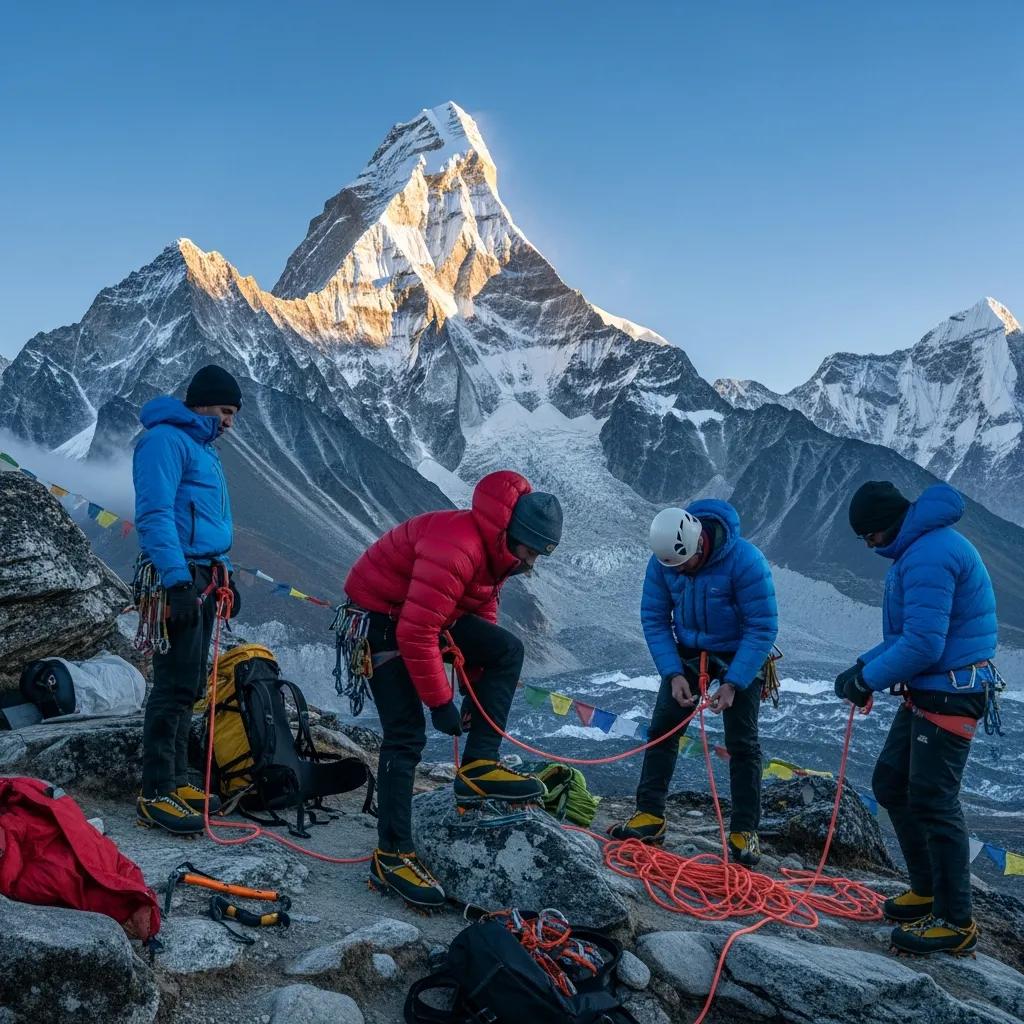
What to Climb Before Ama Dablam: The Best Progression Peaks
Choose your pre-Ama Dablam climbs by the skills you still need to prove. Island Peak is a strong first choice for fixed-line systems, Lobuche East adds steeper and more exposed technical terrain, and Mera Peak tests altitude endurance near 6,500 m. You do not need all three if equivalent fixed-line, alpine and 6,000-meter experience is already part of your résumé.
What Should You Climb Before Ama Dablam?
For a climber building Himalayan technical experience from the ground up, a strong sequence is Island Peak → Lobuche East → Mera Peak → Ama Dablam. Each peak fills a different gap.
Island Peak is useful for fixed-line systems, crampons and a first technical summit above 6,000 m. Lobuche East adds steeper snow and ice, more exposed ridge movement and a larger technical step. Mera Peak is less technical, but at 6,476 m it is a valuable test of acclimatization, pacing and long summit-day performance.
That sequence is not mandatory. Current Ama Dablam operators do not require one universal list of Nepal peaks. They look for capabilities: technical alpine climbing, steep fixed-rope movement, crampons and axe, exposure tolerance, and prior performance around 6,000 m.
If those capabilities are already proven on climbs elsewhere, choose only the precursor that fills the remaining gap.
The Ama Dablam Readiness Pillars
The best precursor is the mountain that proves one of these categories without introducing all four at once.
Move Efficiently on Rope Systems
Ascender use, clipping, anchor transitions, equipment organization and controlled descent should feel routine in gloves and poor light.
Climb Rock, Snow & Ice
Crampons on mixed ground, steep snow, exposed ridge movement and hands-and-feet climbing matter more than simply reaching a high summit.
Function Around 6,000 m+
Eating, drinking, pacing, sleeping and organizing gear need to keep working when altitude and recovery make simple tasks slower.
Keep Technique Under Fatigue
The real test is whether clean rope and movement systems survive a long technical day at altitude rather than falling apart when tired.
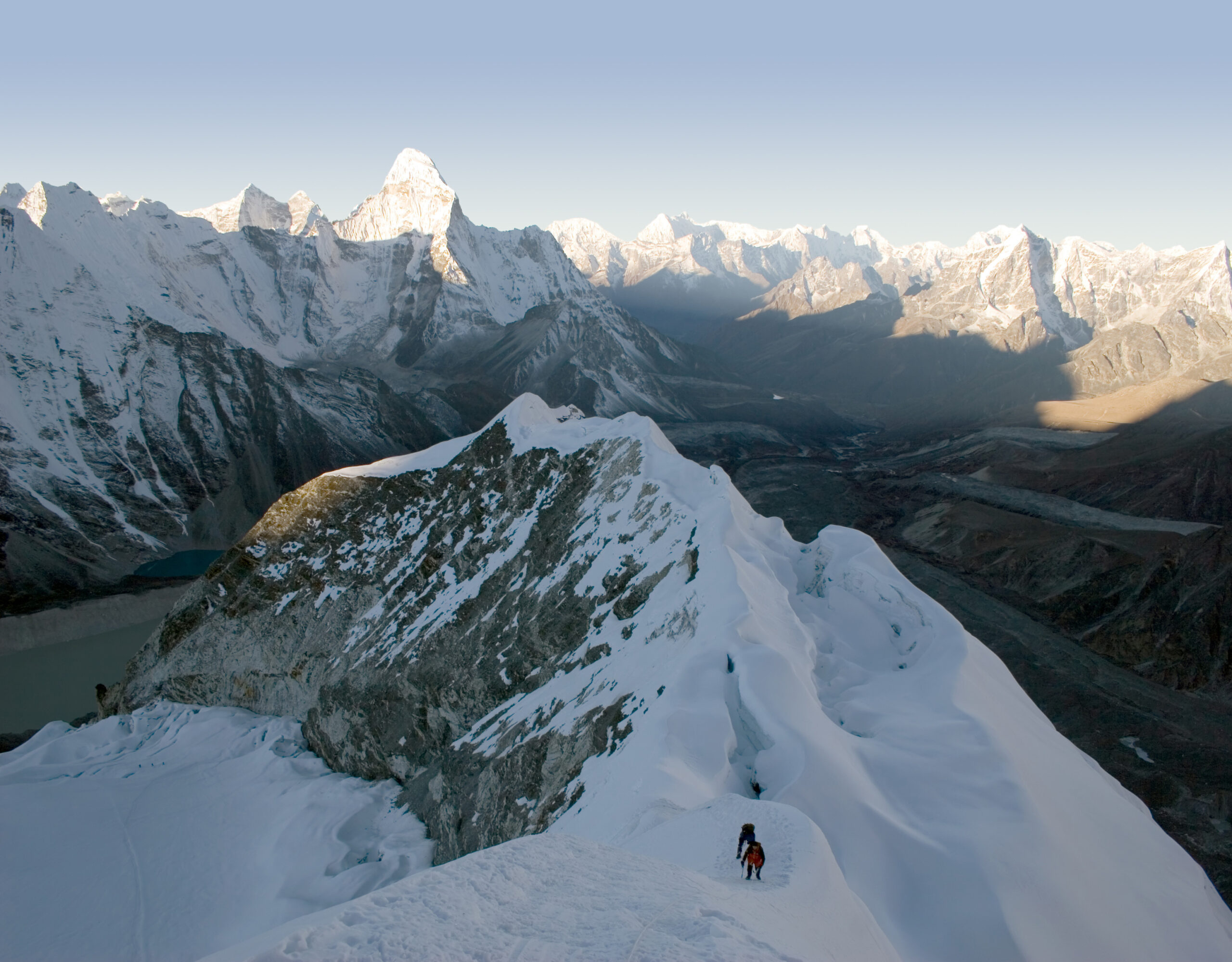
The Right Precursor Makes One Part of Ama Dablam Less New.
Altitude, fixed lines, mixed climbing, exposure and expedition systems should not all arrive for the first time on the Southwest Ridge. Good progression removes one category of novelty after another.
Island Peak → Lobuche East → Mera Peak → Ama Dablam
This is one logical progression for climbers starting with limited technical Himalayan experience—not a compulsory checklist.
Island Peak
6,189 m. Useful for first Himalayan crampon travel, glacier rhythm, fixed-line ascent and descent, and summit-day work above 6,000 m.
Leaves behind: sustained mixed terrain and major ridge exposure.
Island Peak guide →Lobuche East
6,119 m. Adds steeper snow and ice, more technical fixed-rope movement and an exposed summit-ridge environment.
Leaves behind: Ama Dablam’s sustained commitment and higher technical camps.
Lobuche East guide →Mera Peak
6,476 m. Less technical than the preceding step, but valuable for long summit-day pacing, acclimatization and functioning near 6,500 m.
Leaves behind: exposed technical ridge climbing and sustained fixed-line work.
Mera Peak guide →Ama Dablam
6,812 m. Combines technical rock, snow and ice, fixed ropes, exposure, high camps and altitude into one much more committing objective.
Requires: the preceding systems or credible equivalents to already be familiar.
Ama Dablam guide →How the Progression Peaks Prepare You
| Mountain | Fixed-line systems | Technical terrain | Altitude test | Exposure | Primary value |
|---|---|---|---|---|---|
| Island Peak | Good introduction | Moderate step | 6,189 m | Limited to moderate | First technical Himalayan systems |
| Lobuche East | Useful practice | Steeper snow/ice + more technical movement | 6,119 m | More exposed summit ridge | Technical confidence + exposure |
| Mera Peak | Limited/basic | Primarily snow/glacier | 6,476 m | Lower | Altitude endurance + acclimatization proof |
| Ama Dablam | Fluent systems required | Sustained rock/snow/ice/mixed terrain | 6,812 m | High | Combines every category |
You May Not Need All Three Peaks
Progression should close gaps, not create a mountain-collecting requirement.
Strong Trekker, Little Technical Climbing
Best next step: Island Peak. Convert altitude fitness into crampon travel, glacier systems and fixed-line movement above 6,000 m.
Fixed-Line Basics, Weak on Exposure
Best next step: Lobuche East or an equivalent alpine climb. Build steeper movement, ridge exposure and clean rope technique where the terrain feels consequential.
Technically Strong, Limited Altitude
Best next step: Mera Peak or another well-acclimatized 6,000 m+ objective. Test whether your systems remain reliable near Ama Dablam’s altitude band.
Strong Technical + 6,000 m Background
Ama Dablam may be the next step. Your guide should still review recent technical climbing, altitude performance, fitness and fixed-line efficiency.
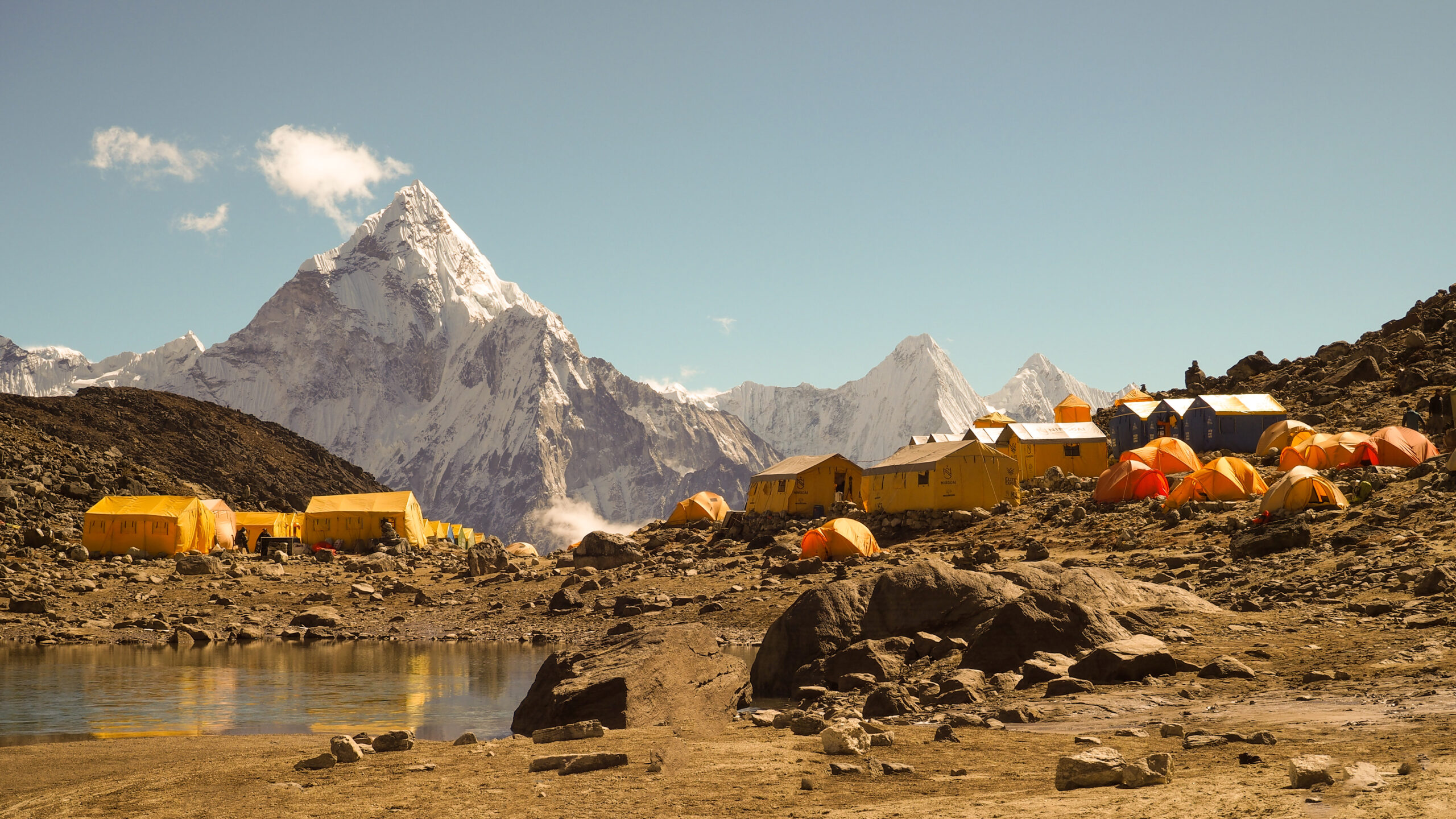
Ama Dablam Preparation Is More Than Climbing Technique.
Cold equipment management, hydration, eating, sleep and recovery need to remain organized in exposed high camps. A technically talented climber who cannot function well at altitude still has a major readiness gap.
Equivalent Climbs Can Replace Parts of the Nepal Ladder
Current operator prerequisites support this approach: they describe experience and technical standards rather than naming one compulsory sequence of peaks.
| Experience already proven | What it may replace | What still needs proof |
|---|---|---|
| Recent alpine AD-level rock / mixed climbing | Part of Lobuche East’s technical-development role | High-altitude fixed-line systems and performance near 6,000 m+ |
| Repeated fixed-rope climbing on steep snow/ice | Part of Island Peak’s systems role | Himalayan altitude, expedition rhythm and mixed-terrain efficiency |
| Recent glaciated 6,000 m+ summit | Part of Mera Peak’s altitude role | Ama Dablam-level exposure and technical fixed-line movement |
| Strong technical + fixed-line + 6,000 m résumé | Potentially all three named Nepal precursor peaks | Route-specific evaluation by the Ama Dablam guide/operator |
The objective is not to arrive with three specific summit certificates. It is to arrive with fewer unknowns.
Operator Prerequisites Are a Better Reality Check Than a Peak List
Technical + Altitude Experience
- Comfortable with ropes, ice axe, crampons and jumars.
- Steep rock and hard water-ice experience.
- Comfort on alpine AD routes or comparable technical climbing.
- Prior climbing around 6,000 m / 19,000 ft.
- Strong fitness and efficient movement on rocky terrain.
Fixed Ropes + Exposure
Madison describes the Southwest Ridge as steep snow, ice and rock and says climbers need fixed-rope experience and comfort on very exposed ridgelines.
The common thread is clear: technical movement and exposure should not be new on Ama Dablam.
Madison Ama Dablam →Why Fixed-Line Fluency Matters So Much
Efficient Jumar Movement
Ascender technique should be smooth enough that the rope system does not become the main source of fatigue. Efficiency becomes more valuable as altitude rises.
Anchor Changes Without Confusion
Transitions expose weak systems. Clipping order, backups and gear organization should remain clean in gloves and poor light.
Control When Tired
The summit is not the end of the technical work. Descent systems have to remain organized after the longest and most hypoxic part of the day.
Crampons + Ropes + Exposure
Ama Dablam requires several systems at once. The skill is not owning the equipment; it is using it efficiently on exposed terrain while tired and high.
What Should Already Be Familiar Before Ama Dablam?
What Not to Do Before Ama Dablam
Chasing Elevation Alone
A higher non-technical summit does not automatically prepare you for Ama Dablam’s technical systems. Mera is useful for altitude; it does not replace exposed rock and fixed-line competence.
Collecting Nepal Peaks Without Closing Gaps
Three summits do not help if every climb was guide-managed to the point that you never became competent with the systems yourself.
Ignoring the Descent
Fixed-line descent, fatigue and exposed down-climbing deserve the same preparation attention as ascending.
Booking Before Résumé Review
Use an experienced Ama Dablam operator to evaluate whether your recent technical and altitude background is actually comparable to its requirements.
Ama Dablam Preparation Guides
Ama Dablam Climbing Guide
Southwest Ridge, camps, difficulty, season and complete expedition planning.
Open Ama Dablam →OperatorsAma Dablam Operators
Compare guiding models, technical expectations and expedition support.
Compare operators →ProgressionMountain Progression Plans
Build a long-term sequence around what each mountain actually teaches.
Open progression plans →Technical skillFixed Lines & Jumars
Review the systems that should already feel familiar before Ama Dablam.
Review fixed lines →Deep recovery 1Glacier Travel Basics
Build crampon movement, rope-team discipline and glacier systems.
Review glacier travel →Deep recovery 2Crevasse Rescue Basics
Understand the rescue layer behind a complete glacier foundation.
Review rescue systems →Deep recovery 3Mountaineering Fitness Standards
Benchmark the reserve needed for long technical alpine days.
Check fitness →AltitudeAcclimatization Explained
Understand why technical competence and altitude competence must converge.
Read acclimatization →Sources for Ama Dablam Experience Expectations
Progression recommendations should be checked against what active Ama Dablam guide companies expect from climbers.
Adventure Consultants
Current Ama Dablam material emphasizes fixed-rope competence, exposure tolerance, alpine ascents, ropes, ice axe, crampons, jumars, steep rock and ice, and prior altitude around 6,000 m.
Open Adventure Consultants →Madison Mountaineering
Madison emphasizes fixed-rope experience, comfort on exposed ridgelines and the steep snow, ice and rock of the Southwest Ridge.
Open Madison →What to Climb Before Ama Dablam FAQ
What should I climb before Ama Dablam?
A strong Nepal progression is Island Peak for fixed-line systems, Lobuche East for steeper technical terrain and ridge exposure, and Mera Peak for altitude endurance. You do not need all three if equivalent experience is already established.
Do I need to climb Island Peak before Ama Dablam?
No. Island Peak is a useful first technical Himalayan objective, but no named precursor peak is universally required. Equivalent fixed-line, glacier and 6,000-meter experience can fill the same role.
Is Lobuche East good preparation for Ama Dablam?
Yes. Lobuche East adds steeper snow and ice, fixed-rope movement and greater summit-ridge exposure. It still does not reproduce Ama Dablam’s sustained technical commitment or high camps.
Is Mera Peak good preparation for Ama Dablam?
Yes for altitude endurance. Mera reaches 6,476 m and is useful for testing acclimatization, pacing and long summit-day performance. Its standard route is less technical than Ama Dablam.
Do I need all three: Island Peak, Lobuche East and Mera Peak?
No. Treat them as three different training tools rather than mandatory badges. Choose only the peak or equivalent climb that addresses a real weakness in your background.
What experience do current Ama Dablam operators expect?
Requirements vary. Adventure Consultants currently asks for ropes, ice axe, crampons and jumars, steep rock and ice, alpine AD routes or comparable technical climbing, and prior altitude around 6,000 m. Other operators similarly emphasize fixed ropes and exposure.
Can alpine climbs outside Nepal count?
Yes. Recent technical alpine climbing, fixed-rope systems, glacier travel and 6,000-meter altitude experience can replace parts of the Nepal progression if those skills are genuinely established.
How high is Ama Dablam?
Ama Dablam is 6,812 m / 22,349 ft in Nepal’s Khumbu region.
What is the single best preparation peak?
For a climber new to technical Himalayan climbing, Island Peak is often the cleanest first step. For a climber already fluent on fixed lines but weak on exposure, Lobuche East may be more valuable. For a technically strong climber lacking high-altitude proof, Mera Peak can fill the larger gap.
Do Not Collect Peaks. Remove Unknowns.
Island Peak, Lobuche East and Mera Peak are useful because each isolates a different part of Ama Dablam’s challenge. If those capabilities already exist in your climbing résumé, skip the redundant step. Arrive at the Southwest Ridge with fixed lines, technical movement, altitude and high-camp systems already familiar.
What to Climb Before Ama Dablam
Ama Dablam is a graduation peak, not a first one. See the progression, the trekking peaks and the guide below.
Was this helpful?
🏔Related guides
🧭Explore & compare
Global Summit Guide is an independent mountaineering resource founded in 2026. The team combines first-hand trekking and climbing experience with in-depth research and professional health and nutrition review to help climbers choose objectives, prepare properly, and stay safe.
Health, altitude, and nutrition content is reviewed by Taylor Ludlow (Registered Nurse) and Brigg Hoopes (Nutritionist).
What We Don't Know Yet
Mountain information changes quickly. This box explains the limits of what this page can responsibly promise.
- Guide-company prices, departure dates, guide ratios, included services, and cancellation rules can change without notice.
- Weather, snowpack, avalanche risk, road access, and route conditions can change quickly and may be different on your climbing dates.
- Route conditions, trailhead access, crevasse exposure, stream crossings, and rescue access may vary from published planning guidance.
- Gear requirements can change by season, route variation, weather window, personal cold tolerance, and guide-service requirements.
- Fitness and altitude response vary by person; no guide, itinerary, or training plan can guarantee acclimatization or summit success.
Verify current conditions with official land managers, guide services, local forecasts, and current route reports before booking or climbing.
Mountaineering, rock and ice climbing, glacier travel, and high-altitude activity are inherently dangerous and can result in serious injury or death. The information on Global Summit Guide is provided for general informational and educational purposes only and is not a substitute for professional instruction, qualified guiding, proper equipment, or your own judgment and experience.
Route conditions, weather, snowpack, permits, regulations, and hazards change constantly and may differ from what is described here. Details may be incomplete, out of date, or contain errors. Always verify current information with local authorities, certified guides, and official sources before making any decision in the mountains.
Nothing on this site is medical, legal, or financial advice. Our fitness, acclimatization, altitude, and nutrition content is general in nature; consult a qualified physician before beginning any strenuous exercise program or exposing yourself to high altitude.
You are solely responsible for your own safety and decisions. To the fullest extent permitted by law, Global Summit Guide and its team accept no liability for any loss, injury, damage, or expense arising from use of, or reliance on, this information. By using this site you acknowledge these risks and accept these terms.
Some links on this site may be affiliate links. If you buy through them we may earn a small commission at no extra cost to you; this never affects our recommendations.
Global Summit Guide recommendation path
Next Best Mountain to Research
Use these recommendations to continue the right planning path instead of stopping on one page.
Use current permit, weather, route, and operator information before booking or climbing.
Explore Travel Options for Your Destination
Once your mountain, dates and route are taking shape, compare flights, hotels and other travel options that fit the trip.
Affiliate link. We may earn a commission at no additional cost to you.