
Last updated September 14, 2026

Mount Robson Routes: Kain Face, Emperor Ridge, Emperor Face & More
The Kain Face is the standard first route on Mount Robson, but no line on the mountain is easy. The South Face trades distance for objective hazard; the North Face and Emperor Ridge add major commitment; and the Emperor Face belongs to elite alpine climbers.
Updated August 12, 2026 · By Travis Ludlow · Global Summit Guide Research
Which Mount Robson Route Should You Climb?
For a climber making a first Mount Robson attempt, the Kain Face is the default route to evaluate first. It is the best-documented normal line and avoids some of the South Face’s unavoidable hanging-ice exposure. The South Face can be shorter but carries more objective hazard. The Wishbone Arête, Fuhrer Ridge, North Face and Emperor Ridge are more committing alpine objectives. The Emperor Face is a separate expert category of sustained multi-day mixed and ice climbing.
- First Robson ascent: start by evaluating Kain Face.
- Faster but more exposed: South Face.
- Long ridge challenge: Wishbone or Emperor Ridge.
- Steep snow-and-ice objective: North Face.
- Elite face climbing: Emperor Face lines such as Infinite Patience and Running in the Shadows.
Mount Robson Route Comparison
The important distinction is not simply technical grade. Approach, objective hazard, retreat options, weather exposure and total commitment change dramatically from route to route.
| Route | Character | Commitment | Best fit | Primary concern |
|---|---|---|---|---|
| Kain Face | Glacier + steep snow/ice + upper ridge | Serious multi-day alpine climb | Most first-time Robson teams | Weather, ice condition, long summit/descent day |
| South Face | Direct mixed/snow line | Shorter but exposed | Teams with current local route knowledge | Serac, rockfall and avalanche exposure |
| Wishbone Arête | Very long southwest ridge | High | Strong traditional alpine teams | Loose rock, route finding, duration |
| Fuhrer Ridge | Long ridge / mixed terrain | High | Experienced Rockies alpinists | Glacier approach, avalanche/icefall exposure, retreat |
| North Face | Sustained snow and ice | Very high | Strong steep-ice teams | Face condition, bergschrunds, weather |
| Emperor Ridge | Long northwest ridge | Very high | Elite ridge climbers | Length, mixed terrain, multi-day weather |
| Emperor Face | Major mixed/ice wall | Extreme | Elite alpinists only | Technical difficulty + objective hazard + retreat complexity |
On Mount Robson, “standard route” should be interpreted as the normal serious route, not as an easy line. Conrad Kain himself later wrote that Robson was long, offered many problems to the leader, and contained dangerous sections from every side even in good conditions.
Kain Face — The Standard Mount Robson Route
The 1913 first-ascent line remains the benchmark for most climbers considering Robson for the first time.
Albert H. MacCarthy, W. W. Foster and guide Conrad Kain made Mount Robson’s first accepted ascent in 1913 from the Robson Glacier side. The historical importance matters, but the modern planning reason to choose the Kain Face is simpler: it is the route with the strongest combination of established information, repeat history and a recognizable sequence of glacier, steep face and summit-ridge terrain.
The core climbing problem is the steep snow-and-ice face followed by the exposed upper mountain. Conditions can shift the character dramatically. Firm snow or ice can make movement efficient; warmth, new snow, poor visibility or deteriorated glacier bridges can transform the same route into a much worse proposition. The descent deserves equal weight in the route decision because fatigue arrives after the most committing terrain has already been climbed.
Why Kain Face is still the first route to evaluate
It does not make Robson easy. It makes the problem more legible. A climber can compare current condition reports, the Mount Robson gear system, forecast, glacier travel plan and descent timing against a route with a long history of repeat ascents.
South Face — Shorter Does Not Mean Safer
The South Face can reduce distance while increasing the amount of hazard that climber skill cannot fully control.
The South Face is historically associated with Conrad Kain’s later Robson ascents and offers a more direct attack on the mountain. The attraction is obvious: less wandering around the massif and a route that can look efficient from below. The cost is exposure to terrain where serac fall, rockfall and avalanche hazard can dominate the decision.
This is the route-choice lesson that matters: technical difficulty and total risk are not the same thing. A climber may be perfectly capable of the moves and still decide that the objective hazard is unacceptable. The correct question is not “Can I climb it?” but “Can my team move through the exposed zones quickly enough, in the right conditions, with an acceptable retreat plan?”
Do not select the South Face because it is shorter.
Select it only when current route conditions, local knowledge and team competence make the objective-hazard tradeoff defensible.
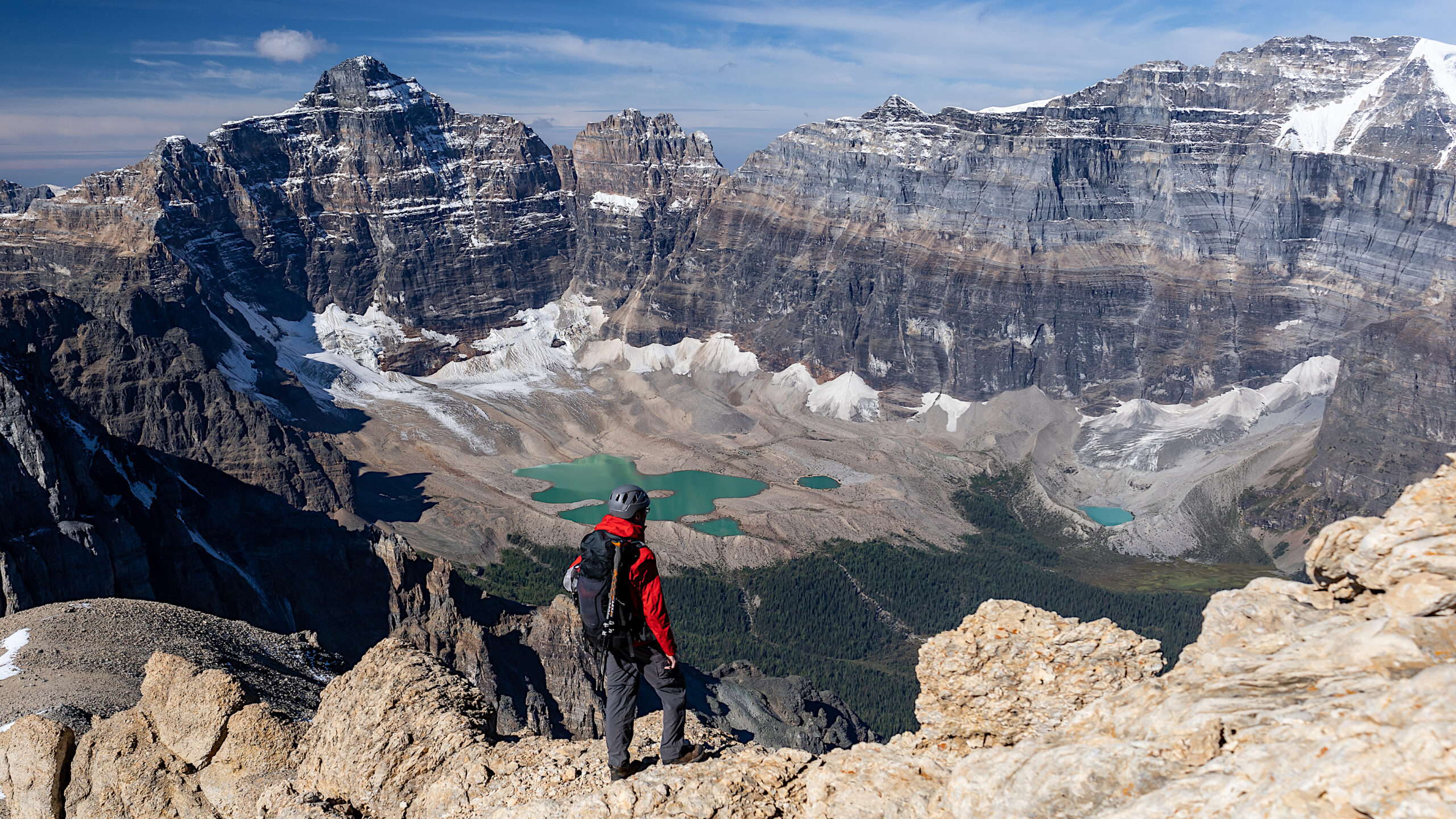
Robson Is Not the Mountain to Learn Long Alpine Route-Finding.
Build those systems on smaller Canadian Rockies objectives first, then bring them to a route where retreat, weather and objective hazard are less forgiving.
Wishbone Arête, Fuhrer Ridge and North Face
These routes are not simply alternate ways to the same summit. Each changes the type of mountaineering problem.
Long, loose and psychologically serious
The southwest arête is a historic Canadian Rockies line. American Alpine Club accident reports emphasize the consequences of underestimating its length, route-finding and poor protection. It is a route for teams comfortable moving efficiently through sustained low- to mid-grade alpine terrain where the consequence of a mistake can still be high.
Glacier approach plus committing ridge terrain
The Fuhrer Ridge sits in a serious northwest-side environment where the approach and descent are part of the climb. Historical accident records around this side of Robson reinforce the importance of crevasse systems, avalanche judgment and an exit plan that remains viable after a long summit push.
Sustained snow and ice
Patrick Callis and Dan Davis made the first ascent of the North Face in 1963. The line is a major steep snow-and-ice objective rather than a variation for someone simply seeking a quieter Kain Face. Face condition, bergschrund access and weather determine whether the route is climbable at all.
Emperor Ridge and Emperor Face
On the northwest side, Mount Robson stops being a standard alpine summit and becomes a major wall-and-ridge objective.
Emperor Ridge — first climbed in 1961
Ron Perla and Jim Spencer made the first ascent of Emperor Ridge in 1961. Their American Alpine Journal account makes the essential character clear: a long, committing ridge requiring bivouac planning and the willingness to continue through deteriorating mountain weather. The ridge is a route for climbers whose résumé already includes large alpine ridges with mixed terrain and limited retreat options.
Emperor Face — first face route in 1978
The Emperor Face is the mountain’s elite arena. The first ascent of the face came in 1978 with the Logan–Stump line. Later routes expanded the technical standard, including Infinite Patience in 2002 and additional modern mixed lines. The face should be treated as its own expedition category rather than as the “hard version” of a Kain Face ascent.
Running in the Shadows — 2020, not 2023
Ethan Berman and Uisdean Hawthorn established Running in the Shadows from September 30 to October 2, 2020. The American Alpine Club records the new line at roughly 2,300 m, VI AI5 M6 with some aid. Their route climbed previously traveled ground low on the wall, then broke onto new terrain before exiting near Emperor Ridge.
| Emperor-side line | First ascent / era | What it represents |
|---|---|---|
| Emperor Ridge | 1961 · Perla–Spencer | Major northwest ridge; long, mixed and weather dependent |
| Logan–Stump | 1978 | First complete route on the Emperor Face |
| Cheesmond–Dick | 1981 | Another early major Emperor Face line |
| Infinite Patience | 2002 | Modern mixed/ice test piece on the face |
| Haley–House line | 2007 | Modern face climbing linked into the upper mountain |
| Kruk–Walsh | 2010 | Modern mixed line on the right half of the face |
| Running in the Shadows | 2020 · Berman–Hawthorn | 2,300 m modern line; VI AI5 M6 with some aid |
Which Mount Robson Route Fits Your Team?
Choose by the hardest system you must manage—not by the shortest mileage or most attractive photograph.
| If your team’s goal is… | Route to evaluate first | Why |
|---|---|---|
| First Mount Robson summit | Kain Face | Best-established normal route and clearest planning information |
| Direct line with local expertise | South Face | Shorter geometry but higher objective-hazard tradeoff |
| Long traditional Rockies ridge | Wishbone Arête | Route-finding, loose rock and endurance dominate |
| Serious mixed ridge | Fuhrer Ridge | Glacier, mixed terrain and retreat complexity |
| Steep alpine ice | North Face | Face condition and sustained snow/ice are central |
| Elite committing ridge | Emperor Ridge | Multi-day ridge with severe exposure to weather |
| World-class mixed wall | Emperor Face | Technical face climbing at the highest commitment level on the mountain |
Route choice can change after you arrive.
Mount Robson is famous for rapidly changing weather and alpine conditions. A team that arrived for one route may need to wait, switch objectives or leave without an attempt. Build the trip around decision quality rather than a fixed summit promise.
Berg Lake Trail Access and Camping
The access story changed materially after several years of storm damage and phased restoration.
Reopened after restoration
BC Parks says the Berg Lake Trail has reopened after four years of phased restoration and that extensive repairs to the entire trail are complete. Advisories can still change after severe weather.
Reservation required
BC Parks requires reservations for overnight campground stays on the Berg Lake Trail during peak season. Outside peak season, some campgrounds may operate first-come, first-served.
No permit/day-use fee
BC Parks states that day-hiking on the Berg Lake Trail does not require a permit or day-use fee. That does not automatically settle mountaineering-specific registration or route-access questions.
No cell service on trail
BC Parks states there is no cell phone service on the Berg Lake Trail. Climbers should plan independent emergency communication appropriate to a technical expedition.
First 7 km only
Cycling is permitted only on the first 7 km from the trailhead to the north end of Kinney Lake. Beyond the bike rack, the approach continues on foot.
Check immediately before departure
Weather damage and trail closures have occurred repeatedly. Confirm current BC Parks advisories, campground status and any route-specific requirements before travel.
Season, Weather and Route Condition
Mount Robson’s route quality depends more on the current freeze, snowpack and storm sequence than on a generic “best month.”
Summer is the normal planning season for the standard routes, but a calendar date cannot tell you whether the Kain Face is firm, whether a bergschrund is passable, whether loose rock has thawed out of a ridge, or whether a major northwest face has frozen enough for mixed climbing. Emperor Face teams have historically targeted colder windows precisely because frozen terrain can be safer and more climbable than warm summer choss.
BC Parks itself directs Berg Lake visitors to Environment Canada and Avalanche Canada among its weather and avalanche resources. For a summit attempt, add mountain-specific forecasting, freezing-level trends and direct observation. The decision should be based on the elevations and aspects that control the route—not conditions at the highway.
Use the broader Mountain Weather for Climbers guide to interpret wind, precipitation and freezing level, then return to the Mount Robson parent guide for full mountain logistics.
Gear and Skills Change by Route
A single “Mount Robson packing list” only works after the route and current condition are known.
| System | Kain / standard planning | Emperor-side escalation |
|---|---|---|
| Glacier travel | Rope team, crevasse rescue, efficient transitions | Same foundation plus faster technical transitions under bigger commitment |
| Ice tools | Appropriate alpine snow/ice tools for current face condition | Technical tools suited to sustained steep ice/mixed climbing |
| Protection | Route- and condition-specific snow/ice/alpine rack | Expanded mixed/rock/ice protection based on the exact line |
| Bivy system | Contingency shelter for delay or retreat | Integral part of multi-day ridge/face strategy |
| Navigation | Whiteout-capable map/GPS/compass systems | Same plus complex face/ridge route finding in poor visibility |
| Communication | Satellite-capable emergency communication recommended | Essential redundancy for remote high-commitment objectives |
Use the dedicated equipment child.
The Mount Robson Gear List owns the detailed packing question. This route guide should determine what terrain the equipment must solve.

Canadian Rockies Progression
Two related Canadian Rockies pages deserve to be part of the Robson decision because they help climbers calibrate difficulty before committing to the mountain.
Mount Temple
Mount Temple is not a substitute for Robson’s glacier and ice experience, but it is useful for testing Rocky Mountain movement, exposed route finding, weather judgment and whether a climber actually enjoys long days in loose alpine terrain.
Open Mount Temple → Classic Canadian alpine objectiveMount Assiniboine
Assiniboine adds a more serious technical alpine problem and remote-trip logistics. It helps climbers understand how quickly a beautiful Rockies objective can become a full mountaineering commitment.
Open Mount Assiniboine → Regional comparisonCanadian Rockies 11,000ers
Compare Mount Robson with Mount Alberta, Temple, Assiniboine and the wider 11,000-foot peak list before deciding where it belongs in your progression.
Compare the 11,000ers →Continue Planning
Use the parent page for the mountain, this page for route choice, the gear child for equipment, and the regional guides for progression.
Mount Robson Climb Guide
The mountain-level parent for history, access, overall difficulty, logistics and expedition planning.
Open guide →Equipment childMount Robson Gear List
Route-specific boots, crampons, tools, glacier gear, protection and bivouac equipment for the Canadian Rockies.
Open guide →Regional pillarCanadian Rockies 11,000ers
Place Robson inside the major 11,000-foot peaks of the Canadian Rockies and compare progression options.
Open guide →Related objectiveMount Alberta
A serious Canadian Rockies 11,000er for climbers comparing technical commitment and progression.
Open guide →British ColumbiaMount Waddington
Compare Robson with British Columbia’s larger Coast Mountains alpine environment and technical expedition style.
Open guide →ConditionsMountain Weather for Climbers
Use freezing level, precipitation, wind and forecast uncertainty to decide whether a Robson route is viable.
Open guide →TimingBest Time to Climb
Understand why a nominal summer season is less important than the actual snow, ice and weather window.
Open guide →SkillsGlacier Travel Basics
Robson approaches and routes require practiced rope-team movement and crevasse-management systems.
Open guide →SafetyCrevasse Rescue Basics
Refresh hauling systems and partner-rescue planning before committing to the Robson Glacier or Berg Glacier systems.
Open guide →Elite objectivesTop 50 Technical Mountaineering Objectives
The Emperor Face appears in Global Summit Guide’s wider technical-objective framework.
Open guide →Mount Robson Routes FAQ
Direct answers to the questions most likely to matter before a climber chooses a line and commits to the approach.
What is the standard route on Mount Robson?
The Kain Face is the standard route for most first Mount Robson ascents. It is still a serious multi-day alpine climb involving glacier travel, steep snow and ice, a long upper-mountain traverse and a demanding descent. “Standard” on Mount Robson does not mean easy.
What is the easiest route on Mount Robson?
Mount Robson has no easy or non-technical summit route. The Kain Face is the normal first-choice route because it has the clearest established climbing line and the greatest amount of modern route information, but it still demands strong glacier, snow, ice and alpine decision-making skills.
Is the Berg Lake Trail open in 2026?
Yes. BC Parks says the Berg Lake Trail has reopened after four years of phased restoration and that extensive repairs to the entire trail are complete. Severe weather and closures can still occur, so climbers should check current BC Parks advisories immediately before departure.
Do I need a permit to approach Mount Robson via Berg Lake?
BC Parks currently states that day-hiking on the Berg Lake Trail does not require a permit or day-use fee. In peak season, overnight campground stays on the trail require a reservation. Mountaineers should separately confirm any current route-specific registration, camping or access requirements with BC Parks before the trip.
How difficult is the Emperor Ridge?
Emperor Ridge is a highly committing northwest-ridge route first climbed in 1961. It is far more serious than the standard Kain Face because of its length, mixed alpine terrain, exposure and dependence on a stable multi-day weather window.
How difficult is the Emperor Face?
The Emperor Face is elite alpine terrain. Its established lines include the first face route from 1978, Infinite Patience, later mixed lines and Running in the Shadows. These are major multi-day ice and mixed climbs requiring expert-level route finding, technical speed and self-sufficiency.
When was Running in the Shadows first climbed?
Ethan Berman and Uisdean Hawthorn climbed Running in the Shadows on September 30 through October 2, 2020. The American Alpine Club records the route as roughly 2,300 m and graded VI AI5 M6 with some aid.
What should I climb before Mount Robson?
A sensible progression includes several Canadian Rockies alpine routes that build glacier travel, long-day endurance, mixed movement and weather judgment. Mount Temple can build Rocky Mountain movement and route-finding experience, while larger glaciated objectives should precede a Mount Robson attempt. Route choice on Robson should match the climber’s actual technical résumé, not just fitness.
Methodology
Current access comes from BC Parks; historical route claims are checked against American Alpine Club records where available.
Current Access Sources
- BC Parks — Berg Lake Trail
- BC Parks — Mount Robson Park
- BC Parks advisories should be rechecked immediately before every trip.
Route History Sources
For a First Robson Attempt, Start with Kain Face—Then Let Current Conditions Decide.
Robson rewards teams that arrive with enough skill and margin to change plans. Use this route guide to choose the right problem, the parent page for full logistics, and the gear child to build the system required by that route.
Mount Robson Routes: What Changes After the Simple Comparison?
The existing route table above answers the first question: which family of route belongs on your shortlist? This deeper matrix answers the second: what technical grade, crux, objective hazard, descent problem and access system comes with that choice?
The most established normal climbing line, but still a serious glacier-and-ice expedition.
Shorter geometry does not make it the safer or simpler alternative.
A major multi-day ridge objective with limited margin for poor weather.
A separate category of world-class mixed and ice climbing.
Mount Robson Route Planning Matrix
Grades vary slightly between guidebook systems and individual route variants. They are included here as route-character references, not as substitutes for a current topo, condition report or experienced local judgment.
| Route | Common Grade Reference | Typical Commitment | Main Crux / Character | Objective Hazard | Descent Problem | Camp / Bivy Logic | Best Fit | 2026 Access Note |
|---|---|---|---|---|---|---|---|---|
| Kain Face Standard route | AD · WI3 · ~45° Some North American references describe the complete objective as Grade IV. | Commonly planned as a 3–4 day alpine climb, normally with additional weather margin. | Glacier approach, bergschrund, sustained steep snow/ice on the Kain Face and the exposed upper mountain. | Weather, crevasses, icefall, changing face condition and deterioration during a very long summit/descent day. | Reversing steep snow/ice after the summit while tired. Anchor and rappel strategy must be planned before leaving camp. | Multi-day glacier/high-camp system with enough shelter and fuel to absorb Robson’s weather uncertainty. | Strong glacier and alpine-ice teams making a first Mount Robson attempt. | Berg Lake Trail is reopened. Peak-season overnight trail camping requires reservations; verify BC Parks advisories before entry. |
| South Face Direct / exposed | AD · WI2 Route condition can matter more than the modest technical number. | Serious multi-day alpine objective despite the more direct line. | Snow/mixed terrain and efficient movement through exposed south-side terrain. | Serac, rockfall and avalanche exposure are the central reason not to choose it merely because it is shorter. | Retreat and descent remain exposed to objective hazard. | South-side route-specific high camp or bivouac strategy. Confirm current access rather than assuming Berg Lake logistics apply. | Experienced local/Canadian Rockies teams choosing conditions over popularity. | Berg Lake reopening does not automatically determine south-side alpine access. Confirm route-specific logistics separately. |
| Wishbone Arête Classic ridge | TD- · 5.6 · WI3 Traditional references also commonly list the route around Grade IV/V 5.6. | Roughly 3 days is a common planning reference. | Very long southwest ridge, loose alpine rock, route finding and the upper gargoyle/summit terrain. | Loose rock, storms, duration and getting off-line on a huge ridge. | Long descent after a route where duration itself is a hazard. | Bivouac planning is integral, not emergency-only. | Strong traditional Rockies climbers who value ridge climbing and route finding more than speed. | South-side access problem rather than a simple Berg Lake campground itinerary. |
| Fuhrer Ridge Mixed ridge | TD- · 5.4 Often described in older North American references as Grade IV 5.4. | Commonly 3–4 days. | Long mixed ridge combining glacier approach, rock and snow/ice terrain. | Glacier hazard, avalanche/icefall exposure, poor retreat options and weather. | Complex retreat once committed to the ridge. | Multi-day bivouac/high-camp strategy with real storm margin. | Experienced Canadian Rockies teams already comfortable on mixed alpine ridges. | Treat access as expedition logistics, not merely hiking to Berg Lake. |
| North Face Steep snow / ice | TD · WI3 · ~55° North American references often call the complete route Grade IV. | Roughly 3–4 days is a common planning reference. | Sustained snow and ice once established on the face. | Bergschrund access, changing face condition, ice/avalanche hazard and weather. | Descent planning must account for the condition of the face and summit terrain. | Glacier/high-camp strategy with cold-condition competence. | Strong steep-alpine-ice teams. | Berg Lake/Robson Glacier corridor benefits from the reopened trail, but alpine glacier access remains independent of hiking-trail condition. |
| Emperor Ridge Elite ridge | TD · 5.6 Common older North American references describe the complete climb as Grade V 5.6. | Roughly 3 days in historic route descriptions, with weather reserve essential. | Enormous northwest ridge, mixed terrain, technical climbing and multiple bivouac decisions. | Length, exposure to storms, difficult retreat and cumulative fatigue. | Finishing the route is only half the problem; descent after multi-day ridge climbing demands substantial reserve. | Bivouac system is a core part of the route strategy. | Elite ridge climbers with large Canadian Rockies / Alaska-style résumé. | Berg Lake Trail reopening improves the lower approach corridor; no trail status should be interpreted as upper-mountain readiness. |
| Emperor Face Elite wall | ED+ / VI depending on the exact line. Infinite Patience: 5.9 M5 WI5. Running in the Shadows: WI5 M6 with aid in published references. | Multi-day major alpine-wall climbing. | Sustained mixed/ice climbing on a roughly 1,500 m face; line-specific technical cruxes dominate. | Objective hazard, severe weather, route condition, difficult retreat and the consequences of slow movement. | Descent becomes part of the expedition problem after an already extreme face climb. | Planned wall bivouacs and full remote-alpine self-sufficiency. | Elite alpinists already competent on major Grade VI mixed walls. | Berg Lake access is reopened, but Emperor Face viability depends on alpine freeze, snow/ice condition and a serious weather window. |
Berg Lake Access: What “Open” Actually Means in 2026
BC Parks has reopened the Berg Lake Trail after four years of phased restoration. That restores a major approach corridor, but climbing access, trail camping and upper-mountain conditions remain separate decisions.
Extensive repairs are complete, but BC Parks continues to warn that severe weather and closures can occur.
Campground stays along the Berg Lake Trail require reservations during the peak reservation season.
BC Parks currently says day hiking itself does not require a permit or day-use fee.
BC Parks states there is no cell service on the Berg Lake Trail. Technical teams should plan appropriate satellite communication.
Verification Sources
Current public access was rechecked September 14, 2026 against BC Parks. Route grades and historical line descriptions are cross-checked against Canadian Rockies climbing references and American/Canadian alpine records. Conditions on the glacier and climbing routes must still be verified locally.
BC Parks Berg Lake Trail → BC Parks Mount Robson →Grades are reference descriptions, not guarantees of current difficulty. Ice, snow, bergschrund condition, rockfall, glacier change and weather can materially alter any Mount Robson route from one season—or one week—to the next.
Was this helpful?
🏔Related peaks nearby
🧭Explore & compare
Global Summit Guide is an independent mountaineering resource founded in 2026. The team combines first-hand trekking and climbing experience with in-depth research and professional health and nutrition review to help climbers choose objectives, prepare properly, and stay safe.
Health, altitude, and nutrition content is reviewed by Taylor Ludlow (Registered Nurse) and Brigg Hoopes (Nutritionist).
What We Don't Know Yet
Mountain information changes quickly. This box explains the limits of what this page can responsibly promise.
- Route conditions, trailhead access, crevasse exposure, stream crossings, and rescue access may vary from published planning guidance.
- Visa, passport, vaccination, border, insurance, and local transportation rules may change before your trip.
- Route conditions, snowpack, closures, and weather can change quickly after this page is updated.
- Permit rules, fees, quotas, and reservation windows may change between review cycles.
- Operator availability, pricing, guide ratios, and cancellation terms can change by season.
Verify current conditions with official land managers, guide services, local forecasts, and current route reports before booking or climbing.
Mountaineering, rock and ice climbing, glacier travel, and high-altitude activity are inherently dangerous and can result in serious injury or death. The information on Global Summit Guide is provided for general informational and educational purposes only and is not a substitute for professional instruction, qualified guiding, proper equipment, or your own judgment and experience.
Route conditions, weather, snowpack, permits, regulations, and hazards change constantly and may differ from what is described here. Details may be incomplete, out of date, or contain errors. Always verify current information with local authorities, certified guides, and official sources before making any decision in the mountains.
Nothing on this site is medical, legal, or financial advice. Our fitness, acclimatization, altitude, and nutrition content is general in nature; consult a qualified physician before beginning any strenuous exercise program or exposing yourself to high altitude.
You are solely responsible for your own safety and decisions. To the fullest extent permitted by law, Global Summit Guide and its team accept no liability for any loss, injury, damage, or expense arising from use of, or reliance on, this information. By using this site you acknowledge these risks and accept these terms.
Some links on this site may be affiliate links. If you buy through them we may earn a small commission at no extra cost to you; this never affects our recommendations.
Global Summit Guide recommendation path
Next Best Mountain to Research
Use these recommendations to continue the right planning path instead of stopping on one page.
Use current permit, weather, route, and operator information before booking or climbing.
Explore Travel Options for Your Destination
Once your mountain, dates and route are taking shape, compare flights, hotels and other travel options that fit the trip.
Affiliate link. We may earn a commission at no additional cost to you.