
Last updated July 21, 2026
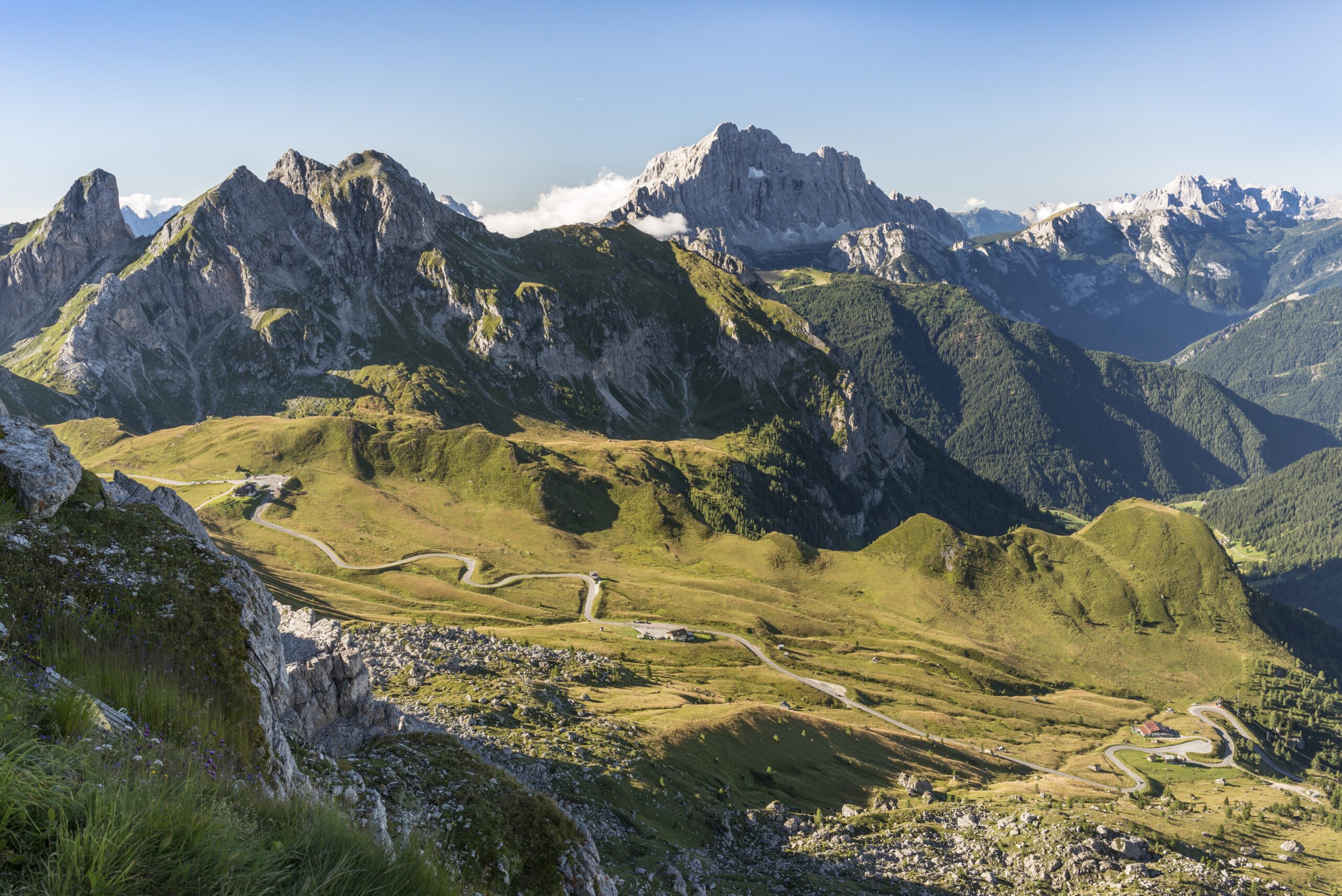
Climbing Monte Civetta 2026: The Wall of Walls, the Solleder Route & Three Classic Via Ferratas
The Dolomites’ Wall of Walls rises 1,200 m above the Zoldo Valley, one of the largest rock faces in the Alps. Three via ferratas reach the 3,220 m (10,564 ft) summit, and the 1925 Solleder-Lettenbauer Route remains the legendary trad climb. Here is the complete 2026 guide. Elevations in metres (feet).
Presence, not height, is what makes Civetta.
Civetta is not the highest Dolomites peak, nor the most climbed, but its Northwest Face is a single coherent monument: 1,200 m tall, three kilometres wide, near-uniformly steep. Walter Bonatti called it the Wall of Walls.
Three via ferratas reach the summit, from a medium Normal Route to the severe Tissi, while the 1925 Solleder-Lettenbauer line remains a UIAA VI trad test piece. Most climbers come for the ferratas; a smaller community comes for the wall.
Summit (10,564 ft)
High in the Dolomiti Bellunesi, Veneto, Italy.
NW Face (3,940 ft)
The Wall of Walls, three kilometres wide.
Solleder Route
The legendary UIAA VI trad line up the face.
Classic ferratas
Alleghesi, Tissi, and the Normal Route.
Marmolada holds the Dolomites height record at 3,343 m (10,968 ft), and the Tre Cime see more daily traffic, but Civetta has a presence no other peak in the range quite matches. Stand at Rifugio Tissi at sunset and watch the whole face turn pink, and you understand why generations of climbers have made the pilgrimage. This guide covers what you actually need to climb it in 2026, across all four routes, plus refuges, seasons, and costs. For the wider range, see our Alps Classics collection.
Civetta at a glance
The essential facts, organised for fast reference.
| Summit elevation | 3,220 m (10,564 ft) |
| Location | Dolomiti Bellunesi, Veneto, Italy |
| Coordinates | 46.3801 N, 12.0533 E |
| Mountain group | Dolomites, Italian Alps |
| Protected area | UNESCO World Heritage Site (Dolomites, 2009) |
| Northwest Face | 1,200 m (3,940 ft) tall, 3 km wide – the Wall of Walls |
| First ascent | 1855 (likely), Simeone di Silvestro, via the Tivan line |
| First recorded ascent | May 31, 1867, Francis Ford Tuckett with the Anderegg guides |
| Solleder-Lettenbauer Route | 1925, NW Face direct, UIAA VI |
| Main routes | Normal Route (Sentiero Tivan), Via Ferrata Alleghesi, Via Ferrata Tissi |
| Elevation gain from valley | about 1,520 m (4,987 ft) |
| Gateway villages | Alleghe (west), Pecol and Selva di Cadore (east) |
| Key refuges | Coldai (2,135 m), Tissi (2,281 m), Torrani (2,910 m) |
| Best season | Late June to mid-September; peak July to mid-August |
| Park fee | None; refuge bookings paid directly |
| 2026 guided cost | 800 to 1,500 euro for 2 to 3-day programs |
| Nearest airports | Venice (2 hr), Treviso (2 hr), Innsbruck (2.5 hr) |
Why Civetta matters
Three things converge here that do not combine anywhere else in the Alps.
The Northwest Face is what climbers come to see. At 1,200 m tall and three kilometres wide it is the largest single rock face in the Dolomites, and arguably the largest in the Alps by uninterrupted continuity. Most great alpine faces are complexes of ridges, couloirs, and hanging glaciers; Civetta’s is pure rock, nearly all vertical, with a coherent visual identity you can take in whole from across the valley. Photographs rarely capture the scale because there is nothing else in frame for reference.
The second thing is history. On August 7, 1925, Solleder and Lettenbauer traced a direct line up the wall in a single day using hemp ropes, hobnail boots, and a handful of pitons. Graded UIAA VI today, the route remains a watershed in alpine climbing and still draws strong trad climbers, most of whom bivouac partway up. The third is the trio of via ferratas, giving genuine route choice by difficulty, aspect, and character. Many walkers also meet Civetta on the Alta Via 1, and often return years later as climbers.
The four routes
Three via ferratas plus the trad line on the Northwest Face. Match yourself to the route that fits your experience, not the most famous one.
| Route | Aspect | Difficulty | Time |
|---|---|---|---|
| Via Ferrata degli Alleghesi | East face | Medium-difficult ferrata | 4 to 5 hrs |
| Via Ferrata Tissi | South face | Difficult ferrata (Grade D+) | 4 to 5 hrs |
| Normal Route (Sentiero Tivan) | East-northeast | Medium ferrata, about 22 cables | 5 to 6 hrs |
| Solleder-Lettenbauer Route | Northwest face | UIAA VI trad rock | 12 to 18 hrs |
Via Ferrata degli Alleghesi
East face · Medium-difficult ferrata · 4 to 5 hrs. The most popular route and the standard recommendation for fit, experienced ferrata climbers. From Rifugio Coldai it traverses to Casera di Pioda, climbs a pillar to the side-summit of Punta Civetta at 2,920 m (9,580 ft), then follows the equipped ridge to the true summit. A few lower sections (UIAA II) are uncabled, so basic rock skill helps. Most climbers descend the Normal Route to avoid re-climbing.
Via Ferrata Tissi
South face · Difficult ferrata (Grade D+) · 4 to 5 hrs. One of the hardest ferratas in the Dolomites, ascending the south face through a 300 m near-vertical step. The approach starts from Rifugio Vazzoler. The step is sustained and demanding, needing solid arm endurance, clean rope technique, and confidence on overhanging ground. It is far quieter than the Alleghesi and reaches the Rifugio Torrani plateau below the summit.
Normal Route (Sentiero Tivan)
East-northeast · Medium ferrata, about 22 cables · 5 to 6 hrs. The historic line, first climbed in 1855 and 1867, now more often descended than climbed. It follows a marked path with roughly 22 cable sections and exposed scrambling between Rifugio Torrani and Rifugio Coldai. Some rockfall risk exists in the upper section. It is a viable, less-crowded ascent for climbers who want the traverse.
Solleder-Lettenbauer Route
Northwest face · UIAA VI trad rock · 12 to 18 hrs. A serious trad rock climb up the central Northwest Face, established by Emil Solleder and Gustav Lettenbauer on August 7, 1925. It traces a near-direct line through 1,200 m (3,940 ft) of variable Dolomites limestone at grades up to UIAA VI. Loose rock and complex route-finding add time, and most parties bivouac partway up. It is reserved for accomplished trad climbers leading UIAA VI on natural rock.
Climbing history
From a hunter’s first ascent to a UNESCO peak.
Simeone di Silvestro, a hunter from the Zoldo Valley, almost certainly made the first ascent via what is now the Sentiero Tivan.
On May 31, Francis Ford Tuckett climbed Civetta with the Swiss guides Melchior and Jakob Anderegg, the first ascent recorded in alpine literature.
On August 7, Solleder and Lettenbauer climbed the Northwest Face in a single day on hemp ropes and hobnail boots, a watershed in alpine history.
Emilio Comici and others opened further lines on the wall, making Civetta a proving ground for European alpinism.
The Italian Alpine Club equipped the Sentiero Tivan, then the Alleghesi and Tissi ferratas, opening the peak to fit amateurs.
UNESCO inscribed the Dolomites as a World Heritage Site; Civetta sits within the protected area, with no climbing permits or quotas introduced.
Refuges run mid-June to mid-September, cables were inspected over the off-season, and half-board sits around 70 to 90 euro; book Torrani 4 to 6 weeks ahead for July and August.
Refuges and logistics
Climbing Civetta means planning around the refuge network and the cable lifts.
| Refuge | Elevation | Position | Capacity | Half-board |
|---|---|---|---|---|
| Rifugio Coldai | 2,135 m (7,005 ft) | NE side, near Lake Coldai | ~90 beds | 70 to 85 euro |
| Rifugio Tissi | 2,281 m (7,484 ft) | SW side, NW Face viewpoint | ~70 beds | 70 to 85 euro |
| Rifugio Torrani | 2,910 m (9,548 ft) | South side, summit plateau | ~30 beds | 75 to 90 euro |
| Bivacco Torrani | ~3,150 m (10,335 ft) | Near the summit | ~8 places | Free (emergency only) |
Rifugio Coldai is the standard base for the Alleghesi, reached by the Alleghe cable lift to Col dei Baldi at 1,946 m (6,385 ft) then a 2.5 to 3-hour hike. Rifugio Tissi sits below the Northwest Face with the iconic sunset view and suits Solleder climbers and Alta Via 1 walkers. Rifugio Torrani, near the summit plateau, is small at about 30 beds and books out fast. Cable-lift tickets run 15 to 25 euro a ride, with multi-day passes available, and the Alleghe cableways run daily from late June to mid-September. All three refuges need advance booking, and most require half-board.
When to climb
The season, window by window.
Late June to early July – early season
Refuges begin opening and the cables clear of snow. Conditions can be excellent and quiet, though late-season snow patches may linger on the upper ridge and lift schedules are reduced. A good window for climbers with flexible dates.
Mid-July to mid-August – peak window
The prime window: all refuges open, lifts daily, and the most stable weather, though afternoon thunderstorms remain a daily concern. Crowds peak on the Alleghesi, where queues can form at cable sections, and refuge bookings are essential 3 to 6 weeks ahead.
Mid-August to mid-September – late season
Declining crowds with slowly rising weather risk. Refuges stay open through mid-September and lifts keep running, but daylight shortens, so start earlier. Many climbers rate late August to early September the connoisseur’s window.
October to May – off-season
Refuges close, cables can ice up, and rockfall risk rises as the rock heats and cools. The peak is climbable for experienced winter alpinists, but the refuges, lifts, and rescue support are absent, so most climbers wait for summer.
Dolomites afternoon thunderstorms are frequent and dangerous on exposed metalwork, and there is no fast escape from the upper sections of any route. Build a day or two of flexibility into your plan, start early, and be willing to sit out a storm. This guide is educational, not a substitute for a certified guide, current forecasts, and your own judgment.
Cost breakdown
Civetta is among the more affordable major Dolomites climbs.
| Component | 2026 amount |
|---|---|
| Refuge half-board (per night) | 70 to 90 euro |
| Cable lift access (per ride) | 15 to 25 euro |
| Via ferrata gear rental (trip) | 30 to 50 euro |
| Food and water for climb day | 15 to 30 euro |
| Total 2 to 3-day independent budget | 200 to 400 euro |
| Program | 2026 cost |
|---|---|
| 3-day Via Ferrata Alleghesi (Alpine Guide) | 1,000 to 1,400 euro |
| 2-day Civetta program | 700 to 1,000 euro |
| Custom private guiding (per day) | 400 to 600 euro |
| Solleder Route guided ascent (per day) | 800 to 1,200 euro |
For comparison, a guided Mont Blanc expedition runs 2,500 to 4,000 euro and a Matterhorn ascent 1,500 to 2,500 euro, so Civetta offers a comparable experience at lower cost. Access to the Dolomites is free, with no permits or quotas.
Gear checklist
Core kit for the ferratas, plus the extra rack for the Solleder.
Via ferrata essentials
- Via ferrata set (Y-shaped lanyards with energy absorber, CE EN 958)
- Climbing harness and a helmet for rockfall protection
- Via ferrata gloves and approach shoes or light boots with sticky soles
- A 30 to 50 L pack for water, food, and layers
Clothing system
- Base layers, a light mid-layer, and a light insulated jacket
- A hardshell jacket and durable climbing trousers for fast-changing weather
- Sun hat and warm hat, sunglasses (category 3 to 4), sunscreen and lip balm
Personal and safety
- Headlamp, 2 L of water capacity, and cash in euros for refuges and lifts
- Personal first-aid kit and travel insurance with mountain-rescue cover
Solleder Route additions
- A single trad rack with a few pitons for variable Dolomites protection
- A 60 m rope or twin 50 m ropes, alpine slings, and bivouac gear
For deeper gear guidance, see our complete climbing gear checklist, and build the underlying fitness with our fitness standards. Read mountain weather for climbers before you go.
Civetta FAQ
The questions climbers ask most about Monte Civetta.
How tall is Monte Civetta and where is it located?
Monte Civetta rises to 3,220 m (10,564 ft) in the Italian Dolomites, in the province of Belluno in Veneto, at 46.3801 N, 12.0533 E. It sits between Alleghe to the west and the Zoldo Valley to the east, both about two hours from Venice by car. Its Northwest Face, the Wall of Walls, is 1,200 m tall and 3 km wide, one of the largest rock faces in the Alps, and the peak lies within the UNESCO World Heritage Dolomites.
What are the main routes up Monte Civetta?
Three via ferratas reach the summit, plus a trad rock route. The Normal Route via the Sentiero Tivan is the easiest, a marked path with about 22 cables, usually descended rather than climbed. The Via Ferrata degli Alleghesi is the popular ascent, climbing the east face to Punta Civetta then along the ridge. The Via Ferrata Tissi is a difficult south-face route with a 300 m vertical step. The Solleder-Lettenbauer Route of 1925 is the legendary UIAA VI trad line up the Northwest Face.
How difficult is climbing Monte Civetta?
It depends on the route. The Normal Route is a medium ferrata, the Alleghesi is medium-difficult and needs a head for exposure, and the Tissi is a difficult Grade D+ ferrata for experienced climbers only. The Solleder Route is a UIAA VI multi-pitch rock climb over 1,200 m, serious alpine climbing for accomplished trad climbers. The elevation gain from valley parking is about 1,520 m (4,987 ft) on any route.
When is the best time to climb Monte Civetta?
The season runs late June to mid-September, with July and August the most stable and reliable window on the ferratas. June can hold residual snow on the cables, and September brings shorter days and earlier snow risk high up. From October to May the refuges close, cables can ice up, and rockfall risk rises, so most climbers wait for summer. Afternoon thunderstorms are a daily concern all season.
How much does climbing Monte Civetta cost in 2026?
Independent climbers can budget roughly 200 to 400 euro for a two to three-day trip, covering refuge half-board (70 to 90 euro a night), cable lifts (15 to 25 euro a ride), and food. A certified Alpine Guide runs about 400 to 600 euro per person per day, and most guided Civetta programs fall in the 800 to 1,500 euro range. Gear rental adds 30 to 50 euro. Access to the Dolomites is free, with no permit fees.
Do I need a guide to climb Monte Civetta?
A guide is not legally required, and independent climbers regularly do all three ferratas. A guide is strongly advised for first-time Dolomites visitors, anyone out of recent ferrata practice, and anyone attempting the difficult Tissi. IFMGA-certified Italian Alpine Guides work from Alleghe, Cortina, and Belluno. For the Solleder Route, a guide or extensive trad experience with a strong partner is essential.
What refuges should I book on Monte Civetta?
Three refuges serve the mountain. Rifugio Coldai (2,135 m) is the base for the Alleghesi. Rifugio Tissi (2,281 m) gives the iconic Northwest Face view and suits Solleder climbers and any visitor. Rifugio Torrani (2,910 m) sits near the summit plateau for climbers descending the Alleghesi. All need advance booking; Torrani, with only about 30 beds, is the most competitive, so book it 4 to 6 weeks ahead for peak season.
Can I climb Monte Civetta in one day?
It is possible from the cable lifts for strong, experienced climbers: take the Alleghe cableways to Col dei Baldi, hike to Rifugio Coldai, climb the Alleghesi to the summit, and descend the Normal Route in about 10 to 12 hours of moving time. It needs an early start, settled weather, and a fast, steady pace on technical ground. Most climbers find a refuge night safer and more rewarding.
📋 How this guide is built
This guide is compiled by Travis Ludlow, Founder and Head of Research at Global Summit Guide, from CAI refuge and via ferrata records, Alpine Club and Alpine Journal history, published route sources, and the UNESCO Dolomites listing, with sources named below. It was reviewed for safety by Dawson Ludlow, our Climbing and Mountaineering Lead (Wilderness First Aid). Our team has no first-hand ascent of Civetta, so we report the cited records rather than personal anecdote, and we flag details that shift by season, such as refuge prices and cable-lift schedules.
Sources and further reading
- SummitPost and Mountain Project – Monte Civetta route descriptions and Solleder-Lettenbauer notes.
- Dolomiti.org and the Alleghe tourism portal – access, cable lifts, and refuge information.
- Italian Alpine Club (CAI) – refuge booking portal and via ferrata maintenance records.
- UNESCO World Heritage Centre – Dolomites inscription (2009).
- Francis Ford Tuckett’s Alpine Journal account (1867) and the American Alpine Journal for the Solleder history.
Planning a Dolomites trip?
Civetta pairs naturally with the wider range. Explore our Alps Classics collection, compare the giants in the greatest Alps mountains compared, and weigh guiding options in private guide vs group expedition. For flights and lodging around Venice and Alleghe, browse travel on Expedia.
Disclosure: the Expedia link above is a sponsored affiliate link. We may earn a commission at no extra cost to you.
Was this helpful?
🏔Related peaks nearby
🧭Explore & compare
Global Summit Guide is an independent mountaineering resource founded in 2026. The team combines first-hand trekking and climbing experience with in-depth research and professional health and nutrition review to help climbers choose objectives, prepare properly, and stay safe.
Health, altitude, and nutrition content is reviewed by Taylor Ludlow (Registered Nurse) and Brigg Hoopes (Nutritionist).
What We Don't Know Yet
Mountain information changes quickly. This box explains the limits of what this page can responsibly promise.
- Permit availability, reservation windows, quotas, and official fee rules may change after this page is updated.
- Weather, snowpack, avalanche risk, road access, and route conditions can change quickly and may be different on your climbing dates.
- Route conditions, trailhead access, crevasse exposure, stream crossings, and rescue access may vary from published planning guidance.
- Total trip cost can change with flights, lodging, guide pricing, permits, gear rentals, transportation, and exchange rates.
- Gear requirements can change by season, route variation, weather window, personal cold tolerance, and guide-service requirements.
Verify current conditions with official land managers, guide services, local forecasts, and current route reports before booking or climbing.
Mountaineering, rock and ice climbing, glacier travel, and high-altitude activity are inherently dangerous and can result in serious injury or death. The information on Global Summit Guide is provided for general informational and educational purposes only and is not a substitute for professional instruction, qualified guiding, proper equipment, or your own judgment and experience.
Route conditions, weather, snowpack, permits, regulations, and hazards change constantly and may differ from what is described here. Details may be incomplete, out of date, or contain errors. Always verify current information with local authorities, certified guides, and official sources before making any decision in the mountains.
Nothing on this site is medical, legal, or financial advice. Our fitness, acclimatization, altitude, and nutrition content is general in nature; consult a qualified physician before beginning any strenuous exercise program or exposing yourself to high altitude.
You are solely responsible for your own safety and decisions. To the fullest extent permitted by law, Global Summit Guide and its team accept no liability for any loss, injury, damage, or expense arising from use of, or reliance on, this information. By using this site you acknowledge these risks and accept these terms.
Some links on this site may be affiliate links. If you buy through them we may earn a small commission at no extra cost to you; this never affects our recommendations.
Global Summit Guide recommendation path
Next Best Mountain to Research
Use these recommendations to continue the right planning path instead of stopping on one page.
Use current permit, weather, route, and operator information before booking or climbing.