
Last updated July 11, 2026
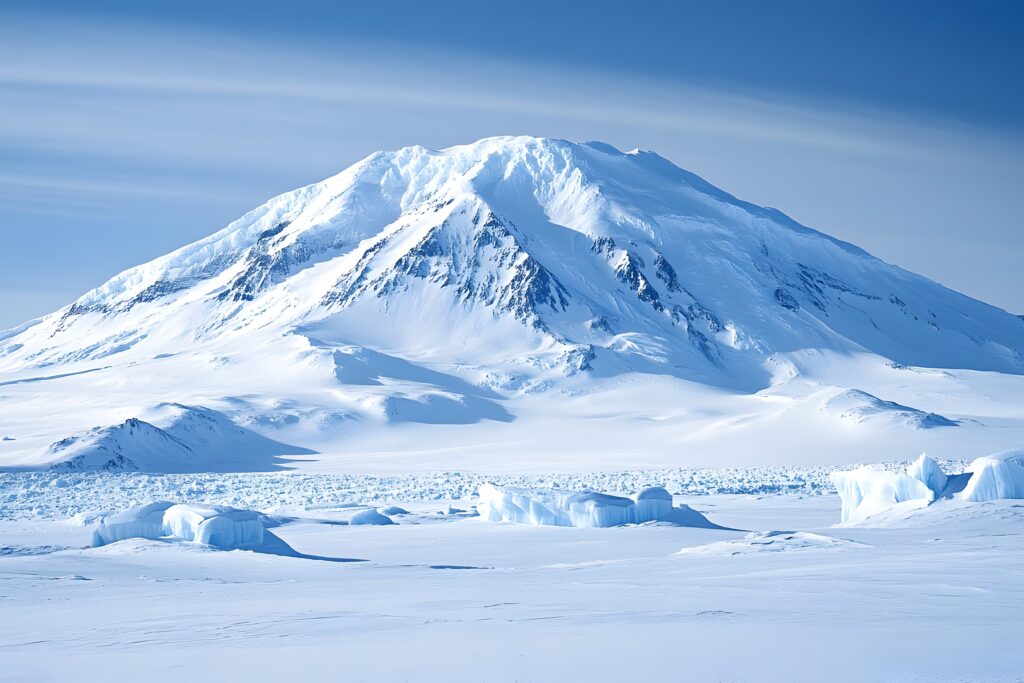
Mount Erebus: The World’s Southernmost Active Volcano
A fire mountain at the bottom of the world — 3,794 m of active stratovolcano on the Antarctic ice, holding one of the only persistent lava lakes on Earth. It’s one of the most fascinating volcanoes anywhere, and one of the very few peaks you almost certainly cannot climb. Here’s why, what makes it extraordinary, and what to climb instead.
You almost certainly cannot climb Mount Erebus. Unlike every other peak on this site, Erebus isn’t gated by difficulty or price — it’s gated by international treaty. Access is restricted to scientists and support staff on national Antarctic programs via McMurdo Station (US) or Scott Base (NZ). No operator sells an Erebus climb, and no commercial flights reach Ross Island.
So treat this as what it is: a guide to an extraordinary phenomenon — the southernmost active volcano, a rare persistent lava lake, and the site of New Zealand’s deadliest disaster — rather than a trip you can book. If you want to actually climb in Antarctica, the realistic objectives are Mount Vinson (the continent’s highest) or Mount Sidley (its highest volcano).
On this page
Where it is
Ross Island, in McMurdo Sound — beside the two big Antarctic research bases.
Mount Erebus rises on Ross Island, in McMurdo Sound off Victoria Land, in the sector of Antarctica claimed by New Zealand (a claim held in abeyance under the Antarctic Treaty). McMurdo Station (US) sits about 35 km southwest of the summit, with New Zealand’s Scott Base nearby — the two hubs through which nearly all human access to the volcano flows. Air access is only via US and NZ military flights from Christchurch; there are no commercial flights. Ross Island also carries three extinct volcanoes — Terror, Terra Nova, and Bird.
The volcano, in brief
Lower than Vinson, far more famous — and permanently on fire.
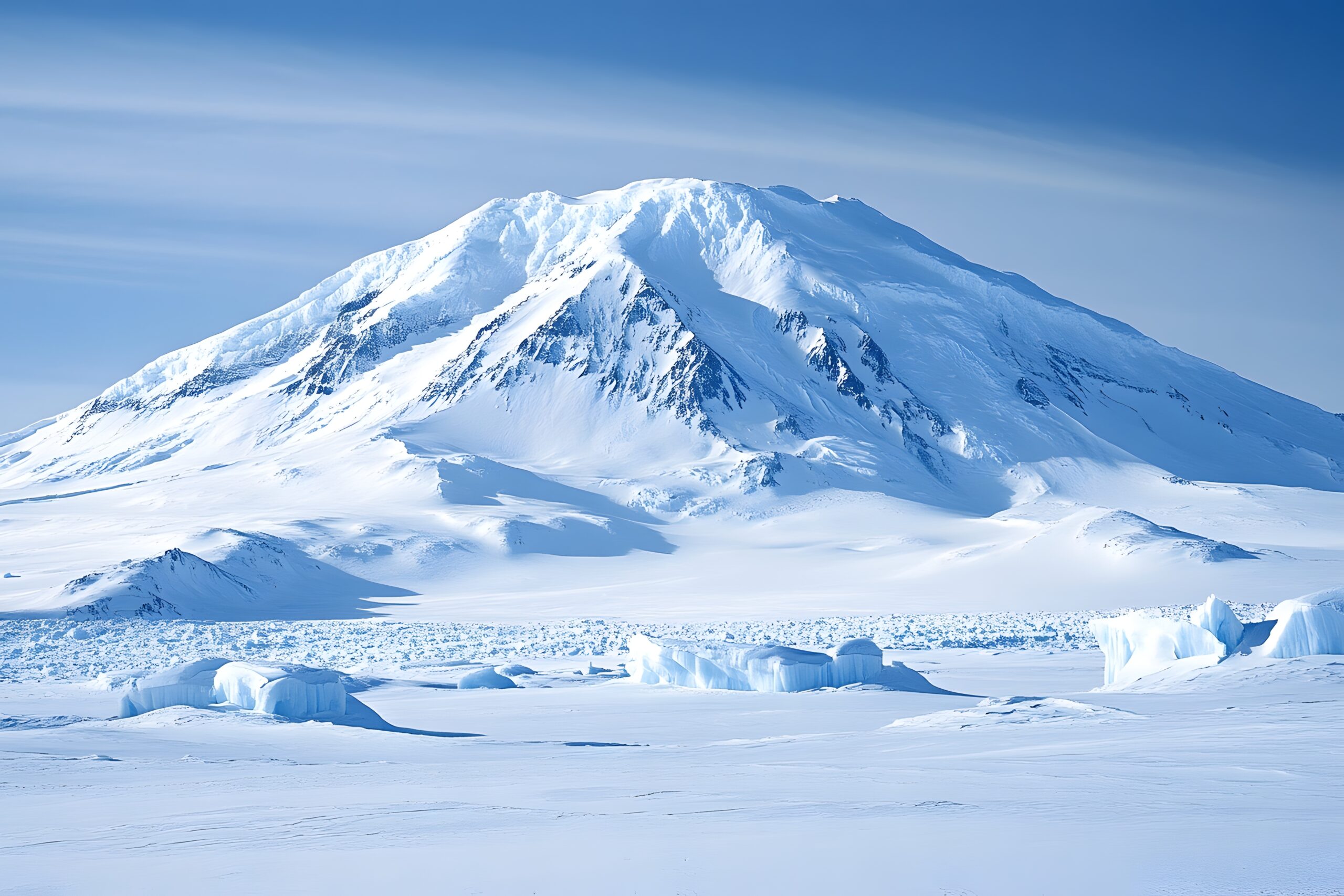
At 3,794 m (12,448 ft), Erebus is the second-highest volcano in Antarctica (after the dormant Mount Sidley) and the second-most prominent mountain on the continent (after Mount Vinson), with about 3,765 m of prominence — 34th most prominent on Earth. It’s a phonolite stratovolcano roughly 1.3 million years old, sitting on the Terror Rift of the West Antarctic Rift System. What sets it apart is that it is continuously active: its summit crater holds a persistent lava lake, and it is one of only two active volcanoes anywhere in Antarctica.
Why you can’t climb it
Not the terrain — the treaty.
Erebus is closed not by difficulty (the standard route is non-technical) but by international policy. Access is governed by the Antarctic Treaty’s environmental protocol and is limited in practice to people affiliated with a national Antarctic program. Here’s the reality:
| Who reaches Erebus | Who doesn’t |
|---|---|
| Scientists on national programs (USAP, Antarctica NZ) | General tourists and recreational climbers — no operator offers it |
| Authorized support staff at McMurdo / Scott Base | Antarctic cruise passengers — cruises go to the Peninsula, not Ross Island |
| A few government officials, journalists, and film crews | Volcanic Seven Summits aspirants without science affiliation |
The lava lake & ice towers
Two features that exist almost nowhere else on the planet.
Erebus holds one of only a handful of persistent lava lakes on Earth — molten rock continuously exposed in an inner crater about 250 m across and 100 m deep, nested inside the larger summit crater. It has been documented as active since at least 1972, and its unusual phonolite magma drives steady Strombolian bursts that throw volcanic bombs onto the rim. Its rare peers are the likes of Nyiragongo, Erta Ale, Yasur, and Kīlauea.
The volcano’s flanks carry another oddity: more than a hundred ice fumaroles — chimneys of ice that build up where warm volcanic gas escapes and instantly freezes, some several metres tall, with hollow interiors and ice caves. Those caves shelter microbial life adapted to warm gas and deep cold, making them a prized natural analog for the search for life on Mars and the icy moons.
The 1979 Air New Zealand disaster
Erebus’s most consequential modern history isn’t about climbing.
On 28 November 1979, Air New Zealand Flight 901 — a DC-10 on a sightseeing flight from Auckland — flew into the lower slopes of Mount Erebus, killing all 257 people aboard (237 passengers, 20 crew). The flight’s navigation waypoints had been changed shortly before departure without the crew being briefed; believing they were over open McMurdo Sound, the pilots were in fact tracking straight at the mountain, which “sector whiteout” had rendered invisible against the snow and cloud.
It remains New Zealand’s deadliest peacetime disaster — in a country of three million, almost everyone knew someone aboard. Two official inquiries clashed: the Chippindale report blamed pilot error, while Justice Peter Mahon‘s inquiry blamed the airline’s procedures and its “orchestrated litany of lies” (a finding of conspiracy the Privy Council later set aside, though his criticism of the procedures stood). The crash reshaped aviation-safety culture, ended Antarctic sightseeing flights for decades, and gave Erebus a profound place in New Zealand’s national memory. The wreckage site is a protected memorial requiring special permits.
Discovery & first ascent
Named by an explorer, first climbed by Shackleton’s men.
| 27 Jan 1841 | Discovery. Sir James Clark Ross sights the erupting volcano and names it after his ship HMS Erebus (the Greek deity of darkness), and neighbouring Mount Terror after HMS Terror. Both ships were later lost with all hands on Franklin’s 1845 Arctic expedition. |
| 10 Mar 1908 | First ascent. A six-man party from Shackleton’s Nimrod Expedition — led by geologist Edgeworth David, with Douglas Mawson among them — reaches the crater rim after a five-day climb and makes the first direct human observation of the lava lake. |
| 1956–59 | Bases & treaty. McMurdo Station (US, 1956) and Scott Base (NZ, 1957) are founded; the Antarctic Treaty (1959) freezes territorial claims and makes the continent a scientific preserve. |
| 1972–2016 | Monitoring. The Mount Erebus Volcano Observatory runs continuous on-site monitoring for 44 years, establishing the lava lake’s long-term persistence; observation later shifts to satellites. |
The Volcanic Seven Summits question
Is Erebus on the list? It’s actively disputed.
The Volcanic Seven Summits challenge — the highest volcano on each continent — has two competing versions for Antarctica. Some lists use Erebus, because it’s the highest active volcano on the continent; others use Mount Sidley (4,285 m), the highest volcano overall, though it’s dormant. Because Erebus is effectively closed while Sidley is reachable through specialized operators, most modern completionists use Sidley. If you’re pursuing the challenge, check which peak your preferred recognition body requires before committing.
What to climb instead
If you want to stand on an Antarctic peak, these are the real options.
| Peak | Elevation | Access & cost (2026) | Why climb it |
|---|---|---|---|
| Mount Vinson | 4,892 m | Commercial expeditions; ~US$45,000–70,000 | Antarctica’s highest — the Seven Summits objective |
| Mount Sidley | 4,285 m | Specialized operators; ~US$80,000–120,000 | Antarctica’s highest volcano — the usual Volcanic Seven Summit |
| Mount Erebus | 3,794 m | Effectively closed; science affiliation only | Not a realistic climbing objective — study it, don’t book it |
Conditions & season
Continuous daylight or continuous dark — and some of the harshest weather on Earth.
Antarctic seasons are absolute: continuous daylight from about October to March (when McMurdo runs at full strength and any activity on the volcano happens, peaking December–February), and continuous darkness and extreme cold from April to September. Summit temperatures average roughly −20 °C in summer and −50 °C in winter. The live reading below is model data for the summit region — a reminder of just how hostile this place is.
Mount Erebus — summit region (~3,794 m)
Loading live data…Frequently asked questions
Can you climb Erebus as a tourist?
No — it’s effectively closed. Access is restricted under the Antarctic Treaty to scientists and support staff on national programs via McMurdo or Scott Base; no operator sells it and no commercial flights reach Ross Island. Climb Vinson or Sidley instead.
How tall is it?
About 3,794 m (12,448 ft) — the second-highest volcano in Antarctica after the dormant Mount Sidley, and second-most prominent peak on the continent after Vinson.
What’s the lava lake?
One of only a few persistent lava lakes on Earth — molten rock continuously exposed in the inner crater, active since at least 1972, with unusual phonolite magma and steady Strombolian bursts. Now monitored mainly by satellite.
What happened in 1979?
Air New Zealand Flight 901, a DC-10 sightseeing flight, flew into the lower slopes in whiteout after its waypoints were changed without the crew’s knowledge, killing all 257 aboard — NZ’s deadliest peacetime disaster.
Is it still erupting?
Yes — one of only two active volcanoes in Antarctica, with a persistent lava lake and continuous low-level Strombolian activity confirmed by recent satellite imagery.
Is it a Volcanic Seven Summit?
Disputed. Some lists use Erebus (highest active volcano in Antarctica); most completionists use Mount Sidley (highest volcano overall) because it’s actually accessible. Check your recognition body.
How we built this
Research-based and historical. This guide draws on the Smithsonian Global Volcanism Program, NASA/ESA satellite monitoring, the US and NZ Antarctic programs, and the official Flight 901 inquiries, cross-checked for elevation, activity, history, and access. We’ve framed Erebus honestly — as a phenomenon to understand rather than a climb to sell — because that’s the truthful state of access, and we point you to the realistic Antarctic objectives instead.
Antarctic activity levels, monitoring, and access policy can change. For current volcanic status, consult the Smithsonian Global Volcanism Program; for access, the relevant national Antarctic program.
The volcano at the bottom of the world
Mount Erebus is a mountain to marvel at, not to summit — a permanently erupting peak on the Antarctic ice, a rare window into a molten lava lake, and a place of deep memory for New Zealand. If it’s Antarctic climbing you’re after, Vinson and Sidley are the peaks that will actually let you stand on top.
Climb Mount Vinson →All Antarctic peaks →This peak is one of Antarctica’s major mountaineering objectives
Antarctica is the most remote mountaineering region on Earth. See the complete Antarctic peaks collection covering all 10 major mountain objectives across the Ellsworth Mountains (5 of 6 highest peaks), Transantarctic Mountains, Marie Byrd Land volcanoes, Ross Island (Mount Erebus’s active lava lake), and the South Shetland Islands — plus ALE logistics, Antarctic Treaty compliance, and the November-January climbing window.
View Antarctic Peaks Collection →🏔 Part of Antarctica’s Peaks
One of 10 major Antarctic mountains. See the complete collection with ALE logistics, Vinson to Erebus, and the Nov-Jan climbing window.
View All Antarctic Peaks →Vinson Massif belongs to both Antarctica’s Peaks and the Seven Summits
As Antarctica’s highest peak (4,892m), Vinson Massif is the Seven Summit for the Antarctic continent and the headline objective of Antarctic mountaineering. The Seven Summits requires climbing the highest peak on every continent; Antarctica’s Peaks collection covers all 10 major Antarctic mountaineering objectives across the Ellsworth Mountains, Transantarctic Mountains, Ross Island, and beyond.
Seven Summits → Antarctic Peaks →Was this helpful?
🏔Related peaks nearby
🧭Explore & compare
Global Summit Guide is an independent mountaineering resource founded in 2026. The team combines first-hand trekking and climbing experience with in-depth research and professional health and nutrition review to help climbers choose objectives, prepare properly, and stay safe.
Health, altitude, and nutrition content is reviewed by Taylor Ludlow (Registered Nurse) and Brigg Hoopes (Nutritionist).
What We Don't Know Yet
Mountain information changes quickly. This box explains the limits of what this page can responsibly promise.
- Permit availability, reservation windows, quotas, and official fee rules may change after this page is updated.
- Guide-company prices, departure dates, guide ratios, included services, and cancellation rules can change without notice.
- Weather, snowpack, avalanche risk, road access, and route conditions can change quickly and may be different on your climbing dates.
- Total trip cost can change with flights, lodging, guide pricing, permits, gear rentals, transportation, and exchange rates.
- Fitness and altitude response vary by person; no guide, itinerary, or training plan can guarantee acclimatization or summit success.
Verify current conditions with official land managers, guide services, local forecasts, and current route reports before booking or climbing.
Mountaineering, rock and ice climbing, glacier travel, and high-altitude activity are inherently dangerous and can result in serious injury or death. The information on Global Summit Guide is provided for general informational and educational purposes only and is not a substitute for professional instruction, qualified guiding, proper equipment, or your own judgment and experience.
Route conditions, weather, snowpack, permits, regulations, and hazards change constantly and may differ from what is described here. Details may be incomplete, out of date, or contain errors. Always verify current information with local authorities, certified guides, and official sources before making any decision in the mountains.
Nothing on this site is medical, legal, or financial advice. Our fitness, acclimatization, altitude, and nutrition content is general in nature; consult a qualified physician before beginning any strenuous exercise program or exposing yourself to high altitude.
You are solely responsible for your own safety and decisions. To the fullest extent permitted by law, Global Summit Guide and its team accept no liability for any loss, injury, damage, or expense arising from use of, or reliance on, this information. By using this site you acknowledge these risks and accept these terms.
Some links on this site may be affiliate links. If you buy through them we may earn a small commission at no extra cost to you; this never affects our recommendations.
Global Summit Guide recommendation path
Next Best Mountain to Research
Use these recommendations to continue the right planning path instead of stopping on one page.
Use current permit, weather, route, and operator information before booking or climbing.