
Last updated September 3, 2026
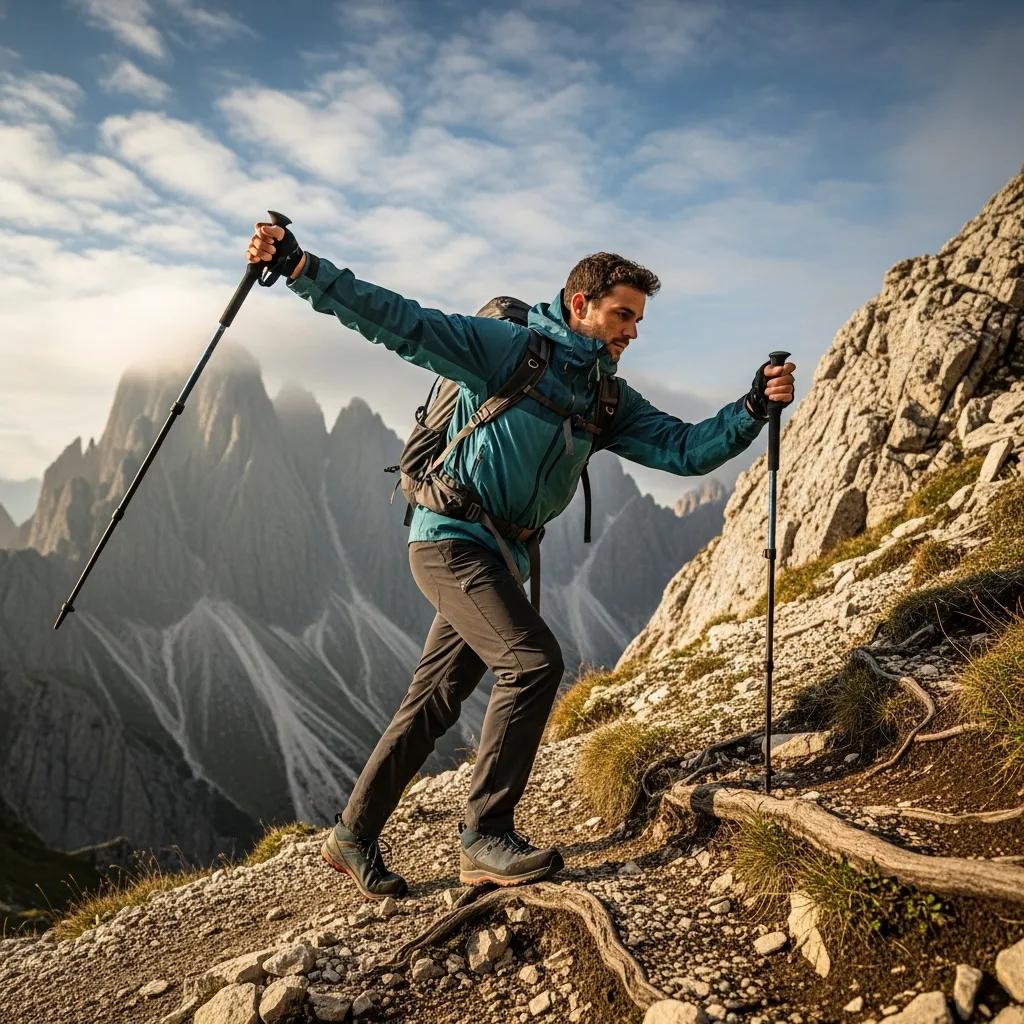
Best Trekking Poles for Mountain Hiking in 2026
For most mountain hikers, start with an adjustable aluminum pole and an external lever lock. Aluminum tolerates rough trail use well, the length can be changed for steep climbs and descents, and lever locks are easy to inspect in the field. Move to carbon when lower swing weight matters enough to justify the higher price and lower tolerance for sharp impacts; choose a folding design when you frequently stow the poles on a small pack.
What Trekking Poles Are Best for Mountain Hiking?
LEKI Makalu Lite is the strongest all-around mountain-hiking pick in this group. It uses an HTS 6.5 aluminum shaft, a simple external Speed Lock Plus system, an extended Aergon Air grip and a 100–135 cm adjustment range. It is not the lightest option here; that is part of the appeal when the goal is everyday mountain durability rather than shaving every gram.
Black Diamond Alpine Carbon Cork is the premium choice if you want lower swing weight and a cork grip in a full-length adjustable pole. Black Diamond Trail Back is the simpler value choice for hikers who would rather spend less and accept a little more weight.
For fastpacking, travel and routes where the poles spend time strapped to the pack, Black Diamond Distance Carbon FLZ is the compact option. REI’s current Traverse is a strong value alternative if you want cork grips and aluminum shafts.
2026 Mountain Hiking Pole Comparison
Weights come from current manufacturer or retailer listings. Where a brand lists weight per pole rather than per pair, it is labeled that way.
| Model | Editorial role | Shaft | Grip | Lock / format | Weight | Best fit |
|---|---|---|---|---|---|---|
| LEKI Makalu Lite Best overall | Durable adjustable | HTS 6.5 aluminum | Aergon Air foam | Speed Lock Plus · telescoping | 248 g per pole | General mountain hiking, backpacking, steep terrain |
| Black Diamond Alpine Carbon Cork Premium carbon | Light full-length mountain pole | 100% carbon | Cork + grip extension | Dual FlickLock Pro · telescoping | ~1.07 lb pair | Long mileage, backpacking, hikers who value lower swing weight |
| Black Diamond Trail Back Simple value | Durable no-frills pole | Aluminum | Foam + extension | FlickLock · telescoping | ~1 lb 2 oz pair | Day hikes, backpacking, mixed mountain terrain |
| REI Co-op Traverse Value cork | Comfortable adjustable value | 7001 aluminum | Cork | External lever · telescoping | ~1 lb 2.5–3.5 oz pair | Long trail days, backpacking, budget-conscious cork users |
| Black Diamond Distance Carbon FLZ Ultralight folding | Packability + low swing weight | 100% carbon | Foam | Folding / adjustable | ~0.68–0.8 lb pair | Fastpacking, travel, alpine approaches, frequent stowing |
Best Trekking Poles for Mountain Hiking
These are use-case picks, not a claim that one pole is best for every hiker, body size or route.
LEKI Makalu Lite
The Makalu Lite has the combination most mountain hikers actually need: aluminum shafts, quick external adjustment, an extended grip for traverses and steep pitches, and enough length range for varied terrain. LEKI’s Aergon Air grip gives you a broad top for palming on descents and a lower extension for quick hand changes.
The tradeoff is pack size. At 67 cm collapsed, it is not a small folding pole. If you spend a lot of time scrambling with poles on your pack, move down this list to a folding design.
Black Diamond Alpine Carbon Cork
Black Diamond places the Alpine series at the rugged end of its trekking-pole line, and this model keeps a conventional three-section adjustable format rather than chasing the smallest folded size. Cork grips and grip extensions suit long days where you change hand position often.
Carbon saves swing weight and feels quiet on hard trail surfaces, but sharp lateral impacts remain the reason some mountain hikers stay with aluminum. If you routinely wedge poles between boulders or beat them through talus, lighter is not automatically better.
Black Diamond Trail Back
Trail Back is the uncomplicated choice: three aluminum sections, external FlickLocks, foam grips and a broad adjustment range. The current version also includes trekking and snow baskets, which makes it more useful across shoulder-season hiking than a trail-only pole with a fixed small basket.
It is heavier than carbon and folding options, but that extra weight buys a straightforward design and leaves more room in the budget for boots, pack or rain gear.
REI Co-op Traverse
The current Traverse keeps the design mountain hikers tend to live with easily: aluminum, external lever locks, extended cork grips and two length ranges rather than one oversized universal pole. The smaller size also packs slightly shorter.
It is not ultralight. That is less important on ordinary hiking and backpacking routes than a comfortable grip, secure adjustment and a size range that actually fits the user.
Black Diamond Distance Carbon FLZ
The Distance Carbon FLZ solves a different problem: how to carry poles when you do not want them in your hands all day. The folding chassis packs far shorter than a standard telescoping pole, while FLZ adjustment gives more flexibility than a fixed-length running pole.
That makes it useful for fastpacking, air travel, alpine approaches and hikes that alternate between open trail and hands-on terrain. It is a poor value if the poles simply stay extended from trailhead to trailhead.
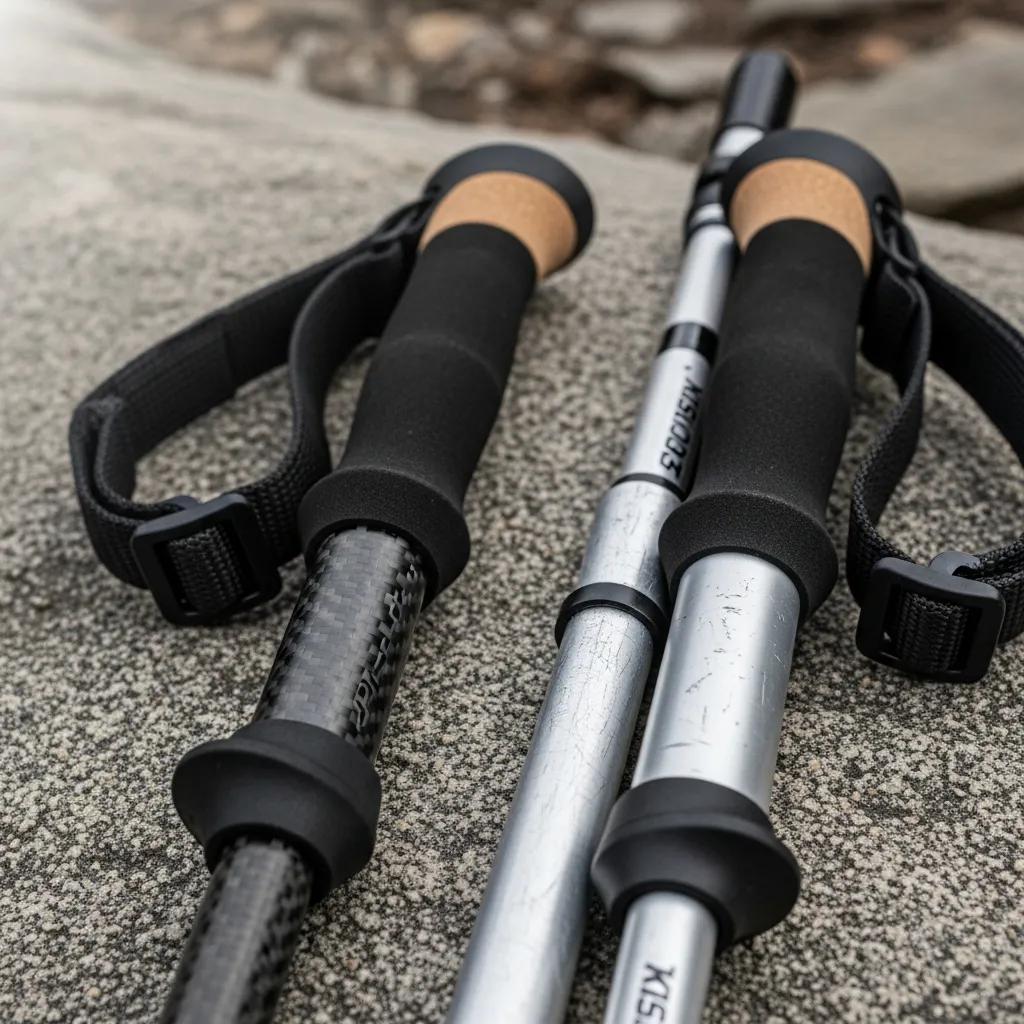
Carbon Saves Weight. Aluminum Buys Forgiveness.
Carbon feels light in the hand and cuts repeated swing weight over a long day. Aluminum is less elegant but tends to tolerate rough contact better. For a first pair of mountain poles, durability usually matters more than winning a scale comparison.
Carbon vs Aluminum Trekking Poles
Neither material is universally stronger. They fail differently, which is more useful to understand than a simple light-versus-heavy label.
| Factor | Carbon fiber | Aluminum | What matters in the mountains |
|---|---|---|---|
| Weight | Usually lower | Usually higher | Low swing weight adds up on very long days |
| Impact behavior | Can crack after a sharp impact | More likely to bend before complete failure | Aluminum is easier to trust around talus, scree and rough handling |
| Vibration | Typically damps vibration well | More direct feel | Mostly a comfort preference |
| Price | Usually higher | Usually lower | Spend on fit and lock quality before chasing carbon |
| Best use | High-mileage, fastpacking, weight-sensitive trips | General mountain hiking, backpacking, rough trails | Aluminum is the safer default for most buyers |
Telescoping vs Folding vs Fixed-Length
Telescoping
Best for general mountain hiking. You get the widest adjustment range, easy inspection of the locks and simple changes between climbs, descents and side-hill traverses. The penalty is a longer collapsed size.
Folding / Z-pole
Best when the poles go on and off the pack repeatedly. They collapse short and deploy quickly. Adjustment range may be narrower, and the internal cord/joint system adds another mechanism to inspect.
Fixed-length
Light and mechanically simple, but poorly suited to hikers who want different lengths for steep ascents and descents. Better for running and consistent terrain than a first pair of mountain poles.
Three-section lever-lock aluminum
It is not the lightest or smallest solution. It is the easiest format to understand, adjust and use across ordinary mountain terrain.
For detailed sizing, grip technique and how to change pole length on steep ground, use the separate Trekking Poles Guide: How to Choose & Use Them.
Locks, Grips, Straps & Baskets
External lever locks
They are easy to see, open and retension in the field. Check the lever before each hike; any adjustable pole can slip if the lock is loose or contaminated.
Cork vs foam
Cork feels good through warm, long days and gradually conforms to the hand. Foam is light, comfortable with gloves and common on performance poles. Shape and fit matter more than marketing around the material.
Useful on traverses
An extended lower grip lets you choke down on the uphill pole without stopping to change the shaft length. This is one feature worth having on irregular mountain terrain.
Match them to the surface
Small trekking baskets snag less on rock and brush. Wider snow baskets keep the pole from punching deeply into soft snow. Interchangeable baskets add useful four-season flexibility.
Which Pole Type Fits Your Mountain Terrain?
| Terrain / trip | Best pole setup | Why | Model from this page |
|---|---|---|---|
| Rocky mountain trail | Aluminum telescoping, lever lock | Impact tolerance and easy adjustment | LEKI Makalu Lite / BD Trail Back |
| Long backpacking trip | Cork or foam grip, adjustable | Comfort and multiple hand positions | BD Alpine Carbon Cork / REI Traverse |
| Fastpacking | Carbon folding | Low swing weight and short packed length | BD Distance Carbon FLZ |
| Steep descents | Adjustable lever-lock pair | Length can be increased and both poles used for support | Makalu Lite / Traverse / Trail Back |
| Soft snow | Adjustable pole with snow-basket compatibility | Wider basket reduces deep punching | Trail Back with included snow baskets |
| Frequent scrambling | Folding pole or compact telescoping model | Easier to stow when hands are needed | Distance Carbon FLZ |
| Travel-heavy itinerary | Folding | Short packed size simplifies checked luggage and small packs | Distance Carbon FLZ |
Do Trekking Poles Reduce Fatigue or Knee Load?
The useful answer is “sometimes, depending on terrain and technique.” The evidence is stronger than a marketing claim but narrower than saying poles prevent injury.
Less soreness and lower perceived exertion
Howatson and colleagues studied 37 active participants on an ascent and descent of Snowdon. The pole group reported lower perceived exertion on the ascent and showed lower post-trek muscle soreness and several lower markers of muscle damage.
PubMed study →Lower knee forces in steep downhill testing
On a 25-degree downhill ramp, researchers reported significant reductions in several ground-reaction, knee moment and tibiofemoral force measures when poles were used; the reported differences in key measures were roughly 12–25%.
PubMed study →Work shifted away from the lower body
In uphill treadmill backpacking with a pack equal to 30% of body mass, poles reduced activity in several lower-extremity muscles and lowered perceived exertion, while increasing upper-body involvement.
PubMed study →Level walking did not show the same knee benefit
A separate biomechanics study found that increasing pole force during level walking did not reduce estimated knee compressive force. That is a useful reminder that steep downhill results should not be generalized to every surface.
PubMed study →Make the Poles Reliable Before the Trailhead
Load-test the locks
Extend both poles to your normal length, close every lever and put body weight through them. Retension a loose lever before the trail rather than after the first slip.
Dry the sections apart
Separate telescoping sections after prolonged rain or stream crossings. Let them dry before storage, especially with aluminum shafts and internal hardware.
Inspect tips, baskets and joints
Replace worn carbide tips and cracked baskets. On folding poles, inspect the joints and tension cord for play before a long trip.
Look for cracks, not just bends
Carbon damage may be less obvious than a bent aluminum section. Retire a shaft with visible cracking, crushing or suspicious soft spots.
Keep the Trekking-Pole Topic Organized
How to Choose & Use Trekking Poles
Length, grip technique, pole rhythm, ascents, descents and how to use the straps.
Learn pole technique → Gear systemMountaineering Gear Checklist
Place poles inside the complete mountain-hiking or climbing kit rather than choosing them in isolation.
Open checklist → FootwearHiking vs Mountaineering Boots
Match footwear stiffness and traction to the same terrain that drives your pole choice.
Compare boots → Deep recovery 1Mountaineering Boots Guide
Useful when the hiking route begins moving into snow, crampons or stiffer footwear.
Choose boots → Deep recovery 2High-Altitude Layering
Build a clothing system for the mountain day rather than solving one gear item at a time.
Build layers → Deep recovery 3Mountain Weather
Wind, snow and wet conditions can matter more to the day than the difference between two pole models.
Read weather guide → Trip planningPlan the Mountain Trip
Transport, luggage, route timing and the practical decisions around the gear.
Plan the trip → Gear hubGear & Safety
Move from trekking poles into packs, layering, footwear and mountain safety systems.
Open gear hub →Selection Method
Mountain use first
We weighted shaft durability, locking system, adjustment, grip extension, packability, basket compatibility and current availability. A trail-running pole can be excellent and still rank lower here if it gives up too much durability or adjustment for ordinary mountain hiking.
Lowest weight alone
A 50-gram saving is not automatically an upgrade. On rough mountain trails, a secure lock and a pole you trust under load are often more useful than a spec-sheet win.
Frequently Asked Questions
What trekking poles are best for mountain hiking?
For most hikers, use an adjustable aluminum pole with an external lever lock. It is durable, easy to inspect and simple to change for steep terrain. LEKI Makalu Lite and Black Diamond Trail Back are good examples of that format.
Are carbon or aluminum trekking poles better?
Choose aluminum when durability and value matter most. Choose carbon when lower swing weight matters enough to justify the price and you are comfortable with its lower tolerance for sharp impacts. Neither material is automatically better for every route.
Are folding poles good in the mountains?
Yes. They are especially useful when the route alternates between hiking and hands-on terrain because they pack shorter. Standard telescoping poles usually offer more adjustment and are simpler as an all-purpose first pair.
Do trekking poles reduce knee stress?
They can during steep downhill walking. One biomechanics study reported lower knee forces and moments with poles on a steep ramp, while a later level-walking study did not find reduced knee compression. Terrain and technique matter.
Are anti-shock poles better?
Not necessarily. Anti-shock systems soften the feel of pole plants, which some hikers like on long descents. Standard rigid poles give direct feedback and use fewer moving parts. Treat shock absorption as a comfort preference, not a requirement.
What grip is best: cork or foam?
Cork works well for long warm-weather days and changes shape slightly with use. Foam is light, warm and comfortable with gloves. Choose the grip that fits your hand; a poorly shaped cork grip is not better than a comfortable foam one.
Should trekking poles have snow baskets?
If you hike on soft snow, yes. A wider basket keeps the shaft from punching deeply into the surface. Small trekking baskets are better on dry trail because they catch less on rocks and vegetation.
How do I size trekking poles?
Use the separate GSG trekking-pole technique guide for sizing. As a starting point on flat ground, many hikers adjust the pole so the elbow is near a right angle, then shorten it for steep climbs and lengthen it for descents.
Buy for the Roughest Terrain You Use Regularly.
If your hiking is steep, rocky and loaded, start with adjustable aluminum poles and good lever locks. If you regularly hike long distances and carry the poles on your pack, lighter carbon or a folding chassis begins to earn its cost. Fit, lock security and route match matter more than the brand name on the grip.
Was this helpful?
🏔Related peaks nearby
🧭Explore & compare
Global Summit Guide is an independent mountaineering resource founded in 2026. The team combines first-hand trekking and climbing experience with in-depth research and professional health and nutrition review to help climbers choose objectives, prepare properly, and stay safe.
Health, altitude, and nutrition content is reviewed by Taylor Ludlow (Registered Nurse) and Brigg Hoopes (Nutritionist).
What We Don't Know Yet
Mountain information changes quickly. This box explains the limits of what this page can responsibly promise.
- Gear requirements can change by season, route variation, weather window, personal cold tolerance, and guide-service requirements.
- Comparisons simplify complex decisions; the better mountain depends on current conditions, skills, timing, budget, and risk tolerance.
- Route conditions, snowpack, closures, and weather can change quickly after this page is updated.
- Permit rules, fees, quotas, and reservation windows may change between review cycles.
- Operator availability, pricing, guide ratios, and cancellation terms can change by season.
Verify current conditions with official land managers, guide services, local forecasts, and current route reports before booking or climbing.
Mountaineering, rock and ice climbing, glacier travel, and high-altitude activity are inherently dangerous and can result in serious injury or death. The information on Global Summit Guide is provided for general informational and educational purposes only and is not a substitute for professional instruction, qualified guiding, proper equipment, or your own judgment and experience.
Route conditions, weather, snowpack, permits, regulations, and hazards change constantly and may differ from what is described here. Details may be incomplete, out of date, or contain errors. Always verify current information with local authorities, certified guides, and official sources before making any decision in the mountains.
Nothing on this site is medical, legal, or financial advice. Our fitness, acclimatization, altitude, and nutrition content is general in nature; consult a qualified physician before beginning any strenuous exercise program or exposing yourself to high altitude.
You are solely responsible for your own safety and decisions. To the fullest extent permitted by law, Global Summit Guide and its team accept no liability for any loss, injury, damage, or expense arising from use of, or reliance on, this information. By using this site you acknowledge these risks and accept these terms.
Some links on this site may be affiliate links. If you buy through them we may earn a small commission at no extra cost to you; this never affects our recommendations.
Global Summit Guide recommendation path
Next Best Mountain to Research
Use these recommendations to continue the right planning path instead of stopping on one page.
Use current permit, weather, route, and operator information before booking or climbing.