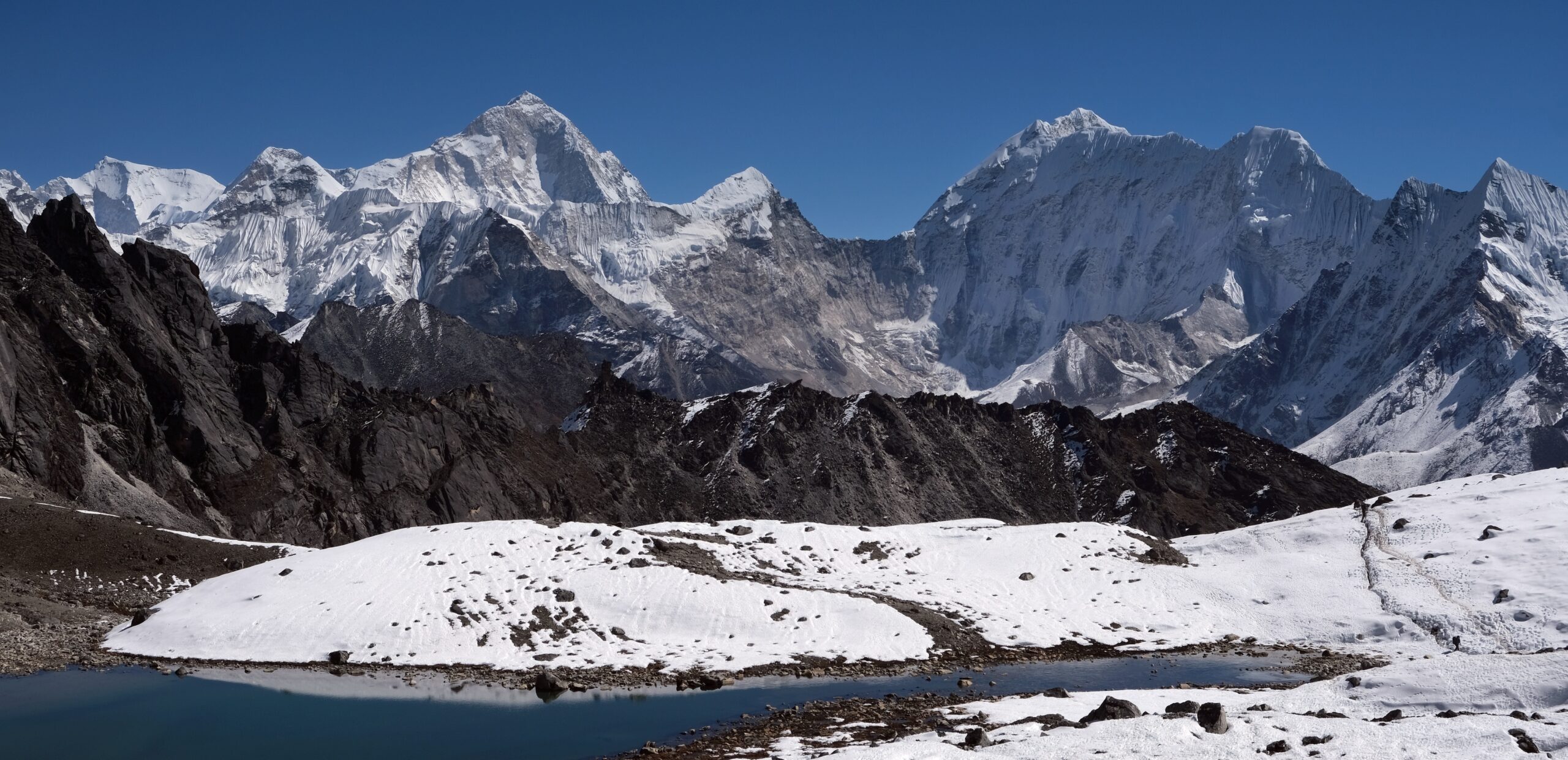
Climbing Makalu: The Great Black Pyramid, Fifth-Highest on Earth
At 8,485 meters (27,838 ft), Makalu is the world’s fifth-highest mountain and one of the most technical 8,000m peaks — an isolated four-sided pyramid whose dark granite summit demands actual rock climbing at extreme altitude. The name itself comes from the Sanskrit Maha Kala, meaning “Great Black One,” reflecting the mountain’s dramatic appearance and spiritual weight in Himalayan culture. This complete guide covers the Northwest Ridge via Makalu La standard route pioneered by the 1955 French first-ascent expedition, the 2026 Nepal permit structure following the September 2025 fee increase to $3,000, expedition costs, the 2025 season recap featuring Matthew Scholes’ no-oxygen summit, and Makalu’s role as a preparation peak for Everest-bound Seven Summits climbers.
(27,838 ft)
permit fee
death rate
since 1955
Makalu Location & Current Conditions
Live 7-day forecast at Makalu Base Camp elevation (4,870m) in the Barun Valley and interactive terrain map of the Mahalangur Himal region on the Nepal-China border.
Makalu · Nepal/China Border
27.8897°N, 87.0881°EBase Camp Weather
Elev: 4,870 mMakalu is the mountain that doesn’t get enough respect. Overshadowed by Everest (19 km to the northwest) and Kangchenjunga (to the east), Makalu is often treated as a secondary 8,000m objective — but climbers who have actually stood on its summit know better. Makalu is one of the most technical 8,000m peaks in the world, with a dark granite summit pyramid that demands genuine rock climbing at 8,300m+. The mountain’s name — from Sanskrit Maha Kala, meaning “Great Black One” — reflects both its visual character and its cultural weight. French climbers Lionel Terray and Jean Couzy made the first ascent on May 15, 1955, leading an extraordinary expedition in which all nine climbing team members reached the summit across three consecutive days — a feat unmatched in 1950s Himalayan climbing. The first winter ascent came 54 years later on February 9, 2009 by Italian Simone Moro and Kazakh Denis Urubko, making Makalu the last 8,000m peak to receive a winter ascent. This complete guide covers the Northwest Ridge via Makalu La standard route, the 2026 Nepal permit structure following the September 2025 increase to $3,000, expedition costs of $42,000-$100,000+, and the 2025 season’s hard-earned lessons including Matthew Scholes’ impressive no-oxygen summit on May 4 after other climbers had retreated from buried ropes.
All 2026 figures in this guide — permit fees, regulations, expedition costs, and logistics — were verified against the official Nepal Department of Tourism fee schedule and the Nepal Tourism Board. Historical climbing data draws on The Himalayan Database (Elizabeth Hawley’s canonical expedition archive), the American Alpine Club Publications, and the ExplorersWeb reporting on the 2025 season. The 1955 first-ascent narrative draws from Jean Franco’s expedition account and the archives of the French Himalayan Committee. Inline expedition facts have been cross-referenced against at least two independent sources. Fact-check date: April 18, 2026.
Makalu Quick Facts: Elevation, Route, Duration & Success Rate
Before diving into routes, logistics, and the 2026 permit structure, here are the essential facts every Makalu climber should know about the Great Black Pyramid.
Why Makalu Is One of the Most Technical 8,000m Peaks
Makalu’s reputation as a highly technical 8,000m peak is well-earned. While Everest and Lhotse share Khumbu Icefall infrastructure and Cho Oyu offers relatively moderate terrain, Makalu presents genuine climbing throughout — culminating in a summit pyramid where rock climbing at extreme altitude is unavoidable. Understanding these factors is essential before committing to an expedition.
Rock Climbing at 8,300m+
Unlike Everest, Cho Oyu, or Manaslu — where summit ridges are primarily snow and ice — Makalu’s final summit pyramid involves sustained mixed rock and ice climbing at extreme altitude. Climbers must place crampons on exposed granite, execute technical moves in oxygen-depleted air, and manage rope work on terrain that would be challenging at sea level. The summit pyramid above approximately 8,300m is the defining feature that separates Makalu from “walking 8,000m peaks” — and the reason experienced Himalayan climbers rank Makalu among the technically hardest of the 14 eight-thousanders.
Extreme Isolation
Makalu is more isolated than almost any other 8,000m peak. The mountain stands alone in the Mahalangur Himal — separated from Everest by deep valleys and reached only via the remote Barun Valley. Unlike Everest’s Khumbu region with its lodges, helicopter service, and commercial infrastructure, the Makalu approach through the Makalu-Barun National Park is wild, lightly trafficked, and logistically demanding. Rescue timelines are longer than most commercial 8,000m peaks. Supply chains can break. The Barun Valley itself is one of the most beautiful trekking corridors in Nepal, but its remoteness adds 2-3 weeks to any expedition’s total timeline.
Death Rate Higher Than Everest
Makalu’s historical death rate runs approximately 7-8% — significantly higher than Everest’s 1-3%. Through early 2026, approximately 50 climbers have died on Makalu against over 560 successful summits. Notably, 37 of those deaths occurred among climbers attempting Makalu without supplemental oxygen, reflecting how the technical terrain combined with extreme altitude amplifies risk for climbers without O2 support. The mountain’s technical summit pyramid, exposed ridges, and isolated logistics all contribute to the elevated mortality rate. While Makalu is not as deadly as K2 or Annapurna, it sits clearly in the upper tier of 8,000m peaks for fatal risk.
The Pyramidal Geometry Amplifies Everything
Makalu’s signature four-sided pyramid shape — one of the most geometrically pure mountains on Earth — creates four distinct ridges (northwest, southeast, northeast, southwest) and four major faces. This geometry means there is no easy side. Every route involves sustained steep climbing on exposed terrain. The pyramid also amplifies weather effects: wind accelerates around the sharp ridges, and the four faces collect and shed snow unpredictably. The 1955 French expedition leader Jean Franco described the pyramid’s north face as deceptively steep — climbers consistently report that Makalu’s angles are harder than photographs suggest.
Makalu La Wind & Exposure
The Makalu La — the 7,400m col between Makalu and its subsidiary peak Kangchungtse — is one of the most exposed high camps on any 8,000m peak. The 1955 French team recorded winds exceeding 100 km/h during their Camp V establishment. Modern climbers still encounter severe weather at the col, with camp destruction incidents reported across multiple expedition seasons. Camp 3 is typically placed on or near the Makalu La, making it both the critical acclimatization anchor and a location where expeditions have been forced to retreat due to weather. Climbers must plan for the possibility that Camp 3 may be uninhabitable during storm cycles.
Variable Route Conditions
Makalu’s standard route can vary dramatically in character from season to season. Some years present clean ice climbing with well-established fixed lines; other years feature deep snow that buries ropes and forces teams to break trail through drifts. The 2025 season famously began with buried fixed lines that forced multiple teams to retreat from early summit attempts — until Matthew Scholes’ no-oxygen push on May 4 proved that the route could be climbed with patience and skill. Operators watch snow conditions, rope readiness, and weather stability closely each season, and experienced Makalu climbers build flexibility into their timelines.
Late Winter First Ascent (2009)
Makalu was the last 8,000m peak to receive a winter ascent. From 1955 through 2008, Makalu repeatedly defeated winter expeditions — including the 2006 disappearance of French alpinist Jean-Christophe Lafaille, who attempted a solo winter ascent and was never found. It took until February 9, 2009 for Simone Moro (Italy) and Denis Urubko (Kazakhstan) to complete the first winter ascent. The mountain’s resistance to winter climbing illustrates how severe Makalu’s upper conditions can become — jet stream winds, extreme cold, and technical terrain combine to create conditions that defeated even elite alpinists for more than five decades after the first summer ascent.
West Pillar: The Ultimate Challenge
Beyond the standard route, Makalu’s West Pillar (sometimes called the French Pillar) is widely regarded as one of the hardest technical climbs on any 8,000m peak. First climbed in May 1971 by Frenchmen B. Mellet and Y. Seigneur, the West Pillar involves sustained extreme-difficulty climbing at altitude. John Roskelley’s second ascent in 1980 without Sherpa support or bottled oxygen is considered one of the great alpine-style climbs in Himalayan history. The route won the 1998 Piolet d’Or when a Russian team successfully ascended the West Face. The existence of these routes — some of the hardest on Earth — reinforces that Makalu is fundamentally a technical mountain, not a walking 8,000er.
Who Can Realistically Climb Makalu?
Makalu is not for climbers with minimal 8,000m experience. Unlike Everest or Lhotse, which benefit from shared commercial infrastructure in the Khumbu region, Makalu requires climbers to be genuinely capable at every phase of the climb — from the remote Barun Valley approach through the technical summit pyramid. Understanding the actual prerequisites helps aspiring Makalu climbers assess whether the mountain is within reach or still years of progression away.
Minimum Experience Prerequisites
Reputable Makalu operators typically require the following experience before accepting clients:
- Multiple successful 7,000m+ summits — ideally including technical peaks, not just walk-ups
- At least one prior 8,000m summit — most operators strongly prefer Cho Oyu, Manaslu, or Lhotse as preparation. Everest alone is acceptable but not ideal since Everest’s trade route is less technical than Makalu.
- Strong rock climbing ability in mountaineering boots — the summit pyramid requires genuine rock movement with crampons at extreme altitude
- Proven fixed-line and jumar competence on steep technical terrain
- Exceptional aerobic fitness — Makalu’s long summit days reward endurance over raw strength
- Cold-weather tolerance below -30°C — summit temperatures routinely fall below -35°C with wind chill
- Mature expedition judgment — Makalu’s remoteness means small errors compound quickly
Makalu Is Appropriate For:
Experienced 8,000m climbers progressing through the 14 peaks. Makalu is often climbed in the middle of 14-8000ers projects by climbers who have completed Manaslu, Cho Oyu, Lhotse, and ideally Everest. The ideal candidate has proven capability on both standard and technical 8,000m objectives.
Seven Summits climbers seeking Everest preparation. While Makalu itself is not a Seven Summit, it is widely considered one of the best preparation peaks for Everest among climbers pursuing the Seven Summits. The technical terrain and extreme altitude build skills directly applicable to Everest’s South Col route and beyond.
Climbers who value the wilderness experience. Makalu’s remote Barun Valley approach, Makalu-Barun National Park trekking, and relative lack of commercial crowding reward climbers who want a more traditional expedition experience compared to the increasingly commercialized Everest or Cho Oyu.
Technical climbers seeking an 8,000m pyramid. For mountaineers who prefer real climbing to walking, Makalu offers sustained technical interest from Base Camp to summit. Climbers coming from alpine backgrounds often find Makalu more satisfying than less technical 8,000m peaks.
Makalu Is Not Appropriate For:
Climbers whose only 8,000m experience is Everest’s trade route. Makalu’s technical character differs significantly from Everest’s South Col route. Everest-only summiters without additional technical 8,000m experience are at elevated risk on Makalu.
Climbers without any 8,000m experience. Jumping from 7,000m peaks directly to Makalu is risky and typically not accepted by reputable operators. The technical summit pyramid is not the place to experience extreme altitude for the first time.
Climbers without rock climbing ability. Unlike Everest or Cho Oyu, where the summit ridge is essentially snow walking with fixed lines, Makalu’s summit pyramid demands actual rock climbing capability. Climbers who struggle on 5.6 terrain at sea level will struggle catastrophically on the Makalu summit pyramid at 8,300m.
Climbers expecting Everest-level commercial infrastructure. Makalu operates with significantly smaller teams, less fixed-line redundancy, and minimal helicopter rescue capability above Base Camp. Climbers who depend on commercial infrastructure to compensate for skill gaps will be exposed to the mountain’s full character.
A realistic progression to Makalu typically spans 7-10 years of serious mountaineering: 2 years building technical rock and alpine climbing skills, 2-3 years on 6,000-7,000m peaks (Island Peak, Ama Dablam, Baruntse), at least one 8,000m summit (Manaslu or Cho Oyu before Makalu), and ideally Lhotse or Everest experience before Makalu. Climbers who attempt Makalu as their first or second 8,000m peak are at significantly elevated risk compared to those who build genuine technical 8,000m experience first.
Makalu & The Seven Summits: Why Climbers Use Makalu as Everest Preparation
Makalu is not one of the Seven Summits — the highest peaks of each continent — because Asia’s representative in that framework is Mount Everest. However, Makalu plays a well-established role in the Seven Summits pathway as one of the best Everest preparation peaks available. Climbers targeting the full Seven Summits circuit (and particularly those worried about Everest’s technical demands) often choose Makalu specifically because its technical character builds the skills Everest will demand.
Explore the Seven Summits Framework
Makalu is not a Seven Summit itself, but it prepares climbers for Everest — Asia’s representative in the Seven Summits. Climbers pursuing the full continental high points often use Makalu, Lhotse, or Cho Oyu as their final 8,000m preparation before Everest.
Why Makalu Builds Everest-Ready Skills
Several specific capabilities transfer directly from a successful Makalu expedition to an Everest attempt:
- Extreme altitude physiological experience. Makalu’s 8,485m summit places climbers in the extreme death zone for extended summit-day periods — building the physiological tolerance Everest’s 8,848m summit demands.
- Technical climbing under oxygen debt. The summit pyramid rock climbing teaches climbers how to execute complex movements when oxygen-depleted — a critical skill Everest’s more moderate terrain does not reliably develop.
- Remote expedition logistics. The Barun Valley approach teaches self-sufficiency in ways Everest’s Khumbu infrastructure does not. Climbers who successfully manage Makalu logistics are better equipped for any future expedition.
- Decision-making under duress. Makalu’s variable conditions — buried ropes, weather delays, challenging terrain — force real decision-making rather than simple protocol-following. This judgment transfers to Everest.
- Sherpa and team coordination. Working with a Makalu Sherpa team on technical terrain builds the trust and communication patterns that benefit any future Everest expedition.
Seven Summits Climbers and Makalu Strategic Timing
For climbers targeting the full Seven Summits, Makalu typically fits into the pathway in one of three ways:
Pre-Everest preparation (most common): Climb Makalu 1-2 years before attempting Everest to build technical 8,000m capability. This is the approach taken by many serious Seven Summits aspirants who understand Everest is hardest on the continental list.
Alongside Everest as dual objectives: Some climbers attempt Makalu and Everest in the same spring season — typically Everest first (late April summit push), then Makalu later in May. This is extraordinarily demanding and requires premium commercial support.
After Everest for the 14-8000ers crossover: Climbers who complete the Seven Summits and want to progress to the 14 eight-thousanders typically add Makalu as their second or third 8,000m peak after Everest, using Everest’s trade-route experience as foundation.
For detailed Seven Summits planning, see our complete Seven Summits guide and Your Path to the Seven Summits planning tool.
Makalu History: From 1954 Reconnaissance to the 2009 Winter Ascent
Makalu’s climbing history spans over seven decades — from the 1921 British Everest reconnaissance that first photographed and mapped the peak, through the failed American attempt of 1954, the legendary 1955 French first ascent, the technical revolution of the 1970s, and the long-awaited 2009 winter summit. Understanding this history provides essential context for the mountain’s character.
Early Exploration (1921-1954)
Makalu was first photographed and mapped from the Tibetan side in 1921 as part of the British Everest reconnaissance expedition — decades before any climbing attempts. The mountain’s isolated pyramid shape was immediately recognizable to European observers, and its technical character was noted. However, Makalu received no serious climbing attention until after Everest was climbed in 1953.
The first serious attempt came in spring 1954 with the California Himalayan Expedition led by medical physicist William Siri. The ten-man American team included Sierra Club members, Yosemite climber Allen Steck, and Willi Unsoeld (who would later climb Everest via the West Ridge in 1963). The team attempted the Southeast Ridge but was turned back at 7,100m by constant storms, heavy snowfall, and high winds. Their attempt demonstrated Makalu’s serious character and identified challenges for subsequent expeditions.
Later in fall 1954, a French reconnaissance expedition led by Jean Franco reached the Makalu La at 7,400m and made the first ascent of the subsidiary summit Kangchungtse (Makalu II, 7,678m) on October 22, 1954, by Franco, Gyaltsen Norbu, and Pa Norbu. The same expedition also climbed Chomo Lonzo (7,804m), with Jean Couzy and Lionel Terray likely completing that first ascent on October 30. This reconnaissance established the route that would succeed in 1955.
The 1955 French First Ascent
The successful ascent came through the 1955 French Makalu Expedition, led by Jean Franco — the 40-year-old mountain guide entrusted with the expedition by the Himalayan Committee. The team included veterans of the 1950 Annapurna success: Jean Couzy (specialized equipment and oxygen), Lionel Terray (filming), Guido Magnone (technical development), and others. The expedition approached with 180 porters and 6.5 tonnes of equipment.
On May 15, 1955, Lionel Terray and Jean Couzy reached the summit — the first humans to stand on Makalu. They climbed via the north face and northeast ridge, traversing the Makalu La between Makalu and Kangchungtse. The team used supplemental oxygen above 7,100m.
But the expedition’s extraordinary achievement was not just the first ascent — it was that every single climbing team member reached the summit across three consecutive days:
- May 15, 1955: Lionel Terray and Jean Couzy
- May 16, 1955: Jean Franco, Guido Magnone, and Sherpa sirdar Gyaltsen Norbu
- May 17, 1955: Jean Bouvier, Serge Coupé, Pierre Leroux, and André Vialatte
Nine climbers summited across three days. This was unprecedented in 1950s Himalayan expeditions, which typically put only one or two climbers on top while the rest served as support. The 1955 French expedition remains one of the most remarkable team achievements in Himalayan history.
Makalu’s 1955 summit made it the sixth of the 14 eight-thousanders to be climbed, following Annapurna (1950), Everest (1953), Nanga Parbat (1953), K2 (1954), and Cho Oyu (1954). The rapid pace of first ascents during 1950-1955 represented the “Golden Age of Himalayan mountaineering” — an era when large national expeditions with substantial equipment and support pioneered routes that smaller teams still climb today.
The Technical Route Era (1970s)
After the 1955 standard route, Makalu saw increasingly technical route development through the 1970s:
- May 23, 1970: First ascent of the Southeast Ridge by Y. Ozaki and A. Tanaka of a Japanese expedition — the same ridge the 1954 American team had attempted and failed on
- May 1971: First ascent of the extremely technical West Pillar (also called the French Pillar) by Frenchmen B. Mellet and Y. Seigneur — widely considered one of the hardest technical lines on any 8,000m peak
- 1975: First ascent of the South Face by a Slovenian expedition led by Aleš Kunaver — the third ascent of an 8,000m peak by a great mountain face. Slovenian Marjan Manfreda made the first oxygen-free ascent of Makalu during this expedition.
- 1976: South Pillar route completed by a Czechoslovak expedition, following the 1973 attempt that ended tragically with the death of Jan Kounický at 8,010m
Modern Notable Ascents
- October 15, 1981: Polish climber Jerzy Kukuczka ascended Makalu solo via a new route on the north-western side — Alpine style without supplemental oxygen
- April 27, 1988: Frenchman Marc Batard climbed Makalu in a single day from high camps via the West Buttress
- May 15, 1990: First female ascent by Kitty Calhoun via the West Pillar — the technical route, not the standard
- May 15, 1994: Anatoli Boukreev and Neal Beidleman climbed Makalu in 46 hours, commemorating the 39th anniversary of the first ascent
- 1997: First ascent of the West Face after seven failed attempts between 1977 and 1996 — a Russian expedition led by Sergey Efimov won the 1998 Piolet d’Or for this climb
- January 27, 2006: French alpinist Jean-Christophe Lafaille disappeared on Makalu attempting the first solo winter ascent — his body was never found
- February 9, 2009: First winter ascent by Simone Moro (Italy) and Denis Urubko (Kazakhstan) — Makalu was the last 8,000m peak to receive a winter ascent
Through early 2026, Makalu has seen approximately 560+ successful summits and roughly 50 deaths, establishing its historical record as one of the more challenging 8,000m peaks. Notably, 37 of the recorded deaths occurred among climbers without supplemental oxygen, reflecting how technical terrain amplifies risk for no-O2 attempts.
Makalu’s Climbing Routes: Northwest Ridge & Technical Alternatives
Makalu has seen more than a dozen distinct route lines over its climbing history, but only one — the Northwest Ridge via Makalu La — is the commercial standard. The technical alternatives (West Pillar, South Face, South Pillar) are reserved for elite alpinists and are essentially never attempted by commercial teams. This guide focuses on the standard route since it is the only realistic option for most climbers.
| Route | Country Access | Base Camp Elev | Key Features | Share | Character |
|---|---|---|---|---|---|
| Northwest Ridge via Makalu La | Nepal (Barun) | 4,870 m | Makalu La col, northwest face, summit pyramid | ~80%+ | Standard commercial |
| Southeast Ridge | Nepal | ~5,000 m | 1954 American attempt line, 1970 Japanese FA | ~5-8% | Technical alternative |
| West Pillar (French Pillar) | Nepal | ~5,100 m | One of hardest 8000m lines ever climbed | <2% | Elite alpine only |
| South Face | Nepal | ~4,900 m | 1975 Slovenian FA, no-O2 Marjan Manfreda | <1% | Elite alpine only |
Northwest Ridge via Makalu La
The Northwest Ridge via Makalu La is the standard commercial route on Makalu and the line pioneered by the 1955 French first-ascent expedition. It begins from Makalu Base Camp at approximately 4,870m in the Barun Valley and climbs through the northwest face to the summit pyramid. The route’s defining logistical feature is the Makalu La col at 7,400m — the high pass between Makalu and Kangchungtse where Camp 3 is typically established.
The route’s character evolves through distinct zones. The approach from Base Camp through Camps 1 (~6,100m) and 2 (~6,600m) involves glacier travel and moderate snow climbing. Above Camp 2, the climb steepens significantly as climbers work through the northwest face toward the Makalu La. The col itself is highly exposed — wind speeds exceeding 100 km/h have been recorded during expedition seasons, and camp establishment at Camp 3 on the Makalu La can be repeatedly disrupted by storms.
From the Makalu La, the route turns up the northwest ridge toward the summit pyramid. Camp 4 is typically at 7,800m. Summit day involves climbing progressively steeper terrain culminating in the summit pyramid rock climbing above 8,300m — the crux of the entire route and the defining technical feature that separates Makalu from less demanding 8,000m peaks. Climbers must execute rock climbing moves with crampons at extreme altitude, an unusual skill requirement among the standard routes of the 14 eight-thousanders.
Southeast Ridge
The Southeast Ridge is Makalu’s most significant alternative route. It was the line attempted by the 1954 American California Himalayan Expedition led by William Siri, which reached 7,100m before retreating in storms. The first ascent was completed on May 23, 1970 by Japanese climbers Y. Ozaki and A. Tanaka.
The Southeast Ridge is significantly more technical than the Northwest Ridge standard route, with sustained steep climbing on exposed terrain and fewer natural camp sites. It is not a standard commercial route, and expeditions attempting the Southeast Ridge are typically small alpine-style teams rather than guided commercial clients. Fixed-line infrastructure is minimal or nonexistent in any given season.
For practical commercial climbing planning, the Southeast Ridge is not a realistic option. Climbers interested in technical Makalu variants should work with specialty operators running alpine-style expeditions, and have substantial Himalayan technical experience first.
West Pillar (French Pillar) & South Face
Makalu’s West Pillar — also called the French Pillar — was first climbed in May 1971 by Frenchmen B. Mellet and Y. Seigneur and is widely regarded as one of the hardest technical routes on any 8,000m peak. John Roskelley’s 1980 second ascent without Sherpa support or bottled oxygen is considered one of the great alpine-style climbs in Himalayan history. The route demands sustained extreme-difficulty climbing at altitudes above 8,000m.
The South Face was first climbed in 1975 by a Slovenian expedition led by Aleš Kunaver — the third ascent of an 8,000m peak by a great mountain face. Slovenian Marjan Manfreda made the first oxygen-free ascent of Makalu during this expedition, setting a high-altitude record for no-O2 climbing at the time. The 1998 Piolet d’Or was awarded to the Russian expedition that climbed the West Face in 1997 after seven previous failed attempts.
These routes are not commercial objectives and should not be considered realistic planning options. Climbers researching Makalu for guided commercial climbing should focus entirely on the Northwest Ridge standard route. The technical lines exist for elite alpinists pursuing career-defining objectives, and any attempt requires extensive personal preparation, alpine-style expedition experience, and specialized logistics support.
2026 Makalu Permits, Fees & Nepal Regulations
Makalu climbing permits are administered by the Nepal Department of Tourism under the same framework that governs all of Nepal’s 8,000m peaks. The 2026 permit structure reflects the significant fee increase that took effect on September 1, 2025, with Makalu’s spring permit rising from $1,800 to $3,000 — a 67% increase matching the proportional hike applied to Lhotse, Kangchenjunga, Manaslu, Dhaulagiri, and Annapurna I.
Effective September 1, 2025, Nepal raised climbing permit fees for all 8,000m peaks. Makalu’s spring permit rose from $1,800 to $3,000 per climber — a 67% increase matching the proportional hikes applied to all Nepali 8,000ers except Everest (which jumped from $11,000 to $15,000). Nepal cited safety, environmental protection, overcrowding management, and rescue infrastructure funding as justifications. The new fees are considered final for 2026 — expeditions applying now should budget the updated rates.
2026 Makalu Permit Fees
Foreign climbers:
- Spring (March-May): $3,000 per climber — the overwhelming majority of Makalu permits are issued in this category
- Autumn (September-November): $1,500 per climber — rare attempts
- Winter (December-February) & Monsoon (June-August): $750 per climber — specialized attempts only
Nepali climbers: Reduced rates proportionally lower than foreign fees, typically NPR 50,000-75,000 for spring ($400-600 equivalent).
Key Regulatory Requirements
Beyond the permit fee, several Nepal regulations govern 8,000m expeditions:
- Permit validity: 55 days from issuance (reduced from the previous 75-day window per 2025 regulatory changes)
- Mandatory licensed guide: 1 guide per 2 climbers required on peaks above 8,000m since 2025
- Liaison officer: Nepal government Liaison Officer accompanies each expedition
- GPS tracking: Climbers required to carry GPS tracking devices per 2025 regulations
- Biodegradable waste bags: Mandatory for human waste
- Insurance requirements: Climbers must carry insurance with evacuation coverage; Sherpa and porter staff must be insured through the expedition operator
- Makalu-Barun National Park entry fee: Separate fee for the national park (approximately NPR 2,000-4,000 per person)
- Environmental deposits: Expeditions must provide environmental/garbage deposits refunded upon verified cleanup
Access Logistics
Makalu access is significantly more complex than Everest-region peaks due to the remote Barun Valley location:
- International flight to Kathmandu: Nepal’s main international airport (Tribhuvan International)
- Domestic flight Kathmandu → Tumlingtar: 30-45 minute flight to the eastern Nepal trailhead staging area
- Tumlingtar → Num: Jeep transport to the trekking trailhead
- Num → Makalu Base Camp: 7-9 day trek through the Makalu-Barun National Park via Seduwa, Tashigaon, Kongma La pass, and the Barun Valley to Base Camp at approximately 4,870m
The Barun Valley approach is widely considered one of the most beautiful trekking routes in Nepal — traversing subtropical lowlands, rhododendron forests, alpine meadows, and finally the glaciated Barun cirque. The approach consumes 10-14 days from Kathmandu to Base Camp, adding significant time to total expedition length.
Makalu Expedition Costs in 2026
Makalu expeditions cost more than Lhotse or Cho Oyu due to the longer approach logistics, fewer operators, and higher Sherpa staffing requirements for the technical summit pyramid. Understanding the full cost picture helps climbers budget realistically.
Standard Expedition: $32,000–$55,000
A standard commercial Makalu expedition in 2026 costs $32,000-$55,000 per climber for a full 6-8 week Nepal-side program. This tier includes the $3,000 permit, Liaison Officer fees, Base Camp services with meals and tents, fixed lines and group equipment, basic Sherpa support, essential oxygen supply (4-5 bottles), and logistics management through the Barun Valley approach. Operators in this tier are typically Nepali outfitters with established Makalu experience.
Premium Expedition: $55,000–$80,000
Premium Makalu operators charge $55,000-$80,000 for enhanced expeditions featuring higher Sherpa-to-client ratios (often 1:1), more oxygen bottles (5-7), Western guides, superior Base Camp amenities, enhanced safety protocols, and smaller team sizes. Operators in this tier include Madison Mountaineering, Seven Summit Treks, SummitClimb, Imagine Nepal, Elite Exped, Satori Adventures Nepal, 8K Expeditions, and specialty alpine-style operators.
Luxury/Personal Sherpa: $80,000–$100,000+
The luxury Makalu tier offers personalized services: private Nepali Sherpa assigned to each client, unlimited oxygen, enhanced base camp facilities, and technical climbing support specifically tuned to the summit pyramid rock climbing. Some operators also offer combined Makalu + other 8,000m peak programs for 14-8000ers project climbers.
Additional Required Costs Beyond Expedition Fee
- Personal gear: $5,000-$12,000 (8,000m boots, down suit, technical climbing equipment)
- International flights to Kathmandu: $1,200-$2,500 round trip
- Travel insurance with high-altitude coverage: $1,500-$4,000 (Makalu evacuation is expensive due to remote location)
- Pre/post-climb Kathmandu hotels: $300-$800
- Tips for Sherpa and support staff: $800-$1,800
- Personal communications (satellite phone rental): $300-$800
- Supplemental oxygen (if using beyond included): $400-$600 per bottle
- National park fees & local taxes: $150-$300
Total realistic Makalu expedition budget: $42,000-$70,000 (standard), $65,000-$95,000 (premium), $95,000-$130,000+ (luxury).
Makalu Gear Checklist
Makalu gear requirements mirror other 8,000m peaks but with specific emphasis on the summit pyramid’s technical rock climbing requirements. Every climber should have quality technical climbing equipment capable of handling steep rock and ice at extreme altitude.
Death Zone Clothing
- Full down suit (Himalaya-grade, 800-fill, -40°C rated)
- Or: expedition parka + down pants combination
- 2-3 sets base layers (merino wool or synthetic)
- Heavyweight fleece mid-layer
- Windproof/water-resistant hardshell jacket and pants
- Expedition mitts + liner gloves (2+ pairs of mitts)
- Balaclava + buff for face protection
- Category 4 glacier sunglasses + goggles for wind
8,000m Boot System
- 8,000m double/triple boots (La Sportiva Olympus Mons, Scarpa Phantom 8000, Millet Everest)
- Insulated overboots (if not triple boot)
- 4-5 pairs heavy-duty socks
- Sock liners (multiple pairs)
- Chemical foot warmers (emergency backup)
Technical Climbing Gear (Rock-Ready)
- Climbing harness (alpine style, rated for extreme conditions)
- Climbing helmet (rockfall protection essential)
- 12-point steel crampons with horizontal front points for mixed rock/ice
- 70cm ice axe + lightweight technical second tool for summit pyramid
- Ascender (jumar) + backup ascender for sustained fixed-line work
- Belay/rappel device (ATC or similar)
- 10-12 locking carabiners + 8-10 non-locking
- Prusik cords (3mm, multiple pieces)
- Personal quickdraws, slings, and anchor materials
Oxygen System
- Oxygen mask (Summit Oxygen or Topout)
- Regulator matched to operator’s bottles
- 4-6 oxygen bottles standard
- Spare mask parts (valves, seals)
- Backup low-flow regulator
Sleep System
- Down sleeping bag rated to -40°C
- Closed-cell foam pad + inflatable pad combination
- Compression stuff sack
- Silk or thermal liner for additional warmth at higher camps
Hydration & Nutrition
- Insulated water bottles (Nalgene with parka sleeves) — hydration bladders freeze
- Water purification tablets (chlorine dioxide)
- High-calorie expedition food (6,000-7,000 cal/day summit push)
- Gels and easy-digest foods for long summit days
- Electrolyte supplements
Self-Rescue & Emergency Kit
- Personal first aid kit with altitude medications (Diamox, dexamethasone if prescribed)
- Blister and frostbite prevention supplies
- Emergency bivy bag or space blanket
- Headlamp + 4-5 spare battery sets
- Satellite messenger (Garmin inReach or similar) — critical given remote rescue timelines
- GPS device (mandatory per Nepal 2025 regulations)
Documents & Electronics
- Nepali tourist visa (typically obtained on arrival)
- Climbing permit documents
- Makalu-Barun National Park permit
- Travel insurance documents (high-altitude + body recovery)
- Medical certificate
- Solar charger + cold-resistant power bank
- Camera (with spare cold-resistant batteries)
- Watch with altimeter
The Summit Pyramid: Makalu’s Defining Technical Challenge
No feature defines Makalu more than the summit pyramid — the dark granite apex above approximately 8,300m where climbers must execute genuine rock climbing at extreme altitude. Understanding the summit pyramid is essential to understanding how Makalu expeditions differ from less technical 8,000m peaks.
What the Summit Pyramid Is
The summit pyramid is the geometrically regular four-sided rock pyramid that forms Makalu’s upper mountain above approximately 8,300m. Its sharp ridges give Makalu its distinctive appearance from all directions, and its granite composition gives the mountain its “Great Black One” character — the rock is noticeably darker than surrounding peaks, particularly visible from the south and west.
Climbers on the Northwest Ridge route showing the technical terrain characteristic of Makalu’s upper mountain
Why It Demands Rock Climbing
Unlike Everest, Lhotse, Cho Oyu, and most other 8,000m standard routes where summit ridges are primarily snow and ice climbing with fixed lines, Makalu’s summit pyramid involves:
- Exposed granite slabs — climbers must place crampons carefully on rock that would be considered 5.4-5.6 at sea level (but much harder at 8,300m+)
- Mixed rock-and-ice sections — climbers move from ice to rock and back, requiring adaptable crampon and tool technique
- Narrow passages where only one climber can move at a time
- Limited fixed-line infrastructure — fixed ropes are often only partial or absent on summit pyramid sections
- Rockfall exposure — warming granite faces can release rocks during the day
Summit-Day Implications
The summit pyramid’s technical character shapes every aspect of Makalu summit days:
- Early-start imperative: Climbers must depart Camp 4 before midnight to reach the summit pyramid in morning cold, before solar warming loosens rock
- Technical gear at altitude: Technical ice tools and supplementary rock gear must be carried high, adding weight on summit day
- Slower movement rates: Makalu summit days often take 12-16 hours round trip from Camp 4, longer than many other 8,000m peaks due to technical terrain
- Turnaround discipline: Climbers experiencing any hesitation on the summit pyramid should retreat rather than force difficult moves at altitude
- Weather-window sensitivity: The summit pyramid is exposed and loses safety margins faster than less technical terrain when weather deteriorates
Experienced Makalu climbers consistently emphasize that the summit pyramid is where training pays off — climbers who developed real rock climbing skill and experience before Makalu will manage the pyramid successfully, while climbers who skipped this preparation often find themselves overwhelmed by conditions their body cannot execute in oxygen-depleted air.
Makalu route map showing the Northwest Ridge camp system from Base Camp at 4,870m to the summit at 8,485m
Makalu Safety, Mortality & the No-Oxygen Problem
Makalu’s historical death rate runs approximately 7-8% of ascents — significantly higher than Everest’s 1-3% but lower than K2’s 20-25% or Kangchenjunga’s 20-22%. Understanding where Makalu deaths actually occur — and the striking pattern that most fatalities involve climbers without supplemental oxygen — is essential for realistic planning.
Makalu Mortality Statistics
Through early 2026, approximately 50+ climbers have died on Makalu against over 560 successful summits. A striking pattern emerges from the statistics: 37 of the recorded deaths — approximately 74% — occurred among climbers attempting Makalu without supplemental oxygen. This pattern reflects how Makalu’s technical terrain combines with extreme altitude to create conditions where oxygen-depleted decision-making and coordination become catastrophic.
Why No-Oxygen Makalu Is So Dangerous
The technical summit pyramid makes Makalu particularly unforgiving for climbers without supplemental oxygen:
- Rock climbing requires cognitive function. Unlike walking a snow ridge, executing rock moves at altitude demands the kind of fine motor control and judgment that oxygen depletion degrades rapidly.
- Technical movement demands cardiovascular reserve. Without supplemental O2, climbers operating at 8,300m+ have dramatically reduced physical reserves for sustained technical effort.
- Error consequences are immediate. On Everest’s South Col route, a slightly-slower climber has hours of walking terrain to recover. On Makalu’s summit pyramid, a single poorly-executed move can be fatal.
- Weather window pressure. No-O2 climbers move slower, giving weather more time to deteriorate during exposed summit-day climbing.
- Exhaustion-related falls. Many of the 37 no-O2 deaths occurred during descent when exhaustion combined with technical terrain produced fatal falls.
Other Death Patterns
- Summit pyramid falls: Multiple climbers have died on descent from the summit pyramid, where exhaustion combined with technical terrain produces catastrophic accidents
- Makalu La wind events: Camp 3 on the Makalu La has been destroyed by wind multiple times, with climbers caught unprepared
- Disappearances: Jean-Christophe Lafaille’s 2006 disappearance during solo winter attempt is the most famous, but multiple climbers have been lost without recovery over the decades
- Altitude illness: HAPE and HACE account for a portion of Makalu deaths, particularly on early-season attempts before full acclimatization
Safety Principles for Makalu
Experienced Makalu climbers emphasize these principles:
- Use supplemental oxygen unless you have specific no-O2 experience. Given the 74% no-O2 death rate, oxygen is a significant safety advantage on Makalu’s technical terrain.
- Practice technical rock climbing in mountaineering boots before arrival. The summit pyramid is not the place to discover that your rock climbing skills don’t translate to crampons.
- Turnaround discipline is absolute on the summit pyramid. If you’re hesitating on moves, you’re past your margin — retreat.
- Respect Makalu La weather. Wind events at Camp 3 can destroy tents and force emergency descents. Build weather flexibility into summit-push timing.
- Coordinate with fixed-line rope teams. Makalu’s fixed-line infrastructure varies by season and operator — verify rope status before committing to summit push.
- Budget generous descent energy. The summit pyramid’s technical terrain demands as much attention going down as going up.
- Carry satellite communication. Remote Base Camp location means rescue timelines are longer than Everest-region peaks — self-sufficiency matters.
When to Climb Makalu
Makalu’s climbing calendar is tightly constrained by Himalayan weather patterns and the mountain’s eastern Nepal position. Spring is the overwhelming standard season, with autumn seeing minimal activity and winter reserved for extreme specialized attempts.
Spring (Late April–May): Primary Season
Virtually all successful Makalu summits occur between late April and late May. The pre-monsoon spring offers the best combination of settled weather, longer daylight, and manageable temperatures. Summit windows typically open between May 1 and May 25 based on jet stream patterns, with most successful expeditions timing attempts for early-to-mid May.
The 2025 season produced multiple summit days in May: Matthew Scholes’ no-oxygen summit on May 4 (despite difficult rope conditions), the 14 Peaks Expedition team on May 9, Madison Mountaineering on May 11, and Satori Adventures Nepal on May 11. This distribution reflects Makalu’s typical pattern of multiple shorter windows rather than one dominant summit day.
Autumn (September–October): Minimal Climbing
Post-monsoon autumn sometimes sees Makalu attempts, but success rates are low. The monsoon leaves the route heavily snow-loaded, creating dangerous avalanche conditions on the exposed pyramid faces. Shorter daylight and rapidly cooling temperatures compress the viable climbing window. Commercial operators rarely offer autumn Makalu programs.
Winter (November–February): Elite Specialized Only
Winter Makalu was first climbed on February 9, 2009 by Simone Moro and Denis Urubko after five decades of failed attempts. Subsequent winter ascents have occurred but the peak remains rarely climbed in winter. Conditions bring temperatures below -40°C, jet stream winds routinely exceeding 200 km/h, and technical rock climbing on the summit pyramid becomes even more hazardous in winter. Winter Makalu is not a commercial opportunity.
Monsoon (June–August): No Climbing
Monsoon season climbing is impossible due to continuous precipitation and extreme avalanche risk.
Realities of the Summit Window
Key considerations for Makalu summit timing:
- Window structure: Makalu tends to produce 2-4 viable summit windows (2-4 days each) across the early-to-late May period
- Route condition variability: Snow depth and rope status can dramatically affect climbing feasibility, as demonstrated by the 2025 season’s initial buried-rope challenges
- Jet stream patterns: Early-May jet stream typically blocks summit attempts; windows open as jet stream lifts or diverts
- Monsoon arrival: Late-May attempts face growing monsoon risk — climbers must be off the mountain by early June
- Ready-state required: Climbers must be fully acclimatized before windows open — teams still rotating often miss them
- Patience dominates: 3-5 weeks at Base Camp waiting is normal for Makalu; climbers who cannot manage this psychologically fail regardless of physical preparation
Five Notable Makalu Expeditions from 2025
The 2025 Makalu season produced a revealing cross-section of modern Himalayan climbing — from independent no-oxygen ascents to commercial guided teams. The season was defined by challenging early-season snow conditions that buried fixed lines and forced multiple teams to retreat from early attempts, until the route consolidated in early May.
Matthew Scholes No-Oxygen Ascent
Summit without O2Matthew Scholes reached the summit of Makalu without supplemental oxygen after other climbers had retreated because deep snow had buried sections of the fixed lines. His climb showed how experience, calm judgment, and comfort on exposed ground can still matter when the route is not in ideal condition. Scholes’ ascent was one of the standout achievements of the 2025 Himalayan season, combining technical capability with the patience to wait for the right summit-day conditions.
14 Peaks Expedition Summit Team
Summit ReachedThe 14 Peaks Expedition team reported a successful Makalu summit on May 9 after the upper mountain became more workable for organized summit pushes. Their ascent reflected the importance of waiting until the route is truly ready rather than forcing a summit bid too early. The 14 Peaks team has built significant Makalu operational experience in recent seasons and consistently delivers well-timed summit pushes.
Madison Mountaineering Summit Day
Summit ReachedMadison Mountaineering’s team summited on May 11 and described a successful climb after a careful acclimatization process. Their season showed how Makalu rewards climbers who stay patient through the approach, protect their energy, and arrive on summit day prepared for a demanding upper mountain. Madison has been running Makalu expeditions for many years and their 2025 result reflected the operator’s accumulated expertise.
Satori Adventures Nepal Team
Summit ReachedSatori Adventures Nepal reported a summit success on May 11 during a season that used a long climbing period and a carefully timed final push. Their result showed how Makalu often rewards teams that are willing to spend time on proper acclimatization instead of chasing the first possible summit day. Satori is one of the experienced Nepali operators building Makalu programs in the post-2020 commercial growth era.
Early Summit Attempts Forced to Retreat
Turned BackMultiple early-season 2025 expedition attempts were forced to retreat before the summit because buried fixed lines and difficult snow conditions made the upper route impractical. The main issue was rope conditions that made climbing impossible without extensive trail-breaking. The season lesson was clear: do not confuse possible with wise. Makalu punishes early impatience — teams that forced early attempts lost energy and time that the successful late-season climbers preserved for their actual summit pushes.
What Climbers Learned on Makalu in 2025
These advice notes reflect the most practical lessons that stood out from the 2025 Makalu season:
Do not rush a mountain that is not ready. One of the clearest 2025 lessons was that early summit attempts can fail simply because the route is still too buried or too unstable. Climbers would likely say they would wait longer rather than trying to force momentum too early. Multiple successful May ascents came after the early-season retreats provided time for the route to consolidate.
Technical confidence matters when fixed lines are unreliable. The season showed that buried or incomplete ropes can completely change the character of Makalu. Climbers would likely say they learned to rely first on judgment and skill, and only second on the assumption that the route will be perfectly prepared. Matthew Scholes’ no-oxygen summit reflected this principle — technical capability allowed him to handle conditions that forced others to retreat.
Deep snow drains more energy than expected. Makalu in 2025 reinforced that snow depth can quietly turn a normal summit day into a much harder effort. Climbers would do well to start slower, hydrate earlier, and preserve more energy than they think they need. The combination of technical terrain and deep snow depletes reserves faster than climbers anticipate.
Independent decisions still matter on guided climbs. Even on commercial expeditions, climbers still have to read their body, monitor pace, and be honest about whether they are climbing well. Makalu remains serious enough that poor self-awareness can become dangerous quickly. The mountain’s technical character means individual decision-making cannot be outsourced to guides.
Acclimatization still wins over impatience. The strongest 2025 results came from teams that let the process work. Climbers would likely say they would not shorten rotations unnecessarily, because Makalu rewards preparation more than urgency. The successful May 11 summits came from teams that had completed full rotation schedules rather than compressed schedules.
The summit only matters if the descent stays controlled. The mountain’s upper terrain demands enough focus for the way down as well as the way up. The clearest season-long lesson is that Makalu rewards climbers who leave enough physical and mental margin to descend safely. The summit pyramid requires as much technical attention going down as going up, and climbers who spent everything on the ascent have less to give on the descent when they need it most.
Makalu Planning Guides
For climbers actively preparing a Makalu expedition, these detailed planning guides cover routes, costs, timing, gear, and training — the core knowledge required to assemble a successful 6-8 week commitment.
Frequently Asked Questions About Climbing Makalu
How hard is Makalu compared to Everest?
Makalu is widely considered more technical than Everest despite being 363 meters shorter. At 8,485m, Makalu is an isolated four-sided pyramid whose final summit pyramid involves genuine rock climbing at extreme altitude — a character that Everest’s South Col route lacks. The standard Northwest Ridge via Makalu La route climbs through 4,870m Base Camp, the Makalu La col at 7,400m, and then up the steep northwest face to the summit pyramid where sustained mixed rock-and-ice climbing at 8,000m+ is required. Makalu’s historical death rate runs approximately 7-8% compared to Everest’s 1-3%. Through early 2026, Makalu has seen over 560 summits against approximately 50 deaths. The mountain has fewer commercial operators, smaller fixed-line infrastructure, and significantly less rescue support than Everest. Climbers who completed Everest typically find Makalu’s summit day technically harder than anything on Everest’s trade route, particularly the rock climbing required on the summit pyramid above 8,300m.
How much does it cost to climb Makalu in 2026?
A commercial Makalu expedition costs $32,000 to $55,000 in 2026, with premium operators charging $55,000-$80,000. The 2026 Makalu permit fee for foreign climbers is $3,000 for spring (March-May), up from $1,800 before September 1, 2025 when Nepal raised fees across all 8,000m peaks except Everest in proportional increases. Autumn permits are approximately $1,500, winter permits approximately $750. Beyond the permit, climbers face Nepali Sherpa fees ($8,000-$15,000 per private Sherpa), oxygen systems ($2,500-$5,000 for 4-6 cylinders), domestic flights from Kathmandu to Tumlingtar, jeep transport and trek logistics to Makalu Base Camp in the Barun Valley, Makalu-Barun National Park fees, expedition logistics including fixed-line support and Base Camp operations, insurance with evacuation coverage ($1,500-$4,000), and the mandatory Nepal government liaison officer. Total realistic Makalu budget: $42,000-$70,000 standard, $65,000-$100,000 premium. Makalu is typically 30-40% cheaper than Everest but slightly more expensive than Lhotse due to longer approach logistics.
How long does a Makalu expedition take?
A complete Makalu expedition takes 6-8 weeks from arrival in Nepal through final descent. The typical timeline: Days 1-3 arrive Kathmandu, domestic flight to Tumlingtar in eastern Nepal. Days 4-6 jeep transport and trek to Num and then on to higher villages. Days 7-14 trek through the Makalu-Barun National Park via Seduwa, Tashigaon, and the Barun Valley to Makalu Base Camp at approximately 4,870m. Weeks 3-5 acclimatization rotations between Base Camp and higher camps, with Camp 1 at ~6,100m, Camp 2 at ~6,600m, Camp 3 at ~7,400m (on Makalu La), and Camp 4 at ~7,800m. Weeks 6-7 weather watching for summit windows in early-to-late May. Summit push from Base Camp typically 4-5 days. Descent and return trek 8-12 days. Makalu’s remote approach through the Barun Valley is one of the most beautiful trekking routes in Nepal but adds 2-3 weeks to total expedition time.
Who was the first to climb Makalu?
French climbers Lionel Terray and Jean Couzy were the first to reach the summit of Makalu on May 15, 1955, as part of the 1955 French Makalu expedition led by Jean Franco. The expedition is one of the most celebrated in Himalayan history because it became the first and only major expedition of the era to put its entire climbing team on the summit — Terray and Couzy on May 15, followed by leader Jean Franco, Guido Magnone, and Sherpa sirdar Gyaltsen Norbu on May 16, and then Jean Bouvier, Serge Coupé, Pierre Leroux, and André Vialatte on May 17. Nine climbers summited over three consecutive days, an unprecedented achievement at the time. The team climbed via the north face and northeast ridge, traversing the Makalu La (7,400m col) between Makalu and its subsidiary peak Kangchungtse — this route became the standard and remains so today. The expedition used supplemental oxygen above 7,100m. The first winter ascent of Makalu came 54 years later on February 9, 2009, by Italian Simone Moro and Kazakh Denis Urubko — Makalu was the last of the 14 eight-thousanders to receive a winter ascent.
Can a beginner climb Makalu?
Absolutely not. Makalu is one of the most technically demanding 8,000m peaks, featuring genuine rock climbing on the summit pyramid at altitudes above 8,300m. It is not appropriate for any climber without extensive prior high-altitude and technical mountaineering experience. Minimum recommended prerequisites: multiple successful 7,000m+ summits, at least one other 8,000m peak (typically Manaslu, Cho Oyu, or Lhotse before Makalu), strong fixed-line and jumar competence, solid technical ice and mixed terrain skills, comfort with rock climbing in crampons at extreme altitude, exceptional endurance, cold-weather tolerance below -30°C, and mature high-altitude decision-making. Makalu’s remoteness makes it less forgiving of errors than Everest-region 8,000m peaks with better infrastructure — there is no quick helicopter rescue to the upper camps, and logistics breakdowns have bigger consequences. Climbers attempting Makalu as a first or second 8,000m peak face significantly elevated mortality risk.
Is Makalu one of the Seven Summits?
No, Makalu is not one of the Seven Summits. The Seven Summits are the highest mountains on each of the seven continents: Mount Everest (Asia), Aconcagua (South America), Denali (North America), Kilimanjaro (Africa), Mount Elbrus or Mont Blanc (Europe, depending on the list), Vinson Massif (Antarctica), and Kosciuszko or Carstensz Pyramid (Oceania, depending on the list). Makalu is the fifth-highest mountain in the world, but Mount Everest holds the title for Asia in the Seven Summits framework. However, Makalu is widely considered an excellent preparation peak for Everest among climbers pursuing the Seven Summits — its technical difficulty, extreme altitude, and demanding expedition character build the skills and experience needed for Everest’s South Col route. Many Seven Summits climbers target Makalu (or Lhotse, Cho Oyu, or Manaslu) as their final 8,000m preparation before attempting Everest. For climbers specifically targeting the 14 eight-thousanders, Makalu is a distinct summit in that collection but not part of the Seven Summits framework.
What is the Makalu La?
The Makalu La is a high mountain col (pass) at approximately 7,400m elevation, connecting Makalu’s main summit to its subsidiary peak Kangchungtse (Makalu II) at 7,678m. The col is the critical logistical hinge of the standard Northwest Ridge climbing route — climbers ascend through the northwest face to reach the Makalu La, typically establishing Camp 3 on or near the col. From the Makalu La, the route turns toward Makalu’s northwest ridge and climbs through progressively steeper terrain to reach the summit pyramid. The 1954 French reconnaissance expedition was the first to reach the Makalu La, establishing it as a viable high camp. The Makalu La has also been the jumping-off point for first ascents of Kangchungtse (October 22, 1954 by Jean Franco, Gyaltsen Norbu, and Pa Norbu) and Chomo Lonzo. The col is highly exposed to wind — Camp 3 placements on the Makalu La have recorded wind speeds exceeding 100 km/h during 1955 expedition conditions, and modern climbers still encounter severe weather at this altitude.
When is the best time to climb Makalu?
Late April through May is overwhelmingly the best time to climb Makalu. The pre-monsoon spring season offers the best combination of settled weather, longer daylight, and manageable temperatures at extreme altitude. Summit windows typically open between May 5 and May 25 based on jet stream patterns, with most successful expeditions timing attempts for mid-May. The 2025 season produced multiple summit days including Matthew Scholes’ no-oxygen summit on May 4, the 14 Peaks Expedition team on May 9, and Madison Mountaineering plus Satori Adventures Nepal on May 11. Autumn attempts (September-October) are occasionally attempted but face rapidly deteriorating post-monsoon weather and poor snow stability. Winter Makalu was first climbed on February 9, 2009 by Simone Moro and Denis Urubko after Makalu remained the last unclimbed 8,000m peak in winter — it is reserved for extreme specialized mountaineering. Monsoon season (June-August) climbing is impossible. Climbers should arrive at Base Camp by mid-April to allow full acclimatization rotations before the May summit windows open.
Why is Makalu called the Great Black One?
The name Makalu derives from the Sanskrit Maha Kala, meaning ‘Great Black One’ or ‘Great Dark One’ — a name traditionally associated with the Hindu deity Shiva (specifically the fierce Mahakala aspect). The name reflects Makalu’s dramatic visual appearance: the mountain is an isolated four-sided pyramid with dark granite faces and sharp ridges that stand in stark contrast to the surrounding snow. From a distance, Makalu’s stone color appears darker than the surrounding peaks, giving it a somber and imposing character that contributed to the name. The mountain’s isolation amplifies this impression — unlike Everest and Lhotse which share infrastructure in the Khumbu region, Makalu rises alone from the Barun Valley, separated from its neighbors by deep valleys. The local peoples of the Makalu-Barun region have long considered the mountain a powerful spiritual presence, and the Great Black One name reflects both the physical appearance and the cultural weight of the peak. The Makalu-Barun National Park, established in 1992, protects the ecological and cultural significance of this region.
Which Makalu route is the standard commercial route?
The Northwest Ridge via Makalu La is the overwhelming standard commercial route on Makalu, accounting for approximately 80%+ of all successful summits. The route was pioneered by the 1955 French expedition led by Jean Franco and climbed to the top by Lionel Terray and Jean Couzy on May 15, 1955. The route begins from Makalu Base Camp at approximately 4,870m in the Barun Valley, climbs through progressively higher camps on the northwest face, traverses the Makalu La col at 7,400m between the main summit and Kangchungtse, and then follows the northwest ridge through increasingly technical terrain to the summit pyramid. The final summit pyramid involves rock climbing sections that can be significantly harder than anything on Everest’s trade route. Other climbed lines include the more technical Southeast Ridge (first climbed May 23, 1970 by Japanese climbers Y. Ozaki and A. Tanaka), the extremely difficult West Pillar (also called the French Pillar, first climbed May 1971 by Frenchmen B. Mellet and Y. Seigneur and widely considered one of the hardest lines on any 8,000m peak), the South Face (first climbed 1975 by a Slovenian team), and the South Pillar (climbed 1976 by a Czechoslovak expedition). For practical commercial climbing planning, the Northwest Ridge is the only realistic option.
Explore Related Peak Guides & Skills
Makalu is one of the most technical 8,000m peaks and is often climbed as part of a broader 8,000m progression or as Seven Summits preparation for Everest. The guides below cover related peaks, Seven Summits context, other 8,000m peaks, and the technical skills climbers must master before attempting Makalu.
Makalu Is One of the Best Everest Preparation Peaks
Whether you’re pursuing the Seven Summits or the 14 eight-thousanders, Makalu’s technical character and extreme altitude build skills that transfer directly to Everest and beyond. Use our planning tools and guides to build your path to the Great Black Pyramid.