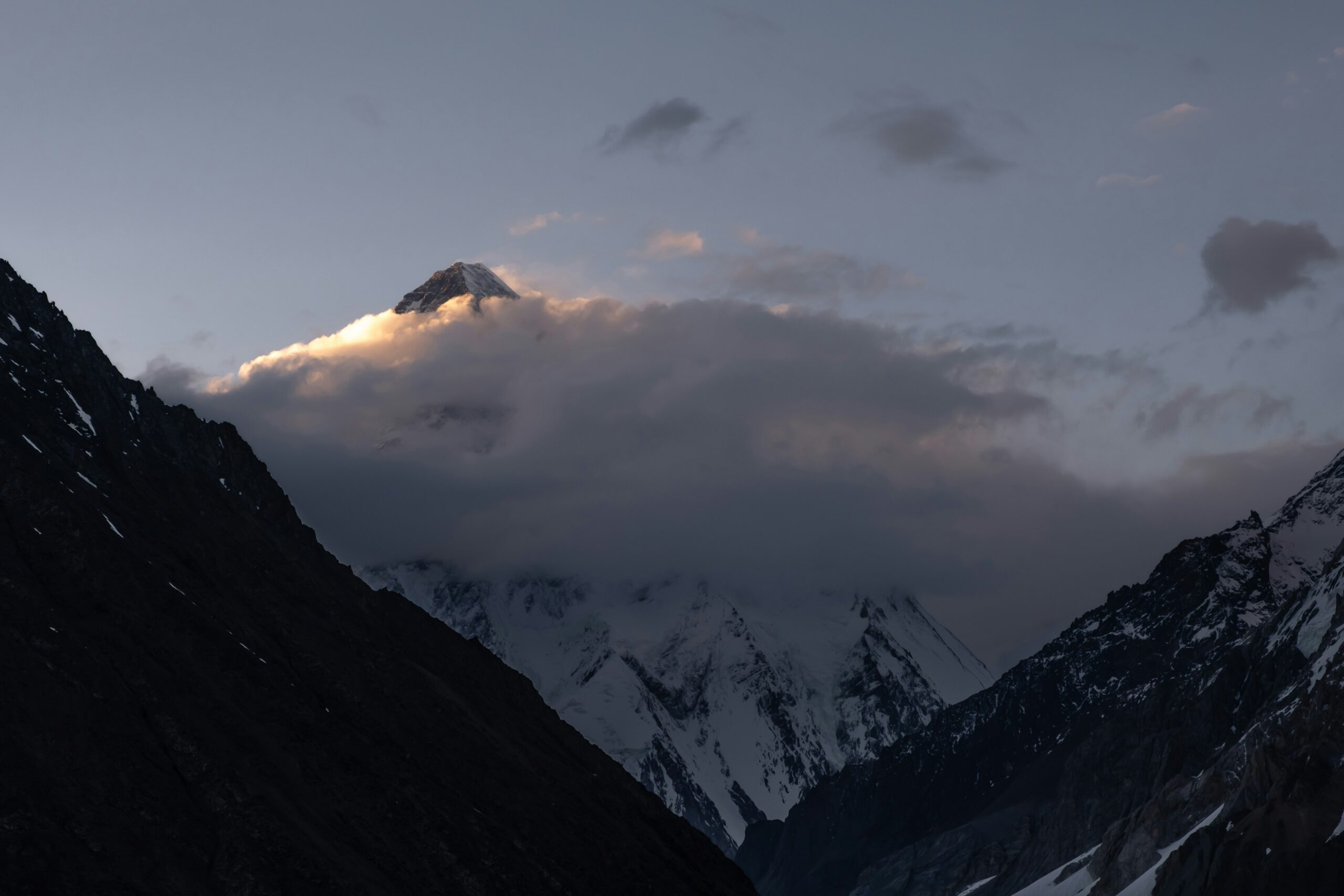
The Deadliest Season on Each 8000er
Everest’s Spring 2023 season leads this dataset with 18 deaths—but the number alone hides the pattern. From Nanga Parbat’s 1937 avalanche catastrophe to Broad Peak’s 2026 avalanche, here is the highest verified single-season death toll on every one of the world’s 14 eight-thousanders.
Everest has the highest deadliest-season toll in this 14-peak dataset: 18 deaths in Spring 2023.
Behind Everest are Nanga Parbat in Summer 1937 with 16 deaths, Manaslu in Spring 1972 with 15, K2 in Summer 1986 with 13, and Broad Peak in Summer 2026 with 10. Those five records were created in very different ways. Nanga Parbat and Manaslu were dominated by catastrophic avalanche events. K2’s 13 deaths accumulated across multiple accidents over an entire season. Everest 2023 involved a mixture of incidents. Broad Peak’s new 2026 record came from one avalanche that killed all 10 members of an international expedition.
This is an absolute seasonal fatality ranking. It is not a ranking of which 8,000er has the highest cumulative death rate, which mountain is hardest, or which mountain gives an individual climber the greatest probability of dying. Those questions require different denominators.
The deadliest recorded season on all 14 eight-thousanders
Sorted by the peak’s highest verified single-season death toll. Ties are retained rather than broken artificially.
Highest deaths in one recognized climbing season
Absolute deaths · not a probability or death-rate ranking| Rank | Mountain | Deadliest season | Deaths | Primary pattern | Record note | GSG data / guide |
|---|---|---|---|---|---|---|
| 1 | Everest | Spring 2023 | 18 | Mixed: serac collapse, illness, falls & disappearances | Clean Himalayan Database season record; 18 Everest South deaths. | Everest fatality data → |
| 2 | Nanga Parbat | Summer 1937 | 16 | Avalanche / ice collapse | Sixteen died in the 1937 German expedition catastrophe. | Nanga Parbat death rate → |
| 3 | Manaslu | Spring 1972 | 15 | Avalanche | Camp III avalanche killed 15 expedition members and staff. | Manaslu guide → |
| 4 | K2 | Summer 1986 | 13 | Mixed: avalanche, falls, rockfall, crevasse & storm | Thirteen across the full season; five belonged to the August storm sequence. | K2 death rate → |
| 5 | Broad Peak | Summer 2026 | 10 | Avalanche | July 30 avalanche killed all 10 members of an international expedition. | Broad Peak guide → |
| 6T | Annapurna I | Autumn 1991 | 7 | Avalanche-dominated | Seven season deaths; six were killed in one September 19 avalanche. | Annapurna death rate → |
| 6T | Dhaulagiri I | Spring 1969 | 7 | Avalanche / collapsing ice | Seven died when collapsing ice triggered a major avalanche. | Dhaulagiri guide → |
| 8T | Kangchenjunga | Spring 2013 | 5 | Multiple high-altitude incidents | Five deaths are listed for Kangchenjunga in the Himalayan Database spring record. | Kangchenjunga guide → |
| 8T | Gasherbrum I | Summer 2013 | 5 | Separate falls / disappearance incidents | Five deaths occurred in three separate incidents during the 2013 season. | Gasherbrum I guide → |
| 10T | Makalu | Spring 2019 | 4 | Multiple high-altitude incidents | Four on-mountain deaths. This methodology excludes the 2002 post-evacuation helicopter crash. | Makalu death rate → |
| 10T | Cho Oyu | Autumn 1959 | 4 | Avalanche | Four members of the 1959 women’s expedition were killed in the disaster. | Cho Oyu death rate → |
| 10T | Shishapangma | Spring 1991 / Autumn 2023 | 4 | Avalanche | Tied record: four in 1991 and four in the twin-avalanche 2023 season. | Shishapangma guide → |
| 13 | Gasherbrum II | Summer 1976 / Summer 1982 | 3 | Separate climbing accidents | Tied record seasons in the compiled Karakoram fatality record. | Gasherbrum II guide → |
| 14 | Lhotse | Spring 2025 | 2 | Two separate fatalities | Two Lhotse deaths in the Himalayan Database spring 2025 record; Lhotse Shar is excluded. | Lhotse guide → |
Dataset cutoff: September 16, 2026. Historical records can be revised as archives improve. Global Summit Guide will update the table when a primary or stronger established source changes a peak record.
What exactly counts as a “deadliest season”?
Most online lists fail here. They mix calendar years, single accidents, death-rate ratios and annual totals as if they were the same measurement.
Spring, Summer, Autumn and Winter are separate. We do not add Spring and Autumn fatalities together simply because they share a calendar year.
Expedition members and hired/high-altitude workers are included when the record attributes the fatality to climbing activity on that mountain.
A death on Lhotse Shar does not automatically become a Lhotse Main death. The dataset follows the identity used by the underlying mountain record.
This is why Makalu’s 2002 post-evacuation helicopter crash is discussed as an edge case rather than used to replace the Spring 2019 climbing record.
Shishapangma’s record of four is shared by Spring 1991 and Autumn 2023. Gasherbrum II’s record of three is shared by Summer 1976 and Summer 1982.
For Nepal/Tibet peaks we prioritize Himalayan Database season records. For Pakistan/Karakoram history we prioritize AAJ, Alpine Journal and established expedition archives, using current wire reporting for the 2026 Broad Peak event.

Sixteen deaths made 1937 one of mountaineering’s defining early expedition disasters.
The German expedition’s catastrophe was not a modern summit-day crowding event. An avalanche and ice-collapse sequence overwhelmed the high camp system, killing 16 people. Contemporary Alpine Journal reporting described it as an unprecedented mountaineering death toll for its era.
Five mountains, five very different ways a season became deadly
The top five alone show why a raw death count cannot be converted into a universal danger ranking.
18 deaths: the highest clean season total in this dataset
The Himalayan Database’s Spring 2023 death list records 18 deaths on Everest’s Nepal side. The season did not hinge on one event. Three Nepali workers were killed in an April serac collapse in the Khumbu Icefall, while later fatalities involved a mixture of high-altitude illness, falls, disappearances and other incidents during the busiest part of the summit season.
That mixed mechanism is exactly why “18 deaths” should not be interpreted as one Everest disaster. It is a season-level total.
Explore the Everest fatality record →16 deaths: a catastrophic high-camp avalanche
The 1937 German expedition disaster killed 16 climbers and porters after avalanche and collapsing ice struck the high camp system. Unlike Everest 2023, the season record was created overwhelmingly by one catastrophic event.
The historical context matters: expedition communications, forecasting, route knowledge and rescue options were nothing like modern standards. Yet the structural hazard—large unstable snow and ice above occupied camps—remains recognizable today.
Explore Nanga Parbat death-rate data →15 deaths: Camp III overwhelmed
On April 10, 1972, an avalanche struck the expedition’s Camp III and killed 15 people—four Koreans, one Japanese climber and 10 Sherpas according to the contemporary American Alpine Journal record. That single event establishes Manaslu’s highest season toll in this dataset.
It also demonstrates why workers and expedition support staff must be included in mountain-fatality accounting. Excluding them would radically misrepresent what happened.
Explore the Manaslu climbing guide →13 deaths: a whole season, not one storm
K2’s Black Summer is often compressed into the famous August storm, but the 13-death number belongs to the full season. Earlier deaths involved avalanche, disappearance on descent, falls, a crevasse accident and rockfall. Five deaths belonged to the final high-camp storm sequence.
The distinction is essential. K2 1986 is a textbook example of how a season total and a single-disaster toll can both be important without being interchangeable.
Read K2 1986: The Black Summer →10 deaths: the newest deadliest-season record on any mountain in this dataset
On July 30, 2026, an avalanche swept away a 10-person international expedition on Broad Peak in Pakistan. Subsequent reporting confirmed that all 10 climbers were killed. Because the entire toll occurred in one recognized Summer 2026 climbing season—and all deaths were directly attributable to the mountain event—the accident sets Broad Peak’s current deadliest-season record.
This is also why the page carries a specific dataset cutoff. A roundup frozen at 2025 would already be wrong for Broad Peak.
Explore the Broad Peak climbing guide →
Manaslu · 15 deaths in Spring 1972
A single avalanche at Camp III accounts for the record. Wikimedia Commons image; source & license.

K2 · 13 deaths in Summer 1986
K2’s total came from multiple separate incidents across the season. Wikimedia Commons; source & license.

Broad Peak’s July 30 avalanche moved its record to 10.
The 2026 event is not historical background—it is current mountain-safety data. All 10 members of the international expedition were confirmed dead after the avalanche, making Summer 2026 Broad Peak’s deadliest recorded season under this methodology.
The other nine eight-thousanders—and the records that need context
Several of the lower totals contain the hardest methodological questions in the entire dataset.
7 deaths
Six climbers were killed in one avalanche on September 19, but the full recognized season contains seven Annapurna I deaths. That is why the mountain’s record is seven even though its best-known 1991 accident killed six.
Annapurna death-rate data →7 deaths
Seven members of the American Dhaulagiri expedition died when collapsing ice triggered an avalanche. Contemporary AAJ reporting makes this one of the cleaner historical season records in the dataset.
Dhaulagiri guide →5 deaths
The Himalayan Database lists five Kangchenjunga deaths in the Spring 2013 season. Unlike Manaslu 1972, they were not all produced by one single avalanche event.
Kangchenjunga guide →5 deaths
Five people died in three separate incidents during a difficult Karakoram season. The record is therefore another reminder not to treat a season maximum as one coherent “disaster.”
Gasherbrum I guide →4 deaths
Four on-mountain deaths appear in the Himalayan Database’s Spring 2019 record. A 2002 helicopter crash killed six after evacuation from Makalu Base Camp, but this dataset excludes that off-mountain transport accident from the climbing-season maximum.
Makalu death-rate data →4 deaths
The Claude Kogan-led international women’s expedition suffered an avalanche disaster in October 1959. Four members of the expedition were killed, setting the seasonal maximum used here.
Cho Oyu death-rate data →4 deaths
Spring 1991 and Autumn 2023 are tied at four. The 2023 season ended after twin avalanches killed four climbers, including two elite climbers and two high-altitude support climbers.
Shishapangma guide →3 deaths
Summer 1976 and Summer 1982 share the compiled record at three deaths. Because the Karakoram historical archive is less standardized than Himalayan Database season lists, the tie is presented rather than forced into a single “winner.”
Gasherbrum II guide →2 deaths
The Himalayan Database lists two Lhotse fatalities in Spring 2025. Lhotse Shar is treated as a separate mountain identity in the source record and is not folded into Lhotse Main simply to inflate the total.
Lhotse guide →
Annapurna I · 7 in Autumn 1991
The season total is seven even though six died in the best-known September avalanche. Photo: Solundir · CC BY-SA 3.0 source.

Dhaulagiri I · 7 in Spring 1969
A collapsing-ice avalanche created the mountain’s highest seasonal toll in this dataset. Wikimedia Commons; source & license.
Deadliest season ≠ deadliest day ≠ highest death rate
These three questions sound similar in search results but measure different things.
| Metric | What it counts | Useful for | What it cannot tell you |
|---|---|---|---|
| Deadliest season | Absolute deaths in one Spring/Summer/Autumn/Winter season | Finding exceptional historical seasons and comparing peak maximums | An individual’s probability of dying |
| Deadliest day / incident | Deaths in one tightly bounded accident or event | Studying avalanche, serac, storm or route-system catastrophes | The full season’s cumulative toll |
| Death-to-summit ratio | Deaths divided by successful summit ascents over a stated period | Historical mountain-level outcome comparison when methodology is consistent | Attempt-based personal risk; the denominator is summits, not climbers |
| Attempt fatality rate | Deaths divided by climbers/attempts | Closer approximation to individual expedition risk | Often unavailable consistently across all 14 peaks and eras |
| Technical difficulty | Route skills, terrain, objective hazard, altitude and logistics | Choosing an appropriate objective | It is not a fatality statistic at all |
Avalanche dominates many records—but not all of them.
The dataset is too small and heterogeneous for a fake “percentage of all records” claim to be especially meaningful, but the recurring mechanisms are clear.
One catastrophic avalanche can define the entire season.
Nanga Parbat 1937, Manaslu 1972, Dhaulagiri 1969, Cho Oyu 1959 and Broad Peak 2026 are examples where avalanche or collapsing snow/ice is central to the record. Shishapangma’s tied records are also avalanche-linked.
Objective hazardOther records accumulate through unrelated incidents.
Everest 2023 and K2 1986 are fundamentally different. Their totals were built by multiple accidents and mechanisms over a season rather than one single catastrophic event.
Cumulative seasonDescent repeatedly appears in fatal histories.
K2 1986, Gasherbrum I 2013 and many individual Himalayan Database entries reinforce a basic expedition truth: reaching the summit does not end mountain exposure. The route still has to be reversed.
Post-summit riskCamp placement can turn a hazard into a mass-casualty event.
Historical expedition styles often concentrated many people in fixed high camps below seracs, avalanche paths or unstable slopes. When the mountain released, the number exposed at one location could be large.
Exposure concentrationModern support does not eliminate objective hazard.
Satellite forecasts, commercial logistics, fixed ropes and faster rescue improve margins, but the 2026 Broad Peak avalanche demonstrates that a single event can still overwhelm a highly organized expedition.
Modern relevanceTraffic changes the meaning of raw totals.
Everest now exposes far more people in a typical spring than many peaks did historically. A large absolute toll may reflect both mountain hazard and a much larger population at risk. That is another reason not to turn this list into a “danger ranking.”
Denominator mattersFive edge cases that can change the answer
These are not footnotes. They are the difference between a reproducible dataset and a list of numbers copied from different definitions.
One accident killed six; the season record is seven.
If the question is “deadliest single Annapurna accident,” the September 19 avalanche toll is six. If the question is “deadliest recognized Annapurna climbing season,” the full Autumn 1991 record is seven. This page answers the second question.
A helicopter crash can distort an on-mountain comparison.
Six people associated with Makalu died in a 2002 helicopter accident after evacuation from Base Camp. Because this dataset is comparing climbing exposure on the mountains themselves, it does not use that transport accident as Makalu’s on-mountain record. Spring 2019 therefore stands at four.
A tie is more honest than an invented winner.
Four deaths are documented for Spring 1991 and four for Autumn 2023. The modern event may be more familiar because the twin avalanches were widely reported, but recency does not break a numerical tie.
Karakoram archives are less standardized.
The compiled record gives three deaths in both Summer 1976 and Summer 1982. Rather than imply database precision the source system does not have, Template 8.0 retains the tie and labels the evidence type.
Named subsidiary peaks should not be silently merged.
Lhotse Shar has its own climbing identity and historical record. Folding its deaths into Lhotse Main simply because the peaks share a massif would change the statistic without changing the underlying event. This dataset follows the peak identity used by the source record.
Source hierarchy behind the 14-peak dataset
Historical fatality research gets unreliable quickly when a later roundup silently replaces the original record. This page works from stronger sources outward.
Himalayan Database
Used as the primary season-list source for many Nepal/Tibet peaks, including the 18 Everest deaths in Spring 2023, five Kangchenjunga deaths in Spring 2013, four Makalu deaths in Spring 2019 and two Lhotse deaths in Spring 2025.
American Alpine Journal
Used for contemporary expedition reporting where Karakoram or historic Nepal records require expedition-level reconstruction.
Alpine Journal & historic archives
The 1937 Nanga Parbat record is anchored to contemporary Alpine Journal reporting, which described the 16-person catastrophe in the context of that season rather than through a later “killer mountain” retelling.
Current 2026 reporting
Broad Peak’s record changed after this site’s older historical datasets would have been compiled. Associated Press reporting in August 2026 confirmed that all 10 members of the July 30 international expedition were killed by the avalanche.
Global Summit Guide’s role
This post does not claim to replace the Himalayan Database or expedition archives. Its original value is standardization: applying one season definition to all 14 peaks, preserving ties, labeling exclusions, and connecting each mountain record to its dedicated GSG risk or climbing page.
Update policy
The dataset is current through September 16, 2026. A new record season, a stronger primary source or a correction in a source database should trigger an update to the relevant mountain row, chart bar, FAQ/schema answer and any linked death-rate child page.
Deadliest 8000er season FAQ
Short answers to the queries most likely to be confused by inconsistent denominators.
Which 8000er had the deadliest single climbing season?
Everest has the highest toll in this standardized 14-peak dataset: 18 deaths in Spring 2023. That is an absolute season total, not an attempt fatality rate.
What was K2’s deadliest season?
Summer 1986, with 13 deaths across the full season. The famous August storm sequence accounts for five of those deaths; eight others occurred in separate accidents before or immediately around that final catastrophe.
What was Nanga Parbat’s deadliest season?
Summer 1937, with 16 deaths in the German expedition catastrophe. Contemporary Alpine Journal reporting documented the scale of the accident.
What was Manaslu’s deadliest season?
Spring 1972. An April 10 avalanche overwhelmed Camp III and killed 15 people, including expedition climbers and Sherpa staff.
What is the newest deadliest-season record among the 14 eight-thousanders?
Broad Peak’s Summer 2026 record is the newest. A July 30 avalanche killed all 10 members of an international expedition, according to subsequent reporting.
Is “deadliest season” the same as “most dangerous 8000er”?
No. A large absolute season toll can reflect one catastrophic event, a large population exposed, or several unrelated accidents. Calling a mountain “most dangerous” requires a defined denominator and risk model, not simply the largest raw death count.
Why is Makalu listed at four instead of the six deaths associated with 2002?
The six 2002 deaths occurred in a helicopter crash after evacuation from Makalu Base Camp. This dataset is designed to compare mountain-attributed climbing deaths, so it excludes that off-mountain transport event and uses Spring 2019’s four on-mountain deaths.
Which 8000er has the lowest deadliest-season maximum?
Lhotse is lowest in this dataset at two deaths in Spring 2025. That does not make it the safest 8,000er; it only means no recognized Lhotse Main climbing season in the source record used here exceeds that total.
Why are Shishapangma and Gasherbrum II shown with ties?
Because two seasons share the same verified maximum. Shishapangma is tied at four deaths in Spring 1991 and Autumn 2023. Gasherbrum II is tied at three in Summer 1976 and Summer 1982. The dataset does not invent a tiebreaker.
A record season tells you where history spiked—not which mountain will kill the next climber.
The 14 records range from two deaths on Lhotse to 18 on Everest. Some were created by one avalanche; others accumulated through unrelated accidents. To understand mountain-level risk, continue into the death-rate pages and keep the denominator attached to every statistic.
Explore Death Rates by MountainDeath rates, disaster records & all 14 eight-thousanders
This post owns the single-season maximum question. The pages below own the denominator, individual mountain histories, disaster case studies and broader 8,000-meter comparisons.