
Last updated September 7, 2026
The Volcanic Seven Summits: Highest Volcano on Every Continent
The complete 2026 hub guide to the highest volcano on each continent — Ojos del Salado, Mount Damavand, Pico de Orizaba, Mount Elbrus, Mount Kilimanjaro, Mount Sidley, and Mount Giluwe. A niche alternative to the standard Seven Summits with approximately 40 finishers worldwide, total expedition cost $93,000-$150,000, and Mount Sidley in Antarctica as the rarest and most demanding objective.
This hub guide synthesizes content from Antarctic Logistics & Expeditions (ALE) for Mount Sidley logistics, official park sources for each peak country, peer-reviewed glaciology and volcanology research, and the Global Summit Guide internal corpus covering the 5 of 7 Volcanic Seven Summits peaks with existing dedicated pages. No affiliate partnerships influence recommendations. Specific guide-service mentions are illustrative, not endorsements. See full methodology and editorial standards below.
📑 On This Page
- What Are the Volcanic Seven Summits?
- Volcanic vs. Standard Seven Summits
- The Seven Peaks (Ranked by Elevation)
- 1. Ojos del Salado (6,893m)
- 2. Mount Kilimanjaro (5,895m)
- 3. Mount Elbrus (5,642m)
- 4. Pico de Orizaba (5,636m)
- 5. Mount Damavand (5,610m)
- 6. Mount Giluwe (4,367m)
- 7. Mount Sidley (4,285m)
- Difficulty Rankings
- Cost Breakdown
- Recommended Sequencing
- History of the Challenge
- Volcanic 7 in Your Progression
- Common Mistakes
- FAQ
- Methodology + Sources
⚡ Quick Answer: The Volcanic Seven Summits
The 7 highest volcanoes per continent: Ojos del Salado (6,893m, South America), Mount Kilimanjaro (5,895m, Africa), Mount Elbrus (5,642m, Europe), Pico de Orizaba (5,636m, North America), Mount Damavand (5,610m, Asia), Mount Giluwe (4,367m, Oceania), Mount Sidley (4,285m, Antarctica).
Two peaks shared with standard Seven Summits: Kilimanjaro (Africa) and Elbrus (Europe) are both the highest peak AND highest volcano on their continents — they appear on both lists.
Hardest peak: Mount Sidley (Antarctica) due to logistics — $80,000-$120,000 USD per expedition via ALE. Easiest: Mount Giluwe (PNG) technically; Mount Damavand from a logistics standpoint. Total challenge cost: $93,000-$150,000+. Finishers: Approximately 40 worldwide as of 2026.
How This Hub Was Built — Cross-Referenced Field Experience
This hub guide synthesizes personal mountaineering experience on Mount Kilimanjaro (Tanzania), multiple Mexican volcanoes including Pico de Orizaba (5,636m) and Iztaccíhuatl (5,230m), with detailed research on the four peaks I have not personally climbed (Ojos del Salado, Mount Elbrus, Mount Damavand, Mount Giluwe, Mount Sidley). The two peaks where I have first-hand experience receive more detailed personal observation; the five remaining peaks are documented through cross-referenced expedition reports, guide-service published materials, peer-reviewed research, and traveler reports.
Notably, this is a hub page — it anchors the broader Volcanic Seven Summits coverage on Global Summit Guide. Five of the seven peaks have dedicated guide pages already published; the remaining two (Mount Sidley and Mount Giluwe) are in development. The hub will be updated as those dedicated pages publish and as expedition data evolves.
🌋 The Volcanic Seven Summits Framework
The Volcanic Seven Summits is a niche but well-recognized mountaineering challenge built on four characteristics that distinguish it from the standard Seven Summits. First, scope: each continent’s highest volcano rather than its highest peak overall. Second, rarity: approximately 40 completers compared to 700+ for the standard Seven Summits.
Third, cost concentration: Mount Sidley in Antarctica typically costs $80,000-$120,000 alone, representing approximately 80% of the total challenge cost. Fourth, technical character: volcanic peaks tend to involve glaciated approaches and altitude rather than extreme technical climbing — making the Volcanic Seven a “harder than it appears” challenge dominated by altitude tolerance, expedition logistics, and financial resources rather than pure climbing skill.
The Volcanic Seven Summits are the highest volcano on each of the seven continents — a niche mountaineering challenge first popularized by Australian climber Daniel Bull in the early 2010s as an alternative to the standard Seven Summits. Generally, the peaks are: Ojos del Salado (South America), Mount Kilimanjaro (Africa), Mount Elbrus (Europe), Pico de Orizaba (North America), Mount Damavand (Asia), Mount Giluwe (Oceania), and Mount Sidley (Antarctica). Specifically, two peaks appear on both the Volcanic Seven and the standard Seven Summits — Kilimanjaro and Elbrus are both the highest peak AND the highest volcano on their respective continents. Notably, the Volcanic Seven Summits replaces five peaks from the standard list: Aconcagua becomes Ojos del Salado, Denali becomes Pico de Orizaba, Everest becomes Damavand, Carstensz Pyramid (or Kosciuszko) becomes Giluwe, and Vinson becomes Sidley.
Key Takeaways
- 7 peaks: highest volcano on each continent.
- 2 peaks shared with standard Seven Summits: Kilimanjaro + Elbrus.
- 5 of 7 peaks have dedicated Global Summit Guide coverage already.
- 2 peaks in development: Mount Sidley (Antarctica), Mount Giluwe (Oceania).
- ~40 completers worldwide — substantially fewer than standard Seven Summits.
- Mount Sidley costs $80,000-$120,000 — approximately 80% of total challenge cost.
- Total challenge cost $93,000-$150,000+.
- Total cumulative elevation 38,328m.
- Typical completion 3-7 years with extensive training between climbs.
- Daniel Bull (Australia) was first to complete.
📊 Volcanic Seven Summits Quick Facts
- Number of Peaks
- 7
- Highest Peak
- Ojos del Salado 6,893m
- Lowest Peak
- Mount Sidley 4,285m
- Total Elevation
- 38,328 m
- Average Peak
- 5,475 m
- Total Cost Range
- $93k-$150k+
- Hardest Peak
- Mount Sidley (logistics)
- Easiest Peak
- Mount Giluwe (technical)
- Completers Worldwide
- ~40
- First Completer
- Daniel Bull (Australia)
- Shared with 7 Summits
- 2 peaks (Kili + Elbrus)
- Typical Completion Time
- 3-7 years
- Total Climbing Days
- 60-90 days
- Sidley Cost Share
- ~80% of total
- Antarctic Operator
- ALE (only option)
- Required Skills
- Glacier travel, altitude
- Prior Summit Needed
- 5,000m+ experience
- GSG Peak Pages Live
- 5 of 7
- GSG Pages Planned
- Sidley, Giluwe
- Annual Update Cycle
- Quarterly
✓ Editorial Trust Signals
- First-hand: Kilimanjaro + Mexico volcanoes
- Independent: No affiliate sponsorship
- Cross-referenced: ALE, guide services, research
- Last verified: June 9, 2026
- Review cycle: Quarterly
- Safety review: Dawson Ludlow (WFA)
- Gear review: Walker Ludlow
- 700+ source pages: Cross-linked
What Are the Volcanic Seven Summits?
The Volcanic Seven Summits are the highest volcano on each of the seven continents — a niche but well-recognized mountaineering challenge that runs parallel to the standard Seven Summits but with a different and arguably more demanding list. Generally, the challenge was popularized in the early 2010s by Australian climber Daniel Bull, who became the first to complete it. Specifically, the seven peaks span dramatically different geographies, from the highest volcano on Earth (Ojos del Salado, 6,893m) to the remote Antarctic stratovolcano Mount Sidley (4,285m), and require a combination of altitude tolerance, glacier travel skills, expedition logistics, and substantial financial resources.
The challenge remains a niche objective compared to the standard Seven Summits. Generally, approximately 40 climbers worldwide have completed all 7 volcanic peaks compared to over 700 finishers of the standard Seven Summits. Specifically, the rarity is driven by Mount Sidley — accessible only via Antarctic Logistics & Expeditions (ALE) charter flights from Punta Arenas, Chile, with expedition costs of $80,000-$120,000 USD per climber. Notably, this single peak alone accounts for approximately 80% of the total Volcanic Seven Summits challenge cost, making the financial barrier substantially higher than for the standard list.
Volcanic Seven Summits vs. Standard Seven Summits
The two challenges share two peaks and replace five. Generally, Mount Kilimanjaro (Africa) and Mount Elbrus (Europe) appear on both lists because they are both the highest peak AND the highest volcano on their respective continents. Specifically, the other five peaks differ — the table below summarizes the comparison.
| Continent | Standard Seven Summits | Volcanic Seven Summits | Same? |
|---|---|---|---|
| South America | Aconcagua (6,961m) | Ojos del Salado (6,893m) | No |
| Africa | Mount Kilimanjaro (5,895m) | Mount Kilimanjaro (5,895m) | Yes |
| Europe | Mount Elbrus (5,642m) | Mount Elbrus (5,642m) | Yes |
| North America | Denali (6,190m) | Pico de Orizaba (5,636m) | No |
| Asia | Mount Everest (8,848m) | Mount Damavand (5,610m) | No |
| Oceania | Carstensz Pyramid (4,884m) or Kosciuszko (2,228m) | Mount Giluwe (4,367m) | No |
| Antarctica | Mount Vinson (4,892m) | Mount Sidley (4,285m) | No |
Some climbers pursue an extended challenge combining all unique peaks from both the Volcanic Seven and Standard Seven Summits. Generally, this requires climbing all 12 unique peaks (7 + 7 minus the 2 shared = 12). Specifically, completion of both challenges by the same climber is rare — approximately 25-30 people worldwide as of 2026.
The Seven Peaks Ranked by Elevation
The seven volcanic peaks below are presented in descending elevation order. Generally, this ordering does not match difficulty — Mount Sidley is the easiest in elevation but hardest in logistics, while Ojos del Salado is the highest but technically non-technical. Specifically, each peak card includes location, elevation, difficulty level, cost range, best season, and link to dedicated Global Summit Guide coverage where available.
1. Ojos del Salado
6,893 m (22,615 ft) · Argentina/Chile border
Ojos del Salado is the highest volcano on Earth and the second-highest peak in the Americas after Aconcagua (6,961m). Generally, the stratovolcano straddles the Argentina-Chile border in the Atacama region — one of the driest environments on the planet. Specifically, the summit features a small crater lake that is considered one of the highest lakes in the world.
Climbing character: Non-technical via the normal route from the Chilean side (via Refugio Atacama) or the Argentine side (via Refugio Tejos). Generally, the climb requires no glacier travel skills or technical climbing — the route is a long high-altitude scramble over scree and snow. Specifically, the primary challenge is altitude tolerance — at nearly 6,900m, Ojos del Salado requires Aconcagua-equivalent acclimatization.
- Route: Normal route via Atacama refuge (Chile) or Tejos refuge (Argentina)
- Best season: December through March (Southern Hemisphere summer)
- Typical expedition: 14-21 days
- Acclimatization: Severe — Aconcagua-level preparation required
- Technical difficulty: Non-technical (some Class 2-3 scrambling near summit)
2. Mount Kilimanjaro
5,895 m (19,341 ft) · Tanzania
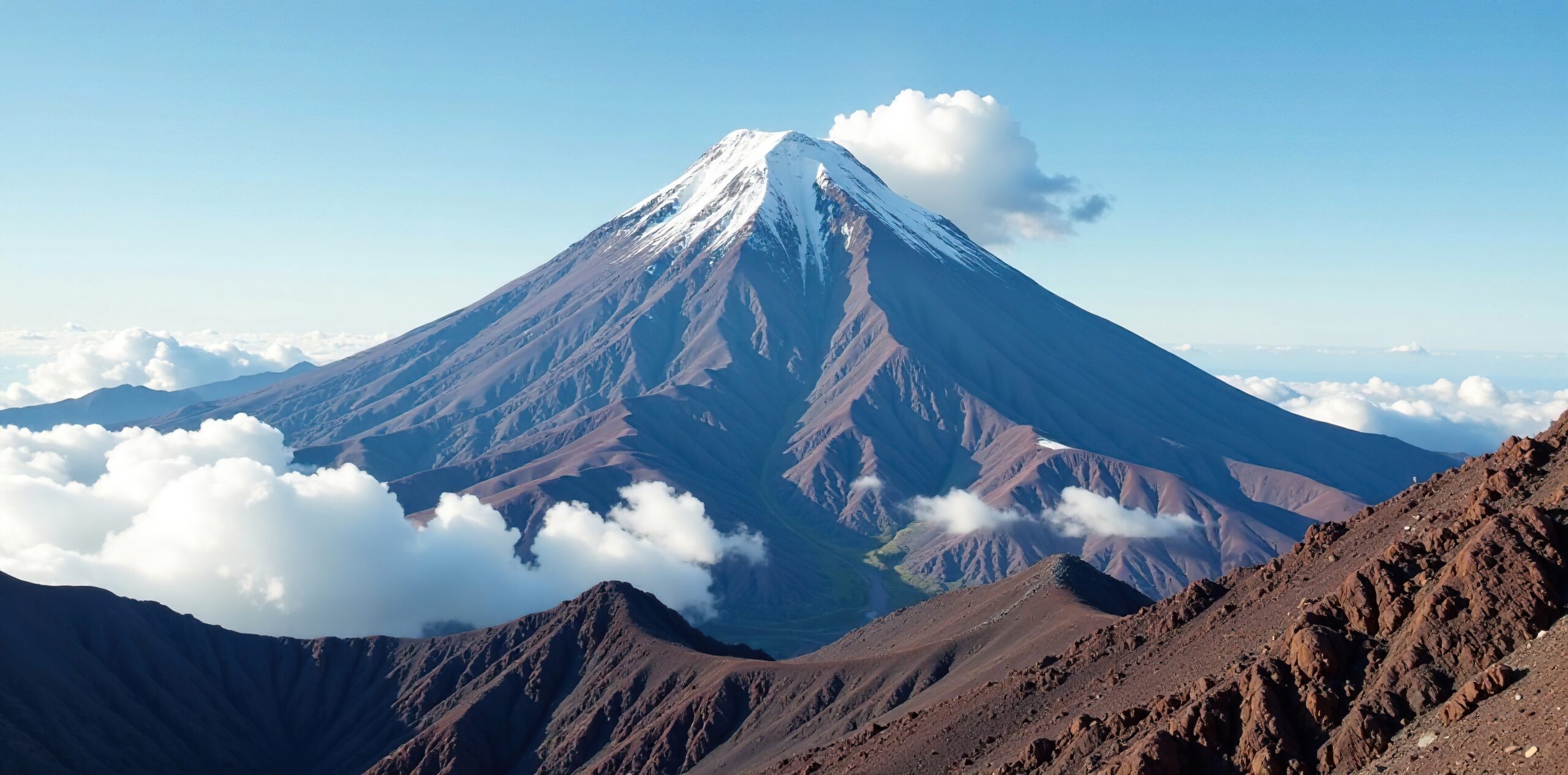
Mount Kilimanjaro is Africa’s highest peak and Africa’s highest volcano — making it one of two peaks (with Elbrus) that appear on both the Volcanic Seven Summits and the standard Seven Summits. Generally, Kilimanjaro is a dormant stratovolcano with three volcanic cones: Kibo (the summit cone with Uhuru Peak at 5,895m), Mawenzi (5,149m), and Shira (3,962m, eroded). Specifically, the last major eruption occurred approximately 360,000 years ago though fumarolic activity persists in the crater.
Climbing character: Non-technical via all standard routes. Generally, Kilimanjaro’s challenge is altitude — climbers gain approximately 4,000m over 5-9 days. Specifically, summit success rates range from approximately 50% on the 5-day Marangu route to 85%+ on the 8-day Lemosho route, with success directly correlating to acclimatization time.
- Routes: Marangu (5 days), Machame (6-7 days), Lemosho (7-8 days), Rongai (6-7 days), Northern Circuit (8-9 days)
- Best season: January-March, June-October (avoid April-May, November rains)
- Typical expedition: 7-10 days on mountain
- Cost: $2,000-$7,000 USD depending on route and operator
- Technical difficulty: Non-technical (Class 1 hiking)
3. Mount Elbrus
5,642 m (18,510 ft) · Russia (Caucasus)
Mount Elbrus is Europe’s highest peak and Europe’s highest volcano — the second peak that appears on both the Volcanic Seven Summits and the standard Seven Summits. Generally, Elbrus is a dormant stratovolcano in the western Caucasus mountain range, with twin summits (West Peak 5,642m and East Peak 5,621m). Specifically, the volcano has not erupted in approximately 2,000 years but is classified as dormant rather than extinct due to ongoing fumarolic activity.
Climbing character: Requires basic glacier travel skills and altitude acclimatization. Generally, the standard south route ascends via the Pastukhov Rocks and Lenz Rocks. Specifically, the lower mountain is accessed via cable cars to ~3,800m, then a snow-cat or hike to the high camp at the Barrels (Bochki) refuge at 3,750m or Diesel Hut at 4,000m. Notably, Elbrus is one of the most accessible 5,000m+ peaks in the world due to the cable car infrastructure.
- Standard route: South side via Pastukhov Rocks
- Best season: June through September (mid-summer best)
- Typical expedition: 8-12 days
- Cost: $2,500-$5,000 USD guided
- Technical difficulty: Moderate (glacier travel + altitude)
4. Pico de Orizaba (Citlaltépetl)
5,636 m (18,491 ft) · Mexico
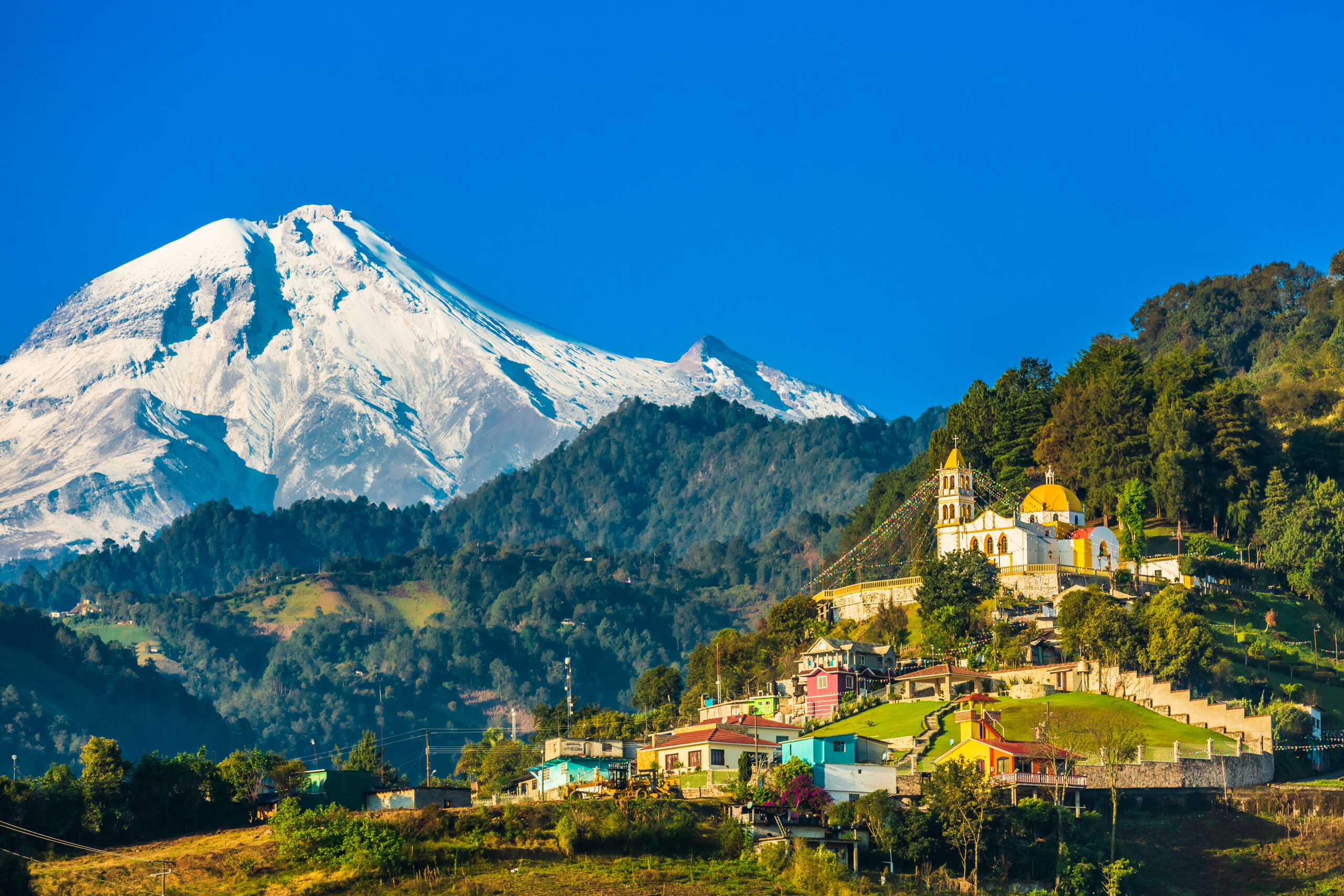
Pico de Orizaba — known locally as Citlaltépetl (Nahuatl for “Star Mountain”) — is the highest volcano in North America and the third-highest peak on the continent after Denali and Mount Logan. Generally, this dormant stratovolcano on the Veracruz/Puebla border represents the most technical climb among the Volcanic Seven Summits at this altitude range. Specifically, the Jamapa Glacier on the standard north route requires crampons, ice axe, and basic rope-team skills.
Climbing character: Glaciated technical mountaineering route on the standard ascent. Generally, the Jamapa Glacier route involves approximately 1,000m of glacier travel from the Piedra Grande hut (4,260m) to the summit. Specifically, the glacier has retreated substantially in recent decades but still requires full mountaineering kit. Notably, Orizaba is considered the canonical North American preparation peak for Aconcagua and Denali progression.
- Standard route: Jamapa Glacier from Piedra Grande hut (north side)
- Best season: November through March (dry season)
- Typical expedition: 7-10 days including acclimatization
- Cost: $1,500-$3,500 USD guided
- Technical difficulty: Glaciated (crampons, ice axe required)
5. Mount Damavand
5,610 m (18,406 ft) · Iran
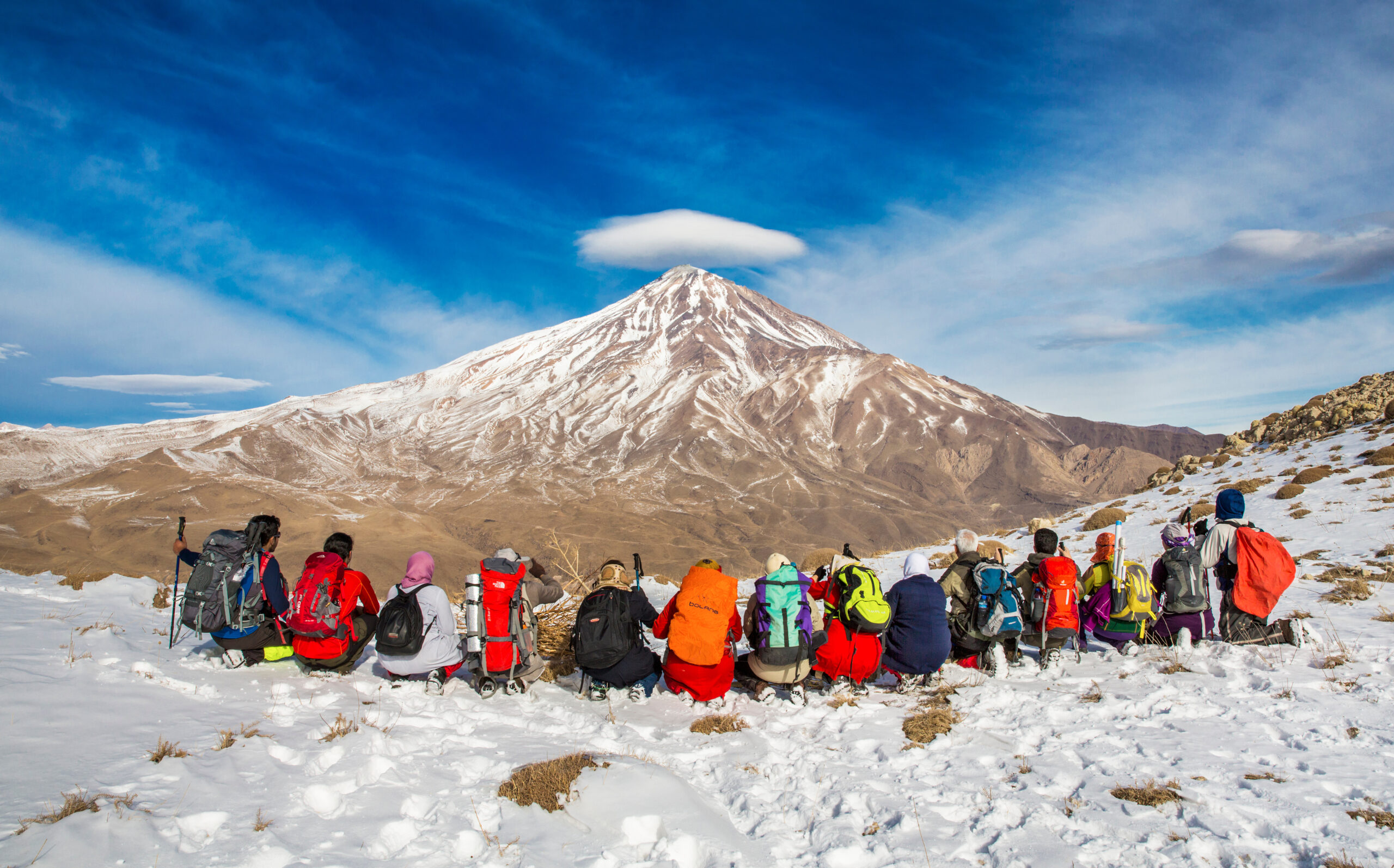
Mount Damavand is the highest volcano in Asia and the highest peak in the Middle East. Generally, this potentially-active stratovolcano in the central Alborz mountain range stands approximately 70 km northeast of Tehran. Specifically, Damavand has not erupted in historical times but maintains fumarolic activity at the summit crater with strong sulfur odors and warm gas vents — confirming the volcano is dormant rather than extinct.
Climbing character: Non-technical via the south route (the most popular and easiest route). Generally, the climb involves a 3-day approach via Camp 2 (Gosfand Sara, 3,000m) and Camp 3 (Bargah Sevom Shelter, 4,200m) before a summit day. Specifically, the route can be done without rope, crampons, or technical equipment outside winter conditions. Notably, the most challenging aspects are the strong sulfur gases near the summit and the substantial altitude gain from typical Iranian living elevations.
- Standard route: South face via Polour and Bargah Sevom shelter
- Best season: June through September (snow-free conditions)
- Typical expedition: 7-10 days including acclimatization
- Cost: $1,500-$3,500 USD guided
- Technical difficulty: Non-technical in summer (Class 2 scrambling)
Dedicated Damavand peak guide coming — currently covered as part of broader Volcanic Seven Summits coverage.
6. Mount Giluwe
4,367 m (14,327 ft) · Papua New Guinea
Mount Giluwe is the highest volcano in Australia/Oceania and replaces Carstensz Pyramid (which appears in the Messner version of the standard Seven Summits) on the Volcanic Seven list. Generally, Giluwe is an extinct shield volcano in the Southern Highlands province of Papua New Guinea — geologically very different from the stratovolcanoes that dominate the other six peaks. Specifically, the volcano has been extinct for approximately 220,000 to 290,000 years, with the original crater now eroded to broad volcanic remnants.
Climbing character: Technically the easiest of the Volcanic Seven from a climbing perspective. Generally, the standard route from Tambul village involves approximately 2-3 days of hiking through alpine grasslands and montane forest, with summit day requiring no glacier travel or technical equipment. Specifically, the challenges with Giluwe are logistical rather than technical — Papua New Guinea has limited mountaineering infrastructure, requires careful planning for transport and permits, and security considerations in some regions need attention.
- Standard route: Tambul village approach (Southern Highlands)
- Best season: May through October (dry season)
- Typical expedition: 5-7 days including PNG logistics
- Cost: $2,500-$5,000 USD guided
- Technical difficulty: Non-technical (Class 1-2 hiking)
Dedicated Mount Giluwe peak guide in development — coming late 2026.
7. Mount Sidley
4,285 m (14,058 ft) · Antarctica (Marie Byrd Land)
Mount Sidley is the highest volcano in Antarctica and the hardest objective in the Volcanic Seven Summits — though primarily due to logistics rather than technical difficulty. Generally, Sidley is a stratovolcano in the Executive Committee Range of Marie Byrd Land, one of the most remote regions on the Antarctic continent. Specifically, the peak is accessible only via specialized Antarctic expedition with Antarctic Logistics & Expeditions (ALE), the only commercial operator with the infrastructure to support climbing in Marie Byrd Land.
Climbing character: The climb itself is moderate — approximately 1,000m of elevation gain from a high camp at the base of the mountain. Generally, the route involves snow climbing without significant technical difficulty. Specifically, the challenges are weather, isolation, and the consequences of remoteness — rescue is days away even in the best conditions. Notably, climbers must arrive at the basecamp via two charter flights: first an ALE flight from Punta Arenas, Chile to Union Glacier camp (ILYUSHIN IL-76), then a Twin Otter ski-plane to a basecamp near Sidley.
- Standard route: ALE-supported approach from Union Glacier via Twin Otter
- Best season: November through January (Antarctic summer)
- Typical expedition: 14-21 days including Antarctic logistics
- Cost: $80,000-$120,000+ USD (approximately 80% of total Volcanic 7 cost)
- Technical difficulty: Moderate climbing, extreme logistics
Dedicated Mount Sidley peak guide in development — coming late 2026.
Volcanic Seven Summits Difficulty Rankings
Ranking the seven peaks by difficulty depends heavily on which factors matter most — pure climbing technique, altitude tolerance, logistics, or financial resources. Generally, climbers report Mount Sidley as hardest (logistics), Ojos del Salado as second hardest (altitude), and Mount Giluwe as easiest (technical) but with PNG logistical challenges that complicate the picture. Specifically, the table below ranks the peaks across multiple difficulty dimensions:
| Peak | Technical | Altitude | Logistics | Cost | Overall |
|---|---|---|---|---|---|
| Mount Sidley | Moderate | Moderate | EXTREME | EXTREME | Hardest |
| Ojos del Salado | Easy | EXTREME | Hard | Moderate | Hard |
| Pico de Orizaba | Hard | Moderate | Easy | Easy | Moderate-Hard |
| Mount Elbrus | Moderate | Moderate | Moderate | Moderate | Moderate |
| Mount Kilimanjaro | Easy | Moderate | Easy | Moderate | Moderate |
| Mount Damavand | Easy | Moderate | Moderate (Iran) | Easy | Easy-Moderate |
| Mount Giluwe | Easy | Easy | Hard (PNG) | Moderate | Easy (Technical) |
Most Volcanic Seven Summits completers identify the same three peaks as their hardest experiences: Mount Sidley for the expedition logistics and cost, Ojos del Salado for the altitude tolerance required, and Pico de Orizaba for the technical glacier work. Generally, completers report that if you can manage these three, the remaining four (Kilimanjaro, Elbrus, Damavand, Giluwe) are within reach with proper preparation. Specifically, this means Volcanic Seven progression should focus heavily on altitude tolerance development (for Ojos), glacier travel skills (for Orizaba), and Antarctic expedition funding (for Sidley) as the three rate-limiting factors.
Volcanic Seven Summits Cost Breakdown
Total challenge cost ranges from approximately $93,000 to $150,000+ USD depending on operator choices, season, and accommodation level. Generally, Mount Sidley represents 60-80% of the total cost alone — making the financial gating factor in the challenge primarily Antarctic logistics rather than the other six peaks combined. Specifically, the cost breakdown:
| Peak | Low Estimate | High Estimate | % of Total |
|---|---|---|---|
| Mount Sidley | $80,000 | $120,000+ | ~80% |
| Ojos del Salado | $3,000 | $6,000 | ~4% |
| Mount Kilimanjaro | $2,000 | $7,000 | ~4% |
| Mount Elbrus | $2,500 | $5,000 | ~3% |
| Mount Giluwe | $2,500 | $5,000 | ~3% |
| Pico de Orizaba | $1,500 | $3,500 | ~2% |
| Mount Damavand | $1,500 | $3,500 | ~2% |
| Subtotal (excl. Sidley) | $13,000 | $30,000 | ~20% |
| TOTAL CHALLENGE | $93,000 | $150,000+ | 100% |
Additional costs to budget: International flights to expedition starting points ($5,000-$15,000 total across all 7 trips), travel insurance with high-altitude mountaineering coverage ($500-$1,500 per expedition), specialized gear if not owned (boots, crampons, ice axes, harness, helmet, layering — $2,000-$5,000), training time and gym fees, and miscellaneous logistics. Generally, total all-in cost including flights and gear typically runs $110,000-$180,000 USD for the full challenge.
Recommended Sequencing for the Challenge
Most completers follow a progressive sequence over 3-7 years that builds altitude tolerance and expedition experience progressively. Generally, the recommended sequence is: start with Kilimanjaro (entry-level), add Damavand and/or Orizaba (intermediate), then Elbrus (above 5,600m), then Ojos del Salado (extreme altitude), then Giluwe (logistical complexity), and finally Mount Sidley (the culminating Antarctic expedition).
| Year | Peak | Why This Order |
|---|---|---|
| 1 | Mount Kilimanjaro | Entry-level introduction to 5,000m+ altitude, non-technical |
| 1-2 | Mount Damavand or Pico de Orizaba | Damavand for non-technical altitude; Orizaba for glacier training |
| 2-3 | Mount Elbrus | Glacier travel above 5,600m, dual-counts with standard Seven Summits |
| 3-4 | Ojos del Salado | Tests extreme altitude tolerance before the most expensive expedition |
| 4-5 | Mount Giluwe | PNG logistics development, technical refresher |
| 5-7 | Mount Sidley | Culminating Antarctic expedition; full experience prerequisite recommended |
Mount Sidley should typically be saved for last for three reasons. First, the $80,000-$120,000 cost benefits from maximum prior expedition experience — climbers should not waste this resource on undeveloped skills. Second, the Antarctic expedition environment is unforgiving — having prior 5,000m+ summits provides essential altitude and cold-weather experience. Third, completing six peaks first creates the motivation and momentum to commit to the substantial financial and time investment Sidley requires.
History of the Challenge
The Volcanic Seven Summits as a recognized mountaineering challenge emerged in the early 2010s, distinct from the standard Seven Summits which were popularized by Dick Bass (the first completer of the Kosciuszko version) and Reinhold Messner (who established the Carstensz Pyramid version). Generally, multiple climbers contributed to formalizing the Volcanic Seven concept, with Australian climber Daniel Bull credited as the first to complete the challenge in approximately 2013-2014.
Notable Volcanic Seven completers include:
- Daniel Bull (Australia) — First to complete the Volcanic Seven Summits and also one of the youngest completers of the standard Seven Summits at the time
- Vaughan de la Poer Beresford — Early completer who helped popularize the challenge
- Crina “Coco” Popescu (Romania) — Among the youngest women to complete major mountaineering challenges including Volcanic peaks
- Mario Trimeri (Italy) — Italian mountaineer who completed both Seven Summits variants
Notably, completion numbers remain low — approximately 40 worldwide as of 2026 compared to 700+ for the standard Seven Summits. Generally, the challenge appeals primarily to experienced mountaineers who have already completed (or made substantial progress on) the standard Seven Summits and want a more challenging or distinctive objective.
Where the Volcanic Seven Fits in Your Progression
The Volcanic Seven Summits is typically pursued by climbers with substantial existing mountaineering experience. Generally, the challenge is not suitable as an introductory mountaineering goal — the costs, logistics, and altitude requirements demand prior experience. Specifically, recommended prerequisites before attempting the Volcanic Seven include:
- Foundation mountaineering skills: Completion of the 10 essential skill categories (foot skills, ice axe, knots, belay, anchors, glacier travel, rappel, navigation, weather, rescue)
- Prior 5,000m+ summit: Mount Rainier (4,392m), Mount Whitney winter (4,421m), Cotopaxi (5,897m), or equivalent
- Formal mountaineering course: 5-7 day course with AMGA/AAI/IFMGA-certified guides
- Glacier travel competence: Required for Pico de Orizaba and Elbrus
- Multi-week expedition experience: Required for Ojos del Salado and Mount Sidley
- Antarctic expedition planning: Specific preparation for Mount Sidley logistics
| Progression Stage | Recommended Approach |
|---|---|
| Beginner | Build foundation skills, climb Mount Hood, Adams, Baker — do NOT attempt Volcanic Seven peaks yet |
| Intermediate | Add Rainier, Whitney winter, Cotopaxi; complete formal mountaineering course; develop multi-week trip experience |
| Advanced | Begin Volcanic Seven attempts: Kilimanjaro first, then build through Damavand/Orizaba/Elbrus to Ojos del Salado |
| Expert | Tackle Mount Giluwe and Mount Sidley as culminating objectives; total challenge complete |
Common Mistakes Climbers Make Pursuing the Challenge
(1) Underestimating Mount Sidley logistics — Many climbers focus on the climbing and miss that ALE booking, charter flight scheduling, and Antarctic weather contingency dominate the actual planning. (2) Attempting Ojos del Salado without adequate altitude preparation — Ojos requires Aconcagua-equivalent acclimatization; climbers who skip this preparation suffer high failure rates. (3) Skipping the formal mountaineering course — Several peaks (Orizaba, Elbrus) require glacier skills that can’t be safely self-taught. (4) Rushing the timeline — Most successful completers take 3-7 years; attempts to complete in 1-2 years often fail. (5) Underbudgeting — All-in costs typically run 20-30% higher than initial estimates due to gear, training, contingency flights, and weather delays. (6) Choosing Kosciuszko-list instead of Volcanic list to avoid Carstensz — Mount Giluwe is also challenging logistically; this isn’t an “easy out”. (7) Ignoring PNG security considerations — Some Mount Giluwe regions require specific security planning that affects cost and routing. (8) Treating Mount Sidley as just another climb — Antarctic expedition is a fundamentally different experience requiring polar-specific preparation.
Frequently Asked Questions About the Volcanic Seven Summits
What are the Volcanic Seven Summits?
The Volcanic Seven Summits are the highest volcano on each of the seven continents: Ojos del Salado (6,893m, South America, Argentina/Chile), Mount Kilimanjaro (5,895m, Africa, Tanzania), Mount Elbrus (5,642m, Europe, Russia), Pico de Orizaba (5,636m, North America, Mexico), Mount Damavand (5,610m, Asia, Iran), Mount Giluwe (4,367m, Oceania, Papua New Guinea), and Mount Sidley (4,285m, Antarctica). The challenge was first popularized by Australian climber Daniel Bull in the early 2010s as a niche alternative to the standard Seven Summits.
What is the highest volcano in the world?
Ojos del Salado at 6,893 meters (22,615 feet) on the Argentina-Chile border is the highest volcano on Earth and the highest peak in the Volcanic Seven Summits. The stratovolcano features a crater lake near the summit which is one of the highest lakes in the world. The summit is non-technical via the normal route but requires substantial altitude acclimatization equivalent to Aconcagua preparation. Best season is December through March (Southern Hemisphere summer).
How many people have completed the Volcanic Seven Summits?
As of 2026, approximately 40 climbers worldwide have completed the Volcanic Seven Summits — substantially fewer than the standard Seven Summits which has had over 700 finishers. The first to complete the challenge was Australian climber Daniel Bull. The rarity is due to the logistics of Mount Sidley in Antarctica (typically 80,000 to 120,000 USD per expedition) and Mount Giluwe in Papua New Guinea (challenging PNG logistics) which together restrict completion to climbers with substantial financial resources and Antarctic expedition experience.
What is the difference between Volcanic Seven Summits and standard Seven Summits?
The standard Seven Summits are the highest peak on each continent regardless of mountain type. The Volcanic Seven Summits are specifically the highest volcano on each continent. Two peaks appear on both lists: Mount Kilimanjaro (Africa) and Mount Elbrus (Europe) are the highest peaks AND the highest volcanoes on their respective continents. The other five differ. Specifically, the Volcanic Seven replaces Aconcagua with Ojos del Salado, Denali with Pico de Orizaba, Everest with Mount Damavand, Carstensz Pyramid (or Mount Kosciuszko) with Mount Giluwe, and Mount Vinson with Mount Sidley.
Which is harder: Volcanic Seven Summits or Seven Summits?
The Volcanic Seven Summits is generally considered harder than the standard Seven Summits despite involving slightly lower peaks. The increased difficulty comes from three factors: Mount Sidley in Antarctica is more remote and expensive than Mount Vinson; Mount Giluwe in Papua New Guinea has more challenging logistics than Carstensz Pyramid for many climbers; and Ojos del Salado requires nearly the same altitude tolerance as Aconcagua. The standard Seven Summits includes Mount Everest as the hardest entry, while the Volcanic Seven Summits has Mount Sidley as its hardest entry — Sidley is logistically harder but technically easier than Everest.
How much does it cost to climb the Volcanic Seven Summits?
Total cost to complete the Volcanic Seven Summits ranges from approximately 93,000 to 150,000+ USD depending on choices. The breakdown is: Mount Sidley 80,000-120,000 USD (Antarctic expedition via ALE), Ojos del Salado 3,000-6,000 USD, Mount Kilimanjaro 2,000-7,000 USD, Mount Elbrus 2,500-5,000 USD, Mount Giluwe 2,500-5,000 USD, Pico de Orizaba 1,500-3,500 USD, and Mount Damavand 1,500-3,500 USD. Mount Sidley alone accounts for approximately 80% of the total challenge cost. Additional costs for flights, gear, and contingency typically add 20-30% to these estimates.
What is the easiest Volcanic Seven Summit?
Mount Giluwe in Papua New Guinea is widely considered the easiest of the Volcanic Seven Summits from a technical and altitude standpoint. At 4,367 meters with a non-technical 2-3 day trek route, Giluwe requires no glacier skills or technical climbing. However, the PNG logistics — flights, permits, local guides, and security considerations — make Giluwe less accessible than its modest technical difficulty suggests. Mount Damavand at 5,610m and Mount Kilimanjaro at 5,895m are the easiest from a logistics standpoint.
What is the hardest Volcanic Seven Summit?
Mount Sidley in Antarctica is widely considered the hardest of the Volcanic Seven Summits, though primarily due to logistics rather than technical difficulty. The peak itself is a moderate climb but requires a full Antarctic expedition with Antarctic Logistics & Expeditions (ALE) including charter flight from Punta Arenas, Chile, a Twin Otter flight to a basecamp near the Executive Committee Range in Marie Byrd Land, and full Antarctic camping logistics. Total expedition cost runs 80,000-120,000 USD per climber. After Sidley, Ojos del Salado is the next hardest due to extreme altitude (6,893m, nearly Aconcagua-equivalent acclimatization required).
Can you climb the Volcanic Seven Summits without prior experience?
No, the Volcanic Seven Summits requires substantial mountaineering experience before attempting most of the peaks. Climbers should complete the 10 essential mountaineering skill categories through formal courses, have prior summit experience at 5,000+ meters (such as Mount Rainier, Cotopaxi, or Mount Kilimanjaro), and develop glacier travel competence before attempting Pico de Orizaba, Mount Elbrus, or Ojos del Salado. Mount Sidley specifically requires polar expedition experience or extensive Antarctic preparation. Most successful completers progress through 2-5 years of mountaineering before completing the challenge.
How long does it take to climb the Volcanic Seven Summits?
Total climbing time on the mountain ranges from approximately 60 to 90 days across all 7 expeditions. Most climbers complete the challenge over 3-7 years rather than back-to-back due to cost, training between climbs, and logistics. Specifically, individual expedition durations are: Mount Sidley 14-21 days (Antarctic logistics), Ojos del Salado 14-21 days, Mount Kilimanjaro 7-10 days, Mount Elbrus 8-12 days, Pico de Orizaba 7-10 days, Mount Damavand 7-10 days, and Mount Giluwe 5-7 days. Training time between climbs typically equals or exceeds time on the mountain.
Methodology & Editorial Standards
How This Hub Was Built
1. Primary Source: Cross-Referenced Field Experience
This hub guide draws on personal mountaineering experience on Mount Kilimanjaro (Tanzania) and multiple Mexican volcanoes including Pico de Orizaba (5,636m) and Iztaccíhuatl (5,230m). For the five peaks where I have not personally climbed (Ojos del Salado, Mount Elbrus, Mount Damavand, Mount Giluwe, Mount Sidley), the guide synthesizes published guide-service materials, peer-reviewed research, and traveler reports cross-referenced across multiple sources.
2. Antarctic Logistics & Expeditions (ALE)
Mount Sidley specifics including expedition logistics, cost ranges, and timing are sourced from Antarctic Logistics & Expeditions (ALE) — the only commercial operator with infrastructure to support Marie Byrd Land climbing. Costs are documented at ALE’s published rates with allowance for individual climber variance.
3. Internal Cross-Reference
This hub is cross-referenced against Global Summit Guide’s existing dedicated guides for 5 of the 7 Volcanic Seven Summits peaks (Ojos del Salado, Pico de Orizaba, Mount Elbrus, Mount Kilimanjaro, with Damavand in active development) plus related collections (Standard Seven Summits, 14 Eight-Thousanders, Andes High-Altitude Giants, Mexico Volcanoes, Africa’s Highest Peaks, Antarctica Polar Expedition Peaks).
4. Editorial Independence
No affiliate partnerships influence recommendations. Specific guide services and operators are mentioned where they exemplify a category (ALE for Antarctic expeditions, RMI for North American training peaks), not as endorsements. The article generates revenue only through Google AdSense display ads when applicable.
5. Update Cycle
This hub is reviewed quarterly. Next scheduled review: September 2026. Dedicated guides for Mount Sidley and Mount Giluwe are in development and expected to publish in late 2026 — each addition will update this hub with internal links to the new dedicated content.
Sources and References
Numbered Source References
This Volcanic Seven Summits hub guide synthesizes data from authoritative mountaineering, glaciology, and expedition logistics sources combined with first-hand field experience.
- Antarctic Logistics & Expeditions (ALE) · https://www.ale-expeditions.com/ — Mount Sidley logistics, costs, and expedition support.
- American Alpine Club · https://americanalpineclub.org/ — Volcanic Seven Summits completion tracking and trip reports.
- Daniel Bull official website — First completer of the Volcanic Seven Summits, documentation of the challenge history.
- Tanzania National Parks Authority (TANAPA) · Mount Kilimanjaro official information.
- Iran Cultural Heritage Organization · Mount Damavand documentation and UNESCO tentative list information.
- CONAF Chile · Ojos del Salado access from Chilean side, Nevado Tres Cruces National Park.
- National Park “Las Cuevas” · Argentine side of Ojos del Salado.
- Parque Nacional Pico de Orizaba · Mexican National Park documentation.
- Russian Geographic Society · Mount Elbrus and Caucasus documentation.
- Papua New Guinea Tourism Promotion Authority · Mount Giluwe access and PNG mountaineering logistics.
- Global Summit Guide internal research — Cross-referenced from existing 700+ articles plus dedicated guides for 5 of 7 Volcanic Seven peaks.
- SummitPost expedition trip reports · Multiple climbers’ field reports for all 7 peaks.
Methodology note. Quarterly review cycle — next review September 2026. Expedition costs (especially Mount Sidley via ALE), climbing techniques, and access regulations evolve continuously; verify current information with the cited organizations before committing to bookings or expeditions.
About the Author
Explore the Mountain Collections
Start the Volcanic Seven Summits Journey
The Volcanic Seven Summits is one of mountaineering’s most distinctive challenges — combining altitude tolerance, expedition logistics, and global travel into a multi-year project that fewer than 40 climbers worldwide have completed. Generally, the path starts with foundation skills and progresses through Kilimanjaro to the more demanding objectives. Specifically, build slowly, save aggressively for Mount Sidley, and treat the challenge as a 3-7 year commitment rather than a sprint.
Start with Kilimanjaro →Standard Seven Summits →The Volcanic Seven Summits
The highest volcano on each continent is a distinct challenge from the Seven Summits. Meet the peaks below.
Was this helpful?
Global Summit Guide is an independent mountaineering resource founded in 2026. The team combines first-hand trekking and climbing experience with in-depth research and professional health and nutrition review to help climbers choose objectives, prepare properly, and stay safe.
Health, altitude, and nutrition content is reviewed by Taylor Ludlow (Registered Nurse) and Brigg Hoopes (Nutritionist).
What We Don't Know Yet
Mountain information changes quickly. This box explains the limits of what this page can responsibly promise.
- Weather, snowpack, avalanche risk, road access, and route conditions can change quickly and may be different on your climbing dates.
- Route conditions, trailhead access, crevasse exposure, stream crossings, and rescue access may vary from published planning guidance.
- Total trip cost can change with flights, lodging, guide pricing, permits, gear rentals, transportation, and exchange rates.
- Gear requirements can change by season, route variation, weather window, personal cold tolerance, and guide-service requirements.
Verify current conditions with official land managers, guide services, local forecasts, and current route reports before booking or climbing.
Mountaineering, rock and ice climbing, glacier travel, and high-altitude activity are inherently dangerous and can result in serious injury or death. The information on Global Summit Guide is provided for general informational and educational purposes only and is not a substitute for professional instruction, qualified guiding, proper equipment, or your own judgment and experience.
Route conditions, weather, snowpack, permits, regulations, and hazards change constantly and may differ from what is described here. Details may be incomplete, out of date, or contain errors. Always verify current information with local authorities, certified guides, and official sources before making any decision in the mountains.
Nothing on this site is medical, legal, or financial advice. Our fitness, acclimatization, altitude, and nutrition content is general in nature; consult a qualified physician before beginning any strenuous exercise program or exposing yourself to high altitude.
You are solely responsible for your own safety and decisions. To the fullest extent permitted by law, Global Summit Guide and its team accept no liability for any loss, injury, damage, or expense arising from use of, or reliance on, this information. By using this site you acknowledge these risks and accept these terms.
Some links on this site may be affiliate links. If you buy through them we may earn a small commission at no extra cost to you; this never affects our recommendations.
Global Summit Guide recommendation path
Next Best Mountain to Research
Use these recommendations to continue the right planning path instead of stopping on one page.
Use current permit, weather, route, and operator information before booking or climbing.
Start Planning Your Next Mountain Adventure
Found a mountain, hiking region or destination worth exploring? Use Expedia to start comparing the flights, places to stay, rental cars and travel options that can turn the idea into a realistic trip.
Explore current travel options for your next destination.
Affiliate disclosure: Global Summit Guide may earn a commission if you book through this link, at no additional cost to you.