
Last updated September 7, 2026
Everest vs Cho Oyu: Is Cho Oyu the Best First 8,000m Peak?
One is the summit of the world; the other is the safest way to find out whether you belong in the death zone at all. Here’s the honest head-to-head — height, difficulty, cost, access, and why Cho Oyu is the classic stepping stone to Everest.
For most climbers, Cho Oyu first, then Everest. Cho Oyu (8,188 m) is the safest of the fourteen 8,000ers and the standard first one — a non-technical Tibetan route that lets you test the death zone, learn the oxygen and fixed-rope systems, and build the resume Everest operators want, at a fraction of Everest’s cost and risk.
Everest (8,848.86 m) is the goal, not the training ground. It’s viable as a first 8,000er only with a premium operator and strong lower-altitude experience — but doing Cho Oyu (or Manaslu) first is the lower-risk, lower-cost way to learn whether 8,000 m climbing is for you before betting six figures on the highest mountain on Earth.
- Non-technical route, but a long death-zone day
- Khumbu Icefall objective hazard (Nepal side)
- ~3% fatality · ~55–65 day expedition
- ~$50,000–$150,000+ all-in
- Best as a follow-on, not a first 8,000er
- Non-technical “walk-up” with one steep ice band
- Drive-up Base Camp · no icefall
- ~1.4% fatality (safest 8000er) · ~40–50 days
- ~$35,000–$65,000 all-in
- The classic stepping stone to Everest
Where to go next
This page is the head-to-head. For the full pre-Everest ladder of peaks, see what to climb before Everest; to compare Cho Oyu guiding companies, see the Cho Oyu operators comparison; and read each peak in full in the Cho Oyu climb guide and Everest climb guide.
On this page
Quick comparison at a glance
The whole decision on one screen.
| Category | Everest | Cho Oyu |
|---|---|---|
| Height | 8,848.86 m / 29,032 ft | 8,188 m / 26,864 ft |
| World rank | 1st highest | 6th highest |
| Standard route | South Col (Nepal) / North Col (Tibet) | Northwest Ridge (Tibet) |
| Technical style | Non-technical, but long & high; Khumbu Icefall | Non-technical “walk-up,” one steep ice band |
| Fatality rate | ~3% | ~1.4% (safest 8000er) |
| Base Camp access | Trek in via the Khumbu (Nepal) | Drive-up Chinese Base Camp (Tibet) |
| Expedition length | ~55–65 days | ~40–50 days |
| Season | Spring (Apr–May) | Spring (Apr–May) & autumn (Sep–Oct) |
| Typical all-in cost | ~$50,000–$150,000+ | ~$35,000–$65,000 |
| Helicopter rescue | Available (Nepal side) | Not available (Tibet side) |
| Role | The goal peak | The first 8000er / Everest prep |
Where they sit
Neighbours in the Mahalangur Himalaya — about 30 km apart, on opposite sides of the border.
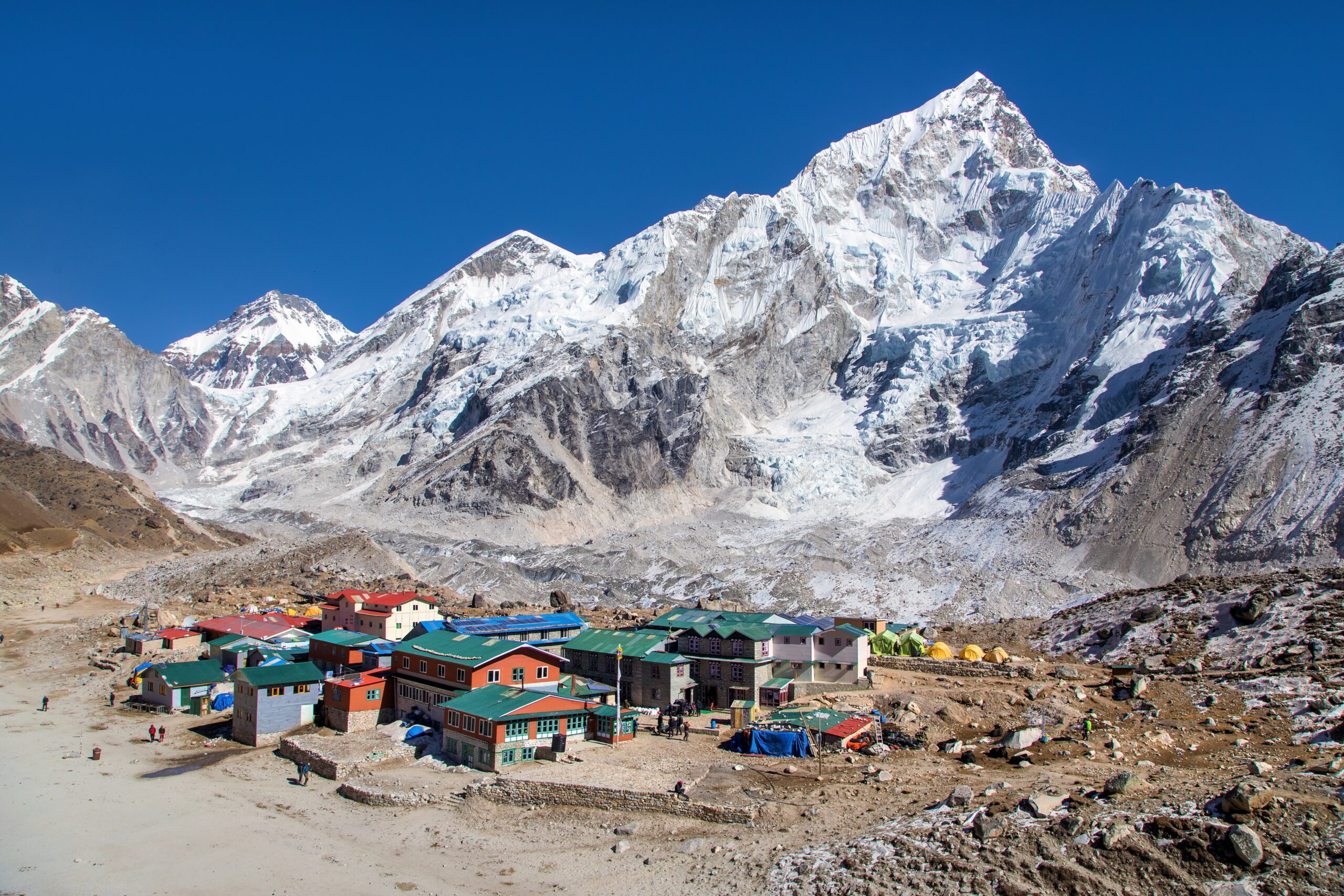
Everest and Cho Oyu are close neighbours: Cho Oyu is the westernmost major peak of the Khumbu, roughly 30 km from Everest, and from Cho Oyu’s summit plateau you look straight across at Everest, Nuptse, and Ama Dablam. The difference is which side you climb from. Everest’s busiest route rises from Nepal through the Khumbu; Cho Oyu’s standard route rises from Tibet, reached overland from Kathmandu.
How much harder is Everest?
Both are altitude climbs — but Everest keeps you in the death zone far longer.
Neither peak is a steep technical route by its standard line; both are, at heart, high-altitude endurance climbs on fixed ropes with supplemental oxygen. The gap between them is exposure and scale, not climbing grade.
Why Cho Oyu is the gentler mountain
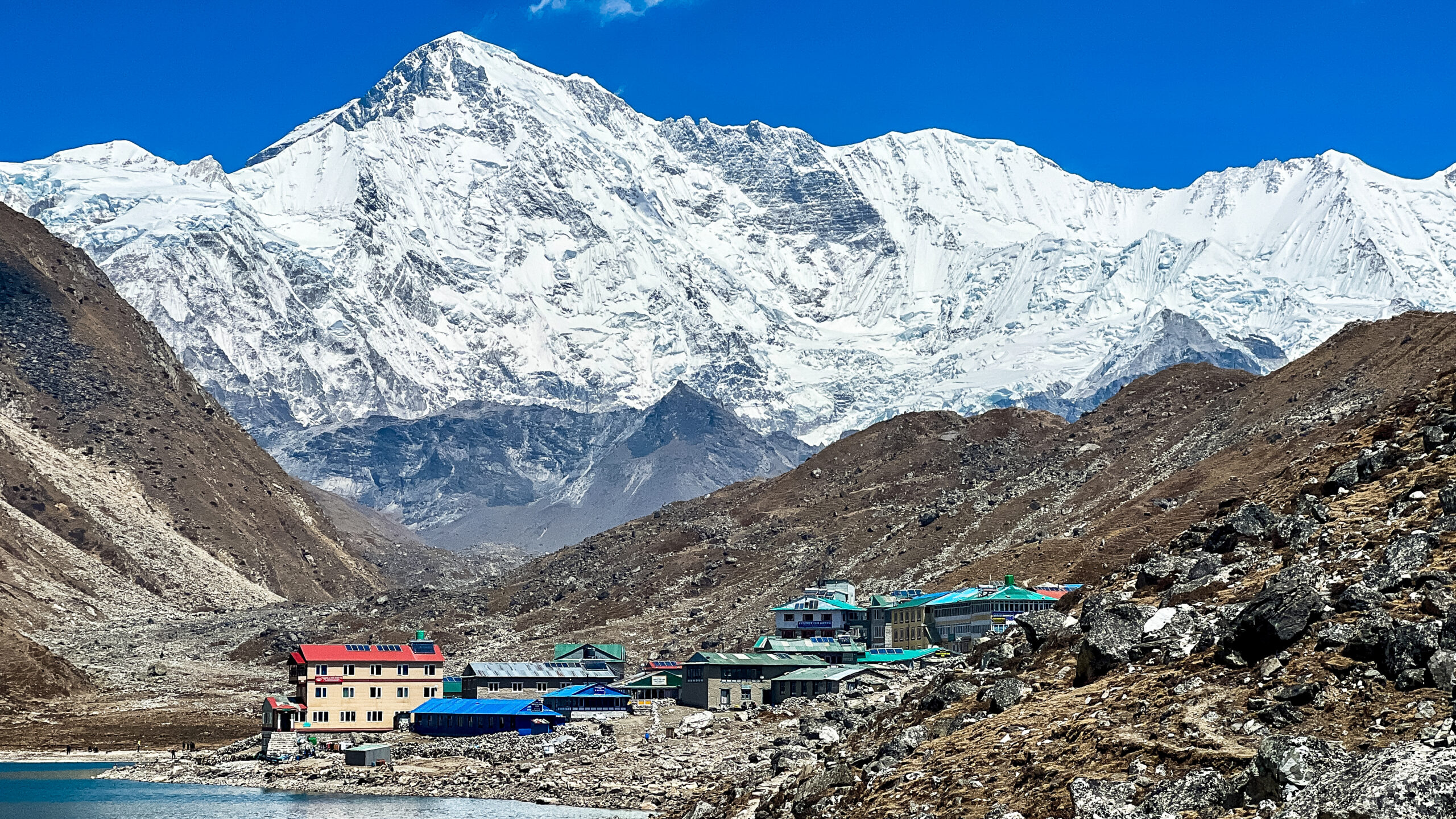
Cho Oyu tops out 661 m lower, and that gap matters more than it sounds in the death zone. Its Base Camp is a drive-up on the Tibetan plateau, so there’s no multi-week trek and no Khumbu Icefall to cross repeatedly. The route is broad, moderate-angled snow with a single steep ice band — the Yellow Band around 6,800–7,000 m — usually fixed with rope. Summit day is long but direct, and the whole expedition is shorter. It is a serious 8,000 m climb, but the safest one.
Why Everest is the bigger undertaking
Everest adds the Khumbu Icefall, a shifting maze of seracs and crevasses that climbers must pass through several times — an objective hazard with no equivalent on Cho Oyu. Summit day is far longer, with more hours above 8,000 m, and the climb spends hundreds more metres and many more hours in the death zone. That extra exposure, not any single hard pitch, is why Everest’s fatality rate (~3%) runs roughly double Cho Oyu’s (~1.4%).
Why Cho Oyu is the first 8000er
It’s the standard stepping stone for a reason — four of them.
Ask experienced guides what to climb before Everest and Cho Oyu comes up first, with Manaslu close behind. Here’s what a first 8,000er on Cho Oyu actually buys you:
1. A real death-zone test at the lowest risk. The only way to know how your body performs above 8,000 m is to go there. Cho Oyu lets you find out on the safest 8,000er — if extreme altitude turns out not to suit you, you learn it here, not at 8,500 m on Everest.
2. The systems, rehearsed. Supplemental oxygen and masks, jumaring fixed lines for hours, high-camp living, rotation rhythm, and the mental grind of a long expedition are all things you can practise on Cho Oyu and arrive on Everest already knowing.
3. The resume Everest operators want. Reputable Everest programs prefer — and premium ones effectively expect — a prior 8,000 m summit. Cho Oyu is the standard box to tick, and many climbers use the same operator for Cho Oyu one year and Everest the next, keeping the relationship and trust intact.
4. A cheaper place to fail. A Cho Oyu attempt costs a fraction of Everest. Discovering that 8,000 m isn’t for you on a $40,000 climb is a far better outcome than discovering it on a $100,000 one.
Cost, access & the Tibet factor
Cho Oyu is cheaper — but it comes with a permit risk Everest’s Nepal side doesn’t.
On price, Cho Oyu wins clearly: roughly $35,000–$65,000 all-in against Everest’s $50,000 to well over $150,000. The catch is access. Cho Oyu’s standard route is climbed from Tibet, which means China Tibet Mountaineering Association permits and overland travel from Kathmandu — and Tibet access has periodically been restricted or closed during politically sensitive periods. Established operators manage this and can often transfer a booking to Manaslu if Tibet is shut, but it’s a real planning variable. One more hard fact: helicopter rescue is not available on the Tibet side, so the safety margin depends more heavily on the operator’s own systems and your insurance.
Base-camp weather
Neighbouring peaks, near-identical weather — and a monsoon summer that shuts both down.
Being 30 km apart, Everest and Cho Oyu share almost the same weather. Both climb in the pre-monsoon spring (April–May) window, and Cho Oyu adds a post-monsoon autumn (September–October) season. In midsummer, as the live base-camp forecasts below show, the monsoon dominates and neither is in season — the summits are far colder and stormier than these staging-altitude readings suggest.
🏔️ Everest Base Camp — ~5,360 m
Loading…
🏔️ Cho Oyu Base Camp — ~5,100 m
Loading…
Who should choose which
Match the mountain to where you are in your climbing life.
Start with Cho Oyu if…
- You’ve climbed solid 6,000 m and 7,000 m peaks but no 8,000er yet
- You want to test your death-zone response at the lowest risk
- You’re building toward Everest and need the resume
- You want a shorter, cheaper 8,000 m expedition
- You accept the Tibet-access and no-heli-rescue trade-offs
Go for Everest if…
- You already have an 8,000 m summit (ideally Cho Oyu or Manaslu)
- Everest is your singular, defining goal
- You have a premium operator and strong high-altitude experience
- You can commit 55–65 days and a six-figure budget
- You’re ready for the Icefall and a long death-zone summit day
Frequently asked questions
Is Cho Oyu a good first 8,000m peak before Everest?
For most climbers, yes — it’s the standard choice. Cho Oyu is the safest 8,000er (~1.4% fatality), non-technical by its Tibetan route, and it lets you test the death zone and learn the systems before Everest, at lower cost and risk. Manaslu is the main alternative.
How much higher is Everest than Cho Oyu?
About 661 m. Everest is 8,848.86 m; Cho Oyu is 8,188 m. Both are in the death zone, but Everest keeps climbers there far longer on summit day.
Is Cho Oyu easier than Everest?
Yes, clearly. It’s lower, shorter, has a drive-up Base Camp, no Khumbu Icefall, and one short ice band. Its fatality rate is roughly half Everest’s.
How much does each cost?
Cho Oyu runs about $35,000–$65,000 all-in; Everest ranges from about $50,000 on a budget program to $150,000 or more premium, with the Nepal spring permit alone at $15,000 in 2026.
Can you climb Everest without Cho Oyu first?
Yes, with a premium operator and strong lower-altitude experience — but doing a first 8,000er such as Cho Oyu or Manaslu first is safer, cheaper, and what most strong operators prefer.
Do you need Tibet access for Cho Oyu?
For the standard route, yes. It’s climbed from Tibet, needs CTMA permits, and access can be restricted — verify current status before booking. Helicopter rescue is not available on the Tibet side.
How long does each expedition take?
Cho Oyu is about 40–50 days, helped by a drive-up Base Camp; Everest runs 55–65 days. Both climb in spring; Cho Oyu also has an autumn season.
How we compared them
Research-based. Neither peak is within our team’s first-hand experience. Heights, routes, fatality data, seasons, and costs are compiled from the Himalayan Database, CTMA and Nepal permit schedules, and published 2026 commercial-operator programs, cross-referenced across multiple operators. A comparison simplifies a complex decision; the right mountain for you depends on your experience, budget, and current access conditions.
Permit rules, Tibet access, and pricing change between seasons. Confirm current requirements and a current forecast, and read each peak’s full guide, before booking or climbing.
Build the progression, not just the summit
Cho Oyu is where you learn the death zone; Everest is where you spend what you learned. Climb them in the right order, with the right operator, and the odds — and the experience — are on your side.
Cho Oyu guide → What to climb before Everest →Everest vs Cho Oyu: Hardest vs Most Accessible
The highest against the most accessible 8000er is a key first-8000er question. Read the related comparisons below.
Was this helpful?
🏔Related peaks nearby
🧭Explore & compare
Global Summit Guide is an independent mountaineering resource founded in 2026. The team combines first-hand trekking and climbing experience with in-depth research and professional health and nutrition review to help climbers choose objectives, prepare properly, and stay safe.
Health, altitude, and nutrition content is reviewed by Taylor Ludlow (Registered Nurse) and Brigg Hoopes (Nutritionist).
What We Don't Know Yet
Mountain information changes quickly. This box explains the limits of what this page can responsibly promise.
- Permit availability, reservation windows, quotas, and official fee rules may change after this page is updated.
- Guide-company prices, departure dates, guide ratios, included services, and cancellation rules can change without notice.
- Route conditions, trailhead access, crevasse exposure, stream crossings, and rescue access may vary from published planning guidance.
- Total trip cost can change with flights, lodging, guide pricing, permits, gear rentals, transportation, and exchange rates.
- Fitness and altitude response vary by person; no guide, itinerary, or training plan can guarantee acclimatization or summit success.
Verify current conditions with official land managers, guide services, local forecasts, and current route reports before booking or climbing.
Mountaineering, rock and ice climbing, glacier travel, and high-altitude activity are inherently dangerous and can result in serious injury or death. The information on Global Summit Guide is provided for general informational and educational purposes only and is not a substitute for professional instruction, qualified guiding, proper equipment, or your own judgment and experience.
Route conditions, weather, snowpack, permits, regulations, and hazards change constantly and may differ from what is described here. Details may be incomplete, out of date, or contain errors. Always verify current information with local authorities, certified guides, and official sources before making any decision in the mountains.
Nothing on this site is medical, legal, or financial advice. Our fitness, acclimatization, altitude, and nutrition content is general in nature; consult a qualified physician before beginning any strenuous exercise program or exposing yourself to high altitude.
You are solely responsible for your own safety and decisions. To the fullest extent permitted by law, Global Summit Guide and its team accept no liability for any loss, injury, damage, or expense arising from use of, or reliance on, this information. By using this site you acknowledge these risks and accept these terms.
Some links on this site may be affiliate links. If you buy through them we may earn a small commission at no extra cost to you; this never affects our recommendations.
Global Summit Guide recommendation path
Next Best Mountain to Research
Use these recommendations to continue the right planning path instead of stopping on one page.
Use current permit, weather, route, and operator information before booking or climbing.
Explore Travel Options for Your Destination
Once your mountain, dates and route are taking shape, compare flights, hotels and other travel options that fit the trip.
Affiliate link. We may earn a commission at no additional cost to you.